Written by Andrew Horn of Amherst, NH.
 |
According to the House Calendar, tomorrow:
5 bills in Commerce and Consumer Affairs
1 bill in Science, Technology, and Energy
If you can’t make it in person to a House hearing, you can submit testimony online.
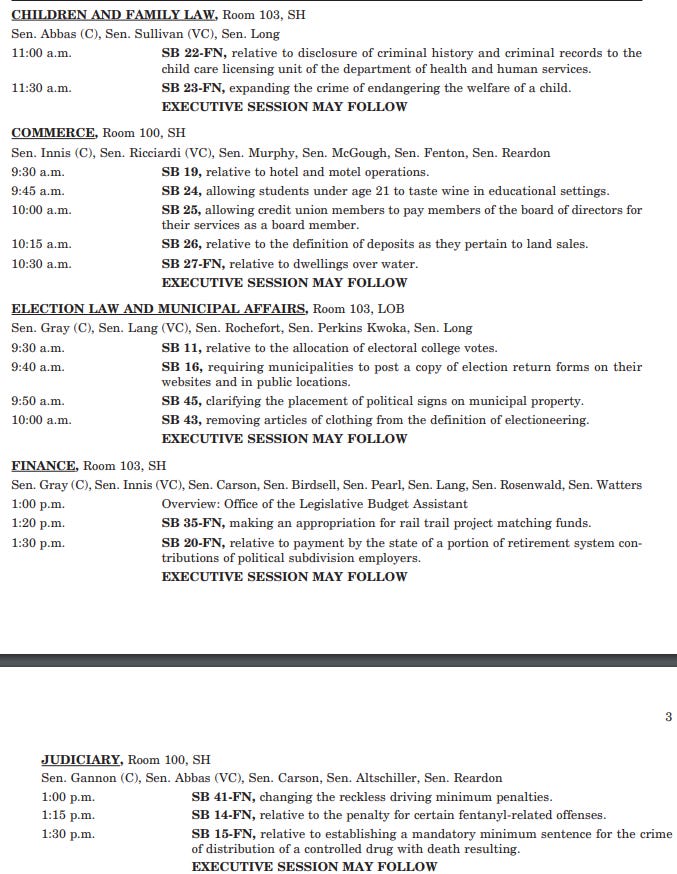
According to the Senate Calendar, tomorrow:
2 bills in Children and Family Law
5 bills in Commerce
4 bills in Election Law and Municipal Affairs
2 bills in Finance
3 bills in Judiciary
Contents
Screenshots from House and Senate Calendar
House Commerce and Consumer Affairs bills
HB 242
HB 81
HB 77-FN
HB 79
HB 276
House Science, Technology, and Energy bills
HB 106
Children and Family Law
SB 22-FN
SB 23-FN
Commerce
SB 19
SB 24
SB 25
SB 26
SB 27-FN
Election Law and Municipal Affairs
SB 11
SB 16
SB 45
SB 43
Finance
SB 35-FN
SB 20-FN
Judiciary
SB 41-FN
SB 14-FN
SB 15-FN
Screenshots from House and Senate Calendars
 |
 |
 |
House Commerce and Consumer Affairs
HB 242
AN ACT relative to brew pub licenses.
Primary Sponsor: Rep. John Hunt (R)
Selected quotes from the bill:
This bill is a request of the liquor commission.
RSA 178:13, XV is repealed and reenacted to read as follows:
Notwithstanding the provisions of RSA 179:11, a holder of a brew pub license may hold an on-premises or off-premises license under this chapter
limited to self- distributing to not more than one on-premises license owned by the brew pub licensee and shall not exceed 2,500 barrels of beer and/or cider during their licensing period.
Analysis: This bill appears to (1) clarify existing law on brew pubs, (2) creates an exception to existing law, allowing brew pubs to self-distribute, however, self-distribution is limited to 2,500 barrels per license and one location the licensee owns.
Read in-depth AI Analysis of HB 242 here.
Relevant background:
Possible arguments for and against:
For: This bill promotes small business growth, allowing brew pubs to own a retail store can provide them with additional revenue streams and reduce reliance on third-party wholesalers and retailers.
Against: This erodes the three-tier system meant to keep manufacturing, wholesaling, and retailing separate in alcohol markets.
Read in-depth AI arguments for and against HB 242 here.
Online Testimony: none
Hearing: Tuesday, Jan 14 at 10:00 am in Room 307 in the Legislative Office Building and streaming on YouTube.
HB 81
AN ACT allowing patrons to take purchased alcoholic beverages into the restroom of a restaurant.
Primary Sponsor: Rep. Jared Sullivan (D)
Co-Sponsors: Rep. Erica Layon (R), Rep. Jonah Wheeler (D), Rep. Keith Ammon (R), Rep. Tom Mannion (R), Rep. Christine Seibert (D), Rep. Anita Burroughs (D), Rep. Ellen Read (D)
Selected quote from the bill:
No beverages or liquor shall be served or consumed in foyers, hallways, kitchens, [restrooms,] or other areas not approved for service by the commission. Patrons may take a beverage that they have purchased from the establishment into the restroom of that establishment.
Analysis: This bill would allow patrons to take alcoholic beverages into the restroom.
Possible arguments for and against:
For: Patrons can keep their drinks with them at all times, reducing the risk of drink tampering or accidental mix-ups.
Against: It could become more difficult for staff to monitor alcohol consumption if people congregate in restrooms.
Read in-depth AI arguments for and against HB 81 here.
Support:
Curtis Howland of Manchester, NH
Eric Pauer of Brookline, NH
Oppose:
none
Hearing: Tuesday, Jan 14 at 10:15 am in Room 307 in the Legislative Office Building and streaming on YouTube.
HB 77-FN
AN ACT prohibiting businesses from scanning individuals' licenses when selling alcohol or tobacco products.
Primary Sponsor: Rep. Kevin Verville (R)
Co-Sponsors: Rep. Keith Ammon (R)
Selected quotes from the bill:
Amend RSA 263:12
[Knowingly scan]Scan, record, retain, or store, in any electronic form or format, personal information, as defined in RSA 260:14, obtained from any license[, unless authorized by the department].
This paragraph shall prohibit any person selling alcohol or tobacco products from scanning, recording, retaining, or storing, in any electronic form or format, personal information, as defined in RSA 260:14, obtained from any license.
Analysis: This bill prohibits businesses from retaining personal information from licenses.
Possible arguments for and against:
For: By prohibiting electronic scanning and storage, the bill reduces the amount of personal data collected and retained, lowering the risk of data breaches and identity theft.
Against: Many businesses rely on ID scanners to detect fake licenses and automatically verify age. Prohibiting scanning might make it more difficult to spot sophisticated fraudulent IDs and could slow transaction times.
Read in-depth AI arguments for and against HB 77-FN here.
Support:
Debra Johnson of Grantham, NH
“I wish to speak on this bill in person and will bring documents.” (Source)
Eric Pauer of Brookline, NH
Julie Smith of Nashua, NH
Oppose:
none
Hearing: Tuesday, Jan 14 at 10:45 am in Room 307 in the Legislative Office Building and streaming on YouTube.
HB 79
AN ACT establishing a commission to study the privatization of the liquor commission.
Primary Sponsor: Rep. Peter Leishman (D)
Co-Sponsors: Rep. Jaci Grote (D), Rep. Marjorie Smith (D), Rep. Gerald Griffin (R)
Selected quotes from the bill:
Amend RSA 176 by inserting after section 19 the following new section:
There is established a commission to study the privatization of the liquor commission.
(e) One member of the New Hampshire Retail Association, appointed by the president of that association.
(f) One member of the New Hampshire Lodging and Restaurant Association, appointed by the president of that association.
Analysis: This bill would create a commission exploring whether to privatize the liquor commission.
Loose observation: The bill says that it repeals RSA 176:20, but RSA 176:20 does not seem to exist right now. I’m not sure if I’m just misinterpreting this or if it’s a mistake. Quote:
2 Repeal. RSA 176:20, relative to the commission to study the privatization of the liquor commission, is repealed.
Possible arguments for and against:
For: “A study commission gathers concrete data and input from experts, which can lead to more informed legislative decisions regarding privatization.”
Against: “New Hampshire’s state-run liquor model is frequently cited as a revenue success. Privatization could undermine guaranteed income to the state if revenue flows become more market-dependent or if oversight is diluted.”
Read in-depth AI arguments for and against HB 79 here.
Online Testimony: none
Hearing: Tuesday, Jan 14 at 1:15 pm in Room 307 in the Legislative Office Building and streaming on YouTube.
HB 276
AN ACT removing the requirement that on-premises beverage licensees serve food.
Primary Sponsor: Rep. Wayne Hemingway (R)
Selected quotes from the bill:
[ at such times as food is available].
[when the restaurant kitchen is in operation and meals are being actively promoted and served in that dining room]. The dining room shall not, however, be used as a substitute for lounge operations. [Licenses shall be granted only to restaurants approved by the commission and which show the commission on forms, filed with the license application, covering the 12 most recent calendar months prior to filing, that at least 50 percent of the gross sales of any such licensee is in food. Restaurants with annual food sales of at least $75,000 shall be exempt from the 50 percent requirement.]
(2) The dining room shall be open for business at least 5 days a week [for evening meals], unless the commission has granted an exemption.
(3) Private groups contracting for function rooms may also be served beverages and liquor[ without food].
Such license shall allow the sale of liquor [with food] or beverages or specialty beverages in any area of the vessel approved by the commission.
Analysis: This bill removes the requirement that on-premises beverage licensees serve food.
Read in-depth AI explanation of HB 276 here.
Read AI generated historical context of HB 276 here.
Relevant background:
Possible arguments for and against:
For: Removing the food service requirement makes it easier for new businesses, such as bars, lounges, and cafes, to obtain beverage licenses without the need for significant investment in kitchen facilities.
Against: Food often acts as a moderator for alcohol consumption, slowing the absorption of alcohol and reducing the risk of overconsumption. Without this, patrons might consume more alcohol in a shorter period.
Read in-depth AI arguments for and against HB 276 here.
Support:
Curtis Howland of Manchester, NH
Oppose:
none
Hearing: Tuesday, Jan 14 at 2:00 pm in Room 307 in the Legislative Office Building and streaming on YouTube.
House Science, Technology, and Energy bills
HB 106
AN ACT establishing a commission to determine the monetary costs of climate damage to the state of New Hampshire and the best means of recouping such costs.
Primary Sponsor: Rep. Tony Caplan (D)
Co-Sponsors: Rep. Wendy Thomas (D), Rep. Christine Seibert (D), Rep. Peter Bixby (D), Rep. Kat McGhee (D), Rep. Thomas Cormen (D), Sen. David Watters (D)
Selected quotes from the bill:
pertaining to:
(a) The various likely scenarios of climate damages impacting New Hampshire in the next 20 years and the next 50 years.
(b) The likely scope of damage to New Hampshire, its people, cities and towns, rural areas, natural resources, infrastructure, industry, agriculture, tourism, and other relevant industries.
(c) The likely adaptations needed to prevent these scenarios.
(d) The financial estimates of such scenarios and preventative measures.
(e) The best means of recouping costs accumulated by the state in preventing and responding to climate-related damage, including municipal bonding, insurance, legal action, fees, and other methods.
Analysis: This bill establishes a commission to determine the financial cost of climate damage to New Hampshire and methods of recouping such costs.
Possible arguments for and against:
For: By quantifying adaptation and mitigation costs in advance, the state can budget more effectively and prevent higher expenses from emergency response or infrastructure repairs later.
Against: Detractors may claim that numerous national and international studies on climate costs already exist, making a separate state-led commission duplicative or unnecessary.
Read in-depth AI arguments for and against HB 106 here.
Support:
36 individuals, with 18 submitting additional messages, below
Oppose:
4 individuals, with none submitting additional messages
Selected quotes from online testimony (all in support):
Right now we are seeing the devastation of the fires around Los Angeles, California. Estimates of $56 Billion, $56,000,000,000 are being thrown around – the cost to the economy of California.
—Leonard Campbell of Meredith, NH
More carbon in the atmosphere means that poison ivy is stronger – the oils on the plant are more potent.
—Mary Beth Raven of Merrimack, NH
I have a small sheep farm in southern NH. Climate change has affected grazing and hay making dramatically in the past 5 years.
The fossil fuel industry knew what its products were doing to the planet over 50 years ago and followed the tobacco industry's strategy, crank up the disinformation machine and deny the science.
—Gerald Beck of Holderness, NH
Over a number of years our NH farmers have been experiencing very difficult growing conditions due to droughts, floods and weather changes which effect crop pests, and plant and livestock management.
New Hampshire taxpayers cannot afford to shoulder the billions of dollars annually in fossil-fuel induced climate change damage to our infrastructure and economy, let alone the $3.7 billion annual health-related costs from fossil-fuel air pollution
—Paul Friedrichs of Exeter, NH
It is difficult to deny what is happening to our climate as our winters get shorter, there is less snow, the summers get hotter, and drought conditions or flooding happen in NH.
We are not immune to the effects of extreme weather fluctuations, particularly when it comes to flooding.
Recent fires and flooding are just the beginning of expensive problems we can expect as a result of climate change.
—Anne Huberman of Peterborough, NH
Winters are no longer as robust as they once were, impacting tourism as well as people and nature residing in the Valley.
It's imperative that we begin to plan for the ways that climate change will affect our future.
Last winter in Concord, the ponds never froze so that people could go ice skating, the entire winter.
We have already seen coastal damage due to climate change.
—Robin Schnell of Portsmouth, NH
Climate change is damaging the natural beauty of New Hampshire and imposing a huge and growing cost.
—Meredith Smith of New London, NH
But if we don’t act to find a way to pay for damages and adaptations, the cost will be much higher, with tragic implications for the economy, public health (including deaths), and unimaginable devastation.
—Barbara Southard of Bradford, NH
We can no longer pretend it does not exist, it is here.
—Stephanie S of Rollingford, NH
My family produces and sells maple syrup. … I cannot invest in my business when I don't even know whether the maple trees will be here in the near future.
—Sarah Weck of West Chesterfield, NH
In the north country, we’ve experienced a loss in revenue due to lack of snow for the ski industry (both alpine and cross country).
—Dawson Winch of Intervale, NH
Hearing: Tuesday, Jan 14 at 3:30 pm in Room 302-304 in the Legislative Office Building and streaming on YouTube.
House Children and Family Law
SB 22-FN
AN ACT relative to disclosure of criminal history and criminal records to the child care licensing unit of the department of health and human services.
Primary Sponsor: Sen. Howard Pearl (R)
Selected quotes from the bill:
The bill is a request of the department of health and human services.
Amend RSA 170-E:7, II(b)
Upon completion of the [background investigation] criminal history report, the division of state police shall release [copies of the criminal conviction record] a report of the applicant’s criminal history and record information, including confidential criminal history record information,
If any individual … is registered or required to be registered on a state sex offender registry or repository, or the National Sex Offender Registry, or has been charged pending disposition or …
Upon completion of the [background investigation] criminal history report, the division of state police shall release [copies of the criminal conviction records] a report of the applicant’s criminal history and record information, including confidential criminal history record information,
If any person … is registered or required to be registered on a state sex offender registry or repository, or the National Sex Offender Registry, or has been charged pending disposition or …
Analysis: This bill allows the child care licensing unit of the department of health and human services to access directly from the state police an applicant's criminal history and record information and use such information as a factor to determine an applicant's eligibility.
Possible arguments for and against:
For: By improving how quickly and accurately the department can access criminal history and sex offender registry information, childcare providers can make more informed hiring decisions, reducing the risk that someone with a disqualifying criminal background works with children.
Against: Opponents may argue that allowing DHHS to receive full criminal history and confidential record information opens the door to potential misuse or unnecessary dissemination of sensitive data.
Read in-depth AI arguments for and against SB 22-FN here.
Hearing: Tuesday, Jan 14 at 11:00 am in Room 103 in the State House.
SB 23-FN
AN ACT expanding the crime of endangering the welfare of a child.
Primary Sponsor: Sen. Patrick Long (D)
Co-Sponsors: Rep.Alicia Gregg (D)
Selected quotes from the bill:
Amend RSA 639:3
[purposely] violating a duty of care, protection or support he owes to such child or incompetent
IV-a. In the prosecution of any person under this section, engaging in conduct that places a child under the age of 18 in danger of serious bodily injury or death constitutes endangering the welfare of such child.
IV-b. In the prosecution of any person under this section, engaging in conduct that results in serious bodily injury or death to a child under the age of 18 constitutes endangering the welfare of such child.
V. A person who endangers the welfare of a child or incompetent by violating paragraph IV-b of this section shall be guilty of a class A felony. A person who endangers the welfare of a child or incompetent by violating paragraph III or IV-a of this section, or who engages in a pattern of violating paragraph I of this section, is guilty of a class B felony. All other violations of this section are misdemeanors. For the purposes of this section, "pattern" means committing more than one act under paragraph I over a period of 2 months or more and within a period of 5 years.
Analysis: This bill expands what constitutes endangering the welfare of a child by adding additional violative conduct.
Possible arguments for and against:
For: Supports might argue that this bill will help law enforcement, prosecutors, and courts better classify and address serious child-endangerment situations.
Against: Critics may argue that the new language—particularly regarding conduct that “places a child under the age of 18 in danger of serious bodily injury or death” (paragraph IV-a)—could be interpreted too broadly.
Read in-depth AI arguments for and against SB 23-FN here.
Hearing: Tuesday, Jan 14 at 11:30 am in Room 103 in the State House.
Senate Commerce
SB 19
AN ACT relative to hotel and motel operations.
Primary Sponsor: Sen. Daniel Innis (R)
Selected quotes from the bill:
Amend RSA 353:3-b
All hotel keepers and all persons keeping public lodging houses, tourist camps, or cabins shall, upon the registration of each guest, [cause an entry to be made in the book or card system required by RSA 353:3 which shall] record the guest's agreed upon departure time and date.
The following are repealed:
I. RSA 353:3-a, relative to posting of rental rates.
II. RSA 353:5, relative to motel signs.
Analysis: Repeals requirements for hotels to post rental rates in rooms and displayed outside.
Read in-depth AI analysis of historical context of SB 19 here.
Possible arguments for and against:
For: In the digital age, many consumers research and book rooms online, where rates, discounts, and promotions are clearly displayed and often updated in real time.
Against: Some consumers—particularly those who do not use smartphones or internet booking—rely on posted or on-premises information to make informed decisions.
Read in-depth AI arguments for and against SB 19 here.
Hearing: Tuesday, Jan 14 at 9:30 am in Room 100 in the State House and streaming on YouTube.
SB 24
AN ACT allowing students under age 21 to taste wine in educational settings.
Primary Sponsor: Sen. Daniel Innis (R)
Co-Sponsors: Sen. Victoria Sullivan (R), Sen. Howard Pearl (R), Sen. Timothy Lang (R), Sen. Kevin Avard (R), Sen. Ruth Ward (R), Sen. David Rochefort (R), Sen. James Gray (R), Sen. Keith Murphy (R), Sen. Daryl Abbas (R), Sen. Mark McConkey (R), Rep. Timothy Horrigan (D), Rep. John Potucek (R), Rep. Alvin See (R), Rep. James Thibault (R)
Selected quotes from the bill:
II. A qualified student may taste an alcoholic beverage
(a) A qualified student shall attend and complete an alcohol educational program, provided by the liquor commission, before the student tastes any alcoholic beverage provided by the qualified academic institution.
(b) The qualified academic institution shall maintain records of tastings which shall include the course number, instructor, location of the tasting, and listing of alcoholic beverages tasted. Such records shall be made available to the liquor commission upon request.
(g) The qualified student tastes the alcoholic beverage for educational purposes as part of the instruction in a course required for an associate degree or bachelor degree.
Analysis: This bill allows students under 21 to taste alcoholic beverages as part of the instruction in a course required for an associate’s or bachelor’s degree.
Possible arguments for and against:
For: Students in enology, brewing, culinary, or hospitality programs need direct, sensory experiences to fully understand techniques, processes, and nuances of wine (e.g., aroma, flavor profiles).
Against: Although SB 24 states that “taste” does not include swallowing, in practice, it can be difficult to monitor whether students are actually spitting out the wine. This may increase the risk of underage drinking on campus.
Read in-depth AI arguments for and against SB 24 here.
Hearing: Tuesday, Jan 14 at 9:45 am in Room 100 in the State House and streaming on YouTube.
SB 25
AN ACT allowing credit union members to pay members of the board of directors for their services as a board member.
Primary Sponsor: Sen. Daniel Innis (R)
Selected quotes from the bill:
RSA 383-E:6-607(a) is repealed and reenacted
Any credit union may pay to each of the members of the board of directors, credit committee, and supervisory committee for his or her services as a member of the board or committee(s) a sum that may, from time to time, be fixed by the members at an annual meeting.
Analysis: This bill allows members of a credit union board of directors to be paid for their services as directors.
Possible arguments for and against:
For: Allowing credit unions to compensate board members can help attract highly qualified individuals who have specialized knowledge of banking, finance, risk management, and governance.
Against: One of the core tenets of the credit union movement is volunteer governance—board members are traditionally volunteers serving out of commitment to the community. Paying directors may conflict with this historical mission.
Read in-depth AI arguments for and against SB 25 here.
Hearing: Tuesday, Jan 14 at 10:00 am in Room 100 in the State House and streaming on YouTube.
SB 26
AN ACT relative to the definition of deposits as they pertain to land sales.
Primary Sponsor: Sen. Howard Pearl (R)
Co-Sponsors: Sen. Keith Murphy (R), Sen. Timothy Lang (R), Sen. Tara Reardon (D), Sen. Daniel Innis (R), Rep. Michael Moffett (R), Rep. Alvin See (R), Rep. Kevin Verville (R), Rep. Carol McGuire (R), Rep. Scott Bryer (R)
Selected quotes from the bill:
Amend RSA 356-A:1
Amend RSA 356-B:3
"Deposits" means the deposit of earnest money for a purchase and sales agreement for the disposition of any sale, contract, assignment, or any other voluntary transfer of a legal or equitable interest in a lot, parcel, unit, or interest in subdivided lands. Deposit shall be limited to earnest money and shall not include any change orders, upgrades, or additional funds due to the seller or seller’s agent due to buyer upgrades or selections.
Analysis: This bill defines deposits in land sales.
Possible arguments for and against:
For: By defining “deposit” (sometimes called “earnest money”) in the Land Sales Full Disclosure Act and Condominium Act, the bill gives clarity as to what is covered by deposit-related protections. This alleviates confusion about what must be held in escrow or subject to statutory rules.
Against: Creating a separate legal category for “deposits” (earnest money) vs. “upgrade funds” could add procedural steps: developers or brokers may need to maintain two different escrow accounts or two sets of rules, which some might find burdensome.
Read in-depth AI arguments for and against SB 26 here.
Hearing: Tuesday, Jan 14 at 10:15 am in Room 100 in the State House and streaming on YouTube.
SB 27-FN
AN ACT relative to dwellings over water.
Primary Sponsor: Sen. Timothy Lang (R)
Co-Sponsors: Sen. Pat Long (D), Sen. Keith Murphy (R), Sen. Mark McConkey (R)
Selected quotes from the bill:
Amend RSA 482-A:26, III
dwelling … may be repaired, [or] reconstructed, or improved for maintenance purposes [only] or to bring the dwelling into compliance with any state or applicable local building code …. no expansion of the existing footprint or outside dimensions which would result in an increase in interior living space shall be permitted. Without intending to limit the foregoing, the addition of a means of egress to a dwelling over water required under the state or applicable local building code shall not be deemed an impermissible expansion of the existing footprint or outside dimensions.
the commissioner may waive the existing standards in order to allow a structure to be expanded, provided that there shall be no negative impact to the environment, expansion of the existing footprint, [outside dimensions,] and square footage of [floor] living space[; and there shall be a net reduction in the total square footage of kitchen, bathroom, shower, and toilet facilities].
Analysis: This bill allows structures over water to be improved
Possible arguments for and against:
For: By explicitly allowing improvements to meet state or local building codes (e.g., adding a required emergency exit), the bill promotes safety for occupants.
Against: Opponents may worry that allowing improvements under the guise of “compliance” will gradually weaken the prohibition against expanding dwellings over water. Even small exceptions (like a required egress) could pave the way for larger expansions.
Read in-depth AI arguments for and against SB 27-FN here.
Hearing: Tuesday, Jan 14 at 10:30 am in Room 100 in the State House and streaming on YouTube.
Senate Election Law and Municipal Affairs
SB 11
AN ACT relative to the allocation of electoral college votes.
Primary Sponsor: Sen. Bill Gannon (R)
Co-Sponsors: Sen. Kevin Avard (R), Sen. David Rochefort (R), Sen. Tim McGough (R), Sen. Regina Birdsell (R), Sen. Victoria Sullivan (R), Sen. Timothy Lang (R), Rep. Lilli Walsh (R)
Selected quotes from the bill:
Amend RSA 655:54
Each party shall nominate 2 at-large presidential electors and one presidential elector for each congressional district.
Amend RSA 660:29
Each at-large presidential elector shall cast his or her ballot for the presidential and vice-presidential candidates who received the highest number of votes in the state. Each congressional district presidential elector shall cast his or her ballot for the presidential and vice-presidential candidates who received the highest number of votes in his or her congressional district.
Analysis: This bill would change how New Hampshire apportions its electoral votes in the presidential election to be more like how Maine and Nebraska do it. Two electoral votes would be awarded to the presidential candidate who wins the state, and then other electoral votes are given to the candidate that gets a plurality within each Congressional district.
Possible arguments for and against:
For: By allocating electors at the congressional district level, the results of presidential elections in New Hampshire are more likely to mirror how different parts of the state actually voted. Voters in a congressional district that favors one candidate would see their district’s elector cast a vote aligned with that preference, even if the statewide result went to another candidate.
Against: One of the main criticisms of allocating electors by congressional district is that its fairness depends on how those districts are drawn. If districts are gerrymandered to favor one party, the electoral college results can be skewed, no longer cleanly reflecting the statewide will.
Read in-depth AI arguments for and against SB 11 here.
Hearing: Tuesday, Jan 14 at 9:30 am in Room 103 in the Legislative Office Building and streaming on YouTube.
SB 16
AN ACT requiring municipalities to post a copy of election return forms on their websites and in public locations.
Primary Sponsor: Sen. James Gray (R)
Selected quotes from the bill:
Amend RSA 659:73
The city or town clerk shall, within 7 days of an election, post copies of the election return forms submitted to the secretary of state under paragraphs I and II of this section. The city or town clerk shall post copies in the 2 places where the municipality regularly posts notices of its governing body meetings and on the municipalities' main website and any social media accounts utilized by the municipality.
Analysis: This bill would require the city or town clerk to post election results in public within 7 days of an election.
Possible arguments for and against:
For: Not all citizens have the time or means to visit town offices during business hours to inspect election returns. Posting materials online allows voters with internet access to review results at their convenience.
Against: Smaller towns or those with limited administrative staff might find it difficult to meet strict deadlines for posting. Ensuring that copies are made available online and in public locations within 7 days could strain resources, especially during high-turnout elections.
Read in-depth AI arguments for and against SB 16 here.
Hearing: Tuesday, Jan 14 at 9:40 am in Room 103 in the Legislative Office Building and streaming on YouTube.
SB 45
AN ACT clarifying the placement of political signs on municipal property.
Primary Sponsor: Sen. James Gray (R)
Selected quotes from the bill:
Amend RSA 664:17
No political advertising shall be placed on or affixed to any public property [including highway rights-of-way] or private property without the owner's consent or as provided below.
(c) The advertising is not more than 10 feet from the property line and no larger than 32 square feet.
V. Unless the town or city prohibits political advertising on its rights-of-way, political advertising may be placed on town or city owned rights-of-way
Analysis: This bill clarifies rule with respect to placing political signs on municipal property. It also appears to limit the size of signs.
Possible arguments for and against:
For: Proponents may argue that the bill ensures consistent and clear rules for candidates, campaigns, and municipal officials by laying out uniform conditions under which signs can be placed on municipal land.
Against: Opponents may worry that clarifying and broadening the allowance of signs on municipal property encourages an influx of temporary signage, detracting from the local character, creating eyesores, and reducing the general aesthetic appeal of public spaces.
Read in-depth AI arguments for and against SB 45 here.
Hearing: Tuesday, Jan 14 at 9:50 am in Room 103 in the Legislative Office Building and streaming on YouTube.
SB 43
AN ACT removing articles of clothing from the definition of electioneering.
Primary Sponsor: Sen. Timothy Lang (R)
Selected quotes from the bill:
Amend RSA 659:43
The distribution or posting of electioneering communications, including but not limited to posters, cards, handbills, placards, pictures, pins, stickers, or circulars, [or articles of clothing,] is prohibited within any no-electioneering corridor established outside the polling place by the moderator.
Analysis: This bill removes “articles of clothing” from categories of electioneering. This would allow people to wear political articles of clothing outside polling places.
Possible arguments for and against:
For: Removing articles of clothing from the definition of electioneering allows individuals to express their political beliefs through their attire without fear of violating election laws. Clothing is a fundamental means of personal expression, and restricting it could infringe upon First Amendment rights.
Against: Candidates may use clothing to display logos, slogans, or symbols that influence voters indirectly. Removing clothing from restrictions could allow for pervasive and less transparent campaign messaging within and around polling places.
Read in-depth AI arguments for and against SB 43 here.
Hearing: Tuesday, Jan 14 at 10:00 am in Room 103 in the Legislative Office Building and streaming on YouTube.
Senate Finance
SB 35-FN
AN ACT making an appropriation for rail trail project matching funds.
Primary Sponsor: Sen. Daniel Innis (R)
Co-Sponsors: Sen. David Watters (D), Sen. Tara Reardon (D), Sen. Ruth Ward (R), Sen. Kevin Avard (R), Sen. Donovan Fenton (D), Rep. Stephanie Payeur (D)
Selected quote from the bill:
In addition to any other state investments in rail trail projects, the sum of $600,000 in general funds for the fiscal year ending June 30, 2026, is appropriated to the department of transportation to be granted to the town of Warner as matching funds for the Congestion Mitigation and Air Quality (CMAQ) grant to build a section of the rail trail in Warner to link Contoocook Village with downtown Warner.
Analysis: This bill gives $600,000 to the town of Warner as matching funds to build a section of a rail trail.
Possible arguments for and against:
For: Developing a rail trail can attract cyclists, hikers, and tourists, leading to increased spending in local businesses such as restaurants, shops, and lodging.
Against: Allocating $600,000 from the general fund may strain the state budget at a time when the state is about to go through a fierce budget fight.
Read in-depth AI arguments for and against SB 35-FN here.
Hearing: Tuesday, Jan 14 at 1:20 pm in Room 103 in the State House and streaming on YouTube.
SB 20-FN
AN ACT relative to payment by the state of a portion of retirement system contributions of political subdivision employers.
Primary Sponsor: Sen. Cindy Rosenwald (D)
Co-Sponsors: Sen. Pat Long (D), Sen. Donovan Fenton (D), Sen. Tara Reardon (D), Sen. Debra Altschiller (D), Sen. Suzanne Prentiss (D), Sen. David Watters (D), Sen. Rebecca Perkins Kwoka (D), Rep. Mary Jane Wallner (D), Rep. Laura Telerski (D), Rep. Alexis Simpson (D), Rep. Michael Edgar (D), Rep. David Nagel (R)
Selected quotes from the bill:
Amend RSA 100-A:16, II(b) and (c)
any employer [shall pay the full amount of such total contributions] other than the state, shall pay 92.5 percent of such total contributions, and 7.5 percent thereof shall be paid by the state; and provided further that, in case of group II members employed by the state, the state shall pay both normal and accrued liability contributions.
in the case of teachers, any employer other than the state, shall pay 92.5 percent of such total contributions, and 7.5 percent thereof shall be paid by the state; and provided further that, in case of teacher members employed by the state, the state shall pay both normal and accrued liability contributions.
Analysis: This bill would have the state of New Hampshire assume 7.5% of the retirement system contributions currently paid by cities and towns for Group I teachers and Group II members, which include firefighters and local police.
Relevant context: During her inaugural address, Gov. Ayotte said she supports making investments into the Group II retirement system. She said:
If we're going to keep New Hampshire the safest state in the nation, we have to make critical investments in the Group 2 retirement system to keep it competitive so that we can recruit and retain the men and women who do this critical work for our communities.
Read in-depth AI explanation of SB 20-FN here.
Possible arguments for and against:
For: By shifting 7.5% of retirement contributions to the state, municipalities can alleviate their financial burdens. This can free up local funds for other critical services or infrastructure projects.
Against: Allocating an additional $28 million to $29.51 million annually from the general fund could strain the state’s budget, potentially impacting other state-funded programs or necessitating cuts elsewhere. This is especially important in a year with a difficult budget fight coming.
Read in-depth AI arguments for and against SB 20-FN here.
Hearing: Tuesday, Jan 14 at 1:30 pm in Room 103 in the State House and streaming on YouTube.
Senate Judiciary
SB 41-FN
AN ACT changing the reckless driving minimum penalties.
Primary Sponsor: Sen. Regina Birdsell (R)
Co-Sponsors: Sen.Bill Gannon (R), Rep. Terry Roy (R)
Selected quotes from the bill:
This bill is at the request of the department of safety.
Amend RSA 265:79
or the first offense and $750 plus penalty assessment for the [second] subsequent offense nor more than $1,000 plus penalty assessment and his or her license or operating privilege shall be revoked for a period of 60 days for the first offense and from 60 days to one year for the [second] subsequent offense.
Whoever upon any way drives a vehicle at a speed of 100 miles per hour or greater and thereby violates any of the provisions of this title or any rules adopted by the director, shall be, notwithstanding the provisions of title LXII, guilty of a violation and fined not less than $750 plus penalty assessment for the first offense and $1000 plus penalty assessment for the subsequent offense and his or her license or operating privilege shall be revoked for a period of 90 days for the first offense and from 90 days to one year for the subsequent offense.
Analysis: This bill enhances the penalties for driving a vehicle in excess of 100 miles per hour.
Possible arguments for and against:
For: Higher fines and longer license suspensions for driving at ≥100 mph can discourage individuals from engaging in extreme speeding, thereby reducing the incidence of dangerous driving behaviors.
Against: The threshold of 100 mph is exceptionally high and may result in disproportionate penalties for what might be isolated incidents, potentially criminalizing behaviors that pose minimal additional risk beyond existing reckless driving laws.
Read in-depth AI arguments for and against SB 41-FN here.
Hearing: Tuesday, Jan 14 at 1:00 pm in Room 100 in the State House and streaming on YouTube.
SB 14-FN
AN ACT relative to the penalty for certain fentanyl-related offenses.
Primary Sponsor: Sen. Bill Gannon (R)
Co-Sponsors: Sen. Daryl Abbas (R), Sen. Timothy Lang (R), Sen. Kevin Avard (R), Sen. Daniel Innis (R), Sen. David Rochefort (R), Sen. Regina Birdsell (R), Sen. Keith Murphy (R), Sen. Kenneth Weyler (R), Sen. Mark Pearson (R), Sen. JD Bernardy (R)
Selected quotes from the bill:
Amend RSA 318-B:26
(A) A fentanyl class drug in a quantity of 5 grams or more, including any adulterants or dilutants, shall carry a minimum term of imprisonment of not less than 3 years and 6 months incarceration. A fentanyl class drug in a quantity of 28 grams or more, including any adulterants or dilutants, shall carry a minimum term of imprisonment of not less than 7 years incarceration. The court may not defer, combine, or run concurrently with any other sentence the mandatory minimum unless:
(i) The offender was less than 18 years of age at the time of the commission of the offense for which the offender is to be sentenced;
(ii) The offender’s mental capacity, at the time of the commission of the offense for which the offender is to be sentenced, was significantly impaired to the extent that the defendant was deemed incompetent. However, a voluntarily induced intoxicated or drugged condition may not be considered an impairment for the purposes of this subparagraph; or
(iii) The offender was an accomplice, the conduct constituting the offense was principally the conduct of another, and the offender's participation was relatively minor.
Analysis: This bill creates mandatory minimums for possession of 5 grams or more of fentanyl class drugs. The minimum imprisonment is 3 years and 6 months for possessing 5 grams or more, and the minimum is 7 years for possessing 28 grams or more. The bill makes exceptions for children, the incompetent, and accomplices.
Possible misspelling: “Dilutants” should probably be spelled “dilutents.”
Possible arguments for and against:
For: By imposing mandatory minimum sentences for significant quantities of fentanyl, the bill aims to deter individuals from engaging in the production, distribution, and trafficking of this highly dangerous substance. The severe penalties signal the state's commitment to combating the opioid crisis.
Against: Mandatory minimum sentences can lead to a significant increase in the prison population, exacerbating overcrowding issues. This strains the correctional system and can lead to higher operational costs without necessarily improving rehabilitation outcomes.
Read in-depth AI arguments for and against SB 14-FN here.
Hearing: Tuesday, Jan 14 at 1:15 pm in Room 100 in the State House and streaming on YouTube.
SB 15-FN
AN ACT relative to establishing a mandatory minimum sentence for the crime of distribution of a controlled drug with death resulting.
Primary Sponsor: Sen. Bill Gannon (R)
Co-Sponsors: Sen. Kevin Avard (R), Sen. James Gray (R), Sen. Daryl Abbas (R), Sen. Timothy Lang (R), Sen. Regina Birdsell (R), Rep. Michael Vose (R), Rep. Lilli Walsh (R), Rep. Melissa Litchfield (R), Rep. JD Bernardy (R), Rep. Aboul Khan (R)
Selected quotes from the bill:
Amend RSA 318-B:26, IX
Any person who manufactures, sells, or dispenses methamphetamine, lysergic acid, diethylamide phencyclidine (PCP) or any other controlled drug classified in schedules I or II, or any controlled drug analog thereof, in violation of RSA 318-B:2, I or I-a, is strictly liable for a death which results from the injection, inhalation or ingestion of that substance, and [may] shall be sentenced to not less than 10 years of imprisonment up to [for] life imprisonment [or for such term as the court may order].
Analysis: This bill sets a mandatory minimum sentence for the crime of distribution of a controlled drug with death resulting.
Possible arguments for and against:
For: Mandatory minimum sentences can deter individuals from engaging in the distribution of controlled substances by imposing severe penalties, thereby reducing drug-related deaths.
Against: Mandatory minimums can lead to higher prison populations, exacerbating existing issues with overcrowded correctional facilities.
Read in-depth AI arguments for and against SB 15-FN here.
Hearing: Tuesday, Jan 14 at 1:30 pm in Room 100 in the State House and streaming on YouTube.
Autistic Poem of the Day
 |
Alien by Annaliese Cohen
Like all aliens, I am ignored
Because I cannot be understood