Written by Andrew Horn of Amherst, NH
 |
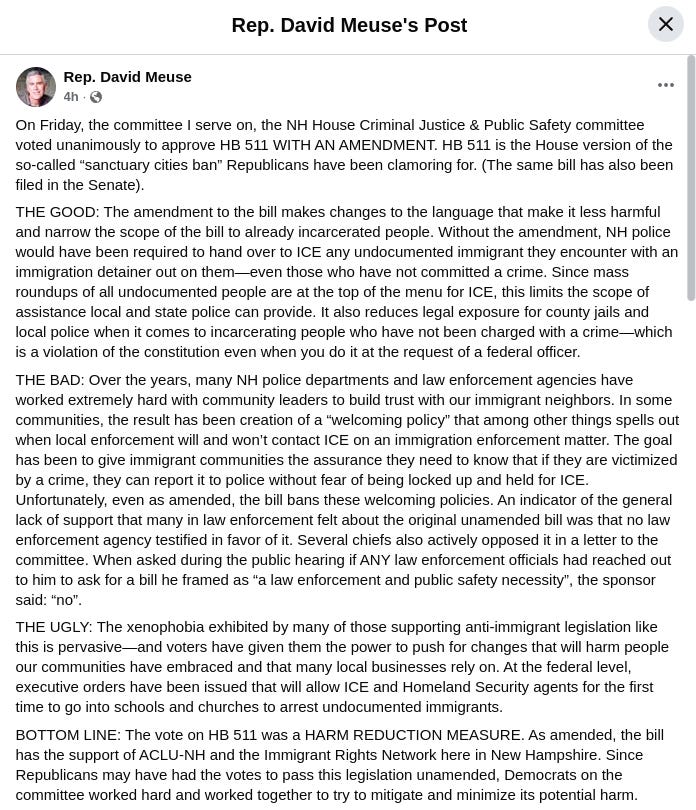
In a social media post published Sunday, Rep. David Meuse (D) explained why he and his fellow Democratic members of the House Criminal Justice and Public Safety Committee unanimously recommended that HB 511-FN ought to pass with amendment. Rep. Meuse referred to the bill as “the House version of the so-called ‘sanctuary cities ban’ that Republicans have been advocating for.” The bill, with or without amendment, aims to prohibit specific local policies restricting cooperation with federal immigration authorities. The amendment is not yet publicly available, but according to Rep. Meuse, it narrows the scope of the bill so that it applies only to already incarcerated individuals. Originally, the bill would have compelled local law enforcement to cooperate with federal immigration authorities in all cases, not just those involving incarcerated individuals. He wrote:
The amendment to the bill makes changes to the language that make it less harmful and narrow the scope of the bill to already incarcerated people.
…
BOTTOM LINE: The vote on HB 511 was a HARM REDUCTION MEASURE. As amended, the bill has the support of ACLU-NH and the Immigrant Rights Network here in New Hampshire.
This endorsement from ACLU-NH and the Immigrant Rights Network is notable given their advocacy for immigrant rights.
On Friday, the House Criminal Justice and Public Safety Committee held two votes on HB 511-FN: one on the amendment that narrows the scope of the bill and one on the bill, as amended. Both votes passed unanimously in committee.
The committee, without objection, also placed the bill on the “Consent Calendar,” which is “a list of bills that is considered noncontroversial measures,” according to the NH Center for Nonprofits. It’s noteworthy the bill was placed on the consent calendar because sanctuary policy bans are not generally considered noncontroversial and because Rep. Meuse, himself, voiced reservations for some of the ultimate effects of the bill in his social media post. Bills on the Consent Calendar are not debated on the floor of the House and are voted on all at once, in a stack. House members may remove bills from the Consent Calendar before the Calendar is voted upon in order to debate and vote on those bills individually, but “ten members are required to remove a bill from the Consent Calendar” in order for that to happen according to the House rules.
Democrats and immigrant rights advocacy groups may find support for an amendment that narrows the scope of the bill logical. However, it remains unclear why Democrats would, afterward, vote to recommend a version of the bill that still imposes certain restrictions on existing “welcoming policies” used by local law enforcement. While narrowing the scope of the bill may make it less broad than the original version, questions remain about whether recommending it “ought to pass” aligns with the Democrats’ previously stated objections. Specifically, Rep. Meuse acknowledged that even as amended, the bill would effectively eliminate some local “welcoming policies” designed to foster trust between law enforcement and immigrant communities. He wrote:
Over the years, many NH police departments and law enforcement agencies have worked extremely hard with community leaders to build trust with our immigrant neighbors. In some communities, this has resulted in ‘welcoming policies’ that … give immigrant communities the assurance they need to know that if they are victimized by a crime, they can report it to the police without fear. Unfortunately, even as amended, the bill bans these welcoming policies.
Rep. Meuse characterized the committee’s vote as a “harm reduction measure,” suggesting that adopting the amended bill was necessary to avoid an even more expansive version of the legislation that might compel local agencies to cooperate with ICE in all circumstances. According to his post, both the ACLU-NH and the Immigrant Rights Network support the bill in its amended form, though their official statements are not yet publicly available for verification.
NH Republicans have placed banning sanctuary policies as one of their top priorities for this session. "We will ban sanctuary cities in our state," said Senate President Sharon Carson at a press conference earlier this month. “We also need to ban sanctuary policies in our state, and I am counting on the legislature to do just that this term,” said Gov. Kelly Ayotte in her inaugural address earlier this month.
While the amendment represents a shift in the bill's scope, it raises several questions about the underlying motivations and potential impacts of ultimately supporting the bill as amended.
Unanswered Questions
Despite Rep. Meuse’s explanation, I still have several questions about the Democrats’ unanimous decision to recommend that HB 511-FN pass with an amendment. Rep. Meuse voiced his dislike of what could happen if the bill became law, and I think it’s fair to assume that other Democrats on the committee—as well as groups like ACLU-NH and the Immigrant Rights Network—may share similar concerns. That leads me to wonder why Democrats would vote for a measure that does something they presumably oppose.
Is there a tactical or strategic reason behind their support?
Does the amendment include stronger protections for undocumented individuals than what exists in current law?
Did committee Democrats strike a deal with Republicans, trading their support for the amended bill in exchange for its narrowed scope?
Could voting “ought to pass with amendment” serve as an act of good faith intended to encourage further compromise with Republicans?
How does this amended bill genuinely “reduce harm” for undocumented people, given that it still appears to eliminate local “welcoming policies”?
Since Rep. Meuse’s post does not address these points in detail, I remain uncertain about the true impact of this committee action and what it will mean for immigrant communities in New Hampshire.
Rep. Meuse was not immediately available for further comment before publication of this article.
You can watch the committee vote on the amendment and on the bill as amended here.
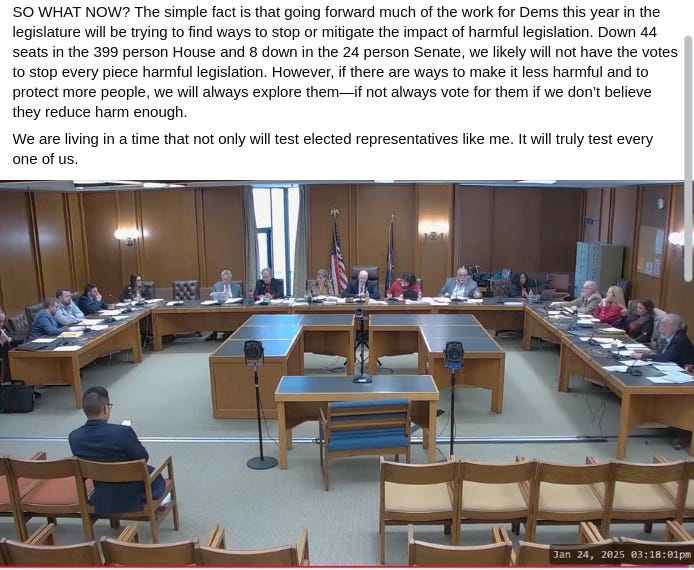
Below are screenshots from the whole message, retrieved earlier today.
 |
 |