Written by Andrew Horn of Amherst, NH.
 |
You can tell an important idea by how old it is and how proportionally undigested that idea is by our culture. Nietzsche’s Eternal Recurrence fits the bill spot-on.
Before talking about Nietzsche, however, it’s sadly important to emphasize that although he’s often associated with the Nazis, in actuality he would’ve hated the Nazis. As Prof. Phillip Cary once pointed out, every time Nietzsche rhetorically criticized “the Jews,” he would emphasize “that goes double for the Christians.” Nietzsche lived in a time and place where German Christians believed that Jesus was a Jew in name only, so Nietzsche used Jesus’ Jewishness as a critique against the German Christianity of his time. In fact, although Nietzsche was quite critical of German Christianity, he found in Jesus an intensely worthy ideological and intellectual opponent, where he found the German Christians of his time intensely sheep-like in their herd mentality. He might’ve traced a straight line from the German Christians of the late 1800’s that he knew and the German Nazis of the early-to-mid 1900’s for their reflex to group-think and conformity. Although we often associate Nietzsche with antisemitism, in fact, he in his writing was often antisemitism’s fiercest critic.
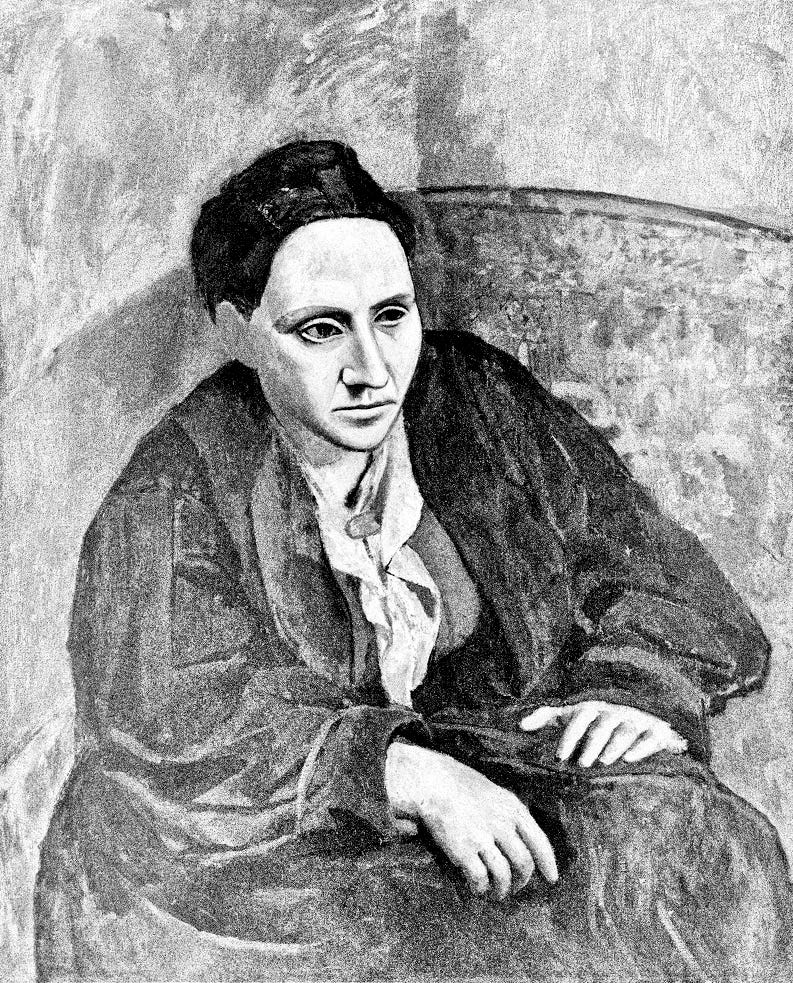
In Nietzsche, we can find the roots of important movements in art, writing, and philosophy that begin in the early 1900’s including Picasso’s Cubism, Gertrude Stein’s and Hemingway’s Modernism, Camus’ Absurdism, Sartre’s Existentialism, Dalí’s Surrealism, Kafka’s Expressionism, and Joyce’s proto-Postmodernism.
And the most essential and least widely known of Nietzsche’s ideas is the idea of Eternal Recurrence. Namely, that each of us, you and me, will live this life we’re now living an infinite number of times in the future with every event and every decision exactly the same, with no changes or differences. He believed that we should live our lives, each of us, as if this is true. And, using this reasoning, Nietzsche concludes with one of his most famous quotes: “Live dangerously.”
This is not to say that we should each recede into heroin-induced stupor, but rather, we should each of us observe the common risk-lessness that most people use as their North Star, guiding their lives, and instead live with courage, living bounded by the value systems that each of us create for ourselves, totally agnostic of the walls of conformity that seek to close around us.
The political significance of this is that when we act in reflex in conformity, we sow the seed that bullies can reap. The fuel that keeps fascism and authoritarianism going is fear, driving reflexive conformity, which allows bullies, visible and invisible, to rule with impunity and abandon. Courage is the only defense and the only antidote.
Nietzsche’s first description of Eternal Recurrence appears in The Gay Science in perhaps his most discomforting of aphorisms:
The greatest weight.— What, if some day or night a demon were to steal after you in your loneliest loneliness and say to you: "This life as you now live it and have lived it, you will have to live once more and innumerable times more; and there will be nothing new in it, but every pain and every joy and every thought and sigh and everything unutterably small or great in your life will have to return to you, all in the same succession and sequence—even this spider and this moonlight between the trees, and even this moment and I myself. The eternal hourglass of existence is turned upside down again and again—and you with it, speck of dust!"— Would you not throw yourself down and gnash your teeth and curse the demon who spoke thus? Or have you once experienced a tremendous moment when you would have answered him: "You are a god and never have I heard anything more divine!" If this thought gained possession of you, it would change you as you are or perhaps crush you; the question in each and every thing, "Do you desire this once more, and innumerable times more?" would lie upon your actions as the greatest weight. Or how well disposed would you have to become to yourself and to life to crave nothing more fervently than this ultimate eternal confirmation and seal?
It is with these words that I urge you, dear reader, to consider what it means for you to live as a political being with integrity. I urge you to act with what your heart believes fervently to be right over what you feel is politically expedient. Think about what it looks like to live by your personal code well before you think about how a certain act or word would be seen by your peers and leaders. Listen to Nietzsche: conformity for conformity’s sake is the path to ruin.
—
Citizen in a Republic is nonpartisan and non-ideological and is dedicated to publishing opinions addressing political problems in New Hampshire, especially opinion pieces from or about members of marginalized groups. If you want to submit an opinion piece for publication, please submit it here. If you want to submit a letter to the editor for publication, please submit it here.