Written by Andrew Horn of Amherst, NH.
Must read article today: How to Fix America’s Two-Party Problem in the New York Times
 |
According to the House Calendar, tomorrow:
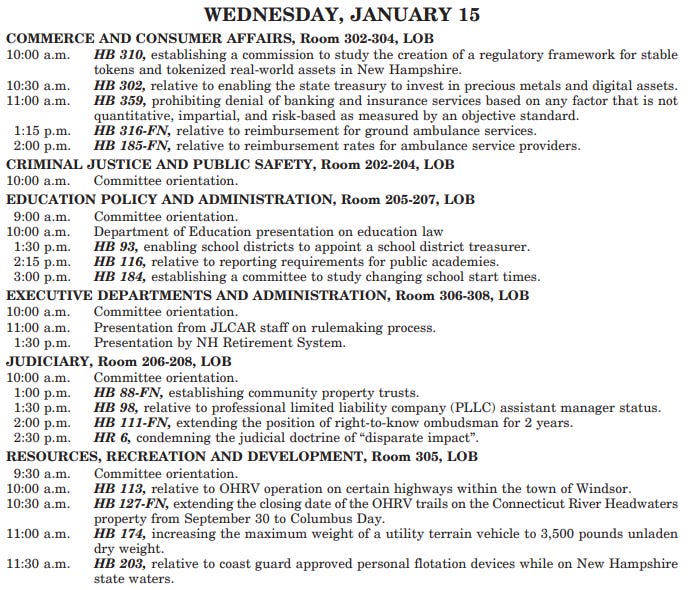
6 bills in Commerce and Consumer Affairs
3 bills in Education Policy and Administration
4 bills in Judiciary
4 bills in Resources, Recreation, and Development
If you can’t make it in person to a House hearing, you can submit testimony online.
According to the Senate Calendar, tomorrow:
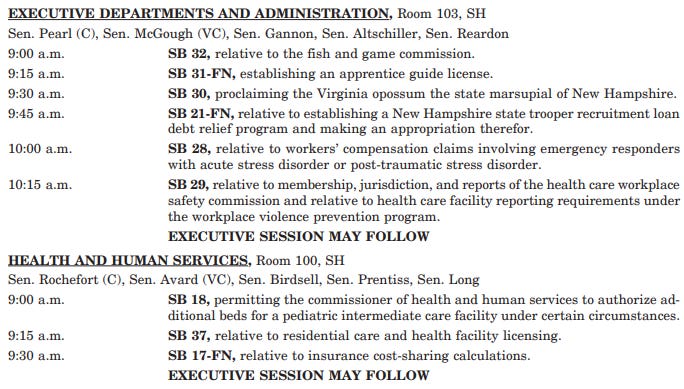
6 bills in Executive Departments and Administration
3 bills in Health and Human Services
Contents
Screenshots from House and Senate Calendar
House Commerce and Consumer Affairs
HB 310
HB 302
HB 359
HB 316-FN
HB 185-FN
House Education Policy and Administration
HB 93
HB 116
HB 184
House Judiciary
HB 88-FN
HB 98
HB 111-FN
HR 6
House Resources, Recreation, and Development
HB 113
HB 127-FN
HB 174
HB 203
Senate Executive Departments and Administration
SB 32
SB 31-FN
SB 30
SB 21-FN
SB 28
SB 29
Senate Health and Human Services
SB 18
SB 37
SB 17-FN
 |
 |
House Commerce and Consumer Affairs
HB 310
AN ACT establishing a commission to study the creation of a regulatory framework for stable tokens and tokenized real-world assets in New Hampshire.
Primary Sponsor: Rep. Keith Ammon (R)
Co-Sponsors: Rep. Mark Warden (R), Sen. Daryl Abbas (R), Rep. Calvin Beaulier (R), Rep. Joe Alexander (R)
Selected quote from the bill:
1 New Subdivision; Commission to Study Stable Tokens and Real-World Assets Framework. Amend RSA 383 by inserting
383:26 Commission to Study Stable Tokens and Real-World Assets Framework. There is hereby established a commission to study the creation of a regulatory framework for stable tokens and tokenized real-world assets ("RWAs") in New Hampshire.
I. The commission shall study and make recommendations regarding the following:
(a) The current landscape of stable token and tokenized RWA regulation within and outside New Hampshire.
(b) Legal, financial, and technological considerations for a state-level regulatory framework.
(c) Best practices from other jurisdictions for stable token and RWA regulation.
(d) Potential benefits and risks associated with the adoption of stable token and RWA frameworks in New Hampshire.
(e) Mechanisms for consumer protection and risk management.
(f) Economic opportunities related to blockchain technology and digital assets, including fostering innovation and job creation.
Analysis: This bill establishes a commission to study the creation of a regulatory framework for stable tokens and tokenized real-world assets ("RWAs") in New Hampshire.
Possible arguments for and against:
For: By examining the legal and regulatory landscape for stable tokens and RWAs, New Hampshire could position itself as a leader in emerging fintech and blockchain technology.
Against: Some argue that excessive or premature regulation can discourage startups and developers, especially in a rapidly evolving tech field where rules quickly become outdated.
Read in-depth AI arguments for and against HB 310 here.
Online Testimony: Eric Pauer of Brookline in support. None opposed.
Hearing: Wednesday, Jan 15 at 10:00 am in Room 301-304 in the Legislative Office Building and streaming on YouTube.
HB 302
AN ACT relative to enabling the state treasury to invest in precious metals and digital assets.
Primary Sponsor: Rep. Keith Ammon (R)
Co-Sponsors: Rep. Jason Osborne (R), Rep. Calvin Beaulier (R), Rep. Joe Sweeney (R), Rep. Mark Warden (R), Rep. Joe Alexander (R), Sen. Daryl Abbas (R), Sen. Kevin Avard (R), Sen. Keith Murphy (R)
Selected quotes from the bill:
1 New Section; State Treasurer and State Accounts. Amend RSA 6 by inserting …
6:8-d Strategic Reserve Established.
II. Notwithstanding RSA 6:8, the state treasurer may invest a portion of public funds in precious metals, any digital asset with a market capitalization of over $500 billion averaged over the previous calendar year, and stablecoins from the general fund, the revenue stabilization fund established in RSA 9:13-e, and any other funds as authorized by the legislature.
III. The state treasurer shall not invest more than 10 percent of the total amount of public funds in any of the authorized investments under paragraph II.
Analysis: This bill enables the state treasurer to invest state funds into precious metals and digital assets.
Possible arguments for and against:
For: Investing in precious metals and digital assets allows the state treasury to diversify its investment portfolio, reducing dependence on traditional assets like stocks and bonds. This diversification can help mitigate risks associated with market volatility.
Against: Digital assets are notoriously volatile, which could lead to significant fluctuations in the value of state investments. This unpredictability may pose a financial risk to public funds.
Read in-depth AI arguments for and against HB 302 here.
3 expressed support, with 1 submitting text.
5 expressed opposition, with all 5 submitting text.
Support
I am here today to express my strong support … with an important amendment: the legislation should explicitly specify “Bitcoin” rather than the broader term “cryptocurrency.”
Oppose
Digital assets, crypto, is not a good idea. Crypto requires a lot of energy. Countries doing well with this have invested in alternate energy positioning them well for growth.
What happens if the state loses big time with crypto - a scenario that is not impossible at all - and we have that tax burden as well. Terrible idea!!!
Please vote NO! This is so wrong.
—Ingrid Ostrem Nosek of New Boston
I absolutely do NOT want state funds going into crypto. Not enough people understand it so it would be very easy to "game" the system.
"Digital assets" (crypto currency) has been wildly volatile. It is not a safe investment for our tax dollars.
Hearing: Wednesday, Jan 15 at 10:30 am in Room 301-304 in the Legislative Office Building and streaming on YouTube.
HB 359
AN ACT prohibiting denial of banking and insurance services based on any factor that is not quantitative, impartial, and risk-based as measured by an objective standard.
Primary Sponsor: Rep. Travis Corcoran (R)
Co-Sponsors: Rep. Ross Berry (R), Rep. Tom Mannion (R), Rep. Mike Belcher (R)
Selected quotes from the bill:
1 New Section; Anti-Discrimination; Financial Institutions. Amend RSA 383-A by inserting
…
III. A financial institution shall not deny or cancel its services to a person, or otherwise discriminate against a person in making available such services or in the terms or conditions of such services, on the basis of any of the following:
(a) The person's political opinions, speech, or affiliations.
(b) … the person's religious beliefs, religious exercise, or religious affiliations.
…
(d) The use of a rating, scoring, analysis, tabulation, or action that considers a social credit score based on factors including:
…
(3) The person's lawful ownership of a firearm;
(4) The person's engagement in the lawful manufacture, distribution, sale, purchase, or use of firearms or ammunition;
(5) The person's engagement in the … manufacture of fossil fuel-based energy, timber, mining, or agriculture;
(6) The person's support of the state or federal government in combating illegal immigration, drug trafficking, or human trafficking;
…
(8) The person's failure to meet or commit to meet … the following as long as such person is in compliance with applicable state or federal law:
(A) Environmental standards …
(B) Social governance standards …
(C) Corporate board or company employment composition standards …
(D) Policies or procedures requiring or encouraging employee participation in social justice programming, including diversity, equity, or inclusion training.
Analysis: By establishing clear standards, this bill strives to protect individuals and companies from discrimination rooted in personal beliefs, affiliations, or non-objective criteria when dealing with financial institutions.
AI in-depth explanation of HB 359.
Possible arguments for and against:
For: By prohibiting service denial based on political opinions, religious beliefs, or other non-objective factors, HB 359 ensures that all individuals have equal access to banking and insurance services.
Against: Institutions may argue that the ability to consider non-quantitative factors can be essential for nuanced risk assessments and business strategies.
Read in-depth AI arguments for and against HB 359 here.
Support
Curtis Howland of Manchester
James McConnell of North Swanzey
Julie Smith of Nashua
Oppose
Dan Watkins of Derry
Hearing: Wednesday, Jan 15 at 11:00 am in Room 301-304 in the Legislative Office Building and streaming on YouTube.
HB 316-FN
AN ACT relative to reimbursement for ground ambulance services.
Primary Sponsor: Rep. John Hunt (R)
Selected quotes from the bill:
The bill is a request of the insurance department.
1 New Subdivision; Managed Care Law; Reimbursement for Ground Ambulance Services. Amend RSA 420-J by adding a new subdivision
420-J:28 Rate Schedule Established.
II. … the commissioner shall adopt a rule … that establishes a statewide default cost-based rate schedule for health carriers offering fully-insured coverage to use in reimbursing nonparticipating ground ambulance providers.
2 New Chapter; Prohibition on Balance Billing Covered Persons for Ground Ambulance Services. Amend RSA by inserting after chapter 358-T …
358-U:2 Balance Billing for Ground Ambulance Services Prohibited.
I. … the ground ambulance provider shall not bill, and shall not hold liable, the covered person for a payment amount for such services that is more than the cost-sharing requirement for such services under the covered person’s health benefit plan.
4 New Section; Commission on an All-Payer Model Program for ground ambulance services. Amend RSA 153-A by inserting …
III. The commission shall determine the feasibility and advisability … to enter into an all-payer model agreement for ground ambulance services in the state
5 Repeal. RSA 153-A:38 and the section heading preceding RSA 153-A:38, relative to the commission to study reforms to the New Hampshire ground ambulance and delivery system, are repealed.
Analysis: This bill makes changes to the regulatory environment for ground ambulance services and commercial health insurance reimbursement for these services by establishing a uniform, default rate schedule, prohibiting ground ambulance providers from balance billing, providing for continued updating of the rate schedule, and establishing a commission on an all-payer model program for ground ambulance services.
AI in-depth explanation of HB 316-FN.
Possible arguments for and against:
For: By prohibiting ground ambulance providers from balance-billing, patients with commercial insurance avoid unexpected charges beyond normal cost-sharing (copays, deductibles, etc.).
Against: If default rates for ambulance services are set higher than what insurers currently negotiate, insurers could pass on increased costs to consumers in the form of higher premiums.
Read in-depth AI arguments for and against HB 316-FN here.
Relevant Background:
Support
Kent Hackmann of Andover
Dan Watkins of Derry
Oppose
none
Hearing: Wednesday, Jan 15 at 1:15 pm in Room 301-304 in the Legislative Office Building and streaming on YouTube.
HB 185-FN
AN ACT relative to reimbursement rates for ambulance service providers.
Primary Sponsor: Rep. Mark Proulx (R)
Selected quotes from the bill:
1 Individual Health Insurance; Ambulance Service Provider Reimbursement; Direct Payment. Amend RSA 415:6-q to read as follows:
415:6-q Reimbursement for Ambulance Service Providers.
I. Each insurer that issues or renews any individual policy, plan, or contract of accident or health insurance that constitutes health coverage under RSA 420-G:2, IX, and that provides benefits for medically necessary ambulance services shall reimburse the ambulance service provider directly [subject to the terms and conditions of the policy, plan, or contract]. An insurer shall provide reimbursement for ambulance services at rates negotiated between the insurer and the ambulance service provider. In the absence of agreed upon rates, an insurer shall pay the amount billed by the ambulance service provider for the service, subject to review by the insurance department in the event of a dispute regarding whether the charge is reasonable. The provisions of this section shall not apply to policies that do not include coverage for ambulance services.
2 Group Insurance Ambulance Service Provider Reimbursement; Direct Payment. Amend RSA 415:18-v to read as follows:
415:18-v Reimbursement for Ambulance Service Providers.
[Same as paragraph above]
Analysis: This bill seeks to ensure that ambulance providers receive fair compensation for their services, either through direct billing amounts or mutually agreed-upon rates.
AI in-depth explanation of HB 316-FN.
Possible arguments for and against:
For: By mandating direct reimbursement at billed or negotiated rates, ambulance services receive fair compensation, reducing financial strain and promoting sustainability.
Against: Mandating reimbursement at billed or negotiated rates may lead to increased expenses for insurers, especially if billed rates are significantly higher than current negotiated rates.
Read in-depth AI arguments for and against HB 185-FN here.
Hearing: Wednesday, Jan 15 at 2:00 pm in Room 301-304 in the Legislative Office Building and streaming on YouTube.
House Education Policy and Administration
HB 93
AN ACT enabling school districts to appoint a school district treasurer.
Primary Sponsor: Rep. Joe Alexander (R)
Co-Sponsors: Rep. Glenn Cordelli (R), Rep. Katy Peternel (R)
Selected quotes from the bill:
1 New Section; Appointed School Treasurer. Amend RSA 197 by inserting after section 23-a the following new section:
197:23-b Appointed School Treasurer. Any school district … may, under an article in the warrant for the annual school district meeting, vote to authorize the appointment rather than the election of a school district treasurer. … Any school district may rescind a vote to appoint a school district treasurer under an article in the warrant for the annual school district meeting.
Analysis: This bill enables school districts to appoint a school district treasurer instead of elect them.
Possible arguments for and against:
For: Appointing a treasurer allows school boards to select individuals with specific financial expertise and experience, ensuring competent management of district funds.
Against: Electing a treasurer empowers voters to have a direct say in who manages public funds, enhancing democratic participation and accountability.
Read in-depth AI arguments for and against HB 93 here.
Support
Richard Luhtjarv of Hillsboro
Oppose
none
Hearing: Wednesday, Jan 15 at 1:30 pm in Room 205-207 in the Legislative Office Building and streaming on YouTube.
HB 116
AN ACT relative to reporting requirements for public academies.
Primary Sponsor: Rep. Jess Edwards (R)
Co-Sponsor: Rep.Michael Moffett (R)
Selected quote from the bill:
1 Reports Required; Cities and School Districts. Amend RSA 198:4-d to read as follows:
198:4-d Reports Required; Cities and School Districts. The governing body of each city, school district, public academy, and chartered public school shall submit to the commissioner of the department of education the following reports …
Analysis: This bill requires public academies to submit financial disclosure reports to the department of education.
Relevant background
Possible arguments for and against:
For: Requiring public academies to submit detailed financial disclosure reports ensures that these institutions are accountable for their financial management.
Against: Public academies may need to allocate additional resources, including time and personnel, to comply with the new reporting requirements. This could divert resources away from educational activities and student services.
Read in-depth AI arguments for and against HB 116 here.
Support
Richard Luhtjarv of Hillsboro
Oppose
none
Hearing: Wednesday, Jan 15 at 2:15 pm in Room 205-207 in the Legislative Office Building and streaming on YouTube.
HB 184
AN ACT establishing a committee to study changing school start times.
Primary Sponsor: Rep. Jonah Wheeler (D)
Selected quote from the bill:
3 Duties. The committee shall study what types of legislation would most effectively allow for changes to school start times.
Analysis: This bill establishes a committee to study changing school start times.
Relevant background:
States debate later high school start times (Stateline, 2023)
Should the school day start later? It's complicated. (The Week, 2023)
The Economic Case for Letting Teenagers Sleep a Little Later (New York Times, 2017)
Possible arguments for and against:
For: Numerous studies demonstrate that later school start times improve adolescents' sleep duration, mental health, academic performance, and reduce car accidents.
Against: Forming a committee might be perceived as a way to delay immediate action, prolonging the implementation of beneficial changes for students.
Read in-depth AI arguments for and against HB 184 here.
Support
Vanessa Blais of Manchester
Richard Luhtjarv of Hillsboro
Oppose
none
Hearing: Wednesday, Jan 15 at 3:00 pm in Room 205-207 in the Legislative Office Building and streaming on YouTube.
House Judiciary
HB 88-FN
AN ACT establishing community property trusts.
Primary Sponsor: Rep. Dan McGuire (R)
Co-Sponsors: Rep. Bob Lynn (R), Rep. Keith Ammon (R), Rep. John Hunt (R)
Selected quotes from the bill:
1 New Paragraph; Community Property Trust Transfer Exemption. Amend RSA 78-B:2 by inserting …
564-B:13-1307 Death of Spouse; Distribution of Assets. Upon the death of a spouse, one-half of the aggregate value of the property owned by a community property trust established by the spouses reflects the share of the surviving spouse and the other one-half reflects the share of the decedent. …
564-B:13-1308 Dissolution of Marriage; Termination of Trust. Upon the dissolution of the marriage of the settlor spouses, the community property trust shall terminate and the trustee shall distribute one-half of the trust assets to each spouse, with each spouse receiving one-half of each asset, unless otherwise agreed to in writing by both spouses.
Analysis: This bill allows community property trusts to be formed in New Hampshire.
Relevant background:
Possible arguments for and against:
For: Community property trusts provide a structured framework for married couples to manage and protect their jointly owned assets. By clearly defining ownership and management rights, couples can minimize disputes and ensure that their property is handled according to their mutual agreements.
Against: The exemption of property transfers to community property trusts from real estate transfer taxes could result in a significant decrease in state revenue. Given the current financial strain, any reduction in tax income could exacerbate budgetary challenges.
Read in-depth AI arguments for and against HB 88-FN here.
Hearing: Wednesday, Jan 15 at 1:00 pm in Room 206-208 in the Legislative Office Building and streaming on YouTube.
HB 98
AN ACT relative to professional limited liability company (PLLC) assistant manager status.
Bill text (PDF)
Primary Sponsor: Rep. Eric Turer (D)
Selected quotes from the bill:
Professional Limited Liability Companies; Officers and Managers. Amend RSA 304-D:12 to read as follows:
304-D:12 Officers and Managers.
In the case of a single-member professional limited liability company, unless the operating agreement provides otherwise, and subject to RSA 304-D:5, upon the manager’s death, incapacity, or becoming a disqualified person, the assistant manager may, for a period of up to one year after the date of the manager’s death, incapacity, or becoming a disqualified person, exercise all of the manager’s rights held by the manager immediately before the manager's death, incapacity, or becoming a disqualified person. Consistent with RSA 304-D:5, this section does not authorize the assistant manager to perform any professional duties or exercise any professional judgment within the scope of the subject profession.
Analysis: This bill amends the law to permit a single-member professional limited liability company to designate an assistant manager, who is not a qualified person, to manage the PLLC in the case of the death, incapacity, or disqualification of the manager for certain purposes.
Relevant context:
Possible arguments for and against:
For: By allowing an assistant manager to take over in cases of death, incapacity, or disqualification of the primary manager, the PLLC can maintain uninterrupted operations.
Against: Non-qualified assistant managers may lack the necessary knowledge and expertise to make informed managerial decisions, potentially leading to mismanagement.
Read in-depth AI arguments for and against HB 98 here.
Hearing: Wednesday, Jan 15 at 1:30 pm in Room 206-208 in the Legislative Office Building and streaming on YouTube.
HB 111-FN
This bill extends the office of the right-to-know ombudsman, complaint process, appeal and enforcement, and rulemaking for 2 years.
Primary Sponsor: Rep. Bob Lynn (R)
Co-Sponsors: Rep. Jim Maggiore (D), Rep. Katelyn Kuttab (R), Rep. Marjorie Smith (D), Sen. Sharon Carson (R)
Selected quotes from the bill:
1 Office of Right-To-Know Ombudsman; Duration. Amend 2022, 250:7, II-III to read as follows:
II. Sections 5 and 6 of this act shall take effect July 1, [2025] 2027.
Analysis: This bill extends the office of the right-to-know ombudsman, complaint process, appeal and enforcement, and rulemaking for 2 years. The original bill creating the ombudsman was created with a sunset clause, and this extends that sunset.
Relevant context:
Section 5 (2022, 250:5) changes RSA 91-A:7 back to how it was before 2022, without an ombudsman.
Section 6 (2022, 250:6) repeals RSA 91-A:7-a through 91-A:7-d, removing the office of ombudsman.
Possible arguments for and against:
For: The Right-to-Know Ombudsman provides citizens with a simpler, less expensive, and faster alternative to filing complaints in Superior Court.
Against: Testimonies indicate that the ombudsman office has failed to meet the mandated 50-day resolution period, with cases pending for over a year, undermining the office's effectiveness.
Read in-depth AI arguments for and against HB 111-FN here.
Eric Pauer of Brookline supports, and Terence O’Rourke of Rochester opposes
Navigating the RKO process is more convoluted, ultimately costs more, and takes far longer than seeking relief in Superior Court. Accordingly, House Bill 111-FN should not be enacted.
—Terence O’Rourke, Esq., City Attorney of the City of Rochester
Hearing: Wednesday, Jan 15 at 2:00 pm in Room 206-208 in the Legislative Office Building and streaming on YouTube.
HR 6
A RESOLUTION condemning the judicial doctrine of "disparate impact".
Primary Sponsor: Rep. Mike Belcher (R)
Co-Sponsors: Rep.Kristine Perez (R)
Selected quotes from the bill:
Whereas, the practice of univariate analysis for complex, real-world phenomena is illegitimate and unscientific, rendering such nonsensical conclusions as "thing one happened, then thing two happened, therefore the first thing was causative of the second thing;" and
Resolved … that the judicial doctrine of "disparate impact" must be overturned as a necessary restraint on government and to secure the liberty of the people, the exercise of federalism, and the powers delegated to the several states
Analysis: This house resolution condemns the judicial doctrine of "disparate impact".
Relevant context:
Possible arguments for and against:
For: The resolution contends that “disparate impact” rests on overly simplistic, one-factor (univariate) analysis to prove causation, ignoring the multitude of factors at play in complex real-world circumstances. By focusing solely on a single statistical disparity (e.g., differences in hiring rates between demographic groups), it overlooks potential confounding factors, such as industry-specific trends, local economic conditions, or job qualifications. This oversimplification can lead to misguided conclusions and legal actions.
Against: While the resolution casts “disparate impact” as illegitimate, one must note that its logic is not unlike the well-established concept of negligence. In negligence law, an actor can be held liable for harm that results from a failure to meet a certain standard of care, irrespective of intent. Disparate impact similarly holds an actor accountable for policies that lead to unjustifiable adverse effects—even if the harm was not deliberate.
Read in-depth AI arguments for and against HR 6 here.
Support
none
Oppose
Mikey Anair of Alexandria
Haley Demers of Portsmouth
Hannah Dufoe of Barnstead
Hearing: Wednesday, Jan 15 at 2:30 pm in Room 206-208 in the Legislative Office Building and streaming on YouTube.
House Resources, Recreation, and Development
HB 113
AN ACT relative to OHRV operation on certain highways within the town of Windsor.
Primary Sponsor: Rep. Riché Colcombe (R)
Co-Sponsors: Rep. James Creighton (R)
Selected quotes from the bill:
1 New Subparagraph; OHRV Operation on Certain Designated Highways. Amend RSA 215-A:10, IV by inserting …
(e) The following sections of state highway shall be designated for OHRV use: Windsor Road in Windsor from the Hillsborough town line to the intersection of Black Pond Road; Black Pond Road in Windsor from the intersection of Windsor Road to Miller Road.
Analysis: This bill designates a portion of certain highways within the town of Windsor for off highway recreational vehicle (OHRV) operation.
Possible arguments for and against:
For: Designating specific highways in Windsor for OHRV use expands recreational options for residents and visitors. This can promote outdoor activities, improve quality of life, and cater to enthusiasts of off-highway recreational vehicles.
Against: Allowing OHRV operations on highways, even specific sections, may increase the risk of accidents involving recreational vehicles and conventional motor vehicles, pedestrians, or wildlife, potentially leading to injuries or fatalities.
Read in-depth AI arguments for and against HB 113 here.
Hearing: Wednesday, Jan 15 at 10:00 am in Room 305 in the Legislative Office Building and streaming on YouTube.
HB 127-FN
AN ACT
Bill text (PDF)
Primary Sponsor: Rep. Mike Ouellet (R)
Co-Sponsors: Rep. James Tierney (R), Rep. Lori Korzen (R), Rep. Sean Durkin (R), Rep. Richard Lascelles (R), Sen. David Rochefort (R)
Selected quote from the bill:
1 New Section; Connecticut Lakes Headwaters Working Forest; OHRV Trails Closure Date. Amend RSA 215-A by inserting after section 215-A:3-b …
215-A:3-c Connecticut Lakes Headway Working Forest OHRV Trail Annual Closure Date.
Notwithstanding any conservation easement provisions or other contracts, laws, or rules to the contrary, all OHRV trails on the Connecticut Lakes headwaters working forest property shall remain open until the second Monday in October, which is Columbus Day.
Analysis: This bill extends the annual closing date for OHRV trails on the Connecticut Lakes headwaters working forest property until the second Monday in October, which is Columbus Day.
Possible arguments for and against:
For: Extending the ATV riding season until Columbus Day allows for an additional two weeks of tourism. This can significantly boost local businesses such as hotels, restaurants, campgrounds, and retail stores, contributing millions to the local economy.
Against: Critics like Boyd Smith argue that passing individual bills like HB 127-FN undermines the purpose of the Commission to Study OHRV Use in the State (HB 1188). Bypassing comprehensive studies may lead to unaddressed issues and unintended consequences.
Read in-depth AI arguments for and against HB 127-FN here.
60 people expressed support, 52 of which being Granite Staters and 29 of which submitted text testimony
8 people expressed opposition, 7 of which being Granite Staters and 5 of which submitted text testimony
Some people who “opposed” this legislation may actually support what it does, such as Brad Kelloway, Kyle Conner, and Anthony Biscotti
Support:
After Sept 30 Pittsburg becomes a ghost town. People call to book rooms with us and then when they find out our trail system is closed they cancel and book in our neighboring towns.
Pittsburg is the ONLY town in the entire State of NH that the DNCR has denied the request to extent the OHRV season into Columbus Day weekend. This is unfair and unjust.
Allowing the OHRV systems to stay open throughout every township in the State of New Hampshire with the exception of Pittsburg, makes no sense.
—Open letter signed by 30 organizations and 3 individuals
I am a member of the Selectboard for the Town of Pittsburg … I find it ludicrous and hypocritical that the State of New Hampshire would not treat all municipalities fairly
—Douglas Ahlstrin of Pittsburg
attended the Headwaters public meeting this past fall in regard to if they thought there was a need to make a recommendation to the full Committee. Unfortunately, it was as if the group already their minds made up to not recommend it.
Unfortunately when the atv trails close on Sept.30th … businesses in the area see a definite decrease in business. Therefore my hours get cut back. I am a retiree and the income … helps me to pay my bills through out the year.
This is usually the best time due to foliage usual peaking at this time. All of the neighboring communities set their trail closure at this time and it would be great if this could be extended for the Pittsburg trails also.
The costs associated with maintaining the trails during this extended period would be minimal compared to the substantial economic benefits.
Cutting Pittsburg season HURTS the economy in the north country.
Oppose
The machines and the people that come with them have ruined the peace and quiet in the north country.
The HB 1188 "Commission to Study OHRV use in the state” has not taken a vote on any of these bills. This commission was created to come up with comprehensive solutions. Passage of individual bills undermines the purpose and effectiveness of the Commission. This request went through an extensive current public process and was denied - legislative go-around should be tabled. Please vote to ITL this proposal or send it to the HB 1188 Commission for comprehensive consideration.
Hearing: Wednesday, Jan 15 at 10:30 am in Room 305 in the Legislative Office Building and streaming on YouTube.
HB 174
AN ACT increasing the maximum weight of a utility terrain vehicle to 3,500 pounds unladen dry weight.
Primary Sponsor: Rep. Mike Ouellet (R)
Co-Sponsors: Rep. Ron Dunn (R), Rep. Michael Murphy (R), Rep. Brian Cole (R), Rep. Sean Durkin (R), Rep. David Rochefort (R), Rep. Arnold Davis (R), Rep. Richard Lascelles (R), Rep. Lori Korzen (R)
Selected quotes from the bill:
1 Utility Terrain Vehicle; Maximum Weight. Amend RSA 215-A:1, XXIV to read as follows:
(c) A person may operate an OHRV within Jericho Mountain state park which weighs up to [2,000] 3,500 pounds unladen dry weight
Analysis: This bill changes the weight maximum of a utility terrain vehicle, and thus the weight of an OHRV, from 2,000 pounds unladen dry weight to 3,500 pounds unladen dry weight.
Possible arguments for and against:
For: Heavier UTVs can carry more passengers and equipment, making them more versatile for both recreational and commercial use.
Against: Heavier UTVs can cause more significant wear and tear on trails, leading to erosion, habitat destruction, and long-term damage to natural areas.
Read in-depth AI arguments for and against HB 174 here.
Support
This would allow 4 seat SxS with heat and AC to be used on our trails.
Oppose
The HB 1188 "Commission to Study OHRV use in the state” has not taken a vote on any of these bills. This commission was created to come up with comprehensive solutions. Passage of individual bills undermines the purpose and effectiveness of the Commission.
Hearing: Wednesday, Jan 15 at 11:00 am in Room 305 in the Legislative Office Building and streaming on YouTube.
HB 203
AN ACT relative to coast guard approved personal flotation devices while on New Hampshire state waters.
Primary Sponsor: Rep. John MacDonald (R)
Co-Sponsors: Rep. Will Darby (D), Rep. Rosemarie Rung (D), Rep. Karel Crawford (R)
Selected quote from the bill:
1 New Paragraph; General Rules for Vessels Operating on Water. Amend RSA 270-D:2 by inserting after paragraph X the following new paragraph:
X-a. All occupants from November 15 through May 15 in canoes, kayaks, or rowing sculls, not engaged in official competition shall wear a PFD, as defined by RSA 270-D:1, IX, at all times while navigating on state waters.
Analysis: This bill requires occupants of canoes, kayaks, or rowing sculls on state waters who are not part of an official competition to wear a personal flotation device (PFD) of a type approved by the United States Coast Guard.
Possible arguments for and against:
For: Mandatory use of Coast Guard-approved personal flotation devices (PFDs) can significantly decrease the number of drowning accidents among canoe, kayak, and rowing scull users.
Against: Purchasing Coast Guard-approved PFDs can be an additional expense for individuals, particularly for those who engage in water activities sporadically.
Read in-depth AI arguments for and against HB 203 here.
Support
Andrew LaMoreaux of Concord, NH Lakes
Kent Hackmann of Andover
Oppose
Julie Smith of Nashua
Curtis Howland of Manchester
Hearing: Wednesday, Jan 15 at 11:30 am in Room 305 in the Legislative Office Building and streaming on YouTube.
Senate Executive Departments and Administration
SB 32
AN ACT relative to the fish and game commission.
Primary Sponsor: Sen. Howard Pearl (R)
Co-Sponsors: Sen. Regina Birdsell (R), Sen. Kevin Avard (R), Sen. Timothy Lang (R), Sen. Daniel Innis (R), Sen. David Rochefort (R), Sen. Tara Reardon (D)
Selected quotes from the bill:
1 Hearings to Receive Suggestions from the Public; Digital Hearing Notices Allowed. Amend RSA 206:11 …
206:11 Hearings to Receive Suggestions from the Public. … Public notice of said hearings may be published on the newspaper's website.
2 New Paragraph; Methods of Taking; Hunting from Motor Vehicle, OHRV, Snowmobile, Boat, or Aircraft. Amend RSA 207:7 by inserting …
V. The provisions of this section shall not apply shooting of injured or crippled waterfowl from a motorized watercraft.
3 Nets; Traps. Amend RSA 211:9 to read as follows:
211:9 Nets; Traps. … A circular drop net, not more than 48 inches in diameter, or a square net of equal area, may be used for taking minnows for bait, from waters not inhabited by [brook] trout.
4 Fisheries Habitat Fee; Established in Rule. Amend RSA 214:1-g, I to read as follows:
I. A [one dollar] fisheries habitat fee, which shall be set in rules adopted by the executive director in accordance with RSA 541-A, shall be required to be paid by all persons 16 years of age or older …
5 Repeal. RSA 213-A, relative to the Connecticut River Atlantic salmon commission, is repealed.
Analysis:
Digital Public Hearing Notices
Amendment: Allows public hearing notices to be posted digitally on newspaper websites.
Shooting Injured or Crippled Waterfowl from Motorized Watercraft
Amendment: Permits the shooting of injured or crippled waterfowl from a motorized watercraft.
Modification of Trout References
Amendment: Removes the word "brook" from references to trout in methods of taking fish.
Fisheries Habitat Fee Regulation
Amendment: Grants the Executive Director of Fish and Game the authority to set the fisheries habitat fee through rulemaking.
Repeal of the Connecticut River Atlantic Salmon Commission
Amendment: Repeals RSA 213-A, effectively dissolving the Connecticut River Atlantic Salmon Commission.
Read in-depth AI arguments for and against SB 32 here.
Hearing: Wednesday, Jan 15 at 9:00 am in Room 103 in the State House and streaming on YouTube.
SB 31-FN
AN ACT establishing an apprentice guide license.
Primary Sponsor: Sen. Howard Pearl (R)
Co-Sponsors: Sen. Daniel Innis (R), Sen. Timothy Lang (R), Sen. Kevin Avard (R), Sen. Tara Reardon (D), Sen. David Rochefort (R), Rep. Judy Aron (R), Rep. James Spillane (R)
Selected quotes from the bill:
This bill is a request of the fish and game department.
1 New Section; Apprentice Guide License. Amend RSA 215 by inserting after section 9 the following new section:
215:10 Apprentice Guide License.
I. Any person who wishes to become a hunting or fishing guide but who has not completed the written and oral board requirements to become a licensed guide as required in RSA 215:2, may purchase an apprentice guide license. … A person holding a valid apprentice guide license may guide in activities, including hunting or fishing, only when accompanied by a properly licensed guide who is 18 years of age or older.
Analysis: This bill establishes an apprentice guide license.
Possible arguments for and against:
For: The apprentice guide license creates a clear and structured pathway for individuals aiming to become fully licensed hunting or fishing guides. This tiered approach allows apprentices to gain practical experience under the supervision of seasoned guides before meeting all licensing requirements.
Against: Additional licensing requirements, such as criminal background checks and first-aid certification, may deter qualified individuals from pursuing a career as a guide. This could lead to a shortage of available guides, negatively impacting the industry.
Read in-depth AI arguments for and against SB 31-FN here.
Hearing: Wednesday, Jan 15 at 9:15 am in Room 103 in the State House and streaming on YouTube.
SB 30
AN ACT proclaiming the Virginia opossum the state marsupial of New Hampshire.
Primary Sponsor: Sen. Donovan Fenton (D)
Co-Sponsors: Sen. Timothy Lang (R), Sen. Rebecca Perkins Kwoka (D), Sen. Pat Long (D), Sen. Daryl Abbas (R), Sen. Daniel Innis (R), Sen. David Watters (D), Sen. Keith Murphy (R), Sen. Denise Ricciardi (R), Sen. David Rochefort (R), Sen. Regina Birdsell (R), Sen. Tara Reardon (D), Sen. Suzanne Prentiss (D), Sen. Ruth Ward (R), Sen. Debra Altschiller (D), Rep. Mark Pearson (R), Rep. Cathryn Harvey (D), Rep. Paul Berch (D)
Selected quotes from the bill:
1 New Section; State Marsupial. Amend RSA 3 by inserting after section 31 the following new section:
3:32 State Marsupial. The Virginia opossum (Didelphis virginiana) is hereby designated as the official state marsupial of New Hampshire.
Analysis: This bill proclaims the Virginia opossum the state marsupial of New Hampshire.
Hearing: Wednesday, Jan 15 at 9:30 am in Room 103 in the State House and streaming on YouTube.
SB 21-FN
AN ACT relative to establishing a New Hampshire state trooper recruitment loan debt relief program and making an appropriation therefor.
Primary Sponsor: Sen. Bill Gannon (R)
Co-Sponsors: Sen. Pat Long (D), Sen. David Rochefort (R), Sen. Tim McGough (R), Sen. Kevin Avard (R), Sen. Howard Pearl (R), Sen. Timothy Lang (R), Rep. Michael Vose (R), Rep. Kenneth Weyler (R), Rep. JD Bernardy (R), Rep. Kimberly Rice (R), Rep. Lilli Walsh (R)
Selected quotes from the bill:
1 New Section; State Trooper Retention School Loan Debt Relief Program. Amend RSA 106-B by inserting …
106-B:1-a State Trooper Retention School Loan Debt Relief Program.
I. … The program shall provide financial incentives to new state troopers, through student loan repayment assistance upon completion of a term of employment as a state trooper in the state of New Hampshire. …
II. Applicants shall be eligible for the program if they were hired as police employees on or after July 1, 2025 and owe at least $10,000 in student loans. Applicants deemed eligible shall, no later than 30 days after their anniversary of employment, receive a tax free disbursement towards their student loan debt in the amount of $10,000 for the first 5 years they remain police employees, up to a maximum total disbursement of $40,000.
Analysis: This bill establishes the New Hampshire state trooper school loan debt relief program.
Possible arguments for and against:
For: By alleviating student loan debt, the bill makes the state trooper position more financially attractive, potentially increasing the number of applicants and improving retention rates.
Against: The Department of Safety estimates expenditures ranging from $100,000 to $1,000,000 over the first few years. In the context of a looming budget fight, committing these funds could be politically challenging.
Read in-depth AI arguments for and against SB 21-FN here.
Hearing: Wednesday, Jan 15 at 9:45 am in Room 103 in the State House and streaming on YouTube.
SB 28
AN ACT relative to workers' compensation claims involving emergency responders with acute stress disorder or post-traumatic stress disorder.
Primary Sponsor: Sen. Regina Birdsell (R)
Co-Sponsors: Sen.Bill Gannon (R), Sen. Pat Long (D), Sen. Suzanne Prentiss (D), Rep. Timothy Soucy (D), Rep. Stephen Pearson (R)
Selected quotes from the bill:
1 Workers' Compensation; Acute Stress Disorder and Post-Traumatic Stress Disorder. Amend RSA 281-A:17-c …
281-A:17-c Acute Stress Disorder and Post-Traumatic Stress Disorder; Presumption.
I. Notwithstanding … [RSA 281-A:16,] …
II. For purposes of this section, the date of injury for acute stress disorder and post-traumatic stress disorder in an emergency responder shall be subject to the provisions for determining date of injury for occupational disease or cumulative trauma under RSA 281-A:16.
Analysis: This bill provides that "date of injury" for purposes of workers' compensation claims by emergency responders with acute stress disorder or post-traumatic stress disorder shall be determined in accordance with the statute governing date of injury for occupational disease or cumulative trauma.
Read in-depth AI explanation for SB 28 here.
Possible arguments for and against:
For: This bill acknowledges that acute stress disorder and post traumatic stress disorder are legitimate occupational diseases for emergency responders, ensuring they receive appropriate compensation and support.
Against: Extending workers' compensation coverage to include acute stress disorder and post traumatic stress disorder may lead to increased insurance premiums and costs for employers, particularly those with limited resources.
Read in-depth AI arguments for and against SB 28 here.
Hearing: Wednesday, Jan 15 at 10:00 am in Room 103 in the State House and streaming on YouTube.
SB 29
AN ACT relative to membership, jurisdiction, and reports of the health care workplace safety commission and relative to health care facility reporting requirements under the workplace violence prevention program.
Primary Sponsor: Sen. Cindy Rosenwald (D)
Co-Sponsors: Sen. James Gray (R), Sen. Tara Reardon (D), Sen. Denise Ricciardi (R), Sen. Donovan Fenton (D), Sen. Kevin Avard (R), Rep. Brian Sullivan (D), Rep. Mark MacKenzie (D), Rep. Wayne MacDonald (R), Rep. Lucy Weber (D), Rep. William Palmer (D)
Selected quotes from the bill:
The bill is a request of the health care workplace safety commission.
1 New Subparagraph; Health Care Workplace Safety Commission; Membership; Hampstead Hospital Added. Amend RSA 151-J:1, II(a) by inserting after subparagraph (2) the following new subparagraph:
(2-a) A representative of Hampstead hospital, appointed by the hospital.
2 Health Care Workplace Violence Prevention Program; Reporting of Workplace Violence Events to the Department of Labor. Amend RSA 277-C:2, IV and V to read as follows:
IV-a. The commissioner of the department of labor … shall adopt rules … deemed necessary for the implementation of this section, including a common reporting form. Health facilities shall use the form to report workplace violence or hostile words incidents to the department of labor on a monthly basis.
V.(a) The annual report required under paragraph IV and the monthly reports to the department of labor required under paragraph IV-a shall include … workplace violence or hostile words incident …
3 Reports; Confidentiality. Amend RSA 151-J:7 to read as follows:
151-J:7 Reports. … Annual reports of the commission shall not be confidential, but any information about processes or outcomes [provided pursuant to this section] shall be aggregate data only and shall not reference individual incidents, patients, health care providers, or institutions, in accordance with the confidentiality requirements of RSA 151-J:5.
4 Repeal. RSA 151-J:9, relative to the exemption of state operated medical facilities from the jurisdiction of the New Hampshire health care workplace safety commission, is repealed.
Analysis: This bill adds a representative of Hampstead hospital to the health care workplace safety commission, requires monthly reporting of incidents to the department of labor, repeals an exemption for state operated health care facilities from jurisdiction of the commission, and clarifies that annual reports of the commission are not confidential.
Read in-depth AI explanation of SB 29 here.
Read in-depth AI arguments for and against SB 29 here.
Hearing: Wednesday, Jan 15 at 10:15 am in Room 103 in the State House and streaming on YouTube.
Senate Health and Human Services
SB 18
AN ACT permitting the commissioner of health and human services to authorize additional beds for a pediatric intermediate care facility under certain circumstances.
Primary Sponsor: Sen. Cindy Rosenwald (D)
Co-Sponsors: Sen. David Rochefort (R),Sen. Pat Long (D),Sen. Regina Birdsell (R),Sen. Donovan Fenton (D),Sen. Suzanne Prentiss (D),Rep. Lucy Weber (D),Rep. David Nagel (R)
Selected quotes from the bill:
1 Residential Care and Health Facility Licensing; License or Registration Required; Pediatric Intermediate Care Facility; Bed Capacity. Amend RSA 151:2, VI(a) to read as follows:
(2) Provided however … any pediatric intermediate care facility, established before the effective date of this subparagraph is authorized to house 2 additional pediatric residents beyond its licensed capacity prior to that date…. Notwithstanding the moratorium established in subparagraph (a)(1), the commissioner of health and human services may assess the capacity of any pediatric immediate care facility and report any need for additional beds to the standing policy committees of the house and senate with jurisdiction over health and human services and the fiscal committee of the general court. If the commissioner determines additional beds are necessary, the commissioner may increase a pediatric intermediate care facility's number of licensed beds upon approval of the fiscal committee of the general court.
Analysis: This bill allows the commissioner of health and human services to increase the bed capacity of a pediatric intermediate care facility with the approval of the joint fiscal committee.
Possible arguments for and against:
For: Allowing additional beds in pediatric intermediate care facilities can help meet the growing demand for specialized pediatric healthcare services, reducing wait times and improving access for children in need.
Against: Rapid expansion of bed capacity may outpace the availability of qualified healthcare professionals, leading to overworked staff and potential declines in patient care quality.
Read in-depth AI arguments for and against SB 18 here.
Hearing: Wednesday, Jan 15 at 9:00 am in Room 100 in the State House and streaming on YouTube.
SB 37
AN ACT relative to residential care and health facility licensing.
Primary Sponsor: Sen. Timothy Lang (R)
Co-Sponsors: Sen. Pat Long (D), Sen. Keith Murphy (R), Sen. Mark McConkey (R)
Selected quotes from the bill:
The bill is a request of the department of health and human services.
1 Residential Care and Health Facility Licensing; Proceedings of Residential Care Facility Quality Assurance Program; Confidentiality. Amend RSA 151:5-c, I …
I. … in licensed residential care facilities, such facilities [may voluntarily] shall maintain a quality assurance program for its residents as set forth in this section.
2 Residential Care and Health Facility Licensing; Investigations and Consultations. Amend RSA 151:6, I …
I. The department of health and human services may investigate, in response to a complaint alleging a violation of this chapter or when it has good reason to believe that the provisions of this chapter or rules adopted under this chapter have been violated by any facility licensed under this chapter or agency required to be licensed in accordance to RSA 151:2, I or any facility providing services beyond room and board to 2 or more individuals unrelated to the owner or manager. ... Investigation results shall be provided as a written report that identifies any noncompliance with this chapter and applicable rules adopted under this chapter. The results of this investigation and any later investigation shall be posted in a conspicuous place in the facility in the manner determined by the commissioner of the department of health and human services. The results so posted shall indicate the facilities and services investigated and the results for each such facility or service.
3 Residential Care and Health Facility Licensing; Annual Inspection. Amend RSA 151:6-a, II(c) to read as follows:
(c) Facilities shall [not] be required to post notices to correct issued under subparagraph (a) of this paragraph.
4 Residential Care and Health Facility Licensing; Civil Fines. Amend RSA 151:16-b to read as follows:
151:16-b Civil Fines. All [administrative fines and other] civil monetary penalties collected by the department from facilities licensed under this chapter shall be kept by the state treasurer …
5 Residential Care and Health Facility Licensing; Patients' Bill of Rights. Amend RSA 151:21, XXIII(b)(1)(D) to read as follows:
(D) Visitors are noncompliant with written [hospital] facility policy.
6 Residential Care and Health Facility Licensing: Patients' Bill of Rights. Amend RSA 151:21, XXIII(f)(3) …
(3) [Hospital] Facility visitation policy detailing the rights and responsibilities specified in this paragraph, and the limitations placed upon those rights by written hospital policy on its website.
7 Residential Care and Health Facility Licensing; Dementia Training for Direct Care Staff in Residential Facilities; Continuing Education. Amend RSA 151:50 …
151:50 Continuing Education. The commissioner shall adopt rules to require at least 6 hours of initial [continuing] education for covered administrative staff members and covered direct service staff members and shall require at least 4 hours of [ongoing training] continuing education each calendar year.
Analysis: This bill revises residential care and health facility licensing requirements by (1) requiring licensed residential care facilities to have quality assurance programs; (2) requiring the results of any investigation be posted in a conspicuous place in the facility; (3) requiring facilities to post the results of Life Safety inspections known as “notices to correct;” (4) removing a redundant reference to administrative fines; (5) changing the term “hospital” to the term “facility;” and (6) removing the word “continuing” from the initial education requirements and replacing the term “ongoing training” with continuing education in the annual training requirement.
Read in-depth AI explanation of SB 37 here.
Possible arguments for and against:
For: Requiring all residential care facilities to maintain quality assurance programs ensures consistent monitoring and improvement of care standards, leading to better resident outcomes.
Against: Implementing mandatory quality assurance programs and additional reporting requirements can strain administrative resources, especially for smaller facilities with limited staff.
Read in-depth AI arguments for and against SB 37 here.
Hearing: Wednesday, Jan 15 at 9:15 am in Room 100 in the State House and streaming on YouTube.
SB 17-FN
AN ACT relative to insurance cost-sharing calculations.
Primary Sponsor: Sen. Dan Innis (R)
Analysis: This bill provides that, when calculating an enrollee's contribution to cost-sharing requirements, the insurer or pharmacy benefits manager shall include any amount paid by the enrollee or paid on their behalf. The bill includes a limited exception for health savings account-qualified high deductible health plans if application of the requirement would result in account ineligibility under the Internal Revenue Code.
Read AI explanation of SB 17-FN here.
Possible arguments for and against:
For: By requiring insurers and Pharmacy Benefit Managers (PBMs) to include all amounts paid by or on behalf of the enrollee in cost-sharing calculations, the bill ensures that policyholders have a clearer understanding of their true financial responsibilities.
Against: Including all amounts paid on behalf of enrollees may lead insurers to increase premiums to offset the additional financial transparency and potential cost burdens.
Read in-depth AI arguments for and against SB 17-FN here.
Hearing: Wednesday, Jan 15 at 9:30 am in Room 100 in the State House and streaming on YouTube.
Autistic Poem of the Day
 |
Spiral by Arbor-Day
Life toils on again.