Written by Andrew Horn of Amherst, NH.
Yet what newspaper publishers gradually came to understand in the nineteenth century—and what generations of new publishers across other technologies refined with significant hardship and later, under duress, began to forget in the twentieth—is that those who produce news in an organization (whether their ultimate motive is profit, prestige, community building, authority, audience reach, or some mix) must have one allegiance above all others. And this commitment forms the second element of journalism:
Journalism’s first loyalty is to citizens.
—The Elements of Journalism, 4th Edition by Bill Kovach and Tom Rosenstiel
 |
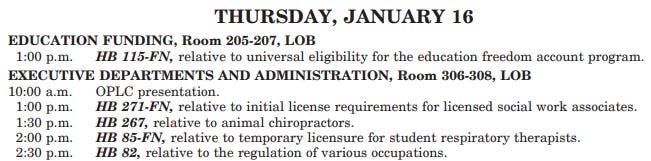
According to the House Calendar, tomorrow:
1 bill in Education Funding
4 bills in Executive Departments and Administration
Contents
Screenshots from House Calendar
House Education Funding
HB 115-FN
AI Analysis of Online Testimony
House Departments and Administration
HB 271-FN
HB 267
HB 85-FN
HB 82
 |
House Education Funding
HB 115-FN
AN ACT relative to universal eligibility for the education freedom account program.
Primary Sponsor: Rep. Valerie McDonnell (R)
Co-Sponsors: Rep. Glenn Cordelli (R), Rep. Rick Ladd (R), Rep. Joe Sweeney (R), Rep. Kristin Noble (R), Rep. Sheila Seidel (R), Rep. Julius Soti (R), Rep. Joe Alexander (R), Rep. Kevin Verville (R), Rep. Kenneth Weyler (R), Sen. Keith Murphy (R), Sen. Ruth Ward (R), Sen. Victoria Sullivan (R), Sen. Daniel Innis (R)
Selected quotes from the bill:
1 Education Freedom Accounts; Definitions; Eligible Student. Amend RSA 194-F:1, VI to read as follows:
VI. "Eligible student" means a resident of this state who is eligible to enroll in a public elementary or secondary school [and whose annual household income at the time the student applies for the program is less than or equal to 350 percent of the federal poverty guidelines as updated annually in the Federal Register by the United States Department of Health and Human Services under 42 U.S.C. section 9902(2). No income threshold need be met in subsequent years, provided the student otherwise qualifies].
Analysis: This bill removes household income limits to qualify for an Education Freedom Account.
Relevant background:
Possible arguments for and against:
For: Removing the household income criteria allows all families, regardless of income, to access the Education Freedom Account (EFA) program. This ensures that more students have the opportunity to choose educational settings that best fit their needs.
Against: Removing income eligibility is projected to increase the number of students eligible for EFA grants, leading to higher state expenditures. With the state already facing a potential $21 million deficit, this could exacerbate fiscal challenges.
Read in-depth AI arguments for and against HB 115-FN here.
Support
440 people, of which 215 submitted text testimony, including 4 public officials and lobbyists as well as 211 members of the public
Read public officials’ and lobbyists’ supportive testimony here.
Read AI analysis from supportive members of the public here.
Oppose
1594 people, of which 735 submitted text testimony, including 18 public officials and lobbyists as well as 717 members of the public
Read public officials’ and lobbyists’ opposition testimony here.
Read AI analysis from opposition members of the public here.
Neutral
2 people, of which 1 submitted text testimony
Selected supportive quotes from the public:
“I support this bill. The money should follow the child.”
—Wesley Littlefield of Belmont, NH
“Due to many circumstances, public school was not the best option for my family […] She is thriving, and I’m thankful we have the option to approach her education in this way.”
—Keeley Rollert of Franklin, NH
“Not every child learns the same. Some are more hands on vs sitting on a computer all day. This is a wonderful [way] for all families to help get their children learning at their comfort zone and pace.”
—Amy Chambers of Belmont, NH
“If we feel the public school system is not the best place for our children then we should be able to use those funds for a different way to educate them.”
—Mary Oakes of Portsmouth, NH
“I support access to EFA accounts to all who can use them to better their child’s education.”
—Deidra Benjamin of Pittsfield, NH
“Every New Hampshire family deserves access to an Education Freedom Account. This isn’t a form of assistance or ‘financial aid’—it’s simply their rightful share of the funds allocated for their children’s education.”
—Lindsay Lobas of Pelham, NH
“I believe the combination of the intimate class size plus dedicated reading help has set our son up for success and allowed him to thrive. It has been a joy to watch his confidence grow!”
—Amy Daigle of Auburn, NH
“Moving to a better school district isn’t an option for many families. Maybe it’s not financially viable […]. I support access to EFA accounts to all who can use them.”
—Deidra Benjamin of Pittsfield, NH
“Stop the hate!”
(Context: This quote is from a testimony cautioning that if universal school vouchers are used, private and religious schools should meet the same standards as public schools.)
—Ray Fortier of Manchester, NH
“Let the funds follow the child regardless of where they receive their education. Parents know what is best for their children.”
—Devon Matthews of Wilmot, NH
“Children, as all humans, have individual and varying needs. The EFA program has given us the freedom and means to choose what we feel will best support our son.”
—Amy Daigle of Auburn, NH
“…the fewer children educated in the traditional public school model the better.”
(This reflects a purely financial argument, where fewer public-school enrollees reduce property taxes.)
—Daniel Koenig of Brookline, NH
Selected opposition quotes from the public:
“This is a gross misuse of our tax dollars and will fall on the backs of us property owners. STOP THE STEAL.”
—Johnna Davis of Gilford, NH
“Removing the income eligibility cap is so far removed from what the original explanation of school voucher was in 2019 ... One more step in defunding public schools.”
—Liz Tentarelli of Manchester, NH
“The school voucher/freedom account program is already causing major increases to our property taxes in NH. … How about we support the local public school?”
—Sheila Quick of Bedford, NH
“Raising the income cap will only exacerbate this problem. … If the legislature was truly concerned with increasing low-income families’ access to alternative schools, it stands to reason that this legislation would include provisions requiring participating families to send their children to schools that offer priority admission to low-income families.”
—Daniel Smith of Newmarket, NH
“The school voucher program will divert resources from public schools, which I strongly oppose. Taxpayer money should not be used to send students to private institutions.”
—Bethany Metts of Madison, NH
“Vouchers were intended for low income families to access alternative places for education. … Tax payers should not be paying for private schools if there is no financial need demonstrated by the family.”
—Amy Clark Canty of Milford, NH
“How about we support local communities by fully funding special education costs, maintaining or increasing aid to be able to hire or retain qualified educators, and funding building aid so that students have safe and healthy environments to learn?”
—Benjamin Ludwig of Plymouth, NH
“I vehemently oppose any effort to divert taxpayer dollars from public schools to private and religious schools. … Any Representative who votes for this bill is voting against the 90% of Granite Staters who support NH public schools.”
—Jennifer Adams of Antrim, NH
“Public schools are the backbone of society. State funding limits already leave our schools struggling and relying on property taxes. … My tax dollars should not fund religious education.”
—Julie Smiley of Amherst, NH
“Until our public schools are fully funded and have all their needs met, our public dollars shouldn’t be funding private schools at all!”
—Casey Kristoff of Bethlehem, NH
Hearing: Thursday, Jan 16 at 1:00 pm in Room 205-207 in the Legislative Office Building and streaming on YouTube.
House Executive Departments and Administration
HB 271-FN
AN ACT relative to initial license requirements for licensed social work associates.
Primary Sponsor: Rep. Peter Schmidt (D)
Selected quote from the bill:
1 Repeal. The following are repealed:
I. RSA 330-A:18-c, I(a)(5), relative to examination requirement for initial licensure for licensed social work associates.
Selected quote from related law:
330-A:18-c Licensed Social Work Associate: Initial License. –
I. An applicant for an initial license as a licensed social work associate shall comply with the following requirements:
(a)(1) Graduate with a bachelor's degree in clinical mental health, social work, psychology, behavioral health counseling, human services discipline, or equivalent program from an accredited college or university.…
(5) Pass a national proctored examination approved by the board.
Analysis: This bill eliminates the national proctored examination requirement for initial licensure for licensed social work associates.
Relevant perspectives and resources:
As health worker shortages continue, state facilities rely more on temporary staff (NHPR)
Four ways occupational licensing damages social mobility (Brookings)
Reforming occupational licensing policies (The Hamilton Project)
Possible arguments for and against:
For: By removing the national proctored exam requirement, the licensure process becomes quicker and less burdensome, enabling more Licensed Social Work Associates (LSWA) to enter the workforce promptly to meet the high demand for mental health services.
Against: The national proctored examination serves as a standardized measure to ensure that all Licensed Social Work Associates (LSWA) possess a baseline level of knowledge and competency essential for providing quality mental health services.
Read in-depth AI arguments for and against HB 271-FN here.
Support
Michelle Townsend of Brookline
Jillian Dubois of Concord
Karen Trudel of Penacook
B Widger of Manch
Oppose
Melinda Asbury, MD, PhD of Keene who also submitted text testimony
Opposition
As both the Chief Executive and Chief Medical Officer of a NH-based Community Mental Healthcare Center, I can attest first-hand to the workforce shortage within the mental health sector. In addition to workforce limitations, we are also facing financial challenges due to the state's reimbursement rates and its non-reimbursement of non-licensed practitioners. Removing the proctored examination requirement would improve the ability of CMHCs to increase the revenue stream. This subsequent increase in revenue would allow these centers to hire more therapists, i.e. increase their capacity to secure a larger workforce, and thus serve more individuals with mental health needs.
—Melinda Asbury, MD, PhD of Keene
Hearing: Thursday, Jan 16 at 1:00 pm in Room 306-308 in the Legislative Office Building and streaming on YouTube.
HB 267
AN ACT relative to animal chiropractors.
Primary Sponsor: Rep. Diane Kelley (R)
Co-Sponsors: Rep. Ellen Read (D), Rep. Jonah Wheeler (D)
Selected quote from the bill:
1 New Hampshire Veterinary Practice Act; License Required and Exceptions. Amend RSA 332-B:2 by inserting by inserting after paragraph X the following new paragraph:
XI. Animal chiropractic practice by an individual with a doctorate of veterinary medicine (DVM) or a doctor of chiropractic (DC) degree, and who has completed a nationally recognized animal chiropractic program as determined by the executive director in accordance with rules adopted pursuant to RSA 541-A and in consultation with the board of veterinary medicine and the board of chiropractic examiners.
Quote from relevant law:
332-B:2 License Required and Exceptions. –
Except as provided in RSA 332-B:9, no person may practice veterinary medicine in the state who is not a licensed veterinarian, or the holder of a valid temporary permit issued by the office of professional licensure and certification. This chapter shall not be construed to prohibit:
Analysis: This bill allows people with a doctorate of veterinary medicine or a doctor of chiropractic degree to not need to become a licensed veterinarian in order to open an animal chiropractic practice.
Relevant perspectives and resources:
Four ways occupational licensing damages social mobility (Brookings)
Reforming occupational licensing policies (The Hamilton Project)
Possible arguments for and against:
For: Animal chiropractors can offer specialized treatments that complement traditional veterinary care, potentially improving overall animal health and well-being.
Against: While chiropractors may have expertise in spinal adjustments and musculoskeletal care, they may lack comprehensive training in broader veterinary medicine, potentially leading to gaps in animal healthcare.
Read in-depth AI arguments for and against HB 267 here.
Support
Curtis Howland of Manchester
Diane Richardson of Georges mills
Joseph Zalewski of Concord
Lauri Zalewski of Concord
Oppose
Lise Boyer of Brentwood who also submitted text testimony
Opposition
I am a veterinarian licensed in the state of New Hampshire. I am well versed in chiropractic and other modalities. The wording of the bill only requires graduation from a program, not current professional licensure in the state so it is possible that a veterinarian or chiropractor with a suspended or revoked license could provide these services even though they are not licensed. In addition, veterinary chiropractic care should only be done by a non-veterinarian with the consent and indirect supervision of a licensed veterinarian (i.e. require veterinary referral). I have treated patients who have been to non-veterinary chiropractors and were severely injured or misdiagnosed. A chiropractor does not have the ability to do diagnostic radiographs or lab work prior to treatment in a safe manner, nor are they trained in the interpretation of these results. I am opposed to this bill in its entirety for these reasons.
Hearing: Thursday, Jan 16 at 1:30 pm in Room 306-308 in the Legislative Office Building and streaming on YouTube.
HB 85-FN
AN ACT relative to temporary licensure for student respiratory therapists.
Primary Sponsor: Rep. Carol McGuire (R)
Co-Sponsors: Sen. Sharon Carson (R), Sen. Keith Murphy (R)
Selected quotes from the bill:
4 Respiratory Care Practice; Exemptions from Licensure. Amend RSA 326-E:6, I(a) to read as follows:
(a) A person matriculated in an education program approved by the board who is pursuing a degree in respiratory care or respiratory therapy from satisfying supervised clinical education requirements related to the person's respiratory care education while under direct supervision of a respiratory care practitioner or physician. Respiratory care services may be performed without a license by a student when these services are related to the clinical aspect of a student's course of study.
Analysis: This bill allows for the temporary licensure of student respiratory therapists and authorizes the office of professional licensure and certification, in consultation with the advisory board of respiratory care practitioners, to adopt rules governing this temporary licensure.
Relevant perspectives and resources:
Four ways occupational licensing damages social mobility (Brookings)
Reforming occupational licensing policies (The Hamilton Project)
Possible arguments for and against:
For: By allowing student respiratory therapists to obtain temporary licensure, the bill can help alleviate shortages in the respiratory care workforce. This is particularly crucial in healthcare settings where timely respiratory care is essential for patient outcomes.
Against: Even under supervision, student respiratory therapists may lack the comprehensive training and experience required to handle complex respiratory care scenarios, potentially compromising patient safety.
Read in-depth AI arguments for and against HB 85-FN here.
Support
Curtis Howland of Manchester
Katherine Lesnyk of Barrington
Oppose
none
Hearing: Thursday, Jan 16 at 2:00 pm in Room 306-308 in the Legislative Office Building and streaming on YouTube.
HB 82
AN ACT relative to the regulation of various occupations.
Primary Sponsor: Rep. Carol McGuire (R)
Co-Sponsors: Rep.Jaci Grote (D)
Analysis: House Bill 82 aims to streamline the regulatory structure of professional licensure and certification in New Hampshire by consolidating certain responsibilities under the Office of Professional Licensure and Certification (OPLC). This restructuring modifies and repeals existing statutes governing several professions, standardizes procedures, and updates disciplinary, licensing, and administrative processes across a range of occupations.
Read AI explanation of HB 82 here.
Selected quote from the bill:
This bill is at the request of the office of professional licensure and certification.
Relevant resource:
Possible arguments for and against:
For: Centralizing licensure and certification under the Office of Professional Licensure and Certification (OPLC) streamlines processes, reducing bureaucratic overhead and delays.
Against: Eliminating individual boards diminishes the role of professionals in self-regulating their fields, potentially leading to decisions made without sufficient expertise.
Read in-depth AI arguments for and against HB 82 here.
Support
Bruce Buttrick of Goffstown who submitted text testimony
Curtis Howland of Manchester
Oppose
Régent Champigny, MLADC of Hollis who submitted text testimony
Support
Regarding the Professional Engineers
—Bruce Buttrick of Goffstown, NH
Oppose
I currently serve on the Board of Alcohol and Other Drug Use Professionals and will be its Chair effective January 29, 2025. I am licensed as an MLADC, LCMHC, and ADS. I am writing to express my concerns with certain aspects of HB82 as it pertains to the aforementioned board, specifically: 330C.5. Powers and Duties of the Board
—Régent Champigny, MLADC of Hollis
Hearing: Thursday, Jan 16 at 2:30 pm in Room 306-308 in the Legislative Office Building and streaming on YouTube.
Autistic Poem of the Day
 |
Dysfunction by Caelum Aine
I’ve always struggled
with menial tasks
just washing clothes
kicks my ****