Written by Andrew Horn of Amherst, NH
 |
Executive Summary - (Part 1 of 2):
HB 486-FN (Grandparent Visitation): Expands grandparent visitation rights criteria, including separate parental living arrangements and primary caretaker roles. Notable due to the high volume of online testimony (169 support, 14 oppose).
HB 350-FN (Family Court Recording): Requires video/audio recording and live broadcasts of family court hearings upon request. Notable due to concerns raised by the NH Office of the Child Advocate regarding potential harm to children and privacy violations.
HB 335-FN (Family Court Evaluations): Mandates risk assessments and potential counseling in contested custody cases involving child rejection of a parent. Notable due to concerns about questionable science and potential trauma for children.
HB 769-FN (Education Funding): Increases per-pupil funding and sets statewide education property tax rate. Notable for its substantial funding increase and potential impact on taxpayers.
HB 747-FN (Gifted Student Scholarships): Creates an enrichment scholarship program for gifted students. Notable for its potential impact on public school funding.
HB 772-FN (Foundation Opportunity Budget): Establishes a new foundation opportunity budget system for education funding. Notable for its potential to shift education funding mechanisms and address equity concerns.
CACR 5 (No-Excuse Absentee Voting): Amends the constitution to allow no-excuse absentee voting. Notable for its potential to significantly change voter access.
HB 418 (Restricting Absentee Voting): Restricts absentee voting eligibility to absence or disability. Notable for its potential to disenfranchise voters and the overwhelming opposition in online testimony (47 support, 937 oppose).
HB 707 (Landfill Setbacks): Establishes site-specific setback distances for new landfills. Notable for its potential to protect water resources and the large volume of supporting testimony.
HR 10 (Environmental Rights): Recognizes the right to clean air, water, and a healthy environment. Notable for its symbolic importance.
Contents
Quick Summaries - Part 1 of 2
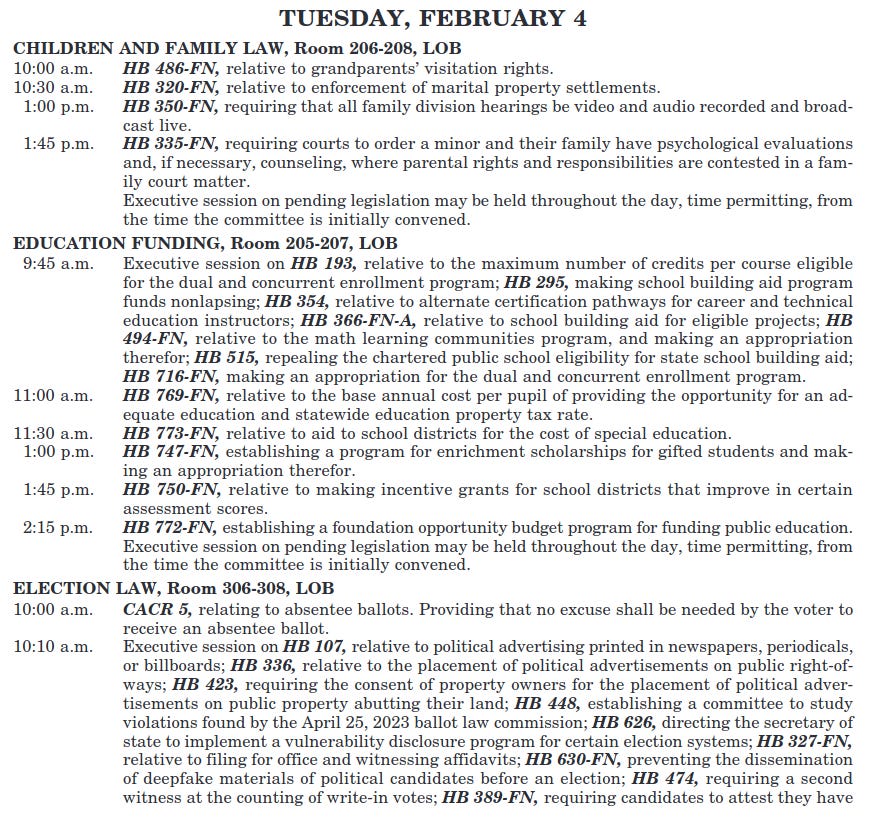
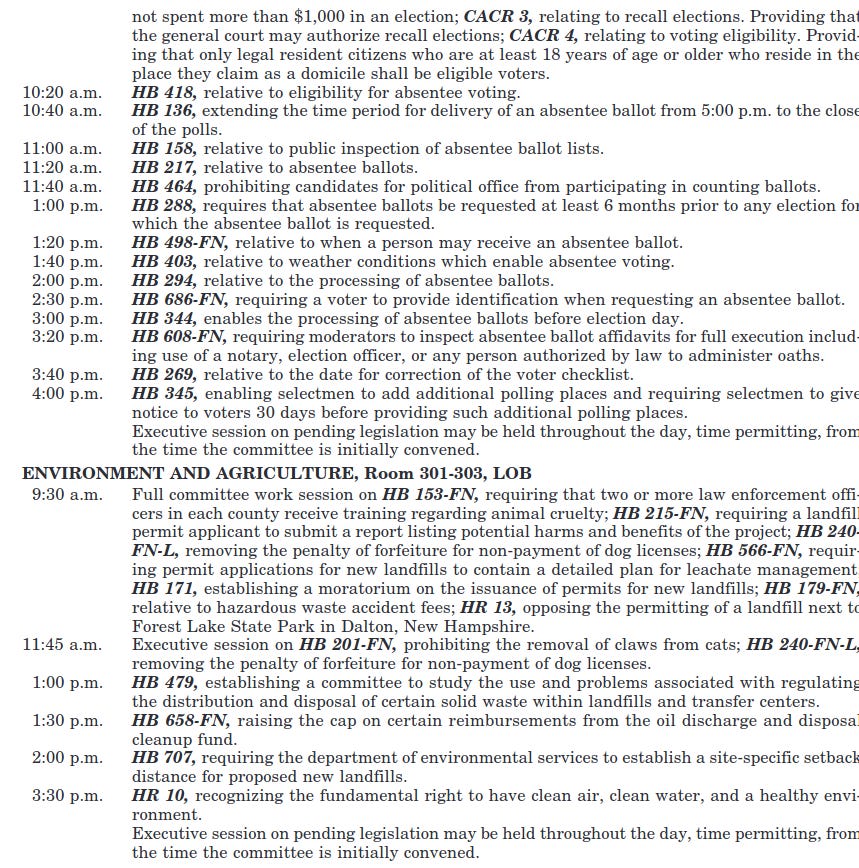
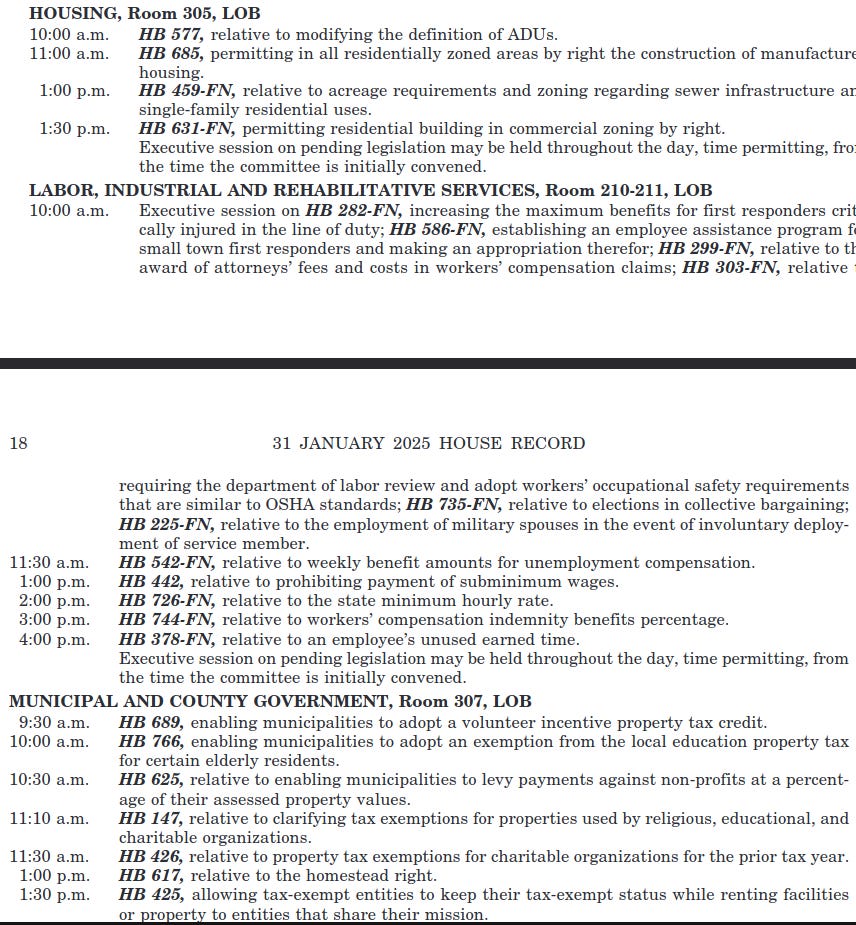
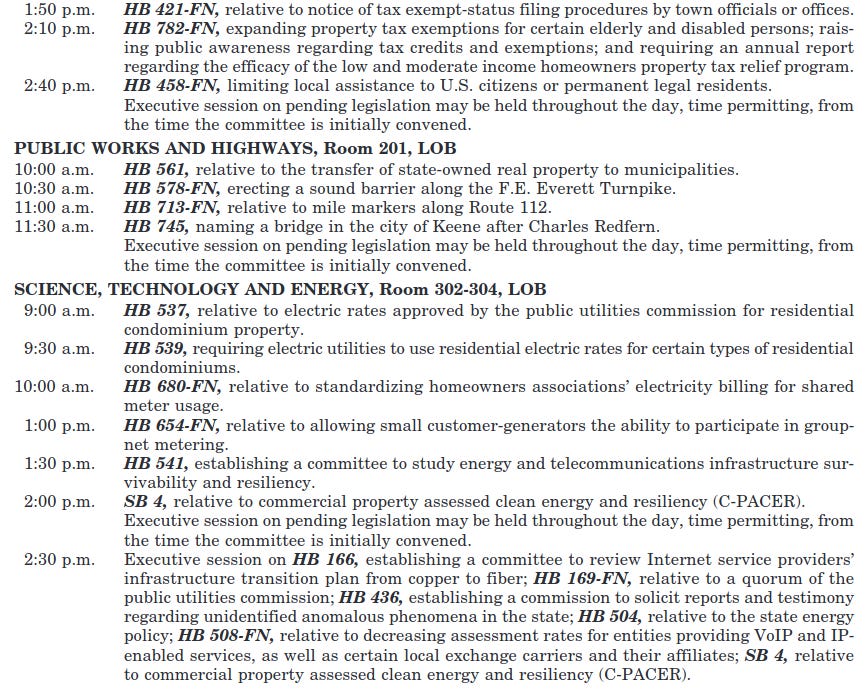
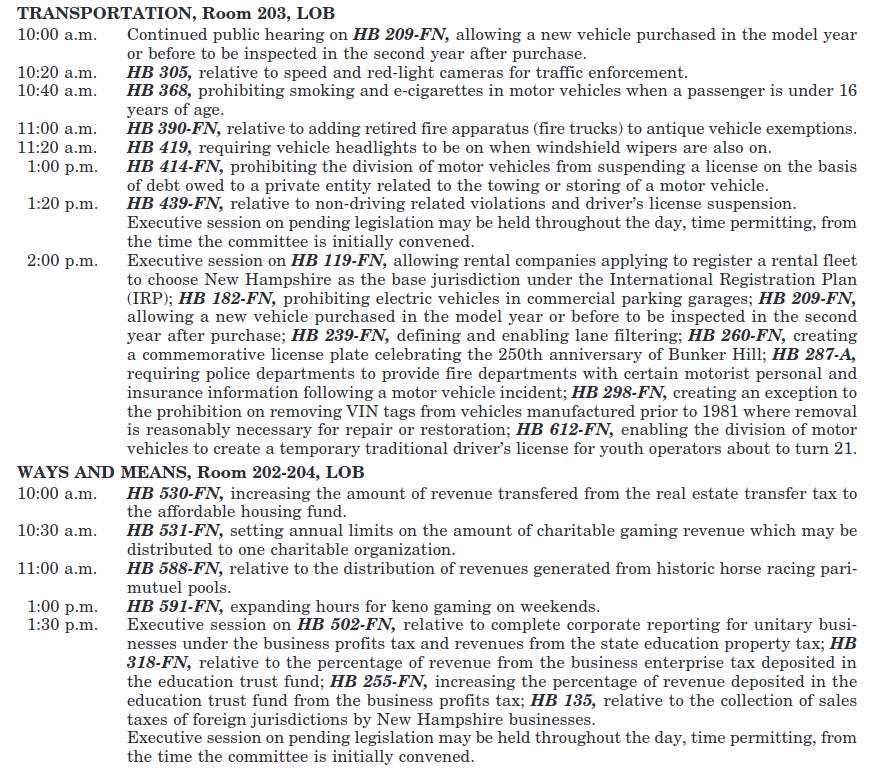
Screenshots from House Calendar
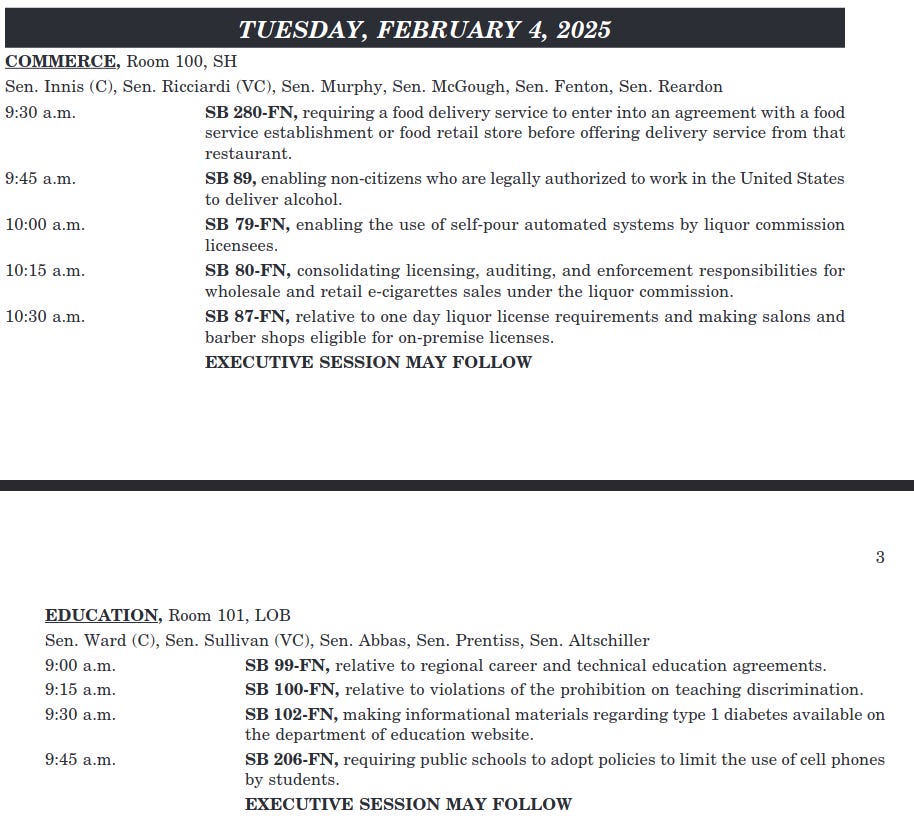
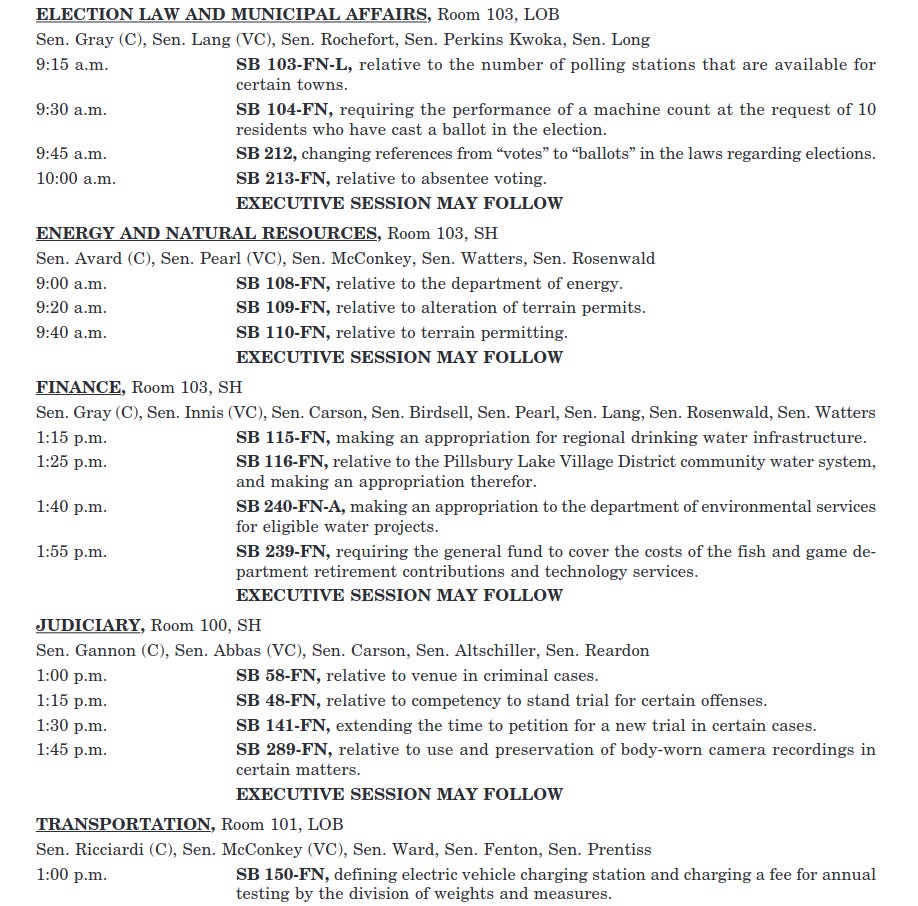
Screenshots from Senate Calendar
In-Depth Analyses - Part 1 of 2
Quick Summaries - Part 1 of 2
House Children And Family Law
HB 486-FN: Expands criteria for grandparents' visitation rights. 8 sponsors, Republican. 169 online testimonies in support, 14 in opposition.
HB 320-FN: Establishes standards for enforcing marital property settlements and divorce decrees. 5 sponsors, Republican. 2 online testimonies in support, 1 in opposition.
HB 350-FN: Requires recording and live broadcasting of family division hearings. 7 sponsors, Republican. 4 online testimonies in support, 11 in opposition.
HB 335-FN: Requires psychological evaluations in contested family court matters involving minors rejecting a parent. 8 sponsors, Republican. 4 online testimonies in support, 11 in opposition.
House Education Funding
HB 769-FN: Increases base per-pupil cost for education and sets statewide education property tax rate. 1 sponsor, Republican. 3 online testimonies in support, 10 in opposition.
HB 773-FN: Changes special education funding distribution. 1 sponsor, Republican. 3 online testimonies in support, 3 in opposition.
HB 747-FN: Establishes an enrichment scholarship program for gifted students. 7 sponsors, Republican. 5 online testimonies in support, 27 in opposition.
HB 750-FN: Creates incentive grants for school districts with improved math scores. 1 sponsor, Republican. 3 online testimonies in support, 36 in opposition.
HB 772-FN: Establishes a foundation opportunity budget program for public education funding. 3 sponsors, Democratic. 38 online testimonies in support, 7 in opposition.
House Election Law
CACR 5: Constitutional amendment for no-excuse absentee voting. 2 sponsors, Democratic. 134 online testimonies in support, 58 in opposition.
HB 418: Restricts absentee voting eligibility. 7 sponsors, Republican. 47 online testimonies in support, 937 in opposition.
HB 136: Extends absentee ballot deadline to poll closing time. 10 sponsors, Lean Democratic. 93 online testimonies in support, 51 in opposition.
HB 158: Requires public inspection of absentee ballot lists. 11 sponsors, Republican. 45 online testimonies in support, 74 in opposition.
HB 217: Requires additional documentation for absentee voter registration. 2 sponsors, Republican. 49 online testimonies in support, 461 in opposition.
HB 464: Prohibits candidates from counting ballots before elections. 2 sponsors, Democratic. 16 online testimonies in support, 9 in opposition.
HB 288: Requires absentee ballot requests 6 months prior to election. 3 sponsors, Republican. 44 online testimonies in support, 428 in opposition.
HB 498-FN: Limits absentee ballot application distribution to 45 days before election. 1 sponsor, Republican. 41 online testimonies in support, 17 in opposition.
HB 403: Expands weather-related absentee voting eligibility. 1 sponsor, Democratic. 91 online testimonies in support, 44 in opposition.
HB 294: Removes the ability for voters to postpone absentee ballot processing. 8 sponsors. 336 online testimonies in support, 48 in opposition.
HB 686-FN: Requires photo ID and notarization for absentee ballot applications. 8 sponsors, Lean Republican. 42 online testimonies in support, 427 in opposition.
HB 344: Enables absentee ballot pre-processing. 8 sponsors. 341 online testimonies in support, 48 in opposition.
HB 608-FN: Requires notarized absentee ballot affidavits. 7 sponsors, Republican. 7 online testimonies in support, 444 in opposition.
HB 269: Changes deadline for voter checklist corrections. 5 sponsors, Lean Republican. 9 online testimonies in support, 7 in opposition.
HB 345: Enables additional polling places with 30-day notice. 6 sponsors, Republican. 7 online testimonies in support, 5 in opposition.
House Environment And Agriculture
HB 479: Establishes a committee to study solid waste regulation. 3 sponsors, Democratic. 133 online testimonies in support, 3 in opposition.
HB 658-FN: Raises reimbursement cap for oil cleanup fund. 4 sponsors, Lean Democratic. 6 online testimonies in support.
HB 707: Requires site-specific setback distances for new landfills. 13 sponsors. 188 online testimonies in support, 4 in opposition.
HR 10: Resolution recognizing the right to a healthy environment. 9 sponsors, Democratic. 150 online testimonies in support, 3 in opposition.
House Housing
HB 577: Modifies definition and regulations of ADUs. 9 sponsors. 110 online testimonies in support, 45 in opposition.
HB 685: Permits manufactured housing in residential zones by right. 10 sponsors. 15 online testimonies in support, 39 in opposition.
HB 459-FN: Limits lot size requirements for single-family residential uses. 11 sponsors. 13 online testimonies in support, 46 in opposition.
HB 631-FN: Permits residential building in commercial zones by right. 10 sponsors, Lean Democratic. 35 online testimonies in support, 41 in opposition.
Screenshots from House Calendar
 |
 |
 |
 |
 |
Screenshots from Senate Calendar
 |
 |
 |
In-Depth Analyses - Part 1 of 2
House Children And Family Law
HB 486-FN
AN ACT relative to grandparents' visitation rights.
8 sponsors, Republican
Sponsor(s): (Prime) Rep. Jodi Nelson (R), Rep. Debra DeSimone (R), Rep. Kimberly Rice (R), Rep. Lisa Post (R), Rep. Sandra Panek (R), Rep. Sheila Seidel (R), Rep. Lorie Ball (R), Rep. Jay Markell (R)
Selected quote(s) from the bill:
1 Grandparent Visitation; Criteria. Amend RSA 461-A:13 to read as follows:
461-A:13 Grandparents' Visitation Rights.
…
(c) The nature of the relationship between the grandparent and the minor child, including but not limited to, the frequency of contact, and whether the child has lived with the grandparent [and length of time of such residence] for at least 6 months with or without the parent, or the grandparent acted as a primary caretaker of the child for at least 6 months, or the grandparent previously had regular visitation with the child for at least 12 months, and when there is no reasonable cause to believe that the child's physical and emotional health would be endangered by such visitation or lack of it.
…
(e) The circumstances which resulted in the absence of a nuclear family, [whether] including divorce, death, separate parental living arrangements, inability to determine the whereabouts of one or both parents, relinquishment or termination of parental rights, or other cause.
…
V. Upon the motion of any original party, the court may modify or terminate any order made pursuant to this section to reflect changed circumstances of the parties involved. Changed circumstances shall not include changes in frequency of contact due to a parent’s noncompliance with a prior grandparent's visitation order.
Summary:
This bill expands the criteria a court considers when determining grandparent visitation rights, including adding separate parental living arrangements and the grandparent's role as primary caretaker to the list of factors.
Argument For:
This bill ensures that grandparents who have played significant roles in their grandchildren's lives, such as acting as primary caretakers or maintaining consistent contact, are not unjustly denied visitation due to technicalities. The updated criteria recognize the evolving nature of families and the importance of maintaining strong grandparent-grandchild relationships. Children benefit greatly from the love and support extended family provides, and this bill ensures their access to that support, even in non-traditional family structures.
Argument Against:
This bill potentially infringes on parents' fundamental rights to raise their children as they see fit, which should be the primary consideration in visitation disputes. Expanding the criteria for grandparent visitation could lead to increased court battles and conflict within families, ultimately harming the children involved. The bill may also place undue burden on the courts to navigate complex family dynamics, potentially causing delays in resolving custody and visitation matters.
Online Testimony
Currently, 169 people support and 14 people oppose the bill. 92% support of 183 people
Support
As a grandparent actively involved in my grandson's life for 5 years and now have very limited access, I support this bill. ... Now the father is fighting for custody and we are no longer given time with our grandson Alex. ... I believe this is not fair to Alex as he always looked forward to our time
—MaryShannon Braswell, of Manchester
I support HB 486. ... Grandparents should always have the right to petition the court for visitations. ... New legislation for grandparent visitation is definitely needed in today’s society to protect it. ... Unfortunately, a lot of parents use these children as pawns and weapons against their parents.
I am a grandparent that doesn’t want to have my grandchildren taken away from their grandparents. ... We will also be a casualty of that relationship ending because she will be vindictive. ... She will take it out on his entire family. ... We want to keep that relationship going.
Grandparents are being leaned upon more and more these days to provide for their grandchildren. ... There should be no restriction on visitation unless it is duly deemed that it would be a detriment to the child. ... Many are being harmed by adult children who are not being truthful. ... It is not acceptable to these precious children who are innocent and love their grandparents.
The children should not be alienated from their grandparents because of the actions and animosity of the parents, no matter what the parents marital situation is. Children deserve as much love and family they can be exposed to, for growth and family values.
I have had personal family experience with regard to this need for grandparents rights. Grandparents provide another layer of support for the children. This bill is needed for our state to project and nurture the children. This also preserves and respects the active positive influence grandparents can have in the children’s lives. I urge you to vote in favor of this bill.
I support this bill. ... It shouldn’t matter if the parents are now married, separated, or divorced all grandparents should have rights. ... Many grandparents take on a nurturing role, providing care, comfort, and attention. ... What is a nuclear family in today’s society?
I support this bill 100%. ... Grandparents play a vital role in their grandchildren’s lives. ... You could tell that these girls were thriving and happy in her care. ... This is just so heartbreaking. Please pass this law, allowing grandparents visitations and rights whether the parents are married, separated, or divorced.
—Jacqueline Duhamel, of Manchester
I believe all grandparents should be able to see their grandchildren, even if the parent of the grandchildren don’t have a good relationship with their parents. Especially if they did in the past, but due to addiction the situation changed the relationship. This is not healthy for the grandchildren, they need their grandparents
—Deborah Cameron, of Litchfield
I support this bill 100%. ... The Way the language is in the RSA about the nuclear family and the parents can restrict for any reason. ... Grandparents should have rights to see their grandchildren whether the parents are married, divorced or separated. ... What about the children’s rights and the right to continue to have a healthy loving relationship with their grandparents and extended family?
Opposition
Natural parents of their children shall remain in the upmost decision when visitation is denied. ... Parents shall remain the ultimate authority over their children. ... Formal testimony should hold upmost importance in regard to the child’s best interest. ... It is imperative for parents to maintain authority over the contact of any adult.
—Shelbie Anderson, of Manchester
I support a parents fundamental right to raise and deem what’s in the child’s best interest wether grandparent visitation is allowed, over all. Nh supreme court has spoken and been heard and respect the parents at the upmost. A parents fundamental rights above all else should always come first. Especially when the child refuses contact with the grandparents. I oppose this bill.
—Brandon Davolio, of Methuen, MA
I believe parental rights should supercede those of other (non parent) relatives, especially when children are safe and well cared for with all their needs provided for.
—Anthony Elkins, of Westbrook, ME
I oppose this bill for the simple fact that this particular bill is being raised due to a citizen disgruntled by decision made by a court ordained official. ... The individual who raised this bill has been misleading by withholding details to the public. ... I cannot in good conscious support this bill. ... The individual who materialized this bill is simply trying to manipulate the system.
—Javier Torres, of Greencastle, PA
This bill is clearly brought forward by an individual who has supporting votes by all her personal family and friends. ... It does not take into consideration a natural parent's fundamental rights, nor the best interest of a child. ... Disregarding the parents' rights to raise her children. ... This bill is disingenuous and concerning for all parents.
—Christine O’Brien, of Manchester
The parents should have a say. If the parent wanted their own parents to see them, they would bring them. As long as their isn’t a death, this is only in the case of separation or divorce- so that parent could visit with the grandparents on their own time. Grandparents should not have rights, parents do what is best for their own children- just because you are blood , doesn’t mean you get a say.
I thought NH supported “PARENTS RIGHTS.” ... A parent should have a right to decide what visitation their parents have with THEIR children. ... How dare the state decide that it can override the parents’ rights. ... I guess I shouldn’t be surprised that y’all don’t care about anyone’s consent.
Hearing: Tuesday, Feb 04 at 10:00 a.m. in Room 206-208 in the Legislative Office Building and streaming on YouTube.
HB 320-FN
AN ACT relative to enforcement of marital property settlements.
5 sponsors, Republican
Sponsor(s): (Prime) Rep. Jay Markell (R), Rep. Debra DeSimone (R), Rep. Mark Pearson (R), Rep. JD Bernardy (R), Rep. Lilli Walsh (R)
Selected quote(s) from the bill:
1 New Section; Annulment, Divorce, and Separation; Enforcement; Defense. Amend RSA 458 by inserting after section 51 the following new section:
458:51-a Enforcement; Defense.
I. Upon motion or petition by a party for enforcement of a final property settlement or decree of divorce, or for contempt related to any proceeding under this chapter, the court shall enforce such settlement or decree according to its terms, unless the settlement or decree or relevant part thereof, is shown to be invalid due to fraud, duress, deceit, impossibility, misrepresentation, mutual mistake, undue influence, or subsequent illegality by a preponderance of the evidence.
II. In the enforcement of any such final decree, the court shall fashion remedies that place the parties in the position as if the decree had been fully performed according to its terms.
III. This section shall apply to any motion or petition filed after the effective date of this section, regardless of when the underlying settlement or decree was entered.
Summary:
This bill establishes standards for enforcing a property settlement or divorce decree, allowing respondents to argue that specific terms are invalid due to fraud, duress, misrepresentation, or other legal defects.
Potential Argument For:
This bill ensures that property settlements and divorce decrees are enforced fairly by allowing individuals to challenge terms that may have been agreed upon under fraudulent or coercive circumstances.
Potential Argument Against:
This bill could increase litigation costs and prolong divorce and property settlement disputes by encouraging more challenges to finalized agreements.
Online Testimony
Currently, 2 people support and 1 people oppose the bill. 67% support of 3 people
Hearing: Tuesday, Feb 04 at 10:30 a.m. in Room 206-208 in the Legislative Office Building and streaming on YouTube.
HB 350-FN
AN ACT requiring that all family division hearings be video and audio recorded and broadcast live.
7 sponsors, Republican
Sponsor(s): (Prime) Rep. Lisa Post (R), Rep. Jess Edwards (R), Rep. David Love (R), Rep. Erica Layon (R), Rep. Cyril Aures (R), Rep. Kristine Perez (R), Rep. Susan DeRoy (R)
Selected quote(s) from the bill:
1 New Section; Recording and Broadcasting Proceedings. Amend RSA 490-D by inserting after section 490-D:15 the following new section:
490-D:16 Recording and Broadcasting Family Division Proceedings.
I.(a) All family division proceedings shall be audio and video recorded by the family division. The recording shall include audio and video of all courtroom proceedings.
Summary:
This bill requires the family division to audio and video record all proceedings and broadcast live proceedings upon request of named parties or their representatives, unless the opposing party demonstrates that doing so would cause specific irreparable harm.
Argument For:
This bill enhances transparency and accountability in family court proceedings by ensuring that all cases are recorded and, when requested, broadcast live, providing greater public oversight and protection for litigants. Increased accessibility to court proceedings can help prevent judicial misconduct and ensure fairness in the legal process.
Argument Against:
This bill threatens the privacy and well-being of children and vulnerable individuals by making highly personal family court proceedings public, potentially exposing sensitive details to widespread dissemination. The NH Office of the Child Advocate warns that it could enable abusers to further harass their victims by requesting live broadcasts, causing unnecessary trauma. Additionally, the financial burden of implementing and maintaining video recording and live-streaming technology would be substantial, with costs estimated in the hundreds of thousands of dollars annually.
Online Testimony
Currently, 4 people support and 11 people oppose the bill. 73% oppose of 15 people
Support
This is necessary for the protection of the citizens of New Hampshire and for transparency
—KRISTINE PEREZ, of Londonderry who is, An Elected Official
Opposition
The internet is forever & the children involved in these cases deserve privacy. This is simply to intimidate witnesses who would testify. Especially the kids. This is abuse proposed by abusers. This is just more of abusers trying to use the family law court system to further abuse their victims. We see you.
The NH Office of the Child Advocate has concerns about HB350 requiring that all family division hearings be video and audio recorded and broadcast live. ... This bill would significantly impact the privacy of minors, without any regard to the potential harm to children. ... Divorce and parenting proceedings can be extremely high conflict and traumatic. ... Adding video recording would be a substantial cost to the system, for little benefit.
—Lissa Mascio, of Concord who is State Agency Staff, representing NH Office of the Child Advocate
Hearing: Tuesday, Feb 04 at 1:00 p.m. in Room 206-208 in the Legislative Office Building and streaming on YouTube.
HB 335-FN
AN ACT requiring courts to order a minor and their family have psychological evaluations and, if necessary, counseling, where parental rights and responsibilities are contested in a family court matter.
8 sponsors, Republican
Sponsor(s): (Prime) Rep. Lisa Post (R), Rep. John Potucek (R), Rep. Jodi Nelson (R), Rep. Sandra Panek (R), Rep. Yury Polozov (R), Rep. Kristine Perez (R), Rep. Daniel Popovici-Muller (R), Rep. Lorie Ball (R)
Selected quote(s) from the bill:
1 New Subparagraph; Required Risk Assessment. Amend RSA 461-A:4, II by inserting after subparagraph (h) the following new subparagraph:
(i) Court-ordered risk assessments.
2 New Section; Court-Ordered Risk Assessments. Amend RSA 461-A by inserting after section 6 the following new section:
461-A:6-a Court-Ordered Risk Assessments.
I. In contested divorce proceedings where a minor child under the age of 18 years rejects or is being withheld from a parent, the court shall order a risk assessment within 14 days of the initial petition for divorce, the cost of which shall be borne equally by the parties. The risk assessment shall be performed by a clinical psychologist credentialed in scientific research of and applied knowledge in the following areas:
(a) Family systems therapy to assess family conflict.
(b) Attachment pathology to assess a child rejecting a parent.
(c) Trauma pathology to assess possible child abuse or spousal abuse.
(d) Personality pathology to assess possible narcissistic-borderline-dark personality pathology.
(e) Child development to assess childhood pathology across multiple child developmental levels.
(f) Self-psychology to assess psychological development of children within the parent-child relationships.
II. A risk assessment order shall include the following constructs to be evaluated:
(a) A possible shared shared/induced persecutory delusion.
(b) A possible factitious attachment pathology being imposed on the child for secondary gain to the parent.
(c) A possible psychological child abuse.
(d) A parent-child relational problem.
(e) A child affected by parental relationship distress.
(f) Identity disturbance due to prolonged and intense coercive persuasion.
(g) Possible spousal psychological abuse of one parent using the child’s induced pathology as the spousal abuse weapon.
Summary:
This bill requires courts to order a risk assessment and, if necessary, counseling in contested family court cases where a minor child rejects or is withheld from a parent.
Argument For:
This bill ensures the protection of families and transparency in family court proceedings by mandating a psychological evaluation in cases where a child is rejecting or being withheld from a parent. By requiring assessments from qualified clinical psychologists, it aims to uncover underlying issues such as parental alienation, abuse, or personality disorders that could be affecting the child's well-being.
Argument Against:
This bill mandates psychological evaluations for entire families in contested custody cases, even though judges already have the discretion to order such assessments when necessary. It risks subjecting children to unnecessary and potentially traumatic evaluations, especially in cases where rejection of a parent may stem from abuse. The Office of the Child Advocate has raised concerns that the bill's language and diagnostic criteria rely on questionable science, could stigmatize children with unrecognized diagnoses, and may serve the interests of one parent rather than the best interests of the child. Additionally, New Hampshire's ongoing shortage of mental health providers could make it difficult for families to comply with the law, further complicating custody disputes.
Online Testimony
Currently, 4 people support and 11 people oppose the bill. 73% oppose of 15 people
Support
This is necessary for the protection of the citizens of New Hampshire and for transparency
—KRISTINE PEREZ, of Londonderry who is, An Elected Official
Opposition
Why do we need a law that mandates a whole entire family submit to psychiatric services when a family law judge could just order that anyway? What happens when people don’t have Medicaid anymore, or even when they have the best insurance but they can’t get into a therapist in New Hampshire because we’ve had mental health crisis levels of provider shortages in this state for decades?
This bill does not appear to be for the advancement of the best interest of children. ... "Rejection" or "withholding" could be indicators of physical or sexual abuse, or psychological maltreatment. ... Such an "evaluation" may not be appropriate or therapeutic for the child, as it could cause additional trauma. ... Much of the language of this bill is incredibly concerning, such as: "narcissistic-borderline-dark personality pathology," "shared/induced persecutory delusion," and "factitious attachment pathology."
—Lissa Mascio, of Concord who is State Agency Staff, representing NH Office of the Child Advocate
Hearing: Tuesday, Feb 04 at 1:45 p.m. in Room 206-208 in the Legislative Office Building and streaming on YouTube.
House Education Funding
HB 769-FN
AN ACT relative to the base annual cost per pupil of providing the opportunity for an adequate education and statewide education property tax rate.
1 sponsor, Republican
Sponsor(s): (Prime) Rep. Linda Gould (R)
Selected quote(s) from the bill:
1 Cost of an Opportunity for an Adequate Education. Amend RSA 198:40-a, I-II(a) to read as follows:
I. For the biennium beginning July 1, [2023] 2025, the annual cost of providing the opportunity for an adequate education as defined in RSA 193-E:2-a shall be as specified in paragraph II. The department shall adjust the rates specified in this paragraph in accordance with RSA 198:40-d.
II.(a) A cost of [$4,100] $7,356.01 per pupil in the ADMR, plus differentiated aid as follows:
76:3 Education Tax. Beginning July 1, [2005] 2025, and every fiscal year thereafter, [the commissioner of the department of revenue administration shall set] the education tax rate [at a level sufficient to generate revenue of $363,000,000 when] shall be set at $2.50 per $1,000 and imposed on all persons and property taxable pursuant to RSA 76:8, except property subject to tax under RSA 82 and RSA 83-F. [The education property tax rate shall be effective for the following fiscal year. The rate shall be set to the nearest 1/2 cent necessary to generate the revenue required in this section.]
2 Effective Date. This act shall take effect July 1, 2025.
Summary:
This bill increases the base per-pupil cost for an adequate education from $4,100 to $7,356.01 and sets the statewide education property tax rate at $2.50 per $1,000 of assessed property value.
Potential Argument For:
This bill significantly increases funding for public education, ensuring that schools have more resources to provide students with a higher quality education.
Argument Against:
This bill increases education funding without safeguards to ensure that taxpayer money remains within public schools, potentially accelerating the diversion of public funds to voucher programs and charter schools that lack transparency and accountability. By adjusting the statewide education property tax rate, it may also place an increased financial burden on taxpayers without guaranteeing that additional funding will benefit the majority of students in traditional public schools.
Online Testimony
Currently, 3 people support and 10 people oppose the bill. 77% oppose of 13 people
Opposition
This bill fails to ensure that additional taxpayer dollars will remain in public schools, where they are most needed. ... Without explicit safeguards, HB 769 could accelerate this trend, diverting vital resources from local districts. ... The lack of oversight in these programs means that taxpayer money can flow to institutions that are not held to the same academic and ethical standards. ... Instead of opening the door to more privatization, we should be focusing on policies that invest directly in our public school districts.
Hearing: Tuesday, Feb 04 at 11:00 a.m. in Room 205-207 in the Legislative Office Building and streaming on YouTube.
HB 773-FN
AN ACT relative to aid to school districts for the cost of special education.
1 sponsor, Republican
Sponsor(s): (Prime) Rep. Rick Ladd (R)
Selected quote(s) from the bill:
1 Education; Special Education; State Aid. Amend RSA 186-C:18, III(a)-(b) to read as follows:
III.(a) The state board of education through the commissioner, department of education, shall distribute aid available under this paragraph as entitlement to such school districts as have a special education pupil for whose costs they are responsible, for whom the costs of special education in the fiscal year exceed 3 and 1/2 times the estimated state average expenditure per pupil for the school year preceding the year of distribution. [If in any year, the amount appropriated for distribution as special education aid in accordance with this section is insufficient therefor, the appropriation shall be prorated proportionally based on entitlement among the districts entitled to a grant.] …
(b) The school district shall be liable for 3 and 1/2 times the estimated state average expenditure per pupil for the school year preceding the year of distribution, plus 20 percent of the additional cost, up to 10 times the estimated state average expenditure per pupil for the school year preceding the year of distribution. The department of education shall distribute to the school district not less than 85 percent of the district’s entitlement for catastrophic aid costs in the fiscal year.
Summary:
This bill removes the requirement that catastrophic special education funds be prorated among school districts and mandates that at least 85% of a district’s entitlement for catastrophic aid costs be disbursed in a fiscal year.
Potential Argument For:
This bill ensures that school districts receive a more predictable and stable amount of catastrophic special education funding, reducing financial uncertainty and helping schools better support students with significant needs.
Potential Argument Against:
This bill increases state education expenditures without identifying a funding source, potentially creating budget shortfalls or requiring cuts to other educational programs.
Online Testimony
Currently, 3 people support and 3 people oppose the bill. 50% support of 6 people
Hearing: Tuesday, Feb 04 at 11:30 a.m. in Room 205-207 in the Legislative Office Building and streaming on YouTube.
HB 747-FN
AN ACT establishing a program for enrichment scholarships for gifted students and making an appropriation therefor.
7 sponsors, Republican
Sponsor(s): (Prime) Rep. Glenn Cordelli (R), Rep. Gregory Hill (R), Rep. Maureen Mooney (R), Rep. Paul Terry (R), Rep. Kristin Noble (R), Rep. Daniel Popovici-Muller (R), Sen. Ruth Ward (R)
Selected quote(s) from the bill:
1 New Chapter; Enrichment Scholarships. Amend RSA by inserting after chapter 194-F the following new chapter:
CHAPTER 194-G
ENRICHMENT SCHOLARSHIPS
…
194-G:2 Program.
I. There is established in the department a program for enrichment scholarships to be awarded to gifted students pursuant to this chapter.
II. Scholarships of up to $1,000 annually shall be awarded by the department to eligible students.
III. Parents of a program student shall use the funds deposited in their student's account only for the following qualifying expenses:
(a) Fees for transportation paid to a fee-for-service transportation provider for the student to travel to and from a scholarship service provider.
(b) Tuition and fees for online learning programs.
(c) Tutoring services provided by an individual or a tutoring facility.
(d) Tuition for individual classes and curricular activities and programs at a district public school, chartered public school, public academy, or independent school.
(e) Textbooks, curriculum, or other instructional materials, including, but not limited to, any supplemental materials or associated online instruction required by either a curriculum or a scholarship service provider.
(f) Computer hardware, Internet connectivity, or other technological services and devices, that are primarily used to help meet the student's educational needs.
(g) Educational software and applications.
(h) Tuition and fees for summer education programs and specialized education programs.
(i) Educational services and therapies, including, but not limited to, occupational, behavioral, physical, speech-language, and audiology therapies.
(j) Any other educational expense approved by the department.
IV. Scholarship funds shall not be refunded, rebated, or shared with a parent or student in any manner. Any refund or rebate for goods or services purchased with scholarship funds shall be refunded to the department.
V. Parents may make payments for the costs of educational goods and services not covered by the scholarship funds.
VI. Funds deposited in a scholarship account shall not constitute taxable income to the parent or student.
…
3 Department of Education; Enrichment Scholarship; New Position and Contracted Services; Appropriation.
I. The sum of $115,000 for the fiscal year ending June 30, 2026 is hereby appropriated to the department of education, division of education analytics and resources, for the enrichment scholarship program position established in RSA 21-N:7-b.
II. The sum of $75,000 for the fiscal year ending June 30, 2026 is hereby appropriated for contracted services to aid in the eligibility determination process and provision of scholarships. The governor is authorized to draw a warrant for said sum out of any money in the treasury not otherwise appropriated.
4 Department of Education; Enrichment Scholarship; Appropriation. There is appropriated the sum of $1,000,000 to the department of education for the enrichment scholarship program for the fiscal year ending June 30, 2026 and the sum of $1,000,000 to department of education for the enrichment scholarship program for the fiscal year ending June 30, 2027 for the payments of scholarships awarded by the department pursuant to RSA 194-G. The governor is authorized to draw a warrant for said sum out of any money in the treasury not otherwise appropriated.
5 Effective Date. This act shall take effect July 1, 2025.
Summary:
This bill creates an enrichment scholarship program for gifted students, providing up to $1,000 annually to pay for qualifying education expenses such as tutoring, summer programs, and educational materials.
Potential Argument For:
This bill expands educational opportunities for gifted students by providing financial support for specialized programs and resources that enhance their learning experiences.
Argument Against:
This bill diverts public funds from the existing education system instead of addressing long-standing issues with school funding, particularly the reliance on property taxes, which places an unfair burden on property owners.
Online Testimony
Currently, 5 people support and 27 people oppose the bill. 84% oppose of 32 people
Opposition
Why not fix the public school money that is funded with property taxes. For years it has been a burden on the property owners yet the powers that be refuse to fix the issue. Enough of siphoning off money for public schools.
Hearing: Tuesday, Feb 04 at 1:00 p.m. in Room 205-207 in the Legislative Office Building and streaming on YouTube.
HB 750-FN
AN ACT relative to making incentive grants for school districts that improve in certain assessment scores.
1 sponsor, Republican
Sponsor(s): (Prime) Rep. Michael Moffett (R)
Selected quote(s) from the bill:
1 New Section; Education Achievement Incentive Grants. Amend RSA 193-C by inserting after section 12 the following new section:
193-C:13 Education Achievement Incentive Grants.
I. The sum of $1,000,000 is appropriated for the fiscal year ending June 30, 2026 to the department of education from the education trust fund established under RSA 198:39 for the purpose of rewarding school districts which demonstrate measurable improvement regarding designated standardized mathematics test scores. The governor is authorized to draw a warrant from the education trust fund to satisfy the state's obligation under this section.
II. The commissioner of the department of education shall award amounts not to exceed $50,000 to school districts which document improvements to student performance in mathematics test scores on the statewide education improvement and assessment program under RSA 193-C:6. The department shall determine criteria to qualify for awards to take into account differences such as grade level, school size, and other applicable data.
III. The funds for incentive grants shall not lapse and shall remain under the administration of the department until such time as funds are awarded. If more than 20 districts qualify in the first year, then the awards will be prorated by dividing the fund total by the number of qualifying districts. After the initial year, awards of $50,000 shall be made to districts in the order that they document qualifying data, until such time as the fund is exhausted.
IV. The commissioner of the department of education shall communicate with school districts and shall adopt such administrative arrangements under RSA 541-A as necessary to implement this section.
Summary:
This bill transfers $1,000,000 from the education trust fund to the Department of Education for the commissioner to award grants of up to $50,000 to school districts that show measurable improvements in standardized mathematics test scores.
Potential Argument For:
This bill incentivizes school districts to focus on improving mathematics education by offering financial rewards for measurable student progress, encouraging better instructional strategies and resource allocation.
Potential Argument Against:
This bill diverts funds from the education trust fund for competitive grants, which may disproportionately benefit wealthier districts with more resources to improve test scores, rather than addressing systemic issues in underperforming schools.
Online Testimony
Currently, 3 people support and 36 people oppose the bill. 92% oppose of 39 people
Hearing: Tuesday, Feb 04 at 1:45 p.m. in Room 205-207 in the Legislative Office Building and streaming on YouTube.
HB 772-FN
AN ACT establishing a foundation opportunity budget program for funding public education.
3 sponsors, Democratic
Sponsor(s): (Prime) Rep. David Luneau (D), Rep. Dick Ames (D), Rep. Hope Damon (D)
Selected quote(s) from the bill:
2 Definition of Adequate Education. RSA 193-E:2-a is repealed and reenacted to read as follows:
193-E:2-a Definition of a Constitutionally Adequate Education; Statewide Public Education Opportunity Goal.
I. The general court determines that a constitutionally adequate education is defined, with respect to each local school district, as a public education that provides students in the district with an opportunity to achieve the statewide public education opportunity goal.
II.(a) Beginning in the school year 2024-2025, and for each year thereafter, the specific criteria and substantive educational program that deliver the opportunity for an adequate education shall be defined and identified as the school approval standards in the following learning areas:
(1) English/language arts and reading.
(2) Mathematics.
(3) Science.
(4) Social studies, including civics, government, economics, geography, history, and Holocaust and genocide education.
(5) Arts education, including music and visual arts.
(6) World languages.
(7) Health and wellness education, including a policy for violations of RSA 126-K:8, I(a).
(8) Physical education.
(9) Engineering and technologies including technology applications.
(10) Personal finance literacy.
(11) Computer science.
(b) Teachers shall use academic and applied instruction to teach the learning areas under subparagraph (a). The following skills shall be integrated into the learning areas:
(1) Computer use and digital literacy.
(2) Logic and rhetoric.
…
10 Data Related to Provision of Public Education. Amend the section heading of RSA 193-E:3 and RSA 193-E:3, I to read as follows:
193-E:3 Delivery of Data Related to Provision of Public [an Adequate] Education.
I. Annually, each school district shall report data to the department of education at the school and district levels on the indicators set forth in this paragraph. …Indicators shall include the following areas:
(a) Enrollment, average daily membership in attendance, and attendance rates [Attendance rates].
…
(m) Career and technical education participation rates. [Expulsion and suspension rates, including in-school and out-of-school suspensions including data identifying the percentage of out-of-school suspensions of more than 10 days for each school year. This indicator shall be categorized by district, school, and grade level with each category disaggregated and broken down by gender, race, IEP, and eligibility for free and reduced-price meal programs.]
…
(o) The number and percentage of graduating high school students provided in-person school assistance in completing a free application for federal student aid (FAFSA) form.
(p) Access to community or school-based early childhood education programs.
(q) Progress toward competency-based student experiences that emphasize work-study practices and community-based learning (such as extended learning opportunities).
(r) Implementation of structural reforms to achieve greater efficiency and effectiveness related to school or district size, technology-mediated instruction, and cross-district collaboration.
(s) An outline of the curriculum and graduation requirements of the district.
(t) Pupil/teacher ratios and class size policy and practices.
(u) Teacher and administrator evaluation procedures.
(v) Statistics, policies, and procedures relative to truancy and dropouts.
(w) Statistics, policies, and procedures relative to expulsions and in-school and out-of-school suspensions, and suspensions of more than 10 days. These data shall be categorized by district, school, and grade level with each category disaggregated and broken down by gender, race, IEP, and eligibility for free and reduced-price meal programs.
(x) Number of school-age children attending public schools, private schools, homeschools, dual enrollment with a community college, alternative schools, and EFA students.
(y) Racial composition of teaching and administrative staff.
(z) Art and music programs.
(aa) Technology education.
(bb) Programs to encourage and improve student effort and growth.
(cc) Adult education programs.
(dd) Library and media facilities.
(ee) Condition of instructional materials including textbooks, workbooks, audio-visual materials, and laboratory materials.
(ff) Types and condition of computers and computer software.
(gg) Basic skills remediation programs.
(hh) Drug, tobacco, and alcohol abuse programs.
(ii) Multi-cultural education training for students and teachers.
(jj) Global education.
(kk) Nutrition and wellness programs.
Summary:
This bill establishes a new system for determining and funding a constitutionally adequate education in New Hampshire by implementing foundation opportunity budgets and state foundation opportunity grants to ensure equitable distribution of education funding.
Argument For:
This bill ensures that all students in New Hampshire, regardless of where they live, receive the opportunity for a constitutionally adequate education by addressing disparities in school funding. By implementing foundation opportunity budgets and state foundation opportunity grants, it creates a fairer system where funding is based on student needs rather than local property values. Supporters argue that this shift will provide underfunded districts with the resources necessary for smaller class sizes, modern instructional materials, and stronger support services, helping to level the playing field for students across the state.
Argument Against:
This bill continues the failed approach of attempting to centrally manage education funding through bureaucratic formulas, which critics argue results in inefficiencies and inconsistent outcomes. Opponents contend that instead of increasing government control, the state should prioritize parental choice in education, allowing funding to follow students rather than being dictated by complex state-driven funding mechanisms. They argue that such a system burdens taxpayers while benefiting government jobs and union pensions rather than improving student outcomes.
Online Testimony
Currently, 38 people support and 7 people oppose the bill. 84% support of 45 people
Support
This bill acknowledges the disparities in educational resources across school districts and seeks to address them by establishing a foundation opportunity budget program and state foundation opportunity grants. ... A well-structured foundation opportunity budget has the potential to reduce these inequities, ensuring that every child has access to high-quality instruction. ... If implemented thoughtfully, this bill can be a transformative step toward educational equity in New Hampshire.
This is a step in the right direction for our local taxpayers. The state must foot more of the bill for education costs -- towns are not equal but the state is acting like they are. Just because a school district is lucky enough to have lakefront or mountainside property (high-value) should not mean that the districts who have steep slopes and swamps in their land should have to pay more for their education.
Opposition
Saying the state has a constitutional obligation is virtue signaling in extreme. ... Micro-managing education markets by vague equity sentiment fails constitutional and rational muster. ... The only folks who benefit are the thousands of government jobs required to manage it, and the union pension fund. ... Let freedom ring!
Hearing: Tuesday, Feb 04 at 2:15 p.m. in Room 205-207 in the Legislative Office Building and streaming on YouTube.
House Election Law
CACR 5
CONCURRENT RESOLUTION PROPOSING CONSTITUTIONAL AMENDMENT
RELATING TO: absentee ballots.
PROVIDING THAT: no excuse shall be needed by the voter to receive an absentee ballot.
2 sponsors, Democratic
Sponsor(s): (Prime) Rep. Connie Lane (D), Sen. Rebecca Perkins Kwoka (D)
Selected quote(s) from the bill:
I. That article 11 of the first part of the constitution be amended to read as follows:
[Art.] 11 [Elections and Elective Franchises.] … The general court shall provide by law for voting by qualified voters who at the time of the biennial or state elections, or of the primary elections therefor, or of city elections, or of town elections by official ballot, [are absent from the city or town of which they are inhabitants, or who by reason of physical disability are unable to vote in person,] want to vote by absentee ballot for any reason in the choice of any officer or officers to be elected or upon any question submitted at such election. …
Summary:
This bill amends the New Hampshire Constitution to allow absentee voting for any reason.
Argument For:
This bill modernizes New Hampshire's election process by recognizing that many voters face obstacles to in-person voting, whether due to work schedules, health concerns, or other personal circumstances. It eliminates the need for voters to justify their request for an absentee ballot, ensuring that no one is forced to choose between voting and their personal responsibilities. By making absentee voting accessible to all, it increases voter participation and enhances trust in the electoral system.
Argument Against:
This bill weakens election security by removing accountability in the absentee ballot process, increasing the risk of voter fraud and administrative burdens for election officials. The right to vote is fundamental, but it should not be treated as a matter of convenience, and in-person voting remains the best way to ensure election integrity. Expanding absentee voting beyond those with legitimate needs undermines public confidence in the election system and invites unnecessary vulnerabilities.
Online Testimony
Currently, 134 people support and 58 people oppose the bill. 70% support of 192 people
Support
I'm testifying in support of CACR5. This bill would allow more people to vote, making our state decision-making representative of the views of the populace.
Voting by absentee ballot is convenient and can increase participation among groups of voters. As an older person, I would like the opportunity to use an absentee ballot to avoid germs and crowds, and to avoid weather. Please consider this legislation.
Allowing all NH voters to cast a ballot by absentee makes voting more accessible to all registered voters!
—Virginia Schonwald, of Barrington who is, An Elected Official
I believe more peoplewojld vote if the option of absentee ballots was available to them, specifically if they were provided as a general rule rather than needing to be requested.
I do support Absentee Ballots for all who seek them.(Supporting democracy with a capital "D."
—William Thomas, of Manchester
As someone who lives remotely a couple of months per year, I want to know that I can always vote! I’m normally at my home in Greenland,NH, during election season but I have a couple of medical matters that can land me in the hospital. Once again, I claim my right to vote!
—Lauren Silverman, of Greenland
I support this bill because I think it is important to make voting by mail easier. This benefits working people and the elderly in particular.
—Shirley Montgomery, of Hanover
I believe the point of a democracy is for people to participate. ... We need to do all we can to lower legislative obstacles that make it harder to manage all the government we buy. ... Also - for most who work full time there is a very small window to get to the polls. ... Not supporting this is a slap in the face to the principals our nation was founded on.
It is the fundamental right in a democracy that residents can vote and one should not need an excuse for an absentee voting ballot.
This is the only law that should be written for access to an absentee ballot. ... My residency has been proven, my name is on the qualified voter list in my town and that is all that should be required. ... Those who vote "no" on Bill CACR5 is simply trying to keep individuals from voting.
Opposition
The right to vote is sacred, and must be protected for all citizens. It is not a matter of convenience. This CACR will create significantly more work for Town Clerks and Moderators, It will also make possible new forms of voter fraud, as control of the ballots is critical to ensuring the accuracy of the vote count. We should not sacrifice accountability for the sake of expediency.
This bill creates vulnerabilities in the election integrity process and absentee voting should be limited.
—Christine Campbell, of Newton
Elections should be in person always except the physically disabled homebound, hospital bound , or over seas service members.
—Carol Petrusewicz, of Rochester
I am totally opposed to this bill. I believe in the traditional meaning of "absentee ballot"; a citizen who cannot vote on the day of the election in person due to extenuating circumstances like being in the military. It should be a rigorous reason and procedure as it was several years ago. Otherwise these ballots can be a tool for election fraud, much like mail-in ballots.
—Jim Avallon, of North Hampton
Absentee voting has become overused and watered down, no longer adhering to the oversight originally required and subjects our election integrity to further mistrust.
This bill will create consistent fraud and abuse in the election system. This will undermine public trust and disenfranchise voters. Respectfully submitted, Joseph Abasciano
The ability to manage and control acceptance criteria for absentee voting has changed over the decades, and will continue with technological change. I see no reason to be so adamantly resistant to change that a constitutional amendment is required with such a blanket pronouncement The legislature can handle such change in the normal manner, without this constraint.
Absentee ballots have loose requirements and open the possibility of fraudulent abuse. Absentee ballots should be a limited exception when voters truly can not vote in person. Allowing unlimited reasons for absentee ballots would open the possibilty of fraud and erode the publics trust in elections.
—Richard Brooks, of Somersworth
Our ballots can be viewed as money. You need to have accountability for a valid request for an absentee ballot. We cannot have election integrity if we allow absentee ballot requests without reason.
Hello, Please OPPOSE this bill. Absentee ballots were designed for people in the military who are out of the country and for the disabled, that's it. Everyone else should be voting in person. Voting day needs to be voting day. Thank you and God bless, Deb
Hearing: Tuesday, Feb 04 at 10:00 a.m. in Room 306-308 in the Legislative Office Building and streaming on YouTube.
HB 418
AN ACT relative to eligibility for absentee voting.
7 sponsors, Republican
Sponsor(s): (Prime) Rep. John Sellers (R), Rep. Sandra Panek (R), Rep. Clayton Wood (R), Rep. Alvin See (R), Rep. Katelyn Kuttab (R), Rep. Kelley Potenza (R), Rep. Matt Sabourin dit Choinière (R)
Selected quote(s) from the bill:
1 Absentee Voting. RSA 657:1 is repealed and reenacted to read as follows:
657:1 Absentee Voting.
I. Any person who will be absent on the day of any state election from the city, town, or unincorporated place in which he or she is registered to vote or who is unable to vote there in person by reason of physical disability may vote at such elections by absentee ballot.??
II.(a) As required by RSA 652:20, the clerk's office shall be open to receive applications for absentee ballots, to provide voters the opportunity to complete absentee ballots, and to receive returned ballots on the day immediately prior to an election at a minimum from 3:00 p.m. to 5:00 p.m. The clerk may designate a deputy clerk or assistant to provide this service, provided the individual has taken the oath of office and has been trained in the requirements for using an absentee ballot and the procedures for issuing and receiving absentee ballots.
(b) In the event an election is postponed pursuant to RSA 669:1, the provisions of subparagraph (a) shall apply to the day before the date of the originally scheduled election and the day before the date of the postponed election.
2 Absentee Ballots. Amend RSA 656:33 to read as follows:
656:33 Official Absence[, Religious Observance,] and Disability Absentee Ballots. Prior to any state election, the secretary of state shall prepare, in such quantity as the secretary of state may deem necessary, absence[, religious observance,] and disability absentee ballots in the same form as nearly as practicable as the official ballot to be used at said election. Said absentee ballots shall have the words "absentee ballot" printed on them and shall be similarly endorsed and printed on paper of the same color as that used for official ballots.
3 Absentee Ballot; Forms. Amend RSA 657:4, I to read as follows:
…
Absence (Excluding Absence Due to Residence Outside the United States)[, Religious Observance,] and Disability:
I hereby declare that (check one):
…
[_____ I cannot appear in public on election day because of observance of a religious commitment.]
…
[_____ I cannot appear at any time during polling hours at my polling place because of an employment obligation. For the purposes of this application, the term "employment" shall include the care of children and infirm adults, with or without compensation.
For use only on the Monday immediately prior to the election: I cannot appear at my polling place on election day because the National Weather Service has issued a winter storm warning, blizzard warning, or ice storm warning for election day applicable to my city, town, or unincorporated place and either (check one):
_____ I am elderly or infirm or I have a physical disability, and would otherwise vote in person but I have concerns for my safety traveling in the storm.
_____ I anticipate that school, child care, or adult care will be canceled, and would otherwise vote in person but will need to care for children or infirm adults.]
Summary:
This bill restricts absentee voting eligibility in New Hampshire to only those voters who are either absent from their town or city of domicile or are disabled, thereby eliminating exemptions for reasons such as work conflicts, religious observance, childcare, or weather-related issues.
Argument For:
This bill promotes election integrity by ensuring that only voters with a demonstrable need—those who are either out of town or physically unable to vote in person—can cast absentee ballots, which helps prevent fraud and maintains accountability in the voting process. It aims to close loopholes that could be exploited, thereby creating a more level playing field in our election system.
Argument Against:
This bill unnecessarily disenfranchises many eligible voters who face legitimate barriers to voting in person, such as work obligations, caregiving responsibilities, or adverse weather conditions, thereby restricting access to the ballot without any proven issue of absentee ballot fraud. It undermines democratic participation by limiting the flexibility that many New Hampshire residents rely on to exercise their constitutional right to vote.
Online Testimony
Currently, 47 people support and 937 people oppose the bill. 95% oppose of 984 people
Support
Our ballots can be viewed as money. You need to have accountability for a valid request for an absentee ballot. We cannot have election integrity if we allow absentee ballot requests without reason. We need an affidavit to ensure that there is no fraud.
Hello, Please SUPPORT this bill. Thank you, Deb Manchester Ward 12
Hello, Please SUPPORT this bill. Thank you, Dan Manchester Ward 12
Absentee voting originally required and should require now, a notarized affidavit from any voter domiciled in NH that wishes to cast an absentee ballot.
This bill will eliminate the current system that creates unequal protections in the law. This bill will also close a significant loophole that opens our election system to fraud and abuse. I strongly support this bill. Respectfully submitted, Joseph Abasciano
I hold my right to vote to be a sacred and honorable duty as a citizen of New Hampshire. ... Foremost among those responsibilities is that I be informed before I decide. ... Those rules must be in place. ... I support this bill, for the greater good of New Hampshire and her people.
This bill restores voter ID requirements, by requiring a notarized affidavit returning to the NH and US Constitution.
—Christine Campbell, of Newton
Notorized affidavits must be reinstated to ensure the absentee voter is actual person voting. Without this common sense safeguard, any person could simply fill out the absentee ballot. This may be a rare occurrence, but a very real and actual scenario that if done, can not be undone after the fact.
—Richard Brooks, of Somersworth
Elections should be in person always except the physically disabled homebound, hospital bound , or over seas service members.
—Carol Petrusewicz, of Rochester
Opposition
I rise in opposition of HB418. … The process is already very narrow in scope. To limit it further, removing a number of reasons why a resident may cast an absentee ballot, is a clear cut effort to further restrict ballot access in the state, especially given the groups that would be most affected.
—Tim Sennott, of Nashua who is An Elected Official
I FIRMLY OPPOSE THIS BILL. There are plenty of reasons why someone might not be able to get to the polls: they are caregivers, they cannot get to the polls due to lack of transportation or work schedule. WE SHOULD make it EASIER for people to vote, not harder. VOTING IS, AFTER ALL, A RIGHT UNDER THE CONSTITUTION.
There is no need to further restrict voting laws in NH. We should focus on making voting more accessible - not less.
I oppose this bill because it is a blatant attempt at voter suppression. We should be looking for ways to make voting more accessible to eligible voters, not erecting barriers at every turn. This is shameful. It's almost as if the Republican party is afraid to see the will of the people.
—Amanda Tombarelli, of Portsmouth
I strongly oppose HB418 because it creates barriers in order for people to vote. Not everyone can get away from work, childcare duties or taking care of an elderly/disabled child/parent to vote. This bill would, in effect, discourage eligible voters from voting.
—Diane Schaefer, of Portsmouth
I am a clinical social worker and oppose this bill for several reasons. ... This divorced 50something year-old woman can only go out when she's able to find someone to care for her severely disabled, non-verbal son who is not ambulatory. ... We must continue to make absentee voting available for persons like her.
The reason why someone can't get to the polls is irrelevant. EVERYONE HAS THE RIGHT TO VOTE. STOP TRYING TO TAKE THAT AWAY. ARE YOU REPUBLICIANS PROUD OF STRIPPING PEOPLES RIGHTS AWAY?
The state of NH already has some of the strictest voting laws in the country and no proven evidence of voter fraud. This bill will further limit the abilities of law-abiding NH citizens to exercise their constitutionally protected right to vote.
—Lynn Coakley, of Milford who is An Elected Official
This law is too restricting and violates the rights of voters who are otherwise limited (strained by childcare, elderly, unable to get away from a job on election day) and unable to vote in person on the day of election.
New Hampshire has a limited number of qualifications for voters to cast an absentee ballot – this bill would further narrow which voters are eligible to vote absentee. I urge you to vote NO.
Hearing: Tuesday, Feb 04 at 10:20 a.m. in Room 306-308 in the Legislative Office Building and streaming on YouTube.
HB 136
AN ACT extending the time period for delivery of an absentee ballot from 5:00 p.m. to the close of the polls.
10 sponsors, Lean Democratic
Sponsor(s): (Prime) Rep. Jim Maggiore (D), Rep. Marjorie Smith (D), Rep. Thomas Southworth (D), Rep. Dick Thackston (R), Rep. Kat McGhee (D), Rep. Mike Bordes (R), Rep. Bill Boyd (R), Rep. Peggy Balboni (D), Sen. Rebecca Perkins Kwoka (D), Sen. Debra Altschiller (D)
Selected quote(s) from the bill:
1 Procedure by Voter; Delivery of Absentee Ballots. Amend RSA 657:17, III to read as follows:
III. … Absentee ballots delivered through the mail or by the voter's delivery agent shall be received by the town, city, or ward clerk no later than [5:00 p.m.] the close of the polling place on the day of the election.
Summary:
This bill extends the deadline for submitting absentee ballots from 5:00 p.m. on election day to the close of the polling place.
Argument For:
This bill ensures that absentee voters have the same opportunity to submit their ballots as in-person voters, reducing confusion and allowing for maximum participation in the electoral process. The 5:00 p.m. deadline is arbitrary since polling places remain open later, and extending the deadline up to poll closing will help ensure that all eligible votes are counted.
Argument Against:
This bill increases the risk of election fraud by allowing last-minute ballots to be introduced, potentially altering election outcomes. There is no logical reason why an absentee voter cannot meet the 5:00 p.m. deadline, especially since they have up to 30 days before the election to submit their ballot. Additionally, extending the deadline complicates the closing process for poll workers and may decrease public trust in election integrity.
Online Testimony
Currently, 93 people support and 51 people oppose the bill. 65% support of 144 people
Support
extending the time to bring in an absentee ballot will help cut down on voter confusion.
Come on, the polls are open, people should be able to get their absentee ballot in by the time the polls close. This is arbitrary to say 5pm.
Absentee ballots should be delivered until the polls close to allow for the maximum Voices to be included in the vote.
—Beverly Spiro, of Peterborough
The polls close later than 5. Ballots should be able to be submitted till polls close.
I support this bill that seeks to ensue that all cast votes are counted.
—Graham Johnson, of Sanbornton
Opposition
Our ballots can be viewed as money. You need to have accountability for a valid request for an absentee ballot. We cannot have election integrity if we allow absentee ballots up until the close of polls. This in itself will create an environment for potential fraud where last minute ballots can be added to change an outcome.
I am totally opposed to this bill. I believe in the traditional meaning of "absentee ballot"; a citizen who cannot vote on the day of the election in person due to extenuating circumstances like being in the military. It should be a rigorous reason and procedure as it was several years ago. Otherwise these ballots can be a tool for election fraud, much like mail-in ballots.
—Jim Avallon, of North Hampton
There is no logical reason for an Absentee voter missing the 5;00pm deadline on Election Day, when in fact, they can vote 30days prior to Election Day. Extending the deadline compromises those working the polls to close the election in a timely manner and again projects the image of rigging an election.
This strongly oppose this bill. As poll challenger I observed at least 2 voters who had received an absentee ballot but decided to vote in person. These types of loopholes must be closed not expanded if we want to restore public trust in our election systems. Respectfully submitted, Joseph Abasciano
Restricting reasons for absentee voting is petty. ... A voter who works in the Boston area, as many do, may not be able to make it to the polling place at all. ... Voters who have essential jobs may be called out at any time. ... It is unfair to make them restrictive.
This bill creates risk the integrity of the absentee votes in our elections, increasing the chances that the ballots could be manipulated to alter the results of the election results.
—Christine Campbell, of Newton
Hearing: Tuesday, Feb 04 at 10:40 a.m. in Room 306-308 in the Legislative Office Building and streaming on YouTube.
HB 158
AN ACT relative to public inspection of absentee ballot lists.
11 sponsors, Republican
Sponsor(s): (Prime) Rep. Gregory Hill (R), Rep. Joe Sweeney (R), Rep. Thomas Walsh (R), Rep. Kevin Verville (R), Rep. Vanessa Sheehan (R), Rep. Ross Berry (R), Rep. Stephen Boyd (R), Rep. JD Bernardy (R), Sen. Kevin Avard (R), Sen. Howard Pearl (R), Sen. Mark McConkey (R)
Selected quote(s) from the bill:
1 Procedure for Absence, Religious Observance, and Disability and Overseas Voting; Sending Absentee Ballots. Amend RSA 657:15, I to read as follows:
I. … The lists, excluding voters who have presented to the supervisors of the checklist valid protective orders pursuant to RSA 173-B, shall [not] be available for public inspection [at any time without] 60 days after the election day for which the absentee ballot was requested, or earlier with a court order.
I-a. The secretary of state shall use the information contained in the statewide centralized voter registration database regarding absentee ballot requests arriving by mail, except UOCAVA requests, to create a report detailing:
(a) The number of absentee ballot requests received by mail throughout the state arranged by voting district.
(b) The number of absentee ballot requests received by mail that were sent to an address other than the address shown on the checklist for that person.
(c) The number of absentee ballot requests received by mail where more than 3 ballots were sent to a common address.
(d) For the 20 most common addresses, as determined by the number of ballots sent to that address, the actual addresses where the ballots were mailed.
Summary:
This bill requires town and city clerks to make absentee ballot voter lists available for public inspection 60 days after an election and mandates the secretary of state to produce reports on absentee ballot requests.
Argument For:
This bill increases transparency and accountability in the election process by allowing the public to inspect absentee ballot records, which can help restore voter confidence. Supporters argue that public access to absentee ballot data is essential for ensuring fair and honest elections, as it allows scrutiny of potential irregularities and prevents fraud. Election officials have testified that they have observed questionable absentee ballots but currently lack the means to investigate them, making this bill a necessary step toward greater election integrity.
Argument Against:
This bill compromises voter privacy by exposing absentee ballot voters to potential harassment, intimidation, or undue scrutiny. Opponents argue that just as an individual’s party affiliation is private, so too should be their method of voting. Releasing absentee voter lists could facilitate targeted voter suppression efforts and create unnecessary burdens on those who rely on absentee voting, such as the elderly, disabled, or those living overseas.
Online Testimony
Currently, 45 people support and 74 people oppose the bill. 62% oppose of 119 people
Support
We need to provide proof that our elections are fair and honest. I support this bill to allow records of absentee ballot requests to be able to be viewed by the public. I have investigated multiple elections where I have found that things are not so transparent.
Hello, Please SUPPORT this bill. We need transparent elections. Deb Manchester Ward 12
Hello, Please SUPPORT this bill. We need transparent elections. Dan Manchester Ward 12
denying the public, access to absentee voter lists and UOCAVA's compromises the voter confidence our elected officials claim to be so concerned about. Demonstrate it with your actions and pass this bill.
I as well as the other five voting members of my household strongly support transparency and accountability in our election system. This bill will help retore said transparency which will increase voter trust and confidence in the election process. Respectfully submitted, Joseph Abasciano
Once again. If someone can run a ballot through the voting machine until close, why can't the ballot be delivered up to that same time. Yes the machines may not stop at the exact closing time, but who cares. The important thing is that if someone makes an effort to participate obstacles with no real value should be removed.
This bill allows the public to see critical information about absentee ballots in order to increase voter confidence and ensure election integrity.
—Christine Campbell, of Newton
As an election official with 10 years of experience, I have seen numerous absentee ballots that caused me to question the authenticity, with no way to follow up on the absentee ballots in question. Providing additional transparency to the public would allow scrutiny of absentee ballots and shed light on suspected fraudulent ballots. This could potentially catch fraudulent abuse of absentee abllots.
—Richard Brooks, of Somersworth
Opposition
Personally, I do not public inspection of absentee ballot lists! Privacy?
—William Thomas, of Manchester
Just as it is no one’s business which party someone votes for, it’s also none of their business whether they voted in person or absentee.
This would place an undue hardship both timewise and financially on absentee voters
In what way does making the nature of the manner in which a person votes relevant to others. I support protecting the privacy of all voters without requiring special action on their behalf. It is veiled attempt at voter intimidation.
—Graham Johnson, of Sanbornton
Public inspection of absentee ballot lists would facilitate harassment of absentee voters and vigilantism.
—Judith Clementson, of Londonderry
Hearing: Tuesday, Feb 04 at 11:00 a.m. in Room 306-308 in the Legislative Office Building and streaming on YouTube.
HB 217
AN ACT relative to absentee ballots.
2 sponsors, Republican
Sponsor(s): (Prime) Rep. Bob Lynn (R), Sen. James Gray (R)
Selected quote(s) from the bill:
1 Absentee Registration Affidavit. Amend RSA 654:17 to read as follows:
654:17 Absentee Registration Affidavit.
I. The absentee registration affidavit shall be prepared by the secretary of state and shall be in substantially the following form:
Affidavit (Absence from town)
…
1) That I am a citizen of the United States, my legal domicile is in the town of _______________, New Hampshire, …
…
4) That I hereby enclose [one of the following as proof of identity and domicile:
(a) A copy of a current and valid New Hampshire driver's license or an armed services identification or other photo identification issued by the United States government that shows my name and address; or
(b) A copy of a current and valid photo identification and a copy of a current utility bill, bank statement, government check, paycheck, other government document that shows my name and address, or a letter from the administrator of a nursing home or similar facility affirming that I am a resident of that facility that was provided to me at my request pursuant to the administrator's duty to provide such a letter upon my request; ] copies of the documentation required by RSA 654:12 to establish my citizenship, age, domicile, and identity as qualifications to vote;
5) That I acknowledge that if I do not provide a copy of [proof of identity and domicile] the documentation as required by section 4) above, this application [may] shall not be approved; and
Summary:
This bill requires absentee ballot voters to submit information demonstrating citizenship, age, domicile, and identity in order to qualify to vote.
Argument For:
This bill ensures that absentee voters meet the same requirements as in-person voters by requiring proof of citizenship, age, domicile, and identity, thereby maintaining the integrity of elections and preventing potential fraud. It brings absentee registration in line with in-person voter registration standards, ensuring fairness and equal treatment for all voters.
Argument Against:
This bill creates unnecessary barriers to voting by requiring additional documentation that voters have already provided when registering. It disproportionately affects seniors, people with disabilities, and those with limited access to technology, potentially disenfranchising eligible voters and making it harder for them to exercise their right to vote.
Online Testimony
Currently, 49 people support and 461 people oppose the bill. 90% oppose of 510 people
Support
I support additional information required for absentee ballots. Again our ballots should be thought of as money. You could not go to a bank without proper identification to withdraw money. The same logic should be the same here.
It is a shame this bill is needed, but our various criminal sanctuaries in NH have necessitated this distinction.
I am totally opposed to this bill. I believe in the traditional meaning of "absentee ballot"; a citizen who cannot vote on the day of the election in person due to extenuating circumstances like being in the military. It should be a rigorous reason and procedure as it was several years ago. Otherwise these ballots can be a tool for election fraud, much like mail-in ballots.
—Jim Avallon, of North Hampton
Citizenship is a constitutional requirement for all voters and should not be queasy for those choosing the absentee process.
The standard for registering absentee should be as rigorous as registering in person. ... Let's bring the absentee registration process in line with in-person voter registration by requiring absentee registrants to provide proof of US citizenship.
I as well as the other five voting members of my household strongly support citizenship and domicile verification of voters. New Hampshire voters should be verified citizens and residents of the State of New Hampshire. Respectfully submitted, Joseph Abasciano
This bill confirms citizenship of the ballot applicants. Essential to assure only US citizens are allowed to vote in our elections.
—Christine Campbell, of Newton
Currently and without enactjng this common sense law, absentee ballots provide a loophole allowing non citizens to cast a vote without providing the proof of Citizenship that in person voters must provide.
—Richard Brooks, of Somersworth
This bill will make sure that all voters are treated equally with the SAME requirements. Thank you for writing this bill and correcting the oversight that has allowed fraudulent, illegal votes to be cast here in NH. I appreciate your efforts!
—Carol Petrusewicz, of Rochester
Opposition
Voters attest to their eligibility when they register via a sworn affidavit, punishable by penalty of perjury. Adding additional requirements to scan, print, and send documents can disenfranchise eligible voters – especially those with disabilities who are registering absentee because they are unable to do so in person.
We should be making it easier for registered voters to vote not restricting it .
—FRANCES FERRARI, of Merrimack
Stop this disenfranchisement! Voters attest to their eligibility when they register via a sworn affidavit, punishable by penalty of perjury. Adding additional requirements to scan, print, and send documents can disenfranchise eligible voters – especially those with disabilities who are registering absentee because they are unable to do so in person.
Absentee voting is a secure, reliable process that does not benefit one political party over another. … Adding additional requirements to scan, print, and send documents can disenfranchise eligible voters – especially those with disabilities who are registering absentee because they are unable to do so in person.
—Richard and Susan Spence, of Dover
This unnecessary bill places a burden on those who especially need absentee voting. The extra steps will clearly discourage voting. This bill is a solution in search of a problem. Overreach.
—Stephen Barker, of Springfield
Another bill to prevent people from voting. My elderly mom was prevented from voting when Wisconsin approved laws like this. Shameful.
I oppose any attempt to reduce the ability or people to be able to vote.
I believe that restricting absentee ballots only to people with disabilities and are away from home restricts voting for many people. ... I am 80 years old and have several chronic conditions that limit my strength and endurance, but am not disabled. ... It took me several days to recover..
Adding additional requirements to scan, print and send documents can disenfranchise eligible voters, especially people with disabilities and seniors who are registering absentee because they are not able to do so in person.
This bill is clearly designed to suppress voting and creates obstacles for people least able to find the necessary documentation, which has never been required for good reason. There is no evidence of non-citizen voting of any significance.
Hearing: Tuesday, Feb 04 at 11:20 a.m. in Room 306-308 in the Legislative Office Building and streaming on YouTube.
HB 464
AN ACT prohibiting candidates for political office from participating in counting ballots.
2 sponsors, Democratic
Sponsor(s): (Prime) Rep. Erica de Vries (D), Rep. Heath Howard (D)
Selected quote(s) from the bill:
1 Counting Ballots; Election Morning Procedures. Amend RSA 658:31 to read as follows:
658:31 Counting Ballots. … No person who appears on the ballot shall count ballots prior to the election.
Summary:
This bill prohibits candidates who appear on the ballot from participating in the counting of ballots before the election.
Argument For:
This bill ensures the integrity of the election process by eliminating potential conflicts of interest when candidates are involved in pre-election ballot counting. Preventing candidates from handling ballots before voting begins upholds public trust in the electoral system by removing any perception of bias or misconduct.
Argument Against:
This bill unnecessarily restricts who can assist in counting unmarked ballots before an election, creating logistical challenges in towns and wards where volunteers are already scarce. There is no evidence of harm caused by candidates participating in pre-election ballot counts, and the focus should be on simplifying election laws rather than adding new regulations.
Online Testimony
Currently, 16 people support and 9 people oppose the bill. 64% support of 25 people
Support
This support for this bill should be obvious to anyone who believes that potential conflicts of interest are always detrimental to fairness.
—Graham Johnson, of Sanbornton
Opposition
There often aren't enough people available to help with counting ballots on election day mornings before the polls open, and I see no valid reason to disallow candidates from helping with this necessary & burdensome task to count unmarked ballots.
There is NO harm done by people on the ballot counting blank ballots before an election. Anyone should be able to assist the Moderator in the pre-counts of elections. We should be focusing on reducing this 500 page election law manual and not adding to it with unnecessary and unhelpful new laws. Thank you.
—Carol Petrusewicz, of Rochester
Hearing: Tuesday, Feb 04 at 11:40 a.m. in Room 306-308 in the Legislative Office Building and streaming on YouTube.
HB 288
AN ACT requires that absentee ballots be requested at least 6 months prior to any election for which the absentee ballot is requested.
3 sponsors, Republican
Sponsor(s): (Prime) Rep. Robert Wherry (R), Rep. Clayton Wood (R), Rep. Claudine Burnham (R)
Selected quote(s) from the bill:
1 Elections; Absentee Voting; Procedure by Applicant. Amend RSA 657:6 to read as follows:
657:6 Procedure by Applicant. … Application forms shall be received or postmarked within 6 months of the election for which the absentee ballot is being requested. Any application received or postmarked prior to the 6-month period shall not be accepted by the secretary of state or any town or city clerk.
Summary:
This bill requires that absentee ballot applications be submitted within six months of an election, rejecting any applications received before this period.
Argument For:
This bill ensures that absentee ballots are requested within a reasonable timeframe, reducing opportunities for misuse and fraud while maintaining election integrity. Supporters argue that the absentee voting system has become overly lenient and needs stricter controls to ensure only qualified voters, such as military members and those with legitimate needs, can access absentee ballots. By enforcing a six-month request window, this bill strengthens the security of the voting process and prevents unnecessary administrative burdens.
Argument Against:
This bill imposes an unreasonable barrier to voting by requiring voters to predict six months in advance whether they will need an absentee ballot, which is impractical given life’s uncertainties. Opponents argue that it would disenfranchise many voters, including those who experience last-minute illnesses, work obligations, or unexpected travel. New Hampshire already has a restrictive absentee voting system, and this bill further limits access without addressing any proven election security concerns.
Online Testimony
Currently, 44 people support and 428 people oppose the bill. 91% oppose of 472 people
Support
I as well as the other five voting members of my household strongly support this piece of legislation. The absentee system has become overly abused and has opened our election systems to fraud. This legislation will rightly restrict absentee ballots for those who truly need it such as our military members.
This bill limits exposure of the absentee votes in our election assuring only qualified voters are eligible.
—Christine Campbell, of Newton
Opposition
To expect a voter to anticipate and even plan to file for an absentee ballot SIX MONTHS IN ADVANCE is unreasonable. … But it also can impact long haul truckers, traveling nurses, construction workers, military personnel, and anyone who travels for business. … If your target is college students … you are also hurting many other voters.
This bill would narrow the amount of voters. We don’t plan vacations 6-months out. This will limit our ability to perform our civic duties. This will only block your constituents from voting. This is too restrictive.
Only someone with a working crystal ball should consider voting in support of this bill. … A way to know that their employer will schedule a trip out of state with mandatory attendance the week of an election. … Any Representative with such a crystal ball might see this bill as sensible.
Are you out of your mind!!!!! My son is defending this country in the military and away from NH. You think he is going to be able to or remember to request a ballot 6 months out! Why are you trying to take away peoples ability to vote? I oppose this bill adamantly.
Requiring a voter to predict six months in advance whether they will need an absentee ballot ignores the reality of modern life. … Under this bill, countless eligible voters would be denied their right to vote simply because their circumstances changed after an arbitrary deadline.Sincerely, Sean Devlin
Requiring voters to request absentee ballots 6 months prior to an election would basically eliminate many absentee ballots. … NH has a safe absentee ballot system and one of the most restrictive in the country.
—Jill Griffiths, of Francestown
This is ridiculous. I cannot control if my work will send me on a business trip with six month notice.
New Hampshire has a limited number of qualifications for voters to cast an absentee ballot – this bill would further narrow which voters are eligible to vote absentee. I urge you to vote NO.
this is nothing other than an attempt at voter suppression. It requires a voter who wants to fulfill their citizen responsibility to vote -- requires that citizen to plan their appointments and responsibilities, whether of work or health or travel or family, 6 months prior to an election. That is unreasonable.
I absolutely oppose this bill. No one can know if they can vote in person or need an absentee ballot six months prior to an election.
Hearing: Tuesday, Feb 04 at 1:00 p.m. in Room 306-308 in the Legislative Office Building and streaming on YouTube.
HB 498-FN
AN ACT relative to when a person may receive an absentee ballot.
1 sponsor, Republican
Sponsor(s): (Prime) Rep. Kelley Potenza (R)
Selected quote(s) from the bill:
1 Elections; Absentee Voting; Forwarding Forms. Amend RSA 657:5 to read as follows:
657:5 Forwarding Forms. … The secretary shall not send absentee ballot applications to city or town clerks prior to 45 days before an election. The secretary of state shall keep a record of the date when and the manner in which the absentee ballot applications were sent to said clerks and of the number of absentee ballot applications so forwarded.
Summary:
This bill requires that absentee ballot applications be distributed no sooner than 45 days prior to an election.
Argument For:
This bill aims to enhance election integrity by ensuring stricter control over absentee ballot applications, reducing the risk of fraud and improper handling. Supporters argue that absentee ballots present a significant loophole in the election process, and limiting their distribution period will help maintain chain-of-custody oversight and prevent potential abuse. By restricting absentee ballots to those who truly need them, such as military members, this bill seeks to restore public trust in the electoral process.
Argument Against:
This bill imposes unnecessary restrictions on absentee ballot applications, creating potential barriers for voters who rely on early access to ensure their ballots are received and counted on time. Opponents argue that given delays in the postal system, a 45-day window may be insufficient for voters to request, receive, complete, and return their ballots, effectively disenfranchising eligible voters. Additionally, critics see no valid justification for limiting when applications can be distributed and view this measure as a form of voter suppression.
Online Testimony
Currently, 41 people support and 17 people oppose the bill. 71% support of 58 people
Support
I have investigated a local COOP school election performing a six town investigative sweep. I also have worked on Lou Garguilio's investigative town with a seven town sweep. I can tell you that absentee ballots is a major loop hole that needs to be closed to restore integrity in our electoral process.
Chain of custody with ballots are a concern. This will at least chip away at some of the concerns and risks of compromised ballots.
Absentee ballots should have the same reconciliation requirements as "same day" ballots, not achievable without additional control and traceability oversight.
I as well as the other five voting members of my household strongly support this piece of legislation. ... This legislation will rightly restrict absentee ballots for those who truly need it such as our military members. ... This system has been gone unchecked and opened our election process to fraud which destroys the public trust.
This bill controls the integrity and traceability of the absentee votes in our election.
—Christine Campbell, of Newton
Absentee ballots allow too many potential scenarios for fraudulent abuse. This would help secure absentee votes.
—Richard Brooks, of Somersworth
Opposition
I see no reason that absentee ballot requests should not be provided as soon as the candidates have been defined. Given the ever diminishing efficiency of the postal system with only 45 days no one could assure that the requests could be mailed out, completed and returned to the town official for counting in time for inclusion in the count.
—Graham Johnson, of Sanbornton
Hearing: Tuesday, Feb 04 at 1:20 p.m. in Room 306-308 in the Legislative Office Building and streaming on YouTube.
HB 403
AN ACT relative to weather conditions which enable absentee voting.
Bill text (PDF) - Docket Democratic
Sponsor(s): (Prime) Rep. Seth Miller (D)
Selected quote(s) from the bill:
1 Absence, Religious Observance, and Disability Absentee Voting. Amend the introductory paragraph in RSA 657:1, II to read as follows:
II. When the National Weather Service has issued [a winter storm warning, blizzard warning, or ice storm warning] any severe weather watch or warning for election day applicable to the city, town, or unincorporated place:
Summary:
This bill enables absentee voting when the National Weather Service declares any severe weather watch or warning, expanding current law beyond just winter storm warnings.
Argument For:
This bill ensures that all voters, including the elderly and parents with small children, can safely exercise their right to vote when severe weather conditions make in-person voting hazardous. Current law only accounts for winter storms, but hurricanes, tornadoes, and flooding can also prevent voters from safely reaching polling places. By allowing absentee voting under any severe weather warning, this bill removes unnecessary barriers and ensures broader access to the ballot without postponing elections.
Argument Against:
This bill expands absentee voting beyond what is permitted under the New Hampshire Constitution, which only allows it for those absent from their town or physically disabled. Broadening absentee voting for weather conditions risks undermining election integrity and could lead to increased opportunities for fraud. Additionally, expanding the eligibility for absentee ballots could create logistical challenges for election officials, potentially increasing administrative burdens.
Online Testimony
Currently, 91 people support and 44 people oppose the bill. 67% support of 135 people
Support
The exceptions to voting in person during hazardous weather should apply year-round. ... Hurricanes, tornados, windstorms, and flooding can impact voter's ability to vote in person on election day. ... This bill does not postpone an election. It simply allows individual voters deterred from voting on election day by hazardous weather to vote in person the day before.
Sometimes weather plays havoc with voting. Both November and when our presidential primaries occur can be problematic. Absentee voting should be a convenient option.
How is anyone to know six months in advance if they will be traveling, sick, required to work an extra long day or a myriad of other legitimate reasons to vote absentee,
This bill seems only common sense, especially to the older citizens who fear driving in storm conditions. Let's try to help our citizens to have their vote count and not be injured in the process.
—Graham Johnson, of Sanbornton
This is a great idea given the extreme event occurring in weather. Mums with small kids! Elderly definitely need this accommodation
—Erline Johnson, of Sanbornton
If a storm is coming, let people go get ballots. ... In the last few years we have had bad snow storms for our March election. Everyone would have been better off if more people could have voted early.
As the weather fiasco of a few years ago should have taught us, voters should not have to risk their lives in icy roads to cast a ballot!
—Virginia Schonwald, of Barrington who is, An Elected Official
Opposition
A big NO here. we do not need to allow absentee voting based on weather conditions. Seriously. This bill would facilitate fraud.
Show up and do your civic duty like an adult. We had an 'extreme cold warning' today. It didn't stop me from going to 99 for Sunday half price appetizers. It shouldn't stop you from swinging by the town hall to vote either.
The NH Constitution only allows for people who are out of town or disabled to vote via absentee. ... No where does it state we can vote absentee when there is inclement weather. ... Expanding absentee ballot eligibility without a constitutional amendment undermines the integrity of the voting system and sets a dangerous precedent.
The NH Constitution only allows for people who are out of town or disabled to vote via absentee. ... No where does it state we can vote absentee when there is inclement weather. ... If the law is to change, it should be through a constitutional amendment, not a legislative act that contradicts established election rules.
I am totally opposed to this bill. I believe in the traditional meaning of "absentee ballot"; a citizen who cannot vote on the day of the election in person due to extenuating circumstances like being in the military. It should be a rigorous reason and procedure as it was several years ago. Otherwise these ballots can be a tool for election fraud, much like mail-in ballots.
—Jim Avallon, of North Hampton
Reasons allowing for the use of Absentee ballots is already covered in the NH Constitution. Any expansion should be done through Constitutional Amendment, not through the RSA process.
The absentee system has become overly abused and has opened our election systems to fraud. ... This legislation will increase the risk of fraud. ... We should not be expanding a system that has already been exploited by thousands. ... Secure elections require in-person voting whenever possible to maintain voter confidence and prevent manipulation.
This bill violates the NH Constitution by adding reasons for absentee voting.
—Christine Campbell, of Newton
Absentee ballots are intended for voters that have traveled away from their voting district. All other voters endure the short amd local travel to the physical polling location, weather should be a excuse for obtaining an absentee ballot.
—Richard Brooks, of Somersworth
This would create absolute k-oss for the poll workers. Please vote "no" on this bill. Thank you.
—Carol Petrusewicz, of Rochester
Hearing: Tuesday, Feb 04 at 1:40 p.m. in Room 306-308 in the Legislative Office Building and streaming on YouTube.
HB 294
AN ACT relative to the processing of absentee ballots.
8 sponsors, Bipartisan
Sponsor(s): (Prime) Rep. Gary Daniels (R), Rep. Jack Flanagan (R), Rep. Thomas Schamberg (D), Rep. Brian Sullivan (D), Rep. Paul Dargie (D), Rep. Peter Petrigno (D), Rep. Vanessa Sheehan (R), Rep. Wayne MacDonald (R)
Selected quote(s) from the bill:
1 Processing of Absentee Ballots. Amend RSA 659:49, II to read as follows:
II. [Notwithstanding the provisions of paragraph I, upon the written challenges of 10 or more voters who are present at the polls no later than 1:00 p.m., the moderator shall postpone the processing of all absentee ballots until after the polls close and prior to the counting of all ballots cast in the election.] The moderator, or his or her designee, shall post the time at which the processing of absentee ballots shall begin at the polling place and one other public location at least 24 hours before the polls open. In addition, when the polls open the moderator shall announce the time at which the processing of absentee ballots shall begin.
2 Effective Date. This act shall take effect 60 days after its passage.
Summary:
This bill removes the ability of 10 voters to postpone the processing of absentee ballots until after the polls close.
Argument For:
This bill ensures that absentee ballots are processed in a timely manner, preventing unnecessary delays in vote counting and election results. Allowing a small group of voters to delay the process creates confusion, undermines voter confidence, and forces election workers to stay late into the night, increasing the likelihood of errors. Election officials already have the authority to set the time for processing absentee ballots, making this bill a necessary step to streamline the process and prevent obstruction.
Argument Against:
This bill removes the right of citizens to postpone the processing of absentee ballots, limiting public oversight and reducing transparency in the election process. By eliminating this safeguard, the bill increases the risk of absentee ballots being processed without sufficient public scrutiny, potentially compromising election integrity. Opponents argue that the absentee ballot system has already been abused, and this change could further weaken protections against fraud.
Online Testimony
Currently, 336 people support and 48 people oppose the bill. 88% support of 384 people
Support
I do not believe that absentee ballot processing should be delayed by a small group of citizens. All of our elected officials and volunteers that help make our elections run smoothly are already working very late on most election nights. Delaying the processing of ballots does nothing other than adding more hours to these folks' time commitment.
—Gabriele Lieberg, of Newfields
Delaying absentee processing until the end of election day only serves to delay counting and results into later in the night – resulting in confusion and undermining voter confidence.
as someone who has voted absentee this would be a great step forward to making it easier to vote
—Meghan McClure, of Lyndeborough
The ability for 10 voters to delay absentee vote processing is an inappropriate interference in the election process. ... This bill will eliminate the ability of politically-motivated citizens from interfering with the hard work of our Secretary of State and state and local election officials.
This is the simplest way to give our clerks relief from all the constraints you put on their voluntary service to our communities and the election process.
—Susan Almy, of Lebanon who is, An Elected Official
Delaying absentee processing until the end of election day only serves to delay counting and results into later in the night – resulting in confusion and undermining voter confidence. Please SUPPORT this bill.
—Cora QUISUMBING-KING, of Dover
We Allow a group of citizens to take away the right for citizens to cast a vote? We like bullies now?
—Erline Johnson, of Sanbornton
Please support this bipartisan bill that ends ability to delay processing of absentee ballots.
Delaying absentee processing until the end of election day makes no sense and only serves to delay counting and results into later in the night – resulting in confusion and undermining voter confidence.
Stop this disenfranchisement! In the 2024 general election, a small minority of voters in some communities successfully petitioned to delay absentee ballot processing to then challenge absentee ballots and delay results at the end of the night. Delaying absentee processing until the end of election day only serves to delay counting and results into later in the night – resulting in confusion and undermining voter confidence.
Opposition
Hello, Please OPPOSE this bill. Thank you, Dan Manchester Ward 12
Hello, Please OPPOSE this bill. Thank you, Deb Manchester Ward 12
I am totally opposed to this bill. I believe in the traditional meaning of "absentee ballot"; a citizen who cannot vote on the day of the election in person due to extenuating circumstances like being in the military. It should be a rigorous reason and procedure as it was several years ago. Otherwise these ballots can be a tool for election fraud, much like mail-in ballots.
—Jim Avallon, of North Hampton
Passing this legislation further compromises election integrity and further distances the citizens from having say in the election process. Wrong direction - AGAIN.
The absentee system has become overly abused and has opened our election systems to fraud. This legislation will increase the risk of fraud. ... We should not be expanding a fraudulent system that is being abused by thousands.
This bill removes the right of citizens to postpone processing of absentee ballots until close of polls to allow for the process to be conducted in full view of witnesses to assure integrity of the ballots.
—Christine Campbell, of Newton
Why would you want to take away the People's rights? Legislators only function is to defend and protect inalienable rights. I am not seeing any benefit to this bill. Please vote, "no." Thank you.
—Carol Petrusewicz, of Rochester
Hearing: Tuesday, Feb 04 at 2:00 p.m. in Room 306-308 in the Legislative Office Building and streaming on YouTube.
HB 686-FN
AN ACT requiring a voter to provide identification when requesting an absentee ballot.
8 sponsors, Lean Republican
Sponsor(s): (Prime) Rep. Kelley Potenza (R), Rep. Len Turcotte (R), Rep. Ross Berry (R), Rep. Aidan Ankarberg (I), Rep. Robert Wherry (R), Rep. Katelyn Kuttab (R), Rep. Claudine Burnham (R), Rep. Susan DeRoy (R)
Selected quote(s) from the bill:
1 Elections; Absentee Voting; Forms. Amend RSA 657:4, I to read as follows:
I. … If the applicant does not have the application form notarized, the applicant's ballot application will be rejected, subject to the applicant appearing before their city or town clerk to cure their defective application under RSA 657:6. The applicant must provide a color copy of a valid government issued photo identification with this form to receive an absentee ballot. If the applicant does not include a color copy of a valid government issued photo identification, the applicant's ballot application will be rejected, subject to the applicant appearing before their city or town clerk to cure their defective application under RSA 657:6.
2 Elections; Absentee Voting; Procedure by Applicant. Amend RSA 657:6 to read as follows:
657:6 Procedure by Applicant.
…
II. Any applicant whose application form does not comport with the requirements of RSA 657:4 may appear before their city or town clerk, subject to their ability to verify their domicile with the clerk, and amend their application form to cure any and all defects.
Summary:
This bill requires absentee ballot applicants to submit a government-issued photo ID, have their applications notarized, and personally correct any errors in their application while proving their domicile to the city or town clerk.
Argument For:
This bill strengthens election integrity by ensuring that absentee ballots are only issued to verified voters, closing potential loopholes that could allow fraudulent voting. Requiring photo identification and notarization establishes safeguards similar to those used in financial transactions, helping to restore public confidence in the electoral process. By mandating in-person corrections for errors, the bill further ensures that only eligible voters participate in absentee voting.
Argument Against:
This bill imposes unnecessary barriers to voting, particularly for seniors, people with disabilities, and those without easy access to notaries or color printing. The current absentee ballot system is already secure, with sworn affidavits signed under penalty of perjury, making additional notarization and ID requirements redundant and burdensome. Requiring voters to appear in person to correct errors further disenfranchises those who rely on absentee ballots precisely because they cannot easily travel, effectively suppressing voter participation.
Online Testimony
Currently, 42 people support and 427 people oppose the bill. 91% oppose of 469 people
Support
We need to close the loophole on absentee ballots.. Again if we treat absentee ballots as money we would have better safe guards to ensure the integrity of our elections.
Hello, Please SUPPORT this bill. All voters NEED to show a valid ID to receive a ballot. This includes people voting by an absentee ballot. Thank you and god bless, Deb Manchester Ward 12
Inconceivable that requirement of photo ID for an absentee voter is not already in place!
I as well as the other five voting members of my household strongly support voter identification at every level. This bill, if signed into law, will help restore public trust in our system by eliminating this unequal protection in the law.
This bill confirms validity of the ballot applicants. Essential to assure the integrity of the votes in our elections.
—Christine Campbell, of Newton
Allowing absentee ballots without requiring a ID opens the possibility of fraudulent abuse and creates a loophole to vote without verifying voter identity.
—Richard Brooks, of Somersworth
This bills makes affidavits legal- but notarizing them. However, it should be amended to include PROOF OF CITIZENSHIP. Thank you for trying to fix the Absentee Ballot legality issues.
—Carol Petrusewicz, of Rochester
Opposition
By requiring an additional step of having the application notarized, voters will have a more difficult time completing this form – resulting in their application being rejected, late, or not completed at all.
My mother is 91 and not able to move around to get her own ballot. I have to get it for her. She is not able to present her ID in person. This bill would prevent her from voting.
This would be burdensome or impossible for many voters, especially those who are absent from home .
I am the deputy moderator in charge of elections in my town. I am therefore not an elected official, but I was appointed by the select board. I believe that democracy works best when all eligible voters vote. This bill adds an unnecessary layer of proving identity and making it more difficult to vote.
Many seniors and voters with disabilities vote via absentee ballot because they are unable to vote in person on election day. … Both notarization and color copies have monetary costs – this bill would add those costs and burden to voting absentee.
—Richard and Susan Spence, of Dover
I have voted in NH since 1970. I have volunteered at the polls a few times. ... Documents to get an absentee ballot are already signed under penalty of perjury, which has serious consequences for falsifying. This bill would require an additional step to get those ballots notarized – a process that can cost money and require travel.
—Deborah Lievens, of Londonderry
My mother lived the last 5 years of her life at Kendal at Hanover. ... HB 686, requiring notarization of absentee ballots and a color copy of her passport, would have made it impossible for her, and many other residents of Kendal, to vote.
I strongly oppose this bill as it will put undue and unnecessary burden on those who need to rely on absentee ballots. There is NO evidence of fraud in absentee voting as it stands. Please do not place unnecessary hurdles blocking the right to vote. Pat hoopes Londonderry
—Patricia Hoopes, of Londonderry
VOTER FRAUD IS A MYTH, and efforts like this proposed legislation only serve to undermine our democracy. ... You expose yourselves as anti-democracy operatives when you show us that these constituents matter less than a flimsy, unproven voter fraud myth.
Absentee voting is a secure, reliable way for voters who cannot make it to the polls. ... This is essentially a voting TAX that is antithetical to live free or die. To ask people to pay to vote is the stuff of monarchies, not New Hampshire.
—Nathaniel Furey, of Nottingham
Hearing: Tuesday, Feb 04 at 2:30 p.m. in Room 306-308 in the Legislative Office Building and streaming on YouTube.
HB 344
AN ACT enables the processing of absentee ballots before election day.
8 sponsors, Bipartisan
Sponsor(s): (Prime) Rep. Gary Daniels (R), Rep. Jack Flanagan (R), Rep. Thomas Schamberg (D), Rep. Brian Sullivan (D), Rep. Paul Dargie (D), Rep. Peter Petrigno (D), Rep. Clayton Wood (R), Sen. James Gray (R)
Selected quote(s) from the bill:
1 Opening the Absentee Ballot Outer Envelopes. Amend RSA 659:49-b to read as follows:
659:49-b Opening Absentee Ballot Outer Envelopes. The moderator or the moderator's designee may authorize the opening of absentee ballot outer envelopes [on election day] no more than one week prior to the time established for processing absentee ballots in RSA 659:49, provided that the opening of the outer envelopes occurs in public with notice of the time and place.
Summary:
This bill allows moderators or their designees to open absentee ballot outer envelopes up to one week before election day, with public notice of the time and place, while ensuring the inner ballot envelopes remain sealed until processed on election day.
Argument For:
This bill improves election efficiency by allowing election officials to pre-process absentee ballots, reducing delays and administrative burden on election day. It enhances transparency by ensuring that ballot processing occurs in public sessions, giving voters the opportunity to correct errors such as missing signatures before their ballots are rejected. During the 2020 election, a similar pre-processing process was successfully implemented, demonstrating its effectiveness in saving time and ensuring all votes are counted.
Argument Against:
This bill weakens the security of absentee ballot processing by introducing additional handling before election day, increasing the risk of misplaced or mishandled ballots. Election integrity is best maintained when all ballots are processed on election day under direct public scrutiny, reducing the possibility of errors or fraudulent activity. Allowing pre-processing creates two classes of voters—those whose ballots are handled early and those who vote in person—potentially undermining public confidence in the election system.
Online Testimony
Currently, 341 people support and 48 people oppose the bill. 88% support of 389 people
Support
Public pre-processing sessions allow for greater transparency and the ability for voters to cure their ballots if they made a mistake. Processing absentee ballots on election day can also be a time consuming process for election officials and lead to later results if the process cannot be completed before polls close.
We should be making it easier - not harder - for election officials to process ballots. Election Day is a long and stressful day for many election officials.
—Virginia Schonwald, of Barrington who is, An Elected Official
Currently, election officials open and process absentee ballots on election day at the polls, meaning it is difficult or impossible for voters to cure their ballots in the event they missed a signature or other required steps. … Public pre-processing sessions allow for greater transparency and the ability for voters to cure their ballots if they made a mistake. … Towns were able to pre-process their absentee ballots in 2020 during the pandemic and election officials found it to be a helpful process.
With public notice of the time and place, public pre-processing sessions allow for greater transparency and the ability for voters to cure their ballots if they made a mistake. If it can only be done on election day it is time consuming and can lead to much later results. I support this bill.
I have assisted my disabled father, age 99, in casting his absentee ballot. … Absentee voting in New Hampshire is more restrictive than in other states where I have voted. … My preference would in fact be to expand the excuses for absentee voting so as to relieve lines and crowding at the polls.
Hello, This is a process that has proven to be successful and allows for more transparency in the process. Thank You, Kevin Blanchette
Please SUPPORT HB-344 HB-344 enables the processing of absentee ballots more efficiently without violating the proven integrity and security of the vote cast and the absentee voting process.
This bill is just common sense. ... Officials could note unintended or technical mistakes on ballots that voters could correct instead of being disenfranchised. ... The workload of our election officials would be eased. ... The integrity and fairness of our elections would be strengthened by providing an opportunity for election officials to pre-process absentee ballots.
Helping our hard-working election workers process absentee ballots in a timely manner should not be controversial. This bell needs the support of all.
Getting ahead of the task of unwrapping and counting absentee ballets allows for more efficient time use by town officials and also allows the final vote count to be completed more quickly and the will of the public to be known in a more timely manner.
—Graham Johnson, of Sanbornton
Opposition
Maintaining the transparency of counting absentee ballots is crucial to ensuring they are processed correctly. ... Election Day is just that - the day where we exercise and process the results of our right to self-determination. ... Require absentee ballots to be counted on Election Day so that citizens can witness and monitor the process.
I am totally opposed to this bill. I believe in the traditional meaning of "absentee ballot"; a citizen who cannot vote on the day of the election in person due to extenuating circumstances like being in the military. It should be a rigorous reason and procedure as it was several years ago. Otherwise these ballots can be a tool for election fraud, much like mail-in ballots.
—Jim Avallon, of North Hampton
No votes should processed before Election Day , Period! More voter suspicion and potential fraud! Oppose, Oppose, Oppose!
I as well as the other five voting members of my household strongly oppose this bill. Our system has become far less than transparent without criminal neglect in regard to chain of custody. This opens our system up for nefarious acts to be done by bad actors. We need a system that can be trusted and verified. This bill will only erode further the public trust in a system that has already lost the confidence of the majority of voters.
This bill weakens controls of absentee ballots and the procedures for securely processing of these ballots.
—Christine Campbell, of Newton
Elections should be a one day event. Allowing additional days opens the possibility of the voter Checklist to loosen the current strict chain of custody. While slim, it could open the possibility of errors.
—Richard Brooks, of Somersworth
This bill would create 2 classes of voters, some walk in voters on Election Day, and some voters who are pre-processed by opening the envelope. The Moderators/Ward Clerks/Selectmen are quite capable to efficiently open envelops at the polls. Please reduce the election law manual and not add unnecessary and not-of-benefit legislation.
—Carol Petrusewicz, of Rochester
Hearing: Tuesday, Feb 04 at 3:00 p.m. in Room 306-308 in the Legislative Office Building and streaming on YouTube.
HB 608-FN
AN ACT requiring moderators to inspect absentee ballot affidavits for full execution including use of a notary, election officer, or any person authorized by law to administer oaths.
7 sponsors, Republican
Sponsor(s): (Prime) Rep. Sandra Panek (R), Rep. John Sellers (R), Rep. Lisa Mazur (R), Rep. Mike Drago (R), Rep. Kristine Perez (R), Rep. Katelyn Kuttab (R), Rep. Matt Sabourin dit Choinière (R)
Selected quote(s) from the bill:
1 Absentee Ballot Envelope; Affidavit Required. RSA 659:50, I(b) is repealed and reenacted to read as follows:
(b) The affidavit on the absentee ballot envelope is a fully executed legal affidavit that is witnessed and signed by a notary, election officer, or any person authorized by law to administer oaths, to verify the identity and signature of the voter, and
Summary:
This bill requires moderators to inspect absentee ballot affidavits to ensure they are fully executed with verification by a notary, election officer, or any person authorized by law to administer oaths.
Argument For:
This bill restores absentee ballot execution to its original intent, ensuring greater verification and security in the voting process. By requiring a notary or authorized official to verify the affidavit, the bill strengthens election integrity and helps prevent potential fraud.
Argument Against:
This bill imposes an unnecessary burden on absentee voters, particularly seniors, disabled individuals, and those without easy access to a notary, potentially disenfranchising them. Absentee voting in New Hampshire is already secure, with strong safeguards in place, and there is no evidence of fraud that justifies adding a notarization requirement. Election workers have also expressed concerns that this would add unnecessary complexity and workload without improving election security.
Online Testimony
Currently, 7 people support and 444 people oppose the bill. 98% oppose of 451 people
Support
This bills returns absentee ballots to the original intent of execution. Thank you for passing this bill.
—Carol Petrusewicz, of Rochester
Opposition
This bill adds a significant burden to those voters trying to complete an absentee ballot and could result in many of those voters being unable to successfully complete their absentee ballot in acceptable form.
—Gabriele Lieberg, of Newfields
Many of the people voting by absentee ballot are disabled and elders, both populations with physical and financial limitations and constraints. ... Voting is a right. It should not cost money to complete these requirements process, nor cause additional unnecessary hardships.
Negatively impacts those with disabilities and seniors who cannot travel. The current process is secure and reliable. There is no evidence of wrong doing with the current process.T his is clearly an attempt to make it difficult for some to cast their vote!
There is no evidence of any wrongdoing around absentee ballots or any cases of individuals wrongfully submitting absentee ballots, and there are important fail-safes in our process to ensure this is a secure and reliable process. Adding a requirement for ballots to be notarized only serves as a burden on voters. This is an attempt to limit access to voting and to disenfranchise voters.
I FIRMLY OPPOSE THIS BILL. If someone is having trouble getting to the polls, now you are adding a requirement to get a notarized copy of their absentee application? WHAT ARE YOU TRYING TO SOLVE???? We have very safe elections, you are making it harder for people to vote. I guess that is your goal. IT SHOULD BE EASY TO VOTE. IT IS OUR RIGHT.
This requirement will require travel, a challenge for some seniors and those with disabilities who vote absentee. The result will be depriving citizens of NH of their right to vote.
As a New Hampshire resident, as a parent, and a citizen of this country I whole heartedly urge you to OPPOSE this blatant disregard for personal autonomy and our right to vote as citizens. … This bill would make Absentee ballots near obsolete as somebody who is legally allow to see oath signings must be present.
Asking a person who is already having difficulty getting to the polls to have an absentee ballot notarized is clearly just obstructionist. Voting is a right. We should not make it more difficult.
This is a stupid move...having diversity in all aspects of policy will help to improve the health and wellbeing of all NH residents. We also need to assure that everyone is in the pool for hiring, etc. A meritocracy is diverse so we should not be afraid of aspiring for health equity and environmental justice.
—Deborah Klein Walker, of Meredith
Notarization of absentee ballots is an unnecessary burden for both the voter and the Moderator/Town Clerk.
Hearing: Tuesday, Feb 04 at 3:20 p.m. in Room 306-308 in the Legislative Office Building and streaming on YouTube.
HB 269
AN ACT relative to the date for correction of the voter checklist.
5 sponsors, Lean Republican
Sponsor(s): (Prime) Rep. Katelyn Kuttab (R), Rep. Julius Soti (R), Rep. Bob Lynn (R), Rep. Aidan Ankarberg (I), Sen. Regina Birdsell (R)
Selected quote(s) from the bill:
1 Checklists; Deadline for Changes and Additions. Amend RSA 654:28 to read as follows:
654:28 Procedure. … No additions or corrections shall be made after the [Saturday] session as provided in RSA 654:27, except as provided in RSA 659:12 [or RSA 654:27].
Summary:
This bill removes the requirement that a session of the supervisors of the checklist must be held on a Saturday before election day, allowing it to be held at any time as required by statute.
Argument For:
This bill ensures that the voter checklist is as up-to-date as possible before election day, providing election officials with the most accurate list of eligible voters. By allowing flexibility in scheduling the checklist session, it accommodates the needs of both election officials and voters while maintaining statutory requirements.
Argument Against:
This bill removes a guaranteed Saturday session, which may make it harder for some voters, particularly those who work weekdays, to access the process of correcting or adding their names to the checklist, potentially leading to voter suppression.
Online Testimony
Currently, 9 people support and 7 people oppose the bill. 56% support of 16 people
Support
As much time as possible should be made available to have an up-to-date voter list finalized ahead of the election.
—Graham Johnson, of Sanbornton
I am assuming this bill allows for the most up to date voter list at the time of election.
—Erline Johnson, of Sanbornton
Wow, thank you for supporting your constituents! This bill empowers those who wish to come to a Supervisor Session that ability to come on a Saturday. Thank you for thinking of this beneficial legislation! Your constituents will appreciate your thoughtfulness.
—Carol Petrusewicz, of Rochester
Hearing: Tuesday, Feb 04 at 3:40 p.m. in Room 306-308 in the Legislative Office Building and streaming on YouTube.
HB 345
AN ACT enabling selectmen to add additional polling places and requiring selectmen to give notice to voters 30 days before providing such additional polling places.
6 sponsors, Republican
Sponsor(s): (Prime) Rep. Kristine Perez (R), Rep. Louise Andrus (R), Rep. Mike Belcher (R), Rep. Ron Dunn (R), Rep. Katelyn Kuttab (R), Rep. Daniel Popovici-Muller (R)
Selected quote(s) from the bill:
1 In Towns; Notice of Polling Places. Amend RSA 658:10 to read as follows:
658:10 In Towns. [If any town shall so vote, the] The selectmen [shall] may provide one or more additional polling places in such town and shall give notice to all affected voters [ ,] at least 30 days before the [next following general] election at which the additional polling places will be in effect[,]. The selectmen shall determine the boundaries of the voting district to be served by each such additional polling place.
Summary:
This bill enables selectmen to establish additional polling places in a town and requires them to notify affected voters at least 30 days before an election where such additional polling places will be in effect.
Argument For:
This bill expands voter access by allowing towns to establish additional polling places, reducing travel burdens and long wait times for voters. By requiring a 30-day notice, it ensures that voters are well-informed and can take full advantage of these new polling locations, particularly in areas that are currently underserved.
Potential Argument Against:
This bill could create logistical and administrative challenges for towns, potentially increasing costs and confusion over polling place assignments.
Online Testimony
Currently, 7 people support and 5 people oppose the bill. 58% support of 12 people
Support
Voting is a citizen's right. Enabling this vote by providing more locations just enables this right to be exercise more readily.
—Graham Johnson, of Sanbornton
additional polling places allow greater access for voters. As long as it gives time to publish the location and which needs to serve areas less served
—Erline Johnson, of Sanbornton
Hearing: Tuesday, Feb 04 at 4:00 p.m. in Room 306-308 in the Legislative Office Building and streaming on YouTube.
House Environment And Agriculture
HB 479
AN ACT establishing a committee to study the use and problems associated with regulating the distribution and disposal of certain solid waste within landfills and transfer centers.
3 sponsors, Democratic
Sponsor(s): (Prime) Rep. Lucius Parshall (D), Rep. James Gruber (D), Sen. Donovan Fenton (D)
Selected quote(s) from the bill:
1 Committee Established. There is established a committee to study the use and problems associated with regulating the distribution and disposal of certain solid waste within landfills and transfer centers.
…
3 Duties. The committee shall examine the use and problems associated with regulating the distribution and disposal of certain solid waste within landfills and transfer centers. The committee shall review past legislation on subject and may solicit information and testimony from any individual or entity with experience or expertise relevant to the study.
…
5 Report. The committee shall report its findings and any recommendations for proposed legislation to the speaker of the house of representatives, the president of the senate, the house clerk, the senate clerk, the governor, and the state library on or before November 1, 2025.
Summary:
This bill establishes a committee to study the use and problems associated with regulating the distribution and disposal of certain solid waste within landfills and transfer centers.
Argument For:
This bill takes a necessary step toward addressing New Hampshire’s growing solid waste problem by creating a committee to study waste management practices and their environmental and financial impacts. Testimony highlights concerns about plastics in landfills, microplastic contamination in food and water, and the costs municipalities face in managing waste. By studying the long-term effects of solid waste disposal, including harmful chemical additives like PFAS, the state can make informed policy decisions to protect public health and the environment.
Potential Argument Against:
This bill lacks clear parameters on what types of waste will be studied, potentially making the committee’s findings unfocused or ineffective.
Online Testimony
Currently, 133 people support and 3 people oppose the bill. 98% support of 136 people
Support
This is a fantastic bill that will eliminate a huge source of pollution and plastic waste. Many other cities, towns, and states have already done it so there is loads of precedent to show it works. Please vote yes on this bill.
New Hampshire's natural beauty and outdoor recreation economy depend on maintaining clean waterways, forests, and wildlife habitats. ... These bags take over 500 years to decompose, fragmenting into microplastics that contaminate our water systems and harm wildlife. ... The transition away from single-use plastic bags represents a practical step toward preserving our state's natural resources for future generations.
—Janet Perkins-Howland, of Durham
I think it would be good to know what is being disposed of, and which dumps are getting which materials, especially given that we accept trash from other states and some things are more toxic than others. Thank you for your work.
Solid waste is a broad topic, and could include tires, construction debris, food scraps. The language does not specify plastic bags, as this is an open-ended study committee, but this is the only bill this year providing an opportunity to discuss plastic pollution – the disposal costs for municipalities, the harm to the environment, and serious human health risks.
As an environmental educator and global traveler, I’ve learned about and seen first hand the toll that excess plastic waste creates by polluting soils and water systems, entering our bodies through the food we eat, the water we drink and even the air we breathe. This is something we can control by changes in policy and use.
This is a much needed step to address solid waste issues in NH. My town and other neighboring towns are struggling with waste, including plastics, in addition to funding, space and planning for the future and how to handle our waste. We need a better plan, and one that has long term vision with ways to reduce and streamline our waste by coordinating across town boundaries.
This is a rational response to impending problems with waste disposal. This would provide a good opportunity to study plastics pollution, which is endangering human and animal life. Please vote to pass this bill.
While this bill does not directly address single use plastic, especially plastic bags, NH should legislate the phase-out of their use. Our convenience should not lead to a future world polluted by plastic waste. We owe those who follow us better than that.
Get rid of the plastic bags to help the customers pay less, the stores pay less, and the Earth pay less.
I support this bill because it's shameful that non-recyclable plastics come into our communities and we are stuck with having to deal with them. ... Plastics litter our roads, our parks, our lakes and rivers, our natural areas and they take up space in our landfills. ... I hope a study committee will come up with good recommendations.
Hearing: Tuesday, Feb 04 at 1:00 p.m. in Room 301-303 in the Legislative Office Building and streaming on YouTube.
HB 658-FN
AN ACT raising the cap on certain reimbursements from the oil discharge and disposal cleanup fund.
4 sponsors, Lean Democratic
Sponsor(s): (Prime) Rep. Michael Edgar (D), Rep. Nancy Murphy (D), Sen. David Watters (D), Sen. Howard Pearl (R)
Selected quote(s) from the bill:
1 Oil Discharge and Disposal Cleanup Fund; Board Duties; Report Date. Amend RSA 146-D:5, II to read as follows:
II. The board shall submit an annual report of the status of the oil discharge and disposal cleanup fund no later than [October 1], March 1 to the governor and council, speaker of the house, president of the senate, house environment and agriculture committee and senate environment committee.
2 Oil Discharge and Disposal Cleanup Fund; Eligible Expenses and Availability of Funds. Amend RSA 146-D:6, III to read as follows:
III. Owners of on-premises-use facilities who have demonstrated financial need may apply for reimbursement of costs to meet local and department operating standards in amounts not to exceed a total of [$3,300] $4,000, and may apply for reimbursement of underground storage tank abandonment or removal costs in amounts not to exceed a total of [$2,500] $4,500.
3 Oil Pollution Control Fund; License Required; Effective July 1, 2025. Amend RSA 146-A:11-b, II to read as follows: II. Any person who imports or causes to be imported oil into the state, except those using oil pipelines, railroads, and highways to transport oil products between states other than New Hampshire or for international transport of oil products, shall be licensed by the department of safety under this chapter. The annual fee for the license shall be [$0.01625] $0.01546 per gallon of on-road and off-road gasoline and diesel fuel, [$0.01375] $0.02715 per gallon of fuel oil, diesel products, and used oil for on-premise heating, [$0.04125] $0.01478 per gallon of motor oil and [$.00125] $0.00215 per gallon of all other oil imported into this state.
Summary:
This bill raises the cap on reimbursement from the oil discharge and disposal cleanup fund for owners of on-premise-use facilities who have demonstrated financial need and reauthorizes the collection of oil import fees with adjusted rates.
Potential Argument For:
This bill provides increased financial assistance to low-income homeowners who need to replace or remove outdated oil storage tanks, ensuring safer environmental practices while maintaining funding through adjusted oil import fees.
Potential Argument Against:
This bill increases costs to oil importers, which could lead to higher prices for consumers and businesses that rely on oil products.
Online Testimony
Currently, 6 people support and 0 people oppose the bill. 100% support of 6 people
Hearing: Tuesday, Feb 04 at 1:30 p.m. in Room 301-303 in the Legislative Office Building and streaming on YouTube.
HB 707
AN ACT requiring the department of environmental services to establish a site-specific setback distance for proposed new landfills.
13 sponsors, Bipartisan
Sponsor(s): (Prime) Rep. Kelley Potenza (R), Rep. Peter Schmidt (D), Rep. Anita Burroughs (D), Rep. Judy Aron (R), Rep. Bill Boyd (R), Rep. Seth King (R), Rep. Kristin Noble (R), Rep. Nicholas Germana (D), Rep. Linda Haskins (D), Rep. James Gruber (D), Sen. Denise Ricciardi (R), Sen. Donovan Fenton (D), Sen. David Rochefort (R)
Selected quote(s) from the bill:
2 New Subparagraph; Waste Management Rules. Amend RSA 149-M:7 by inserting after paragraph XV the following new paragraph:
XV-a. Relative to the safe management of solid waste. Such rules shall promote the hierarchy established under RSA 149-M:3, and shall develop and enforce siting, design, operation, and closure requirements.
3 New Paragraphs; Groundwater Protection. Amend RSA 149-M:9 by inserting after paragraph XV the following new paragraphs:
XVI. No permit shall be issued by any division of the department for the siting of a new landfill if any part of the actual solid waste disposal area is proposed to be located sufficiently close to any potable-water aquifer, perennial river, lake, or coastal water of New Hampshire, as defined in RSA 483-B:4, XVI, such that groundwater on the landfill site would be able to reach the water body within 5 years of migrating off-site due to any leak, spill, or other failure. Nothing in this paragraph shall be construed to prohibit the expansion of any landfills that are in operation at the time this act takes effect.
XVII.(a) The department shall establish a site-specific setback distance for any proposed new landfill from any perennial river, lake, or coastal water of New Hampshire, as defined in RSA 483-B:4, XVI. The setback distance shall be sufficient to prevent any contaminated groundwater at any part of the landfill footprint or leachate storage or piping infrastructure from reaching any perennial river, lake, or coastal water of New Hampshire within 5 years. The setback distance shall be calculated as follows:
(1) The applicant shall hire a hydrogeologist which has never worked with or been contracted through a third party with any applicant’s current or previous projects, at the applicant's expense, to estimate based upon adequate and representative on-site field testing of both the landfill footprint and leachate storage or piping infrastructure, the maximum seepage velocity of groundwater in both surficial geological deposits and in bedrock. The maximum seepage velocity shall be defined as the 95th percentile upper confidence limit of the mean measured rate, using the formula recommended by the United States Environmental Protection Agency at EPA 600-R-97/006.
(2) The 5-year distance-of-travel estimate shall be calculated by multiplying the maximum seepage velocity, in units of feet per year, by 5.
(3) The setback from any perennial river, lake, or coastal water of New Hampshire shall be the greater of the 5-year distance-of-travel estimate calculated in subparagraph (2) or 3,000 feet.
(b) No permit shall be issued by any division of the department for siting a new landfill that fails to conform with the setback distance as calculated using the method set forth in subparagraph (a).
(c) Nothing in this paragraph shall be construed to prohibit the expansion of any landfills that are in operation at the time this paragraph takes effect.
Summary:
This bill establishes a formula to determine the minimum setback distance required for new landfills from perennial rivers, lakes, and coastal waters in New Hampshire, ensuring that contaminated groundwater from a landfill site would take at least five years to reach a nearby water body.
Argument For:
This bill is necessary to protect New Hampshire’s water resources, public health, and environment by ensuring that landfills are located far enough from lakes, rivers, and coastal waters to prevent contamination. Current landfill setback rules are inadequate, and NH DES has failed to implement meaningful protections, leading to a need for legislative action. By mandating site-specific setback calculations based on groundwater seepage velocity, this bill ensures that landfill placement is tailored to the unique characteristics of each site, offering stronger safeguards against pollution.
Potential Argument Against:
This bill may impose additional regulatory burdens on landfill development, potentially increasing costs and limiting available locations for waste disposal in the state.
Online Testimony
Currently, 188 people support and 4 people oppose the bill. 98% support of 192 people
Support
Dear Chair Aron and committee, I believe that nothing is more important than protecting our water resources. … It is much easier to prevent contamination than to correct it. … I truly appreciate the attention paid by this committee to the complex issues related to solid waste management.
Seeing the bipartisan sponsorship of HB 707 ... we hope you will welcome the chance to advance this bill. ... NH DES ignored overwhelmingly damning professional, public and legislative comments highlighting the dangers of the new rules. ... Now is the time for such action, and that action is urgent.
—Sarah Doucette, of Whitefield
This bill is vital for ensuring that the placement and operation of landfills are sensitive to the environmental, public health, and community concerns specific to each location. ... By allowing for site-specific setback requirements, we can better mitigate potential risks, such as contamination of local water sources, air quality issues, and disruptions to nearby communities. ... This bill represents a forward-thinking, flexible solution to an important issue.
This bill covers setbacks and it is logical to not have a landfill (at all) close to a sensitive area.
PLEASE SUPPORT HB707! Let’s protect NH’s communities, clean water and environment.
We need to protect water supply! Stop removing and contaminating clean water!
—Jillian Beaulieu, of Marlborough
Please pass this bill. It's long overdue. ... If the state wants to keep people coming here to recreate and live, we need clean water.
It is time for the NH legislature to act regarding regulating landfills as the NH DES has proven they cannot and will not do the job adequately. ... This new bill will require landfill sites to ensure leachate moves no more than 10 feet per year through the soil in case of a leak, offering far better protection against potential contamination, and it should be supported.
The NH DES has proven time and time again they are not going to adequately regulate landfill location selection and monitoring. ... This new bill will require landfill sites to ensure leachate moves no more than 10 feet per year through the soil in case of a leak, offering far better protection against potential contamination, and it should be supported.
I urge the Committee to support HB707, which establishes requirements and methodology for siting of landfills, especially sitings near perennial bodies of water, including groundwater. ... The issue is urgent, particularly in the North Country, where the proposed Dalton landfill continues to face significant opposition.
Hearing: Tuesday, Feb 04 at 2:00 p.m. in Room 301-303 in the Legislative Office Building and streaming on YouTube.
HR 10
A RESOLUTION recognizing the fundamental right to have clean air, clean water, and a healthy environment.
9 sponsors, Democratic
Sponsor(s): (Prime) Rep. Nicholas Germana (D), Rep. Timothy Horrigan (D), Rep. Karen Ebel (D), Rep. Nancy Murphy (D), Rep. Rosemarie Rung (D), Rep. Wendy Thomas (D), Rep. Tony Caplan (D), Rep. Linda Haskins (D), Rep. James Gruber (D)
Selected quote(s) from the bill:
Resolved by the House of Representatives: we recognize that each person has a fundamental right to have clean air, clean water, and a healthy environment.
Let it be further resolved that copies of this resolution be sent to members of the New Hampshire congressional delegation, the president of the New Hampshire senate, and the speaker of the New Hampshire house of representatives.
Summary:
This bill recognizes the fundamental right of every individual to clean air, clean water, and a healthy environment.
Argument For:
This bill affirms that a clean and healthy environment is essential for life, liberty, and the pursuit of happiness, ensuring that all residents of New Hampshire can thrive without the harmful effects of pollution. Protecting air and water quality is not only a moral duty but also an economic necessity, as New Hampshire’s tourism and outdoor recreation industries rely on preserving the state's natural beauty. Testimony highlights concerns about landfill pollution, emphasizing the long-term risks of environmental degradation and the need to prevent New Hampshire from becoming a dumping ground for out-of-state waste.
Argument Against:
Potential Argument Against: This bill is a symbolic resolution with no enforceable provisions, making it an example of unrealistic and idealistic policymaking rather than actionable legislation.
Online Testimony
Currently, 150 people support and 3 people oppose the bill. 98% support of 153 people
Support
This resolution acknowledges the fundamental right of individuals to have access to clean air, clean water, and a healthy environment, and that the right to life, liberty, and the pursuit of happiness is inherently linked to the ability to enjoy a clean and healthy environment. Without health, individuals' capacity to fully exercise their other rights is significantly compromised. Can you argue with this? I hope not.
I support this bill because I believe in the right of individuals to have access to clean water, clean air, and a healthy environment.
—Shirley Montgomery, of Hanover
I fully SUPPORT this resolution! It is a fundamental right that we have. and enjoy. clean air, clean water, and a healthy environment, and, we need to ensure this for our children as well! ... We need to protect and preserve that which makes our great state so unique, our pristine environment and abundant natural resources, key drivers of our state's tourism and outdoor recreation industries!
As creatures on this earth, we’re intrinsically linked to its well-being. If the earth is unwell, we are unwell.
I hope this committee recognizes the truth of the fundamental right of individuals to have access to clean air, clean water, and a healthy environment, and that the right to life, liberty, and that the pursuit of happiness is inherently linked to the ability to enjoy a clean and healthy environment. ... Without health, individuals' capacity to fully exercise their other rights is significantly compromised.
—Margaret Fletcher, of Concord
Clean air, clean water and clean environment are essential for us to survive as humans. These are such basic rights. Please approve this bill.
The right to a healthy and safe environment is the foundation for a happy and healthy life. I am in full support of this bill and enshrining the fundamental right to clean air, clean water, and a healthy environment.
The right to health and a healthy environment sustains and enhances other rights . Support for this bill should be a no-brainer,
Instead of being the dumping ground for New England, why isn't it important and easy really, to be leading the way for the future of our planet?
Fresh air and a clean environment should remain for all citizens of NH. We need to protect our natural resources!
Hearing: Tuesday, Feb 04 at 3:30 p.m. in Room 301-303 in the Legislative Office Building and streaming on YouTube.
House Housing
HB 577
AN ACT relative to modifying the definition of ADUs.
9 sponsors, Bipartisan
Sponsor(s): (Prime) Rep. Joe Alexander (R), Rep. Dan McGuire (R), Rep. Joe Sweeney (R), Rep. Lisa Mazur (R), Rep. Jessica Grill (D), Rep. Alissandra Murray (D), Rep. Hope Damon (D), Sen. Daniel Innis (R), Sen. Keith Murphy (R)
Selected quote(s) from the bill:
1 Accessory Dwelling Unit Definition. Amend RSA 674:71 to read as follows:
…
2 Accessory Dwelling Units. RSA 674:72 is repealed and reenacted to read as follows:
674:72 Accessory Dwelling Units.
I. A municipality shall adopt a zoning ordinance pursuant to the authority granted in this chapter that shall allow accessory dwelling units in all zoning districts that permit single-family dwellings. One accessory dwelling unit, which may be either attached or detached, shall be allowed as a matter of right. The municipality shall allow one accessory dwelling unit without additional requirements for lot size, except as described by this section, setbacks, aesthetic requirements, design review requirements, frontage, space limitations, or other controls beyond what would be required for a single-family dwelling without an accessory dwelling unit. The municipality may not impose greater requirements for a septic system for a single-family home with an accessory dwelling unit than is required by the department of environmental services. The municipality is not required to allow more than one accessory dwelling unit for any single-family dwelling. The municipality may prohibit accessory dwelling units associated with multiple single-family dwellings attached to each other, such as townhouses. The municipality may prohibit accessory dwelling units associated with rented or leased land. Subsequent condominium conveyance of any accessory dwelling unit separate from that of the principal dwelling unit shall be prohibited, notwithstanding the provisions of RSA 356-B:5, unless allowed by the municipality.
II. If a zoning ordinance contains no provisions pertaining to accessory dwelling units, then one accessory dwelling unit shall be deemed a permitted accessory use, as a matter of right, to any single-family dwelling in the municipality, and no municipal permits or conditions shall be required other than building permits, if required by statute.
III. Attached accessory dwelling units shall have either an independent means of ingress and egress or ingress and egress through a common space shared with the principal dwelling. However, the municipality shall not limit the choice of ingress and egress.
IV. Any municipal regulation applicable to single-family dwellings shall also apply to the combination of a principal dwelling unit and an accessory dwelling unit, including but not limited to lot coverage standards and standards for maximum occupancy per bedroom consistent with policy adopted by the United States Department of Housing and Urban Development, provided that such municipal regulations shall not be more restrictive for accessory dwelling units than for any single-family use in the same zoning district. If a municipality has established regulations requiring parking for the principal dwelling unit, it may require up to one additional parking space for each accessory dwelling unit. Required parking spaces may be provided either on-site or at a legally dedicated off-site location, at the property owner’s discretion.
V. The applicant for a permit to construct an accessory dwelling unit shall make adequate provisions for water supply and sewage disposal for the accessory dwelling unit in accordance with RSA 485-A:38, but separate systems shall not be required for the principal and accessory dwelling units. In order to comply with this paragraph and prior to constructing an accessory dwelling unit, an application for approval for a sewage disposal system shall be submitted in accordance with RSA 485-A as applicable. The approved sewage disposal system shall be installed if the existing system has not received construction approval and approval to operate under current rules or predecessor rules, or the system fails or otherwise needs to be repaired or replaced.
VI. A municipality may apply aesthetic standards to accessory dwelling units only if it has also applied such standards to the principal dwelling unit. The total living space of the accessory dwelling unit shall not exceed 950 square feet unless otherwise authorized by the municipality.
VIII. A municipality shallnot require a familial relationship between the occupants of an accessory dwelling unit and the occupants of a principal dwelling unit.
IX. A municipality shall not limit an accessory dwelling unit to only one bedroom.
X. An accessory dwelling unit may be deemed a unit of workforce housing for the purpose of satisfying the municipality's regional fair share obligation under RSA 674:59, III if the unit meets the criteria in RSA 674:58, IV for rental units.
XI. A municipality shall allow accessory dwelling units to be converted from existing structures, including but not limited to detached garages, regardless of whether such structures violate current dimensional requirements for setbacks or lot coverage.
XII. A municipality shall not deny the establishment of a separate electrical panel and separate electrical service to the accessory dwelling unit.
3 Detached Accessory Dwelling Units. Amend RSA 674:73 to read as follows:
674:73 Detached Accessory Dwelling Units. A municipality [is not required to but may] shall permit one detached accessory dwelling [units] unit. Detached accessory dwelling units shall comply with the requirements of, and any municipal ordinances or regulations adopted pursuant to, RSA 674:72, IV through IX. [If a municipality allows detached accessory dwelling units, it may require an increased lot size.]
Summary:
This bill expands the right to build accessory dwelling units (ADUs) by allowing detached ADUs, defining attached and detached ADUs, and increasing the maximum allowable square footage, while restricting municipal regulations that limit their construction.
Argument For:
This bill addresses New Hampshire’s housing crisis by allowing homeowners to build detached ADUs, increasing affordable housing options for young professionals, seniors, and low-income families. By removing unnecessary zoning restrictions, it empowers property owners to create rental units, generate additional income, and provide housing for family members, ultimately alleviating housing shortages. Additionally, detached ADUs provide an option for aging residents to downsize while remaining in their communities, promoting intergenerational living and economic stability.
Argument Against:
This bill undermines local control by mandating municipalities to allow detached ADUs regardless of their infrastructure capabilities, potentially straining local services such as water, sewage, and emergency response. Increased residential density may disrupt neighborhood character, reduce property values, and lead to parking shortages. Furthermore, permitting detached ADUs in environmentally sensitive areas, such as shorelands, risks exacerbating pollution and harming natural resources.
Online Testimony
Currently, 110 people support and 45 people oppose the bill. 71% support of 155 people
Support
Granite Staters, such as seniors, ought to be able to downsize comfortably and still remain in the communities where they built their lives. ... I vote in favor of this bill and ask my Congress reps to do so as well.
This bill supports affordable housing and promotes affordable inter generational living arrangements for (young or older)adults who wish to live and work in New Hampshire. In some building situations a detached ADU will look more appropriate. Thank you.
EVERYONE knows we have a housing crisis that disportionately affects lower income families. Let us put this 10 million to use in favor of lower income individuals. I REQUEST THIS BE PART OF THE RECORD.
This amendment is a sensible and modest improvement that expands the right to accessory dwelling units that may improve help seniors avoid institutionalization and may also slightly ease the affordable housing crisis.
I support this bill. It will impact affordable housing in a positive way.
The woman’s granddaughter and husband were just starting entry level jobs and they did not have the resources to afford housing and there was nothing available. ... The benefits of this housing arrangement impacted both age groups, those just entering the workforce and those nearing retirement.I support this bill because NH residents need affordable housing and creative solutions to increase the pool of homes. ... Adding ADU (homes) may reduce homelessness and keep rental prices down with more inventory, while keeping more money in people's pockets, to spend elsewhere for a stronger economy.
—Christine Gosselin, of Brookfield
We are in the midst of a housing crisis, with a deep deficit of housing units across the state. ... Stand alone ADUs will be especially valuable for seniors and people with disabilities.
This bill expands the accessory dwelling unit (ADU) law to allow for detached ADUs on any lot with a single-family dwelling. ... This is an important way we can empower NH homeowners to take action to address the housing crisis.
Additional dwelling units (ADUs) are essential components to resolving the extreme affordable housing crisis in NH. They utilize less materials and land-space to construct, reducing costs to homeowners. ADUs also pose solutions to providing the elderly and sick with access to caregivers on their property while providing students with inexpensive housing. Hence, HB577 should be passed.
Opposition
Using parking space standards based on major urban areas instead of local norms is not the New Hampshire way. ... Local communities should be allowed to require more spaces based on studies of existing units in that community.
ADUs will destroy the quality of established neighborhoods. All it takes is one bad neighbor jamming in an ADU to start the chain of collapsing market valuations. This invites maggot MA house-flippers (having no community-investment) to invade and reap profits in otherwise quiescent NH town. You KNOW the history of this happening in 1990s.
Detached ADU's are really: "Additional Dwelling Units" on same lot as the other Dwelling Unit. A detached "ADU" structure is visible therefore has the effect of "crowding" the lot with another structure. ADU's by their pure definition "Accessory Dwelling Unit" should only be allowed within an existing dwelling unit.
This is a backdoor way to destroy long established neighborhoods. People who bought homes depended on the zoning classification and overall zoning rules. This also takes away from local control as the localities, not the state should determine development.
I am the Town Planner in Hooksett, which is appointed Town position. ... HB577 and HB459 propose a drastic shift in the practice of zoning which undermine the provisions of existing statutes.
I disagree with Bills that encroach on the right of towns to organize as we wish.
At a time when cyanobacteria in our lakes is a growing problem, Towns should not be required to allow detached accessory dwelling units in the protected shoreland. ... Allowing accessory dwellings in the protected shoreland will do nothing to increase the supply of affordable housing.
Detached accessory units should not be forced on municipalities. Each municipality should be able to evaluate and prepare for levels of residential density appropriate to its infrastructure and resources.
Hearing: Tuesday, Feb 04 at 10:00 a.m. in Room 305 in the Legislative Office Building and streaming on YouTube.
HB 685
AN ACT permitting in all residentially zoned areas by right the construction of manufactured housing.
10 sponsors, Bipartisan
Sponsor(s): (Prime) Rep. Joe Alexander (R), Rep. Joe Sweeney (R), Rep. Fred Doucette (R), Rep. Ellen Read (D), Rep. Ross Berry (R), Rep. Heath Howard (D), Rep. Jessica Grill (D), Rep. Alissandra Murray (D), Rep. Hope Damon (D), Sen. Daniel Innis (R)
Selected quote(s) from the bill:
2 New Section; Allowing Manufactured Housing in Residential Zones. Amend RSA 674 by inserting after section 31-a the following new section:
674:31-b Permitting Manufactured Housing in Residential Zones.
I. Notwithstanding any other provision of law to the contrary, manufactured housing shall be permitted in all residential zoned areas within every municipality in the state.
II. Municipal zoning ordinances shall be amended to comply with this statute, ensuring that manufactured housing is treated as a permitted use in all residential zones.
III. No municipality shall adopt or enforce any zoning ordinance, regulation, or policy that discriminates against manufactured housing by prohibiting or unreasonably restricting its placement in residential zones.
IV. All municipalities shall amend their zoning ordinances to comply with this statute within 6 months of its effective date.
V. The department of housing and urban development shall oversee and ensure compliance with this statute, providing guidance and support to municipalities as needed.
Summary:
This bill updates the definition of manufactured housing and mandates that all municipalities permit manufactured housing in residential zones, overriding local zoning ordinances that prohibit or unreasonably restrict its placement.
Argument For:
This bill expands access to affordable homeownership by preventing municipalities from using zoning laws to exclude manufactured housing, which is a cost-effective and attainable housing option. Manufactured housing is often unfairly restricted due to stigma rather than legitimate concerns, and allowing it in all residential zones will help address New Hampshire’s housing shortage.
Argument Against:
This bill undermines local control by forcing municipalities to allow manufactured housing in all residential zones, disregarding long-established zoning classifications that homeowners relied on when purchasing property. Manufactured homes are built to different standards than conventional houses, and their unrestricted placement may alter the character of neighborhoods, reduce property values, and create unfair burdens on local residents.
Online Testimony
Currently, 15 people support and 39 people oppose the bill. 72% oppose of 54 people
Support
We need to allow manufactured housing in all residentially zoned areas by right. Manufactured housing is an attainable, lower-cost option for home ownership, but it’s often regulated out of communities due to stigmas associated with the design and perceptions of those who live in manufactured housing. Manufactured housing units could be substantially cheaper to build and provide another housing option
Please support this bill which will bring more homeownership opportunities to NH families
Opposition
Manufactured Homes are different than conventional built homes. Manufactured Homes are built/manufactured to a different code than conventional homes. If a Manufactured Home is placed on a lot between two conventional built homes, it is definitely different and out of character. Manufactured Homes should be allowed in Manufactured Home Parks where they are located with similar building stock.
This is a backdoor way to destroy long established neighborhoods. People who bought homes depended on the zoning classification and overall zoning rules. This also takes away from local control as the localities, not the state should determine development.
I disagree with Bills that encroach on the right of towns to organize as we wish.
Hearing: Tuesday, Feb 04 at 11:00 a.m. in Room 305 in the Legislative Office Building and streaming on YouTube.
HB 459-FN
AN ACT relative to acreage requirements and zoning regarding sewer infrastructure and single-family residential uses.
11 sponsors, Bipartisan
Sponsor(s): (Prime) Rep. Joe Alexander (R), Rep. Dan McGuire (R), Rep. Joe Sweeney (R), Rep. Ross Berry (R), Rep. Michael Granger (R), Rep. Jessica Grill (D), Rep. Alissandra Murray (D), Rep. Patrick Long (D), Sen. Keith Murphy (R), Sen. Mark McConkey (R), Sen. Tara Reardon (D)
Selected quote(s) from the bill:
1 New Section; Single Family Housing Acreage. Amend RSA 674 by inserting after section 16-a the following new section:
674:16-b Single Family Housing Acreage.
I. In a majority of land area that is zoned to permit single-family residential uses in a municipality, for lots not serviced by municipal or community sewer infrastructure, no ordinance shall require lot sizes for single-family residential uses larger than is required by the department of environmental services for individual sewage disposal systems pursuant to RSA 485-A and chapter Env-Wq 1000, unless the municipality provides empirical evidence that the health or safety of the community will be meaningfully impacted without the ability to require larger lot sizes. ?In determining what constitutes a majority of land area zoned for residential uses, the municipality may include areas serviced by municipal sewer infrastructure.
II. For lots serviced by municipal or community sewer infrastructure, no ordinance shall require lot sizes greater than 22,000 square feet for single-family residential uses, provided there is adequate sewage system capacity to accommodate development on such lots, unless the municipality provides empirical evidence that the health or safety of the community will be meaningfully impacted without the ability to require larger lot sizes.
Summary:
This bill prohibits zoning ordinances from requiring larger lot sizes for single-family residential uses than necessary for health and safety based on sewer infrastructure, unless a municipality provides empirical evidence justifying larger lot sizes.
Argument For:
This bill addresses the shortage of affordable starter homes in New Hampshire by limiting excessive minimum lot size requirements that drive up housing costs. By aligning lot size requirements with state environmental standards for septic systems and capping lot sizes at 22,000 square feet in areas with municipal sewer infrastructure, it creates more opportunities for young families and downsizing homeowners to find affordable housing. Additionally, reducing lot size minimums supports diverse housing options, such as duplexes and townhouses, and promotes sustainable, walkable communities.
Argument Against:
This bill overrides local control by imposing a statewide mandate on municipal zoning regulations, undermining the authority of local governments to determine the character and development patterns of their communities. Smaller lot sizes could lead to increased density beyond what some towns are prepared for, potentially straining municipal infrastructure and services, particularly in areas where master plans do not account for higher density housing. Additionally, residents who purchased homes under existing zoning laws may feel that their neighborhoods are being altered against their expectations, diminishing the rural or suburban character they value.
Online Testimony
Currently, 13 people support and 46 people oppose the bill. 78% oppose of 59 people
Support
I support this bill because we need to find more ways to enable construction of smaller starter homes all over New Hampshire. ... An analysis of the New Hampshire Zoning Atlas found that only 15% of buildable land allowed for smaller single-family homes, which are well-suited for downsizing and starter homes.
Minimum lot size requirements can significantly hinder homeownership by driving up land costs. ... Small lot zoning supports diverse 'missing middle' housing types, such as duplexes, triplexes, townhouses, and small apartment-style housing, alongside single-family homes.
Opposition
Sponsors are in the multimillionaire developers pocket and need to be primaried. Along with their many other bills, their intent is a money-grubbing developer free-for-all and devastation of what makes NH special.
What is the point of this bill if 1. IV says it doesn't overide local ordinances? Zoning sucks, which is why I'm happy to be in a town without it but this is a local decision. Let locals decide. They voted in zoning locally, they can deal with the consequences. Eventually those towns with the minimums will figure out they can't hire a plow guy as nobody can afford to live there.
This Bill will change the character of Rural towns, as the large lots will no longer exist and become / convert into higher residential densities with the smaller lots, losing their rural character.
This is a backdoor way to destroy long established neighborhoods. People who bought homes depended on the zoning classification and overall zoning rules. This also takes away from local control as the localities, not the state should determine development.
I am the Town Planner in Hooksett, which is an appointed Town position. ... The mandates of HB459, specifically, are not compliant with several municipal Master Plans.
I disagree with Bills that encroach on the right of towns to organize as we wish.
Again, I do not support this bill because it is dictating to the Town how to manage its zoning. ... Serene, peaceful, safe single-family neighborhoods essentially destroyed or at the least severely negatively impacted by dense multifamily buildings being forced on the neighborhood through extortion by the developer through the cudgel of 40B.
—James Avallon, of North Hampton
Decisions about lot sizes should be left to local land use boards, which are in a better position to determine appropriate lot sizes for septic, wells, and setbacks.
Hearing: Tuesday, Feb 04 at 1:00 p.m. in Room 305 in the Legislative Office Building and streaming on YouTube.
HB 631-FN
AN ACT permitting residential building in commercial zoning by right.
10 sponsors, Lean Democratic
Sponsor(s): (Prime) Rep. Alissandra Murray (D), Rep. Joe Sweeney (R), Rep. Kristina Schultz (D), Rep. Christine Seibert (D), Rep. Diane Pauer (R), Rep. Ross Berry (R), Rep. Heath Howard (D), Rep. Jodi Newell (D), Rep. Jessica Grill (D), Sen. David Watters (D)
Selected quote(s) from the bill:
1 New Section; Multifamily or Mixed-Use Developments; Permitted Use. Amend RSA 674 by inserting after section 59 the following new section:
674:59-a Multifamily or Mixed-Use Developments; Permitted Use.
…
II. In a municipality, any part of which is designated as an urban area by the United States Census Bureau with a population over a set amount as of the most recent decennial census, multifamily or mixed-use developments shall be allowed as a permitted use on a parcel or lot that:
(a) Is currently serviced by both a municipal water system and a municipal sewer system; and
(b) Is located on a parcel zoned for commercial, office, retail, or parking uses.
III. Zoning regulations in municipalities meeting the requirements of paragraph II shall not impose the following regulations on multifamily or mixed-use developments permitted under paragraph II:
(a) Minimum or maximum residential density;
(b) Limits on building height lesser than 65 feet;
(c) Limits on the building height of a development that includes restricted-affordable dwelling units or restricted-deeply-affordable dwelling units which would prevent:
(1) Adding 2 additional dwelling units above what would otherwise be feasible for each restricted-affordable dwelling unit included in the development; or
(2) Adding 3 additional dwelling units above what would otherwise be feasible for each restricted-deeply-affordable dwelling unit in the development.
(d) Mandatory setbacks greater than the lesser of:
(i) Standard utility easements;
(ii) 10 feet; or
(iii) The existing setbacks of a building being converted to residential or mixed-use through adaptive re-use.
(e) Restrictions on lot size or coverage;
(f) Mandatory walls, fences, or screening, or use of impervious pavement outdoors other than if necessary for disability accommodation, or public health and safety based on the preponderance of evidence.
(g) Mandatory non-public open space or common areas.
IV. A municipality as provided in paragraph II may require up to 20 percent of available ground floor space be dedicated to retail uses.
V. A municipality as provided in paragraph II may require the development include on-site vehicle parking. The property owner shall have full authority to determine the location and size of the parking lot provided for residents, except as necessary to comply with federal law.
VI. A municipality as provided in paragraph II may regulate the siting and design of a residential or mixed-use development that is required to be permitted under this section provided that the regulations do not individually or cumulatively discourage the development through unreasonable costs or delay.
Summary:
This bill allows multifamily or mixed-use developments as a permitted use by right in certain urban municipalities, restricting local zoning regulations that could limit density, height, setbacks, and other development conditions.
Argument For:
This bill promotes smart growth and affordable housing by enabling residential development in commercial zones, fostering livable and sustainable communities. It also aligns with the New Hampshire State Commission on Aging’s priority to expand accessible housing for older adults and low-wage care workers, helping to address critical housing shortages.
Argument Against:
This bill overrides local control, imposing a top-down mandate that forces municipalities to allow high-density housing in areas that may not align with their master plans or existing zoning rules. It risks dramatically increasing density in certain areas, altering long-established neighborhoods, and undermining the expectations of homeowners who relied on local zoning classifications.
Online Testimony
Currently, 35 people support and 41 people oppose the bill. 54% oppose of 76 people
Support
A huge component of smart growth and affordable housing is mixed use. Allowing residents to build homes in commercial zones would provide solutions to build livable, sustainable communities. Therefore, HB631 should be passed.
The New Hampshire State Commission on Aging supports expanding the availability and affordability of accessible housing as a priority concern for New Hampshire's older adults and the direct care workforce who provide services to older adults and whose wages are low.
Opposition
While there are good features to this bill, I cannot support the triple/quadruple density features for what is called "Restricted-deeply-affordable dwelling unit". These units are for those earning in the $40,000 range depending on the county, and won't help those needing it most, while at the same time leading to Tokyo-like densities for those communities with reasonable zoning.
I oppose this, as it's a top down mandate (from the State) requiring Municipalities to "spot zone" by allowing uses (by right) that might not be compatible and in conflict with their Master Plan.
This is a backdoor way to destroy long established neighborhoods. People who bought homes depended on the zoning classification and overall zoning rules. This also takes away from local control as the localities, not the state should determine development.
I disagree with Bills that encroach on the right of towns to organize as we wish.
HB631 would adversely impact the rights of municipalities to determine their own zoning.
Hearing: Tuesday, Feb 04 at 1:30 p.m. in Room 305 in the Legislative Office Building and streaming on YouTube.