Written by Andrew Horn of Amherst, NH
 |
Executive Summary: 15 Key Bills and Resolutions
Below are 15 notable pieces of legislation and why they stand out in the current session:
HB 322
Allows a parent paying child support to retain the exclusive right to claim the child as a dependent.
Why It’s Notable: Directly impacts tax benefits and fairness in post-divorce arrangements, sparking debates over custodial vs. non-custodial rights.
HB 325
Eliminates term and reimbursement alimony in divorces on grounds of irreconcilable differences.
Why It’s Notable: Could reshape alimony obligations, impacting financial security of divorced spouses, and raising questions of post-divorce fairness.
HB 433-FN
Sets 17 as the marriage age if either party is on active military duty, removing outdated age-waiver language.
Why It’s Notable: Addresses child marriage concerns while providing a military exception, fueling debate over minors’ rights vs. military-family needs.
HB 553-FN
Redefines child abuse/neglect and sets new rebuttable presumption conditions for harm in such cases.
Why It’s Notable: Balances child protection with parents’ due process, potentially broadening what qualifies as abuse/neglect.
HB 646-FN-L
Requires school districts to establish an online application for free and reduced-price meals.
Why It’s Notable: Improves access to school meal programs, reducing paperwork barriers, potentially increasing participation among needy families.
HB 703-FN-A-L
Bars schools from denying meals to students with meal debt and requires the Department of Education to cover unpaid balances.
Why It’s Notable: Tackles student hunger head-on, ensuring no child is turned away, but raises funding questions for unpaid debts.
CACR 3
A constitutional amendment enabling the legislature to authorize recall elections.
Why It’s Notable: Heightens voter power over elected officials, but critics say it can politicize governance and lead to frequent recalls.
HB 566-FN
Mandates leachate management plans in all new landfill permit applications.
Why It’s Notable: Aims to protect water sources from potential contamination while holding new landfill developers accountable.
HB 604-FN
Creates loan forgiveness for lower-income homeowners building or renovating accessory dwelling units (ADUs).
Why It’s Notable: Boosts affordable rental options by incentivizing ADUs, helping families earn extra income and tackle housing shortages.
HB 382
Disallows mandatory on-site parking minimums by municipalities.
Why It’s Notable: Encourages denser, walkable development, potentially lowering housing costs but prompting local concerns about street parking.
HB 558-FN
Requires a public county registry of monthly rents and prohibits algorithm-based rent-setting.
Why It’s Notable: Seeks transparency on rental prices, raising privacy and administrative questions; challenges tech-based pricing in housing.
HB 375
Authorizes municipalities to designate sections of highways for all-terrain vehicle (ATV) use.
Why It’s Notable: Balances recreational access vs. safety and road impacts, spotlighting local control over ATV traffic.
HB 100-FN
Prohibits state funds for new passenger rail projects, including Nashua–Manchester–Concord.
Why It’s Notable: Reflects transportation funding priorities vs. rail expansion supporters, dividing opinions on mobility and economic development.
SB 49-FN
Establishes crimes and penalties for unlawful drone (unmanned aircraft system) use.
Why It’s Notable: Addresses privacy, safety, and airspace concerns, and clarifies law enforcement’s role in regulating drone activities.
SB 149-FN
Adds wrong-way driving as a factor for aggravated DWI.
Why It’s Notable: Highlights public safety concerns around head-on collisions and toughens penalties for such high-risk impaired driving scenarios.
Contents
Introduction - Quick Summaries of All Bills
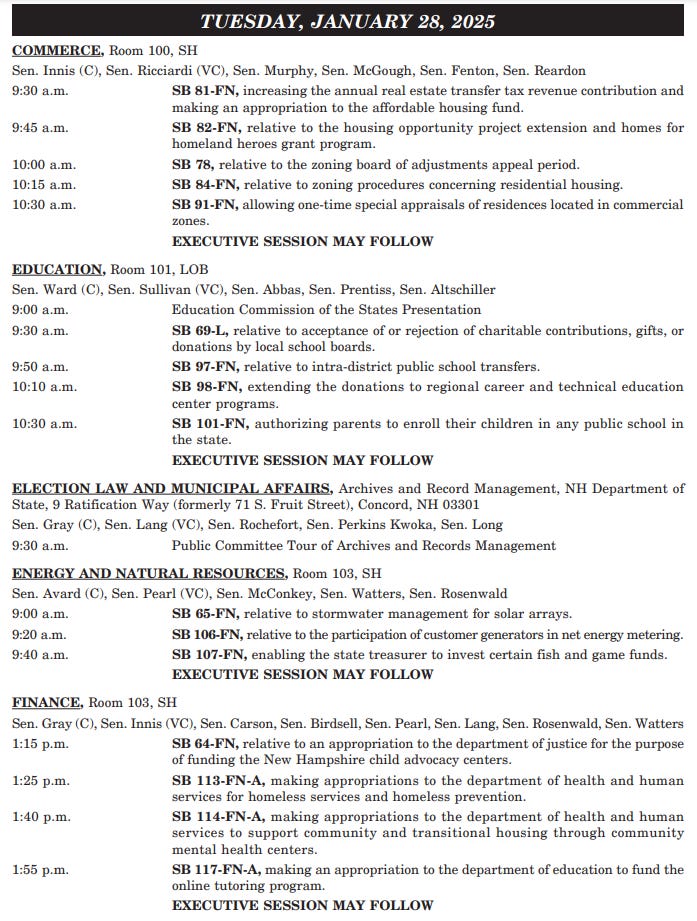
Screenshots from House Calendar
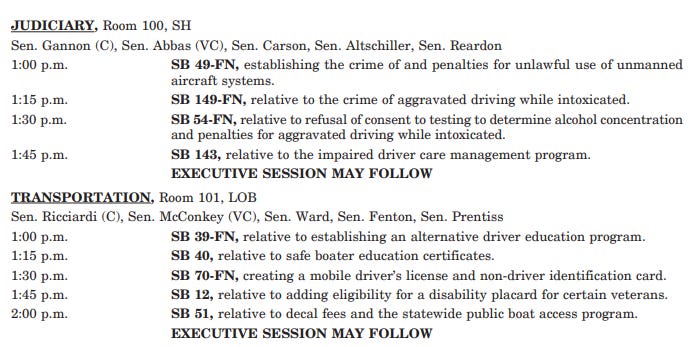
Screenshots from Senate Calendar
In-Depth Analyses of All Bills
Introduction - Quick Summaries of All Bills
House Children And Family Law
HB 322 | 7 Sponsors (Republican)
Allows a parent paying child support to retain the exclusive right to claim the child as a dependent.HB 325 | 3 Sponsors (Republican)
Eliminates term and reimbursement alimony in no-fault divorces.HB 433-FN | 6 Sponsors (Republican)
One-line summary: Sets age of consent for marriage at 17 for active duty military and removes obsolete waiver language.HB 478 | 9 Sponsors (Bipartisan)
Establishes a foster care oversight subcommittee in the children’s services oversight commission.HB 553-FN | 14 Sponsors (Bipartisan)
Redefines child abuse/neglect and sets conditions for a rebuttable presumption of harm.
House Education Funding
HB 651-FN | 1 Sponsor (Democratic)
Increases base and differential aid costs of an adequate education.HB 583-FN-L | 6 Sponsors (Democratic)
Requires state participation in Medicaid direct certification for free/reduced school meals.HB 646-FN-L | 7 Sponsors (Democratic)
Mandates an online application for free and reduced-price school meals in all school districts.HB 703-FN-A-L | 11 Sponsors (Bipartisan)
Prohibits schools from denying meals for unpaid balances and appropriates funds to cover them.HB 656 | 11 Sponsors (Republican)
Classifies federal grants to school districts as unanticipated funds requiring public hearings.HB 716-FN | 1 Sponsor (Republican)
Makes a $6 million appropriation to support the dual/concurrent enrollment program.
House Election Law
HB 107 | 6 Sponsors (Republican)
Removes the requirement to label printed political ads with “Political Advertising.”HB 336 | 9 Sponsors (Bipartisan)
Restricts political ads on public right-of-ways, requiring permission from local subdivisions.HB 423 | 3 Sponsors (Republican)
Requires consent of property owners for placement of political ads on public property abutting their land.HB 448 | 6 Sponsors (Republican)
Establishes a committee to study ballot law commission violations found on April 25, 2023.HB 626 | 5 Sponsors (Republican)
Directs Secretary of State to implement a vulnerability disclosure program for certain election systems.HB 327-FN | 10 Sponsors (Republican)
Lets Secretary of State serve as filing official in towns with limited clerk hours; clarifies affidavit rules.HB 630-FN | 7 Sponsors (Democratic)
Prevents dissemination of political “deepfake” materials before elections.HB 474 | 4 Sponsors (Republican)
Requires a second witness at the counting of write-in votes.HB 389-FN | 6 Sponsors (Bipartisan)
Requires candidates to attest if their election expenditures stay under $1,000.CACR 3 | 5 Sponsors (Republican)
Constitutional amendment authorizing the legislature to permit recall elections.CACR 4 | 8 Sponsors (Republican)
Constitutional amendment limiting voting to legal resident citizens 18 or older residing in the domicile.
House Environment And Agriculture
HB 566-FN | 7 Sponsors (Bipartisan)
Requires new landfill permit applications to include detailed leachate management plans.HB 355 | 9 Sponsors (Bipartisan)
Changes membership of the solid waste working group and extends reporting deadlines.HB 179-FN | 1 Sponsor (Republican)
Increases daily penalty for nonpayment of hazardous materials accident costs after 90 days.HB 171 | 6 Sponsors (Bipartisan)
Establishes a moratorium on new landfill permits until July 1, 2030.HR 13 | 6 Sponsors (Bipartisan)
House resolution opposing permitting of a new landfill next to Forest Lake State Park.
House Housing
HB 572-FN | 7 Sponsors (Democratic)
Establishes a “Partners in Housing” program under the Housing Champions Fund to build workforce housing.HB 604-FN | 11 Sponsors (Democratic)
Creates a loan forgiveness program for ADU construction or renovation for low-income homeowners.HB 382 | 6 Sponsors (Bipartisan)
Removes municipal authority for mandatory on-site parking requirements.HB 558-FN | 5 Sponsors (Democratic)
Creates a public county registry of monthly rents and bans algorithmic rent-setting.HB 628-FN | 4 Sponsors (Democratic)
Prohibits landlords from refusing to rent to prospective tenants with certain Housing Choice Vouchers.HB 623-FN | 7 Sponsors (Democratic)
Bars corporate home purchases in single/multi-family zones for 90 days, with further restrictions to reduce speculation.
House Labor, Industrial And Rehabilitative Services
HB 282-FN | 8 Sponsors (Bipartisan)
Increases maximum benefits for first responders critically injured in the line of duty.HB 586-FN | 5 Sponsors (Bipartisan)
Establishes a state-funded EAP for first responders in towns with volunteer or small departments.HB 299-FN | 8 Sponsors (Bipartisan)
Awards attorneys’ fees and costs to successful workers’ compensation claimants at the department level.HB 303-FN | 4 Sponsors (Bipartisan)
Requires NH DOL to adopt occupational safety rules at least as effective as federal OSHA standards.HB 378-FN | 5 Sponsors (Bipartisan)
Requires unused earned time to be paid out upon separation under certain conditions.
House Public Works And Highways
HB 375 | 2 Sponsors (Republican)
Authorizes municipalities to open sections of state/local highways to ATV use.HB 181-FN-A | 1 Sponsor (Republican)
Makes the state responsible for maintaining Opticom traffic control systems on state roads.HB 300 | 1 Sponsor (Democratic)
Directs DOT to solicit proposals for Conway Branch rail line use and forms a study committee on future railroads.HB 100-FN | 9 Sponsors (Mostly Republican)
Bars use of state funds for new passenger rail projects, e.g., Nashua–Manchester–Concord.
House Science, Technology And Energy
HB 504 | 10 Sponsors (Republican)
Revises state energy policy to emphasize affordable, reliable, and secure resources with limited government intervention.HB 508-FN | 2 Sponsors (Republican)
Decreases the assessment rate for certain VoIP/IP-enabled services providers.HB 535-FN | 2 Sponsors (Democratic)
Clarifies roles of the PUC and Department of Energy, requiring PUC to conduct contested adjudications.HB 450 | 9 Sponsors (Bipartisan)
Replaces certain “energy efficiency and clean energy districts” provisions with a commercial PACE program.
Senate Commerce
SB 81-FN | 11 Sponsors (Bipartisan)
Increases annual real estate transfer tax revenue to the affordable housing fund and appropriates $25 million.SB 82-FN | 3 Sponsors (Republican)
Creates “Housing Opportunity Zones,” allowing counties/municipalities to facilitate workforce housing projects.SB 78 | 7 Sponsors (Bipartisan)
Sets a uniform 30-day appeal period for zoning board of adjustment decisions.
Senate Energy And Natural Resources
SB 65-FN | 1 Sponsor (Republican)
Treats solar arrays as “pervious,” removing extra stormwater requirements beyond other developments.SB 106-FN | 6 Sponsors (Bipartisan)
Requires large net-metered generators to consume at least 20% of self-generated energy annually.SB 107-FN | 1 Sponsor (Republican)
Allows treasurer to invest certain Fish & Game funds, crediting interest back to the nongame species account.
Senate Finance
SB 64-FN | 8 Sponsors (Bipartisan)
Appropriates $3 million to DOJ for New Hampshire child advocacy centers.SB 113-FN-A | 1 Sponsor (Republican)
$30 million appropriation for homeless services, prevention, and supportive housing Medicaid benefit renewal.SB 114-FN-A | 9 Sponsors (Bipartisan)
$750k appropriation over two years for community mental health centers’ housing expansions.SB 117-FN-A | 6 Sponsors (Bipartisan)
Allocates $1 million to fund the online tutoring program (Tutor.com) for the next biennium.
Senate Judiciary
SB 49-FN | 2 Sponsors (Republican)
Establishes new crimes and penalties for unlawful unmanned aircraft system use.SB 149-FN | 8 Sponsors (Bipartisan)
Expands aggravated DWI definitions to include wrong-way driving scenarios.SB 54-FN | 8 Sponsors (Republican)
Increases license suspensions for refusing alcohol tests and modifies aggravated DWI sentencing.SB 143 | 11 Sponsors (Bipartisan)
Updates rules for the Impaired Driver Care Management Program (IDCMP), requiring up-to-date education and evaluations.
Senate Transportation
SB 39-FN | 11 Sponsors (Bipartisan)
Establishes an alternative driver education program with supervised driving and online coursework.SB 40 | 5 Sponsors (Republican)
Permits safe boater education via online exam for adults (NASBLA-approved) in lieu of proctored tests.SB 70-FN | 9 Sponsors (Bipartisan)
Creates a mobile driver’s license / ID system, subject to privacy protections.SB 12 | 5 Sponsors (Bipartisan)
Automatically grants disabled placards to certain veterans who hold special veteran plates.SB 51 | 8 Sponsors (Bipartisan)
Ensures $5 boat decal fees go to the statewide public boat access fund, with a small exception for Sunapee project.
Screenshots from the House Calendar
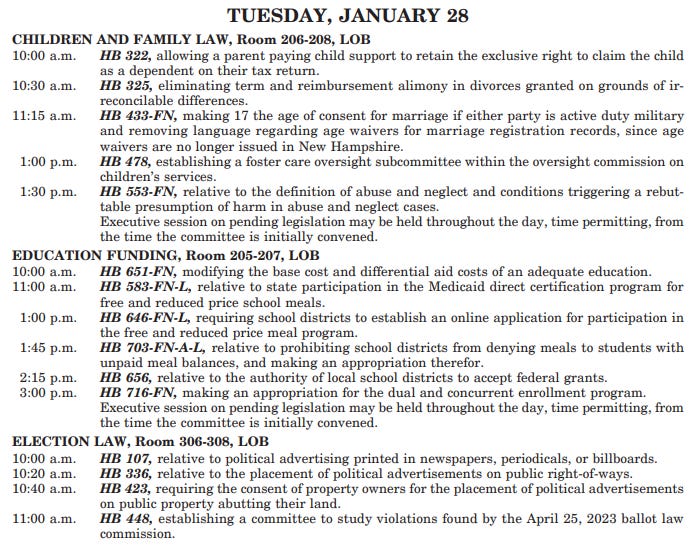 |
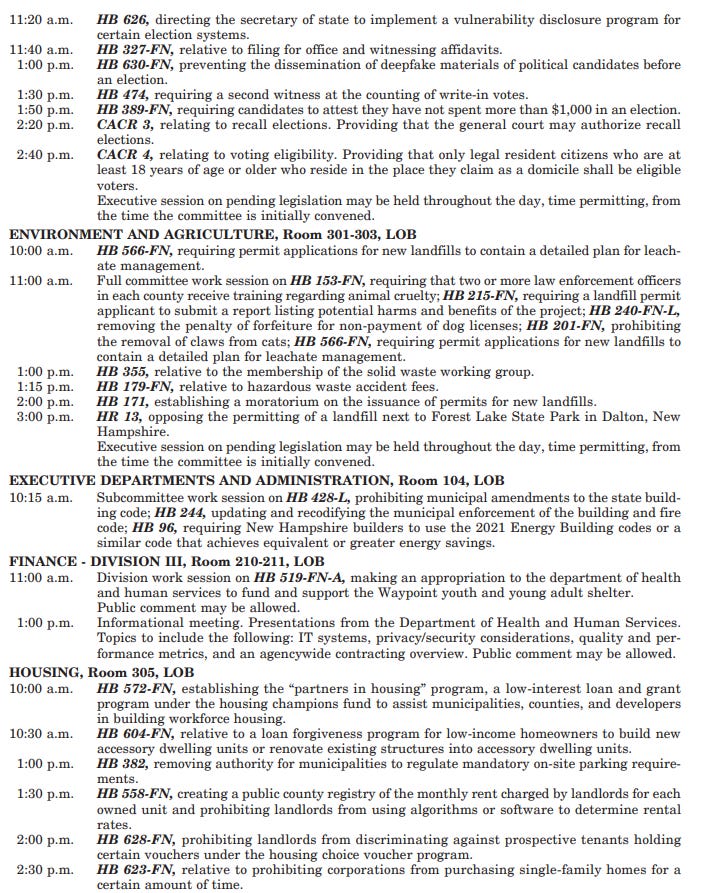 |
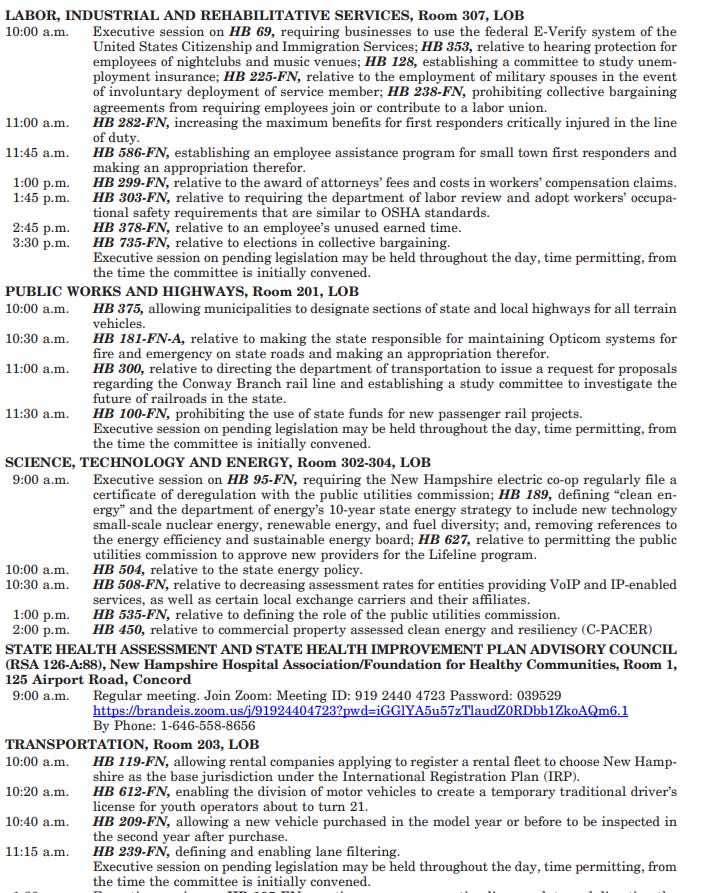 |
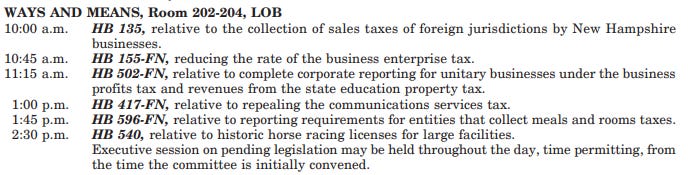 |
Screenshots from the Senate Calendar
 |
 |
In-Depth Analysis of All Bills
House Children And Family Law
HB 322
AN ACT allowing a parent paying child support to retain the exclusive right to claim the child as a dependent on their tax return.
Sponsor(s): (Prime) Rep. Joseph Barton (R), Rep. Debra DeSimone (R), Rep. James Spillane (R), Rep. Len Turcotte (R), Rep. Mark Pearson (R), Rep. Jim Kofalt (R), Rep. Kristin Noble (R)
Selected quote(s) from the bill:
1 New Paragraph; Child Tax Credit. Amend RSA 458:16-a by inserting after paragraph III the following new paragraph:
III-a. A party ordered to pay child support for a dependant child or children shall be entitled annually to claim the child tax credit, if eligible, for each qualifying child, unless otherwise agreed to by the parties. A child support obligor must be current on support obligations for the child whom they are claiming as the tax dependant at the time they claim the child tax credit.
2 New Paragraph; Child Support; Child Tax Credit. Amend RSA 461-A:14 by inserting after paragraph III the following new paragraph:
III-a. All support orders shall provide that, in cases where a divorce decree exists between the obligor and obligee, the obligor shall be entitled to claim the child tax credit for a dependant child as provided in RSA 458:16-a, III-a.
Summary:
This bill allows a parent paying child support to retain the exclusive right to claim the child as a dependent on their tax return.
Online Testimony
Currently, 4 people support and 13 people oppose the bill.
Argument for:
This bill enables the parent paying child support to claim the child tax credit, thereby compensating for the financial burden of child support payments and promoting fairness in tax benefits distribution.
Argument against:
This bill disregards the custodial parent's significant role and financial support, potentially disadvantaging those who provide the majority of care and resources to the child, thereby undermining the equitable distribution of tax benefits.
Hearing: Tuesday, Jan 28 at 10:00 a.m. in Room 206-208 in the Legislative Office Building and streaming on YouTube.
HB 325
AN ACT eliminating term and reimbursement alimony in divorces granted on grounds of irreconcilable differences.
Sponsor(s): (Prime) Rep. Joseph Barton (R), Rep. Debra DeSimone (R), Rep. James Spillane (R)
Selected quote(s) from the bill:
1 Alimony; Irreconcilable Differences. Amend the introductory paragraph of RSA 458:19-a, I to read as follows:
I. The court may order term alimony solely in divorce cases decreed in favor of the innocent party under RSA 458:7, …
2 Reimbursement Alimony; Fault Divorce. Amend the introductory paragraph of RSA 458:19-a, V to read as follows:
V. The court may order reimbursement alimony solely in divorce cases decreed in favor of the innocent party under RSA 458:7, …
3 New Paragraph; Alimony; Non-Retroactive. Amend RSA 458:19-a by inserting after paragraph VI the following new paragraph:
VII. The provisions of this section shall not be applied retroactively to any divorce decree that includes alimony and was granted on grounds of irreconcilable differences under RSA 458:7-a.
Selected quote from relevant law:
458:7 Absolute Divorce, Generally. –
A divorce from the bonds of matrimony shall be decreed in favor of the innocent party for any of the following causes:
I. Impotency of either party.
II. Adultery of either party.
III. Extreme cruelty of either party to the other.
IV. Conviction of either party, in any state or federal district, of a crime punishable with imprisonment for more than one year and actual imprisonment under such conviction.
V. When either party has so treated the other as seriously to injure health or endanger reason.
VI. When either party has been absent 2 years together, and has not been heard of.
VII. When either party habitually abuses alcohol or drugs and has been doing so for 2 or more years together.
VIII. When either party has joined any religious sect or society which professes to believe the relation of husband and wife unlawful, and has refused to cohabit with the other for 6 months together.
Summary:
This bill eliminates term and reimbursement alimony in divorces granted on the grounds of irreconcilable differences.
Online Testimony
Currently, 3 people support and 4 people oppose the bill.
Potential Argument for:
This bill simplifies the divorce process by removing alimony obligations in no-fault divorces, thereby reducing long-term financial liabilities and encouraging both parties to achieve financial independence post-divorce.
Argument against:
This bill would create unnecessary financial hardships for individuals who rely on alimony to transition into financial independence after divorce, particularly those who have sacrificed their careers for their families, thereby eliminating a crucial support system necessary for their stability.
Hearing: Tuesday, Jan 28 at 10:30 a.m. in Room 206-208 in the Legislative Office Building and streaming on YouTube.
HB 433-FN
AN ACT making 17 the age of consent for marriage if either party is active duty military and removing language regarding age waivers for marriage registration records, since age waivers are no longer issued in New Hampshire.
Sponsor(s): (Prime) Rep. Margaret Drye (R), Rep. Debra DeSimone (R), Rep. Skip Rollins (R), Rep. Terry Roy (R), Rep. Harry Bean (R), Rep. Cyril Aures (R)
Selected quote(s) from the bill:
1 Age of Consent to Marry; Active Duty Military. Amend RSA 457:5 to read as follows:
457:5 Of Consent.
…
II. The age of consent is 17 where:
(a) One person in a couple intending to marry is, at the time of application for a marriage license, a member of the armed forces of the United States while on active duty; and
(b) The other person is 17 years of age or older; and
(c) At least one person is a New Hampshire resident.
III. If the other person is 17 and not also a member of the armed forces of the United States while on active duty, they must have written permission to marry from a parent or legal guardian.
IV. Nothing in paragraph II of this section shall waive or change any requirements for obtaining a marriage license under RSA 5-C:42.
Summary:
This bill makes 17 the age of consent for marriage if either party is active duty military and removes language regarding age waivers for marriage registration records, since age waivers are no longer issued in New Hampshire.
Online Testimony
Currently, 4 people support and 299 people oppose the bill.
Potential Argument for:
This bill allows military personnel to marry at 17, recognizing the unique challenges and demands of active duty service, thereby providing stability and support for military families who may need to marry while one or both partners are deployed or frequently relocated.
Argument against:
This bill permits minors to marry under military exceptions, potentially exposing 17-year-olds to exploitation and abuse, undermining the protections established to prevent child marriage, and jeopardizing the well-being and rights of minors who may lack the maturity to make such significant life decisions.
Hearing: Tuesday, Jan 28 at 11:15 a.m. in Room 206-208 in the Legislative Office Building and streaming on YouTube.
HB 478
AN ACT establishing a foster care oversight subcommittee within the oversight commission on children's services.
Sponsor(s): (Prime) Rep. Peter Petrigno (D), Rep. Debra DeSimone (R), Rep. Mark Pearson (R), Rep. Nancy Murphy (D), Rep. Gaby Grossman (D), Rep. Cassandra Levesque (D), Rep. Alicia Gregg (D), Sen. Debra Altschiller (D), Sen. Pat Long (D)
Selected quote(s) from the bill:
1 New Subparagraph; Foster Care Oversight Subcommittee. Amend RSA 21-V:10, III by inserting after subparagraph (e) the following new subparagraph:
(f)(1) Create a foster care oversight subcommittee from the existing members of the commission to:
(A) Provide oversight of foster care programs and services in its effort to support an effective, comprehensive, and coordinated system of services and programs for children, youth, and families;
(B) Review with the office of the child advocate the efficacy of foster care programs and services, trends affecting program costs and participation, and alternative approaches to programmatic and administrative concerns; and
(C) Identify best foster care practices on behalf of children and families, and recommend future legislation to the commission and the general court.
Summary:
This bill establishes a foster care oversight subcommittee within the oversight commission on children's services.
Online Testimony
Currently, 5 people support and 3 people oppose the bill.
Argument for:
This bill creates a foster care oversight subcommittee to enhance the effectiveness and coordination of foster care programs, ensuring comprehensive support for children, youth, and families in New Hampshire.
Potential Argument against:
This bill may introduce additional bureaucracy and costs without necessarily leading to significant improvements in the foster care system, potentially diverting resources from direct services to administrative oversight.
Hearing: Tuesday, Jan 28 at 1:00 p.m. in Room 206-208 in the Legislative Office Building and streaming on YouTube.
HB 553-FN
AN ACT relative to the definition of abuse and neglect and conditions triggering a rebuttable presumption of harm in abuse and neglect cases.
Sponsor(s): (Prime) Rep. Alicia Gregg (D), Rep. Charles McMahon (R), Rep. Debra DeSimone (R), Rep. Kimberly Rice (R), Rep. Mark Pearson (R), Rep. Peter Petrigno (D), Rep. Gaby Grossman (D), Rep. Jodi Nelson (R), Rep. Katelyn Kuttab (R), Rep. Heather Raymond (D), Sen. Sharon Carson (R), Sen. Regina Birdsell (R), Sen. Cindy Rosenwald (D), Sen. Pat Long (D)
Selected quote(s) from the bill:
2 Definitions; Modifications. Amend RSA 169-C:3 to read as follows:
? 169-C:3 Definitions.
…
I. "Abandoned" means the child has been left by [his] their parent, guardian or custodian, without provision for care, including but not limited to their physical, emotional or psychological well-being; supervision; or, financial support although financially able [to provide such support]; or assisted to do so, but not if the child has been left due to a lack of availability of mental or behavioral health services.
II. ["Abused child"] "Abuse" means any of the following: [any child who has been]:
…
(c) Psychologically injured so that said child exhibits symptoms of emotional problems] Emotional harm to a child in such a manner as generally recognized to result from [consistent] mistreatment or neglect, including psychological maltreatment[; or].
(c) [Physically injured] Physical injury to a child by other than accidental means, or indeterminate means if the parents, guardians, or custodians are the primary or sole caregivers and have offered no reasonable alternative explanation for said injuries[; or].
[(e)] (d) [Subjected] Subjection of a child, by any person, to human trafficking as defined in RSA 633:7.[; or]
[(f)] (e) [Subjected] Subjection of a child to an act prohibited by RSA 632-A:10-d.
…
XV. "Imminent danger" means circumstances or surroundings causing immediate peril or risk to a child's psychological or emotional well-being, physical or mental health, or life.
XVI. "Institutional child abuse or neglect" means situations of known or suspected child abuse or neglect wherein the person responsible for the child's welfare is a foster parent or is an employee of a public or private residential home, institution or agency. This includes, but is not limited to, use of restraint or seclusion under circumstances which do not indicate that restraint or seclusion is necessary to ensure the immediate physical safety of a person due to substantial and imminent risk of serious bodily harm to the child or others.
…
XIX. ["Neglected child"] "Neglect" means [a child] any of the following:
…
(b) [Who is without proper parental care or control, subsistence, education as required by law, or other care or control necessary for the child's physical, mental, or emotional health, when it is established that the child's health has suffered or is likely to suffer serious impairment; and the deprivation is not due primarily to the lack of financial means of the parents, guardian, or custodian; or] Failure by a child’s parent, guardian, or custodian, either deliberately or through negligence or inability, to provide proper supervision, care, and attention to a child, or provide adequate food, clothing, shelter, or education, or proper medical care, and it is established that the child's physical, mental, emotional, or psychological wellbeing has suffered or is likely to suffer serious impairment, when such inability is not due solely to inadequate economic means.
…
(d) Entrustment of the care of a child by a parent, guardian, or custodian to an individual who presents a risk of inability to provide safe care, and as a result of such entrustment, the child's physical, mental, emotional, or psychological wellbeing has suffered, or is likely to suffer serious physical or psychological impairment. The following individuals are presumed to present such risk: individuals subject to active protective or restraining orders; individuals previously convicted of sex crimes; individuals convicted of violent crimes; individuals with recent instances of substance misuse or who have been convicted of or alleged to have engaged in manufacturing, sale, or trafficking of illegal drugs.
(e) Exposure of a child in utero to alcohol or drugs such that, once born, the child's health or welfare is threatened by the exposure, unless the exposure is due to the mother's having been prescribed or recommended to take the drugs by a licensed health care provider and the mother was monitored by the provider or other health care professional during the pregnancy.
…
XXV-a. "Psychological maltreatment" means [pervasive and emotionally abusive behavior, which shall include, but not be limited to, patterns of threatening, berating, or demeaning behavior] a pattern of threatening, demeaning, or humiliating behavior directed at the child, which may include, but is not limited to: rejecting, which shall include giving constant criticism or belittling; terrorizing, which shall include threatening abandonment or harm; corrupting, which shall include child involvement in or exposure to criminal activities; coercing, which shall include compelling to action using threat or force; and, which may adversely affect the child cognitively, emotionally, and socially.
…
XXVII-a. "Serious impairment" means [a substantial weakening or diminishment of] an adverse impact on a child's emotional, physical, psychological, or mental [health or of a child's] well-being or safety, and [general well-being] which may result from a single event or from a consistent pattern of behavior, and may be currently observed or predicted. The following circumstances shall be considered in determining the likelihood that a child may suffer serious impairment, with a trauma-informed lens, as defined in RSA 169-C:3, XXVIII:
(a) The age and developmental level of the child; although the child’s age or ability to care for themselves is not dispositive of the potential harm caused by other factors.
(b) [Any recognized mental, emotional, or physical disabilities] The child’s social, emotional, learning, mental health, behavioral health, or physical conditions.
(c) School attendance and [performance] the child’s ability to fully engage in school.
(d) The child's [ illegal use of controlled substances, or the child's contact with other] exposure to persons involved in the [illegal use of controlled substances] misuse or sale, manufacture, or trafficking of legal or illegal substances or the parent's or child's abuse of alcohol.
…
(l) Any single incident or occurrence of serious injury or illness.
(m) Parentification of a child, which occurs when a child is regularly expected to take on parental responsibilities, including but not limited to providing emotional or practical support for a parent or another individual, beyond what would be reasonably expected for the child’s age and circumstances, instead of receiving that care and support themselves.
…
XXVII-d. “Trauma Informed” means a service system in which all parties involved recognize and respond to the impact of traumatic stress on those who have contact with the system including children, families, caregivers, and service providers. It is an expansion of the system’s concerns beyond children’s physical safety and permanence to include children’s psychological safety; attempts to address trauma-related needs by promoting the well-being and resilience of children, families, caregivers, and service providers; treats children and families as partners in their own care; and, collaborates with other relevant agencies and systems.
XXVIII. "Unfounded report" means a report made pursuant to this chapter for which the department determines that there is, by a preponderance of the evidence, insufficient evidence to substantiate a finding that the child is abused or neglected.
…
3 Presumption of Harm. Amend RSA 169-C:12-f to read as follows:
169-C:12-f Rebuttable Presumption of Harm.
There shall be a rebuttable presumption that a child's [health] emotional, physical, psychological, or mental well-being has suffered or is likely to suffer serious impairment by exposure to any of the following conduct:
I. Evidence of a parent's, guardian's, or custodian's substance misuse [that is adversely affecting a child's care or supervision, when that parent, guardian, or custodian is not actively engaged in treatment] or sale, manufacturing, or trafficking of legal or illegal substances, shall create a rebuttable presumption that the child's physical, emotional, or psychological well-being has suffered or is very likely to suffer serious impairment. The presumption may be rebutted by evidence of the parent's compliance with treatment for such use or dependence.
…
III. Evidence of a parent's, guardian's, or custodian's exposure of a child to:
[(a) Physical violence directed at a sibling, the other parent, or another person living in the home; or
(b) Psychological maltreatment directed at the child, a sibling, the other parent, or another person living in the home.] physical violence, verbal abuse, or psychological maltreatment directed at the child, a sibling, the other parent or significant other, or another person living in the home.
IV. The rebuttable presumption of harm established in paragraph III shall not apply to victims of domestic violence who are subject to an abuse or neglect investigation or petition filed pursuant to this chapter as a result of an incident or incidents in which that parent, guardian, or caregiver was the victim.
V. Evidence of serious injury, broken bones, or unexplained injury to any non-ambulatory child, or frequent illnesses that are not being adequately addressed or controlled.
4 Studies; Abuse. Amend RSA 189:10, II to read as follows:
…
IV. Any child subjected to conduct prohibited by paragraph I, but which is not justified pursuant to paragraph III, shall be considered [an abused child] to have suffered abuse pursuant to RSA 169-C:3, II.
Summary:
This bill modifies the definitions of abuse and neglect and establishes conditions for a rebuttable presumption of harm in abuse and neglect cases.
Online Testimony
Currently, 9 people support and 149 people oppose the bill.
Argument for:
This bill strengthens the protection framework for children by clarifying definitions of abuse and neglect and setting clear conditions for presuming harm, ensuring that children's emotional, physical, and psychological well-being is prioritized in legal proceedings.
Argument against:
This bill permits family courts to initiate parental fitness tests without a legal conviction, undermining due process, and introduces vague and subjective criteria for abuse and neglect that could lead to the unjust removal of children from their families and increased government overreach.
Hearing: Tuesday, Jan 28 at 1:30 p.m. in Room 206-208 in the Legislative Office Building and streaming on YouTube.
House Education Funding
HB 651-FN
AN ACT modifying the base cost and differential aid costs of an adequate education.
Sponsor(s): (Prime) Rep. David Luneau (D)
Selected quote(s) from the bill:
II.(a) A cost of [$4,100] $7,356.01 per pupil in the ADMR, plus differentiated aid as follows:
(b) An additional [$2,300] $4,126.20 for each pupil in the ADMR who is eligible for a free or reduced price meal anytime during the determination year; plus
(c) An additional [$800] $1,435.20 for each pupil in the ADMR who is an English language learner anytime during the determination year; plus
(d) An additional [$2,100] $3,767.40 for each pupil in the ADMR who is receiving special education services anytime during the determination year.
2 Cost of an Adequate Education. Amend RSA 193-E:2-b, I to read as follows:
I. … The necessary specific resource elements shall include costs for teachers, teacher benefits, student-teacher ratios, principals, administrative assistants, school counselors, library-media specialists, technology coordinators, custodians, nurse services, instructional materials, technology, professional development, facilities operation and maintenance, and transportation. The general court shall update the cost of an adequate education at least every 2 years. The general court shall use evidence from actual costs from all approved schools to determine the cost of an adequate education.
Summary:
This bill modifies the base cost and differential aid costs of an adequate education by increasing funding and expanding the definition of educational costs.
Online Testimony
Currently, 72 people support and 7 people oppose the bill.
Argument for:
This bill increases essential funding for public education, ensuring that students from low-income families, English language learners, and those requiring special education receive the necessary resources to succeed, thereby promoting educational equity and improving the overall quality of education in New Hampshire.
Potential Argument against:
This bill may significantly increase education funding requirements, potentially leading to higher property taxes or financial strain on local districts, especially in areas with limited resources, thereby affecting taxpayers and possibly leading to budgetary constraints in other areas.
Hearing: Tuesday, Jan 28 at 10:00 a.m. in Room 205-207 in the Legislative Office Building and streaming on YouTube.
HB 583-FN-L
AN ACT relative to state participation in the Medicaid direct certification program for free and reduced price school meals.
Sponsor(s): (Prime) Rep. Laura Telerski (D), Rep. Nancy Murphy (D), Rep. Megan Murray (D), Rep. Jennifer Mandelbaum (D), Rep. Patrick Long (D), Sen. Pat Long (D)
Selected quote(s) from the bill:
1 Department of Education; Application for Medicaid Direct Certification Program; Public Kindergarten, Elementary, and Secondary Schools. The department of education shall seek participation in the Demonstration Projects to Evaluate Direct Certification with Medicaid administered by the United States Department of Agriculture (USDA). The department of health and human services shall assist the department of education as needed in pursuing and implementing this new direct certification methodology.
Summary:
This bill requires the department of education to seek participation in the Medicaid direct certification methodology for the free and reduced price school meals program for students in public kindergarten, elementary, and secondary schools.
Online Testimony
Currently, 160 people support and 8 people oppose the bill.
Argument for:
This bill streamlines the eligibility process for free and reduced-price school meals by integrating Medicaid direct certification, reducing administrative burdens for families and schools, and ensuring that children from low-income households have consistent access to nutritious meals, thereby supporting their academic performance and overall well-being.
Potential Argument against:
This bill could lead to increased administrative complexity for the Department of Education and the Department of Health and Human Services, potentially resulting in delays or errors in certification, and may require additional resources to manage the expanded direct certification process effectively.
Hearing: Tuesday, Jan 28 at 11:00 a.m. in Room 205-207 in the Legislative Office Building and streaming on YouTube.
HB 646-FN-L
AN ACT requiring school districts to establish an online application for participation in the free and reduced price meal program.
Sponsor(s): (Prime) Rep. Laura Telerski (D), Rep. Christine Seibert (D), Rep. Megan Murray (D), Rep. Cassandra Levesque (D), Rep. Lee Ann Kluger (D), Rep. Toni Weinstein (D), Sen. Pat Long (D)
Selected quote(s) from the bill:
1 New Paragraph; Food and Nutrition Programs. Amend RSA 189:11-a by inserting after paragraph VIII the following new paragraph:
IX. The department of education shall adopt rules under RSA 541-A requiring school districts to offer online and physical free or reduced price school meals applications. The department of education shall provide any administrative or technical assistance to school districts establishing an online application for free or reduced price school meals and whose school meal programs are approved to operate through the United States Department of Agriculture. School districts eligible for administrative or technical assistance or funding in these provisions shall be those approved to operate federal school meal programs through the United States Department of Agriculture.
2 Appropriation; Department of Education. The sum of $102,000 for the fiscal year ending June 30, 2026 and the sum of $104,000 for the fiscal year ending June 30, 2027 are hereby appropriated to the department of education, for the establishment of a miscellaneous business operations specialist position to administer the provisions of this act. The governor is authorized to draw a warrant for said sums out of any money in the treasury not otherwise appropriated.
3 Appropriation; Department of Education. The sum of $1,000,000 for the biennium ending June 30, 2027, is hereby appropriated to the department of education, for the purpose of providing school districts software for establishing an online application for free or reduced price school meals. The governor is authorized to draw a warrant for said sum out of any money in the treasury not otherwise appropriated.
Summary:
This bill requires school districts to establish both online and physical applications for participation in the free and reduced price meal program, providing administrative and technical assistance to implement the system.
Online Testimony
Currently, 173 people support and 8 people oppose the bill.
Argument for:
This bill streamlines the application process for free and reduced-price school meals by introducing an online option, making it more accessible for families and reducing administrative burdens for schools. By providing administrative and technical assistance, the bill ensures that all school districts can effectively implement the online application system, increasing enrollment and ensuring that no child goes hungry due to cumbersome paperwork. Implementing an online application promotes efficiency, reduces errors, and aligns with modern technological practices, ultimately supporting family stability and addressing food insecurity in the state.
Potential Argument against:
This bill could impose additional administrative responsibilities on school districts, potentially requiring resources and training that some districts may lack. The implementation of an online application system may create disparities for families without reliable internet access, inadvertently excluding some eligible students from receiving free or reduced-price meals. Allocating funds for administrative and technical assistance might strain the Department of Education’s budget, diverting resources from other essential educational programs and services.
Hearing: Tuesday, Jan 28 at 1:00 p.m. in Room 205-207 in the Legislative Office Building and streaming on YouTube.
HB 703-FN-A-L
AN ACT relative to prohibiting school districts from denying meals to students with unpaid meal balances, and making an appropriation therefor.
Sponsor(s): (Prime) Rep. Hope Damon (D), Rep. Alexis Simpson (D), Rep. Laura Telerski (D), Rep. Mike Bordes (R), Rep. Heath Howard (D), Rep. Muriel Hall (D), Rep. Nicholas Germana (D), Rep. Jodi Newell (D), Rep. Peggy Balboni (D), Sen. Suzanne Prentiss (D), Sen. Rebecca Perkins Kwoka (D), Sen. Debra Altschiller (D)
Selected quote(s) from the bill:
1 Food and Nutrition Programs. RSA 189:11-a, VIII is repealed and reenacted to read as follows:
VIII. All school districts with meal programs approved to operate through the United States Department of Agriculture shall adopt a school meals policy that:
(a) Prohibits schools from denying a meal to, or serving an alternative meal to, a student with an unpaid student meal balance or without funds to pay for a meal.
(b) Prohibits schools from disposing of or taking away any food from a child that already has been served to the child on account of the child having an unpaid student meal balance or lacking the funds to pay for a meal.
(c) Prohibits schools from identifying or stigmatizing a student as receiving a free, reduced price or full-price meal or meals for which the child lacks funds to pay, including, but not limited to, the use of tokens, stickers, stamps, or by placing the child's name on a published list of persons with student meal debt.
(d) Prohibits schools from limiting a student's participation in any school activities, graduation ceremonies, field trips, athletics, activity clubs, or other extracurricular activities, or access to materials, technology, or other items provided to students due to an unpaid student meal balance.
…
IX. The department of education shall pay for the school meal debts accrued and unpaid by students in any schools participating in the USDA National School Lunch program by the end of each fiscal year.
Summary:
This bill prohibits school districts from denying or stigmatizing students for unpaid meal balances and requires the Department of Education to cover these unpaid meal debts.
Online Testimony
Currently, 198 people support and 9 people oppose the bill.
Argument for:
This bill ensures that no child is denied access to nutritious meals due to their family's financial situation, promoting equity and supporting students' ability to learn and thrive without the stigma of unpaid meal balances. By covering unpaid meal debts, the bill alleviates financial burdens on low-income families, contributing to their housing stability and overall well-being. Implementing an online application process alongside this bill also streamlines access to free and reduced-price meals, reducing administrative barriers for eligible families.
Argument against:
This bill requires school districts to continue providing meals to all students without addressing unpaid meal balances, leading to unchecked meal debt and financial strain on nutrition programs. Without mechanisms to recover these costs, school districts may face reduced resources for program improvements, staff wages, and meal quality, ultimately undermining the sustainability of school meal programs. Offering alternative meal options for students with significant meal debt helps maintain financial sustainability and encourages parents to address their balances, which this bill does not provide.
Hearing: Tuesday, Jan 28 at 1:45 p.m. in Room 205-207 in the Legislative Office Building and streaming on YouTube.
HB 656
AN ACT relative to the authority of local school districts to accept federal grants.
Sponsor(s): (Prime) Rep. Katy Peternel (R), Rep. Margaret Drye (R), Rep. Juliet Harvey-Bolia (R), Rep. Diane Pauer (R), Rep. Melissa Litchfield (R), Rep. Riché Colcombe (R), Rep. Kristin Noble (R), Rep. Mike Drago (R), Rep. Pam Brown (R), Rep. Susan DeRoy (R), Sen. David Rochefort (R), Sen. Victoria Sullivan (R)
Selected quote(s) from the bill:
1 Appropriation for Unanticipated Funds Made Available During the Year. Amend RSA 198:20-b, II-III to read as follows:
II. … All funds disbursed from a federal governmental unit shall be deemed to be unanticipated money under the provisions of this section.
III.(a) For unanticipated funds in the amount of $20,000 or more, the school board shall hold a prior public hearing on the action to be taken. Notice of the time, place, and subject of such hearing shall be published in a newspaper of general circulation in the relevant municipality at least 7 days before the meeting is held. Such notice shall contain a summary of any obligations incurred by accepting the unanticipated funds, or state that there are no obligations incurred.
(b) A school board may establish the amount of unanticipated funds required for notice under this subparagraph, provided such amount is less than $20,000. For unanticipated funds in an amount less than $20,000, the school board shall post notice of the funds in the agenda and shall include notice in the minutes of the school board meeting in which such funds are discussed. The minutes of the school board meeting shall contain a summary of any obligations incurred by accepting the unanticipated funds, or state that there are no obligations incurred. The acceptance of unanticipated funds under this subparagraph shall be made in public session of any regular school board meeting.
Summary:
This bill requires that all federal grants disbursed to school districts be classified as unanticipated funds, necessitating school board approval and public notification for grants exceeding $20,000.
Online Testimony
Currently, 104 people support and 42 people oppose the bill.
Argument for:
This bill ensures transparency and community involvement by requiring school boards to approve and publicly disclose any federal grants exceeding $20,000, preventing superintendents from bypassing necessary approvals. By mandating summaries of obligations incurred, it protects local values and priorities, fostering accountability in the use of federal funds for education.
Potential Argument against:
This bill could impose additional administrative burdens on school districts by requiring extensive approval processes and public notices for federal grants, potentially delaying critical funding and support. The minimal appropriation of $1 does not adequately cover the expected financial strain of handling unanticipated funds, undermining the bill’s effectiveness and sustainability.
Hearing: Tuesday, Jan 28 at 2:15 p.m. in Room 205-207 in the Legislative Office Building and streaming on YouTube.
HB 716-FN
AN ACT making an appropriation for the dual and concurrent enrollment program.
Sponsor(s): (Prime) Rep. Rick Ladd (R)
Selected quote(s) from the bill:
1 Dual and Concurrent Enrollment Program; Appropriation. The sums of $3,000,000 for the fiscal year ending June 30, 2026, and $3,000,000 for the fiscal year ending June 30, 2027, are hereby appropriated to the community college system of New Hampshire for the purpose of providing scholarships and program support for the dual and concurrent enrollment program under RSA 188- E:26. These appropriations shall be in addition to any other funds appropriated to the community college system of New Hampshire. The governor is authorized to draw a warrant for said sums out of any money in the treasury not otherwise appropriated. This appropriation shall not lapse.
Summary:
This bill makes an appropriation to the community college system of New Hampshire for the purpose of providing scholarships and program support for the dual and concurrent enrollment program.
Online Testimony
Currently, 3 people support and 6 people oppose the bill.
Potential Argument for:
This bill provides essential funding to support dual and concurrent enrollment programs, allowing high school students to take college courses and gain valuable academic and career experiences, thereby enhancing their educational opportunities and future prospects.
Argument against:
This bill simply pulls money ($6 million!) away from funds that should go to support community public schools.
Hearing: Tuesday, Jan 28 at 3:00 p.m. in Room 205-207 in the Legislative Office Building and streaming on YouTube.
House Election Law
HB 107
AN ACT relative to political advertising printed in newspapers, periodicals, or billboards.
Sponsor(s): (Prime) Rep. Kristine Perez (R), Rep. James Tierney (R), Rep. Jose Cambrils (R), Rep. Julius Soti (R), Rep. Ron Dunn (R), Rep. Katelyn Kuttab (R)
Selected quote(s) from the bill:
1 Identification of Political Advertising; Rates. Amend RSA 664:16 to read as follows:
664:16 [Identification of] Political Advertising; Rates. [Political advertising printed in newspapers, periodicals, or billboards shall be marked at the beginning or at the end thereof "Political Advertising."]
Summary:
This bill removes the requirement to mark political advertising printed in newspapers, periodicals, or billboards as "political advertising."
Online Testimony
Currently, 2 people support and 23 people oppose the bill.
Argument for:
This bill eliminates the unnecessary requirement to label political advertising, trusting that New Hampshire voters can discern political content without explicit markers. It simplifies the publishing process and respects the intelligence of the electorate.
Argument against:
This bill reduces transparency and accountability in the political process by allowing political advertisements to go unmarked, making it harder for voters to identify and evaluate political messaging. Without clear labels, the potential for misinformation and manipulation increases, undermining trust in media sources.
Hearing: Tuesday, Jan 28 at 10:00 a.m. in Room 306-308 in the Legislative Office Building and streaming on YouTube.
HB 336
AN ACT relative to the placement of political advertisements on public right-of-ways.
Sponsor(s): (Prime) Rep. Judy Aron (R), Rep. John Cloutier (D), Rep. Steven Smith (R), Rep. Rosemarie Rung (D), Rep. Ross Berry (R), Rep. Dale Girard (D), Rep. Wayne Hemingway (R), Rep. Michael Aron (R), Sen. Ruth Ward (R)
Selected quote(s) from the bill:
1 Political Advertising; Placement and Removal of Political Advertising; Right of Ways. Amend RSA 664:17 to read as follows:
664:17 Placement and Removal of Political Advertising. No political advertising shall be placed on or affixed to any public property, including highway rights-of-way, unless permission is granted by the political subdivision or by consent of the owner of the land over which the right of way passes. [or private property without the owner's consent.] No political advertising shall be placed on private property without the owner's consent.
Summary:
This bill clarifies the conditions under which political advertisements can be placed on public right-of-ways by requiring permission from political subdivisions or landowners.
Online Testimony
Currently, 5 people support and 3 people oppose the bill.
Potential Argument for:
This bill ensures that political advertisements on public right-of-ways are properly regulated, preventing unauthorized or inappropriate placements and maintaining the integrity of public spaces. By requiring permission, it helps manage the visual and safety aspects of political advertising in shared community areas.
Argument against:
This bill imposes an unnecessary burden by requiring permission from political subdivisions, which could lead to discriminatory practices and limit the ability of individuals and organizations to express their political views. Additionally, the requirement for public notice and summaries of obligations may create administrative challenges and reduce the flexibility of school districts in managing political advertising on public property.
Hearing: Tuesday, Jan 28 at 10:20 a.m. in Room 306-308 in the Legislative Office Building and streaming on YouTube.
HB 423
AN ACT requiring the consent of property owners for the placement of political advertisements on public property abutting their land.
Sponsor(s): (Prime) Rep. Kenneth Weyler (R), Rep. Lilli Walsh (R), Rep. Pam Brown (R)
Selected quote(s) from the bill:
1 Political Advertising; Placement and Removal of Political Advertising; Removal of Advertisements on Public Property by Private Property Owners. Amend RSA 664:17 to read as follows:
664:17 Placement and Removal of Political Advertising. … Political advertising may be placed within state-owned rights-of-way as long as the advertising does not obstruct the safe flow of traffic and the advertising is placed with the consent of the property owner who is the closest abutter [owner of the land over which the right-of-way passes]. No person shall remove, deface, or knowingly destroy any political advertising which is placed on or affixed to public property or any private property except for removal by the owner of the property, persons authorized by the owner of the property, the nearest abutter who did not give consent, or a law enforcement officer removing improper advertising. … The nearest abutter who objects to a political advertisement may cover it or place it flat on the ground. Such person shall then attach to the advertisement a copy of this section and a document identifying themselves and their address.
Summary:
This bill requires the consent of property owners for the placement of political advertisements on public property abutting their land and allows private citizens to remove such advertisements.
Online Testimony
Currently, 2 people support and 10 people oppose the bill.
Potential Argument for:
This bill empowers property owners to control political advertisements near their land, ensuring that such ads do not disrupt their property or community. It also allows private citizens to maintain the integrity of their local environment by removing unwanted political advertisements.
Argument against:
This bill imposes unnecessary and unreasonable burdens on those wishing to place political advertisements by requiring consent from property owners, potentially leading to discriminatory practices. Additionally, it may hinder free speech by restricting the placement of political ads on public property, limiting candidates' ability to communicate with voters.
Hearing: Tuesday, Jan 28 at 10:40 a.m. in Room 306-308 in the Legislative Office Building and streaming on YouTube.
HB 448
AN ACT establishing a committee to study violations found by the April 25, 2023 ballot law commission.
Sponsor(s): (Prime) Rep. JD Bernardy (R), Rep. Aboul Khan (R), Rep. Melissa Litchfield (R), Rep. Lilli Walsh (R), Rep. Susan Porcelli (R), Rep. Kelley Potenza (R)
Selected quote(s) from the bill:
1 Committee Established. There is established a committee to study violations found by the April 25, 2023 ballot law commission.
…
3 Duties. The committee shall consider appropriate penalties for violations found by the ballot law commission and make recommendations for future legislation based on such considerations.
…
5 Report. … on or before November 1, 2025.
Summary:
This bill establishes a committee to study violations found by the April 25, 2023 ballot law commission.
Online Testimony
Currently, 3 people support and 28 people oppose the bill.
Argument for:
This bill ensures that electoral violations and suspected violations are thoroughly studied, enhancing the security and integrity of elections. By establishing a dedicated committee, it demonstrates a commitment to maintaining transparent and accountable election processes.
Argument against:
This bill imposes a disturbing misuse of power by concentrating the responsibility of studying electoral violations in a small, appointed committee. Allowing only three people appointed by the president of the senate to oversee this process may lead to biased outcomes and reduce public trust in election oversight.
Hearing: Tuesday, Jan 28 at 11:00 a.m. in Room 306-308 in the Legislative Office Building and streaming on YouTube.
HB 626
AN ACT directing the secretary of state to implement a vulnerability disclosure program for certain election systems.
Sponsor(s): (Prime) Rep. Donald McFarlane (R), Rep. James Spillane (R), Rep. Katelyn Kuttab (R), Rep. Daniel Popovici-Muller (R), Sen. Keith Murphy (R)
Selected quote(s) from the bill:
1 Secretary of State; Chief Election Officer; Duty to Investigate System Vulnerabilities. Amend RSA 652:23 to read as follows:
652:23 Chief Election Officer.
…
II. Within 180 days of the effective date of this paragraph, the secretary of state shall implement and operate a public vulnerability disclosure program which substantially meets or exceeds the recommendations contained within the publication "Guide to Vulnerability Reporting for America's Election Administrators" published by the Cybersecurity and Infrastructure Security Agency of the United States Department of Homeland Security, to make it easier for security researchers and the general public to report security vulnerabilities appropriately. The scope of the program shall include at least all of the secretary’s information technology systems which bear on the integrity of the voter registration and election processes, including the centralized voter registration database and the user interfaces used by voters, town clerks, ballot clerks, and supervisors of the checklist relative to elections and voter registration. The secretary shall work with the cybersecurity advisory committee established in RSA 21-R:16, and such committee shall be responsible for the oversight of the public vulnerability disclosure program.
2 New Paragraph; Cybersecurity Advisory Committee; Duties. Amend RSA 21-R:16 by inserting after paragraph III the following new paragraph:
IV. The committee shall oversee the public vulnerability disclosure program operated by the secretary of state pursuant to RSA 652:23, II.
Summary:
This bill directs the secretary of state to implement a vulnerability disclosure program for certain election systems and grants the cybersecurity committee oversight of the program.
Online Testimony
Currently, 3 people support and 3 people oppose the bill.
Argument for:
This bill enhances the security of election systems by establishing a vulnerability disclosure program, ensuring that potential security weaknesses are identified and addressed promptly. By giving the cybersecurity committee oversight, it promotes accountability and continuous improvement in safeguarding the integrity of elections.
Potential Argument against:
This bill could lead to increased administrative burdens and costs associated with implementing and managing the vulnerability disclosure program. Additionally, the oversight by the cybersecurity committee may slow down the process of addressing vulnerabilities, potentially leaving election systems exposed for longer periods.
Hearing: Tuesday, Jan 28 at 11:20 a.m. in Room 306-308 in the Legislative Office Building and streaming on YouTube.
HB 327-FN
AN ACT relative to filing for office and witnessing affidavits.
Sponsor(s): (Prime) Rep. Donald McFarlane (R), Rep. Jordan Ulery (R), Rep. Jeanine Notter (R), Rep. Mark Warden (R), Rep. Barbara Comtois (R), Rep. Ross Berry (R), Rep. John Sellers (R), Rep. Linda Franz (R), Sen. Daniel Innis (R), Sen. Keith Murphy (R)
Selected quote(s) from the bill:
1 Nominations by Primary; Official; Official With Whom to File; Definition Changes. Amend RSA 655:15, II and III to read as follows:
II. … In cases where such clerk's hours are such that the clerk is normally or routinely open on fewer than 3 separate days per week, or for fewer than 18 hours in total per week, the secretary of state shall also be an appropriate official.
III. … In cases where such clerk's hours are such that the clerk is normally or routinely open on fewer than 3 separate days per week, or for fewer than 18 hours in total per week, the secretary of state shall also be an appropriate official.
2 Nominations by Primary; Affidavit of Qualifications. Amend RSA 655:28 to read as follows:
655:28 Affidavit of Qualifications. … If the candidate files in person before a town clerk or a deputy town clerk, such clerk shall be empowered to witness the affidavit whether or not that clerk is a notary public.
Summary:
This bill allows the secretary of state to serve as a filing official in towns where the clerk's office is not routinely open and permits town clerks to witness affidavits regardless of notary public status.
Online Testimony
Currently, 4 people support and 1 people oppose the bill.
Potential Argument For:
This bill streamlines the candidacy filing process, ensuring that candidates can submit affidavits even in areas with limited clerk office hours, thereby promoting greater electoral participation without significant additional costs.
Potential Argument Against:
This bill could increase administrative responsibilities for the secretary of state and town clerks, potentially leading to inefficiencies and marginal increases in government spending, complicating the ongoing budget fight.
Hearing: Tuesday, Jan 28 at 11:40 a.m. in Room 306-308 in the Legislative Office Building and streaming on YouTube.
HB 630-FN
AN ACT preventing the dissemination of deepfake materials of political candidates before an election.
Sponsor(s): (Prime) Rep. Thomas Cormen (D), Rep. Dan McGuire (R), Rep. Chris Muns (D), Rep. David Preece (D), Rep. Kat McGhee (D), Rep. Connie Lane (D), Rep. Zoe Manos (D)
Selected quote(s) from the bill:
1 Political Expenditures and Contributions; Political Advertising; Synthetic Media and Deceptive and Fraudulent Deepfakes. Amend RSA 664:14-c to read as follows:
Synthetic Media and Deceptive and Fraudulent Deepfakes.
…
V. This section shall not apply to any of the following:
…
(b) An individual who, within 90 days of an election at which a candidate for elective office will appear on the ballot, distributes a [message] deepfake created using [artificial intelligence or generative AI] synthetic media technology that the individual did not know and had no reasonable way of knowing that the distributed material was a deepfake, as defined in paragraph I, of a candidate, election official, or party on the state or local ballot.
…
(e) A video, audio or any other media that constitutes satire or parody or the production of which is substantially dependent on the ability of one or more individuals to physically or verbally impersonate another person without reliance on [artificial intelligence] synthetic media technology.
Summary:
This bill prevents the dissemination of deepfake materials of political candidates before an election.
Online Testimony
Currently, 23 people support and 0 people oppose the bill.
Argument for:
This bill protects the integrity of elections by preventing deceptive deepfake materials from misleading voters. This bill holds creators accountable for the content they distribute, thereby safeguarding public trust in democratic processes.
Potential Argument against:
This bill may infringe on free speech rights by restricting the creation and distribution of synthetic media. This bill could impose burdensome regulations on media creators, potentially stifling legitimate political discourse.
Hearing: Tuesday, Jan 28 at 1:00 p.m. in Room 306-308 in the Legislative Office Building and streaming on YouTube.
HB 474
AN ACT requiring a second witness at the counting of write-in votes.
Sponsor(s): (Prime) Rep. Claudine Burnham (R), Rep. Glenn Bailey (R), Rep. Robert Wherry (R), Rep. Clayton Wood (R)
Selected quote(s) from the bill:
1 Counting of Votes; Counting Write-In Votes. Amend RSA 659:64-a, I to read as follows:
I. In a town or city that uses a ballot counting device approved by the ballot law commission pursuant to RSA 656:40 and which prints or digitally displays an image of all write-in votes as part of the device's report of votes cast, a moderatormay use the printed or digitally displayed images to count write-in votes in place of examining each ballot to obtain the name of the person who received a write-in vote. This counting shall take place in the presence of a second witness who is registered with an opposing party.
Summary: This bill requires a second witness at the counting of write-in votes.
Online Testimony
Currently, 4 people support and 4 people oppose the bill.
Argument for: This bill ensures transparency in the counting of write-in votes by requiring a second witness. This bill helps build trust in the electoral process by preventing potential misconduct.
Argument against: This bill is unnecessary and vague, as existing observer provisions already provide oversight. This bill could perpetuate false narratives of cheating, targeting moderators without just cause.
Hearing: Tuesday, Jan 28 at 1:30 p.m. in Room 306-308 in the Legislative Office Building and streaming on YouTube.
HB 389-FN
AN ACT requiring candidates to attest they have not spent more than $1,000 in an election.
Sponsor(s): (Prime) Rep. Heath Howard (D), Rep. Ellen Read (D), Rep. Connie Lane (D), Rep. Russell Muirhead (D), Rep. Ross Berry (R), Sen. David Watters (D)
Selected quote(s) from the bill:
1 Reporting by Candidates. Amend RSA 664:7 to read as follows:
664:7 Registering and Reporting by Candidates. … Candidates whose expenditures do not exceed $1,000 during a reporting period shall attest thereto by placing a checkmark in the checkbox indicated on the reporting form, which the secretary of state shall include in the form for this purpose. Such checkbox shall be in substantially the following form:
[____] I attest that my expenditures as candidate for _______ did not exceed $1,000 during the prescribed reporting period.Additionally, any candidate who has receipts or expenditures exceeding $1,000 in an election cycle, shall file statements as required in RSA 664:9-a through 664:9-c before and after an election in like manner and detail as prescribed in RSA 664:6, I-VI.
Summary: This bill requires candidates to attest that their election expenditures do not exceed $1,000.
Online Testimony
Currently, 16 people support and 1 people oppose the bill.
Argument for: This bill enhances transparency in campaign finance by requiring candidates to attest that their expenditures remain below $1,000, thereby increasing public trust in the electoral process. It addresses the high rate of non-filing financial reports by providing a simple affirmation of compliance with spending limits.
Potential Argument against: This bill may impose additional administrative burdens on candidates, particularly for those with limited resources. Additionally, the attestation requirement could lead to inaccurate reporting if candidates do not adhere strictly to the spending limit.
Hearing: Tuesday, Jan 28 at 1:50 p.m. in Room 306-308 in the Legislative Office Building and streaming on YouTube.
CACR 3
CONCURRENT RESOLUTION PROPOSING CONSTITUTIONAL AMENDMENT
RELATING TO: recall elections.
PROVIDING THAT: the general court may authorize recall elections.
Constitutional amendment text (PDF) - Docket
Sponsor(s): (Prime) Rep. Michael Moffett (R), Rep. Juliet Harvey-Bolia (R), Rep. Jodi Nelson (R), Rep. Mike Belcher (R), Sen. Victoria Sullivan (R)
Selected quote(s) from the bill:
I. That article 5 of the second part of the constitution be amended to read as follows:
[Art.] 5. [Power to Make Laws, Elect Officers, Define Their Powers and Duties, Impose Fines and Assess Taxes; Prohibited from Authorizing Towns to Aid Certain Corporations.] … and to provide a recall procedure to permit citizens to remove an elected official before the end of a term of office;
Summary: This bill authorizes the general court to provide a recall procedure allowing citizens to remove an elected official before the end of their term.
Online Testimony
Currently, 7 people support and 14 people oppose the bill.
Argument for: This bill empowers citizens by establishing a formal process to remove elected officials before their term ends, thereby enhancing democratic accountability. It addresses the need for greater public control over elected representatives, increasing transparency and trust in government.
Argument against: This bill lacks clear criteria for when a recall election can be initiated, potentially leading to arbitrary or politically motivated recalls. Additionally, it imposes significant financial and administrative burdens on the state and local governments due to the costs and resources required to conduct recall elections.
Hearing: Tuesday, Jan 28 at 2:20 p.m. in Room 306-308 in the Legislative Office Building and streaming on YouTube.
CACR 4
CONCURRENT RESOLUTION PROPOSING CONSTITUTIONAL AMENDMENT
RELATING TO: voting eligibility.
PROVIDING THAT: only legal resident citizens who are at least 18 years of age or older who reside in the place they claim as a domicile shall be eligible voters.
Sponsor(s): (Prime) Rep. Jordan Ulery (R), Rep. Jeanine Notter (R), Rep. James Spillane (R), Rep. Gregory Hill (R), Rep. Michael Harrington (R), Rep. Michael Moffett (R), Rep. James Summers (R), Sen. Victoria Sullivan (R)
Selected quote(s) from the bill:
I. That article 11 of the first part of the constitution be amended to read as follows:
[Art.] 11 [Elections and Elective Franchises.] All elections are to be free, and every [inhabitant] legal resident of the state of 18 years of age and upwards shall have an equal right to vote in any election. Every person shall be considered [an inhabitant] a qualified voter for the purposes of voting in the town, ward, or unincorporated place where he has his domicile only if they are 18 years of age and upwards, a citizen of the United States, and actually reside in the place they claim as a domicile.
Summary: This bill amends the constitution to ensure that only legal resident citizens who are at least 18 years old and reside in their claimed domicile are eligible to vote.
Online Testimony
Currently, 78 people support and 53 people oppose the bill.
Argument for: This bill enhances election integrity by restricting voting rights to legal resident citizens who truly reside in their claimed domicile. This prevents non-residents and non-citizens from unfairly influencing election outcomes.
Argument against: This bill could disenfranchise certain groups such as snowbirds and out-of-state students who legitimately reside in New Hampshire for significant periods. It may also create ambiguity in determining actual residency, potentially limiting the voting rights of individuals who should otherwise be eligible.
Hearing: Tuesday, Jan 28 at 2:40 p.m. in Room 306-308 in the Legislative Office Building and streaming on YouTube.
House Environment And Agriculture
HB 566-FN
AN ACT requiring permit applications for new landfills to contain a detailed plan for leachate management.
Sponsor(s): (Prime) Rep. Nicholas Germana (D), Rep. Karen Ebel (D), Rep. Alexis Simpson (D), Rep. Mark Pearson (R), Rep. Rosemarie Rung (D), Rep. Judy Aron (R), Rep. Bill Boyd (R), Rep. Kelley Potenza (R), Rep. James Gruber (D), Sen. Donovan Fenton (D)
Selected quote(s) from the bill:
1 New Paragraph; Landfill Permit; Leachate Management Plan Required. Amend RSA 149-M:9 by inserting after paragraph V-a the following new paragraph:
V-b. The department shall not issue a permit for the construction of a new landfill, excluding the expansion of existing landfills, unless the department makes a positive determination that the permit application includes a detailed plan for leachate management, including a narrative of how leachate will be collected and stored on-site, how it will be transported off-site, and the location and type of disposal processing. The permit application shall also include details of any and all contractual arrangements between the applicant and any and all entities that will be engaged in the transport and the processing of the leachate including demonstration that the contractual arrangements are enforceable under the law. The contractual arrangements shall demonstrate, for the entire operating life of the landfill, including the post-closure period, that the expected daily production of leachate can and will be transported off-site in a manner that will minimize the possibility of on-site contamination. The leachate management plan shall include a statement of the projected frequency of leachate transports per month. The contractual arrangements shall also demonstrate that there will be sufficient capacity to process the leachate, including any contingency plans for capacity constraints. To respond to changing conditions, a facility permitted under this section may renegotiate or terminate its contractual arrangements during the operating life of the permitted landfill provided that the new contractual arrangements are filed with the department and otherwise meet the conditions of this paragraph.
Summary: This bill requires permit applications for new landfills to contain a detailed plan for leachate management.
Online Testimony
Currently, 255 people support and 4 people oppose the bill.
Argument for: This bill ensures that all new landfills have comprehensive leachate management plans, thereby protecting water sources and public health. This bill mandates enforceable contracts and proactive strategies to prevent environmental contamination from landfill operations.
Potential Argument against: This bill may impose additional administrative costs and delays on landfill developers, potentially hindering the establishment of necessary waste management facilities. This bill excludes existing landfills, which could allow ongoing leachate management issues to persist.
Hearing: Tuesday, Jan 28 at 10:00 a.m. in Room 301-303 in the Legislative Office Building and streaming on YouTube.
HB 355
AN ACT relative to the membership of the solid waste working group.
Sponsor(s): (Prime) Rep. Karen Ebel (D), Rep. Peter Bixby (D), Rep. Megan Murray (D), Rep. Judy Aron (R), Rep. James Creighton (R), Sen. David Watters (D), Sen. Kevin Avard (R), Sen. Debra Altschiller (D), Sen. Howard Pearl (R)
Selected quote(s) from the bill:
1 Working Group Membership. Amend RSA 149-M:61, I(l) to read as follows:
(l) [One representative of the Northeast Recycling Council, appointed by that council] One representative of the Society for the Protection of New Hampshire Forests, appointed by the organization.
2 Working Group Report Deadlines. Amend RSA 149-M:61, IV to read as follows:
IV. The working group shall hold its organizational meeting no later than November 1, 2021. The working group shall submit its initial report on November 30, 2022, an interim report on November 1, 2026, and its final report on November 1, [2026] 2031, to the speaker of the house of representatives, the president of the senate, the house clerk, the senate clerk, the governor, the state library and the house and senate committees responsible for solid waste oversight.
Summary:
This bill changes a member on the solid waste working group and extends the due dates for interim and final reports.
Online Testimony
Currently, 53 people support and 2 people oppose the bill.
Argument for:
This bill creates a better balance between business and a healthy environment. It ensures that for-profit businesses cannot disrupt the environment and protect small communities for future generations.
Potential Argument against:
This bill may delay critical environmental initiatives by extending report deadlines, potentially hindering timely solutions to solid waste management issues.
Hearing: Tuesday, Jan 28 at 1:00 p.m. in Room 301-303 in the Legislative Office Building and streaming on YouTube.
HB 179-FN
AN ACT relative to hazardous waste accident fees.
Sponsor(s): (Prime) Rep. Mark Proulx (R)
Selected quote(s) from the bill:
1 Nonpayment Fees for Hazardous Materials Accidents.. Amend RSA 154:8-a, II-a(h) to read as follows:
(h) A [one-time] penalty of $1,000 per day, plus interest assessed at the rate of interest established in RSA 336:1, may be assessed for nonpayment after 90 days of nonpayment.
Summary:
This bill changes the fee for nonpayment of hazardous materials or waste accident expenses to $1,000 per day after 90 days of nonpayment.
Online Testimony
Currently, 9 people support and 1 people oppose the bill.
Potential Argument For:
This bill increases revenue by imposing higher penalties for nonpayment, which supports the upcoming budget fight.
Potential Argument Against:
This bill could make the budget fight harder by imposing higher financial penalties on liable parties, potentially increasing enforcement challenges.
Hearing: Tuesday, Jan 28 at 1:15 p.m. in Room 301-303 in the Legislative Office Building and streaming on YouTube.
HB 171
AN ACT establishing a moratorium on the issuance of permits for new landfills.
Sponsor(s): (Prime) Rep. Nicholas Germana (D), Rep. Linda Massimilla (d), Rep. Seth King (R), Rep. David Rochefort (r), Rep. Kelley Potenza (R), Rep. Linda Haskins (D)
Selected quote(s) from the bill:
1 New Section; Moratorium; Study by the Department of Environmental Services. Amend RSA 149-M by inserting after section 9 the following new section:
149-M:9-a Moratorium on Issuance of Permits for New Landfill.
I. Notwithstanding RSA 149-M:9, the department shall not issue any permit to construct or operate a new landfill facility in New Hampshire under RSA 149-M:9. The department may accept applications, but shall not evaluate or process any applications, in order that any evaluation of need, benefit, harm, or appropriateness of the site proposed will await the development of new regulations, data, technologies, and policies.
II. Nothing in paragraph I shall be construed to prohibit the expansion or modification of any landfill facilities on any site on which, as of December 1, 2022, a Resource Conservation and Recovery Act (RCRA) Subtitle D landfill exists that has been fully permitted in accordance with RSA 149-M:9.
III. In this section, the term “site” means a single parcel or adjacent parcels, owned in its entirety by a landfill operator or its affiliates as of December 1, 2022, including a site where one or more public utility easements traverse the site; perennial water bodies traversing a footprint shall still be monitored in accordance with or exceeding United States Environmental Protection Agency regulations and guidelines.
2 Repeal. RSA 149-M:9-a, relative to a moratorium on the issuance of permits for new landfills in New Hampshire, is repealed.
3 Effective Date.
I. Section 2 of this act shall take effect July 1, 2030.
II. The remainder of this act shall take effect upon its passage.
Summary: This bill establishes a moratorium on the issuance of permits for new landfill facilities in New Hampshire until July 1, 2030.
Online Testimony
Currently, 259 people support and 6 people oppose the bill.
Argument for: This bill halts the approval of new landfills, allowing time to address existing PFAS contamination and implement waste reduction goals. This bill prevents further environmental degradation and reduces the influx of out-of-state trash, protecting New Hampshire’s natural resources and public health.
Argument against: This bill may limit necessary landfill capacity, potentially leading to waste management challenges in the future. This bill could hinder economic opportunities for waste management businesses and delay the development of new infrastructure needed to support the state's growing needs.
Hearing: Tuesday, Jan 28 at 2:00 p.m. in Room 301-303 in the Legislative Office Building and streaming on YouTube.
HR 13
A RESOLUTION opposing the permitting of a landfill next to Forest Lake State Park in Dalton, New Hampshire.
Sponsor(s): (Prime) Rep. Jared Sullivan (D), Rep. Seth King (R), Rep. Lori Korzen (R), Rep. Kelley Potenza (R), Rep. Nicholas Germana (D), Rep. Joseph Barton (R)
Selected quote(s) from the bill:
Resolved by the House of Representatives:
That the general court resolves to protect the interests of the state and its citizens by asking the New Hampshire department of environmental services, the governor, and the attorney general to take all appropriate legal actions against the permitting of a landfill next to Forest Lake State Park in Dalton, New Hampshire
Summary: This bill opposes the permitting of a landfill next to Forest Lake State Park in Dalton, New Hampshire.
Online Testimony
Currently, 266 people support and 5 people oppose the bill.
Argument for: This bill protects Forest Lake State Park and its surrounding environment from potential contamination and degradation caused by a nearby landfill. This bill supports the local tourism economy and preserves the natural beauty and public health of the North Country by preventing increased truck traffic, noise, odor, and environmental pollution.
Potential Argument against: This bill may limit necessary waste management infrastructure, potentially leading to future waste disposal challenges for New Hampshire. This bill could also restrict economic opportunities for waste management businesses and hinder the development of infrastructure needed to support the state's growing waste management needs.
Hearing: Tuesday, Jan 28 at 3:00 p.m. in Room 301-303 in the Legislative Office Building and streaming on YouTube.
House Housing
HB 572-FN
AN ACT establishing the "partners in housing" program, a low-interest loan and grant program under the housing champions fund to assist municipalities, counties, and developers in building workforce housing.
Sponsor(s): (Prime) Rep. Laurel Stavis (D), Rep. John Cloutier (D), Rep. Efstathia Booras (D), Rep. Jim Maggiore (D), Rep. Matthew Hicks (D), Rep. Allan Howland (D), Rep. David Fracht (D)
Selected quote(s) from the bill:
1 Legislative Intent.
This act creates a low-interest loan and grant program under the housing champions fund to assist municipalities and developers in building workforce housing, specifically single-family starter homes, duplexes, small apartment buildings, and other missing middle housing on municipally-owned land that is suitable for residential development and provides an additional $10 million in funding for the housing champions fund.
2 Town Property; Authority of Select Board. Amend RSA 41:11-a to read as follows:
41:11-a Town Property.
I. The [selectmen] select board shall have authority to manage all real property owned by the town and to regulate its use, unless such management and regulation is delegated to other public officers by vote of the town, or is governed by other statutes, including but not limited to RSA 31:112, RSA 35-B, RSA 36-A:4, and RSA 202-A:6.
…
III. Notwithstanding paragraph II, the legislative body may vote to [authorize the board of selectmen] grant the select board the authority to rent or lease any municipal property for a term of up to 5 years [without further vote or ratification of the town]. Once adopted, this authority shall remain in effect until specifically rescinded by the legislative body at any duly warned meeting, [provided that the term of any lease entered into prior to the rescission shall remain in effect] however, such rescission shall not terminate any existing leases.
IV. The select board may choose to send to the planning board a list of real property owned by the town and managed by the select board, if any, that is in their judgment appropriate for development for residential use. No property acquired under tax deed pursuant to RSA 80 shall be added to this list.
3 New Paragraph; Duties of the Planning Board. Amend RSA 674:1 by inserting after paragraph VI the following new paragraph:
VII. The planning board may vote to designate any property recommended to it as appropriate for development as a residential use by the select board pursuant to RSA 41:11-a, IV, as appropriate for development for residential use and forward a description of said property to the office of planning and development pursuant to RSA 12-O:55, VIII.
4 New Paragraph; Data and Information Services; Descriptions of Property to be Compiled. Amend RSA 12-O:55 by inserting after paragraph VII the following new paragraph:
VIII. Pursuant to RSA 674:1, VII, compile descriptions of municipally and county owned property determined to be appropriate for development by the select board as a residential use into a publicly available list of properties available for grant or loan funding pursuant to RSA 12-O:72-a.
5 New Section; Partners in Housing Program. Amend RSA 12-O by inserting after section 72 the following new section:
12-O:72-a Partners in Housing Program. The department shall establish a program, known as the partners in housing program, to make grants and loans drawn from the fund created under RSA 12-O:74 for the purpose of building workforce housing, as defined in RSA 674:58, IV. Properties identified on the list created pursuant to RSA 674:1, VII shall be given priority for program funding. Grants and loans may be made by the department to housing developers to whom a municipality or county, pursuant to RSA 28:8-c, transfers ownership of the municipally or county owned property for the purpose of residential development where at least 20 percent of the housing units to be developed will be affordable for a period of at least 20 years. The department shall adopt rules pursuant to RSA 541-A to implement the provisions of this section no later than December 1, 2026.
…
7 New Paragraphs; Power to Review Site Plans. Amend RSA 674:43 by inserting after paragraph V the following new paragraphs:
VI. If the planning board has submitted a property description to the office of planning and development, then the local legislative body may further vote to authorize that properties in the municipality on the list generated pursuant to RSA 12-O:55, VIII qualify for expedited review and approval pursuant to RSA 676:4, III.
VII. If the local legislative body of a municipality has by ordinance or resolution authorized minor site plan review pursuant to RSA 674:43, III, then all solely residential development projects proposing to construct workforce housing, as defined in RSA 674:58, IV, that are included on the list generated pursuant to RSA 12-0:55, VIII, may also qualify for expedited review and approval pursuant to RSA 676:4, III.
VIII. The local legislative body of a municipality may by ordinance or resolution adopt pattern zoning regulations to accelerate the construction of infill housing in neighborhoods. To meet the definition of infill housing, projects must be new residential development constructed on vacant lots interspersed among lots with existing, non-vacant development. Pattern zoning provides permit-ready designs with appropriate zoning and regulations to speed the process of building high quality infill housing that is compatible with existing homes in the neighborhood.
8 Appropriations; Housing Champion Designation and Grant Program Fund.
I. The sum of $10,000,000 for the fiscal year ending June 30, 2025, which shall not lapse until June 30, 2027, is hereby appropriated to the New Hampshire housing champion designation and grant program fund established pursuant to RSA 12-O:74, with $2,000,000 to be dedicated to the partners in housing program established pursuant to RSA 12-O:72-a. The governor is authorized to draw a warrant for said sum out of any money in the treasury not otherwise appropriated.
II. The sum of $500,000 for the fiscal year ending June 30, 2025, which shall not lapse until June 30, 2027, is hereby appropriated to the department of business and economic affairs for the purpose of administering the partners in housing program. The governor is authorized to draw a warrant for said sum out of any money in the treasury not otherwise appropriated.
Summary:
This bill establishes the "Partners in Housing" program, a low-interest loan and grant initiative under the Housing Champions Fund to assist municipalities, counties, and developers in building workforce housing, while allocating an additional $10 million to the fund.
Online Testimony
Currently, 40 people support and 5 people oppose the bill.
Potential Argument for:
This bill provides essential financial support to develop affordable workforce housing, addressing the state's housing shortage and promoting economic stability for low- to middle-income families. By allocating additional funds, it enables municipalities and developers to undertake critical housing projects that benefit the community.
Argument against:
This bill subsidizes wealthy developers at taxpayer expense, continuing the misuse of public funds by allocating an additional $10 million and $5 million in grants to private businesses. It contradicts principles of fiscal restraint and private enterprise, potentially leading to further taxpayer abuse.
Hearing: Tuesday, Jan 28 at 10:00 a.m. in Room 305 in the Legislative Office Building and streaming on YouTube.
HB 604-FN
AN ACT relative to a loan forgiveness program for low-income homeowners to build new accessory dwelling units or renovate existing structures into accessory dwelling units.
Sponsor(s): (Prime) Rep. Jodi Newell (D), Rep. Ellen Read (D), Rep. Nicholas Germana (D), Rep. Carry Spier (D), Rep. Alissandra Murray (D), Rep. Kathy Staub (D), Rep. Hope Damon (D), Rep. Terri O'Rorke (D), Sen. David Watters (D), Sen. Donovan Fenton (D)
Selected quote(s) from the bill:
1 New Section; Loan Forgiveness Program Established. Amend RSA 204-C by inserting after section 70 the following new section:
204-C:64-a Loan Forgiveness Program.
I. There is hereby established a conditional loan program to be administered by the New Hampshire housing finance authority which shall provide conditional loans for lower-income homeowners to construct new attached or detached ADUs or renovate existing structures into attached or detached ADUs. Funds for the program and its administration shall come from the affordable housing fund, pursuant to RSA 204-C:57.
…
III. To be eligible for the program, homeowners must:
(a) Have a household income at or below 80 percent of the AMI.
(b) Propose the construction of a new ADU or the renovation of an existing structure into an ADU.
(c) Commit to maintaining the ADU as affordable housing for the length of the loan terms.
IV. Loans provided under this program shall be forgiven if the following conditions are met:
(a) The ADU is rented at rates affordable to lower-income households for the duration of the loan term.
(b) In the event of a property sale, either the rent cap shall be transferable to the new owner, or a payoff amount shall be required.
V. The authority shall develop a clear and straightforward application process for the program, including guidelines and deadlines for submission. Applications shall be reviewed and approved on a first-come, first-served basis, subject to the availability of funds.
VI. The authority shall provide support services to applicants, including assistance with pre-development activities such as design, budgeting, permitting, and environmental assessments.
VII. The authority shall establish a system for monitoring the use of ADUs created or renovated under this program to ensure compliance with affordability requirements.
VIII. Homeowners found to be in violation of program terms shall be required to repay the loan in full.
Summary:
This bill establishes a conditional loan forgiveness program to support lower-income homeowners in constructing or renovating accessory dwelling units.
Online Testimony
Currently, 36 people support and 6 people oppose the bill.
Argument for:
This bill provides essential financial support to lower-income homeowners, enabling them to build or renovate ADUs and thereby increase affordable housing stock. This bill fosters community stability and allows homeowners to invest in their properties, enhancing their financial well-being.
Argument against:
This bill improperly allocates taxpayer funds by offering forgivable loans, effectively serving as a grant subsidy to households without adequate income verification. This bill could lead to overcrowded lots and diminish neighboring property values by encouraging the addition of multiple ADUs in existing residential areas.
Hearing: Tuesday, Jan 28 at 10:30 a.m. in Room 305 in the Legislative Office Building and streaming on YouTube.
HB 382
AN ACT removing authority for municipalities to regulate mandatory on-site parking requirements.
Sponsor(s): (Prime) Rep. Joe Sweeney (R), Rep. Jason Osborne (R), Rep. Joe Alexander (R), Rep. Ross Berry (R), Rep. Jessica Grill (D), Rep. Alissandra Murray (D)
Selected quote(s) from the bill:
1 Purpose. To promote flexibility in land use, encourage sustainable development, and reduce barriers to housing and economic growth, this act eliminates the authority of municipalities to adopt or enforce regulations that mandate minimum parking requirements.
2 Local Land Use Planning and Regulatory Powers; Zoning; Grant of Power. Amend RSA 674:16, II to read as follows:
II. The power to adopt a zoning ordinance under this subdivision expressly includes the power to adopt innovative land use controls, except for parking standards, which may include, but which are not limited to, the methods contained in RSA 674:21.
3 Local Land Use Planning and Regulatory Powers; Zoning; Grant of Power. Amend RSA 674:16, VII to read as follows:
VII. [In its exercise of the powers granted under this subdivision, the local legislative body of a city, town, or county in which there are located unincorporated towns or unorganized places may regulate accessory parking for vehicles, but shall not require more than 1.5 residential parking spaces per unit for studio and one bedroom units under 1000 square feet that meet the requirements for workforce housing under RSA 674:58, IV, and shall not require more than 1.5 residential parking spaces per unit for multi-family developments of 10 units or more.] Notwithstanding any provision of this chapter, municipalities shall not adopt or enforce any ordinance, regulation, or provision requiring a minimum number of off-street parking spaces for any land use or development. This limitation shall apply to all zoning ordinances and land use regulations under this chapter.
4 New Paragraph; Zoning; Innovative Land Use Controls. Amend RSA 674:21 by inserting after section II the following new paragraph:
II-a. Nothing in this section shall be interpreted to authorize municipalities to regulate or require minimum parking standards or enforce parking minimums for any land use.
5 New Paragraph; Site Plans; Site Plan Review Regulations. Amend RSA 674:44 by inserting after paragraph III the following new paragraph:
III-a. Planning boards shall not impose parking minimum requirements as a condition of site plan review for any non-residential or multi-family residential development.
6 Repeal. RSA 674:16-a, relative to on-site parking requirements, is repealed.
7 Applicability. All municipal ordinances, bylaws, or regulations in effect as of the effective date of this act that impose parking minimums are hereby declared null and void.
Summary: This bill removes the authority of municipalities to regulate mandatory on-site parking requirements.
Online Testimony
Currently, 42 people support and 11 people oppose the bill.
Argument for: This bill promotes flexibility in land use and encourages sustainable development by allowing builders to determine the necessary number of parking spots. This bill helps increase affordable housing availability by eliminating outdated parking mandates that hinder efficient urban design.
Argument against: This bill forces taxpayers to cover parking expenses that should be borne by developers, leading to potential financial burdens. This bill may result in neighborhoods becoming unliveable due to increased car parking on sidewalks and streets.
Hearing: Tuesday, Jan 28 at 1:00 p.m. in Room 305 in the Legislative Office Building and streaming on YouTube.
HB 558-FN
AN ACT creating a public county registry of the monthly rent charged by landlords for each owned unit and prohibiting landlords from using algorithms or software to determine rental rates.
Sponsor(s): (Prime) Rep. Ellen Read (D), Rep. Christine Seibert (D), Rep. Daniel Veilleux (D), Rep. Jodi Newell (D), Rep. Kathy Staub (D)
Selected quote(s) from the bill:
1 New Section; Registry of Rents. Amend RSA 478 by inserting after section 17-j the following new section:
478:17-k Registry of Rents.
I. The register of deeds shall create a registry for properties leased within the county that details:
(a) The monthly rent charged for the property.
(b) The specifications of each property, including square footage, number of bedrooms and bathrooms, location, and any other relevant amenities.
II. Landlords, as defined by RSA 540-A:1, I, who own property within the county shall submit to the register of deeds annually by December 31:
(a) A list recording the information in paragraph I.
(b) A signed and notarized affidavit attesting that the landlord has not used any algorithm or software to make the determination of what rate to set, in compliance with RSA 540-A:3, X.
III. If the landlord changes the rent, he or she shall have 30 days to notify the register of deeds of the change in rent.
IV. Such registry shall be made available to the public.
2 New Paragraph; Prohibited Practices; Landlord and Tenant; Certain Specific Acts Prohibited. Amend RSA 540-A:3 by inserting after paragraph IX the following new paragraph:
X. No landlord shall use any algorithm or software to make the determination of what rate to set in any rental unit.
Summary:
This bill mandates the creation of a public county registry detailing monthly rental rates for each owned unit and prohibits landlords from using algorithms or software to set these rates.
Online Testimony
Currently, 10 people support and 12 people oppose the bill.
Potential Argument for:
This bill promotes transparency in the housing market by making rental rates publicly accessible. This bill seeks to prevent unfair pricing practices by restricting the use of automated tools in determining rental rates.
Argument against:
This bill imposes significant burdens on landlords and county registries, requiring additional resources to maintain the public rent registry. This bill's prohibition of algorithms is overly vague, potentially hindering landlords' ability to set fair rental rates based on property-specific costs.
Hearing: Tuesday, Jan 28 at 1:30 p.m. in Room 305 in the Legislative Office Building and streaming on YouTube.
HB 628-FN
AN ACT prohibiting landlords from discriminating against prospective tenants holding certain vouchers under the housing choice voucher program.
Sponsor(s): (Prime) Rep. Timothy Horrigan (D), Rep. Suzanne Vail (D), Rep. Gaby Grossman (D), Rep. Allan Howland (D)
Selected quote(s) from the bill:
1 Unlawful Discriminatory Practices; Real Estate Transactions. Amend RSA 354-A:10 to read as follows:
354-A:10 Civil Rights Violations and Unlawful Discriminatory Practices; Real Estate Transactions.
…
II. It shall be an unlawful discriminatory practice to refuse to rent or otherwise make unavailable to any person, or deny a dwelling to any prospective tenant on the basis that he or she is a participant in the Housing Choice Voucher Program operated pursuant to 42 U.S.C. section 1437f, provided that no person shall be deemed to have violated this paragraph if the reason for denying the prospective tenant, or making the dwelling unavailable, is:
(a) The rent charged for the dwelling is above that which the housing authority which administers the voucher can lawfully approve, and the rent charged for the dwelling unit is the same as the landlord charges tenants for a comparable unit in the same building or housing development; or
(b) The housing authority determines that the dwelling fails to meet the Housing Quality Standards promulgated by the United States Department of Housing and Urban Development as codified in 24 C.F.R. section 982.401.
Summary:
This bill prohibits landlords from discriminating against prospective tenants holding certain vouchers under the housing choice voucher program.
Online Testimony
Currently, 83 people support and 7 people oppose the bill.
Argument for:
This bill ensures that individuals using housing vouchers are not unfairly denied housing opportunities, promoting equitable access to the rental market. It supports vulnerable populations by safeguarding their rights and fostering stable living environments.
Potential Argument against:
This bill could limit landlords' ability to select tenants based on financial reliability, potentially reducing the willingness of property owners to rent to voucher holders. As a result, the overall availability of rental housing may decrease, exacerbating the housing shortage.
Hearing: Tuesday, Jan 28 at 2:00 p.m. in Room 305 in the Legislative Office Building and streaming on YouTube.
HB 623-FN
AN ACT relative to prohibiting corporations from purchasing single-family homes for a certain amount of time.
Sponsor(s): (Prime) Rep. Alissandra Murray (D), Rep. Ellen Read (D), Rep. Christine Seibert (D), Rep. Heath Howard (D), Rep. Jodi Newell (D), Rep. Jessica Grill (D), Rep. Loren Selig (D)
Selected quote(s) from the bill:
1 New Subdivision; Planning and Zoning; Transfer of Single and Multi-family Housing. Amend RSA 674 by inserting after section 74 the following new subdivision:
Transfer of Single and Multi-family Housing
…
674:76 Transfer of Single and Multi-Family Housing.
I. Real estate with single-family housing, including single-family housing with one or more accessory dwelling units on the same parcel of land, or multi-family housing, may only be acquired, in whole or in part, by natural persons until the property has been on the market for 90 days, subject to the following exceptions:
(a) Real estate on which single-family housing, including single-family housing with one or more accessory dwelling units on the same parcel of land, or multi-family housing is located which is acquired for the purpose of nonhousing development shall be converted to another use within 5 years after the acquisition of the interest in the real property.
(b) Real estate acquired by a non-natural person for the purpose of developing single-family or multi-family housing may be held by a non-natural person for a period not to exceed 2 years after issuance of an occupancy permit, unless the non-natural person can show by a preponderance of the evidence that it has been attempting to convey the property to a natural person. For the purposes of this paragraph, a showing that the non-natural person engaged a person or firm licensed pursuant to RSA 331-A for the purpose of selling the property for the entire 12-month period preceding the expiration of the 2-year term is sufficient to satisfy the burden.
II. This subdivision shall not require divestment of real estate on which single-family housing, including single-family housing with one or more accessory dwelling units on the same parcel of land, or multi-family housing is located if such real estate was acquired by any non-natural person prior to January 1, 2026, subject to the provision that the successor in interest may not also be another non-natural person, unless provided for by another exception in this subdivision.
674:77 Registration. After January 1, 2026, any non-natural person which acquires real estate on which single-family housing, including single-family housing with one or more accessory dwelling units on the same parcel of land, or multi-family housing is located shall register the ownership with the secretary of state. The registration shall be made within 60 days of the acquisition of the interest in the real estate. The registration shall be in the form and manner prescribed by the secretary of state and shall, at a minimum, contain the information required to be captured pursuant to RSA 31:95-a.
674:78 Reports. Any non-natural person who is required to register the ownership of their property shall file a report with the secretary of state before March 31 of each year of registration. The report shall be in the form and manner prescribed by the secretary of state and shall contain sufficient information to identify the initial registration report and the status of the real estate's development.
674:79 Enforcement.
I. If the secretary of state finds that a non-natural person has acquired or holds an interest in real estate in violation of this subdivision or has failed to timely register as required pursuant to RSA 674:77 or has failed to timely report as required pursuant to RSA 674:78, he or she shall report the violation to the attorney general.
II. Investigation of violations of this subdivision shall be conducted by the attorney general. In conducting an investigation or enforcement action, the attorney general may enlist the aid of the county attorneys, municipal prosecutors appointed pursuant to RSA 41:10-a, or any other public officer.
674:80 Penalty.
I. If the court finds that the real estate in question has been acquired in violation of this subdivision or that the land has not been converted to a purpose other than single-family or multi-family housing within 5 years as provided by this subdivision, the court shall declare the land escheated to the municipality or, if in an unincorporated portion of the state, the county in which it is located. When the escheat is decreed by the court, the clerk of court shall notify the governing body of the municipality or county that the title to the real estate is vested in that subdivision of the state and authorize the subdivision of the state to follow the procedures in RSA 80, excluding the provisions requiring prior notice or right of redemption by the prior owner. Any proceeds recovered from the sale of the property shall first be used to satisfy any back taxes owed and court costs related to the escheat. Any excess proceeds shall be paid to the non-natural person divested of the property, but only in an amount not exceeding the actual cost paid by that non-natural person for the property. Proceeds remaining shall be deposited into the unassigned fund balance of the subdivision of the state in which the real estate is located.
II. A civil penalty of not more than $5,000 shall be imposed, for each offense, upon a non-natural citizen who fails to timely file the registration or report required by this subdivision.
674:81 Applicability.
I. Nothing in this subdivision shall be construed to alter existing law regarding mortgages or other lending processes utilized for the purchase of real estate where the title of the property is turned over to the natural person borrower upon payment of the loan.
II. Nothing in this subdivision shall be construed to prevent a natural person from placing their property in a grantor/revocable trust or other legal instrument which allows the individual to retain equitable title or a beneficial interest for life in the subject property.
Summary:
This bill prohibits corporations from purchasing single-family homes for a specified period, restricting acquisitions to natural persons and requiring non-natural persons to register and report such transactions.
Online Testimony
Currently, 36 people support and 3 people oppose the bill.
Argument for:
This bill prevents corporate monopolization of the housing market, ensuring that home ownership remains accessible to New Hampshire citizens and protecting community well-being. It safeguards the residential character of neighborhoods by limiting corporate influence and maintaining affordable housing options for individuals.
Argument against:
This bill does not effectively address corporate overreach in the housing market and could be better managed through existing anti-trust legislation. It may impose unnecessary restrictions without targeting the root causes of corporate acquisitions, potentially limiting legitimate investment in the housing sector.
Hearing: Tuesday, Jan 28 at 2:30 p.m. in Room 305 in the Legislative Office Building and streaming on YouTube.
House Labor, Industrial And Rehabilitative Services
HB 282-FN
AN ACT increasing the maximum benefits for first responders critically injured in the line of duty.
Sponsor(s): (Prime) Rep. Douglas Trottier (R), Rep. Timothy Soucy (D), Rep. Fred Doucette (R), Rep. Mark Proulx (R), Rep. Stephen Pearson (R), Rep. Mike Bordes (R), Sen. Cindy Rosenwald (D), Sen. Suzanne Prentiss (D)
Selected quote(s) from the bill:
1 Workers' Compensation; First Responder's Critical Injury Benefit. Amend RSA 281-A:32-a, II to read as follows:
II. Payments awarded under this section shall be subject to all other provisions of RSA 281-A. Total compensation payments for all additional compensation claims paid under this section shall not exceed $125,000 per claimant. Benefits paid under this section for all claimants shall not exceed [$500,000] $1,000,000 per biennium.
Summary:
This bill increases the maximum benefits for first responders critically injured in the line of duty.
Online Testimony
Currently, 43 people support and 2 people oppose the bill.
Potential Argument For:
This bill does not require new funding and enhances support for first responders within existing budget allocations.
Potential Argument Against:
This bill increases state expenditures by up to $500,000 per biennium, complicating the upcoming budget fight.
Hearing: Tuesday, Jan 28 at 11:00 a.m. in Room 307 in the Legislative Office Building and streaming on YouTube.
HB 586-FN
AN ACT establishing an employee assistance program for small town first responders and making an appropriation therefor.
Sponsor(s): (Prime) Rep. Loren Selig (D), Rep. Mark Proulx (R), Rep. Stephen Pearson (R), Rep. Hope Damon (D), Sen. Suzanne Prentiss (D)
Selected quote(s) from the bill:
1 New Sections; State-Funded Employee Assistance Program for Small Communities; Establishment of Fund. Amend RSA 281 by inserting after section A:17-f the following new sections:
281-A:17-g First Responders Support Fund. There is established a first responders support fund, which shall be administered by the department of health and human services. This fund shall be used for costs incurred in enrolling first responders from communities with volunteer fire departments or with no more than 5 full-time paid first responders into the state-provided employee assistance program (EAP). All fees, monetary grants, gifts, donations, or interest generated by these funds shall be deposited with the state treasurer in a special nonlapsing fund to be known as the first responders support fund and shall be continually appropriated to the department for the administration of this section.
281-A:17-h Eligibility and Enrollment.
I. First responders eligible for the employee assistance program for small communities shall include those working in communities with volunteer fire departments or with no more than 5 full-time paid first responders.
II. The department of health and human services shall ensure that these first responders are enrolled in the state-provided employee assistance program (EAP), which offers comprehensive support services, including those for post-traumatic stress disorder (PTSD) and post-traumatic stress (PTS).
III. The department of health and human services shall develop and implement guidelines for the administration of the fund, including the process for enrollment and provision of services.
IV. The department shall submit an annual report to the legislature detailing the usage of the fund, the number of first responders served, and the outcomes of the program.
2 Appropriations. The sum of $150,000 for the biennium ending June 30, 2027, is hereby appropriated to the department of health and human services to provide coverage for first responders from communities with volunteer fire departments or with no more than 5 full-time paid first responders through the state-provided employee assistance program (EAP). This sum is in addition to any other sums appropriated to the department of health and human services for the biennium. The governor is authorized to draw a warrant for said sum out of any money in the treasury not otherwise appropriated.
Summary:
This bill establishes an employee assistance program for small town first responders and allocates funding to support their enrollment in the state-provided EAP.
Online Testimony
Currently, 14 people support and 3 people oppose the bill.
Argument for:
This bill provides essential mental health support to first responders in small communities, ensuring they receive necessary services for issues like PTSD. By allocating dedicated funds, it removes financial barriers and promotes the well-being of those who handle traumatic events daily.
Potential Argument against:
This bill may impose additional costs on the state budget without guaranteeing its effective implementation, potentially diverting funds from other critical public services. Additionally, mandating participation could infringe on the autonomy of small communities in managing their own first responder programs.
Hearing: Tuesday, Jan 28 at 11:45 a.m. in Room 307 in the Legislative Office Building and streaming on YouTube.
HB 299-FN
AN ACT relative to the award of attorneys' fees and costs in workers' compensation claims.
Sponsor(s): (Prime) Rep. Stephen Pearson (R), Rep. Mike Bordes (R), Sen. Suzanne Prentiss (D)
Selected quote(s) from the bill:
1 Workers' Compensation; Award of Fees and Interest. Amend RSA 281-A:44, VI to read as follows:
VI.(a) … If a claimant prevails at the department level, the claimant shall be entitled to reimbursement of reasonable counsel fees and costs as approved by the commissioner. In determining the amount of the allowable fee, the commissioner shall consider, among other things, the nature, length and complexity of the service performed, the usual and customary charge for work of the like kind and the benefit accruing to the claimant as a result of the legal service performed[; provided, however, that].
(b) When an insurance carrier, self insurer, or payor acting on behalf of such carrier or self insurer disputes the causal relationship of a medical bill to the claimant's injury, or whether a medical bill was required by the nature of the injury, and denies payment of such bill,[is] and after a hearing[,] is ordered to pay or reimburse the bill by the commissioner, the claimant shall be entitled to reimbursement of reasonable counsel fees and costs as approved by the commissioner.
Summary:
This bill entitles claimants who prevail at the department level in workers' compensation disputes to reasonable attorneys' fees and costs.
Potential Argument For:
It helps the budget fight by decreasing state spending through fairer and more efficient resolution of claims.
Potential Argument Against:
It may increase state expenditures by requiring reimbursement of attorneys' fees and costs for successful claimants.
Online Testimony
Currently, 39 people support and 1 people oppose the bill.
Hearing: Tuesday, Jan 28 at 1:00 p.m. in Room 307 in the Legislative Office Building and streaming on YouTube.
HB 303-FN
AN ACT relative to requiring the department of labor review and adopt workers' occupational safety requirements that are similar to OSHA standards.
Sponsor(s): (Prime) Rep. Brian Sullivan (D), Rep. Mark MacKenzie (D), Rep. Donald Bouchard (D), Rep. Dale Girard (D)
Selected quote(s) from the bill:
1 Health and Safety of Employees; Incorporation of OSHA Standards. Amend RSA 277:1 to read as follows:
277:1 Application. This chapter shall apply to all places of employment in which one or more persons are regularly employed. Employers shall provide employees a level of protection that is at least as effective as the level of protection set forth in rules adopted pursuant to RSA 277:16.
2 New Paragraph; Rulemaking; OSHA Standards. Amend RSA 277:16 by inserting after paragraph II the following new paragraph:
III. The commissioner shall adopt such rules, under RSA 541-A, as the commissioner deems reasonable and necessary in order to implement standards that are at least as effective as the level of protection provided under the federal Occupation Safety and Health Administration standards found in 29 C.F.R. part 1910 D through Z, with the exception of subparts U, V, W, and X.
(a) The commissioner shall have authority to determine if standards are inapplicable to employers and are unnecessary to implement. The commissioner shall also have authority to determine the timing and priority of implementation of standards through rulemaking. However, the standards implemented shall be at least as effective as those applicable standards contained within 29 C.F.R. part 1910 D through Z, with the exception of subparts U, V, W, and X, within 3 years from the effective date of this paragraph.
(b) The commissioner shall, on an annual basis, review implemented standards and the need for implantation of additional standards and, through rulemaking, shall update such standards as necessary. The commissioner shall maintain record of annual reviews, inclusive of rational relative to standards reviewed. The commissioner shall make available such record of annual review to any interested party on request.
(c) The commissioner shall make recommendation to the legislature for statutory amendment to RSA 277 when such amendment is identified as necessary following annual review of standards.
3 Additional Staffing Requirement. The labor commissioner may establish up to 6 additional full-time, classified labor inspector positions, at labor grade 22, as well as one full-time classified support position, at labor grade 19. The salary and benefits costs for the positions, in addition to equipment, current expenses, rent, or contract costs necessary to implement this act, shall be a charge against the department of labor administration fund under RSA 281-A:59 or the restricted fund under RSA 273:1-b, in proportions and amounts proposed by the commissioner and approved by the legislative fiscal committee.
Summary: This bill requires the Department of Labor to adopt and enforce workers' occupational safety requirements that are at least as effective as OSHA standards.
Online Testimony
Currently, 23 people support and 3 people oppose the bill.
Argument for: This bill assures that Granite State employees are protected by safety standards that are at least as effective as OSHA standards. This bill promotes a safe work environment, leading to healthier and more loyal employees.
Potential Argument against: This bill could impose additional regulatory burdens on employers, increasing operational costs and potentially leading to reduced hiring or higher prices for consumers.
Hearing: Tuesday, Jan 28 at 1:45 p.m. in Room 307 in the Legislative Office Building and streaming on YouTube.
HB 378-FN
AN ACT relative to an employee's unused earned time.
Sponsor(s): (Prime) Rep. Michael Cahill (D), Rep. Mark Pearson (R), Rep. Stephen Pearson (R)
Selected quote(s) from the bill:
1 New Section; Day's Work; Days of Rest; Unused Earned Time. Amend RSA 275 by inserting after section 35 the following new section:
275:35-a Unused Earned Time.
I. An employer that employs 15 or more employees and offers paid earned time to such employees shall comply with the following:
(a) Inform employees in writing of any policy regarding accrual or use of unused earned time and any limits on accrual or use. In the absence of an accrual system, earned time shall be paid on a prorated basis.
(b) Provide a means through which earned time requests and approvals are processed.
(c) Provide employees with an accounting of earned time used and unused earned time remaining.
(d) RSA 275:43, V-a.
II. For the purpose of this section, the terms "earned time," "vacation" or "vacation time," and "paid time off" have the same meaning .
2 New Paragraph; Protective Legislation; Wages. Amend RSA 275:43 by inserting after paragraph V the following new paragraph:
V-a. Notwithstanding RSA 275:43, V, if an employee is separated from an employer, as defined in RSA 275:35-a, I, because the employer’s business closed, changed ownership or because their employment ended with no reasonable assurance of the employee being able to return to said employer, unused paid time off such as vacation, holiday, and personal time, but not sick days, whether earned by accrual or awarded in some other manner shall be considered wages pursuant to RSA 275:42, III and due upon separation from employment pursuant to RSA 275:44.
(a) When an employer does not delineate the types of paid time off awarded to an employee, as described in RSA 275:43, I, the entire balance of unused paid time off shall be prorated upon separation from employment.
(b) In lieu of payment for unused paid time off an employee described in RSA 275:43, V-a, I may agree in writing that their unused paid time off can be carried forward and transferred to their subsequent employer following a change in ownership.
Summary:
This bill requires an employer to pay an employee for unused earned time upon separation under specified conditions.
Online Testimony
Currently, 21 people support and 4 people oppose the bill.
Potential Argument for:
This bill ensures that employees are fairly compensated for their unused earned time, promoting financial security and employee satisfaction.
Potential Argument against:
This bill may impose additional financial burdens on employers, potentially leading to increased operational costs or reduced hiring.
Hearing: Tuesday, Jan 28 at 2:45 p.m. in Room 307 in the Legislative Office Building and streaming on YouTube.
HB 735-FN
AN ACT relative to elections in collective bargaining.
Sponsor(s): (Prime) Rep. Michael Granger (R), Rep. Jason Osborne (R), Rep. Erica Layon (R), Rep. Melissa Litchfield (R), Rep. Mike Drago (R), Rep. Donald McFarlane (R)
Selected quote(s) from the bill:
1 Public Employee Labor Relations; Elections. Amend RSA 273-A:10, VI to read as follows:
VI.(a) Certification as exclusive representative shall remain valid but shall be recertified by a vote of a majority of the bargaining unit when the members within the unit that have never voted on the issue of collective representation become the majority of members, until the employee organization is dissolved, voluntarily surrenders certification, loses a valid election or is decertified by a vote of the majority of the bargaining unit. The commissioner of the department of labor shall provide notice to each bargaining unit when the members in the unit that have never voted on the issue of certification of collective representation have become the majority of members.
…
(d) All members of a bargaining unit shall be permitted to participate in the recertification vote or any vote held to determine a change in bargaining unit representation.
(e) If a majority of bargaining unit members votes to decertify the unit, a new bargaining unit may be established by a majority vote of the members of the decertified unit within 12 months of the date of decertification.
(f) Documentation of the votes taken pursuant to this paragraph shall be provided to the commissioner of the department of labor within 30 days of the vote.
Summary: This bill requires public employee bargaining units to undergo recertification votes when a majority of their members have never voted on collective representation and mandates participation and documentation in such votes.
Online Testimony
Currently, 5 people support and 442 people oppose the bill.
Potential Argument for: This bill ensures that only actively supported unions represent public employees by requiring recertification votes when a majority of members have never voted on collective representation. It enhances accountability and ensures that union representation accurately reflects the current membership's preferences.
Argument against: This bill imposes significant administrative burdens on unions and public employers by requiring costly and time-consuming recertification processes without providing additional funding. It diverts resources away from collective bargaining and undermines the effectiveness and stability of public sector unions.
Hearing: Tuesday, Jan 28 at 3:30 p.m. in Room 307 in the Legislative Office Building and streaming on YouTube.
House Public Works And Highways
HB 375
AN ACT allowing municipalities to designate sections of state and local highways for all terrain vehicles.
Sponsor(s): (Prime) Rep. Dan McGuire (R), Sen. Howard Pearl (R)
Selected quote(s) from the bill:
1 New Section; ATV Use on Highways. Amend RSA 215-A:6 by inserting after section 215-A:6 the following new section:
215-A:6-a ATV Use on Designated Highways.
I. Notwithstanding any law to the contrary, the governing body of a municipality may designate any part of a state or local highway for ATV use, so long as it does not restrict the use of other vehicles permitted by law on such highway. Municipalities and the bureau of trails are exempt from the permitting process and requirements of 215-A:3, VIII regarding a bridge or connector on a portion of highway designated for ATV travel.
II. To the extent there is any conflict between this section and RSA 215-A:6 and RSA 215-A:9, the conflict shall be resolved in favor of this section.
III. A municipality may limit the designation of any part of the highway to specific dates, seasons, or times of operation. To the extent that this paragraph conflicts with any law, the conflict shall be resolved in favor of this paragraph.
IV. Any portion of a highway designated according to paragraph I of this section shall have a maximum speed limit of 40 miles per hour. A municipality may petition for reduction of speed limit under RSA 265:62 in order to meet the requirements of this section. An ATV must be capable of sustained travel at the posted speed limit of the designated portion to operate on the designated portion.
V. Any person who operates an ATV on a portion of a highway designated according to paragraph I of this section shall hold a valid driver's license and operate the ATV according to the same traffic enforcement laws as other motor vehicles on state and local highways, except that enforcement of vehicle equipment violations shall be based on ATV equipment required under this section.
VI. Any ATV traveling on a designated portion of a state or local road shall be equipped with directional signals, emergency flashers, and a horn, in addition to equipment required under 215-A:14.
VII. The department of transportation shall design and manufacture signage for designated portions of highway allowing ATV travel. A municipality shall be responsible for installation costs of signage, including the cost of signs themselves, and maintenance of required signage on designated portions of highways in its municipality.
VIII. Municipalities with designated highway portions under this section shall provide maps and written descriptions of designated portions within their municipal limits. Municipalities shall make the maps available at a municipal office and on the municipal website.
IX. The department of safety, department of transportation, department of fish and game, and the department of natural and cultural resources shall adopt rules, pursuant to RSA 541-A, necessary to ensure the safety of all motorists on designated portions of highways and to facilitate ATV transportation on designated portions of highways in accordance with this section.
Summary:
This bill allows municipalities to designate sections of state and local highways for all terrain vehicles.
Online Testimony
Currently, 5 people support and 35 people oppose the bill.
Potential Argument for:
Allowing municipalities to designate highways for ATVs can enhance recreational opportunities and support local economies by attracting ATV enthusiasts. This flexibility enables communities to better manage and regulate ATV usage to ensure safety and environmental protection.
Argument against:
This bill undermines current OHRV trail permitting processes and NH DOT safety standards, adding more responsibility to the already understaffed Fish and Game Department. Additionally, it compromises the ongoing work of the HB 1188 OHRV Study Commission and poses increased safety and environmental risks to communities.
Hearing: Tuesday, Jan 28 at 10:00 a.m. in Room 201 in the Legislative Office Building and streaming on YouTube.
HB 181-FN-A
AN ACT relative to making the state responsible for maintaining Opticom systems for fire and emergency on state roads and making an appropriation therefor.
Sponsor(s): (Prime) Rep. Mark Proulx (R)
Selected quote(s) from the bill:
1 Division of Operations and Traffic Signal Preemption Technology Maintenance. Amend RSA 21-L:10, II to read as follows:
II. Maintenance of department equipment and traffic signal preemption technology systems used for emergency vehicles, including the Opticom traffic control system.
Summary: This bill makes the state responsible for maintaining Opticom systems for fire and emergency on state roads and allocates funding for their upkeep.
Online Testimony
Currently, 0 people support and 4 people oppose the bill.
Potential Argument for: This bill ensures that traffic signal preemption systems are reliably maintained, enhancing the safety and efficiency of emergency responses on state roads. By assigning this responsibility to the state, it standardizes the maintenance process and supports critical infrastructure for public safety.
Potential Argument against: This bill provides only $1 in initial funding, which is insufficient to cover the necessary costs of maintaining Opticom systems, potentially leading to inadequate system upkeep. Additionally, without authorization for new positions, the Department of Transportation may struggle to manage the increased workload effectively.
Hearing: Tuesday, Jan 28 at 10:30 a.m. in Room 201 in the Legislative Office Building and streaming on YouTube.
HB 300
AN ACT relative to directing the department of transportation to issue a request for proposals regarding the Conway Branch rail line and establishing a study committee to investigate the future of railroads in the state.
Sponsor(s): (Prime) Rep. Timothy Horrigan (D)
Selected quote(s) from the bill:
1 Conway Branch Planning Group. The department of transportation shall issue a request for proposals (RFP) as soon as possible for using the Conway Branch Line as a working railroad. This RFP shall be open to common carriers and private carriers. The department shall provide railroad companies the opportunity to submit proposals. The deadline for issuing the RFP shall be October 1, 2025, or earlier if possible. The rail division shall assess the costs and income related to the removal of rail and ties where necessary to provide a level and safe surface for recreational activities on the existing trackbed. The department shall seek funding for any trail improvements from private donations, grants, or the sale of existing steel rails. The department shall issue their findings and recommendations to the public on or before January 2, 2026, with copies to the governor and executive council, the speaker of the house, the president of the senate, and the towns of Ossipee and Madison.
2 Committee Established. There is established a committee to study the future of railroads in New Hampshire.
…
4 Duties. The committee shall examine the future of railroads in New Hampshire.
…
6 Report. … on or before November 1, 2025, and shall submit a final report on or before November 1, 2026.
Summary: This bill directs the Department of Transportation to solicit proposals for the Conway Branch rail line and establishes a study committee to explore the future of railroads in New Hampshire.
Online Testimony
Currently, 35 people support and 6 people oppose the bill.
Argument for: This bill promotes healthy transportation and enhances the outdoor recreation and tourism economy by developing a recreation path along the Conway Branch rail line. Additionally, it initiates a study to evaluate sustainable rail alternatives, which could reduce traffic congestion and pollution in New Hampshire.
Argument against: Potential Argument against: This bill could result in significant financial costs without guaranteeing the successful implementation of a new rail line, potentially straining the state’s transportation budget. Moreover, the focus on railroads might neglect the immediate needs for improving existing road infrastructure.
Hearing: Tuesday, Jan 28 at 11:00 a.m. in Room 201 in the Legislative Office Building and streaming on YouTube.
HB 100-FN
AN ACT prohibiting the use of state funds for new passenger rail projects.
Sponsor(s): (Prime) Rep. Aidan Ankarberg (I), Rep. Jess Edwards (R), Rep. Ross Berry (R), Rep. Erica Layon (R)
Selected quote(s) from the bill:
1 Department of Transportation; General Functions; Prohibition on Commuter Rail Projects. Amend RSA 21-L:2, II(a) to read as follows:
(a) Planning, developing, and maintaining a state transportation network which will provide for safe and convenient movement of people and goods throughout the state by means of a system of highways, railroads, air service, mass transit, and other practicable modes of transportation, in order to support state growth and economic development and promote the general welfare of the citizens of the state; provided, however, that no state funds shall be appropriated or expended for the planning, construction, operation, or management of passenger rail projects, including the project named Nashua-Manchester-Concord, project number 40818, in the 2019-2028 Ten Year Transportation Improvement Plan.
2 Use of Toll Credits. Amend RSA 228:12-a to read as follows:
228:12-a Use of Toll Credits. The department may use toll credits as a match for federal highway funds solely for the funding of highway and road projects, projects concerning the travel of motor vehicles on such highways and roads[, and the completion of the project development phase of the project named Nashua-Manchester-Concord, project number 40818, in the 2019-2028 Ten Year Transportation Improvement Plan].
Summary: This bill prohibits the Department of Transportation from using state funds for the planning, construction, operation, or management of new passenger rail projects.
Online Testimony
Currently, 7 people support and 45 people oppose the bill.
Potential Argument for: This bill ensures that state funds are allocated to other critical transportation needs, prioritizing highways and reducing unnecessary expenditures on passenger rail projects. By limiting funding, the state can focus resources on infrastructure that directly benefits the majority of commuters and supports economic growth through existing transportation networks.
Argument against: This bill would prevent the state from investing in vital passenger rail projects that support commuters and reduce traffic congestion, ultimately harming economic development. By blocking state funding, necessary safety and modernization improvements to the rail network are jeopardized, limiting transportation options and environmental benefits.
Hearing: Tuesday, Jan 28 at 11:30 a.m. in Room 201 in the Legislative Office Building and streaming on YouTube.
House Science, Technology And Energy
HB 504
AN ACT relative to the state energy policy.
Sponsor(s): (Prime) Rep. Michael Vose (R), Rep. Jeanine Notter (R), Rep. Keith Ammon (R), Rep. Gregory Hill (R), Rep. Michael Harrington (R), Rep. Michael Moffett (R), Rep. Lex Berezhny (R), Rep. Jose Cambrils (R), Rep. JD Bernardy (R), Rep. Donald McFarlane (R)
Selected quote(s) from the bill:
1 New Hampshire Energy Policy. RSA 378:37 is repealed and reenacted to read as follows: 378:37 New Hampshire Energy Policy.
I. It is the policy of the sovereign state of New Hampshire and purpose of this chapter, to promote affordable, reliable, and secure energy resources for the health, safety, and welfare of its citizens.
(a) New Hampshire shall promote the development of resources to achieve the purpose of this chapter without preference toward technology type, with an emphasis on reliable, on-demand, and firm resources.
(b) New Hampshire shall promote the development of resources, tools, and infrastructure to enhance the state's ability to ensure the state’s energy independence by removing regulatory barriers to innovation to ensure that the state can procure affordable, reliable, and secure energy resources.
(c) New Hampshire shall allow market forces to drive prudent use of energy resources. Government intervention to economically advantage one technology over another should be time- limited, narrow, and necessary to achieve a specific policy goal.
(d) New Hampshire shall pursue energy conservation and efficiency according to market principles and in accordance with cost-effective fiscal strategies as authorized by the legislature.
(e) New Hampshire shall maintain an environment that allows for accurate market signals while balancing low consumer prices, price stability, energy reliability, and the financial stability of utilities and energy suppliers.
(f) State regulatory processes shall balance economic costs with the level of review necessary to ensure protection of the state's various interests, and where federal action is required, New Hampshire will collaborate to encourage expedited federal review and action.
II. Loss of In-State Electrical Generation Capacity.
(a) An in-state electricity generator that receives notice of any external regulatory action that makes continued operation economically infeasible or may result in the involuntary retirement or decommissioning of the generator's facility shall inform the commissioner of the department of energy of the notice and regulation within 30 days after the receipt of said notice.
(b) After being informed of a generator’s involuntary retirement or decommissioning as described in RSA 378:37, II(a), the department of energy shall open an investigatory docket to determine how such an involuntary retirement or decommissioning would affect the reliability and affordability of the state’s energy resources and to recommend any action necessary to defend the generator, including appealing to the attorney general to file an action in court or to participate in administrative proceedings.
(c) The department of energy and the department of justice may seek funding from the legislative fiscal committee to conduct any actions described in RSA 378:37, II(b).
III. Any act or omission by a state agency inconsistent with this section shall not form the basis of any civil suit including, but not limited to, those seeking equitable relief or claiming damages.
Summary:
This bill revises the state energy policy to promote affordable, reliable, and secure energy resources for the health, safety, and welfare of its citizens.
Online Testimony
Currently, 3 people support and 40 people oppose the bill.
Potential Argument for:
This bill provides a structured approach to maintaining energy reliability and security by supporting firm energy sources that ensure a continuous power supply for New Hampshire residents.
Argument against:
This bill de-emphasizes energy diversity and innovation, favoring fossil fuels over renewable sources like solar and wind, which could hinder the state's progress in reducing carbon impacts and limit local economic growth in the clean energy sector.
Hearing: Tuesday, Jan 28 at 10:00 a.m. in Room 302-304 in the Legislative Office Building and streaming on YouTube.
HB 508-FN
AN ACT relative to decreasing assessment rates for entities providing VoIP and IP-enabled services, as well as certain local exchange carriers and their affiliates.
Sponsor(s): (Prime) Rep. Michael Harrington (R), Rep. James Summers (R)
Selected quote(s) from the bill:
1 Expenses of Public Utilities Commission Against Certain Utilities; Assessment. Amend RSA 363-A:2, I(c) and (d) to read as follows:
(c) [33] 10 percent of the gross utility revenue of all excepted local exchange carriers as defined in RSA 362:7, I(c), and 33 percent of the gross revenue of any affiliate of such a carrier received from New Hampshire retail customers for a VoIP service as defined in RSA 362:7, I(d) or an IP-enabled service as defined in RSA 362:7, I(e) that provides the voice capabilities described in RSA 362:7, I(d)(1) and (3), other than a cellular mobile radio communications service provider;
(d) [33] 10 percent of all providers' gross revenue received from New Hampshire retail customers for a VoIP service as defined in RSA 362:7, I(d) or an IP-enabled service as defined in RSA 362:7, I(e) that provides the voice capabilities described in RSA 362:7, I(d)(1) and (3), other than a cellular mobile radio communications service provider or any entity to which subparagraph (c) applies; and
Summary:
This bill decreases the gross utility revenue of all excepted local exchange carriers and providers' gross revenue from New Hampshire retail customers for VoIP and IP-enabled services.
Online Testimony
Currently, 0 people support and 2 people oppose the bill.
Potential Argument for:
This bill reduces the financial burden on local exchange carriers and VoIP service providers, encouraging investment and innovation in communication technologies. It promotes competition by lowering operational costs, which can lead to better services and lower prices for consumers.
Potential Argument against:
This bill may decrease the revenue available for public utility projects and infrastructure improvements. Reducing gross utility revenue could limit the ability of the Public Utilities Commission to regulate and ensure fair practices among service providers.
Hearing: Tuesday, Jan 28 at 10:30 a.m. in Room 302-304 in the Legislative Office Building and streaming on YouTube.
HB 535-FN
AN ACT relative to defining the role of the public utilities commission.
Sponsor(s): (Prime) Rep. Thomas Cormen (D), Sen. David Watters (D)
Selected quote(s) from the bill:
This bill is at the request of the office of the consumer advocate.
…
2 The Public Utilities Commission; Commission; Term. Amend RSA 363:1 to read as follows:
363:1 Commission; Term.
…
II. The authority of the commission shall consist of conducting contested adjudicative proceedings within the meaning of RSA 541-A:31 on matters concerning the rates, charges, tariffs, and services provided by public utilities as defined in RSA 362:2 and others as specifically authorized under this title, and to adopt administrative rules consistent with its authority as provided in this title.
3 Complaints to the Department of Energy and Proceedings Before the Commission; Inspection. Amend RSA 365:6 to read as follows:
365:6 Inspection. [Both the commission and] The department of energy may at any time personally, or by its experts or agents, inspect the property, works, system, plant, devices, appliances and methods used by any public utility, or its books, papers and records.
4 Complaints to the Department of Energy and Proceedings Before the Commission; Authority to Inspect. Amend RSA 365:7 to read as follows:
365:7 Authority to Inspect. Any expert or agent of the department of energy [or the commission], who shall make a demand on behalf of the commission or the department to be allowed to inspect as provided in RSA 365:6, shall produce written authority to make such inspection signed by [the chairperson of the commission or] the commissioner of the department of energy.
5 New Section; Proceedings Before the Commission; Settlement of Contested Cases. Amend RSA 365 by inserting after section 20 the following new section:
365:20-a Settlements. In any contested case before the commission to which the department of energy and the office of the consumer advocate are parties, the commission, in a timely manner, shall approve by order any settlement agreement to which all parties are a signatory, unless the commission determines after hearing that any settlement provision is contrary to law.
6 Supervisory Power of Department of Energy and Public Utilities Commission; Extent of Power. Amend RSA 374:3 to read as follows:
374:3 Extent of Power. The [public utilities commission and] department of energy shall have the general supervision of all public utilities and the plants owned, operated or controlled by the same so far as necessary to carry into effect the provisions of this title.
7 Supervisory Power of Department of Energy and Public Utilities Commission; Duty to Keep Informed. Amend RSA 374:4 to read as follows:
374:4 Duty to Keep Informed. The [commission and the] department of energy shall have power, and it shall be [their] its duty, to keep informed as to all public utilities in the state, their capitalization, franchises and the manner in which the lines and property controlled or operated by them are managed and operated, not only with respect to the safety, adequacy and accommodation offered by their service, but also with respect to their compliance with all provisions of law, orders of the commission and charter requirements. It shall further be the duty of the department of energy to petition the commission for appropriate relief through the means of RSA 365:41-44, RSA 374:41, or other appropriate action when the department reasonably believes that a public utility is failing to discharge its obligations pursuant to this title.
8 Supervisory Power of Department of Energy and Public Utilities Commission; Additions and Improvements. Amend RSA 374:5 to read as follows:
374:5 Additions and Improvements. For the purpose of enabling [the commission and] the department of energy to perform [their] its duty to keep informed as provided in RSA 374:4, every public utility, before making any addition, extension, or capital improvement to its fixed property in this state, except under emergency conditions, shall report to [the commission and] the department of energy the probable cost of such addition, extension, or capital improvement whenever the probable cost thereof exceeds a reasonable amount to be prescribed by general or special order of the commission. For this purpose, the commission may classify public utilities according to the amount of their respective fixed capital accounts, and prescribe a reasonable limitation for each such classification. In no case shall the minimum amount prescribed be less than 1/4 of one percent of such fixed capital account as of December 31 of the preceding year, or $10,000, whichever is the smaller amount. Reports shall be filed in writing within such reasonable time as may be prescribed by the [commission] department before starting actual construction on any addition, extension, or improvement. Upon petition by the department, the commission shall [have discretion to] exclude the cost of any such addition, extension, or capital improvement from the rate base of said utility [where] upon a finding that such written report thereof shall not have been filed in advance as herein provided.
9 Supervisory Power of Department of Energy and Public Utilities Commission; Investigation of Other Utilities; Orders. Amend RSA 374:7 to read as follows:
374:7 Investigation of Other Utilities; Orders. The [commission and the] department of energy shall have power to investigate and ascertain, from time to time, the quality of gas supplied by public utilities and the methods employed by public utilities in manufacturing, transmitting or supplying gas or electricity for light, heat or power, or in transmitting telephone and telegraph messages, or supplying water, and, after notice and hearing thereon, and upon petition of the department, the commission shall have power to order all reasonable and just improvements and extensions in service or methods.
10 Public Utilities; Production of Books, Etc. Amend RSA 374:18 to read as follows:
374:18 Production of Books, Etc. The [commission, by order, or the] department of energy[,] may require any public utility to produce within the state, at such time and place as it may designate, any accounts, records, memoranda, books, or papers kept in any office or place without the state, or verified copies thereof, in order that an examination thereof may be made by or under the direction of [the commission or] the department of energy.
11 Repeal. RSA 365:19, relative to investigations by the commission, is repealed.
Summary:
This bill defines the role of the public utilities commission by clarifying and removing overlapping authorities and requiring the commission to approve settlement agreements in contested cases unless unlawful.
Online Testimony
Currently, 3 people support and 1 people oppose the bill.
Potential Argument for:
This bill enhances the efficiency of utility regulation by streamlining the roles of the public utilities commission and the department of energy, leading to faster and more consistent resolution of contested cases. It also safeguards legal compliance by ensuring that all settlement agreements are reviewed for legality, thereby protecting consumer interests.
Potential Argument against:
This bill may limit the oversight power of the public utilities commission by reducing its authorities, potentially allowing improper settlements to go through without adequate scrutiny. Additionally, the changes could create uncertainty in the regulatory framework, leading to increased complexity and possible delays in addressing utility issues.
Hearing: Tuesday, Jan 28 at 1:00 p.m. in Room 302-304 in the Legislative Office Building and streaming on YouTube.
HB 450
AN ACT relative to commercial property assessed clean energy and resiliency (C-PACER)
Sponsor(s): (Prime) Rep. Sherman Packard (R), Rep. John Hunt (R), Rep. Kenneth Weyler (R), Rep. Alexis Simpson (D), Rep. Michael Vose (R), Sen. David Rochefort (R)
Selected quote(s) from the bill:
1 Energy Efficiency and Clean Energy Districts; Definitions RSA 53-F:1 is repealed and reenacted to read as follows:
…
2 Adoption by Municipality. Amend RSA 53-F:2, IV to read as follows:
IV. The language of the question shall designate [an energy efficiency and clean energy] the district, which may cover all or a portion of the area within the municipality, or may designate all or a portion of the area within the municipality as part of [an energy efficiency and clean energy] a district that encompasses all or portions of multiple municipalities.
3 Authority. Amend RSA 53-F:3 to read as follows:
…
I. The authority is designated by the legislature to administer the program for all municipalities within the state. The authority is authorized to, at its direction, contract with a third party, whether private or governmental, to manage the day-to-day administration of the program. Anticipated expenses for the administration of the program shall be borne by the owners of eligible properties participating in the program.
II. A municipality which adopts this chapter shall thereafter be authorized to establish one or more energy efficiency and clean energy districts. A municipality, at its discretion, may establish the district within the entirety of its jurisdictional boundaries.
[II. Encourage private financing from individuals or institutions for qualifying improvements to eligible properties within the district and enter into agreements with those private lenders to administer the energy conservation and efficiency improvements or clean energy improvements program on their behalf, including evaluating eligible properties, supervising the improvements, arranging for the closing of the loans, collecting the special assessments, and assisting them with the exercise of their lienholder rights, provided that anticipated expenses for the administration of the program shall be borne by the owners of eligible properties participating in the program.]
III. A municipality may enter into an agreement with a property owner to impose a voluntary special assessment to repay the financing of qualified projects on commercial property located in a region.
III-a. An assessment may not be imposed to repay the financing of the purchase or installation of products or devices not permanently affixed to commercial property.
III-b. A municipality may enter into an agreement to impose a voluntary special assessment only after a project application is approved. The special assessment is created through a written contract between the municipality and with the recorded property owner of the commercial property or the property owner of a leasehold estate to be assessed.
III-c. Prior to entering into the written assessment contract, the property owner must receive and furnish to the program administrator a written statement, executed by each holder of a mortgage or deed of trust on the property securing indebtedness, consenting to the assessment and indicating that the assessment does not constitute an event of default under the mortgage or deed of trust.
III-d. To establish a C-PACER program under this chapter, the municipality shall take action in the following order, and adopt a resolution that includes:
(a) A finding that the financing of qualified projects through special assessments is a valid public purpose;
(b) A statement that the municipality intends to authorize direct financing between property owners and capital providers as the means to finance qualified projects;
(c) A statement that the municipality intends to authorize special assessments, entered into voluntarily by a property owner with the municipality by means of the written assessment contract, as the means to repay the financing for qualified projects available to property owners;
(d) A description of the types of qualified projects that may be subject to special assessments;
(e) A description of the boundaries of the region;
(f) That administration of the program shall be by the authority or its designee; and
(g) A statement identifying the appropriate municipal program official or department responsible for executing the appropriate documentation for the imposition of a special assessment.
III-e. The authority is authorized to impose fees and charges deemed necessary by the authority for the purposes of administering the program. To the degree collected from the property owner, the authority shall reimburse a municipality for actual expenses incurred by the municipality in the performance of the municipalities’ duties pursuant to this chapter.
…
[V. Collect charges from participating owners of eligible properties to cover the cost of administration for the district.
VI. Otherwise administer a program for promoting and financing energy efficiency and clean energy improvements within a district in accordance with this chapter, enter into an agreement with a public or private entity to administer such a program on its behalf in accordance with this chapter, and enter into an agreement with one or more other municipalities to share services and otherwise cooperate in the administration of a district or districts in accordance with this chapter.
VII. Adoption of a clean energy efficiency and clean energy district shall include a commercial property assessed clean energy (C-PACE) model implemented according to the most recent U.S. Department of Energy (DOE) released best practice guidelines for PACE financing programs.]
4 Agreements With Property Owners. Amend RSA 53-F:4 to read as follows:
53-F:4 Agreements With Property Owners.
I.(a) A municipality may make an assessment under this chapter only pursuant to an agreement entered into with the free and willing consent of the owner of an eligible property to which the assessment applies. In the case of any eligible property with multiple owners, an agreement under this chapter shall be signed by all owners or the owner or owners designated by appropriate documentation to sign on behalf of the property.
[(b) An agreement with an owner of eligible property shall provide that the owner shall contract for qualifying improvements with one or more qualified contractors, purchase materials to be used in making qualified improvements, or both, and that, upon submission of documentation required by the municipality, the municipality shall disburse funds to those contractors and vendors in payment for the qualifying improvements or materials used in making qualified improvements. An agreement with a property owner shall require that the property owner report post-installation energy use data for program evaluation purposes over a period determined by the municipality.
(c)](b) The agreement shall stipulate that all funding for the qualifying improvements shall be made by private lenders pursuant to a separate financing agreement between the lender and the property owner, and that the [loan] financing is [will be evidenced by a note and] secured by a [mortgage] special assessment lien on the eligible property. The agreement shall include a payment schedule showing the term over which payments will be due on the assessment, the frequency with which payments will be billed and the amount of each payment, and the annual amount due on the assessment. The obligations of the agreement and [loan] lien will run with the eligible property. If the property is sold, the new owner shall automatically assume the obligations of the agreement, note, and [mortgage] subject to the special assessment lien and shall be subject to all liability related to such obligations. Upon full payment of the amount of the special [assessments] assessment lien, including all outstanding interest and charges and any penalties that may become due, the municipality shall provide the then participating property owner with a written statement certifying that [the obligations of the agreement and the loan have been satisfied and] the special [assessments have] assessment lien has been paid in full and shall record a discharge of the [mortgage] lien from the private lender.
II. The [municipality] assessment agreement shall disclose to the owners of eligible property participating in the program the risks associated with their participation, including risks related to their failure to make payments and the risk of enforcement [of property tax or special assessment liens under RSA 53-F:8] by power of sale under RSA 479.
[III. At least 30 days prior to entering into an agreement with a municipality under this chapter, the owner of eligible property shall provide to the holders of any existing mortgages on the property notice of his or her intent to enter into the agreement.]
[IV] III. The municipality shall [file] execute a notice of the assessment and lien, and an assignment of notice of assessment and lien under this chapter for recording in the county registry of deeds. The notice shall consist of the following statement or its substantial equivalent: "This property is subject to a special assessment related to the installation of qualifying [cost-effective energy conservation and efficiency improvements or clean energy improvements] under RSA 53-F."
…
5 Eligibility of Property Owners. Amend RSA 53-F:5 to read as follows:
53-F:5 Eligibility of Property Owners.
I. A municipality may enter into an agreement under this chapter only with the legal owner of eligible property.
II.Prior to entering into an agreement with an owner of eligible property, the municipality shall determine that all property taxes and any other assessments levied with property taxes are current[ and have been current for 3 years or the owner's period of ownership, whichever is less;] and that there are no involuntary liens such as mechanic's liens on the property in excess of $10,000 and which are not removed at the time of the close of the financing transaction. [; and that no notices of default or other evidence of property-based debt delinquency have been recorded during the past 3 years or the property owner's period of ownership, whichever is less. The municipality shall adopt additional criteria, appropriate to property-assessed clean energy finance programs. The municipality shall determine whether any mortgages or liens of record exist in the registry of deeds on the property, whether they are current in the obligations, and whether the total debt to equity ratio specified by the private lender will be met. If any such mortgage or lien exists, the municipality shall notify each such mortgagee or lienholder in writing that a private lender is considering making a loan secured by a municipal lien pursuant to the provisions of this chapter and request the consent of each such mortgagee or lienholder to the making of such loan.]
II-a. A property may be eligible for financing if otherwise qualified improvements were completed and operational no more than 36 months prior to submission of the application to the program administrator. Waivers to the 36-month requirement may be granted in the sole discretion of the program administrator.
III. Each mortgagee or lienholder shall have the right to determine in its sole discretion whether or not it will consent to such [loan] financing. [If all of the mortgagees or lienholders of record elect to consent,] The consents shall be in writing and recorded with the [municipal lien] notice of assessment in the registry of deeds. The legal effect of having all consents shall be that the municipal lien shall not be extinguished in the event of a foreclosure or tax foreclosure or sheriff's sale by the mortgagee or lienholder as provided in RSA 53-F:8. Further, any provision of a deed of trust, mortgage, or any other agreement between a consenting lienholder and a property owner providing for the acceleration of any payment under the deed of trust, mortgage, or agreement solely as the result of entering into an agreement to finance an assessment is not enforceable; however, a holder or loan servicer may increase the monthly amount held in escrow as may be required to annually pay the assessment. And the mortgage holder shall remit such amounts in the manner that property taxes are escrowed and remitted.
IV. The term of repayment shall not exceed 30 years. [If all of the mortgagees or lienholders of record do not consent, but the private lender determines that it will proceed in making such loan, then in the event of a foreclosure or sheriff's sale by a mortgagee or lienholder, the municipal lien shall be extinguished.]
6 Qualifying Improvements. RSA 53-F:6 is repealed and reenacted to read as follows:
53-F:6 Qualifying Improvements.
I. The Authority shall establish a C-PACER application and review process to review and evaluate project applications for C-PACER financing and prescribe the form and manner of the application. Under the application, an applicant shall demonstrate:
(a) That the project provides a benefit to the public, in the form of energy or water resource conservation, reduced public health costs and/or risk, or reduced public emergency response cost and/or risk.
(b) For an existing building:
(1) Where energy or water usage improvements are proposed, an energy analysis by a licensed engineering firm or engineer, or other qualified professional listed in the program guidebook, stating that the proposed qualified improvements will either result in more efficient use or conservation of energy or water, the reduction of greenhouse gas emissions, or the addition of renewable sources of energy or water, or
(2) Where renewable energy is proposed, an engineering study showing that the improvements are feasible; or
(3) Where resilience improvements are proposed, certification by a licensed professional engineer stating that the qualified improvements will result in improved resilience.
(c) For new construction, certification by a licensed professional engineer or engineering firm stating that the proposed qualified improvements will enable the project to exceed the energy efficiency or water efficiency or renewable energy or water usage or resilience requirements of the current building code.
II.(a) The principal amount of any financing, excluding interest, shall not exceed 35 percent of the appraised real property value, as stabilized or as complete, or the actual cost of installing renewable energy systems, energy efficiency improvements, water efficiency improvements and resiliency improvements, including the costs of necessary equipment, materials, and labor, financing costs, ancillary costs, the costs of each related energy or water audit or feasibility study, and the cost of verification of such renewable energy system and energy efficiency, water efficiency, and resiliency improvements.
(b) The financing for assessments imposed may also include but is not limited to:
(1) Permit fees;
(2) Inspection fees;
(3) Lender fees;
(4) Program application and administrative fees;
(5) Project development and engineering fees;
(6) Interest reserves;
(7) Capitalized interest, in an amount determined by the owner of the commercial property and the third-party providing financing under this section; and
(8) Any other fees or costs incurred by the property owner incident to the installation, modification, or improvement on a specific or pro rata basis.
III. The recording of all documents under this section may be performed by the municipality or their designee. A municipality’s duties in a program shall include the:
(a) Timely execution of the written assessment contract between the property owner and the municipality, by a duly authorized official, as well as execution of the municipality notice of assessment and C-PACER lien; and
(b) Execution of the assignment of the assessment agreement and the notice of assessment and C-PACER lien to the capital provider.
IV. The authority and any municipality, its officers, and employees, shall not be liable at law and equity for any actions taken in pursuant of this section, except for gross and willful misconduct. Neither the members of the authority’s board of directors, nor any officer or employee of the authority shall be personally liable in ordinary negligence under this chapter. The state shall indemnify a board member or officer or employee of the authority for expenses related to defense against an ordinary negligence action. Neither the state nor the authority nor any officer or employee of either of them shall be subject to any liability for actions taken to protect the interests of the state, the authority, or any owner of the authority's bonds, provided that such actions are not reckless or wanton.
V. After an approved project is completed, an applicant shall provide to the authority written verification, as defined in the program guidebook, stating that the qualified project was properly completed and is operating as intended.
7 Financing Terms. RSA 53-F:7 is repealed and reenacted to read as follows:
53-F:7 Financing Terms.
I. Prior to entering into a special assessment agreement, the municipality shall receive from the program administrator certification that the proposed eligible improvements, eligible property and property owner qualify for financing pursuant to the program.
II. Upon receiving certification of approval from the program administrator, the municipality shall:
(a) Execute the assessment agreement; and
(b) Execute the written notice of assessment and lien, prepared by the administrator, which shall be recorded in the records of the office of the county register of deeds of the county in which the property is located. The notice required under this subparagraph shall contain:
(1) The amount of the assessment;
(2) The legal description of the property;
(3) The name of each property owner;
(4) A copy of the written assessment agreement;
(5) The date on which the lien was created;
(6) The principal amount of the lien; and
(7) The term of the lien.
(c) The municipality, or its designee, may assign the recording of executed assignment of the notice of assessment and lien.
III. A special assessment that meets the requirements of RSA 53-F:5 and any interest or penalties on the assessment:
(a) Is a first and prior lien against the commercial property on which the assessment is imposed, from the date on which the notice of special assessment is recorded until the assessment, interest, or penalty is paid; and
(b) Has the same priority status as a lien for any other ad valorem tax, except that it shall be junior to any lien for property tax or other taxes or assessments by the municipality;
(c) The lien runs with the land, and that portion of the assessment under the assessment contract that is not yet due may not be accelerated or eliminated by foreclosure of a property tax lien or any foreclosure under state law.
IV. The proposed arrangements for financing a qualified project may authorize the property owner to:
(a) Directly purchase the related equipment and materials for the installation or modification of a qualified improvement; or
(b) Contract directly, including through lease, power purchase agreement, or other service contract, for the related equipment and materials used in the installation or modification of a qualified improvement.
8 Priority; Collection and Enforcement. RSA 53-F:8 is repealed and reenacted to read as follows:
53-F:8 Priority; Collection and Enforcement.
I. The municipality shall be responsible for all billing, collection, and enforcement of the special assessment and lien, provided however that the municipality may delegate such responsibilities to any outside third party approved by the program administrator and further deemed acceptable to the municipality.
II. Under this section, delinquent installments shall incur interest and penalties as specified in the financing agreement between the property owner and capital provider. Enforcement of a delinquent installment by a capital provider shall be enforced with the provisions of paragraph III and shall follow the procedures under RSA 479, including the power of sale, except that assessments not yet due may not be accelerated or eliminated by foreclosure of the past due amounts of the lien. Any outstanding and delinquent property taxes at the time of the enforcement action shall be satisfied along with the delinquent amounts of the special assessment lien.
III. Neither the state nor any county nor any municipality nor any program administrator may use public funds to fund or repay any financing or lien between a capital provider and property owner except to the degree funds are received from the project expressly for such a purpose. No section under this chapter shall be interpreted to pledge, offer, or encumber the full faith and credit of the state, county, program administrator, or a municipality, nor shall any municipality pledge, offer, or encumber its full faith and credit for any lien amount through a program.
Summary:
This bill replaces the existing energy efficiency and clean energy districts statute with a commercial property assessed clean energy and resiliency (C-PACER) program, expanding eligible improvements and formalizing financing structures through private capital providers.
Online Testimony
Currently, 2 people support and 1 people oppose the bill.
Potential Argument for:
This bill establishes a modernized C-PACER program that enables property owners to access private financing for energy efficiency, clean energy, resiliency, and water conservation improvements, reducing energy costs and addressing climate risks without burdening taxpayers. By creating clear guidelines and protections, it encourages investment in sustainable infrastructure while boosting economic development.
Potential Argument against:
This bill may complicate the administration of energy and resiliency programs by shifting the responsibility to private capital providers and imposing financial risks on municipalities for billing, collection, and enforcement. Additionally, the expanded scope of eligible improvements could prioritize private interests over public benefits in some cases.
Hearing: Tuesday, Jan 28 at 2:00 p.m. in Room 302-304 in the Legislative Office Building and streaming on YouTube.
House Transportation
HB 119-FN
AN ACT allowing rental companies applying to register a rental fleet to choose New Hampshire as the base jurisdiction under the International Registration Plan (IRP).
Sponsor(s): (Prime) Rep. James Spillane (R), Rep. Steven Smith (R), Rep. Keith Ammon (R), Rep. Gregory Hill (R), Rep. Michael Moffett (R), Rep. Brian Cole (R), Rep. Lex Berezhny (R), Rep. Jose Cambrils (R), Rep. Bill Boyd (R), Sen. Daniel Innis (R), Sen. Keith Murphy (R)
Selected quote(s) from the bill:
1 New Section; Rental Fleet Base Jurisdiction Choice. Amend RSA 260 by inserting after section 260:73 the following new section:
260:73-a Rental Fleet Registration with New Hampshire as Base Jurisdiction.
I. A rental company applying to register a rental fleet may select New Hampshire as the base jurisdiction for the fleet according to the basing requirements of the International Registration Plan (IRP), except that when the term of the lease of the vehicles in the fleet is greater than 60 days, the leasing rental customer must:
(a) ?Have an established place of business in New Hampshire; and
(b) The fleet must accrue distance in New Hampshire.
Summary:
This bill allows rental companies to designate New Hampshire as the base jurisdiction for registering their rental fleets under the International Registration Plan (IRP), with specific requirements based on lease terms and revenue allocation.
Online Testimony
Currently, 1 people support and 0 people oppose the bill.
Potential Argument for:
This bill promotes New Hampshire as a business-friendly state by providing rental companies the option to use it as their base jurisdiction, potentially increasing state registration revenue and benefiting the highway fund and municipalities through increased funding allocations. It aligns with IRP guidelines while ensuring equitable revenue reporting and vehicle registration proportions.
Potential Argument against:
This bill imposes additional administrative costs on the Department of Safety, requiring new personnel without providing funding, potentially straining state resources. The revenue impact is uncertain, and the increased workload may not justify the administrative and operational challenges introduced.
Hearing: Tuesday, Jan 28 at 10:00 a.m. in Room 203 in the Legislative Office Building and streaming on YouTube.
HB 612-FN
AN ACT enabling the division of motor vehicles to create a temporary traditional driver's license for youth operators about to turn 21.
Sponsor(s): (Prime) Rep. Daniel Veilleux (D), Rep. George Sykes (D), Rep. Peter Petrigno (D), Rep. Dru Fox (D), Rep. Catherine Rombeau (D), Rep. Matthew Coker (R), Rep. Stephanie Grund (D), Rep. Buzz Scherr (D), Sen. David Watters (D)
Selected quote(s) from the bill:
1 New Paragraph; Temporary Licenses for Drivers Turning 21. Amend RSA 263:10 by inserting after paragraph II the following new paragraph:
III. ? Notwithstanding paragraphs I and II, the director may issue temporary licenses to youth operators who are transitioning pursuant to RSA 263:14 to operators' licenses, up to 30 days prior to their twenty-first birthday, provided that the physical license is delivered only on or after their twenty-first birthday. This temporary license shall be valid for driving purposes only until the new license is issued, and it shall remain valid for up to 30 days after the expiration of the youth operator's license.? For all online renewals, a transaction receipt issued upon renewal through the division of motor vehicles website, when accompanied by the existing driver’s license, shall serve as the temporary license and proof of renewal.
Summary:
This bill enables the division of motor vehicles to issue a temporary traditional driver's license to youth operators whose youth operator license is set to expire within 30 days of their 21st birthday, valid for driving purposes until their new license is issued.
Online Testimony
Currently, 2 people support and 2 people oppose the bill.
Potential Argument for:
This bill provides a seamless transition for youth operators by ensuring they can legally drive during the brief period between the expiration of their youth license and the issuance of their over-21 license, preventing potential disruptions in daily life and work.
Potential Argument against:
This bill requires system modifications at a one-time cost of $48,000, which may be seen as an unnecessary expense for a temporary issue that affects only a limited group of individuals.
Hearing: Tuesday, Jan 28 at 10:20 a.m. in Room 203 in the Legislative Office Building and streaming on YouTube.
HB 209-FN
AN ACT allowing a new vehicle purchased in the model year or before to be inspected in the second year after purchase.
Sponsor(s): (Prime) Rep. Matthew Coker (R), Rep. James Spillane (R), Rep. Gregory Hill (R), Rep. Charlie St. Clair (D), Rep. Heath Howard (D), Rep. Donald McFarlane (R), Sen. Timothy Lang (R)
Selected quote(s) from the bill:
4 New Paragraph; New Model Year Vehicle. Amend RSA 266:1 by inserting after paragraph IV the following new paragraph:
IV-a. A vehicle purchased prior to or during the vehicle’s model year, from a licensed dealer by a natural person as the first owner, shall be exempt from inspection until the last day of the registered owner’s birth month in second year after purchase. A vehicle purchased prior to or during the vehicle’s model year, from a licensed dealer by a corporation as the first owner, shall be exempt from inspection until the last day of the purchase anniversary month in the second year after purchase.
Summary:
This bill allows a new vehicle purchased in the model year or before to be exempt from inspection until the second year after purchase.
Online Testimony
Currently, 6 people support and 1 people oppose the bill.
Argument for:
This bill reduces unnecessary costs and inconvenience for vehicle owners, as new vehicles are less likely to have defects requiring immediate inspection, and the change aligns with modern vehicle reliability.
Argument against:
This bill reduces state revenue and local funding for road maintenance and air pollution abatement by delaying inspection fees, potentially impacting critical infrastructure and environmental programs.
Hearing: Tuesday, Jan 28 at 10:40 a.m. in Room 203 in the Legislative Office Building and streaming on YouTube.
HB 239-FN
AN ACT defining and enabling lane filtering.
Sponsor(s): (Prime) Rep. Ellen Read (D), Rep. JD Bernardy (R), Rep. Henry Giasson (R)
Selected quote(s) from the bill:
1 Motorcycles; Lane Filtering. Amend RSA 265:121 to read as follows:
265:121 Driving Motorcycles on Roadways Laned for Traffic.
…
II. [The driver of a motorcycle shall not overtake and pass in the same lane occupied by the vehicle being overtaken.] "Lane filtering" means driving a motorcycle as defined in RSA 259:63, that has 2 wheels in contact with the ground, to overtake and pass motor vehicles stopped or traveling less than 10 miles per hour in the same lane and in the same direction, including on both divided and undivided streets, roads, or highways.
III. [No person shall drive a motorcycle on a roadway between lanes of traffic or between adjacent lines or rows of vehicles.] Lane filtering shall be permitted so long as the overtaking motorcycle operator does not exceed 20 miles per hour and conditions permit continued reasonable and prudent operation.
…
V. [Paragraphs II and III shall not apply to police officers in the performance of their official duties.
…
VI. The division of motor vehicles shall develop educational guidelines relating to lane filtering in a manner that would ensure the safety of the motorcyclist and the drivers and passengers of the surrounding vehicles.
2 New Section; Lane Filtering; Impeding A Motorcycle. Amend RSA 265 by inserting after section 265:121 the following new section:
265:121-a Impeding a Motorcycle. An operator of a motor vehicle who intentionally impedes or attempts to prevent the operation of a motorcycle when the motorcycle is operated under the conditions specified in RSA 265:121 shall be guilty of a violation and fined not less than $250 nor more than $500 for a first offense and not less than $500 nor more than $1,000 for a second or subsequent offense.
Summary: This bill defines and allows lane filtering for motorcycles under specific conditions, establishes fines for impeding motorcycles during lane filtering, and requires the development of educational guidelines to ensure safety.
Online Testimony
Currently, 3 people support and 4 people oppose the bill.
Argument for: This bill enhances motorcycle safety by reducing the risk of rear-end collisions in stop-and-go traffic, a scenario identified as a leading cause of motorcycle accidents, and is endorsed by the American Motorcycle Association as an effective measure to prevent accidents.
Potential Argument against: This bill may increase confusion and potential conflicts among road users unfamiliar with lane filtering, potentially leading to unsafe interactions and the need for significant public education to mitigate risks.
Hearing: Tuesday, Jan 28 at 11:15 a.m. in Room 203 in the Legislative Office Building and streaming on YouTube.
House Ways And Means
HB 135
AN ACT relative to the collection of sales taxes of foreign jurisdictions by New Hampshire businesses.
Sponsor(s): (Prime) Rep. Michael Harrington (R), Rep. Michael Granger (R)
Selected quote(s) from the bill:
1 New Section; Foreign Sales Tax; Collection by New Hampshire Businesses Generally. Amend RSA 78-D by inserting after section 2 the following new section:
78-D:2-a Foreign Sales Taxes; Collection by New Hampshire Businesses Generally. Part I, Article 12 of the New Hampshire Constitution states in part: "Nor are the inhabitants of this State controllable by any other laws than those to which they, or their representative body, have given their consent.” Therefore, no New Hampshire business retailer shall be required to collect sales or use taxes for a foreign government or provide any information for the facilitation of collecting these taxes unless such collection is mandated by the Congress of the United States in accordance with the Commerce Clause, Article 1, Section 8, Clause 3 of the United States Constitution, or by New Hampshire law.
Summary:
This bill states that no New Hampshire business shall be required to collect or facilitate the collection of sales or use taxes for foreign jurisdictions unless mandated by Congress or New Hampshire law.
Online Testimony
Currently, 5 people support and 2 people oppose the bill.
Potential Argument for:
This bill protects New Hampshire businesses from being burdened by tax collection requirements imposed by out-of-state or foreign jurisdictions, upholding the state’s constitutional principle that its inhabitants are not subject to laws they have not consented to. It ensures that only federal or state mandates can impose such obligations, preserving local sovereignty.
Potential Argument against:
This bill may complicate interstate commerce by potentially putting New Hampshire businesses at odds with laws in other jurisdictions, creating legal uncertainty and financial risk for companies engaged in interstate or online sales. It could also lead to increased scrutiny or penalties from jurisdictions seeking to enforce their tax collection laws.
Hearing: Tuesday, Jan 28 at 10:00 a.m. in Room 202-204 in the Legislative Office Building and streaming on YouTube.
HB 155-FN
AN ACT reducing the rate of the business enterprise tax.
Sponsor(s): (Prime) Rep. Joe Sweeney (R), Rep. Jason Osborne (R), Rep. Joe Alexander (R), Rep. Ross Berry (R)
Selected quote(s) from the bill:
1 New Paragraph; Business Enterprise Tax; Rate Reduced. Amend RSA 77-E:2 by inserting after paragraph II the following new paragraph:
III. For all taxable periods ending on or after December 31, 2026, a tax is imposed at the rate of 0.50 percent upon the taxable enterprise value tax base of every business enterprise.
Summary: This bill reduces the rate of the business enterprise tax from 0.55% to 0.50% for taxable periods ending on or after December 31, 2026.
Online Testimony
Currently, 7 people support and 17 people oppose the bill.
Argument for: This bill reduces the income tax burden on New Hampshire small businesses, promoting business development and economic growth. Lowering business taxes encourages entrepreneurship and investment in the state.
Argument against: This bill reduces revenue during a time when New Hampshire is facing a budget deficit, placing a greater financial burden on citizens to compensate for the lost revenue. Giving additional tax breaks to businesses shifts the fiscal responsibility unfairly onto individuals.
Hearing: Tuesday, Jan 28 at 10:45 a.m. in Room 202-204 in the Legislative Office Building and streaming on YouTube.
HB 502-FN
AN ACT relative to complete corporate reporting for unitary businesses under the business profits tax and revenues from the state education property tax.
Sponsor(s): (Prime) Rep. Thomas Schamberg (D), Rep. Thomas Oppel (D)
Selected quote(s) from the bill:
2 Taxation; Apportionment, Assessment and Abatement of Taxes; Commissioner's Warrant. Amend RSA 76:8, II to read as follows:
II. The commissioner shall issue a warrant under the commissioner's hand and official seal for the amount computed in paragraph I to the selectmen or assessors of each municipality by December 15 directing them to assess such sum and [pay it to the municipality for the use of the school district or districts], after subtracting 3 percent as compensation for the municipality's cost carrying out the functions required by this section, pay the remainder to the department of revenue administration for deposit in the education trust fund. Such payments by municipalities, and the 3 percent subtractions, shall be made in accordance with schedules, standards, and procedures established by rules adopted by the department of revenue administration after consultation with the commissioner of the department of education. Such sums shall be assessed at such times as may be prescribed for other taxes assessed by such selectmen or assessors of the municipality.
3 Taxation; Apportionment, Assessment and Abatement of Taxes; Commissioner's Warrant. Amend RSA 76:11-a, II to read as follows:
II. The tax bill shall also contain a statement informing the taxpayer of the types of tax relief for which the taxpayer has the right to apply. The statement shall explicitly list the low and moderate income homeowners property tax relief program specified by RSA 198:57 and shall include information on how to apply for the program. The following statement shall be considered adequate:
"If you are elderly, disabled, blind, a veteran, or veteran's spouse, or are unable to pay taxes due to poverty or other good cause, you may be eligible for a tax exemption, credit, abatement, or deferral, which can reduce your current property tax bill. For details and application information, contact (insert title of local assessing officials or office to which application should be made and deadline for application). Depending on your income, you may also be eligible for a refund of some of your taxes under the low and moderate income homeowners property tax relief program. To find out how to get a refund, call the New Hampshire department of revenue administration at (insert current telephone number here) or visit the department's website (insert current website address here). Applications for refunds are due by June 30." This statement shall be prominent, [and] legible, printed in at least 12-point boldface type, and may either be printed on the tax bill itself, or on a separate sheet of paper enclosed with the tax bill. …
4 Definition; Gross Business Profits. Amend RSA 77-A:1, III(f) to read as follows:
(f) In the case of any business organization which is part of a [water's edge combined group] unitary business with combined net income and which does not make or file a United States income tax return or schedule under subparagraphs (a)-(d), the amount of net income as would be determinable under the provisions of the United States Internal Revenue Code as defined in RSA 77-A:1, XX and applied within the concepts of RSA 77-A for such business organizations.
5 Definition; Combined Net Income. Amend RSA 77-A:1, XIII to read as follows:
XIII. "Combined net income" means the revenues less expenses as would be determinable under the provisions of the Internal Revenue Code as defined in RSA 77-A:1, XX and applied within the concepts of RSA 77-A for all business organizations conducting a unitary business regardless of whether such business organizations are required to file a federal income tax return. This provision shall authorize the application of complete corporate reporting.
6 Definition; Foreign Dividend. Amend RSA 77-A:1, XVII to read as follows:
XVII. "Foreign dividends" as used in RSA 77-A:3, II means dividends from overseas business organizations. [For purposes of RSA 77-A:3, II(b), actual distributions from partnerships, limited liability companies, and "S" corporations are dividends for purposes of this definition.]
7 Education; School Money; Education Trust Fund Created and Invested. Amend RSA 198:39, II(k) to read as follows:
(k) The full amount of education property tax payments from the department of revenue administration pursuant to RSA 76:8, II.
(l) Any other moneys appropriated from the general fund.
8 Education; School Money; Low and Moderate Income Homeowners Property Tax Relief. Amend RSA 198:57, III-IV to read as follows:
III. An eligible tax relief claimant is a person who:
…
(b) Resided in such homestead on [April 1 of] the date of the final tax bill as defined in RSA 76:1-a for the year for which the claim is made, except such persons as are on active duty in the United States armed forces or are temporarily away from such homestead but maintain the homestead as a primary domicile; and
(c) Realizes total household income of:
(1) [$37,000] $75,000 or less if a single person;
(2) [$47,000] $90,000 or less if a married person or head of a New Hampshire household.
IV. All or a portion of an eligible tax relief claimant's [state] education property taxes[, RSA 76:3,] shall be rebated as follows:
(a) Multiply the total local assessed value of the claimant's property by the percentage of such property that qualifies as the claimant's homestead;
(b) Multiply [$220,000] $165,000 by the most current local equalization ratio as determined by the department of revenue administration;
(c) Multiply the lesser of the amount determined in subparagraph (a) or (b) by the [education tax rate as shown on the tax bill under RSA 76:11-a] sum of the following;
(1) The local education tax rate as shown on the tax bill under RSA 76:11 and;
(2) The state education tax rate as shown on the tax bill under RSA 76:11.
(d) Multiply the product of the calculation in subparagraph (c) by the following percentage as applicable to determine the amount of tax relief available to the claimant, provided that the maximum amount of tax relief available to any claimant in any fiscal year shall not exceed $1,100:
(1) If a single person and total household income is:
(A) less than [$23,100] $25,000, 100 percent;
(B) [$23,100] $25,000 but less than [$27,800, 60 percent] $65,000, a
percentage that is reduced by 5 percent for each $2,000 of household income above $25,000;
(C) [$27,800 but less than $32,400, 40 percent; or] more than $65,000, zero percent.
[(D) $32,400 but less than or equal to $37,000, 20 percent.]
(2) If a head of a New Hampshire household or a married person and total household income is:
(A) less than [$29,400] $37,500, 100 percent;
(B) [$29,400] $37,500 but less than [$35,300, 60 percent] $77,500, a percentage that is reduced by 5 percent for each $2,000 of household income above $37,500;
(C) [$35,300 but less than $41,100, 40 percent; or] more than $77,500, zero percent.
[(D) $41,100 but less than or equal to $47,000, 20 percent.]
(e) The amount determined by subparagraph (d) is the allowable tax relief in any year, provided however that the aggregate of tax relief checks issued by the commissioner to all taxpayers claiming eligibility for tax relief shall not exceed $30,000,000 for the fiscal year to which the claim applies, exclusive of late filed claims which are accepted by the commissioner pursuant to paragraph VI(b) which shall be counted against the $30,000,000 limit for the fiscal year in which the claims are received, and that the commissioner shall reduce proportionally the amount of each taxpayer's tax relief check for that fiscal year when a reduction is necessary to conform to the $30,000,000 limit for that fiscal year.
9 New Paragraphs; Low and Moderate Income Homeowners Property Tax Relief; Adjustment for Inflation; Forms. Amend RSA 198:57 by inserting after paragraph VIII the following new paragraphs:
IX. The amounts specified in subparagraph III(c), IV(b), IV(d), and IV(e) shall be adjusted annually for inflation and rounded to the nearest $100 by the commissioner of the department of revenue administration based on the average change in the Consumer Price Index for All Urban Consumers, Northeast Region as published by the Bureau of Labor Statistics, United States Department of Labor. The average change shall be calculated using the calendar year ending 12-months prior to the beginning of the program year.
X. Each year, on or about May 1, the department of revenue administration shall mail the current year forms necessary to apply for property tax relief to each homeowner who received property tax relief under the provisions of paragraph IV in the prior year.
10 Committee Established. There is established a committee to study the low and moderate income homeowners property tax relief program authorized by RSA 198:57-58.
…
III. The committee shall study, with the assistance of the commissioner of the department of revenue administration:
(a) Issues relating to the extension of the low and moderate income homeowners property tax relief program to tenants who indirectly pay education property taxes as part of the rent that they pay for the right to live in their principal place of residence and domicile and shall make recommendations regarding said extension;
(b) The relationship between household income, property values, and property taxation, as well as the sufficiency of data relating to that relationship that is currently available to the department of revenue administration, including data needed to determine the impact of property tax changes by property classification, value, and ownership status, including owner-occupied, out-of-state, commercial, residential, or other relevant ownership categories, and shall report on its findings and recommendations on said relationship, data sufficiency, and changes in assessment data collected, eligibility, and funding levels that would improve the low and moderate income homeowners property tax relief program.
(c) The components of a statewide property tax deferral program designed to provide relief to homeowner property taxpayers where taxpayer-specific circumstances temporarily impair such taxpayers ability to timely pay their property tax bills, and shall make recommendations regarding the development of such a program.
(d) The committee may solicit input or testimony from any person or organization the committee deems relevant to the study.
…
V. The committee shall report its findings … on or before November 1, 2025.
11 Repeals. Water's Edge Combined Reporting for Business Profits Taxation. The following are repealed:
I. RSA 77-A:1, XV, relative to the definition of water's edge combined group.
II. RSA 77-A:1, XVI, relative to the definition of water's edge method.
III. RSA 77-A:1, XVIII, relative to the definition of foreign property, payroll and sales.
IV. RSA 77-A:2-b, relative to conditions for employment of only water's edge combinations.
V. RSA 77-A:3, II(b), relative to apportionment for a combined water's edge group.
VI. RSA 77-A:6, IV, relative to returns for water's edge combined group reporting.
VII. RSA 198:41, I(b), relative to deducting the state education tax warrant.
Summary:
This bill repeals the water’s edge combined group provisions of the business profits tax, mandates the remittance of state education property tax revenues to the education trust fund, revises state education grant calculations, expands property tax relief for low and moderate-income homeowners, and establishes a study committee on property tax relief.
Online Testimony
Currently, 1 people support and 8 people oppose the bill.
Argument for:
This bill ensures fairer taxation by addressing profit-shifting among multinational corporations, increases funding for education by dedicating additional revenues to the education trust fund, and expands much-needed property tax relief for low- and moderate-income homeowners, benefiting vulnerable taxpayers.
Argument against:
This bill combines multiple unrelated provisions into one omnibus measure, making it difficult to properly evaluate each component on its merits and potentially leading to unintended consequences in taxation and property tax relief.
Hearing: Tuesday, Jan 28 at 11:15 a.m. in Room 202-204 in the Legislative Office Building and streaming on YouTube.
HB 417-FN
AN ACT relative to repealing the communications services tax.
Sponsor(s): (Prime) Rep. Donald McFarlane (R), Rep. Jordan Ulery (R), Rep. Jason Osborne (R), Rep. Michael Harrington (R), Rep. Barbara Comtois (R), Rep. Julius Soti (R), Rep. Cyril Aures (R), Rep. Michael Granger (R), Sen. Keith Murphy (R)
Selected quote(s) from the bill:
1 Communications Services Tax; Imposition of Tax; Intrastate Communications Services; Change in Tax Rate. Amend RSA 82-A:3 to read as follows:
82-A:3 Imposition of Tax; Intrastate Communications Services. A tax is imposed upon intrastate communications services furnished to a person in this state and purchased at retail from a retailer by such person, at the rate of [7] 4 percent of the gross charge therefor. However, such tax is not imposed on any communications services to the extent a tax on such services may not, under the Constitution and statutes of the United States, be made the subject of taxation by the state.
2 Communications Services Tax; Imposition of Tax; Interstate Communications Services; Change in Tax Rate. Amend RSA 82-A:4 to read as follows:
82-A:4 Imposition of Tax; Interstate Communications Services. Except as provided in RSA 82-A:4-b, RSA 82-A:4-d, and RSA 82-A:4-e, a tax is imposed upon interstate communications services and private communications services furnished to a person in this state and purchased at retail from a retailer by such person, at the rate of [7] 4 percent of the gross charge when such service purchased on a call-by call basis originates in this state and terminates outside this state or originates outside this state and terminates in this state and the service address is in this state, or when such service purchased on a basis other than a call-by-call basis is provided to a person with a place of primary use in this state or when such private communications services are apportioned to this state in accordance with RSA 82-A:4-c. Provided however, a tax is imposed upon interstate paid calling service furnished to a person in this state and purchased at retail from a retailer by such person, at the rate of [7] 4 percent of the gross charge when the origination point of the communications signal (as first identified by either (a) the seller's telecommunications system, or (b) information received by the seller from its service provider, where the system used to transport such signals is not that of the seller) is in this state. …
3 Repeal. RSA 82-A, relative to the communications services tax, is repealed.
…
11 Effective Date.
I. Sections 1 and 2 of this act shall take effect July 1, 2025.
II. The remainder of this act shall take effect July 1, 2026.
Summary:
This bill reduces the communications services tax from 7% to 4% for the 2026 tax year and repeals the tax entirely beginning in the 2027 tax year.
Online Testimony
Currently, 6 people support and 3 people oppose the bill.
Argument for:
This bill reduces excessive taxation on New Hampshire citizens, providing financial relief by lowering and eventually abolishing the communications services tax.
Argument against:
This bill eliminates a significant source of revenue, $30 million annually, which is critical for addressing potential budget shortfalls, especially in light of potential federal cuts to disaster relief programs.
Hearing: Tuesday, Jan 28 at 1:00 p.m. in Room 202-204 in the Legislative Office Building and streaming on YouTube.
HB 596-FN
AN ACT relative to reporting requirements for entities that collect meals and rooms taxes.
Sponsor(s): (Prime) Rep. David Paige (D), Rep. Susan Almy (D), Sen. Rebecca Perkins Kwoka (D), Sen. David Rochefort (R)
Selected quote(s) from the bill:
1 New Subparagraph; Department of Revenue Administration; Confidentiality; Exclusions. Amend RSA 21-J:14, IV by inserting after subparagraph (d) the following new subparagraph:
(e) Disclosure of the total amount of revenue collected from the meals and rooms tax in each municipality with 10 or more operators, as defined under RSA 78-A:3, pursuant to RSA 78-A:19-a.
2 New Section; Tax on Meals and Rooms; Disclosure. Amend RSA 78-A by inserting after section 19 the following new section:
78-A:19-a Collection and Disclosure of Revenue Information. The department shall collect information about the revenue collected from the meals and rooms tax in each municipality necessary to determine the total amount of meals and rooms tax revenue collected in each municipality. The department shall make its determination of the total amount of meals and room tax revenue collected in a municipality.
3 Meals and Rooms Tax; Collection; Information Required. Amend RSA 78-A:7, II to read as follows:
II. Each operator shall keep books and records in a form acceptable to the department showing the amount of all taxes collected and the town or city in which such taxes were collected.
Summary:
This bill requires the Department of Revenue Administration to collect and report meals and rooms tax revenues by municipality, provided there are at least 10 operators in the municipality.
Online Testimony
Currently, 6 people support and 6 people oppose the bill.
Argument for:
This bill increases transparency by ensuring cities and towns know the specific amount of meals and rooms tax revenue collected within their boundaries, which can aid in better municipal financial planning and accountability.
Argument against:
This bill increases the administrative burden on large operators with multiple locations by requiring them to report tax revenues separately for each municipality, potentially complicating their tax filings and increasing compliance costs.
Hearing: Tuesday, Jan 28 at 1:45 p.m. in Room 202-204 in the Legislative Office Building and streaming on YouTube.
HB 540
AN ACT relative to historic horse racing licenses for large facilities.
Sponsor(s): (Prime) Rep. Bill Ohm (R), Rep. Susan Almy (D), Rep. Sanjeev Manohar (D)
Selected quote(s) from the bill:
1 New Paragraph; Pari-Mutuel Pools on Historic Horse Races. Amend RSA 284:22-b by inserting after paragraph VIII the following new paragraph:
IX. Any entity licensed pursuant to this section which operates a facility with 1,000 or more historic horse racing machines shall annually pay to the lottery commission a fee of $10,000,000 for each such facility.
Summary:
This bill requires any entity operating a facility with 1,000 or more historic horse racing machines to annually pay a $10,000,000 licensing fee to the lottery commission.
Online Testimony
Currently, 4 people support and 0 people oppose the bill.
Argument for:
This bill ensures that large facilities profiting significantly from historic horse racing machines contribute to state revenue, which can be used to fund essential public programs and services. The high licensing fee creates a fair revenue-sharing model for facilities benefiting from state licensing.
Argument against:
This bill imposes a substantial financial burden on facilities with 1,000 or more machines, potentially discouraging investment or expansion within the state. Such a fee might also result in decreased economic activity or job losses in the historic horse racing sector.
Hearing: Tuesday, Jan 28 at 2:30 p.m. in Room 202-204 in the Legislative Office Building and streaming on YouTube.
Senate Commerce
SB 81-FN
AN ACT increasing the annual real estate transfer tax revenue contribution and making an appropriation to the affordable housing fund.
Sponsor(s): (Prime) Sen. Daniel Innis (R), Rep. David Paige (D), Sen. David Watters (D), Sen. Kevin Avard (R), Sen. Ruth Ward (R), Sen. Cindy Rosenwald (D), Sen. Rebecca Perkins Kwoka (D), Sen. Debra Altschiller (D), Sen. Howard Pearl (R), Sen. Tim McGough (R), Sen. Victoria Sullivan (R)
Selected quote(s) from the bill:
1 Real Estate Transfer Tax; Distribution of Funds; Affordable Housing Fund. Amend RSA 78-B:13, III to read as follows:
III. Annually, on or before October 1, the commissioner shall direct the state treasurer to transfer the sum of $10,000,000 [$5,000,000] from revenue collected pursuant to the tax imposed by RSA 78-B:1 to the affordable housing fund established in RSA 204-C:57.
2 Appropriation.
I. The sum of $25,000,000 for the biennium ending June 30, 2027 is hereby appropriated to the New Hampshire housing finance authority for deposit in the affordable housing fund established in RSA 204-C:57 for the administration of RSA 204-C. The governor is authorized to draw a warrant for said sum out of any money in the treasury not otherwise appropriated.
3 Repeal. RSA 204-C:59, I, relative to fees paid to the authority from the development of qualified residential rental projects, is repealed.
Summary:
This bill increases the annual real estate transfer tax revenue contribution to the affordable housing fund from $5,000,000 to $10,000,000 and appropriates $25,000,000 from the General Fund to the New Hampshire Housing Finance Authority for affordable housing initiatives.
Argument for:
This bill addresses the urgent need for affordable housing by increasing funding, which will allow the New Hampshire Housing Finance Authority to expand affordable housing projects and better support vulnerable populations in securing stable housing.
Argument against:
This bill reduces revenue for the General Fund and Education Trust Fund by $5,000,000 annually, which may strain resources for other critical state programs and limit funding available for education and other priorities.
Hearing: Tuesday, Jan 28 at 9:30 a.m. in Room 100 in the State House and streaming on YouTube.
SB 82-FN
AN ACT relative to the housing opportunity project extension and homes for homeland heroes grant program.
Sponsor(s): (Prime) Sen. Denise Ricciardi (R), Sen. Daniel Innis (R), Sen. Howard Pearl (R)
Selected quote(s) from the bill:
674:59-b Housing Opportunity Zones.
I. Counties or municipalities may establish housing opportunity zones for residential development, including but not limited to:
(a) Multifamily units;
(b) Condominiums; or
(c) Single-family homes.
II. Single-family homes may be built on 1/10 acre lots, provided that special zoning exceptions may be required. Condominiums shall have common land, obviating the need for individual lot sizes.
III. Homes shall be built on a slab to reduce costs, with storage provided by an attic or oversized one-car garage. In the event that garages are excluded, attic access shall be provided. The design shall encourage a neighborhood feel, with centralized mail locations, sidewalks, and front porches to foster community interaction.
IV. All homes shall be required to be owner-occupied by deed restriction, preventing entities such as real estate investment trusts from purchasing and renting units at inflated prices. Resales shall be to other owner-occupiers, and municipalities shall be responsible for verifying home ownership every 2 years.
V. Counties or municipalities shall act as developers, managing the project, interviewing builders, and overseeing permitting. They may either sell the entire project to a developer or subcontract portions thereof. Any profits from home sales shall benefit taxpayers, potentially offsetting property taxes or funding infrastructure projects.
VI. The development shall not be restricted to residents 55 years of age or older, nor labeled an “active adult” community. Each home shall have at least 2 bedrooms. Accessory dwelling units shall not be allowed by right in these developments.
674:59-c State Support and Funding.
I. The state shall provide $20 million in grants for infrastructure development, including but not limited to roads, water, and sewer systems. No single municipality shall receive more than $1 million, and no county shall receive more than $5 million in total grants. Joint county-municipal projects may pool funds if the development includes over 50 housing units.
II. Eligible projects must include at least 30 single-family homes or 40 condominium units. Housing options may include a variety of construction methods, including but not limited to stick-built, modular, and 3D-printed homes. Manufactured homes must be secured to a slab with hurricane tie-downs, and all axles must be removed.
III. Homes may be built on long-term leased land with a minimum term of 50 years, with the county or municipality retaining ownership to prevent escalating lot rents.
674:59-d Exemptions and Tax Relief. The first property transfer from developer to owner shall be exempt from real estate transfer taxes. Parcels exceeding the 10-acre threshold shall be exempt from current-use taxes.
Summary:
This bill establishes the Housing Opportunity Project Extension (HOPE) Act, incentivizing New Hampshire counties and municipalities to develop affordable workforce housing through housing opportunity zones, owner-occupancy requirements, state-funded infrastructure grants, and tax exemptions for property transfers and large parcels.
Argument for:
This bill addresses New Hampshire's affordable housing crisis by incentivizing local governments to repurpose land for workforce housing while ensuring community cohesion through design standards and owner-occupancy requirements, supported by state-funded infrastructure grants.
Argument against:
This bill could impose significant administrative and financial burdens on municipalities, as it requires them to act as developers without allocating specific funding sources or a managing state department to oversee implementation, potentially resulting in uncoordinated and underfunded projects.
Hearing: Tuesday, Jan 28 at 9:45 a.m. in Room 100 in the State House and streaming on YouTube.
SB 78
AN ACT relative to the zoning board of adjustments appeal period.
Sponsor(s): (Prime) Sen. Keith Murphy (R), Rep. Jason Osborne (R), Rep. Joe Alexander (R), Rep. Diane Pauer (R), Sen. Daniel Innis (R), Sen. Rebecca Perkins Kwoka (D), Sen. Tim McGough (R)
Selected quote(s) from the bill:
1 Appeals to Board of Adjustment. Amend RSA 676:5, I to read as follows:
I. Appeals to the board of adjustment concerning any matter within the board's powers as set forth in RSA 674:33 may be taken by the applicant, an abutter as defined by RSA 672:3, or by any officer, department, board, or bureau of the municipality affected by any decision of the administrative officer. Such appeal shall be taken within [a reasonable time, as provided by the rules of the board,] 30 days by filing with the officer from whom the appeal is taken and with the board a notice of appeal specifying the grounds thereof. The officer from whom the appeal is taken shall forthwith transmit to the board all the papers constituting the record upon which the action appealed from was taken.
Summary:
This bill replaces the zoning board of adjustment's discretion to set a "reasonable time" for appeals with a mandatory 30-day appeal period.
Argument for:
This bill creates uniformity and clarity in the zoning appeal process by establishing a clear 30-day timeline, which ensures fairness and reduces confusion for applicants and municipalities.
Argument against:
This bill removes the zoning board's flexibility to account for unique or unforeseen circumstances, potentially disadvantaging applicants who may need more time to prepare an appeal.
Hearing: Tuesday, Jan 28 at 10:00 a.m. in Room 100 in the State House and streaming on YouTube.
SB 84-FN
AN ACT relative to zoning procedures concerning residential housing.
Sponsor(s): (Prime) Sen. Keith Murphy (R), Rep. Jason Osborne (R), Rep. Joe Alexander (R), Sen. Daniel Innis (R), Sen. Tim McGough (R)
Selected quote(s) from the bill:
1 New Section; Lot Sizes for Single-Family Residential Uses. Amend RSA 674 by inserting after section 18-a the following new section:
674:18-b Lot Sizes for Single-Family Residential Uses.
I. In a majority of land zoned to permit single-family residential uses in a municipality, for lots not serviced by municipal or community sewer infrastructure, no ordinance shall require lot sizes greater than 66,000 square feet for single-family residential uses. In determining the majority of land zoned for residential uses, the municipality shall include all areas zoned residential or any non-residential zoned areas that allow single-family homes.
II. For lots serviced by municipal or community water infrastructure, no ordinance shall require lot sizes greater than 44,000 square feet for single-family residential uses if there is adequate water system capacity to accommodate development on such lots, unless the municipality provides empirical evidence that the water system cannot support additional homes.
III. For lots serviced by municipal or community sewer infrastructure, no ordinance shall require lot sizes greater than 22,000 square feet for single-family residential uses if there is adequate sewage system capacity to accommodate development on such lots, unless the municipality provides empirical evidence that the sewer system cannot support additional homes.
IV. The requirements of this section shall not be construed to limit the potential for development of lots created prior to July 1, 2024.
V. Nothing in this section shall override or supersede applicable municipal zoning regulations unrelated to minimum lot sizes.
VI. Nothing in this section shall override or supersede applicable department of environmental services septic and well regulations, which may require applicants on a case-by-case basis to have larger lot sizes to meet these regulations.
Summary:
This bill establishes maximum lot size requirements for single-family residential uses based on the availability of municipal or community sewer and water infrastructure, with varying limits depending on service type.
Argument for:
This bill promotes residential development by limiting overly restrictive zoning practices, thereby encouraging the construction of more affordable housing options and addressing housing shortages in municipalities.
Argument against:
This bill imposes state-level mandates on local zoning decisions, potentially increasing municipal costs for compliance and infrastructure assessments while undermining local control over land-use policies.
Hearing: Tuesday, Jan 28 at 10:15 a.m. in Room 100 in the State House and streaming on YouTube.
SB 91-FN
AN ACT allowing one-time special appraisals of residences located in commercial zones.
Sponsor(s): (Prime) Sen. Keith Murphy (R), Rep. Jason Osborne (R), Rep. Joe Alexander (R), Sen. Daniel Innis (R)
Selected quote(s) from the bill:
1 Taxation; Appraisal of Taxable Property; Appraisal of Residences. Amend RSA 75:11, I to read as follows:
I. The owner of record of any residence located in an industrial or commercial zone may apply on or before April 15 of any [each] year to the selectmen or assessors, on a form prepared by the selectmen or assessors, for a special appraisal of the residence [for that year], based upon its value at its current use as a residence. After the initial application, reapplication shall not be required [may be made on a form which shall be sent to the applicant by the assessing officials with the inventory blank]. …
2 Repeal. RSA 75:11, VII, relative to reapplication for a current use assessment, is repealed.
Summary:
This bill allows owners of residences in industrial or commercial zones to apply for a one-time special appraisal of their property based on its current residential use, eliminating the need for annual reapplications.
Argument for:
This bill simplifies the process for property owners by removing the requirement for annual reapplications, reducing administrative burdens on individuals and promoting fairness for homeowners in commercial zones. It ensures stability in property assessments until a change in use occurs, providing clarity and predictability for residents.
Argument against:
This bill increases the administrative burden on municipalities by transferring the responsibility of verifying ongoing residential use from property owners to local officials. The resulting increased costs and complexities for municipalities could strain local resources and potentially lead to inefficiencies.
Hearing: Tuesday, Jan 28 at 10:30 a.m. in Room 100 in the State House and streaming on YouTube.
Senate Education
SB 69-L
AN ACT relative to acceptance of or rejection of charitable contributions, gifts, or donations by local school boards.
Sponsor(s): (Prime) Sen. Keith Murphy (R), Rep. Rick Ladd (R), Rep. Jason Osborne (R), Rep. Joe Alexander (R), Rep. Sheila Seidel (R), Rep. Lisa Mazur (R), Sen. Kevin Avard (R), Sen. Daniel Innis (R)
Selected quote(s) from the bill:
Gifts authorized pursuant to this paragraph shall only be rejected by the school board after being discussed and voted on in a public session.
Summary:
This bill requires local school boards to publicly discuss and vote before rejecting any charitable contributions, gifts, or donations.
Argument for:
This bill ensures transparency and accountability in school board decisions, allowing the public to understand and participate in the process of accepting or rejecting donations that could significantly benefit schools and students.
Argument against:
This bill could impose unnecessary procedural delays and administrative burdens on school boards, potentially hindering timely decisions regarding donations.
Hearing: Tuesday, Jan 28 at 9:30 a.m. in Room 101 in the Legislative Office Building and streaming on YouTube.
SB 97-FN
AN ACT relative to intra-district public school transfers.
Sponsor(s): (Prime) Sen. Victoria Sullivan (R), Rep. Erica Layon (R), Sen. Howard Pearl (R)
Selected quote(s) from the bill:
1 Change of School or Assignment; Best Interest of Student. Amend RSA 193:3, I to read as follows:
I.(a) The parent or guardian of a student may apply to the superintendent of the student's district of residence [if the parent or guardian believes it would be in the best interest of the student] to change the student's school or assignment to another specific public school, public academy, or an approved private school within the district. The parent or guardian of a student may also apply to the superintendent of the student's district of residence if the parent or guardian believes it would be in the best interest of the student to change the student's school or assignment to another public school, public academy, or an approved private school which is outside the district. Unless the student is experiencing a manifest educational hardship, applications pursuant to this paragraph shall be made no later than July 1 for the upcoming school year.
(b) [Upon such request] For requests to change assignments to schools outside the district, or for requests made after July 1 for the upcoming school year, the superintendent shall schedule a meeting with the parent or guardian, to be held within 10 days of the request.
…
(e) In determining whether to authorize a request to transfer to another school within the district, the superintendent shall consider only whether the specifically requested school has the ability to accommodate the student based on teacher to student ratio and existing school capacity. In determining whether it is in the best interest of the student to change the student's school or assignment to a school outside the district, the superintendent shall consider the student's academic, physical, personal, or social needs.
(f) If the superintendent finds it is in the best of the interest of the student to change the student's school or assignment to a school outside the district, or finds the requested school in district has the ability to accommodate the student, the superintendent shall initiate:
…
(g) If a student is reassigned [as a result of a best interest determination] to a public school or public academy, the superintendents or administrators involved in the reassignment shall jointly establish a tuition rate for such student.
…
(i) If the superintendent does not find that it is in the best interest of the student to change the student's school or assignment to a school outside the district, or finds that the requested school in district is unable to accommodate the student, the parent or guardian may request a hearing with the school board of residence to determine if the student is experiencing a manifest educational hardship under paragraph II.
Summary:
This bill authorizes parents to transfer their children to other public schools within their district of residence based solely on the capacity of the requested school to accommodate the student, and it establishes procedures for requesting transfers to schools outside the district.
Argument for:
This bill empowers parents to choose the best educational environment for their children within their district, ensuring access to schools that may better suit a child's needs while maintaining fairness through capacity-based decisions.
Argument against:
This bill could create logistical challenges for school districts, as accommodating transfer requests might strain resources and disrupt existing teacher-to-student ratios, potentially impacting educational quality.
Hearing: Tuesday, Jan 28 at 9:50 a.m. in Room 101 in the Legislative Office Building and streaming on YouTube.
SB 98-FN
AN ACT extending the donations to regional career and technical education center programs.
Sponsor(s): (Prime) Sen. David Watters (D), Rep. Susan Almy (D), Rep. Rick Ladd (R), Rep. Steven Smith (R), Rep. Glenn Cordelli (R), Sen. Sharon Carson (R), Sen. Regina Birdsell (R), Sen. Kevin Avard (R), Sen. Ruth Ward (R), Sen. Bill Gannon (R), Sen. Cindy Rosenwald (D), Sen. Rebecca Perkins Kwoka (D), Sen. Timothy Lang (R), Sen. Donovan Fenton (D), Sen. Debra Altschiller (D), Sen. Howard Pearl (R), Sen. Keith Murphy (R), Sen. Victoria Sullivan (R), Sen. Pat Long (D)
Selected quote(s) from the bill:
1 Donations to Regional Career and Technical Education Center Programs; Repeal Date Extended. Amend 2019, 247:3 to read as follows:
247:3 Repeal; [2026] 2031. RSA 188-E:9-a, relative to donations to regional career and technical education center programs, is repealed.
2 Effective Date Change. Amend 2019, 247:4, I to read as follows:
I. Section 3 of this act shall take effect June 30, [2026] 2031.
Summary:
This bill extends the authority of school districts to accept charitable donations to offset costs of career and technical education center programs from 2026 to 2031.
Argument for:
This bill ensures continued funding for career and technical education center programs by extending the ability for school districts to accept donations, which helps prepare students for skilled careers while fostering public-private partnerships that benefit local economies.
Argument against:
This bill creates an indeterminable decrease in state revenue by allowing continued tax credits for donations, potentially reducing General Fund and Education Trust Fund revenue by up to $500,000 annually, which could impact other state-funded programs.
Hearing: Tuesday, Jan 28 at 10:10 a.m. in Room 101 in the Legislative Office Building and streaming on YouTube.
SB 101-FN
AN ACT authorizing parents to enroll their children in any public school in the state.
Sponsor(s): (Prime) Sen. Timothy Lang (R), Rep. Jason Osborne (R), Rep. Gregory Hill (R), Rep. Erica Layon (R), Sen. James Gray (R), Sen. Daniel Innis (R), Sen. Howard Pearl (R), Sen. Keith Murphy (R), Sen. Victoria Sullivan (R)
Selected quote(s) from the bill:
1 Duty of Parent; Compulsory Attendance by Pupil. Amend the introductory paragraph of RSA 193:1, I to read as follows:
I. A parent of any child at least 6 years of age and under 18 years of age shall cause such child to attend [the] a public school [to which the child is assigned in the child's resident district]. Such child shall attend full time when such school is in session unless:
2 School Attendance; Legal Residence Required. Amend RSA 193:12, III to read as follows:
III. … [If a person removes to another town with the intention of remaining there indefinitely, that person shall be considered to have lost residence in the town in which the person originally resided even though the person intends to return at some future time.] …
3 School Attendance; Legal Residence Required. Amend RSA 193:12, VI(a) to read as follows:
(a) … [If more than one school district is involved in a residency dispute, or the parents who live apart cannot agree on the residence of a minor child, the respective superintendents shall jointly make such decision. In those instances when an agreement cannot be reached, the commissioner of the department of education, or designee, shall make a determination within 30 days of notice of the residency dispute and such determination shall be final. If the unresolved residency dispute has resulted in an interruption of educational or related services, or such an interruption is likely to occur if the determination cannot be made before the expiration of 30 days, the determination shall be made within 14 days. With the agreement of the school districts involved and of the minor child's parent or legal representative, the time for determination of the residency dispute may be extended. Residency disputes may be submitted to the commissioner for determination by a school district involved in a dispute. In cases where the failure to resolve a residency dispute has resulted in or is likely to result in the interruption of educational or related services, a minor child's parent or legal representative may submit a residency dispute for determination to the commissioner. In all cases, all parties with an interest in the dispute shall be notified of the pendency of the proceedings, shall have an opportunity to review all information provided to the commissioner, and shall have an opportunity to present facts and legal arguments to the commissioner.] When addressing residency issues, the only question the commissioner shall consider is whether the child is a resident of the state. …
4 Open Enrollment Schools; Definitions; Open Enrollment Public School. Amend RSA 194-D:1, I to read as follows:
I. "Open enrollment public school" or "open enrollment school" means any public school [which, in addition to providing educational services to pupils] that is currently enrolling pupils both residing within its attendance area or district, [chooses to accept] and pupils from other attendance areas within its district and from outside its district.
…
6 Open Enrollment Schools; Establishment; Parental Choice; Admission. Amend RSA 194-D:2 to read as follows:
194-D:2 Establishment; Parental Choice; Admission.
I. [Any school district legislative body may vote to designate one or more of its schools as an open enrollment school.] Each district legislative body shall establish an open enrollment policy to allow pupils to transfer among schools within the district, from another district in the state, or in any state that has an interstate compact with New Hampshire that does not require nonresident pupils to pay an application fee or tuition.
II. [Open enrollment schools shall operate under the same laws, rules, and policies as any other public school, except as provided in this chapter.] Each school district shall determine for each school in the district the capacity of each school and each grade level. A school district shall post the total capacity of each individual school in the district, the capacity of each grade level, and the number of vacancies in each individual school in the district on the district website by the first of each month. Each school district in the state shall report annually to the state commissioner of education the number of transfer applications, acceptances, denials and the reason for each denial. The department of education shall publish the data annually on it’s web site and provide reports to the senate and house education committees, and the state board of education.
III. [No public school, except a chartered public school, shall be required to be an open enrollment school.] A parent may apply to any school or district within the state on behalf of a pupil.
…
[VIII. A pupil who meets the admission requirements of an open enrollment school, and who is a resident of the district where the school is located or is a dependent child of active duty military personnel whose move resulted from military orders, shall be given absolute admission preference over a nonresident pupil. Once admitted and unless expelled, open enrollment school pupils need not reapply for admission for subsequent years.]
VII. A school district may deny a transfer application only for the following reasons:
(a) The student was expelled by the student's previous district;
(b) The student has a documented history of significant disciplinary issues;
(c) The student has a documented history of chronic absenteeism;
(d) The receiving district does not have available capacity pursuant to this section.
VIII. No receiving school or district shall accept or reject an applicant based upon grade or age levels, pupil needs, areas of academic focus, aptitude, academic or athletic achievement.
IX. Attendance at [an open enrollment] a public school for the purposes of transportation shall not constitute assignment under the provisions of RSA 189:6 and RSA 189:8. … The parent may provide transportation to a specific bus stop on an existing route of the receiving school or district. The district shall provide the parents with information regarding transportation options.
…
[XI. Military-connected students as defined in RSA 110-E:1 who are the dependent children of a member of the active uniformed military services of the United States on full-time active duty status and students who are the dependent children of a member of the military reserve on active duty orders shall be eligible for admission to the school district of their choice. Students shall be eligible if:
(a) At least one parent of the student has a Department of Defense-issued identification card; and
(b) At least one parent can provide evidence that he or she will be on active duty status or active duty orders, meaning the parent will be temporarily transferred in compliance with official orders to another location in support of combat, contingency operation or a natural disaster requiring the use of orders for more than 30 consecutive days.
XII. A school district of residence shall not prohibit the transfer of a pupil who is a child of an active military duty parent to a school in any school district, if the school district to which the parent of the pupil applies approves the application for transfer.]
7 Open Enrollment Schools; Funding. Amend RSA 194-D:5 to read as follows:
194-D:5 Funding.
I. [There shall be no tuition charge for any pupil attending an open enrollment located in that pupil's resident district]. For [an open enrollment school authorized by the school district] transferring students, the pupil's resident district shall pay to [such school] the receiving district an amount equal to [not less than 80 percent of that] the resident district's average cost per pupil as determined by the department of education using the most recent available data as reported by the district to the department, provided that if the receiving district's average cost per pupil is lower than the student's resident district average cost per pupil, then the resident district shall retain such difference. If the transferring student's resident district average cost per pupil is less than the receiving district's average cost per pupil, such difference shall be charged as tuition and paid by the pupil's parents or guardians to the receiving district prior to the start of each semester.
II. In accordance with current department of education standards, the funding and educational decision-making process for children with disabilities [attending] transferring to a [chartered public or open enrollment] school shall be the responsibility of the resident school district and shall retain all current options available to the parent and to the school district.
III. [Any federal or other funding available in any year to a sending district shall, to the extent and in a manner acceptable to the funding source, be directed to an open enrollment school in a receiving district on an eligible per pupil basis.] Students transferring from their resident district pursuant to this chapter shall be calculated in the ADMR of their resident school district under RSA 189:1-d, IV.
…
8 Open Enrollment Schools; State Board; Duties. Amend RSA 194-D:7 to read as follows:
194-D:7 State Board; Duties.
I. The state board shall adopt rules, pursuant to RSA 541-A, consistent with the provisions of this chapter relative to the administration of open enrollment in public schools across the state.
II. The state board [shall] may convene one or more working committees to study and make recommendations regarding the implementation and effectiveness of open enrollment [schools] policies. The recommendations shall be provided to the legislative oversight committee in RSA [194-B:21] 193-C:8-a.
9 Repeal. The following are repealed:
I. RSA 194-D:3, relative to limitations on procedure for adoption and rescission.
II. RSA 194-D:4, relative to pupil selection and enrollment.
Summary:
This bill allows parents to enroll their children in any public school in the state, removing residency-based restrictions on school attendance.
Argument for:
This bill provides parents with greater flexibility and choice in selecting schools that best meet their children’s educational needs, ensuring every student has access to quality education regardless of their residential district. It promotes competition among schools, which could lead to improvements in educational standards statewide.
Argument against:
This bill could lead to overcrowding in popular schools and underfunding in others, creating inequality in educational opportunities. It may also strain local school budgets and resources, as districts face logistical and financial challenges accommodating non-resident students.
Hearing: Tuesday, Jan 28 at 10:30 a.m. in Room 101 in the Legislative Office Building and streaming on YouTube.
Senate Energy And Natural Resources
SB 65-FN
AN ACT relative to stormwater management for solar arrays.
Sponsor(s): (Prime) Sen. Howard Pearl (R)
Selected quote(s) from the bill:
1 New Paragraph; Water Pollution and Waste Disposal; Alteration of Terrain; Solar Arrays. Amend RSA 485-A:17 by inserting after paragraph V the following new paragraph:
VI. The department shall not impose additional requirements on solar arrays that do not apply to other types of development. Solar arrays shall only require a permit from the department to alter characteristics of terrain if the solar array involves over 100,000 square feet of earthmoving or timber harvesting. Any such permit shall consider solar panels as pervious and the land cover in the post-construction condition as meadow for ground-mounted solar arrays.
2 Applicability of Administrative Rules. Any rules previously adopted by the department of environmental services under RSA 541-A, relative to permitting of solar arrays, that are inconsistent with section 1 of this act shall deemed void and unenforceable on or after the effective date of this act.
Summary:
This bill exempts solar arrays from additional stormwater management requirements not applicable to other types of development, mandates permits only for projects involving over 100,000 square feet of earthmoving or timber harvesting, and invalidates any contradictory administrative rules.
Argument for:
This bill ensures that solar arrays are not subjected to unnecessary and burdensome regulations, leveling the playing field with other types of development. By reducing regulatory barriers, it encourages renewable energy development and simplifies permitting processes for solar projects.
Argument against:
This bill weakens stormwater management regulations specific to solar arrays, potentially increasing environmental risks from large-scale earthmoving projects. Treating solar panels as pervious and post-construction conditions as meadow may underestimate their actual environmental impact, leading to insufficient oversight.
Hearing: Tuesday, Jan 28 at 9:00 a.m. in Room 103 in the State House and streaming on YouTube.
SB 106-FN
AN ACT relative to the participation of customer generators in net energy metering.
Sponsor(s): (Prime) Sen. Timothy Lang (R), Rep. Michael Moffett (R), Sen. David Watters (D), Sen. Daniel Innis (R), Sen. Howard Pearl (R), Sen. Tim McGough (R)
Selected quote(s) from the bill:
2 New Paragraph; Net Energy Metering. Amend RSA 362-A:9 by inserting after paragraph II the following new paragraph:
II-a. Alternative tariffs for net energy metering shall be made available to eligible customer-generators by each electric distribution utility in conformance with Order No. 26,029 dated June 23, 2017, and with net metering rules adopted by the commission. Any project that begins receiving compensation under Order No. 26,029 alternative tariffs will be eligible to continue receiving that tariff for either 20 years from the year it first begins receiving compensation or through the initial tariff term ending on December 31, 2040, whichever is longer. If the commission creates new net metering tariffs through an adjudicated proceeding before December 31, 2040, eligible customer-generators receiving Order No. 26,029 alternative tariffs will have the option of transitioning to new tariffs created through that proceeding. If an eligible customer-generator elects to transfer to a new tariff, they may not return to Order No. 26,029 alternative tariffs. Upon the expiration of a customer-generator’s eligibility under Order No. 26,029 alternative tariffs, the eligible customer-generator will have the option of transitioning to the tariff available at that time.
3 New Paragraph; Net Energy Metering; Consumption. Amend RSA 362-A:9 by inserting after paragraph IV the following new paragraph:
IV-a.(a) Facilities eligible for the net metering tariff under this section for customer generators larger than 100 kilowatts and up to 5 megawatt with an in-service date after January 1, 2023 and not acting as a group net metering host, must consume at least 20 percent of the generation, on an annual basis.
(b) Consumption requirements under this section shall not apply to low and moderate income customers as defined in administrative rules of the public utilities commission in PUC 902.21.
Summary:
This bill requires large customer-generators participating in net energy metering to consume at least 20 percent of their own generation annually, with exceptions for low and moderate-income customers as defined by the Public Utilities Commission.
Argument for:
This bill ensures that large customer-generators directly benefit from their renewable energy production, promoting energy self-consumption and reducing dependency on the grid, which aligns with state energy goals and encourages responsible energy generation practices.
Argument against:
This bill imposes additional consumption requirements on large customer-generators, potentially discouraging investment in renewable energy projects by increasing operational constraints and limiting flexibility in how generated energy is used or distributed.
Hearing: Tuesday, Jan 28 at 9:20 a.m. in Room 103 in the State House and streaming on YouTube.
SB 107-FN
AN ACT enabling the state treasurer to invest certain fish and game funds.
Sponsor(s): (Prime) Sen. Timothy Lang (R)
Selected quote(s) from the bill:
1 Nongame Species Account; Investment. Amend RSA 212-B:6, I to read as follows:
I. The state treasurer shall establish a separate nonlapsing account within the fish and game fund to be known as the nongame species account to which moneys obtained by the fish and game department shall be applied, including any federal moneys which become available from the federal government, any state funds appropriated, and all donations received. The state treasurer shall invest funds as provided by law, and any interest received on such investments shall be credited to the nongame account. The moneys in this account shall be used for the development and implementation of a comprehensive nongame species management program.
Summary:
This bill enables the state treasurer to invest funds from the Nongame Species Account, with interest earned credited back to the account.
Argument for:
This bill allows the Nongame Species Account to generate additional revenue through investments, providing more funds for comprehensive nongame species management programs without requiring new appropriations.
Argument against:
This bill reduces General Fund revenue by diverting interest earnings to the Nongame Species Account, potentially impacting funding for other state programs reliant on the General Fund.
Hearing: Tuesday, Jan 28 at 9:40 a.m. in Room 103 in the State House and streaming on YouTube.
Senate Finance
SB 64-FN
AN ACT relative to an appropriation to the department of justice for the purpose of funding the New Hampshire child advocacy centers.
Sponsor(s): (Prime) Sen. Timothy Lang (R), Rep. Michael Moffett (R), Rep. Matthew Coker (R), Sen. Daniel Innis (R), Sen. Cindy Rosenwald (D), Sen. Rebecca Perkins Kwoka (D), Sen. Howard Pearl (R), Sen. David Rochefort (R)
Selected quote(s) from the bill:
1 Appropriation. Department of Justice; New Hampshire Child Advocacy Centers. There is hereby appropriated to the department of justice the sum of $3,000,000 for the fiscal year ending June 30, 2026, which shall not lapse until June 30, 2027, and shall be for the purpose of funding the New Hampshire child advocacy centers. The governor is authorized to draw a warrant for said sum out of any money in the treasury not otherwise appropriated.
Summary:
This bill appropriates $3,000,000 to the Department of Justice for funding New Hampshire child advocacy centers, with funds available through June 30, 2027.
Argument for:
This bill provides critical funding to child advocacy centers, ensuring they have the resources to support children and families in crisis, which enhances child protection services statewide. The appropriation reflects a commitment to addressing the needs of vulnerable children and improving the infrastructure for child welfare.
Argument against:
This bill uses $3,000,000 from the General Fund, which could be allocated to other pressing state priorities or programs. Critics may argue that the funding source and long-term financial impact on the state's budget need further consideration.
Hearing: Tuesday, Jan 28 at 1:15 p.m. in Room 103 in the State House and streaming on YouTube.
SB 113-FN-A
AN ACT making appropriations to the department of health and human services for homeless services and homeless prevention.
Sponsor(s): (Prime) Sen. Regina Birdsell (R)
Selected quote(s) from the bill:
1 Appropriation; Department of Health and Human Services; Homeless Services.
I. The sum of $12,000,000 for the fiscal year ending June 30, 2026, and the sum of $12,000,000 for the fiscal year ending June 30, 2027, are hereby appropriated to the department of health and human services for the purpose of contracting with nonprofits that provide a continuum of services to individuals and families who are experiencing homelessness. The appropriations made in this section shall be in addition to any other funds appropriated to the department. The governor is authorized to draw a warrant for said sums out of any money in the treasury not otherwise appropriated. Notwithstanding RSA 14:30-a, VI, the department is authorized, without prior approval of the fiscal committee of the general court, to accept and expend any matching federal funds available for services.
II. The sum of $3,000,000 for the fiscal year ending June 30, 2026, and the sum of $3,000,000 for the fiscal year ending June 30, 2027, are hereby appropriated to the department of health and human services for the housing stabilization fund to contract with nonprofits that provide eviction prevention and rehousing services. Funding may be used for assistance with rental deposits, rental guarantees, or rental assistance. The department of health and human services shall annually report the usage of this fund with regional breakdowns according to populations including families with children, low-income seniors, and veterans.
III. The commissioner of the department of health and human services shall submit a renewal of the state plan amendment as provided in Section 1915(i) of the Social Security Act or a waiver under other provisions of the Act to the Centers for Medicare and Medicaid Services to sustain a state Medicaid benefit for supportive housing services. The department of health and human services shall fully implement the new supportive housing Medicaid benefit and provide a report to the legislature on its implementation on November 1, 2025 and November 1, 2026.
Summary:
This bill appropriates $30 million to the Department of Health and Human Services over two fiscal years for homeless services, eviction prevention, and supportive housing Medicaid benefits, while requiring renewal of the 1915(i) Medicaid state plan amendment.
Argument for:
This bill addresses the critical need for homelessness prevention and rehousing services by allocating substantial funding to nonprofits, which can provide rental assistance, eviction prevention, and shelter services. It also leverages Medicaid to ensure sustainable supportive housing benefits, reducing long-term homelessness and healthcare costs.
Argument against:
This bill imposes significant financial commitments without clear projections of its fiscal impact or assurance of federal funding support, which could strain the state budget. Additionally, the reliance on nonprofits may result in inconsistent service delivery across regions.
Hearing: Tuesday, Jan 28 at 1:25 p.m. in Room 103 in the State House and streaming on YouTube.
SB 114-FN-A
AN ACT making appropriations to the department of health and human services to support community and transitional housing through community mental health centers.
Sponsor(s): (Prime) Sen. Donovan Fenton (D), Rep. Mark Pearson (R), Rep. Jodi Newell (D), Sen. Bill Gannon (R), Sen. Daniel Innis (R), Sen. Cindy Rosenwald (D), Sen. Denise Ricciardi (R), Sen. Rebecca Perkins Kwoka (D)
Selected quote(s) from the bill:
1 Appropriation; Department of Health and Human Services; Housing Grants. ?
I. ?For the fiscal year ending June 30, 2026, the sum of $500,000 is appropriated to the department of health and human services for the purpose of housing grants. ?The general fund appropriation under this section shall be nonlapsing and continually appropriated to the department to support the stabilization and growth of community and transitional housing through the state’s community mental health centers designated under administrative rule He-M 425.03. The governor is authorized to draw a warrant for said sum out of any money in the treasury not otherwise appropriated.?
II. ?The department of health and human services shall issue a request for grant applications for the purpose of awarding housing grants to community mental health centers to retain and create new housing in the community. ?Grants may be disbursed for up to $50,000 per bed. The department shall initiate the request for grant applications and grant disbursement by December 1, 2025. ?
2 ? Appropriation; Department of Health and Human Services; Community Mental Health Center Supported Housing Programs. There is hereby appropriated to the department of health and human services the sum of $250,000 for the fiscal year ending June 30, 2026 and the sum of $125,000 for the fiscal year ending June 30, 2027 for community mental health center supported housing programs operated by community mental health centers designated under administrative rule He-M 425.03. ?The general fund appropriation shall be non-lapsing and continually appropriated to the department to support for the purpose of covering non-billable services for supported community housing. The governor is authorized to draw a warrant for said sum out of any money in the treasury not otherwise appropriated.
Summary:
This bill appropriates $750,000 to the Department of Health and Human Services over two fiscal years to support community and transitional housing through grants to community mental health centers, covering both new housing creation and non-billable supported housing services.
Argument for:
This bill addresses the critical shortage of housing for individuals with mental illness by providing targeted funding to community mental health centers, enabling them to create and retain housing options that are essential for stability and recovery. By allocating up to $50,000 per bed, the bill ensures that funding is impactful and focused on tangible results.
Argument against:
This bill commits significant state funds without clear metrics for evaluating the effectiveness of the grants in addressing housing shortages or improving outcomes for individuals with mental illness. The lack of oversight mechanisms may lead to inefficient use of taxpayer dollars.
Hearing: Tuesday, Jan 28 at 1:40 p.m. in Room 103 in the State House and streaming on YouTube.
SB 117-FN-A
AN ACT making an appropriation to the department of education to fund the online tutoring program.
Sponsor(s): (Prime) Sen. Daniel Innis (R), Sen. David Watters (D), Sen. Ruth Ward (R), Sen. Bill Gannon (R), Sen. Denise Ricciardi (R), Sen. Tim McGough (R), Sen. Victoria Sullivan (R)
Selected quote(s) from the bill:
1 Appropriation; Department of Education. The sum of $1,000,000 for the biennium ending June 30, 2027 is hereby appropriated to the department of education to continue the state’s online tutoring program, Tutor.com. The governor is authorized to draw a warrant for said sum out of any money in the treasury not otherwise appropriated.? These funds shall be non-lapsing.
Summary:
This bill appropriates $1,000,000 to the Department of Education to continue funding the state's online tutoring program, Tutor.com, for the biennium ending June 30, 2027.
Argument for:
This bill ensures that students across the state continue to have access to online tutoring through Tutor.com, a valuable resource for academic support and equity in education. By providing this appropriation, the state can maintain educational assistance for students who need it most.
Argument against:
This bill allocates insufficient funding to cover the full cost of the Tutor.com program, creating a $2,200,000 shortfall for the biennium, which could disrupt services or necessitate additional appropriations. Without full funding, the state risks failing to meet its commitment to students' educational needs.
Hearing: Tuesday, Jan 28 at 1:55 p.m. in Room 103 in the State House and streaming on YouTube.
Senate Judiciary
SB 49-FN
AN ACT establishing the crime of and penalties for unlawful use of unmanned aircraft systems.
Sponsor(s): (Prime) Sen. Regina Birdsell (R), Rep. Terry Roy (R)
Selected quote(s) from the bill:
1 New Section; Unlawful Operation or Use of Unmanned Aircraft Systems. Amend RSA 644 by inserting after section 644:22 the following new section:
644:23 Unlawful Operation or Use of a Small Unmanned Aircraft System.
I. A person is guilty of a misdemeanor if such person operates a small unmanned aircraft system ("UAS") that interferes with law enforcement, firefighting, or other emergency response operations or violates any provisions of RSA 644:9.
II. A person is guilty of:
(a) A class A misdemeanor if such person negligently operates a small UAS in a manner so as to interfere with or disrupt the flight of a human-occupied aircraft, or otherwise impede the normal course of operations of any international, regional, municipal, or general aviation airport.
(b) A class B felony if such operation results in damage to a human-occupied aircraft in flight.
(c) A class A felony if such operation causes said aircraft to crash and such crash results in death or serious bodily injury.
III. A person is guilty of a misdemeanor if such a person operates a small UAS in FAA-restricted airspace over the property of a federal or state correctional, penal, or detention facility, and a class B felony if such operation is done with the purpose of delivering contraband into the facility or to aid in the escape of a prisoner.
IV. A person is guilty of a class B felony if such person is knowingly in possession of or operates a small UAS equipped with a device capable of causing serious bodily injury, death, or property damage or is otherwise capable of firing or releasing a projectile. Federal, state, and municipal public safety bomb squad personnel are exempted from this provision for the limited purpose of use of a small UAS for the disposal of explosives, bombs, and hazardous devices. Law enforcement's use of a small UAS to deploy distraction or disorientation devices is exempt from this provision.
V. This provision shall not apply to any law enforcement officer acting pursuant to his or her lawful authority.
Summary:
This bill establishes the crime of and penalties for the unlawful use of small unmanned aircraft systems, probably referring to drones, including interference with emergency operations, violation of FAA-restricted airspace, and endangerment or harm caused by the operation of such systems.
Argument for:
This bill enhances public safety by addressing the growing risks posed by small unmanned aircraft systems, particularly in emergency response and aviation contexts, and ensures penalties are in place for violations that endanger lives or disrupt critical operations.
Argument against:
This bill could impose unnecessary restrictions on the operation of small unmanned aircraft systems, potentially stifling innovation and lawful recreational or commercial drone usage, while creating enforcement challenges and additional costs for judicial and correctional systems.
Hearing: Tuesday, Jan 28 at 1:00 p.m. in Room 100 in the State House and streaming on YouTube.
SB 149-FN
AN ACT relative to the crime of aggravated driving while intoxicated.
Sponsor(s): (Prime) Sen. Regina Birdsell (R), Rep. Jason Osborne (R), Rep. Terry Roy (R), Sen. David Watters (D), Sen. Kevin Avard (R), Sen. Bill Gannon (R), Sen. Denise Ricciardi (R), Sen. Timothy Lang (R)
Selected quote(s) from the bill:
1 Aggravated Driving While Intoxicated; Aggravating Factor Added. Amend RSA 265-A:3, I(d)-(e) to read as follows:
…
(f) Drives or operates a vehicle in violation of 265:26, I;
2 Aggravated Driving While Intoxicated; Aggravating Factor Added. Amend RSA 265-A:3, II(d)-(e) to read as follows:
…
(f) Drives or operates a vehicle in violation of 265:26, I; or
Relevant law:
265:26 Driving on Divided Ways. –
I. Whenever any way has been divided into 2 or more roadways by leaving an intervening space or by a physical barrier or clearly indicated dividing section so constructed as to impede vehicular traffic, every vehicle shall be driven only upon the right-hand roadway unless directed or permitted to use another roadway by official traffic control devices or police officers. No vehicle shall be driven over, across or within any such dividing space, barrier or section, except through an opening in such physical barrier or dividing section or space or at a cross-over or intersection as established, unless specifically permitted by public authority.
II. With the exception of any state, federal, county or municipal vehicle or any agent thereof, operating in furtherance of their official duties or any vehicle in an emergency, no vehicle shall be driven to the right of the unbroken painted line marking the barrier between the travel portion of a divided way and the emergency breakdown lane, or to the left of the unbroken painted line marking the barrier between the travel portion of a divided way and the dividing space or barrier.
III. The fine for a violation of this section shall be $150.
Summary: This bill adds wrong-way driving to the list of factors that can elevate a driving while intoxicated offense to an aggravated driving while intoxicated offense.
Argument for: This bill strengthens public safety by addressing the heightened risk posed by intoxicated individuals driving the wrong way, which significantly increases the likelihood of fatal collisions and serious injuries.
Argument against: This bill may lead to increased prosecutorial and correctional costs for the state and local governments without providing evidence that such changes will deter wrong-way driving while intoxicated.
Hearing: Tuesday, Jan 28 at 1:15 p.m. in Room 100 in the State House and streaming on YouTube.
SB 54-FN
AN ACT relative to refusal of consent to testing to determine alcohol concentration and penalties for aggravated driving while intoxicated.
Sponsor(s): (Prime) Sen. Bill Gannon (R), Rep. Kenneth Weyler (R), Rep. Aboul Khan (R), Rep. Michael Vose (R), Rep. Lilli Walsh (R), Sen. David Watters (D), Sen. Regina Birdsell (R), Sen. Tara Reardon (D)
Selected quote(s) from the bill:
1 Driving or Operating Under the Influence of Drugs or Liquor; Refusal of Consent. Amend RSA 265-A:14, I-II to read as follows:
I. If a person under arrest for any violation or misdemeanor under RSA 265 or RSA 215-A refuses upon the request of a law enforcement officer, authorized agent, or peace officer to submit to physical tests or to a test of blood, urine, or breath designated by the law enforcement officer, authorized agent, or peace officer to as provided in RSA 265-A:4, none shall be given, but:
(a) If this is the first refusal with no prior driving or operating while intoxicated or aggravated driving or operating while intoxicated convictions:
(1) The director shall suspend his or her license to drive or nonresident driving privilege for a period of [180 days] one year; or
(2) If the person is a resident without a license or permit to drive a motor vehicle in this state, the director shall deny to the person the privilege to drive and the issuance of a license for a period of [180 days] one year after the date of the alleged violation.
(b) If the person has[a prior driving or operating while intoxicated or aggravated driving or operating while intoxicated conviction] one or more prior convictions under RSA 265-A:2, I, RSA 265-A:3, RSA 630:3, II, or under a reasonably equivalent offense in an out-of-state jurisdiction as defined in RSA 265-A:18, VI(b) or a prior refusal of consent under this section or under a reasonably equivalent law in an out-of-state jurisdiction as defined in RSA 265-A:18, VI(b):
(1) The director shall suspend his or her license to drive or nonresident driving privilege for a period of [2] 3 years; or
(2) If the person is a resident without a license or permit to drive a motor vehicle in this state, the director shall deny to the person the privilege to drive and the issuance of a license for a period of [2] 3 years after the date of the alleged violation.
II. Except as provided in paragraph VI, the [180-day] one-year or [2-year] 3-year suspension period or denial of issuance period imposed pursuant to this section shall not run concurrently with any other penalty imposed under the provision of this title. Any such suspension or denial of a license or privilege to drive shall be imposed in addition to any other penalty provided by law, subject to review as provided in RSA 265-A:31.
2 New Paragraph; Driving or Operating Under the Influence of Drugs or Liquor; Refusal of Consent. Amend RSA 265-A:14 by inserting after paragraph VI the following new paragraph:
VII. In conjunction with a plea of guilty or nolo contendre to an offense resulting in a conviction under RSA 265-A:2 or RSA 265-A:3, the court may suspend up to 180 days of the license suspension imposed pursuant to this section.
3 Driving or Operating Under the Influence of Drugs or Liquor; Penalties for Intoxication or Under Influence of Drugs Offenses. Amend the introductory paragraph in RSA 265-A:18, I(b) to read as follows:
(b) Any person who is convicted of any aggravated DWI offense under RSA 265-A:3, except as provided in subparagraph (c) or (d), shall be:
4 New Subparagraph; Driving or Operating Under the Influence of Drugs or Liquor; Penalties for Intoxication or Under Influence of Drugs Offenses. Amend RSA 265-A:18, I by inserting after subparagraph (c) the following new subparagraph:
(d) Any person who is convicted of aggravated DWI under RSA 265-A:3, III shall be:
(1) Guilty of a class A misdemeanor;
(2) Fined not less than $750;
(3) Sentenced to a mandatory sentence of not less than 17 consecutive days in the county correctional facility, all of which may be suspended. The court shall refer the person to an IDCMP to schedule a full substance use disorder evaluation. A condition of the suspension shall be that upon release from serving any sentence in the county correctional facility, the person shall schedule a substance use disorder evaluation within 30 days of release, complete the required substance use disorder evaluation within 60 days of release, and comply with the service plan developed. The IDCMP shall administer the substance use disorder evaluation and shall develop the service plan from that substance use disorder evaluation. Any portion of the suspended sentence to the county correctional facility may be imposed if the defendant does not comply with all of the requirements of this subparagraph or becomes non-compliant with the service plan during the suspension period;
(4) Ordered to install an interlock device in accordance with RSA 265-A:36; and
(5) Subject to the following:
(A) The person's driver's license or privilege to drive shall be revoked for not less than 18 months and, at the discretion of the court, such revocation may be extended for a period not to exceed 2 years. Upon confirmation from the IDCMP that the person is in full compliance with the service plan, the court may suspend up to 6 months of this sentence, with the condition that an interlock device be installed for the period of the suspended sentence in addition to any period required in accordance with RSA 265-A:36 and provided that all fees have been paid; and
(B) The sentencing court may require the person to submit to random urinalysis or such other tests as the court may deem appropriate.
Summary:
This bill increases license suspension periods for individuals refusing alcohol concentration tests and modifies penalties for aggravated driving while intoxicated, including enhanced fines, mandatory substance use evaluations, and interlock device requirements.
Argument for:
This bill strengthens penalties for refusal to comply with alcohol testing and aggravated DWI offenses, providing a strong deterrent against dangerous driving behaviors and ensuring accountability through mandatory evaluations and interlock device installations. By extending suspension periods, it prioritizes public safety and aligns penalties with the seriousness of impaired driving.
Argument against:
This bill imposes harsher penalties, such as extended license suspensions and mandatory costs for substance use evaluations and interlock devices, which may disproportionately burden low-income individuals. Additionally, increased penalties may overextend the judicial and correctional systems without clear evidence of reducing repeat offenses.
Hearing: Tuesday, Jan 28 at 1:30 p.m. in Room 100 in the State House and streaming on YouTube.
SB 143
AN ACT relative to the impaired driver care management program.
Sponsor(s): (Prime) Sen. Suzanne Prentiss (D), Rep. George Sykes (D), Rep. Mark Proulx (R), Sen. David Watters (D), Sen. Cindy Rosenwald (D), Sen. Denise Ricciardi (R), Sen. Rebecca Perkins Kwoka (D), Sen. Donovan Fenton (D), Sen. Debra Altschiller (D), Sen. Tara Reardon (D), Sen. Pat Long (D)
Selected quote(s) from the bill:
This bill is a request of the department of health and human services.
…
1 Penalties for Intoxication or Under Influence of Drugs Offense. Amend RSA 265-A:18, I(a)(4) to read as follows:
(4) Required to complete a department of health and human services approved impaired driver education program prior to the restoration of the person's driver's license or privilege to drive; [provided however, that if the person has previously completed such a program within the past 5 years and provides required proof, that shall serve as fulfillment of this requirement;]
2 Penalties for Intoxication or Under Influence of Drugs Offense. Amend RSA 265-A:18, III to read as follows:
III. … The person shall schedule a substance use disorder evaluation with a service provider indicated by an IDCMP within 30 days of conviction, or upon release from the correctional facility, whichever occurs later, complete the required substance use disorder evaluation within 60 days of release, comply with the service plan developed by the IDCMP, and complete an approved impaired driver education program [if not previously completed within the past 5 years].
3 Penalties for Intoxication or Under Influence of Drugs Offense. Amend RSA 265-A:18, VIII to read as follows:
VIII. Any person convicted of a violation of RSA 265-A:2, RSA 265-A:3, or RSA 265-A:19, II, and who at the time of driving or attempting to drive a vehicle or off highway recreational vehicle or operating or attempting to operate a boat was transporting a person under the age of 16, shall have the driver's license or privilege to drive revoked for the maximum time period under the section violated and the person's license or privilege to drive shall not be restored until the offender has completed an IDCMP screening within 14 days of conviction, and if testing demonstrates the likelihood of a substance use disorder, the person shall schedule a substance use disorder evaluation within 30 days of conviction or within 30 days of release from the correctional facility, whichever occurs later, complete the required substance use disorder evaluation within 60 days of release from the correctional facility, comply with the service plan developed from the substance abuse disorder evaluation by the IDCMP, and complete a department of health and human services approved impaired driver education program prior to the restoration of the person's driver's license or privilege to drive[; provided however, that if the person has previously completed such a program within the past 5 years and provides required proof, that shall serve as fulfillment of this requirement].
4 Penalties for Boating While Intoxicated. Amend RSA 265-A:19, II to read as follows:
II. Any person convicted of a violation of RSA 265-A:2, II who at the time of the violation was transporting a person under the age of 16 shall not operate a boat on the waters of this state until the person completes a substance use disorder evaluation administered by a service provider indicated by an IDCMP, complies with the service plan developed from the substance abuse disorder evaluation, and completes a department of health and human services approved impaired driver education program[; provided however, that if the person has previously completed such a program within the past 5 years and provides required proof, that shall serve as fulfillment of the impaired driver education program requirement]. Any person operating a boat in violation of this paragraph is guilty of a misdemeanor.
5 Impaired Driver Education Programs. Amend RSA 265-A:39, II to read as follows:
II. An impaired driver education program shall consist, at a minimum, of 20 hours of evidence-based educational curriculum, except that the education hours for an out-of-state resident completing an impaired driver education course in his or her legal state of residence shall comply with the requirements of that state. Unless otherwise noted, the department of health and human services shall establish and maintain standards of instruction and monitor course content.
6 Impaired Driver Education Programs; Impaired Driver Care Management Programs. Amend RSA 265-A:40, III through IX to read as follows:
III. [Before the service plan is finalized,]The client shall provide to the program an original certified copy of the person's driver's license record. Such record shall be secured from the division of motor vehicles, or from the state in which the person holds a driver's license, if an out-of-state resident. The person shall pay for all costs involved in securing the certified copy.
…
V. The approved impaired driver care management program (IDCMP) shall determine whether the client has complied with all requirements [of the service plan]. The IDCMP shall notify the client, the division of motor vehicles, and the court[, and the department of health and human services] when the client has complied with such requirements and paid all applicable fees.
V-a. If a client completed all IDCMP programming requirements and was eligible for license restoration more than 5 years prior to applying to the division of motor vehicles for license restoration, then the client must undergo a new screening and/or evaluation, as applicable, with an IDCMP, and retake the impaired driver education program. If deemed clinically necessary by the IDCMP, the client will then be subject to a new service plan, and pay all associated fees, except he or she shall not be subject to the state fee. This requirement does not apply to individuals who fully completed the multiple offender program prior to January 1, 2013.
V-b. If the client was convicted of an impaired driving charge subsequent to completing all IDCMP program requirements, the client shall be subject to the requirements of paragraph V-a, regardless of how much time has passed.
…
IX. Notwithstanding other provisions in RSA 265-A, out-of-state residents may elect to obtain required screening, evaluation, treatment, and education services in their legal state of residence provided that they register with a New Hampshire IDCMP either prior to, or upon completion of, the requirements of their legal state of residence and that the New Hampshire IDCMP:
(a) Ensures that screening, evaluation, [and] treatment, and education services are provided by [individuals possessing an International Certification & Reciprocity Consortium/Alcohol and Other Drug Abuse (IC&RC) sanctioned license, or, if the client resides in a non-IC&RC state, by] individuals and programs [who] that are approved by [that] the out-of-state resident’s state for the purpose of license reinstatement subsequent to an alcohol or drug DWI conviction, and that the required education is deemed equivalent to New Hampshire requirements, or submits a waiver to the commissioner for the education received out-of-state;
(b) [Ensures that impaired driver education programs are provided by programs which are approved by that state for the purpose of license reinstatement subsequent to an alcohol or drug DWI conviction] Verifies the out-of-state resident successfully completed all license restoration requirements of his or her legal state of residence within the past 5 years;
(c) [Develops the service plan] Verifies the out-of-state resident has not been convicted of any impaired driving offenses in his or her legal state of residence, or the state of New Hampshire, since completing the license restoration requirements;
(d) [Monitors compliance with the service plan and reports noncompliance to the division of motor vehicles and the sentencing court] Verifies the out-of-state resident is eligible for license restoration in his or her legal state of residence; and
(e) [Determines whether the service plan has been completed and, if so, reports completion to the sentencing court, the division of motor vehicles, and the department of health and human services] Reports the out-of-state resident is eligible for license restoration in New Hampshire to the division of motor vehicles.
7 Attendance at Impaired Driver Education Course Required. Amend RSA 265-A:42, I to read as follows:
I. The director shall not restore the license or driving privilege of any person whose license or privilege has been revoked or suspended pursuant to RSA 265-A:2, I or 265-A:3 if the person has not, within the past 5 years, completed a department of health and human services approved impaired driver education program [within the past 5 years], completed an alcohol and drug abuse screening, and if testing demonstrates the likelihood of a substance use disorder, a substance use disorder evaluation, and complied with the service plan developed from the substance abuse disorder evaluation by the IDCMP, furnished proof of completion of a department of health and human services approved impaired driver education, and paid all relevant program fees.
Summary:
This bill modifies the requirements for the Impaired Driver Care Management Program (IDCMP), including education program timelines, out-of-state resident compliance, and criteria for license restoration.
Argument for:
This bill strengthens accountability by ensuring all individuals, including out-of-state residents and repeat offenders, undergo updated education and screening within five years of license restoration, promoting safety and reducing impaired driving recidivism.
Argument against:
This bill imposes additional requirements and costs on individuals who have already completed impaired driver education programs, potentially creating undue burdens without clear evidence of improved outcomes.
Hearing: Tuesday, Jan 28 at 1:45 p.m. in Room 100 in the State House and streaming on YouTube.
Senate Transportation
SB 39-FN
AN ACT relative to establishing an alternative driver education program.
Sponsor(s): (Prime) Sen. Timothy Lang (R), Rep. Jason Osborne (R), Rep. Michael Moffett (R), Rep. Jess Edwards (R), Rep. Judy Aron (R), Rep. Matthew Coker (R), Sen. Ruth Ward (R), Sen. Daniel Innis (R), Sen. Howard Pearl (R), Sen. Keith Murphy (R), Sen. Tara Reardon (D), Sen. Victoria Sullivan (R)
Selected quote(s) from the bill:
1 Driver Education. Amend RSA 263:19, I to read as follows:
I. A driver's license may be issued subject to the provisions of this chapter to a person under the age of 18 years who has attained his or her sixteenth birthday, if such person shall present a certificate of successful completion of a driver education course given by a public or nonpublic secondary school and approved by the department of education in cooperation with the department of safety or given by a motor vehicle drivers' school licensed under the provisions of this chapter, or completes the requirements as outlined in the program authorized pursuant to RSA 263:19-a. …
2 New Section; Driver Training Program. Amend RSA 263 by inserting after section 19 the following new section:
263:19-a Driver Training Program.
I. A driver's license may be issued subject to the provisions of this chapter to a person under the age of 18 years who has attained his or her sixteenth birthday, if such person shall present a certificate of successful completion of all the elements of the driver training program as outlined in this section.
II. To qualify for a driver's license under this section, a person under the age of 18 shall:
(a) Submit written documentation with their parent’s, guardian's, or supervising licensed adult's signature, and under the pains of perjury, of the completion of 40 hours of supervised driving time under the supervision of a licensed parent or guardian, or, if there is no licensed parent or guardian, under the supervision of a licensed adult over the age of 25. At least 10 of the hours of additional supervised driving time shall be during the period from 1/2 hour after sunset to 1/2 hour before sunrise;
(b) Complete classroom instruction through a department approved online driver education course or driver knowledge course given by a public or nonpublic secondary school and approved by the department of education. The commissioner may enter into contracts for assistance in developing, assisting, and conducting an online driver education course;
(c) Complete the visual acuity and knowledge examination as required by RSA 263:6; and
(d) Attend and complete successfully the driver training program created under paragraph III to complete the road skills requirement in RSA 263:6.
III. The director shall create, establish standards for, and administer the driver training program. The standards shall include, but not be limited to, standards for a nationally accepted and state-approved driver training course; and:
(a) The director shall appoint a program coordinator who shall oversee and direct the program by setting program and funding guidelines, and conduct an annual evaluation.
(b) The director may also appoint one or more training specialists who shall assist in establishing driver training courses throughout the state, support and implement program and funding guidelines and supervise instructors and other personnel as necessary. The training specialist may be a trained chief instructor. Driver training courses shall meet minimum standards established by the director, designed to develop and instill the knowledge, attitudes, habits, and skills necessary for the safe operation of a motor vehicle. Driver training courses shall be open to all residents of the state who either hold a current valid driver's license for any classification or who successfully completed the requirements of RSA 263:19-a, II(a)-(c). The director may allow residents of other states who hold a current valid driver's license to take a driver training course only if an adequate number of driver training courses have been provided for New Hampshire residents. An adequate number of driver training courses shall be provided to meet the reasonably anticipated needs of all persons in the state who are eligible and who desire to participate in the program. The division shall issue certificates of completion in the manner and form prescribed by the director to persons who satisfactorily complete the requirements of the course. Program delivery may be phased in over a reasonable period of time.
(c) The director may enter into contracts with either public or private institutions for technical assistance in conducting driver training courses, if the course is administered and taught by a trained instructor as established in RSA 263:44-a. If necessary, an organization conducting a driver training course may charge a reasonable tuition fee, which shall be no greater than a rate to break even to cover the organization's costs. The director shall determine the largest tuition fee a private organization may charge, but shall not exceed $350 per student.
IV. The commissioner is authorized to develop and adopt rules under RSA 541-A to implement this section.
Summary:
This bill establishes an alternative driver education program allowing persons under 18 to obtain a driver's license by completing specific supervised driving, online education, and training requirements under the program created by the Department of Safety.
Argument for:
This bill provides a more accessible and flexible alternative to traditional driver education, ensuring that individuals who may face barriers to traditional programs can still acquire essential driving skills and obtain a license. By including supervised driving hours and an online education option, it reduces costs for families while maintaining safety standards.
Argument against:
This bill may impose significant costs on the state due to the need for additional personnel, vehicles, and infrastructure to implement and manage the program, which is not currently funded. Additionally, the reliance on self-reported supervised driving hours may compromise the consistency and quality of driver education.
Hearing: Tuesday, Jan 28 at 1:00 p.m. in Room 101 in the Legislative Office Building and streaming on YouTube.
SB 40
AN ACT relative to safe boater education certificates.
Sponsor(s): (Prime) Sen. Timothy Lang (R), Rep. Michael Moffett (R), Rep. Jess Edwards (R), Rep. Matthew Coker (R), Sen. Daniel Innis (R)
Selected quote(s) from the bill:
1 Safe Boater Education; Issuance of Safe Boater Education Certificate. Amend RSA 270-D:13, I(a) to read as follows:
(a) Passes a safe boater education course approved by the commissioner in accordance with the criteria of the National Association of State Boating Law Administrators (NASBLA). A classroom course shall provide a minimum of 8 hours of instruction. Passage of a safe boater education course shall require successful completion of an online examination approved by NASBLA that meets U.S. boating education standards if the person is 18 years or older and attests that they are the person taking the online examination, or, at the person's option if offered or if the person is under the age of 18 years, a proctored examination approved by the commissioner. The minimum passing grade for the examination shall be 80 percent; or
Summary:
This bill allows individuals 18 years or older to obtain a safe boater education certificate by passing an online NASBLA-approved examination and requires the Department of Safety to adopt rules for its implementation.
Argument for:
This bill makes safe boater education more accessible by providing an online examination option for adults, reducing barriers such as time and travel while maintaining nationally recognized standards. By offering a modernized approach, it encourages broader compliance with boater safety education requirements.
Argument against:
This bill could increase the risk of fraudulent completion of the online examination, as it relies on self-attestation rather than in-person proctoring. The reduced oversight may undermine the integrity and effectiveness of safe boater education.
Hearing: Tuesday, Jan 28 at 1:15 p.m. in Room 101 in the Legislative Office Building and streaming on YouTube.
SB 70-FN
AN ACT creating a mobile driver's license and non-driver identification card.
Sponsor(s): (Prime) Sen. Timothy Lang (R), Rep. Michael Moffett (R), Sen. David Watters (D), Sen. Bill Gannon (R), Sen. Daniel Innis (R), Sen. Donovan Fenton (D), Sen. Howard Pearl (R), Sen. Keith Murphy (R), Sen. Victoria Sullivan (R)
Selected quote(s) from the bill:
263-A:2 Issuance and Life Cycle Management.
I. The division of motor vehicles shall issue an electronic credential only to individuals who are otherwise eligible to hold a valid physical credential. The data elements that are used to build an electronic credential must match the individual’s current motor vehicle or non-driver identification record.
II. The division may contract with one or more entities to develop an electronic credential system. The electronic credential system shall be designed to comply with the most recent applicable state and federal standards.
III. The validity period of electronic credentials shall be set by the division.
IV. The division may assess a fee for the provisioning of an electronic credential.
263-A:3 Acceptance of Electronic Credentials.
I. The electronic credential holder shall be required to have their physical credential on their person while operating a motor vehicle.
II. Electronic credential systems shall be designed so that there is no requirement for the electronic credential holder to display or relinquish possession of their mobile device to relying parties for the acceptance of an electronic credential.
III. Upon request by law enforcement, an electronic credential holder must provide their physical credential.
IV. Any law or regulation that requires an individual to surrender their physical credential to law enforcement does not apply to the device on which an electronic credential has been provisioned.
263-A:4 Verification Process.
I. Relying parties shall authenticate electronic credentials in accordance with applicable division standards prior to acceptance of the electronic credential.
II. Electronic credential data is subject to data security and privacy protection according to RSA 507-H, as well as any other applicable state and federal law.
III. Relying parties shall only request electronic credential data elements that are necessary to complete the transaction for which that data is being requested.
263-A:5 Privacy and Tracking.
I. Relying parties shall only retain electronic credential data elements for which the relying party explicitly obtained consent from the electronic credential holder. Relying parties shall inform the electronic credential holder of the use and retention period of the electronic data elements and comply with RSA 507-H.
II. The electronic credential system shall be designed to maximize the privacy of the credential holder and comply with RSA 507-H, as well as any other applicable state and federal laws, and shall not track or compile information without the credential holder’s actual consent. The division shall only compile and/or disclose information regarding use of the credential as required by RSA 507-H and other applicable state or federal laws.
263-A:6 Rulemaking. The commissioner of the department of safety shall adopt administrative rules under 541-A that are necessary for the management and operation of an electronic credential system.
Summary:
This bill directs the Division of Motor Vehicles to create mobile driver's licenses and non-driver identification cards, along with an electronic management system to handle their issuance, verification, and use.
Argument for:
This bill modernizes identity verification by providing secure, convenient digital credentials that comply with state and federal standards, enhancing privacy protections and enabling integration with third-party applications like Apple Wallet. It ensures that credential holders retain control over their data, requiring consent for its use and storage.
Argument against:
This bill imposes significant costs on the state, estimated at over $2 million in the first year of implementation, without guaranteeing funding. The requirement to maintain both physical and electronic credentials adds complexity for credential holders and law enforcement, potentially causing confusion during enforcement.
Hearing: Tuesday, Jan 28 at 1:30 p.m. in Room 101 in the Legislative Office Building and streaming on YouTube.
SB 12
AN ACT relative to adding eligibility for a disability placard for certain veterans.
Sponsor(s): (Prime) Sen. David Watters (D), Rep. Steven Smith (R), Rep. Michael Moffett (R), Sen. Regina Birdsell (R), Sen. Donovan Fenton (D)
Selected quote(s) from the bill:
1 New Paragraph; Number Plates; Walking Disability Plates and Placards. Amend RSA 261:88 by inserting after paragraph III the following new paragraph:
III-a. Any individual who has received a special number plate for certain veterans under RSA 261:86 shall be eligible for a walking disability placard under this section due to their evaluation by the United State Department of Veterans Affairs without the need for additional proof.
Summary:
This bill allows individuals with special number plates for certain veterans under RSA 261:86 to automatically qualify for a walking disability placard based on a VA evaluation, without requiring additional proof.
Argument for:
This bill ensures that veterans who have already been evaluated by the Department of Veterans Affairs are not burdened with duplicative paperwork, streamlining access to essential services for those with disabilities. By recognizing VA evaluations, it acknowledges the credibility of the agency and the sacrifices made by veterans.
Argument against:
This bill could lead to an expansion of disability placard eligibility without additional verification, potentially increasing the risk of misuse or administrative challenges. Removing the requirement for further proof may also reduce oversight in the issuance process.
Hearing: Tuesday, Jan 28 at 1:45 p.m. in Room 101 in the Legislative Office Building and streaming on YouTube.
SB 51
AN ACT relative to decal fees and the statewide public boat access program.
Sponsor(s): (Prime) Sen. David Watters (D), Rep. Aboul Khan (R), Rep. James Spillane (R), Rep. Daniel Popovici-Muller (R), Rep. Will Darby (D), Sen. Debra Altschiller (D), Sen. David Rochefort (R), Sen. Mark McConkey (R)
Selected quote(s) from the bill:
1 Public Boat Access Program; Statewide Public Boat Access Fund Established. Amend RSA 233-A:13 to read as follows:
233-A:13 Statewide Public Boat Access Fund Established. There is hereby established a nonlapsing statewide public boat access fund. The $5 boat [registration surcharge] decal fee collected pursuant to RSA [270-E:5, II(d)] 270-E:5-a, II(c), and any other public access funds donated to the state shall be placed in this fund. Funds received under this section are continually appropriated to the fish and game department for the sole purposes of the statewide public boat access program established under this chapter, except for sufficient funds which are hereby appropriated to the department of natural and cultural resources for payment of principal and interest on bonds and notes for the Mount Sunapee state park beach boat ramp project.
Summary:
This bill ensures that decal fees collected for the statewide public boat access fund are used exclusively for the statewide public boat access program, with the exception of funds allocated for the Mount Sunapee state park beach boat ramp project.
Argument for:
This bill strengthens the integrity of the statewide public boat access program by ensuring that decal fees are solely used for their intended purpose, preventing diversion of funds to unrelated projects and guaranteeing better maintenance and improvement of public boat access facilities.
Argument against:
This bill may limit flexibility in the use of funds, potentially preventing resources from being reallocated to other urgent needs or projects that could also benefit from these revenues.
Hearing: Tuesday, Jan 28 at 2:00 p.m. in Room 101 in the Legislative Office Building and streaming on YouTube.