Written by Andrew Horn of Amherst, NH
 |
Become a paid subscriber!
I just turned on paid subscriptions. Please consider supporting this work by becoming a paid subscriber today!
Executive Summary of the Most-Sponsored Bills
The five bills with the greatest number of sponsors are SB 59-FN (20 sponsors), SB 34 (16 sponsors), HB 133-FN (13 sponsors), HB 140-FN (13 sponsors), and HB 225-FN (12 sponsors). SB 59-FN expands a recruitment incentive program within the Community College System for dispatchers and first responders, aiming to address workforce shortages and training needs in public safety. SB 34, probably part of the NH Republican “parental bill of rights,” requires explicit parental consent for each new Medicaid service provided to children in schools, reflecting a strong focus on parental rights and transparency. HB 133-FN modifies driver’s-license transfer requirements for new residents, streamlines notice provisions, and funds DMV tech upgrades. HB 140-FN creates a voluntary “blue envelope” program to aid communication between Autistic drivers and law enforcement. Finally, HB 225-FN extends employment protections to military spouses during involuntary mobilization, safeguarding these families’ job security.
Contents
House Bills: Quick Summary
Senate Bills: Quick Summary
Screenshots from House and Senate Calendars
In Depth Analysis of All Bills
House Bills: Quick Summary
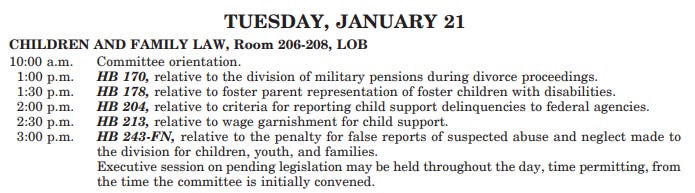
Children and Family Law (HB 170, HB 178, HB 204, HB 213, HB 243-FN)
HB 170 (5 sponsors) prevents military retirement and disability benefits from being divided in divorce.
HB 178 (8 sponsors) clarifies language about foster parents representing children with disabilities.
HB 204 (8 sponsors) requires child support reporting to follow federal thresholds and share arrearage amounts.
HB 213 (9 sponsors) mandates automatic wage garnishment for child support unless an alternative agreement is made and introduces standardized forms.
HB 243-FN (10 sponsors) imposes civil and criminal penalties for intentionally false reports of child abuse or neglect.
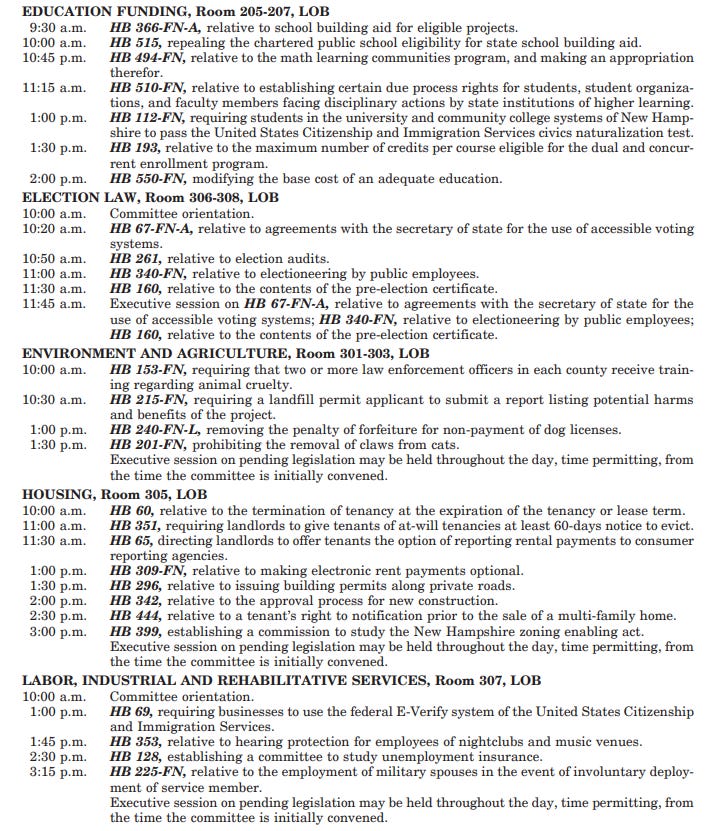
Education Funding (HB 366-FN-A, HB 515, HB 494-FN, HB 510-FN, HB 112-FN, HB 193, HB 550-FN)
HB 366-FN-A (7 sponsors) increases state appropriations for school building aid to at least $60 million annually.
HB 515 (1 sponsor) removes chartered public schools from eligibility for state building-aid grants.
HB 494-FN (1 sponsor) appropriates funds for the Math Learning Communities Program.
HB 510-FN (6 sponsors) enacts due process rights for disciplinary proceedings in state colleges.
HB 112-FN (5 sponsors) requires public university students to pass the U.S. citizenship test for graduation.
HB 193 (5 sponsors) caps the number of credits eligible for dual/concurrent enrollment funding.
HB 550-FN (1 sponsor) raises the base per-pupil cost for an adequate education.
Election Law (HB 67-FN-A, HB 261, HB 340-FN, HB 160)
HB 67-FN-A (2 sponsors) mandates use of accessible voting systems in local elections and provides funding.
HB 261 (6 sponsors) shifts the timing of election audits to occur after recounts in state representative races.
HB 340-FN (6 sponsors) expands the definition of “electioneering” for public employees, outlining prohibited and permitted activities.
HB 160 (8 sponsors) requires more detailed reporting of ballots cast and revises pre-election certificate contents.
Environment and Agriculture (HB 153-FN, HB 215-FN, HB 240-FN-L, HB 201-FN)
HB 153-FN (7 sponsors) requires at least two officers per county to be trained in animal cruelty investigations.
HB 215-FN (9 sponsors) mandates a landfill “net public benefit” report of environmental/health impacts.
HB 240-FN-L (6 sponsors) removes the penalty of dog forfeiture for nonpayment of license fees.
HB 201-FN (8 sponsors) prohibits declawing cats, with certain exceptions.
Housing (HB 60, HB 351, HB 65, HB 309-FN, HB 296, HB 342, HB 444, HB 399)
HB 60 (2 sponsors) allows landlords to end leases of ≥6 months at expiration with 60-days’ notice.
HB 351 (1 sponsor) extends at-will eviction notice to 60 days.
HB 65 (7 sponsors) requires landlords to give tenants the option to report rent payments to credit bureaus.
HB 309-FN (4 sponsors) prohibits landlords from forcing tenants to use electronic rent payments.
HB 296 (1 sponsor) clarifies building permit processes on private roads.
HB 342 (2 sponsors) streamlines local approvals if proposed new construction’s density matches nearby lots.
HB 444 (4 sponsors) gives tenants a 60-day right of first refusal before a multifamily property is sold.
HB 399 (7 sponsors) creates a commission to study the century-old NH Zoning Enabling Act.
Labor, Industrial and Rehabilitative Services (HB 69, HB 353, HB 128, HB 225-FN)
HB 69 (2 sponsors) requires employers to use E-Verify to confirm new hires’ legal work status.
HB 353 (1 sponsor) mandates hearing protection measures for nightclub/music venue employees exposed to loud noise.
HB 128 (1 sponsor) forms a committee to explore possible private-sector alternatives to state-run unemployment insurance.
HB 225-FN (12 sponsors) provides employment protections to military spouses during involuntary mobilization.
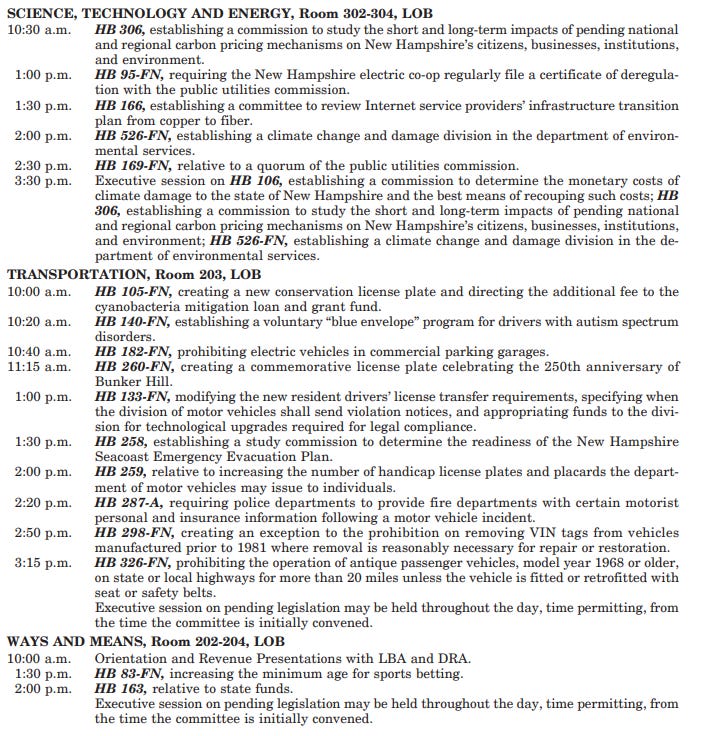
Science, Technology and Energy (HB 306, HB 95-FN, HB 166, HB 526-FN, HB 169-FN)
HB 306 (2 sponsors) creates a commission to study potential impacts of carbon pricing on NH residents and businesses.
HB 95-FN (2 sponsors) requires the NH Electric Co-op to file a certificate of deregulation with the PUC every three years.
HB 166 (5 sponsors) establishes a committee to review the copper-to-fiber transition by Internet providers.
HB 526-FN (1 sponsor) sets up a new “climate change and damage” division in the DES.
HB 169-FN (3 sponsors) changes PUC quorum rules, requiring two-thirds approval regardless of vacancies.
Transportation (HB 105-FN, HB 140-FN, HB 182-FN, HB 260-FN, HB 133-FN, HB 258, HB 259, HB 287-A, HB 298-FN, HB 326-FN)
HB 105-FN (6 sponsors) creates a “Love NH Lakes” license plate to fund cyanobacteria mitigation.
HB 140-FN (13 sponsors) offers an optional “blue envelope” program to help Autistic drivers communicate with law enforcement.
HB 182-FN (1 sponsor) proposes a ban on electric vehicles in commercial parking garages due to potential risks.
HB 260-FN (1 sponsor) creates a commemorative plate for the 250th anniversary of the Battle of Bunker Hill.
HB 133-FN (13 sponsors) modifies driver’s license transfer requirements for new residents, with funding for needed DMV tech upgrades.
HB 258 (3 sponsors) forms a commission to review New Hampshire Seacoast emergency evacuation readiness.
HB 259 (2 sponsors) lets individuals with a walking disability obtain handicapped plates for each vehicle.
HB 287-A (1 sponsor) requires police departments to share accident-related insurance information with fire departments.
HB 298-FN (1 sponsor) allows VIN tags to be removed/reinstalled for pre-1981 vehicle restoration.
HB 326-FN (1 sponsor) mandates seat belts in antique passenger vehicles (model year 1968 or older) for trips >20 miles, with exceptions.
Ways and Means (HB 83-FN, HB 163)
HB 83-FN (4 sponsors) increases the minimum age for sports betting from 18 to 21.
HB 163 (6 sponsors) reorganizes statutes on state funds, aiming to clarify dedicated vs. trust vs. custodial accounts.
Senate Bills: Quick Summary
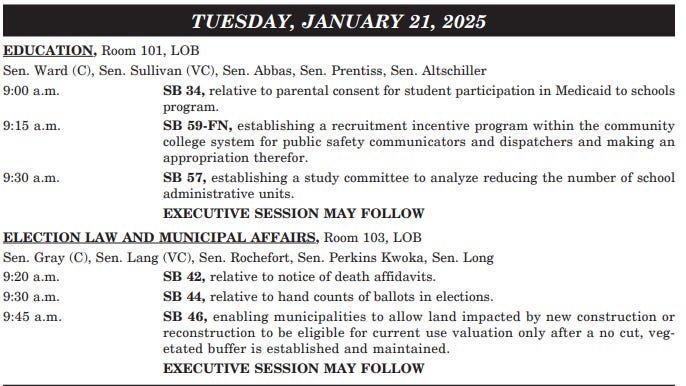
Education (SB 34, SB 59-FN, SB 57)
SB 34 (16 sponsors) requires explicit parental consent for each new Medicaid service provided to a child in school.
SB 59-FN (20 sponsors) expands first-responder recruitment incentives to include public safety communicators/dispatchers.
SB 57 (9 sponsors) creates a committee to study reducing the number of school administrative units (SAUs).
Election Law and Municipal Affairs (SB 42, SB 44, SB 46)
SB 42 (1 sponsor) mandates filing a notice-of-death affidavit when inheriting real property via a transfer-on-death deed.
SB 44 (1 sponsor) lets 100+ voters request a hand recount within 15 days after elections.
SB 46 (1 sponsor) permits municipalities to require a 75-foot no-cut vegetated buffer before newly developed land can qualify for current-use valuation.
Screenshots of House and Senate Calendars
House Calendar
 |
 |
 |
Senate Calendar
 |
In Depth Analysis of All Bills
HB 170
AN ACT relative to the division of military pensions during divorce proceedings.
Sponsor(s): (Prime) Rep. Michael Moffett (R), Rep. Jim Maggiore (D), Rep. Diane Pauer (R), Rep. Mark Pearson (R), Rep. Terry Roy (R)
Selected quote(s) from the bill:
1 Military Retirement and Disability Benefits. Amend RSA 458:16-a, I to read as follows:
… [To the extent permitted by federal law, property shall include military retirement and veterans' disability benefits.] Property shall not include disposable retired pay as defined by 10 U.S.C.A. section 1408.
Summary:
This bill prevents military retirement and veterans' disability benefits from being divided during divorce settlements.
Argument For:
Exempting military pensions from division protects veterans' financial security earned through their service.
Argument Against:
Excluding military benefits from divorce settlements is unfair to non-serving spouses who may have contributed to the marriage.
Hearing: Tuesday, Jan 21 at 1:00 pm in Room 206-208 in the Legislative Office Building and streaming on YouTube.
HB 178
AN ACT relative to foster parent representation of foster children with disabilities.
Sponsor(s): (Prime) Rep. Nancy Murphy (D), Rep. Peter Petrigno (D), Rep. Cassandra Levesque (D), Rep. Loren Selig (D), Rep. Mark Pearson (R), Rep. Susan Elberger (D), Sen. Donovan Fenton (D), Sen. Denise Ricciardi (R)
Selected quote(s) from the bill:
1 Foster Children With Disabilities; Representation. Amend the introductory paragraph of RSA 186-C:14-a, I to read as follows:
I. A foster parent or parents may be appointed by the commissioner of the department of education [that he or she has the knowledge and skills to represent the child adequately in services] or designee
Analysis:
This bill deletes erroneously inserted language regarding child representation to clarify the statute's meaning.
Hearing: Tuesday, Jan 21 at 1:30 pm in Room 206-208 in the Legislative Office Building and streaming on YouTube.
HB 204
AN ACT relative to criteria for reporting child support delinquencies to federal agencies.
Sponsor(s): (Prime) Rep. James Spillane (R), Rep. Debra DeSimone (R), Rep. Erica Layon (R), Rep. Michael Moffett (R), Rep. Mark Pearson (R), Rep. Daniel Popovici-Muller (R), Rep. Jim Kofalt (R), Sen. Daniel Innis (R)
Selected quote(s) from the bill:
1 Duties of the Department of Health and Human Services; Child Support; Compliance with Title IV-D of the Social Security Act. Amend RSA 161:2, XIV to read as follows:
… The department shall maintain an automated system of reporting child support arrearages that complies with the federal guidelines on child support delinquency and shall not report as delinquent any arrearage that does not meet the applicable federal threshold. The system also shall report to the requesting agency the dollar amount of the arrearage if the account is delinquent.
Analysis:
This bill requires the department of health and human services to ensure that the automated system of reporting child support delinquencies meets, but does not exceed, federal guidelines. The bill also directs the department to provide the amount of the arrearage to the requesting agency.
Argument For:
Adhering to federal guidelines ensures that child support arrearage reporting is accurate and standardized, improving accountability and consistency.
Argument Against:
Disclosing the dollar amounts of arrearages to agencies may infringe on individuals' privacy and expose sensitive financial information to potential misuse.
Hearing: Tuesday, Jan 21 at 2:00 pm in Room 206-208 in the Legislative Office Building and streaming on YouTube.
HB 213
AN ACT relative to wage garnishment for child support.
Sponsor(s): (Prime) Rep. James Spillane (R), Rep. Cyril Aures (R), Rep. Debra DeSimone (R), Rep. Terry Roy (R), Rep. Sheila Seidel (R), Rep. Jordan Ulery (R), Rep. Jim Kofalt (R), Sen. Daniel Innis (R), Sen. Keith Murphy (R)
Selected quote(s) from the bill:
1 New Paragraph; Assignment of Income; Notice to Parties. Amend RSA 458-B:2 by inserting after paragraph I the following new paragraph:
I-a. At the time of the hearing the court shall notify each party that their income assignment of wages for child support will be automatic under RSA 458-B:2 unless both parties come to an agreement under another arraignment [sic].
2 New Paragraph; Income Assignment. Amend RSA 458-B:3 by inserting after paragraph I the following new paragraph:
I-a. The circuit court family division shall develop a standard form, which may be an addendum to the child support calculation form, to be presented prior to the temporary hearing for waiving of garnishment of wages, with such form containing the following:
(a) The details of when garnishment of wages will become mandatory.
(b) Allowing for both parties to detail their preferred form of payment arrangement.
(c) Informing the payer that record keeping to prove payments in the event of a discrepancy is their responsibility.
(d) Informing the payee how to report missed payments by the payer.
Summary:
This bill adds restrictions on wage garnishment for child support by requiring courts to notify parties of automatic income assignments and implementing standardized forms for payment arrangements.
Argument For:
Establishing clear notification and standardized procedures ensures that both parties are fully informed and can negotiate fair payment arrangements, promoting transparency and accountability in child support enforcement.
Argument Against:
Imposing additional restrictions and procedural requirements may complicate and delay the wage garnishment process, potentially hindering the timely receipt of child support payments for custodial parents.
Hearing: Tuesday, Jan 21 at 2:30 pm in Room 206-208 in the Legislative Office Building and streaming on YouTube.
HB 243-FN
AN ACT relative to the penalty for false reports of suspected abuse and neglect made to the division for children, youth, and families.
Sponsor(s): (Prime) Rep. James Spillane (R), Rep. Debra DeSimone (R), Rep. Jess Edwards (R), Rep. Katelyn Kuttab (R), Rep. Jeanine Notter (R), Rep. Terry Roy (R), Rep. Sheila Seidel (R), Rep. Jim Kofalt (R), Sen. Bill Gannon (R), Sen. Tim McGough (R)
Selected quote(s) from the bill:
1 Child Protection Act; Reporting Law; Nature of Report; Liability. Amend RSA 169-C:30 and RSA 169-C:31 to read as follows:
169-C:30 Nature and Content of Report. … Reports made to the department may include the name, address, or phone number of the person or persons making the report of suspected abuse or neglect of a child under this chapter. The department may inform the complainant that should the complaint be made maliciously or with the intent to harm, the complainant may be subject to criminal and civil penalties.
169-C:31 Immunity From Liability.
…
II. Nothing in this section shall provide civil or criminal immunity for a professional mandatory reporter who knowingly fails to make a report of suspected abuse or neglect under RSA 169-C:29 or for a person who knowingly files a false report of abuse or neglect with malice or the intent to harm under RSA 169-C:31-a.
2 New Sections; Child Abuse; Intentional False Report; Civil Liability. Amend RSA 169-C by inserting after section 31 the following new sections:
169-C:31-a Intentional False Report of Abuse or Neglect. No person shall maliciously or with the intent to harm make false statements of suspected child abuse or neglect as defined by RSA 169-C:3 to the department, to any court, to any law enforcement agency, to any social services agency, or to any professional mandatory reporter of suspected child abuse identified in RSA 169-C:29. Any person in violation of this section may be subject to civil and criminal liability under RSA 169-C:31-b and RSA 169-C:39, respectively.
169-C:31-b Civil Liability.
I. Any person harmed by the intentional submission of a false report of abuse or neglect under RSA 169-C:31-a may bring a civil action against the responsible party for monetary damages and other appropriate relief.
II. Any person who, in their professional capacity as a mandatory reporter under RSA 169-C:29, knowingly or intentionally fails to report suspected abuse or neglect may be subject to civil liability, including monetary damages, for the harm caused by the failure to report such abuse or neglect.
Summary:
This bill imposes civil and criminal penalties for making false reports of suspected abuse and neglect and holds professional mandatory reporters liable for failing to report such cases.
Argument For:
Imposing penalties ensures that reports of abuse and neglect are made responsibly, reducing malicious false reports and protecting the integrity of the child protection system.
Argument Against:
Holding mandatory reporters liable for failure to report may discourage professionals from making reports due to fear of legal consequences, potentially leading to underreporting of actual abuse and neglect.
Hearing: Tuesday, Jan 21 at 3:00 pm in Room 206-208 in the Legislative Office Building and streaming on YouTube.
House Education Funding
HB 366-FN-A
AN ACT relative to school building aid for eligible projects.
Sponsor(s): (Prime) Rep. Michael Cahill (D), Rep. John Cloutier (D), Rep. Michael Edgar (D), Rep. Toni Weinstein (D), Sen. Donovan Fenton (D), Sen. Rebecca Perkins Kwoka (D), Sen. Pat Long (D)
Selected quote(s) from the bill:
1 School Building Aid; Grants for School Construction. Amend RSA 198:15-a, IV to read as follows:
IV.(a) Beginning July 1, [2013] 2025, and every fiscal year thereafter, school building aid grants for construction or renovation projects approved by the department of education shall not [exceed $50,000,000] total less than $60,000,000 per fiscal year [less any] exclusive of appropriations for debt service payments owed [in the] for previous fiscal [year, unless otherwise provided by an act of the general court] years.
(b) Provided, that at least $5,000,000 per fiscal year of the total in subparagraph (a) shall be awarded to fund one-half of the building aid amount for projects that started construction between July 1, 2009 and June 30, 2019, which would have been eligible for building aid had funding been available for new projects. These projects shall submit a building aid application developed by the department of education and shall be awarded in the ranked order developed pursuant to RSA 198:15-c, II(a) and II(b).
(c) School building aid grants …. Such funds shall be nonlapsing and continually appropriated.
2 School Building Aid; Alternative School Building Aid Grants. Amend RSA 198:15-w to read as follows:
198:15-w Alternative School Building Aid Grants; Procedures. The provisions of RSA 198:15-c through 198:15-h shall apply to any grant made under this subdivision. Provided that grants under RSA 198:15-a, IV(b) for approved alternative school building aid grant applications shall be calculated at 50 percent of the current applicable building aid grant amount pursuant to RSA 198:15-u through RSA 198:15-w for the school district, city, cooperative school district, joint maintenance agreement, or receiving district.
Summary:
This bill increases the minimum annual appropriation for school building aid to at least $60 million and allocates funds for previously approved but unfunded construction and renovation projects.
Argument For:
Raising the minimum funding ensures that more school districts can undertake essential building and renovation projects, improving educational facilities and supporting student learning environments.
Argument Against:
With the state facing significant budget battles this year, allocating additional funds for school building aid is financially unmanageable and could worsen the state's fiscal challenges.
Hearing: Tuesday, Jan 21 at 9:30 am in Room 205-207 in the Legislative Office Building and streaming on YouTube.
HB 515
AN ACT repealing the chartered public school eligibility for state school building aid.
Sponsor(s): (Prime) Rep. Michael Cahill (D)
Selected quote(s) from the bill:
1 School Building Aid; Grants for School Construction; Chartered Public Schools; Requirements Added. Amend RSA 198:15-a, I through III to read as follows:
I. To aid local school districts[and chartered public schools under RSA 194-B] in meeting the costs of school buildings, the department of education shall, from funds appropriated by the general court to carry out the provisions of this subdivision, pay to the school districts [and chartered public schools] of the state, sums in accordance with the provisions of this subdivision[, RSA 198:15-b, I(b)]or the alternative school building aid provisions under RSA 198:15-u through RSA 198:15-w.
…
[II-a. Any chartered public school building to be improved or constructed using school building aid shall be owned by the chartered public school and in the event of a voluntary or involuntary dissolution shall be subject to a plan for the disposition of the chartered public school’s assets, pursuant to RSA 194-B:3, II(z), as approved by the state board of education.]
…
2 School Building Aid; Amount of Grant; Chartered Public Schools. Amend RSA 198:15-b, I(b)(3) to read as follows:
(3) The amount of the grant to any chartered public school established in accordance with RSA 194-B:3-a shall be 30 percent of the eligible cost of construction. [For chartered public school construction projects, the amount of the annual grant to any chartered public school shall be a sum equal to 5 percent of the eligible grant amount each year for 20 years upon approval of the application for school building aid grants by the state board of education. Not more than 10 percent of the eligible grant amount shall be disbursed until the completion of the construction and verification of the final cost of construction have been made by the department of education.]
…
7 Repeal. RSA 194-B:16, IX, relative to charter revocation, is repealed.
Selected quote from relevant law to be repealed:
194-B:16 Charter Revocation; Probation. –
…
IX. In the event of a voluntary or involuntary dissolution of a charter public school, remaining student records maintained by the charter public school shall be forwarded to the department of education, if all records maintained by the public charter school have not been forwarded to the student's district of residence.
Summary:
This bill repeals the eligibility of chartered public schools for state school building aid grants. This bill also repeals RSA 194-B:16, IX, which seems unrelated to the rest of the bill.
Argument For:
Repealing chartered public schools’ eligibility for building aid helps ease the current budget battle by reducing state expenditures.
Argument Against:
Removing building aid grants for chartered public schools limits their ability to improve and expand facilities, potentially harming educational opportunities.
Hearing: Tuesday, Jan 21 at 10:00 am in Room 205-207 in the Legislative Office Building and streaming on YouTube.
HB 494-FN
AN ACT relative to the math learning communities program, and making an appropriation therefor.
Sponsor(s): (Prime) Rep. Rick Ladd (R)
Selected quote(s) from the bill:
1 Math Learning Communities Program in Public Secondary Schools. RSA 193-I is repealed and reenacted to read as follows:
…
193-I:2 Structure and Sequence.
I. The department shall encourage every public high school in the state to consider placement in the program’s courses for students who may benefit from this program. The program of studies will consist of one or more high-school level courses that progress through the mastery of Algebra 2 concepts necessary for college admission and success.? A student who has demonstrated mastery of Algebra 2 concepts shall be considered for dual-enrollment, college-level mathematics courses.
Relevant law to be repealed:
193-I:2 Structure and Sequence. –
I. Eligible students shall have completed or be near completion of algebra I. The department shall encourage every public high school in the state to administer a mathematics assessment to students who may benefit from this program as recommended by a school teacher or guidance counselor and a parent in the spring of grade 10. Students who do not demonstrate an understanding of algebra I on the mathematics assessment and who have the recommendation of a teacher or guidance counselor and a parent may be assigned to course I, advanced math foundations. A student who has demonstrated mastery of algebra I concepts, as demonstrated on the mathematics assessment, shall be considered for either algebra II or course II, quantitative reasoning, or another determined college-level mathematics course.
Analysis:
This bill makes changes to the math learning communities program in public secondary schools, and makes an appropriation therefor.
Note: The bill makes many subtle changes to existing law.
Argument For:
Providing dedicated funding for the Math Learning Communities Program ensures that students who struggle with traditional math courses receive the necessary resources and support to achieve academic success and prepare for postsecondary education and careers.
Argument Against:
Allocating extra funds to this specialized math program may strain limited resources at a time when the state’s finances are already under pressure.
Hearing: Tuesday, Jan 21 at 10:45 am in Room 205-207 in the Legislative Office Building and streaming on YouTube.
HB 510-FN
AN ACT relative to establishing certain due process rights for students, student organizations, and faculty members facing disciplinary actions by state institutions of higher learning.
Sponsor(s): (Prime) Rep. Bob Lynn (R), Rep. Glenn Cordelli (R), Rep. Daniel Popovici-Muller (R), Rep. James Thibault (R), Sen. Timothy Lang (R), Sen. Keith Murphy (R)
Selected quote(s) from the bill:
1 New Chapter; Due Process Protections for Students, Student Organizations, and Faculty Members of New Hampshire Public Post-Secondary Education Institutions. Amend RSA by inserting after chapter 188-J the following new chapter:
…
188-K:3 Due Process Rights Established.
I. In all disciplinary proceedings against a student, student organization, or faculty member, the student, student organization, or faculty member shall be entitled to a hearing under published procedures that include, at a minimum, all of the following:
…
(c) The right to the presumption that no violation occurred. This presumption may be overcome only if the public institution of higher education establishes by a preponderance of the evidence that the violation alleged was committed by the student, student organization, or faculty member charged.
(d) The right against self-incrimination, provided, however, that invocation of this right may afford a basis for the decision-maker to draw an adverse inference against the person who does so.
(e) The right to confront and cross-examine witnesses who provide evidence against the student, student organization, or faculty member.
(f) The right to present a defense and call witnesses in support of the defense.
(g) The right to an impartial hearing officer or panel.
…
(i) The right to have a verbatim record of the hearing made and preserved for use in the event there is an appeal.
…
188-K:5 Applicability of Chapter to Existing Collective Bargaining Agreements. If the rights afforded to faculty members under this chapter conflict with grievance or disciplinary procedures established under a valid collective bargaining agreement between a public institution of higher education and a union representing faculty members of such institution that is in effect when this chapter becomes effective, the grievance or disciplinary procedures provided for in the collective bargaining agreement rather than those provided by this chapter shall apply … From and after the effective date of this chapter, no public institution of higher education and no union representing faculty members of such institution shall enter into any new collective bargaining agreement, nor extend the expiration date of an existing collective bargaining agreement, which contains grievance or disciplinary procedures less protective of faculty members’ due process rights than those established by this chapter.
Summary:
This bill establishes specific due process rights for students, student organizations, and faculty members in disciplinary proceedings at public colleges and universities in New Hampshire.
In cases where this process conflicts with existing collective bargaining agreements, the collective bargaining agreement procedure will supersede this section, but in new collective bargaining agreements, new processes must be at least as protective of faculty due process rights.
Argument For:
Ensuring robust due process in these proceedings promotes fairness and transparency, though the resulting increased administrative costs become more difficult given the coming budget fight.
Argument Against:
Imposing new procedural mandates could unduly burden public institutions of higher learning with significant ongoing legal and administrative expenses.
Hearing: Tuesday, Jan 21 at 11:15 am in Room 205-207 in the Legislative Office Building and streaming on YouTube.
HB 112-FN
AN ACT requiring students in the university and community college systems of New Hampshire to pass the United States Citizenship and Immigration Services civics naturalization test.
Sponsor(s): (Prime) Rep. Michael Moffett (R), Rep. Mike Belcher (R), Rep. Maureen Mooney (R), Rep. Julius Soti (R), Sen. Howard Pearl (R)
Selected quote(s) from the bill:
1 New Section; University System of New Hampshire; Civics Graduation Requirement. Amend RSA 187-A by inserting after section 16-c the following new section:
187-A:16-d Civics Graduation Requirement. Every student admitted or transferring to an institution in the university system of New Hampshire on or after January 1, 2026 shall, as a requirement for graduation and in addition to any other baccalaureate degree graduation requirements, show proof of having passed the 128-question 2020 version of the United States Citizenship and Immigration Services naturalization test with a score of 70 or better, or shall be required take and pass such test with a score of 70 or greater. University system of New Hampshire institutions shall establish procedures to administer, certify, and record results of this assessment for students needing to satisfy this requirement. Exchange students and foreign nationals shall be exempt from this section.
Analysis:
This bill requires university system and community college system students, as a requirement for graduation, to pass the 2020 version of the United States Citizenship and Immigration Services naturalization test.
Argument For:
Requiring the civics naturalization test ensures that graduates possess essential knowledge of U.S. government and civic responsibilities, enhancing their readiness for informed citizenship and societal participation.
Argument Against:
Implementing this requirement imposes additional administrative costs on public higher education institutions, which is increasingly challenging given the upcoming budget constraints.
Hearing: Tuesday, Jan 21 at 1:00 pm in Room 205-207 in the Legislative Office Building and streaming on YouTube.
HB 193
AN ACT relative to the maximum number of credits per course eligible for the dual and concurrent enrollment program.
Sponsor(s): (Prime) Rep. Rick Ladd (R), Rep. Glenn Cordelli (R), Rep. David Luneau (D), Rep. Patricia Cornell (D), Sen. Timothy Lang (R)
Selected quote(s) from the bill:
1 Dual and Concurrent Enrollment Program; Enrollment Requirements. Amend RSA 188-E:27, II to read as follows:
II. A student in the program shall be provided funding for enrollment in no more than 4 dual or concurrent enrollment courses taken in grade 10, no more than 4 dual or concurrent enrollment courses taken in grade 11, and no more than 4 dual or concurrent enrollment courses taken in grade 12. Each course funded pursuant to this paragraph shall not exceed 4 credits. A student may take more than 4 dual or concurrent enrollment courses per year, or courses exceeding 4 credits, at his or her own expense.
Summary:
This bill clarifies that each dual or concurrent enrollment course eligible for state funding cannot exceed four credits and limits state-funded dual or concurrent enrollment courses to four per student each in grades 10, 11, and 12, while allowing additional courses or credits to be taken at the student's own expense.
Argument For:
Establishing clear credit limits for state-funded dual and concurrent enrollment courses ensures efficient allocation of education resources, thereby supporting efforts to manage the upcoming budget challenges.
Argument Against:
Restricting the number of state-funded dual and concurrent enrollment credits may limit students' access to more extensive advanced coursework, potentially hindering their academic and career development.
Hearing: Tuesday, Jan 21 at 1:30 pm in Room 205-207 in the Legislative Office Building and streaming on YouTube.
HB 550-FN
AN ACT modifying the base cost of an adequate education.
Sponsor(s): (Prime) Rep. David Luneau (D)
Selected quote(s) from the bill:
1 Cost of an Opportunity for an Adequate Education. Amend RSA 198:40-a, I-II(a) to read as follows:
…
II.(a) A cost of [$4,100] $7,356.01 per pupil in the ADMR, plus differentiated aid as follows:
2 Cost of an Adequate Education. Amend RSA 193-E:2-b, I to read as follows:
I. … The necessary specific resource elements shall include the costs for teachers, teacher benefits, student teacher ratios, principals, administrative assistants, school counselors, library-media specialists, technology coordinators, custodians, nurse services, instructional materials, technology, professional development, facilities operation and maintenance, and transportation. The general court shall update the cost of an adequate education at least every 2 years. The general court shall use evidence from actual costs from all approved schools to determine the cost of an adequate education.
Summary:
This bill increases the base cost per pupil for an adequate education and broadens its definition, resulting in significantly higher state funding allocations to education programs.
Argument For:
Enhancing the base cost and expanding the definition of an adequate education ensures that schools are properly funded to provide essential resources and support, leading to improved educational quality and student outcomes.
Argument Against:
The substantial increase in education spending strains the state’s financial resources, making it more challenging to address other budgetary needs amidst the upcoming budget fight.
Hearing: Tuesday, Jan 21 at 2:00 pm in Room 205-207 in the Legislative Office Building and streaming on YouTube.
House Election Law
HB 67-FN-A
AN ACT relative to agreements with the secretary of state for the use of accessible voting systems.
Sponsor(s): (Prime) Rep. Mark Paige (D), Rep. Robert Wherry (R)
Selected quote(s) from the bill:
659:20-b Accessible Voting Systems.
…
(b) ?Enter into [a pilot] an agreement with the secretary of state for the use of accessible voting systems in local elections.
…
(a) ?Enter into [a pilot program] an agreement with cities and towns and provide accessible voting systems for use in city, town, and school elections.
…
3 Appropriation; Secretary of State. There is hereby appropriated to the secretary of state the sum of $100,000 to be deposited into the election fund established in RSA 5:6-d for the fiscal year ending June 30, 2025 for the purpose of funding accessible voting systems pursuant to RSA 659:20-b.
Selected quote from existing law:
4 Repeal. The following are repealed:
I. RSA 659:20-b, I(b) relative to cities, towns, and school districts entering into a pilot agreement with the secretary of state for the use of accessible voting systems in local elections.
II. RSA 659:20-b, II(a) relative to cities, towns, and school districts entering into a pilot program with the secretary of state for the use of accessible voting systems for use in local elections.
Summary:
This bill requires cities, towns, and school districts in New Hampshire to enter into agreements with the secretary of state for the use of accessible voting systems in local elections, replaces previous pilot programs, and appropriates $100,000 from the General Fund to support these initiatives.
Argument For:
Mandating accessible voting systems ensures equitable participation in elections for individuals with disabilities, thereby promoting inclusive democratic processes.
Argument Against:
The additional spending required to implement and maintain accessible voting systems imposes financial strain on local jurisdictions, which is particularly challenging given the upcoming budget fight.
Hearing: Tuesday, Jan 21 at 10:20 am in Room 306-308 in the Legislative Office Building and streaming on YouTube.
HB 261
AN ACT relative to election audits.
Sponsor(s): (Prime) Rep. Ross Berry (R), Rep. Robert Wherry (R), Rep. Alvin See (R), Rep. Judy Aron (R), Rep. Michael Aron (R), Rep. Brian Cole (R)
Selected quote(s) from the bill:
1 Recount of Additional Officers On Ballots Involved in Recounts; Audits. Amend the introductory paragraph of RSA 660:17-b to read as follows:
660:17-b Recount of Additional Offices on Ballots Involved in Recounts.
For general election recounts of state representative races, … [in addition to] after recounting the state representative race:
2 Recount and Audit Procedures. Amend RSA 660:17-c to read as follows:
660:17-c Recount and Audit Procedures; Publication. The secretary of state … shall complete any audit conducted under this chapter [prior to the commencement] after the completion of a recount for any recount requested.
Summary:
This bill changes the timing of election audits to occur after the completion of recounts in state representative races.
Argument For:
Adjusting the timing of election audits enhances the accuracy and reliability of election results by ensuring audits verify finalized recounts.
Argument Against:
Delaying election audits until after recounts may prolong the resolution of election disputes, potentially reducing public confidence in the electoral process.
Hearing: Tuesday, Jan 21 at 10:50 am in Room 306-308 in the Legislative Office Building and streaming on YouTube.
HB 340-FN
AN ACT relative to electioneering by public employees.
Sponsor(s): (Prime) Rep. Ross Berry (R), Rep. Joe Alexander (R), Rep. Travis Corcoran (R), Rep. Lisa Mazur (R), Rep. Sheila Seidel (R), Sen. Keith Murphy (R)
Selected quote(s) from the bill:
1 Electioneering by Public Employees. RSA 659:44-a is repealed and reenacted to read as follows:
659:44-a Electioneering by Public Employees.
…
III. For the purposes of this section, "electioneer" means to act in any way designed or having the effect of influencing the vote of a voter on any question or office, including but not limited to:
(a) Distributing or displaying campaign materials for a campaign during an officially declared election period in an unbiased manner.
(b) Making public statements in favor of or against any candidate, political party, or measure.
(c) Organizing or conducting surveys, forums, or events that are expressly or primarily political.
(d) Using official authority or influence to interfere with or affect the vote of a voter.
VI. Nothing in this section shall prohibit:
(a) Lawful participation by candidates, political parties, or private groups in public parades, fairs, festivals, or similar events, including the display of campaign materials or the solicitation of voter support, provided such participation is conducted in accordance with applicable laws and regulations and does not intentionally favor one candidate, party, or measure over another.
…
VII. Any person who violates this section shall be guilty of a misdemeanor.
Current law:
659:44-a Electioneering by Public Employees. –
I. No public employee, as defined in RSA 273-A:1, IX,shall electioneer while in the performance of his or her official duties.
II. No public employee shall use government property or equipment, including, but not limited to, telephones, facsimile machines, vehicles, and computers, for electioneering.
III. For the purposes of this section, "electioneer" means to act in any way specifically designed to influence the vote of a voter on any question or office.
IV. Any person who violates this section shall be guilty of a misdemeanor.
Summary:
This bill amends RSA 659:44-a to expand the definition of "electioneer" and clarify prohibited activities for public employees regarding electioneering. Specifically:
Added Text:
Section III: Expands the definition of "electioneer" to include actions such as distributing unbiased campaign materials, making public statements for or against candidates or measures, organizing political events, and using official authority to influence votes.
Section VI: Introduces exceptions that permit lawful participation by candidates, political parties, or private groups in public events, use of public spaces by private entities for political activities, neutral voter registration drives by public employees, and providing factual information about candidates in an impartial manner.
Section VII: Updates the penalty clause, specifying that any violation shall be classified as a misdemeanor.
Removed Text:
Section III: The original definition of "electioneer" was narrower, limited to actions specifically designed to influence a voter's decision without the detailed examples now provided.
Section IV: The original penalty clause was replaced by the new Section VII.
Argument For:
Expanding the definition of "electioneer" and providing clear examples ensures that public employees maintain impartiality during elections, thereby upholding the integrity of the democratic process. The added exceptions allow for necessary and lawful political activities without overburdening public employees, fostering a fair and unbiased electoral environment.
Argument Against:
The broader definition of "electioneer" may lead to increased scrutiny and potential overreach in monitoring public employees' activities, possibly infringing on their personal freedoms. Additionally, the changes could create ambiguity in enforcement, leading to uncertainty among public employees about what constitutes a violation and increasing the risk of inadvertent misdemeanors.
Hearing: Tuesday, Jan 21 at 11:00 am in Room 306-308 in the Legislative Office Building and streaming on YouTube.
HB 160
AN ACT relative to the contents of the pre-election certificate.
Sponsor(s): (Prime) Rep. Claudine Burnham (R), Rep. Aidan Ankarberg (I), Rep. Ross Berry (R), Rep. Tom Mannion (R), Rep. Sandra Panek (R), Rep. John Sellers (R), Rep. Robert Wherry (R), Rep. Clayton Wood (R)
Selected quote(s) from the bill:
1 Pre-Election Certificate. Amend RSA 658:32 to read as follows:
658:32 Pre-Election Certificate.
I. … the moderator and clerk shall certify thereon the following:
(a) [Total number of ballots received.] The total number of absentee ballots received from the secretary of state.
(b) The number of absentee ballots mailed to voters.
(c) The number of absentee ballots spoiled.
(d) The number of absentee ballots remaining at the close of polls.
…
(i) The number of general election ballots remaining.
(j) The total number of ballots cast.
…
3 General Content of Return. Amend RSA 659:73, V-VI to read as follows:
V. [The moderator shall record and sign a ballots cast form prepared by the secretary of state within 48 hours of the closing of the polls, or other time ordered by the secretary of state, and shall submit the form to the secretary of state, with a copy to the clerk. The ballots cast form shall include, but not be limited to:
(a) The number of official election day ballots cast;
(b) The number of absentee ballots cast;
(c) The number of federal office only cast; and
(d) The total number of ballots cast.
Summary:
This bill requires more detailed information in pre-election and post-election certificates and allows clerks to mandate earlier completion of these forms.
Argument For:
Enhancing certificate details and enabling earlier reporting improves electoral transparency and accountability.
Argument Against:
Increased reporting requirements may burden local clerks and complicate the election process.
Hearing: Tuesday, Jan 21 at 11:30 am in Room 306-308 in the Legislative Office Building and streaming on YouTube.
House Environment and Agriculture
HB 153-FN
AN ACT requiring that two or more law enforcement officers in each county receive training regarding animal cruelty.
Sponsor(s): (Prime) Rep. Barbara Comtois (R), Rep. Judy Aron (R), Rep. Peter Bixby (D), Rep. Catherine Kenny (R), Sen. Daniel Innis (R), Sen. Howard Pearl (R), Sen. Ruth Ward (R)
Selected quote(s) from the bill:
1 New Section; The State Police; Cooperation with Other Police Forces on Animal Cruelty Cases. Amend RSA 106-B by inserting after section 11 the following new section:
106-B:11-a Cooperation with Other Police Forces on Animal Cruelty Cases. The commissioner of the department of safety shall ensure that in every county there is at least one state trooper who is trained in investigations under RSA 644:8 regarding cruelty to animals through instruction …
2 New Section; Sheriffs and Constables; Cooperation with Other Police Forces on Animal Cruelty Cases. Amend RSA 104 by inserting after section 6 the following new section:
104:6-a Cooperation with Local Police Forces on Animal Cruelty Cases. Each sheriff in each county shall ensure that there is at least one deputy sheriff who is trained in investigations under RSA 644:8 regarding cruelty to animals through instruction …
Summary:
This bill requires that two or more law enforcement officers in each county receive training regarding animal cruelty investigations to assist local agencies.
Argument For:
Enhanced training equips law enforcement with the necessary skills to effectively investigate and prevent animal cruelty, thereby improving animal welfare and community safety.
Argument Against:
Implementing the required training may impose additional costs on law enforcement agencies, potentially straining their existing budgets and resources.
Hearing: Tuesday, Jan 21 at 10:00 am in Room 301-303 in the Legislative Office Building and streaming on YouTube.
HB 215-FN
AN ACT requiring a landfill permit applicant to submit a report listing potential harms and benefits of the project.
Sponsor(s): (Prime) Rep. Nicholas Germana (D), Rep. Peter Bixby (D), Rep. James Gruber (D), Rep. Seth King (R), Rep. Kelley Potenza (R), Rep. Jared Sullivan (D), Rep. Wendy Thomas (D), Sen. Donovan Fenton (D), Sen. David Rochefort (R)
Selected quote(s) from the bill:
1 Public Benefit Requirement; Net Public Benefit. Amend RSA 149-M:11, III to read as follows:
III. The department shall determine whether a proposed solid waste facility provides a [substantial] net public benefit based upon the following criteria:
…
(d) To assist the department in the determination of net public benefit, an assessment shall be conducted on behalf of the host community and/or other abutting municipalities by an independent third-party and the costs for such assessment shall be borne by the applicant. This assessment shall include harms that a landfill would likely cause by identifying and determining any potentially harmful impacts on human health, property values, tourism, outdoor recreation, and wildlife. Such impacts may include noise, odor, traffic, groundwater pollution, surface water pollution, greenhouse gas, and other emissions emanating from the facility and to include the emissions from transport of solid waste-related material and by-products to and from the proposed facility.
2 New Subparagraphs; Satisfaction of Capacity Need. Amend RSA 149-M:11, V by inserting after subparagraph (d) the following new subparagraphs:
(e) For an applicant seeking to expand an existing and fully permitted RCRA Subtitle D landfill, the department shall find that the expansion will satisfy the state’s capacity need if, during the years for which the permit shall be granted, the state will face a capacity shortfall for at least one-half of those years.
(f) For an applicant seeking to develop a new landfill at a site where none currently exists, the department shall find that the new project will satisfy the state’s capacity need if, during the years for which the permit shall be granted, the state will face a capacity shortfall for at least one-half of those years. However, the department shall not allow the new landfill to begin accepting waste until the first year in which a shortfall is expected to exist.
3 Public Benefit Requirement; Net Public Benefit. Amend RSA 149-M:11, VIII to read as follows:
VIII. Each applicant for a solid waste permit under this chapter shall have the burden of demonstrating that a proposed solid waste facility provides a net public benefit by showing how the proposed facility satisfies the criteria listed under paragraph III. Such demonstration shall be included as part of each application for a solid waste permit. The net public benefit of a proposed operation or project shall be limited solely to an evaluation of that project and may not be mitigated or enhanced in relation to any other unrelated project.
4 Public Benefit Required; Net Public Benefit. Amend RSA 149-M:11, XI to read as follows:
XI. Facilities permitted under this chapter shall be operated so as to provide a [substantial] net public benefit …
Summary:
This bill requires a landfill permit applicant to submit a report detailing the potential harms and benefits of the project and mandates the Department of Environmental Services to determine that the landfill provides a net public benefit.
Argument For:
Ensuring that landfill projects offer a net public benefit promotes environmentally responsible waste management and safeguards community interests.
Argument Against:
The additional reporting and evaluation requirements may increase administrative burdens and costs for both the Department and landfill applicants.
Hearing: Tuesday, Jan 21 at 10:30 am in Room 301-303 in the Legislative Office Building and streaming on YouTube.
HB 240-FN-L
AN ACT removing the penalty of forfeiture for non-payment of dog licenses.
Sponsor(s): (Prime) Rep. Tom Mannion (R), Rep. Sandra Panek (R), Rep. Jeffrey Tenczar (R), Rep. Ross Berry (R), Rep. Tim Mannion (R), Sen. Daryl Abbas (R)
Selected quote(s) from the bill:
2 Muzzling and Restraining Dogs; Officers' Fees; Reference Removed. Amend RSA 466:32 to read as follows:
466:32 Officers' Fees. Police officers or constables shall be compensated for service under RSA 466:31 [as provided in RSA 466:15].
3 Repeal. The following are repealed:
I. RSA 466:14, relative to warrants and proceedings for failure to license a dog.
II. RSA 466:15, relative to payment of officers for enforcing the forfeiture of dogs.
III. RSA 466:16, relative to the forfeiture of dogs for nonpayment of fees.
Current law to be repealed:
466:14 Warrants; Proceedings. – … The local governing body shall, within 20 days from June 20, issue a warrant to a local official authorized to issue a civil forfeiture for each unlicensed dog. The warrant may also authorize a local law enforcement officer to seize any unlicensed dog. …
466:15 Fees. – Such officers, other than those employed under regular pay, shall receive such compensation for services performed under RSA 466:14 as may be determined by the mayor of the city or the selectmen of the town in which such dogs are seized and held.
466:16 Returns. – …
Summary:
This bill removes the penalty of forfeiture for non-payment of dog licenses.
Argument For:
Eliminating forfeiture penalties may reduce administrative and judicial burdens on dog owners and law enforcement.
Argument Against:
Removing forfeiture penalties could lead to decreased revenue for local governments and weaken enforcement of dog licensing laws.
Hearing: Tuesday, Jan 21 at 1:00 pm in Room 301-303 in the Legislative Office Building and streaming on YouTube.
HB 201-FN-LOCAL
AN ACT prohibiting the removal of claws from cats.
Sponsor(s): (Prime) Rep. Mike Bordes (R), Rep. Charlie St. Clair (D), Rep. Douglas Trottier (R), Rep. Ellen Read (D), Rep. Nicholas Germana (D), Rep. Christine Seibert (D), Rep. Timothy Soucy (D), Sen. Daryl Abbas (R)
Selected quote(s) from the bill:
1 New Section; Removal of Claws from Cats. Amend RSA 644 by inserting after section 8-g the following new section:
644:8-h Removal of Claws from Cats Prohibited.
I. No person shall remove the claws of a cat by performing an onychectomy, partial or complete phalangectomy, or a tendonectomy, by any means, on a cat except when necessary in order to address the physical medical condition of the cat, such as an existing or recurring illness, infection, disease, injury, or abnormal condition in the claw that compromises the cat's health. No person shall remove the claws of a cat for cosmetic or aesthetic reasons or for reasons of convenience in keeping or handling the cat.
II. Any person who violates this section shall be guilty of a violation and subject to a civil penalty of $500 for the first violation, $1,000 for the second violation, and $2,500 for any subsequent violation.
Summary:
This bill prohibits the removal of a cat’s claws, except for medical necessity, and establishes penalties for violations.
Argument For:
This bill protects cats from unnecessary and harmful declawing procedures, aligning with humane treatment standards and veterinary best practices.
Argument Against:
This bill may limit pet owners' options to manage cats with behavioral challenges, potentially leading to more cats being surrendered to shelters.
Hearing: Tuesday, Jan 21 at 1:30 pm in Room 301-303 in the Legislative Office Building and streaming on YouTube.
House Housing
HB 60
AN ACT relative to the termination of tenancy at the expiration of the tenancy or lease term.
Sponsor(s): (Prime) Rep. Bob Lynn (R), Rep. Sheila Seidel (R)
Selected quote(s) from the bill:
1 New Subparagraph; Termination of Tenancy; Expiration of Term. Amend RSA 540:2, II by inserting after subparagraph (h) the following new subparagraph:
(i) For a lease or tenancy the original term of which is 6 months or longer, or for a lease or tenancy the term of which is less than 6 months, but which has been renewed for a total period of 6 months or longer, the expiration of the term of the lease or tenancy, provided that the landlord has provided the tenant with written notice at least 60 days in advance of the termination date of the lease term that the lease will not be renewed and that the tenant must vacate the rental property at the end of the lease term.
Summary:
This bill allows landlords to terminate tenancies at the end of a lease term of six months or longer by requiring a 60-day written notice to tenants.
Argument For:
Providing landlords with the ability to end leases more flexibly can improve property management and investment returns.
Argument Against:
Mandating a 60-day notice period may reduce housing stability for tenants and increase their vulnerability.
Hearing: Tuesday, Jan 21 at 10:00 am in Room 305 in the Legislative Office Building and streaming on YouTube.
HB 351
AN ACT requiring landlords to give tenants of at-will tenancies at least 60-days notice to evict.
Sponsor(s): (Prime) Rep. Matthew Pitaro (R)
Selected quote(s) from the bill:
1 Eviction Notice. Amend RSA 540:3, II to read as follows:
II. For all residential tenancies, [30] 60 days' notice shall be sufficient in all cases
Summary:
This bill requires landlords to give tenants of at-will tenancies at least 60-days notice to evict.
Argument For:
Providing a longer notice period ensures tenants have sufficient time to secure alternative housing, promoting fairness and stability.
Argument Against:
Mandating a 60-day notice period may limit landlords' flexibility in managing their properties and responding to market demands.
Hearing: Tuesday, Jan 21 at 11:00 am in Room 305 in the Legislative Office Building and streaming on YouTube.
HB 65
AN ACT directing landlords to offer tenants the option of reporting rental payments to consumer reporting agencies.
Sponsor(s): (Prime) Rep. Loren Selig (D), Rep. Allan Howland (D), Rep. Alissandra Murray (D), Rep. Efstathia Booras (D), Rep. Christal Lloyd (D), Rep. Jennifer Mandelbaum (D), Sen. Rebecca Perkins Kwoka (D)
Selected quote(s) from the bill:
1 New Section; Election to Have Rental Payments Reported to Consumer Reporting Agencies. Amend RSA 359-B by inserting after section 4-a the following new section:
359-B:4-b Election to Report Rental Payments to Consumer Reporting Agencies.
…
II. Landlords shall offer their tenants the option of having the tenant’s rental payment information reported to at least one nationwide consumer reporting agency or any other consumer reporting agency so long as the consumer reporting agency resells or otherwise furnishes rental payment information to a nationwide consumer reporting agency.
III. The offer of rent reporting shall be made at the time of the lease agreement and at least once annually thereafter. For lease agreements made prior to January 1, 2026, the offer of rent reporting shall be made no later than April 1, 2026, and at least once annually thereafter.
IV. The offer of rent reporting shall include a written election of rent reporting that includes all of the following:
(a) A statement that reporting of the tenant’s rental payment information is optional.
(b) Identification of each consumer reporting agency to which rental payment information will be reported.
(c) A statement that all of the tenant’s rental payments will be reported, regardless of whether the payments are timely, late, or missed.
(d) The amount of any fee charged pursuant under this section.
(e) Instructions on how to submit the written election of rent reporting to the landlord by mail.
(f) A statement that the tenant may opt into rent reporting at any time following the initial offer by the landlord.
(g) A statement that the tenant may elect to stop rent reporting at any time, but that they will not be able to resume rent reporting for at least six months from the same landlord after their election to opt out.
(h) Instructions on how to opt out of reporting rental payment information.
(i) A signature block that the tenant shall date and sign in order to accept the offer of rent reporting.
Summary:
This bill directs landlords to offer tenants of residential tenancies the option to have their rental payments reported to consumer reporting agencies by providing a written election form and outlining the terms and conditions for such reporting.
Argument For:
Offering rental payment reporting can help tenants build their credit histories, enhancing their financial opportunities and incentivizing timely rent payments.
Argument Against:
Requiring landlords to provide rental reporting options may impose additional administrative burdens and potential costs, potentially discouraging some landlords from renting their properties.
Hearing: Tuesday, Jan 21 at 12:30 am in Room 305 in the Legislative Office Building and streaming on YouTube.
HB 309-FN
AN ACT relative to making electronic rent payments optional.
Sponsor(s): (Prime) Rep. Maureen Mooney (R), Rep. Bill Boyd (R), Rep. Julie Miles (R), Sen. Daniel Innis (R)
Selected quote(s) from the bill:
1 New Paragraph; Prohibited Practice and Security Deposits; Certain Specific Acts Prohibited. Amend RSA 540-A:3 by inserting after paragraph IX the following new paragraph:
X. A landlord shall not require a tenant or prospective tenant to pay any amount due under a residential lease, renewal, or extension agreement via electronic funds transfer, including, but not limited to, any automatic, recurring electronic funds transfers.
Summary:
This bill prohibits landlords from mandating electronic funds transfers for rent payments, thereby making electronic rent payments optional for tenants.
Argument For:
Allowing tenants to choose their preferred payment method enhances financial accessibility and accommodates diverse preferences.
Argument Against:
Restricting landlords from requiring electronic payments may reduce efficiency in rent collection and increase administrative burdens.
Hearing: Tuesday, Jan 21 at 1:00 pm in Room 305 in the Legislative Office Building and streaming on YouTube.
HB 296
AN ACT relative to issuing building permits along private roads.
Sponsor(s): (Prime) Rep. Rick Ladd (R)
Selected quote(s) from the bill:
1 Regulation of Subdivision of Land; Erection of Buildings on Streets; Appeals. Amend RSA 674:41, I(d)(1) to read as follows:
(1) The local governing body, after review and comment by the planning board or after establishing that the private road identifies and complies with policy adopted by the governing body of the municipality, has voted to authorize the issuance of building permits for the erection of buildings on said private road or portion thereof …'
Summary:
This bill directs local governing bodies to offer an alternative pathway for issuing building permits along private roads, allowing them to bypass the planning board when municipal policies are met.
Argument For:
Providing an alternative permit approval process can accelerate construction projects and reduce bureaucratic hurdles, enhancing development efficiency.
Argument Against:
Allowing governing bodies to bypass the planning board may undermine comprehensive planning oversight, leading to potential regulatory gaps and increased risk of poorly planned developments.
Hearing: Tuesday, Jan 21 at 1:30 pm in Room 305 in the Legislative Office Building and streaming on YouTube.
HB 342
AN ACT relative to the approval process for new construction.
Sponsor(s): (Prime) Rep. Patrick Long (D), Sen. Daniel Innis (R)
Selected quote(s) from the bill:
1 New Section; Property Density Conformity and Building Without Variance Innovative. Amend RSA 674 by inserting after section 21-a the following new section:
674:21-b Property Density Conformity and Building Without Variance.
…
II. Notwithstanding any other provisions of law to the contrary, property owners shall be allowed to build on their property without seeking a variance for minimum lot size or percentage of lot coverage if the proposed building conforms to the density of the neighborhood as follows:
(a) The building density shall not exceed that of the 10 percent most densely built properties within a 1000-foot radius of the property.
(b) Conformity shall be assessed based on the density of 90 percent of the properties within the 1000-foot radius.
III. The local planning boards shall be responsible for verifying that the proposed building conforms to the density requirements under this section.
IV. Property owners seeking to build shall submit a density conformity assessment to the local planning board for review and approval.
Summary:
This bill allows property owners to build on their property without seeking a variance for minimum lot size or lot coverage if the proposed building density conforms to that of the surrounding neighborhood, as verified by the local planning board.
Argument For:
Streamlining the building approval process by eliminating variance requirements when density aligns with the neighborhood promotes efficient development and reduces bureaucratic delays. This could work toward alleviating the housing crisis.
Argument Against:
Removing variance requirements may limit flexibility for property owners to adapt to unique circumstances and could lead to inconsistent development standards within neighborhoods.
Hearing: Tuesday, Jan 21 at 2:00 pm in Room 305 in the Legislative Office Building and streaming on YouTube.
HB 444
AN ACT relative to a tenant's right to notification prior to the sale of a multi-family home.
Sponsor(s): (Prime) Rep. Ellen Read (D), Rep. Cassandra Levesque (D), Rep. David Preece (D), Rep. Christine Seibert (D)
Selected quote(s) from the bill:
1 New Section; Actions Against Tenants; Tenants' Right to Notification Prior to Sale. Amend RSA 540 by inserting after section 30 the following new section:
540:31 Notice Required Before Sale.
No owner of a restricted multi-family residential property shall make a final unconditional acceptance of any offer for the sale or transfer of the property without first giving 60 days' notice and the opportunity to make an offer to each tenant in the same manner and according to the same procedures required of a manufactured housing park owner in RSA 205-A:21, except that the New Hampshire Manufactured Housing Association shall not be included in any process.
Quote from relevant current law:
205-A:21 Notice Required Before Sale. –
I. No manufactured housing park owner shall make a final unconditional acceptance of any offer for the sale or transfer of a manufactured housing park without first giving 60 days' notice:…
II. During the notice period required under paragraph I, the manufactured housing park owner shall consider any offer received from the tenants or a tenants' association, if any, and the owner shall negotiate in good faith with the tenants concerning a potential purchase. If during the notice period, the tenants decide to make an offer to purchase the manufactured housing park, such offer shall be evidenced by a purchase and sale agreement; however, the tenants shall have a reasonable time beyond the 60-day period, if necessary, to obtain financing for the purchase.
Summary:
This bill requires owners of restricted multi-family residential properties to provide tenants with 60-days' notice and an opportunity to make an offer to purchase the property before finalizing any sale or transfer.
Argument For:
Allowing tenants the chance to purchase their homes enhances housing stability and empowers tenants to maintain their living situations.
Argument Against:
Mandating purchase opportunities can complicate and delay property sales, potentially discouraging investment and reducing the availability of rental housing.
Hearing: Tuesday, Jan 21 at 2:30 pm in Room 305 in the Legislative Office Building and streaming on YouTube.
HB 399
AN ACT establishing a commission to study the New Hampshire zoning enabling act.
Sponsor(s): (Prime) Rep. Joe Alexander (R), Rep. Jason Osborne (R), Rep. Alexis Simpson (D), Rep. Joe Sweeney (R), Sen. Mark McConkey (R), Sen. Keith Murphy (R), Sen. Tara Reardon (D)
Selected quote(s) from the bill:
674:16-b Commission Established. There is established a commission to study the historical evolution of New Hampshire’s zoning enabling act, currently codified at RSA 674:16. The legislative intent is to study the evolution of the New Hampshire Zoning Enabling Act as it turns 100 this year. The goal is to see how the New Hampshire Zoning Enabling Act has changed over time and to consider and make recommendations for future legislation on the balance of zoning powers between the state and municipalities.
…
III. The commission shall:
(a) Study the policy problem that the drafters of the Standard State Zoning Enabling Act intended to solve with the “Grant of Power” section, as enacted by the New Hampshire legislature in RSA 674:16.
(b) Determine if that problem or those problems are still relevant today, whether in whole or in part.
(c) Evaluate if RSA 674:16 has been effective in resolving that problem or problems.
(d) Examine whether the regulatory powers granted by RSA 674:16 were intended to be plenary or limited to those stated.
(e) Assess how those powers have been construed by courts and by local legislators over the years.
(f) Determine if the listed powers are still appropriate and/or applicable today, and if any could be removed or if any not present should be added.
(g) Similarly, assess if the listed purposes in RSA 674:17 are still appropriate or applicable today, and if any could be removed or if any not present should be added.
(h) Identify legislative alternatives to the approach taken by the Standard State Zoning Enabling Act, including any adopted by other states, and consider RSA 674:25, an enabling act for adopting interim zoning ordinances.
(i) Identify elements of the other sections of the Standard State Zoning Enabling Act, as codified at RSA 674:16-23, that would benefit from examination and potential revision.
(j) Investigate the relationship between the zoning provisions of RSA 674:16 et seq. and the subdivision provisions of RSA 674:35 et seq., and explore opportunities for aligning or combining these provisions.
…
2 Repeal. RSA 674:16-b, relative to study the historical evolution of New Hampshire’s zoning enabling act, is repealed.
Quote from relevant law:
674:16 Grant of Power. –
I. For the purpose of promoting the health, safety, or the general welfare of the community, the local legislative body of any city, town, or county in which there are located unincorporated towns or unorganized places is authorized to adopt or amend a zoning ordinance under the ordinance enactment procedures of RSA 675:2-5. The zoning ordinance shall be designed to regulate and restrict:
(a) The height, number of stories and size of buildings and other structures;
(b) Lot sizes, the percentage of a lot that may be occupied, and the size of yards, courts and other open spaces;
(c) The density of population in the municipality; and
(d) The location and use of buildings, structures and land used for business, industrial, residential, or other purposes.
Note: RSA 674:16-b does not seem to appear on the General Court website.
Summary:
This bill establishes a commission to study the historical evolution of New Hampshire’s Zoning Enabling Act, evaluate its effectiveness, and make recommendations for future zoning legislation.
Argument For:
Creating a commission to review and assess zoning laws ensures that zoning regulations remain effective, relevant, and adaptable to the evolving needs of communities, potentially leading to more balanced and sustainable development.
Argument Against:
Establishing a commission may incur additional administrative costs and extend the timeline for implementing zoning reforms, potentially delaying necessary changes and increasing government expenditures.
Hearing: Tuesday, Jan 21 at 3:00 pm in Room 305 in the Legislative Office Building and streaming on YouTube.
House Labor, Industrial and Rehabilitative Services
HB 69
AN ACT requiring businesses to use the federal E-Verify system of the United States Citizenship and Immigration Services.
Sponsor(s): (Prime) Rep. Aidan Ankarberg (I), Rep. Matt Sabourin dit Choinière (R)
Selected quote(s) from the bill:
1 Employment of Undocumented Workers Prohibited; E-Verify. Amend RSA 275-A:4-a to read as follows:
275-A:4-a Employment of Undocumented Workers Prohibited. No employer may employ any employee without verifying employment eligibility through the E-Verify system of the United States Citizenship and Immigration Services and obtaining documentation showing the employee's eligibility to work in the United States.
Summary:
This bill requires businesses to verify employment eligibility using the federal E-Verify system before employing any workers.
Argument For:
Mandating the use of E-Verify helps prevent the employment of undocumented workers, thereby enhancing workforce integrity and ensuring compliance with federal immigration laws.
Argument Against:
Requiring all businesses to use E-Verify may impose additional administrative burdens and costs, potentially disadvantaging small businesses and causing delays in the hiring process.
Hearing: Tuesday, Jan 21 at 1:00 pm in Room 307 in the Legislative Office Building and streaming on YouTube.
HB 353
AN ACT relative to hearing protection for employees of nightclubs and music venues.
Sponsor(s): (Prime) Rep. Mark MacKenzie (D)
Selected quote(s) from the bill:
1 New Section; Labor; Safety and Health of Employment; Hearing Protection for Employees in Nightclubs and Music Venues. Amend RSA 277 by inserting after section 11 the following new section:
277:11-a Hearing Protection for Employees in Nightclubs and Music Venues.
I. Employers who operate nightclubs or music venues shall be responsible for monitoring sound levels to determine the level at the venue.
II. If the sound levels reach a sustained level of 85 decibels over 2 hours, the employer shall take action to protect the hearing of the exposed employees.
III. If the sound level exceeds 90 decibels over an hour the employer shall immediately take steps to protect the exposed worker.
2 Rulemaking. Amend RSA 277:16, I to read as follows:
I. The commissioner of labor shall adopt such rules, under RSA 541-A, as he or she deems reasonable and necessary in order to carry out properly the provisions of RSA 277:10, [and] 277:11, and 277:11-a.
Summary:
This bill mandates that employers operating nightclubs and music venues monitor sound levels and provide hearing protection for their employees when exposure exceeds specific decibel thresholds.
Argument For:
Implementing mandatory hearing protection measures in environments with high noise levels, such as nightclubs and music venues, is crucial for safeguarding employees' long-term auditory health.
Argument Against:
Requiring nightclubs and music venues to monitor sound levels and provide hearing protection can impose significant financial and administrative burdens on business owners, especially smaller establishments with limited resources.
Hearing: Tuesday, Jan 21 at 1:45 pm in Room 307 in the Legislative Office Building and streaming on YouTube.
HB 128
AN ACT establishing a committee to study unemployment insurance.
Sponsor(s): (Prime) Rep. Michael Granger (R)
Selected quote(s) from the bill:
1 Committee Established. There is established a committee to study unemployment insurance.
…
3 Duties. The committee shall study the current structure of the New Hampshire unemployment program and consider ways to introduce competition in the unemployment insurance industry. The committee shall consider the following questions:
I. Why does the government currently monopolize unemployment insurance?
II. What other insurance products are monopolized by the government?
III. Is it economically efficient to have a single provider of unemployment insurance?
IV. Would consumers benefit from having more product options?
V. Would some consumers benefit from having no unemployment insurance at all?
VI. Are there private-sector unemployment insurers? If not, why not?
VII. If there are not private-sector unemployment insurers, would it be desirable to have them?
Summary:
This bill establishes a committee to evaluate the current structure of New Hampshire's unemployment insurance program and explore the introduction of competition within the unemployment insurance industry.
Argument For:
Introducing competition into the unemployment insurance industry could lead to more efficient services and better options for consumers, potentially improving the overall effectiveness of the unemployment insurance program.
Argument Against:
Creating a committee to study and potentially disrupt the existing unemployment insurance system may lead to increased bureaucracy and uncertainty, possibly undermining the stability of the current program.
Hearing: Tuesday, Jan 21 at 2:30 pm in Room 307 in the Legislative Office Building and streaming on YouTube.
HB 225-FN
AN ACT relative to the employment of military spouses in the event of involuntary deployment of service member.
Sponsor(s): (Prime) Rep. James Creighton (R), Rep. Riché Colcombe (R), Rep. Jess Edwards (R), Rep. Larry Gagne (R), Rep. Ted Gorski (R), Rep. Juliet Harvey-Bolia (R), Rep. Megan Murray (D), Rep. Diane Pauer (R), Rep. Terry Roy (R), Sen. Daniel Innis (R), Sen. Suzanne Prentiss (D), Sen. Ruth Ward (R)
Selected quote(s) from the bill:
1 New Section; Employment Protection for Spouses During Involuntary Military Mobilization of Service Members. Amend RSA 110-C by inserting after section 1 the following new section:
110-C:1-a Employment Protection for Spouses During Involuntary Military Mobilization of Service Members. It is the intention of this section to provide employment protections for the spouses of military service members who are involuntarily mobilized in support of war, national emergencies, or contingency operations, and ensuring job security for families during military conflicts. Furthermore, it is the intention of this section to protect employees from layoff during their spouse's mobilization.
…
II. An employer shall not discharge, refuse to hire, or take any adverse employment action against an employee based on the involuntary mobilization of that employee’s spouse.
III.(a) For the same duration of time the employee’s spouse would have reemployment rights under 38 U.S.C. Section 4312, employers shall be required to reemploy the employee in the position he or she held, or in a position of like seniority, status and pay for which he or she is qualified.
(b) Any leave of absence of an employee due to the involuntary mobilization of their spouse shall be unpaid, and no benefits or accrual of benefits shall be provided during this leave unless the employer chooses to do so.
V. Employees shall notify their employers of their spouse's involuntary mobilization within 30 days of their spouse receiving official notice of such mobilization.
VI. Upon the spouse's completion of mobilization, the employee is required to report to or submit a timely application for reemployment to his or her employer.
VII. The employer may reemploy the employee if the employer establishes that its circumstances have so changed as to make reemployment impossible or unreasonable as defined by 20 C.F.R. Section 1002.139.
VIII.(a) Employees who believe they have been subjected to a violation of this statute may file a complaint with the New Hampshire department of labor as provided under RSA 110-C within 180 days of the alleged violation.
(b) If a violation is found, the employer shall be liable for reinstatement, back pay, and any benefits lost due to the violation. The court may also award the employee reasonable attorney’s fees and costs.
(c) The department of labor shall adopt rules pursuant to RSA 541-A to govern complaint and hearing procedures under this section.
IX. This section shall be construed in conjunction with the federal Uniformed Services Employment and Reemployment Rights Act (USERRA) and shall not limit any rights or protections provided under federal law.
Summary:
This bill provides employment protections to spouses of military service members who are involuntarily mobilized, ensuring job security and preventing adverse employment actions during such deployments.
Argument For:
This bill supports military families by safeguarding the employment status of spouses during periods of involuntary deployment, thereby promoting financial stability and reducing stress for affected households.
Argument Against:
The bill may impose additional burdens on employers, potentially leading to increased administrative costs and legal liabilities if employers inadvertently violate the new employment protections.
Hearing: Tuesday, Jan 21 at 3:15 pm in Room 307 in the Legislative Office Building and streaming on YouTube.
House Science, Technology and Energy
HB 306
AN ACT establishing a commission to study the short and long-term impacts of pending national and regional carbon pricing mechanisms on New Hampshire's citizens, businesses, institutions, and environment.
Sponsor(s): (Prime) Rep. Wendy Thomas (D), Rep. Patrick Long (D)
Selected quote(s) from the bill:
12-A:71 Economic Impact of National Carbon Pricing Study Commission.
…
IV. The commission shall study and receive testimony, advice, and other information, at its discretion, from relevant state, regional, and national agencies, organizations, and individuals as to:
(a) The various carbon pricing programs being proposed at the regional and national level and in surrounding states.
(b) The effects such pricing would have on public health, including the morbidity and mortality effects of both reduced greenhouse gas emissions and non-greenhouse gas pollution.
(c) The short and long term effects such pricing would have on state energy costs.
(d) The effects such pricing would have on in-state businesses, municipalities, industries, agriculture, tourism, and the state’s job market.
(e) The short-term and long-term effects such pricing would have on current residents and prospective migration.
(f) The short-term and long-term effects such pricing would have on the state budget and the state's economy.
(g) Whether or not to recommend introducing carbon pricing to reduce greenhouse gas emissions, and if so, how a carbon pricing program should be structured.
(h) The short and long-term health and economic impacts of such a fee structure.
(i) How and to what extent the fees collected might be returned in whole or in part to New Hampshire’s residents, businesses, and municipalities.
(j) The spread of carbon pricing around the world, the rising prices, and development of carbon border adjustment mechanisms (CBAMS) as being indicators that federal carbon pricing is increasingly likely.
…
3 Repeal. RSA 12-A:71, relative to the commission to study the short and long -term impacts of pending national and regional carbon pricing mechanisms, is repealed.
Note: RSA 12-A:71 does not seem to appear on the General Court website.
Summary:
This bill establishes a commission to study the short and long-term impacts of pending national and regional carbon pricing mechanisms on New Hampshire's citizens, businesses, institutions, and environment.
Argument For:
This bill enables New Hampshire to proactively understand and address the effects of carbon pricing, helping to safeguard the interests of its citizens and economy while supporting environmental sustainability.
Argument Against:
This bill may create unnecessary bureaucracy and incur costs without guaranteeing actionable outcomes, potentially hindering timely responses to carbon pricing changes.
Hearing: Tuesday, Jan 21 at 10:30 am in Room 302-304 in the Legislative Office Building and streaming on YouTube.
HB 95-FN
AN ACT requiring the New Hampshire electric co-op regularly file a certificate of deregulation with the public utilities commission.
Sponsor(s): (Prime) Rep. Wendy Thomas (D), Rep. Kat McGhee (D)
Selected quote(s) from the bill:
1 New Paragraph; New Hampshire Electric Cooperative Certificate of Deregulation. Amend RSA 301:57 by inserting after paragraph III the following new paragraph:
III-a. Notwithstanding paragraph III, the New Hampshire Electric Cooperative, Inc. shall regularly file a certificate of deregulation with the public utilities commission no later than December 31, 2026, and no later than December 31 every third year thereafter.
Summary:
This bill requires the New Hampshire electric cooperative to regularly file a certificate of deregulation with the public utilities commission every three years.
Argument For:
This bill ensures that the regulatory status of the electric cooperative is periodically reviewed, promoting accountability and allowing for timely adjustments based on the cooperative's performance and evolving market conditions.
Argument Against:
This bill may impose additional administrative burdens on the electric cooperative and create potential regulatory uncertainty, potentially disrupting operations and increasing compliance costs.
Hearing: Tuesday, Jan 21 at 1:00 pm in Room 302-304 in the Legislative Office Building and streaming on YouTube.
HB 166
AN ACT establishing a committee to review Internet service providers' infrastructure transition plan from copper to fiber.
Sponsor(s): (Prime) Rep. Jess Edwards (R), Rep. Keith Ammon (R), Rep. Lisa Post (R), Sen. Timothy Lang (R), Sen. David Rochefort (R)
Selected quote(s) from the bill:
1 Committee Established. There is established a committee to study the impact of technology innovation in providing Internet service to all New Hampshire residents as Internet service providers and/or broadband providers transition away from supporting copper connectivity to the home to all fiber.
…
3 Duties. The committee shall invite Internet service providers and/or broadband providers to describe plans to transition New Hampshire residents to a mostly all fiber infrastructure, traditionally underserved Internet community leaders, the public utilities commission, Internet service provider union representatives, and other subject matter experts as may be required.
Summary:
This bill establishes a committee to review Internet service providers' infrastructure transition plan from copper to fiber in New Hampshire.
Argument For:
This bill ensures a comprehensive evaluation of the transition to fiber, promoting improved internet quality and accessibility while addressing potential economic and social impacts on residents and businesses.
Argument Against:
This bill could introduce additional administrative delays and costs, potentially slowing down the necessary infrastructure upgrades and increasing expenses for both service providers and consumers.
Hearing: Tuesday, Jan 21 at 1:30 pm in Room 302-304 in the Legislative Office Building and streaming on YouTube.
HB 526-FN
AN ACT establishing a climate change and damage division in the department of environmental services.
Sponsor(s): (Prime) Rep. Wendy Thomas (D)
Selected quote(s) from the bill:
1 New Section; Division of Climate Change and Damage. Amend RSA 21-O by inserting after section 14 the following new section:
21-O:14-a Division of Climate Change and Damage. There is established within the department a division of climate change and damage under the supervision of an unclassified director of climate change and damage. …
I. Adaptation planning, including:
(a) Conducting assessments to identify vulnerabilities to climate change impacts, such as sea-level rise, extreme weather events, and changing ecosystems.
(b) Developing plans to enhance resilience in communities, infrastructure, and natural systems against the effects of climate change.
(c) Collaborating with emergency management agencies to prepare for and respond to climate-related disasters.
II. Research and data analysis, including:
(a) Conducting climate modeling and scenario planning to forecast potential future climate conditions.
(b) Gathering and analyzing data on greenhouse gas emissions, temperature changes, and other relevant environmental indicators.
(c) Regularly monitoring climate change impacts and reporting findings to stakeholders, including government agencies and the public.
III. Public engagement and education, including:
(a) Leading awareness campaigns to educate citizens about climate change and encourage sustainable practices.
(b) Working with local communities to develop grassroots initiatives that address climate change at the local level.
(c) Engaging with businesses, non-governmental organizations, and other stakeholders to foster partnerships in climate action.
IV. Funding and grants management, including:
(a) Administering grant programs that fund climate change mitigation and adaptation projects.
(b) Developing and managing incentive programs for businesses and individuals to adopt sustainable practices.
(c) Allocation of resources effectively to support climate change initiatives within the department.
Summary:
This bill establishes a climate change and damage division within the Department of Environmental Services, appointing a director and outlining responsibilities for adaptation planning, research, public engagement, and management of climate-related funding and grants.
Argument For:
This bill provides a dedicated structure to effectively address and mitigate the impacts of climate change in New Hampshire, enhancing the state's resilience and promoting sustainable practices through focused planning and public education.
Argument Against:
This bill may increase administrative overhead and require significant resources, potentially diverting funds from other essential environmental programs and creating bureaucratic complexities within the Department of Environmental Services.
Hearing: Tuesday, Jan 21 at 2:00 pm in Room 302-304 in the Legislative Office Building and streaming on YouTube.
HB 169-FN
AN ACT relative to a quorum of the public utilities commission.
Sponsor(s): (Prime) Rep. Thomas Cormen (D), Rep. Kat McGhee (D), Sen. David Watters (D)
Selected quote(s) from the bill:
1 Public Utilities Commission Majority Approval of Rules. Amend RSA 363:1 to read as follows:
363:1 Commission; Term. There shall be a public utilities commission, which shall be an independent regulatory agency administratively attached to the department of energy pursuant to RSA 21-G:10. …
2 Quorum. Amend RSA 363:16 to read as follows:
363:16 Quorum. A majority of the commission shall constitute a quorum[ to issue orders, and any hearing may be held or conducted by 2 commissioners or by a single commissioner]. In this chapter, "majority" means at least 2/3 of the commission regardless of any vacancies.
Summary:
This bill defines a "majority" of the Public Utilities Commission as a two-thirds majority regardless of any vacancies and removes the provision allowing hearings to be conducted by two commissioners or a single commissioner, thereby requiring a stricter quorum for all commission activities.
Argument For:
This bill ensures that significant decisions by the Public Utilities Commission have broad support, enhancing the legitimacy and accountability of the commission's regulatory actions.
Argument Against:
This bill may increase administrative costs and cause delays in the commission's operations by necessitating the retention of a Special Commissioner to meet the two-thirds quorum requirement, potentially hindering timely regulatory responses.
Hearing: Tuesday, Jan 21 at 2:30 pm in Room 302-304 in the Legislative Office Building and streaming on YouTube.
House Transportation
HB 105-FN
AN ACT creating a new conservation license plate and directing the additional fee to the cyanobacteria mitigation loan and grant fund.
Sponsor(s): (Prime) Rep. Rosemarie Rung (D), Rep. Karel Crawford (R), Rep. Will Darby (D), Rep. John MacDonald (R), Rep. Daniel Veilleux (D), Sen. David Watters (D)
Selected quote(s) from the bill:
1 New Sections; New Hampshire Lakes Number Plates. Amend RSA 261 by inserting after section 261:97-f the following new sections:
261:97-g New Hampshire Lakes Number Plates.
I. The director may issue special number plates, to be called "Love NH Lakes" number plates. The design of these special plates shall be determined by the division of motor vehicles, in consultation with the department of environmental services. The plates shall prominently display a loon on a lake. The plates shall retain the "live free or die" logo. Such plates shall be issued only upon application and upon payment of a $30 fee that shall be in addition to the regular motor vehicle registration fee and any other number plate fees otherwise required.
…
261:97-i Commercial Use of Plate Design. … The commissioner, with the approval of the governor and council, shall have the authority to enter into contractual arrangements for the commercial use of the "Love NH Lakes" plate design. Any royalties or proceeds derived from such contracts shall be deposited into the cyanobacteria mitigation loan and grant fund under RSA 485-A:61.
2 Funds Derived From "Love NH Lakes" Number Plates. Amend RSA 485-A:61 to read as follows:
485-A:61 Cyanobacteria Mitigation Loan and Grant Fund Established. …Funds from any bond proceeds, grants, loan repayments, legislative appropriations, donations, "Love NH Lakes" number plates under RSA 261:97-g and RSA 261:97-i, and other funds shall be credited to this fund.
Summary:
This bill creates a new conservation license plate, the "Love NH Lakes" number plate, and directs the additional fee from these plates, along with royalties from their commercial use, to the cyanobacteria mitigation loan and grant fund.
Argument For:
This bill promotes environmental conservation and public engagement by introducing a specialized license plate that highlights New Hampshire's lakes. The additional fees and royalties provide targeted funding for mitigating cyanobacteria, which can improve water quality and protect public health.
Argument Against:
The creation, distribution, and management of the new license plate program could require significant administrative resources, increasing operational costs for the Department of Safety.
Hearing: Tuesday, Jan 21 at 10:00 am in Room 203 in the Legislative Office Building and streaming on YouTube.
HB 140-FN
AN ACT establishing a voluntary "blue envelope" program for drivers with autism spectrum disorders.
Sponsor(s): (Prime) Rep. Jodi Newell (D), Rep. Samantha Jacobs (D), Rep. Alissandra Murray (D), Rep. Terry Roy (R), Rep. Loren Selig (D), Rep. Heath Howard (D), Rep. Jeffrey Tenczar (R), Rep. Jonah Wheeler (D), Rep. Linda Harriott-Gathright (D), Rep. Lucius Parshall (D), Sen. Donovan Fenton (D), Sen. Timothy Lang (R), Sen. David Watters (D)
Selected quote(s) from the bill:
1 New Section; Blue Envelope Program for Drivers with Autism Spectrum Disorder. Amend RSA 265 by inserting after section 3-b the following new section:
265:3-c Blue Envelope Program for Drivers with Autism Spectrum Disorders.
I. There is hereby established the Blue Envelope Program to enhance and facilitate communication between members of law enforcement and drivers with autism spectrum disorders.
II. The division of motor vehicles, in consultation with the New Hampshire council on autism spectrum disorders, shall design and make available at no cost blue envelopes that:
(a) Provide written information and guidance on the outside of the envelopes regarding ways to enhance effective communication between a police officer and a person with an autism spectrum disorder;
(b) Provide a designated space for written emergency contact information: and
(c) Are capable of holding a person's driver's license, vehicle registration, and any relevant information from a health care provider, should the driver, or, if the driver is a minor, the parent or guardian, choose to include it.
III. Upon request by a person with an autism spectrum disorder or if such person is a minor, the person's parent or guardian, accompanied by proof of such disorder, the division shall provide a blue envelope designed pursuant to this section to such person, parent or guardian.
IV. The guidance on the outside of the blue envelope shall include an instruction to attach the envelope to the driver's visor on the side facing the driver in the down position for easy and safe access.
V. The commissioner of safety may adopt rules, under RSA 541-A, relative to:
(a) Content and format of the blue envelopes necessary under paragraph II of this section.
(b) Acceptable forms of proof of an autism spectrum disorder to obtain a blue envelope and the handling of confidential medical information.
(c) Requirements for blue envelope attachment to the visor.
Summary:
This bill establishes a voluntary "Blue Envelope" Program for Autistic drivers, allowing them to carry a blue envelope with communication guidance and relevant personal information for interactions with law enforcement.
Argument For:
The program promotes safer and more effective interactions between Autistic drivers and law enforcement by providing clear communication guidelines and essential information.
Argument Against:
The program may require additional administrative resources and raise privacy concerns regarding the handling of personal information contained in the blue envelopes.
Hearing: Tuesday, Jan 21 at 10:20 am in Room 203 in the Legislative Office Building and streaming on YouTube.
HB 182-FN
AN ACT prohibiting electric vehicles in commercial parking garages.
Sponsor(s): (Prime) Rep. Mark Proulx (R)
Selected quote(s) from the bill:
1 New Paragraph; Electric Vehicle Garage Parking. Amend RSA 265:69 by inserting after paragraph III the following new paragraph:
IV. Park an electric vehicle in any commercial parking garage. Any violation of this provision shall be reported to the police department upon discovery of the vehicle and shall result in a fine issued by the town, city or municipal police department having jurisdiction over the parking garage. The amount of the fine shall be determined by each department, to be applied consistently for violations of this paragraph.
Summary:
This bill prohibits electric vehicles from parking in commercial parking garages, imposing fines on violations as determined by local municipalities.
Argument For:
Some say electric cars are way too heavy for older garages and could lead to collapse. Furthermore, some say electric cars are of a higher fire risk than other cars, raising concerns of spontaneous fires in confined spaces.
Argument Against:
It restricts the use of electric vehicles in commercial parking facilities, potentially discouraging environmentally friendly transportation choices and limiting consumer options.
Hearing: Tuesday, Jan 21 at 10:40 am in Room 203 in the Legislative Office Building and streaming on YouTube.
HB 260-FN
AN ACT creating a commemorative license plate celebrating the 250th anniversary of Bunker Hill.
Sponsor(s): (Prime) Rep. Stephen Pearson (R)
Selected quote(s) from the bill:
1 New Section; Battle of Bunker Hill Commemorative License Plates. Amend RSA 261 by inserting after section 91-a the following new section:
261:91-b Battle of Bunker Hill Commemorative License Plates. The director is authorized to adopt rules pursuant to RSA 541-A for the design, sale, and distribution by the department of motor vehicles celebrating the 250th anniversary of the Battle of Bunker Hill, and the display of said plates in place of the front license plate on vehicles for a period not to exceed one year, during which the celebration is taking place. The funds and revenues raised under this section shall be deposited in the land and community heritage investment program administrative fund under RSA 227-M:7-a.
Summary:
This bill creates a commemorative license plate celebrating the 250th anniversary of the Battle of Bunker Hill, authorizing the Division of Motor Vehicles to design, sell, and distribute the plates for a limited period.
Argument For:
It honors a significant historical event, fosters community pride, and generates funds for the land and community heritage investment program.
Argument Against:
It may incur additional administrative efforts and relies on public interest to achieve meaningful financial support for heritage programs.
Hearing: Tuesday, Jan 21 at 11:15 am in Room 203 in the Legislative Office Building and streaming on YouTube.
HB 133-FN
AN ACT modifying the new resident drivers' license transfer requirements, specifying when the division of motor vehicles shall send violation notices, and appropriating funds to the division for technological upgrades required for legal compliance.
Sponsor(s): (Prime) Rep. Andrew Prout (R), Rep. Aidan Ankarberg (I), Rep. Brian Seaworth (R), Rep. Donald Selby (R), Rep. Katherine Prudhomme-O, Rep. Kelley Potenza (R), Rep. Kevin Verville (R), Rep. Kimberly Rice (R), Rep. Len Turcotte (R), Rep. Mike Drago (R), Sen. Tim McGough (R), Sen. Howard Pearl (R), Sen. Victoria Sullivan (R)
Selected quote(s) from the bill:
1 Non Resident Who Establishes a Residency in the State. Amend RSA 263:35 to read as follows:
263:35 Nonresident Who Establishes a Residency in the State.
I.(a) Notwithstanding the provisions of RSA 261:44 or any other law to the contrary, any nonresident driver of a motor vehicle who holds a valid driver's license in another jurisdiction, upon the establishment of a bona fide residency in this state, shall have a maximum of 60 days from the date his or her residency was established to obtain a driver's license issued by the state of New Hampshire; …
(b) An individual subject to subparagraph (a), who ceases to be a resident of this state within 60 days of establishing a bona fide residency and has not yet obtained a driver's license issued by the state of New Hampshire, shall notify the director of their departure from the state.
(c) A resident subject to subparagraph (a), whose out-of-state driver's license expires or is relinquished after becoming a resident of this state shall notify the director.
II. The director shall notify any individual in violation of paragraph I who is more than 30 days past a deadline provided in this section. The notification shall be sent to the in-state address and out-of-state address, if available. The director shall begin sending such notifications within one year of the effective date of this section.
III. The director, for good cause shown, may grant an extension of a deadline in this section to any individual.
2 New Subparagraph; Centralized Voter Registration Database; Information Sharing. Amend RSA 654:45, IV(b) to read as follows:
(b) … For this purpose the voter registration record database may be linked to the state agency or division charged with maintaining vital records and the department of safety, provided that no linked agency or division may save or retain voter information or use it for purposes other than verifying the accuracy of the information contained in the voter database. The link authorized by this subparagraph shall not allow the department of state or election officials direct access to the motor vehicle registration or driver's license records maintained by the division of motor vehicles; provided that such link shall authorize the department of state to identify voter records with out-of-state driver’s license information where the record cannot be matched to an in-state driver’s license obtained within the deadline provided in RSA 263:35. The secretary of state shall authorize the release of information from the voter database necessary for the department of safety to notify an individual pursuant to RSA 263:35, II.…
3 Appropriation. The sum of $40,000 for the biennium ending June 30, 2027 is hereby appropriated to the division of motor vehicles to implement information technology upgrades to carry out the information-sharing and notice provisions regarding license transfer violations pursuant to RSA 654:45. This sum is in addition to any other sums appropriated to the division of motor vehicles for the biennium. The governor is authorized to draw a warrant for said sum out of any money in the treasury not otherwise appropriated.
Summary:
This bill modifies the driver's license transfer requirements for new residents in New Hampshire, establishes procedures for the Division of Motor Vehicles to send violation notices, and appropriates funds for necessary technological upgrades.
Argument For:
It ensures that new residents comply with state licensing laws in a timely manner and enhances the DMV’s ability to manage and enforce these requirements through improved technology.
Argument Against:
It imposes additional administrative responsibilities on the DMV without fully funding the necessary personnel, potentially hindering effective implementation and enforcement of the new requirements.
Hearing: Tuesday, Jan 21 at 1:00 pm in Room 203 in the Legislative Office Building and streaming on YouTube.
HB 258
AN ACT establishing a study commission to determine the readiness of the New Hampshire Seacoast Emergency Evacuation Plan.
Sponsor(s): (Prime) Rep. Matt Sabourin dit Choinière (R), Rep. Linda McGrath (R), Rep. Aboul Khan (R)
Selected quote(s) from the bill:
1 New Section; Study Commission. Amend RSA 21-P by inserting after section 48-a the following new section:
21-P:48-b Commission to Study the New Hampshire Seacoast Emergency Evacuation Plan Readiness.
I. There is established a commission to study and determine the readiness of the New Hampshire Seacoast Emergency Evacuation Plan.
…
IV. The commission shall analyze the evacuation route of the Seabrook Beach district to determine if further construction is necessary in light of the January 2024 flooding.
…
2 Repeal. RSA 21-P:48-b, relative to the commission to study the readiness of the New Hampshire Seacoast Emergency Evacuation Plan, is repealed.
Note: RSA 21-P:48-b does not seem to appear on the General Court website.
Summary:
This bill establishes a study commission to evaluate the readiness of the New Hampshire Seacoast Emergency Evacuation Plan, focusing on potential improvements to evacuation routes and infrastructure.
Argument For:
It proactively addresses public safety by assessing the current emergency evacuation plan and identifying necessary improvements, especially in light of recent events like the January 2024 flooding.
Argument Against:
The commission may duplicate existing efforts or studies, leading to unnecessary administrative costs and delays in implementing actionable solutions.
Hearing: Tuesday, Jan 21 at 1:30 pm in Room 203 in the Legislative Office Building and streaming on YouTube.
HB 259
AN ACT relative to increasing the number of handicap license plates and placards the department of motor vehicles may issue to individuals.
Sponsor(s): (Prime) Rep. Matthew Pitaro (R), Rep. Carol McGuire (R)
Selected quote(s) from the bill:
1 New Paragraph; Walking Disability Plates and Placards.. Amend RSA 261:88 by inserting after paragraph II-a the following new paragraph:
II-b. A person with a walking disability may receive separate special number plates for each motor vehicle owned by the person.
Summary: This bill allows individuals with walking disabilities to receive separate handicap license plates for each motor vehicle they own.
Argument For: It provides greater convenience and flexibility for individuals with walking disabilities, ensuring accessibility across all vehicles they own without requiring plate transfers.
Argument Against: It may lead to administrative burdens and increased costs for the Department of Motor Vehicles without addressing broader accessibility needs.
Hearing: Tuesday, Jan 21 at 2:00 pm in Room 203 in the Legislative Office Building and streaming on YouTube.
HB 287-A
AN ACT requiring police departments to provide fire departments with certain motorist personal and insurance information following a motor vehicle incident.
Sponsor(s): (Prime) Rep. Mark Proulx (R)
Selected quote(s) from the bill:
1 Motor Vehicles; Records and Certification. Amend RSA 260:14, VII-a(c) to read as follows:
(c) Information obtained by the law enforcement agency that accident participants are required to exchange pursuant to RSA 264:25, to an owner, operator, or passenger of a vehicle involved in said accident, pedestrian hit by a vehicle in said accident, owner of property damaged in said accident, or the authorized legal representative of any of the aforementioned; or to a fire department that responded to the accident, which shall be provided upon request by the fire department.
Analysis:
This bill requires police departments to provide fire departments with certain motorist personal and insurance information following a motor vehicle accident.
Argument For:
It enhances interagency coordination by ensuring fire departments have timely access to critical information needed for emergency response, investigation, and follow-up after an accident.
Argument Against:
It may raise privacy concerns by increasing the number of entities handling personal and insurance information, potentially leading to unauthorized access or misuse.
Hearing: Tuesday, Jan 21 at 2:20 pm in Room 203 in the Legislative Office Building and streaming on YouTube.
HB 298-FN
AN ACT creating an exception to the prohibition on removing VIN tags from vehicles manufactured prior to 1981 where removal is reasonably necessary for repair or restoration.
Sponsor(s): (Prime) Rep. Bill Ohm (R)
Selected quote(s) from the bill:
1 Restoration and Repair; Pre-1981 Vehicles. Amend RSA 262:7 to read as follows:
262:7 Changed or Removed Vehicle Identification Number.
I. Any person who buys, receives, possesses, sells or disposes of a motor vehicle or an engine for a motor vehicle, knowing that a vehicle identification number of said motor vehicle or engine has been removed, defaced, obliterated, or changed shall be guilty of a misdemeanor; provided, however, if upon discovery by any person that a vehicle identification number has been removed, defaced, obliterated, or changed, he shall report the same to the nearest police station and shall not be charged with a violation of this section.
II. This section does not apply to a person who removes and reinstalls a manufacturer's serial or identification number on a vehicle whose model year is 1981 or earlier, if the removal and reinstallation are reasonably necessary for repair or restoration, unless the person knows or has reason to know that the motor vehicle is stolen.
Summary: This bill creates an exception to the prohibition on removing vehicle identification numbers (VINs) from motor vehicles, allowing removal and reinstallation for vehicles manufactured before 1981 when necessary for repair or restoration, provided the vehicle is not stolen.
Argument For: It facilitates the restoration and maintenance of vintage vehicles, preserving their historical value and ensuring compliance with modern repair standards without penalizing enthusiasts or restorers.
Argument Against: It could unintentionally create opportunities for fraudulent activities, such as altering or disguising stolen vehicles, increasing the burden on law enforcement to verify legitimate restoration efforts.
Hearing: Tuesday, Jan 21 at 2:50 pm in Room 203 in the Legislative Office Building and streaming on YouTube.
HB 326-FN
AN ACT prohibiting the operation of antique passenger vehicles, model year 1968 or older, on state or local highways for more than 20 miles unless the vehicle is fitted or retrofitted with seat or safety belts.
Sponsor(s): (Prime) Rep. Timothy Horrigan (D)
Selected quote(s) from the bill:
1 New Section; Antique Passenger Vehicles; Seat and Safety Belts. Amend RSA 265 by inserting after section 265:107-a the following new section:
265:107-b Antique Passenger Vehicle Seat and Safety Belts Required.
I. No person shall drive an antique passenger motor vehicle, model year 1968 or older, for more than 20 miles upon a state or local highway unless such person and any passenger is wearing a seat or safety belt that meets the United States Department of Transportation applicable standards set forth in 49 C.F.R. section 571.207-210, which is properly adjusted and fastened.
II. Paragraph I shall not apply to a person driving an antique passenger motor vehicle, and their passengers, when the vehicle is:
(a) Driven in a parade, or is traveling to or from a parade, as a parade vehicle under RSA 265:108-a.
(b) Driven off-road, if otherwise permitted by law.
Summary: This bill mandates the installation and use of seat or safety belts in antique vehicles, model year 1968 or older, for trips exceeding 20 miles on state or local highways, with exceptions for parades and off-road travel.
Argument For: It improves safety for drivers and passengers of antique vehicles, aligning with modern safety standards to reduce potential injuries during accidents.
Argument Against: It imposes financial and logistical burdens on antique vehicle owners, potentially discouraging the use and preservation of historically significant vehicles.
Hearing: Tuesday, Jan 21 at 3:15 pm in Room 203 in the Legislative Office Building and streaming on YouTube.
House Ways and Means
HB 83-FN
AN ACT increasing the minimum age for sports betting.
Sponsor(s): (Prime) Rep. Sallie Fellows (D), Rep. Michael Cahill (D), Sen. Ruth Ward (R), Sen. Suzanne Prentiss (D)
Selected quote(s) from the bill:
1 Sports Betting; Definitions. Amend RSA 287-I:1, II to read as follows:
II. "Authorized sports bettor" means an individual [18] 21 years of age or older who is physically present in the state of New Hampshire when placing a sports wager with the commission or an authorized agent of the commission and is not a prohibited sports bettor.
2 Mobile Sports Wagering Authorized. Amend RSA 287-I:7, I to read as follows:
I. Age verification measures to be undertaken to block access to and prevent sports wagers by persons under the age of [18] 21 years.
Summary:
This bill raises the minimum age for sports betting in New Hampshire from 18 to 21.
Argument For:
It aligns the minimum age for sports betting with other age-restricted activities such as alcohol and casino gambling, promoting consistency and protecting younger individuals from gambling-related risks.
Argument Against:
It could reduce state lottery revenue by approximately $640,000 annually, impacting the education trust fund at a time when a budget battle is approaching, potentially exacerbating funding challenges for critical state programs.
Hearing: Tuesday, Jan 21 at 1:20 pm in Room 202-204 in the Legislative Office Building and streaming on YouTube.
HB 163
AN ACT relative to state funds.
Sponsor(s): (Prime) Rep. Susan Almy (D), Rep. John Janigian (R), Rep. Dan McGuire (R), Rep. Kenneth Weyler (R), Sen. James Gray (R), Sen. Cindy Rosenwald (D)
Selected quote(s) from the bill:
The bill is a request of the state treasurer and state comptroller.
…
1 State Treasurer and State Accounts; Application of Receipts. Amend the introductory paragraph of RSA 6:12, I(b) to read as follows:
(b) Moneys received by the state treasurer, as provided in RSA 6:11, shall be accounted for in the state's accounting system as general revenue of the state, with the exception of the following dedicated funds or accounts:
(1a) Funds received pursuant to RSA 6:12-b, which shall be maintained pursuant to the provisions of RSA 6:12-b.
(1b) Funds received pursuant to RSA 6:12-c, which shall be maintained under the terms of the referenced trust, permanent or endowment fund.
(1c) Funds received pursuant to RSA 6:12-d, which shall be maintained under the terms of the referenced custodial or escrow account.
2 New Subparagraphs; State Treasurer and State Accounts; Application of Receipts. Amend RSA 6:12, I(b) by inserting after subparagraph (399) the following new subparagraphs:
(400) Moneys deposited in the water resources project accounts of the department of environmental services established in RSA 482-A:3, III.
(401) Moneys deposited in the drinking water groundwater trust fund established in RSA 6-D:1.
(402) Moneys deposited in the fox forest trust funds account of the department of natural and cultural resources.
3 State Treasurer and State Accounts; Application of Receipts. Amend RSA 6:12, III(i) to read as follows:
(i) "Custodial fund or account" means moneys or other assets owned by a person or entity but which are entrusted to and controlled by another, the custodian. … The state, as a holder of these assets, acts in a fiduciary capacity, agrees to remit the assets, income from the assets, or both, to a specified beneficiary at a specified time.
4 State Treasurer and State Accounts; Trust and Agency Funds. Amend the title of RSA 6:12-c to read as follows:
6:12-c Trust, Permanent, and Endowment [Agency] Funds.
5 New Subparagraphs; State Treasurer and State Accounts; Trust and Agency Funds. Amend RSA 6:12-c, II by inserting after subparagraph (j) the following new subparagraphs:
(k) The land conservation investment program trust fund under RSA 162-C.
(l) The community conservation endowment pursuant to RSA 227-M:12.
(m) The New Hampshire excellence in higher education endowment trust fund under RSA 6:38.
(n) The Benjamin Thompson trust fund under RSA 11:6.
(o) The Nesmith trust fund under RSA 186-B:8.
(p) The special teacher competence fund under RSA 186:7-a.
(q) The Connecticut lakes headwaters tract monitoring endowment fund under RSA 216:7.
(r) The Connecticut lakes headwaters natural areas stewardship endowment account under RSA 216:9.
(s) The Connecticut lakes headwaters tract road maintenance endowment fund under RSA 216:10.
(t) The Guy Thompson account of the New Hampshire veterans' home.
(u) The youth development center trust funds.
6 New Subparagraphs; State Treasurer and State Accounts; Custodial and Escrow Accounts. Amend RSA 6:12-d, II by inserting after subparagraph (m) the following new subparagraphs:
(n) The private postsecondary career school deposit accounts pursuant to RSA 188-G:3, IV(b).
(o) The yellow transportation escrow account of the department of labor.
(p) The crown paper workers compensation escrow account of the department of labor.
(q) The electric assistance program fund established in RSA 6:12-b.
7 State Treasurer and State Accounts; Reporting Requirements for Dedicated Funds. Amend the introductory paragraph of RSA 6:12-e to read as follows:
6:12-e Reporting Requirements for Dedicated Funds. The definitions established in RSA 6:12 shall apply to this section. The administrator of each fund, account, or trust listed in RSA 6:12, RSA 6:12-b, RSA 6:12-c, and RSA 6:12-d shall complete and file an annual report with the commissioner of administrative services on or before [September] October 15 of each fiscal year, covering the most recently ended fiscal year. …
8 State Treasurer and State Accounts; Inclusion of All Dedicated Funds, Accounts, or Trusts. Amend RSA 6:12-f, II (b) to read as follows:
(b) Submitting a request to the state treasurer to open and separately manage a new trust, permanent or endowment [and agency] fund, pursuant to RSA 6:12-c, or a new custodial or [and] escrow account, pursuant to RSA 6:12-d.
9 Repeal. The following are repealed:
I. RSA 6:12, I(b)(71), relative to funds received pursuant to RSA 6:12-b.
II. RSA 6:12, I(b)(78), relative to moneys deposited in the land conversation investment program trust fund.
III. RSA 6:12, I(b)(115), relative to moneys deposited in the New Hampshire excellence in higher education endowment trust fund.
IV. RSA 6:12, I(b)(134), relative to moneys deposited in the Benjamin Thomas trust fund.
V. RSA 6:12, I(b)(138), relative to moneys deposited in the Nesmith Trust fund.
VI. RSA 6:12, I(b)(139), relative to moneys deposited in the special teacher competence fund.
VII. RSA 6:12, I(b)(167), relative to funds received pursuant to RSA 6:12-c.
VIII. RSA 6:12, I(b)(168), relative to funds received pursuant to RSA 6-12-d.
IX. RSA 6:12, I(b)(219), relative to moneys deposited in the Connecticut Lakes headwaters tract monitoring endowment fund.
X. RSA 6:12, I(b)(220), relative to moneys deposited in the Connecticut Lakes headwaters natural areas stewardship endowment account.
XI. RSA 6:12, I(b)(221), relative to moneys deposited in the Connecticut Lakes headwaters tract road maintenance endowment fund.
XII. RSA 6:12, III(h), relative to the definition of an agency fund.
XIII. RSA 6:12-c, II(a), relative to the Caroline A. Fox fund.
XIV. RSA 6:12-d, II(c), relative to the special fund for active cases account.
XV. RSA 6:12-d, II(e), relative to the dissolution of corporation account.
XVI. RSA 6:12-d, II(h), relative to the Guy Thompson account.
XVII. RSA 6:12-d, II(j), relative to the water resources project accounts.
XVIII. RSA 6:12-d, II(l), relative to the racing and charitable gaming escrow account.
Summary:
This bill reorganizes and clarifies New Hampshire’s statutory framework for certain state funds and accounts by introducing updated definitions, combining or repealing outdated provisions, and reclassifying various dedicated funds under new categories.
Argument For:
It streamlines fund management, enhances transparency, and updates legal references to ensure consistency and clarity across all state funds.
Argument Against:
The reclassification and repeals may cause transitional confusion for agencies accustomed to existing processes and could be seen as unnecessary bureaucracy.
Detailed Analysis:
This bill revises how New Hampshire’s treasury and accounting statutes handle dedicated, trust, permanent, endowment, custodial, and escrow funds. Specifically, it introduces new subcategories for these funds, clarifies existing ones, and repeals references that are no longer needed. The additions to RSA 6:12 (particularly subparagraphs (400), (401), and others) ensure that certain state moneys, such as those tied to environmental services, groundwater projects, and forest trust funds, are recognized as dedicated funds or accounts. It also modifies definitions in RSA 6:12 so that any “custodial” or “escrow” assets are held and managed in a fiduciary capacity, distinguishing them from general revenue.
Additionally, the bill changes reporting deadlines (moving from September 15 to October 15 for annual fund reports) and consolidates or renames certain funds for clarity. By repealing sections that previously defined or referenced these funds in separate subsections, the legislation aims to place them under unified categories such as “trust, permanent, and endowment” funds or “custodial and escrow” accounts. Overall, the changes reflect an effort to modernize the statutes, improve transparency in fund administration, and ensure that agencies have clear guidance on how various accounts should be handled and reported.
Hearing: Tuesday, Jan 21 at 2:00 pm in Room 202-204 in the Legislative Office Building and streaming on YouTube.
Senate Education
SB 34
AN ACT relative to parental consent for student participation in Medicaid to schools program.
Sponsor(s): (Prime) Sen. Ruth Ward (R), Sen. Kevin Avard (R), Sen. James Gray (R), Sen. Bill Gannon (R), Sen. Timothy Lang (R), Sen. Daniel Innis (R), Sen. Regina Birdsell (R), Sen. Tim McGough (R), Sen. Victoria Sullivan (R), Sen. David Rochefort (R), Sen. Keith Murphy (R), Sen. Howard Pearl (R), Rep. Glenn Cordelli (R), Rep. Jim Kofalt (R), Rep. Lorie Ball (R), Rep. JD Bernardy (R)
Selected quote(s) from the bill:
1 Medicaid to Schools Program; Parental Consent Required. Amend RSA 186-C:25, VII to read as follows:
VII. Beginning on September 1, 2018, the commissioner of the department of health and human services shall submit an annual report to the senate president, the speaker of the house of representatives, the chairpersons of the house and senate policy committees with jurisdiction over education, the chairpersons of the house and senate policy committees with jurisdiction over health and human services, and the chairpersons of the house and senate finance committees regarding the total cost of the Medicaid to schools program and the number of students who received services through the program during the prior school year.
VIII. Written parental consent shall be obtained for each new service provided to a Medicaid enrolled child pursuant to RSA 200:27-a. For the purpose of this paragraph and RSA 200:27-a, each new service shall mean each new Medicaid International Classification of Diseases (ICD) diagnostic code.
2 School Health Services; Consent of Parent or Legal Guardian Required. Amend RSA 200:27-a to read as follows:
200:27-a Consent of Parent or Legal Guardian Required. A child's participation in any program that provides medical or dental treatment in any school setting shall require the explicit written consent of the child's parent or legal guardian for each new service as defined by a new diagnostic billing code.
Summary:
This bill requires schools to obtain written parental consent for each new Medicaid-covered service provided to a student and expands reporting requirements to legislative committees.
Context:
May be a part of NH Republicans’ “parental bill of rights.”
Argument For:
This bill ensures parental involvement and oversight in decisions about medical services provided to their children in schools, safeguarding family rights and promoting transparency.
Argument Against:
This bill imposes excessive administrative burdens on schools, potentially delaying or deterring essential healthcare services for vulnerable students and widening disparities in access to care.
Hearing: Tuesday, Jan 21 at 9:00 am in Room 101 in the Legislative Office Building and streaming on YouTube.
SB 59-FN
AN ACT establishing a recruitment incentive program within the community college system for public safety communicators and dispatchers and making an appropriation therefor.
Sponsor(s): (Prime) Sen. David Watters (D), Sen. Pat Long (D), Sen. David Rochefort (R), Sen. Timothy Lang (R), Sen. Kevin Avard (R), Sen. Daryl Abbas (R), Sen. Suzanne Prentiss (D), Sen. Bill Gannon (R), Sen. Daniel Innis (R), Sen. Debra Altschiller (D), Sen. Sharon Carson (R), Sen. Tim McGough (R), Sen. Donovan Fenton (D), Sen. Mark McConkey (R), Sen. Cindy Rosenwald (D), Sen. Rebecca Perkins Kwoka (D), Rep. Terry Roy (R), Rep. Jennifer Rhodes (R), Rep. Alissandra Murray (D), Rep. David Meuse (D)
Selected quote(s) from the bill:
1 Community College System of New Hampshire; Law Enforcement Officers, Professional Firefighters, and Emergency Medical Technicians Career Development, Recruitment, and Retention Program. Amend RSA 188-F:70 to read as follows:
188-F:70 Program Established.
I. There is hereby established in the community college system of New Hampshire the New Hampshire law enforcement officers, professional firefighters, public safety telecommunicators and dispatchers, and emergency medical technicians career development, recruitment, and retention program. To the extent of available funds, New Hampshire law enforcement officers, professional firefighters, public safety telecommunicators and dispatchers, and emergency medical technicians may receive reimbursement, upon successful completion, for the cost of one [course] or more courses per semester, including required fees, in a degree program at an institution in the community college system … Eligible individuals may receive reimbursement for non-credit or degree courses, upon successful completion, as approved for that individual upon recommendation of the person's supervisor and the committee.
II. Upon employment by a New Hampshire fire [service] or law enforcement department, a graduate of the New Hampshire fire or police academy, … shall receive full reimbursement for the cost of the academy not covered by other funding sources.
2 Law Enforcement Officers, Professional Firefighters, and Emergency Medical Technicians Career Development, Recruitment, and Retention Program Committee. Amend the section heading and RSA 188-F:71, I to read as follows:
188-F:71 Law Enforcement Officers, Professional Firefighters, Public Safety Telecommunicators and Dispatchers, and Emergency Medical Technicians Career Development, Recruitment, and Retention Program Committee Established.
I. There is hereby established the law enforcement officers, professional firefighters, public safety telecommunicators and dispatchers, and emergency medical technicians career development, recruitment, and retention program committee. The members of the committee shall be as follows:
…
(k) The president of the New Hampshire Emergency Dispatchers Association, or designee.
…
3 Law Enforcement Officers, Professional Firefighters, and Emergency Medical Technicians Career Development, Recruitment, and Retention Fund. Amend RSA 188-F:72 to read as follows:
188-F:72 Law Enforcement Officers, Professional Firefighters, Public Safety Telecommunicators and Dispatchers, and Emergency Medical Technicians Career Development, Recruitment, and Retention Fund Established. There is hereby established in the state treasury a fund to be known as the law enforcement officers, professional firefighters, public safety telecommunicators and dispatchers, and emergency medical technicians career development, recruitment, and retention fund. …
4 New Section; New Hampshire Police Standards and Training Recruitment and Retention Fund. Amend RSA 188-F by inserting after section 72 the following new section:
188-F:73 New Hampshire Police Standards and Training Recruitment and Retention Fund. There is hereby established in the state treasury a fund to be known as the New Hampshire police standards and training recruitment and retention fund. The fund shall be administered by the police standards and training council. The fund shall be nonlapsing and continually appropriated to the police standards and training council to support the program established in this subdivision. The police standards and training council shall establish procedures for receiving and disbursing funds, and it shall report to the committee established in RSA 188-F:71 on the operation of the fund. The fund may accept state or federal appropriations or grants, or gifts, grants, or donations from any other source.
5 New Subparagraph; Dedicated Funds; New Hampshire Police Standards and Training Recruitment and Retention Fund. Amend RSA 6:12, I(b) by inserting after subparagraph (399) the following new subparagraph:
(400) Moneys deposited in the New Hampshire police standards and training recruitment and retention fund established in RSA 188-F:73.
6 Appropriation; New Hampshire Police Standards and Training Council. There is hereby appropriated to the police standards and training council the sum of $125,000 for the fiscal year ending June 30, 2026. The sum shall be in addition to any other sums appropriated to police standards and training council. Funds shall be used to support the law enforcement officers, professional firefighters, public safety telecommunicators and dispatchers, and emergency medical technicians career development, recruitment, and retention program established in RSA 188-F:70. …
Summary:
This bill establishes a recruitment incentive program within the Community College System of New Hampshire for public safety communicators and dispatchers, expands an existing program for first responders, and allocates $125,000 for related costs. The bill also make several other minor changes.
Argument For:
The bill strengthens public safety by addressing recruitment challenges for dispatchers and communicators, providing necessary resources, and enhancing training opportunities.
Argument Against:
The bill adds to state spending without a clear ongoing funding mechanism, raising concerns about fiscal sustainability amid potential budget constraints.
Hearing: Tuesday, Jan 21 at 9:15 am in Room 101 in the Legislative Office Building and streaming on YouTube.
SB 57
AN ACT establishing a study committee to analyze reducing the number of school administrative units.
Sponsor(s): (Prime) Sen. Keith Murphy (R), Sen. Timothy Lang (R), Sen. Sharon Carson (R), Sen. Victoria Sullivan (R), Sen. Daniel Innis (R), Sen. Ruth Ward (R), Sen. Howard Pearl (R), Rep. Glenn Cordelli (R), Rep. Jason Osborne (R)
Selected quote(s) from the bill:
1 Committee Established. There is established a committee to study reducing the number of school administrative units (SAUs) in the state.
…
3 Duties. The committee shall analyze the administrative, financial, and logistical changes and outcomes from the transition from a municipal school district system to a county school district system. The committee shall consider reducing the number of SAUs in the state down to 12, one for each county and one each for Manchester and Nashua. The committee shall especially consider savings from economies of scale given a potential consolidation.
Summary:
This bill establishes a study committee to analyze the potential benefits, challenges, and financial implications of reducing the number of school administrative units (SAUs) in the state.
Argument For:
This bill could lead to significant cost savings and increased efficiency in school administration by consolidating resources and taking advantage of economies of scale.
Argument Against:
The bill risks diminishing local control and accountability in school districts and could overlook unique community needs that larger administrative units might fail to address.
Hearing: Tuesday, Jan 21 at 9:30 am in Room 101 in the Legislative Office Building and streaming on YouTube.
Senate Election Law and Municipal Affairs
SB 42
AN ACT relative to notice of death affidavits.
Sponsor(s): (Prime) Sen. James Gray (R)
Selected quote(s) from the bill:
1 New Section; Notice of Death Affidavit. Amend RSA 563-D by inserting after section 21 the following new section:
563-D:22 Notice of Death Affidavit. Beneficiaries who receive real property under a transfer on death deed shall file, within 60 days following the death of the transferor, a notice of death affidavit for recording at the registry of deeds in the county where the real property is located. The notice of death affidavit shall contain the name and address of each beneficiary of the transfer on death deed, the street address of the property, the date of the transfer on death deed, the book and page number at which the transfer on death deed was recorded prior to the transferor's death, the name of the deceased transferor, the date and place of death, and the name and address to which all future tax bills should be mailed. The affidavit shall be notarized. After recording the notice of death affidavit, the register of deeds shall return the original affidavit to the person who filed it and transmit a copy of the affidavit to the tax assessor of the municipality where the property is located, in accordance with RSA 478:14. The filing of the notice of death affidavit is not a condition of the transfer of title.
Summary:
This bill requires beneficiaries of a transfer on death deed to file a notice of death affidavit with the registry of deeds within 60 days of the transferor’s death, including detailed property and beneficiary information.
Argument For:
This bill ensures proper documentation of property transfers, improves communication with tax assessors, and streamlines the administrative process for real property inheritance.
Argument Against:
This bill imposes additional administrative burdens on beneficiaries during an already difficult time and could result in penalties or complications for those unaware of the filing requirement.
Hearing: Tuesday, Jan 21 at 9:20 am in Room 103 in the Legislative Office Building and streaming on YouTube.
SB 44
AN ACT relative to hand counts of ballots in elections.
Sponsor(s): (Prime) Sen. Kevin Avard (R)
Selected quote(s) from the bill:
1 New Paragraph; Right to Have Ballot Hand-Counted. Amend RSA 656:42 by inserting after paragraph XI the following new paragraph:
XII. Any city or town that currently uses electronic voting machines shall perform a recount by hand of one or all races of any election at the request of 100 or more registered voters who voted in that election. Such request shall be presented to the secretary of state within 15 days of the election.
Summary:
This bill adds a provision to current election law allowing 100 or more registered voters in a city or town using electronic ballot counting machines to request a hand recount of one or all races within 15 days of an election.
Argument For:
This bill enhances election transparency by allowing concerned voters to request a manual verification of results, fostering greater confidence in election outcomes.
Argument Against:
This bill risks overwhelming election officials with recount requests, causing delays, administrative challenges, and additional costs without evidence of issues in electronic ballot counting.
Hearing: Tuesday, Jan 21 at 9:30 am in Room 103 in the Legislative Office Building and streaming on YouTube.
SB 46
AN ACT enabling municipalities to allow land impacted by new construction or reconstruction to be eligible for current use valuation only after a no cut, vegetated buffer is established and maintained.
Sponsor(s): (Prime) Sen. Ruth Ward (R)
Selected quote(s) from the bill:
1 New Paragraph; Taxation; Current Use Taxation; Assessment of Open Space Land. Amend RSA 79-A:5 by inserting after paragraph VII the following new paragraph:
VIII. Municipalities may adopt ordinances to enroll land affected by new construction or reconstruction for current use only after a minimum 75-foot no-cut vegetated buffer to the ordinary high water line of any adjacent perennial stream, shoreline of any great pond, or from tidal mean higher high water is established and maintained.
Summary:
This bill allows municipalities to require a 75-foot no-cut, vegetated buffer for land affected by new construction or reconstruction before it can be eligible for current use valuation.
Argument For:
This bill promotes environmental conservation and protects water quality by incentivizing the maintenance of vegetated buffers around water bodies, aligning with sustainable land use practices.
Argument Against:
This bill could impose additional costs and regulatory burdens on landowners, potentially discouraging development or reconstruction in areas that could benefit from economic growth.
Hearing: Tuesday, Jan 21 at 9:45 am in Room 103 in the Legislative Office Building and streaming on YouTube.