Written by Andrew Horn of Amherst, NH
 |
Executive Summary: Top 10 Most Interesting or Controversial Bills
HB 75-FN (House Criminal Justice and Public Safety)
Legalizes cannabis for adults 21+Why It’s Noteworthy: Could significantly impact state tax revenue, law enforcement, and public health.
Sponsorship: Republican (1 sponsor).
SB 71-FN (Senate Judiciary)
Prohibits local “sanctuary” policies and enforces cooperation with federal immigration authoritiesWhy It’s Controversial: Sparks debates over local autonomy, federal immigration enforcement, and civil liberties.
Sponsorship: Republican (19 sponsors).
HB 197-FN (House Finance)
Requires the state to pay 7.5% of certain retirement contributions for local teachers, police, and firefightersWhy It’s Noteworthy: Aims to reduce local property taxes but significantly increases state expenditures.
Sponsorship: Democratic (12 sponsors).
HB 519-FN-A (House Finance)
Appropriates $1 million (over two years) to support Waypoint youth and young adult shelterWhy It’s Noteworthy: Addresses youth homelessness and support services, but raises questions on budget priorities.
Sponsorship: Bipartisan (8 sponsors).
HB 348 (House Municipal and County Government)
Allows municipalities to set up to a 90-day residency requirement for local assistanceWhy It’s Controversial: Balances local resource allocation with potential hardship for people needing immediate help.
Sponsorship: Republican (11 sponsors).
HB 453 (House Municipal and County Government)
Prohibits municipalities from banning internal combustion engine-powered grounds/snow removal equipmentWhy It’s Controversial: Highlights tensions between environmental goals and property rights/local control.
Sponsorship: Republican (6 sponsors).
HB 118 (House Legislative Administration)
Requires a 10-minute break every 3 hours in legislative proceedingsWhy It’s Noteworthy: Could affect legislative pacing, workload, and scheduling, raising practical questions.
Sponsorship: Democratic (8 sponsors).
HB 190-FN (House Criminal Justice and Public Safety)
Doubles the possession limit for therapeutic cannabis from 2 oz. to 4 oz.Why It’s Controversial: Impacts medical cannabis availability, potentially increasing access while raising regulatory questions.
Sponsorship: Bipartisan (8 sponsors).
HB 312 (House Commerce and Consumer Affairs)
Allows college athletes to earn compensation for name, image, or likeness (NIL)Why It’s Important: Major shift in collegiate athletics; impacts school compliance and student-athlete rights.
Sponsorship: Bipartisan (8 sponsors).
HB 198-FN (House Criminal Justice and Public Safety)
Legalizes small amounts of cannabis for adults while banning smoking/vaping in publicWhy It’s Noteworthy: Another cannabis reform bill balancing personal freedoms with public consumption restrictions.
Sponsorship: Democratic (3 sponsors).
Become a paid subscriber!
Please consider supporting this work by becoming a paid subscriber today!
Contents
All Bills Today: Quick Summary
House Calendar
Senate Calendar
In-Depth Analysis of All Bills
All Bills Today: Quick Summary
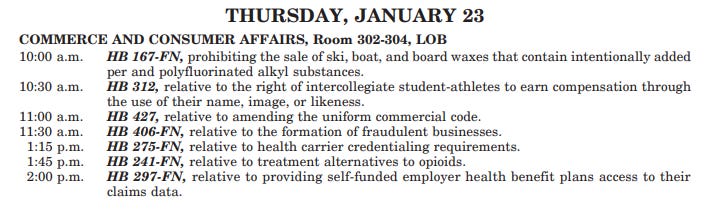
House Commerce and Consumer Affairs
HB 167-FN (6 sponsors, Democratic) – Bans the sale of waxes containing PFAS for skis, boats, and boards.
HB 312 (8 sponsors, bipartisan) – Permits intercollegiate student-athletes to earn compensation from their name, image, or likeness.
HB 427 (1 sponsor, Republican) – Updates the Uniform Commercial Code to clarify that NH law governs certain securities transactions.
HB 406-FN (5 sponsors, bipartisan) – Enables the secretary of state to verify business registry filings and prevent fraudulent formations.
HB 275-FN (1 sponsor, Republican) – Requires health carriers to pay for extra certifications they mandate for provider credentialing.
HB 241-FN (4 sponsors, bipartisan) – Expands insurance coverage for non-opioid pain management therapies.
HB 297-FN (1 sponsor, Democratic) – Allows self-funded employer health plans to opt in to submit claims data and access their own data.
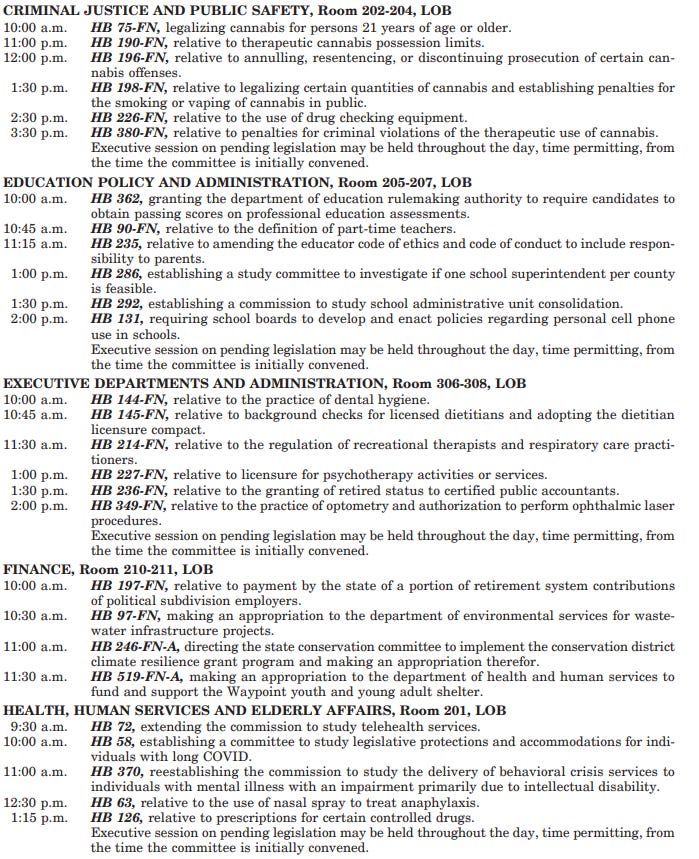
House Criminal Justice and Public Safety
HB 75-FN (1 sponsor, Republican) – Legalizes cannabis possession and use for individuals 21 and older.
HB 190-FN (8 sponsors, bipartisan) – Increases therapeutic cannabis possession limit from 2 oz. to 4 oz.
HB 196-FN (5 sponsors, bipartisan) – Allows annulment or resentencing of small-scale cannabis offenses.
HB 198-FN (3 sponsors, Democratic) – Legalizes certain quantities of cannabis and prohibits public smoking or vaping.
HB 226-FN (7 sponsors, bipartisan) – Removes drug-checking equipment from the definition of “paraphernalia,” promoting harm reduction.
HB 380-FN (6 sponsors, Democratic) – Repeals certain felony penalties for selling therapeutic cannabis to non-patients.
House Education
HB 362 (3 sponsors, Republican) – Gives the department of education rulemaking authority to require passing scores on educator assessments.
HB 90-FN (8 sponsors, Republican) – Defines part-time teachers and exempts them from requiring full state board credentials.
HB 235 (11 sponsors, Republican) – Adds explicit responsibility to parents in the educator code of ethics/conduct.
HB 286 (5 sponsors, Republican) – Creates a study committee on having one superintendent per county.
HB 292 (1 sponsor, Republican) – Establishes a commission to study school administrative unit (SAU) consolidation.
HB 131 (9 sponsors, Republican) – Requires local school boards to create policies regulating student cell phone use in schools.
House Executive Departments and Administration
HB 144-FN (5 sponsors, bipartisan) – Clarifies training requirements for dental hygienists to administer local anesthesia.
HB 145-FN (2 sponsors, Democratic) – Implements background checks for dietitians and adopts the Dietitian Licensure Compact.
HB 214-FN (1 sponsor, Republican) – Clarifies licensing requirements for recreational therapists and respiratory care practitioners.
HB 227-FN (5 sponsors, bipartisan) – Repeals the licensing exemption for certain public employees performing psychotherapy services.
HB 236-FN (2 sponsors, Democratic) – Grants “CPA (retired)” status and clarifies rules for non-practicing accountants.
HB 349-FN (9 sponsors, bipartisan) – Authorizes certified optometrists to perform specific laser eye procedures.
House Finance
HB 197-FN (12 sponsors, Democratic) – State pays 7.5% of local teachers’ and Group II retirement contributions to ease property taxes.
HB 97-FN (4 sponsors, bipartisan) – Appropriates $30 million over two years for wastewater infrastructure projects.
HB 246-FN-A (8 sponsors, bipartisan) – Creates a climate resilience grant program for county conservation districts.
HB 519-FN-A (8 sponsors, bipartisan) – Allocates $1 million to support Waypoint youth and young adult shelter.
House Health, Human Services, and Elderly Affairs
HB 72 (3 sponsors, bipartisan) – Extends the commission studying telehealth services through 2026.
HB 58 (4 sponsors, Democratic) – Establishes a committee to study protections and accommodations for individuals with long COVID.
HB 370 (1 sponsor, Republican) – Reestablishes a commission to improve behavioral crisis services for individuals with mental illness and intellectual disabilities.
HB 63 (10 sponsors, bipartisan) – Allows epinephrine nasal spray for anaphylaxis in schools, camps, and similar entities.
HB 126 (4 sponsors, bipartisan) – Expands certain controlled drug prescriptions to 90-day or 92-day supplies under specific conditions.
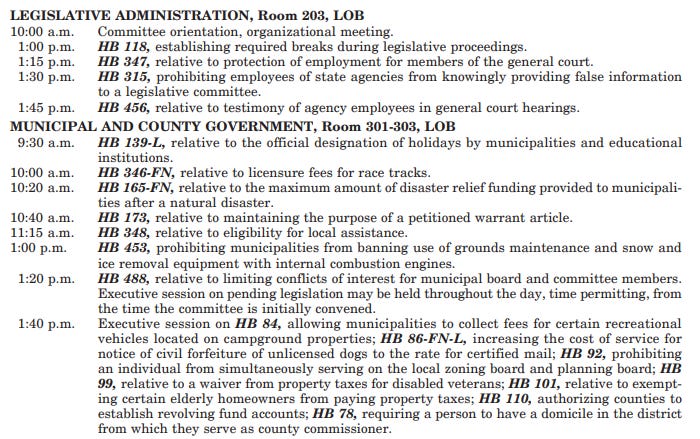
House Legislative Administration
HB 118 (8 sponsors, Democratic) – Mandates at least a 10-minute break in legislative sessions every 3 continuous hours.
HB 347 (9 sponsors, Democratic) – Protects employment for legislators by granting leave to attend up to 168 hours of session days.
HB 315 (1 sponsor, Republican) – Makes it a violation for state employees to knowingly provide false information to a legislative committee.
HB 456 (5 sponsors, bipartisan) – Restricts state agency employees from advocating for or against legislation; they may provide information only upon request.
House Municipal and County Government
HB 139-L (4 sponsors, Democratic) – Repeals mandatory use of official state holiday names by municipalities/educational institutions.
HB 346-FN (1 sponsor, Republican) – Increases annual race track license fees from $100 to $500.
HB 165-FN (9 sponsors, bipartisan) – Raises the maximum disaster relief funding for municipalities from $25K to $100K per year.
HB 173 (10 sponsors, Republican) – Prohibits amendments to petitioned warrant articles that would change their original purpose.
HB 348 (11 sponsors, Republican) – Allows up to a 90-day residency requirement for local assistance eligibility.
HB 453 (6 sponsors, Republican) – Prevents municipalities from banning internal combustion engine grounds/snow equipment.
HB 488 (1 sponsor, Republican) – Limits individuals from holding conflicting municipal positions to reduce conflicts of interest.
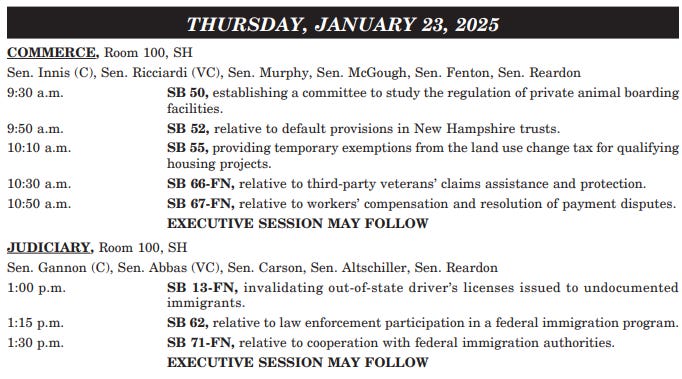
Senate Commerce
SB 50 (1 sponsor, Republican) – Creates a study committee to examine potential regulation of private animal boarding facilities.
SB 52 (3 sponsors, Republican) – Alters default trust provisions regarding discretionary powers and fiduciary duties.
SB 55 (10 sponsors, bipartisan) – Provides temporary exemption from land use change tax for qualifying housing projects with at least 20 units.
SB 66-FN (8 sponsors, bipartisan) – Creates guidelines for third-party veterans’ claims assistance and penalties for violations.
SB 67-FN (3 sponsors, bipartisan) – Sets a 90-day limit for applying to resolve workers’ compensation payment disputes.
Senate Judiciary
SB 13-FN (12 sponsors, Republican) – Invalidates out-of-state driver’s licenses specifically issued to undocumented immigrants.
SB 62 (13 sponsors, Republican) – Permits local law enforcement to join federal 287(g) agreements for immigration enforcement.
SB 71-FN (19 sponsors, Republican) – Prohibits “sanctuary” policies and mandates local cooperation with federal immigration authorities.
House Calendar
 |
 |
 |
Senate Calendar
 |
In-Depth Analysis of All Bills
House Commerce And Consumer Affairs
HB 167-FN
AN ACT prohibiting the sale of ski, boat, and board waxes that contain intentionally added per and polyfluorinated alkyl substances.
Sponsor(s): (Prime) Rep. Wendy Thomas (D), Rep. Christine Seibert (D), Rep. Nancy Murphy (D), Rep. Rosemarie Rung (D), Rep. Jennifer Mandelbaum (D), Sen. Shannon Chandley (D)
Selected quote(s) from the bill:
1 New Subparagraph; Consumer Products; PFAS Use Restricted; Waxes for Boats, Skis, and Boards. Amend RSA 149-M:64, IV by inserting after subparagraph (h) the following new subparagraph:
(i) Waxes produced for use on boats, skis, surfboards, bodyboards, or skimboards.
Summary:
This bill prohibits the sale of ski, boat, and board waxes that contain intentionally added per and polyfluorinated alkyl substances (PFAS).
Argument For:
This bill helps protect public health and the environment from harmful PFAS chemicals while incurring minimal fiscal impact, aiding future budget fights by avoiding costly environmental cleanups.
Argument Against:
This bill could increase costs for consumers and businesses by requiring them to transition to potentially more expensive alternative products, which may reduce state revenue from sales taxes.
Hearing: Thursday, Jan 23 at 10:00 a.m. in Room 302-304 in the Legislative Office Building and streaming on YouTube.
HB 312
AN ACT relative to the right of intercollegiate student-athletes to earn compensation through the use of their name, image, or likeness.
Sponsor(s): (Prime) Rep. Michael Moffett (R), Rep. Jess Edwards (R), Rep. Jim Maggiore (D), Rep. Jose Cambrils (R), Rep. Bob Lynn (R), Rep. Matthew Coker (R), Sen. Daryl Abbas (R), Sen. Victoria Sullivan (R)
Selected quote(s) from the bill:
356-D:1 Definition. In this chapter, “postsecondary educational institution” means an accredited, 4-year institution of higher education whose purpose includes supporting intercollegiate athletic programs.
356-D:2 Compensation of Athletes.
I. A postsecondary educational institution shall not:
(a) Uphold any rule, requirement, standard, or other limitation that prevents a student of that institution participating in intercollegiate athletics from earning compensation as a result of the use of the student's name, image, or likeness;
(b) Except as otherwise provided pursuant to paragraph II, earning compensation from the use of a student's name, image, or likeness shall not affect the student's institutional scholarship eligibility. An institutional scholarship shall not be considered compensation for the purposes of this chapter, and a scholarship shall not be revoked as a result of a student earning compensation or obtaining professional representation;
(c) Provide a prospective student-athlete with compensation in relation to the student-athlete's name, image, or likeness; or
(d) Prevent a student participating in intercollegiate athletics from obtaining professional representation in relation to contracts or legal matters including, but not limited to, representation provided by athlete agents or legal representation provided by attorneys.
…
IV.(a) Notwithstanding paragraph I, a student participating in intercollegiate athletics shall be prohibited from earning compensation as a result of the use of the student's name, image, or likeness in connection with any person, company, or organization related to or associated with the development, production, distribution, wholesaling, or retailing of: adult entertainment products and services; alcohol products; casinos and gambling, including sports betting, the lottery, and betting in connection with video games, online games, and mobile devices; tobacco and electronic smoking products and devices; prescription pharmaceuticals; a controlled dangerous substance; and weapons, including firearms and ammunition.
(b) Earning compensation from the use of a student's name, image, or likeness in connection with products and services listed under subparagraph (a) shall result in the revocation of the student's institutional financial aid eligibility.
356-D:3 Student-Athlete Contracts.
I. A student-athlete who enters into a contract providing compensation to the student-athlete for use of his or her name, image, or likeness shall disclose the contract to an official of the postsecondary educational institution, to be designated by the institution.
II. A student-athlete shall not enter into a contract providing compensation to the student-athlete for use of his or her name, image, or likeness if a provision of the contract:
(a) Conflicts with a provision of the student-athlete's team contract; or
(b) Conflicts with the provisions of RSA 356-D:2, IV.
III. An institutional team contract shall not prevent a student-athlete from using the athlete's name, image, or likeness for a commercial purpose when the athlete is not engaged in official team activities.
IV. An institutional team contract may allow the institution, athletic association, conference, or other group or organization with authority over intercollegiate athletics to use the athlete's name, image, or likeness for advertising and marketing purposes without additional compensation paid to the student-athlete.
…
356-D:4 Applicability. This chapter shall apply to all full-time students of a postsecondary educational institution eligible for intercollegiate competition.
Summary:
This bill allows intercollegiate student-athletes in New Hampshire to earn compensation for the use of their name, image, or likeness (NIL) within specified guidelines and restrictions.
Argument For:
This bill supports student-athletes' financial independence without significant fiscal impact, potentially boosting local economies through increased student spending and entrepreneurship.
Argument Against:
This bill could increase administrative costs for colleges to monitor compliance and may create potential conflicts with existing athletic program agreements, straining institutional budgets.
Hearing: Thursday, Jan 23 at 10:30 a.m. in Room 302-304 in the Legislative Office Building and streaming on YouTube.
HB 427
AN ACT relative to amending the uniform commercial code.
Sponsor(s): (Prime) Rep. JD Bernardy (R)
Selected quote(s) from the bill:
1 Uniform Commercial Code; Investment Securities; Applicability; Choice of Law. Amend RSA 382-A:8-110 (b) to read as follows:
(b) The [local] law of the state of New Hampshire [securities intermediary's jurisdiction, as specified in subsection (e),] governs:
2 Uniform Commercial Code; Investment Securities; Applicability; Choice of Law. RSA 382-A:8-110 (e) - (g) are repealed and reenacted to read as follows:
(e) The local law of the issuer's jurisdiction governs a matter or transaction specified in subsection (a), even if the matter or transaction does not bear any relation to the jurisdiction.
Summary:
This bill amends the Uniform Commercial Code in New Hampshire to specify that state law governs certain transactions, shifting authority from local jurisdictions to the state, and changes the priority of claims among security interests and entitlement holders.
Argument For:
This bill strengthens New Hampshire’s legal framework for commercial transactions, making the state more attractive for financial and legal services, which could generate additional economic activity and tax revenue.
Argument Against:
By shifting authority from local jurisdictions to the state level, this bill may undermine local control and increase administrative and compliance burdens, potentially deterring investment and reducing economic growth, which could negatively impact state revenue.
Hearing: Thursday, Jan 23 at 11:00 a.m. in Room 302-304 in the Legislative Office Building and streaming on YouTube.
HB 406-FN
AN ACT relative to the formation of fraudulent businesses.
Sponsor(s): (Prime) Rep. Luz Bay (D), Rep. John Hunt (R), Rep. Anita Burroughs (D), Rep. Jessica Grill (D), Sen. Donovan Fenton (D)
Selected quote(s) from the bill:
The bill is a request of the secretary of state.
…
1 New Section; Registered Agents Listed in New Hampshire Business Registry. Amend RSA 5 by inserting after section 15-c the following new section:
5:15-d Registered Agents Listed in New Hampshire Business Registry.
I. The following requirements apply to any registered agent required to be appointed by law for any corporation, limited liability company, limited liability partnership, limited partnership, or any other business formation or entity required to be registered with the secretary of state:
…
2 Corporations, Associations, and Proprietors of Common Lands; Voluntary Corporations and Associations; Change of Name; Amending Articles. Amend RSA 292:7 to read as follows:
292:7 Change of Name; Amending Articles. Any corporation now or hereafter … may … restate, or amend its articles of agreement, by a majority vote of such corporation's board of directors or trustees ….
3 Corporations, Associations, and Proprietors of Common Lands; New Hampshire Business Corporation Act; Secretary of State; Powers. Amend RSA 293-A:1.30 to read as follows:
293-A:1.30 Powers.
(a) The secretary of state has the power reasonably necessary to perform the duties required of the secretary [of state] by this chapter.
(b) The secretary of state may verify data submitted to the New Hampshire business registry and confirm that such information has been transmitted with the authorization of the registered business entity for which it is filed. When verifying such data, the secretary may prevent the submission of data that cannot be authenticated and reject the filing of data that cannot be authenticated. If the secretary finds that any data submitted cannot be verified, the secretary may administratively dissolve, forfeit, revoke, or cancel the registered business entity in accordance with the applicable provisions of RSA 292, 293-A, 293-B, 301, 301-A, 301-B, 304-B, 304-C, 305-A, 349, and 564-F.
(c) The secretary of state may take the following measures to prevent the fraudulent submission of data to the New Hampshire business registry:
(1) Authenticate the identity of the person submitting a filing to the secretary.
Summary:
This bill establishes a registry of registered agents for New Hampshire businesses, allows corporations to restate their articles of incorporation, and enables the secretary of state to verify and prevent fraudulent business formations, while also creating penalties for individuals who fraudulently formulate businesses.
Argument For:
This bill may help prevent fraudulent business activity, which could increase state revenue through more accurate business filings and potentially reduce costs associated with investigating and prosecuting fraudulent businesses.
Argument Against:
Increased regulatory burdens on businesses and the secretary of state may require additional staffing and resources, potentially increasing government spending and potentially discouraging business formation.
Hearing: Thursday, Jan 23 at 11:30 a.m. in Room 302-304 in the Legislative Office Building and streaming on YouTube.
HB 275-FN
AN ACT relative to health carrier credentialing requirements.
Sponsor(s): (Prime) Rep. Jack Flanagan (R)
Selected quote(s) from the bill:
1 Managed Care Law; Credentialing Verification Procedures; Health Carrier Responsibility. Amend RSA 420-J:4, VI to read as follows:
VI. Nothing in this section shall be construed to require a health carrier to select a health care professional as a participating provider solely because the health care professional meets the health carrier's credentialing verification standards, … ; provided that the cost of any additional program or certification required by the health carrier as part of its credentialing procedure or provider eligibility determination shall be the responsibility of the health carrier.
Summary:
This bill states that health carriers must cover the costs of any additional programs or certifications they require as part of their provider credentialing process.
Argument For:
This bill could potentially reduce the financial burden on healthcare providers, which may improve access to care and potentially reduce the overall cost of healthcare by making it easier for providers to participate in health insurance networks. This could indirectly benefit the budget by potentially reducing the overall cost of healthcare programs.
Argument Against:
This bill could increase the costs for health insurance carriers, which may lead to higher insurance premiums for consumers and businesses, potentially impacting state revenue through increased costs for state-funded health insurance programs.
Hearing: Thursday, Jan 23 at 1:15 p.m. in Room 302-304 in the Legislative Office Building and streaming on YouTube.
HB 241-FN
AN ACT relative to treatment alternatives to opioids.
Sponsor(s): (Prime) Rep. David Nagel (R), Rep. David Lundgren (R), Rep. Tom Dolan (R), Rep. William Palmer (D)
Selected quote(s) from the bill:
II. The purpose of this act is to both increase access to these therapies in a cost-effective, evidence-based manner in the commercial insurance market and to level the evidence-based standards used in deciding which therapies should be available.
2 New Section; Accident and Health Insurance; Coverage for Pain Management Services; Individual Coverage. Amend RSA 415 by inserting after section 6-a1 the following new section:
415:6-bb Coverage for Pain Management Services.
I. Each insurer that issues or renews any individual policy, plan or contract of accident or health insurance providing benefits for medical or hospital expenses shall provide to persons covered by such insurance who are residents of this state coverage for a broad spectrum of pain management services by providers practicing in a licensed profession, in addition to currently covered pharmacologic and interventionalist treatments. Such services shall include:
(a) Behavioral health interventions, including but not limited to pain self-management training, cognitive behavioral therapy (CBT), acceptance and commitment therapy (ACT), mindfulness and/or other meditation training, support groups, and pain education.
(b) Manual treatments, including, but not limited to: chiropractic treatment of spine, peripheral joints, and soft tissues; osteopathic manipulation of joints and tissues; and massage therapy and manual physical therapy treatments.
(c) Movement therapies, including, but not limited to therapeutic exercises administered by physical therapists and chiropractors.
(d) Acupuncture.
(e) Massage therapy.
II. Policies issued or renewed pursuant to this section shall provide for at least 12 visits for each of the preceding categories of pain management services and shall include coverage for coordination of pain management services during the plan year for each of the preceding pain management services to manage pain by the policy holder’s beneficiaries’ licensed providers to ensure that the provided services are both well integrated and multi-modal.
…
V. No insurer shall establish utilization controls, including prior authorization or step therapy requirements, for clinically appropriate nonopioid therapies, medicinal drugs or drug products approved by the federal Food and Drug Administration for the treatment or management of pain that are more restrictive or extensive than the least restrictive or extensive utilization controls applicable to any clinically appropriate opioid drug.
…
3 New Section; Accident and Health Insurance; Coverage for Pain Management Services; Group. Amend RSA 415 by inserting after section 18-gg the following new section:
415:18-hh Coverage for Pain Management Services.
I. Each insurer that issues or renews a policy of group or blanket accident or health insurance providing benefits for medical or hospital expenses shall provide to persons covered by such insurance … a broad spectrum of pain management services by providers practicing in a licensed profession, in addition to currently covered pharmacologic and interventionalist treatments. Such services shall include:
(a) Behavioral health interventions, including but not limited to pain self-management training, cognitive behavioral therapy (CBT), acceptance and commitment therapy (ACT), mindfulness and/or other meditation training, support groups, and pain education.
(b) Manual treatments, including, but not limited to: chiropractic treatment of spine, peripheral joints, and soft tissues; osteopathic manipulation of joints and tissues; and massage therapy and manual physical therapy treatments.
(c) Movement therapies, including, but not limited to therapeutic exercises administered by physical therapists and chiropractors, independent therapeutic exercise, aquatic therapy, yoga, qi gong, and tai chi.
Summary:
This bill mandates that health insurance plans in New Hampshire cover a wide range of non-opioid pain management therapies, including acupuncture, massage therapy, and various forms of therapy, for individuals with chronic pain.
Argument For:
This bill may improve access to pain management options for individuals suffering from chronic pain, potentially reducing reliance on opioids and their associated risks. This could have long-term public health benefits and potentially reduce healthcare costs associated with opioid addiction and overdoses.
Argument Against:
This bill will likely increase healthcare costs for insurers, leading to higher premiums for individuals and businesses. This could significantly impact the state budget, particularly through increased costs for state-funded health insurance programs, and may strain the state's healthcare system due to increased demand for these services.
Hearing: Thursday, Jan 23 at 1:45 p.m. in Room 302-304 in the Legislative Office Building and streaming on YouTube.
HB 297-FN
AN ACT relative to providing self-funded employer health benefit plans access to their claims data.
Sponsor(s): (Prime) Rep. Carry Spier (D)
Selected quote(s) from the bill:
1 Portability, Availability, and Renewability of Health Coverage; Disclosure of Claims Data from Self-Funded Employer-Sponsored Plans. Amend RSA 420-G:11, V to read as follows:
V. … The carrier or administrator shall also notify the employer that, if such authorization is provided, the commissioner shall provide the employer access, on an annual basis, to the claims data associated with that employer-sponsored plan. The commissioner shall adopt rules under RSA 541-A specifying the form of such opt in, which shall include, but not be limited to, notice to the employer regarding why it is receiving the notification form, the privacy protections for the data submitted should the employer choose to opt in, the access to its own claims data that will be afforded to the employer, and the transparency benefits, including benefits to employers, of broad inclusion of as many lives as possible in the database created under RSA 420-G:11-a. Health carriers and third party administrators administering self-funded employer-sponsored plans shall provide this notice to such employers annually upon renewal. Nothing in this paragraph shall be construed to impose any reporting obligation on any self-funded employer or plan sponsor, or to impose any requirement with respect to the manner in which any such self-funded plan is administered. Nothing in this paragraph shall prevent a health carrier or third party administrator from communicating its views to an employer about the employer's decision whether to opt in to the submission of claims data.
Summary:
This bill requires health carriers and third-party administrators to notify self-funded employers about the option to submit their claims data to the state's health care information system and provides those employers with access to their own claims data if they choose to participate.
Argument For:
This bill may help employers better understand their healthcare spending, identify areas for cost containment, and potentially negotiate better rates with providers, which could lead to lower healthcare costs for businesses and potentially reduce the overall burden on the healthcare system.
Argument Against:
This bill may increase the administrative burden on health carriers and third-party administrators, potentially increasing their operating costs and potentially leading to higher premiums for employers and individuals covered by fully insured plans.
Hearing: Thursday, Jan 23 at 2:00 p.m. in Room 302-304 in the Legislative Office Building and streaming on YouTube.
House Criminal Justice And Public Safety
HB 75-FN
AN ACT legalizing cannabis for persons 21 years of age or older.
Sponsor(s): (Prime) Rep. Kevin Verville (R)
Selected quote(s) from the bill:
6 Controlled Drug Act; Definitions. Amend RSA 318-B:1, XX to read as follows:
XX. "Other stimulant and depressant drugs" means controlled drugs other than amphetamine-type, barbiturate-type, [cannabis-type,] cocaine-type, hallucinogenics, and morphine-type which are found to exert a stimulant and depressant effect upon the higher functions of the central nervous system and which are found to have a potential for abuse.
Summary:
This bill legalizes the possession and use of cannabis for adults aged 21 and older in New Hampshire.
Argument For:
Legalizing cannabis could generate significant tax revenue through the establishment of a regulated market, potentially offsetting other budget shortfalls.
Argument Against:
Legalizing cannabis may increase healthcare costs related to potential public health issues, such as increased traffic accidents and substance abuse, and may strain law enforcement resources.
Hearing: Thursday, Jan 23 at 10:00 a.m. in Room 202-204 in the Legislative Office Building and streaming on YouTube.
HB 190-FN
AN ACT relative to therapeutic cannabis possession limits.
Sponsor(s): (Prime) Rep. Heath Howard (D), Rep. Suzanne Vail (D), Rep. Wendy Thomas (D), Rep. Erica Layon (R), Rep. Tom Mannion (R), Rep. Jodi Newell (D), Rep. Alissandra Murray (D), Sen. Suzanne Prentiss (D)
Selected quote(s) from the bill:
1 Therapeutic Use of Cannabis Protections. Amend RSA 126-X:2, I-II to read as follows:
I. A qualifying patient shall not be subject to arrest by state or local law enforcement, prosecution or penalty under state or municipal law, or denied any right or privilege for the therapeutic use of cannabis in accordance with this chapter, if the qualifying patient possesses an amount of cannabis that does not exceed the following:
(a) [Two] Four ounces of usable cannabis; and
Summary:
This bill increases the amount of therapeutic cannabis a qualifying patient can possess from 2 to 4 ounces and increases the amount they can obtain in a 10-day period from 2 to 4 ounces.
Argument For:
This bill could increase revenue for the state by increasing the sales of medical marijuana.
Argument Against:
This bill could increase the availability of marijuana, which could lead to more people using it recreationally.
Hearing: Thursday, Jan 23 at 11:00 p.m. in Room 202-204 in the Legislative Office Building and streaming on YouTube.
HB 196-FN
AN ACT relative to annulling, resentencing, or discontinuing prosecution of certain cannabis offenses.
Sponsor(s): (Prime) Rep. Jonah Wheeler (D), Rep. Ellen Read (D), Rep. Wendy Thomas (D), Rep. Heath Howard (D), Rep. Tom Mannion (R)
Selected quote(s) from the bill:
2 New Sections; Criminal Code; Sentences; General Provisions; Cannabis Convictions and Sentences. Amend RSA 651 by inserting after section 5-b the following new sections:
651:5-c Annulment of Certain Arrests and Convictions for Cannabis.
I. All convictions and arrests for misdemeanor or violation level offenses for possession of cannabis shall be automatically annulled. Within 6 months of the effective date of this section, the department of safety shall remove any such qualified convictions from its records and notify the court from which the case originated, which shall place an order of annulment in the court file and thereafter process the file in the same manner as any other annulled case. Any person who believes that he or she is eligible for automatic annulment may request that the department of safety examine his or her conviction to determine whether it should be annulled. Should the department of safety fail to annul a qualified conviction, any person so aggrieved may petition the court without fee for further review of eligibility.
Summary:
This bill allows for the annulment of certain cannabis-related convictions and arrests, the resentencing of individuals serving time for cannabis offenses, and the dismissal of pending cannabis charges for possession of small amounts.
Argument For:
This bill could potentially reduce the burden on the criminal justice system, leading to cost savings for the state and local governments.
Argument Against:
This bill could lead to increased costs for the judicial system due to the processing of a potentially large number of annulment and resentencing petitions.
Hearing: Thursday, Jan 23 at 12:00 p.m. in Room 202-204 in the Legislative Office Building and streaming on YouTube.
HB 198-FN
AN ACT relative to legalizing certain quantities of cannabis and establishing penalties for the smoking or vaping of cannabis in public.
Sponsor(s): (Prime) Rep. Jared Sullivan (D), Rep. Heath Howard (D), Rep. Jonah Wheeler (D)
Selected quote(s) from the bill:
2 Personal Possession and Growing of Cannabis; Public Consumption. RSA 318-B:2-c is repealed and reenacted to read as follows:
318-B:2-c Personal Possession of Marijuana.
…
II. Except as provided in paragraph III, if undertaken by a person 21 years of age or older, the following acts shall not be illegal under New Hampshire law, shall not be a criminal or civil offense under New Hampshire law or the law of any political subdivision of New Hampshire, and shall not be a basis for seizure or forfeiture of assets under New Hampshire law:
(a) Possessing, consuming, processing, or transporting an amount of cannabis that does not exceed the possession limit; or
(b) Transferring an amount of cannabis that does not exceed the possession limit to a person who is 21 years of age or older without remuneration. For purposes of this subparagraph, a transfer is for remuneration if cannabis is given away contemporaneously with another transaction between the same parties, if a gift of cannabis is offered or advertised in conjunction with an offer for sale of goods or services, or if the gift of cannabis is contingent upon a separate transaction for goods or services; or
(c) Possessing or purchasing cannabis paraphernalia.
III. No person shall smoke or vaporize cannabis in any public place.
Summary:
This bill legalizes the possession of up to two ounces of cannabis for people 21 years of age or older and prohibits smoking or vaping cannabis in public places. It also reduces the penalties for possessing smaller amounts of cannabis for people under 21.
Argument For:
This bill could generate revenue for the state from the taxation and regulation of cannabis sales. In addition, it could reduce law enforcement costs associated with arresting and incarcerating people for cannabis possession.
Argument Against:
This bill could increase public health costs associated with increased cannabis use. In addition, it could lead to an increase in traffic accidents involving drivers under the influence of cannabis.
Hearing: Thursday, Jan 23 at 1:30 p.m. in Room 202-204 in the Legislative Office Building and streaming on YouTube.
HB 226-FN
AN ACT relative to the use of drug checking equipment.
Sponsor(s): (Prime) Rep. Jodi Newell (D), Rep. Mark Proulx (R), Rep. Ellen Read (D), Rep. Christine Seibert (D), Rep. David Meuse (D), Rep. Tom Mannion (R), Sen. David Watters (D)
Selected quote(s) from the bill:
1 Findings. The general court hereby finds that:
…
II. An increasing percentage of United States drug overdose deaths involve synthetic opioids, particularly illicitly manufactured fentanyl and fentanyl analogs, and stimulants with abuse potential, such as methamphetamine.
III. In New Hampshire in 2023, 94 percent of the 385 opioid related overdose deaths involved the use of fentanyl and 28 percent of the total overdose deaths involved stimulants.
…
4 Controlled Drug Act; Definitions. Amend RSA 318-B:1, X-b to read as follows:
X-b. Notwithstanding the provisions of RSA 318-B:1, X-a, ["drug paraphernalia" shall not include fentanyl test strips, xylazine test strips, or other materials used or intended for use in testing for the presence of fentanyl, xylazine, or a fentanyl or xylazine analog in a substance,] unless possessed in conjunction with other evidence forming the basis of a criminal charge involving the manufacturing, possessing with the intent to sell, or compounding pursuant to RSA 318-B:2, I, "drug paraphernalia" shall not include:
(a) Fentanyl test strips, xylazine test strips, or other materials used or intended for use in testing for the presence of fentanyl, xylazine, or a fentanyl or xylazine analog in a substance.
(b) Other drug checking equipment used to inform individuals of whether a substance has been adulterated by the presence of a synthetic opioid, another controlled substance, or undisclosed chemical compound or contaminant.
(c) Materials used by agents of organizations that provide harm reduction services authorized by the state, a county, a municipality, or a public health department, in the processing, preparing, packaging, repackaging, storing, or containing of a nominal amount of a controlled substance for the purpose of confirmatory testing.
(d) Drug checking equipment used, purchased, transported, or distributed by agents of organizations that provide harm reduction services authorized by the state, a county, a municipality, or a public health department.
Summary:
This bill removes drug checking equipment, including fentanyl test strips, from the definition of "drug paraphernalia," authorizing its legal use to help individuals and harm reduction programs identify dangerous adulterants like fentanyl and reduce overdose risks.
Argument For:
This bill promotes harm reduction by allowing people to test substances for fentanyl, potentially preventing fatal overdoses and reducing long-term healthcare and criminal justice costs, which could ease future state budget pressures.
Argument Against:
By legalizing the possession and use of drug checking equipment, this bill could face criticism for enabling drug use, potentially increasing state spending on public health initiatives, complicating budgetary priorities.
Hearing: Thursday, Jan 23 at 2:30 p.m. in Room 202-204 in the Legislative Office Building and streaming on YouTube.
HB 380-FN
AN ACT relative to penalties for criminal violations of the therapeutic use of cannabis.
Sponsor(s): (Prime) Rep. Suzanne Vail (D), Rep. Christine Seibert (D), Rep. Wendy Thomas (D), Rep. Heath Howard (D), Rep. Jodi Newell (D), Rep. Alissandra Murray (D)
Selected quote(s) from the bill:
1 Use of Cannabis for Therapeutic Purposes; Prohibitions and Limitations on the Therapeutic Use of Cannabis. Amend RSA 126-X:3, VI to read as follows:
VI. Any qualifying patient or designated caregiver who sells cannabis to another person who is not a qualifying patient or designated caregiver under this chapter shall be subject to the criminal penalties specified in RSA 318-B:26[, IX-a,] and shall have his or her registry identification card revoked[, and shall be subject to other penalties as provided in RSA 318-B:26].
2 Repeal. RSA 318-B:26, IX-a, relative to penalties for the sale of cannabis to a person who is not a qualifying patient or designated caregiver, is repealed.
Quote from law to be repealed:
318-B:26 Penalties. –
…
IX-a. A qualifying patient or designated caregiver as defined in RSA 126-X:1 who sells cannabis to a person who is not a qualifying patient or a designated caregiver shall be guilty of a class B felony and shall be sentenced to a maximum term of imprisonment of not more than 7 years, a fine of not more than $300,000, or both.
Summary:
This bill reduces penalties for qualifying patients or designated caregivers who sell cannabis to non-qualifying individuals by repealing specific felony penalties and removing provisions for registry card revocation.
Argument For:
This bill decreases prosecution and incarceration costs by reducing criminal penalties, which could ease the burden on state and local budgets during the upcoming budget fight.
Argument Against:
This bill could lead to increased state expenditures for public health or law enforcement if relaxed penalties result in more unauthorized cannabis sales.
Hearing: Thursday, Jan 23 at 3:30 p.m. in Room 202-204 in the Legislative Office Building and streaming on YouTube.
House Education Policy And Administration
HB 362
AN ACT granting the department of education rulemaking authority to require candidates to obtain passing scores on professional education assessments.
Sponsor(s): (Prime) Rep. Rick Ladd (R), Rep. Glenn Cordelli (R), Rep. Kristin Noble (R)
Selected quote(s) from the bill:
1 Duties of State Board of Education; Passing Score Required. Amend RSA 186:11, X(a) to read as follows:
(a) Certification of teachers, supervisors, and administrators in the public schools. The state board shall also examine the qualifications of candidates for those positions and issue certificates to those who meet the requirements of said rules. All candidates who seek a New Hampshire license for administrator, teacher, instructional specialist or educational specialist shall obtain passing scores on professional education assessments as determined by the New Hampshire state board of education. The local school board may submit a waiver request to the department to exempt a CTE teacher under RSA 188-E from taking a professional education assessment. The department may waive such requirement on the request of the local board accompanied with the recommendation of the superintendent, principal, or CTE director.
Summary:
This bill requires all candidates seeking educator licensure in New Hampshire to obtain passing scores on professional education assessments, with limited waivers available for certain CTE teachers.
Argument For:
This bill ensures higher professional standards for educators, which may improve educational outcomes and reduce long-term costs associated with addressing underperforming schools, indirectly benefiting the state budget.
Argument Against:
This bill could exacerbate the existing teacher shortage by adding another barrier to licensure, making it harder to fill vacant positions and potentially impacting the quality of education in the short term.
Hearing: Thursday, Jan 23 at 10:00 a.m. in Room 205-207 in the Legislative Office Building and streaming on YouTube.
HB 90-FN
AN ACT relative to the definition of part-time teachers.
Sponsor(s): (Prime) Rep. Rick Ladd (R), Rep. Paul Terry (R), Rep. Katy Peternel (R), Rep. Kristin Noble (R), Rep. Valerie McDonnell (R), Sen. Ruth Ward (R), Sen. Timothy Lang (R)
Selected quote(s) from the bill:
1 New Section; Part-Time Teacher; Defined. Amend RSA 189 by inserting after section 39-b the following new section:
189:39-c Part-Time Teacher; Defined. A part-time teacher is not required to hold a state board of education credential provided that:
I. They work up to 20 hours per week.
II. They seek a criminal history record check clearance authorization from the department of education as outlined in RSA 189:13-a prior to receiving a final offer of employment.
III. They are employed or contracted as a full time or adjunct faculty member by a university system of New Hampshire or a community college system of New Hampshire member institution.
IV. Part-time teachers are subject to the New Hampshire code of conduct and ethics for educational professionals.
V. Any person who has had an educator credential, educator license, or other educator certification revoked under RSA 189:14-c or RSA 189:14-d, or who has been rendered ineligible to be employed as an educator under another provision of law, shall not be eligible to teach under this section.
VI. The state board of education shall adopt rules pursuant to RSA 541-A to implement this section.
Summary:
This bill defines "part-time teacher" as an individual working up to 20 hours per week without requiring state board credentials, provided they meet specific conditions, including a criminal history check.
Argument For:
This bill helps address teacher shortages by allowing qualified individuals to teach part-time without requiring full certification, potentially reducing staffing costs for schools and aiding the budget fight.
Argument Against:
This bill could dilute educational standards by permitting individuals without state board credentials to teach, potentially impacting education quality and increasing oversight costs for schools.
Hearing: Thursday, Jan 23 at 10:45 a.m. in Room 205-207 in the Legislative Office Building and streaming on YouTube.
HB 235
AN ACT relative to amending the educator code of ethics and code of conduct to include responsibility to parents.
Sponsor(s): (Prime) Rep. Rick Ladd (R), Rep. Steven Smith (R), Rep. Glenn Cordelli (R), Rep. Jason Osborne (R), Rep. Margaret Drye (R), Rep. Jim Kofalt (R), Rep. Bob Lynn (R), Rep. Katy Peternel (R), Rep. Kristin Noble (R), Sen. Ruth Ward (R), Sen. Timothy Lang (R)
Selected quote(s) from the bill:
1 Rulemaking; Code of Ethics and Code of Conduct. Amend RSA 21-N:9, II(cc)(1)(B) to read as follows:
(B) Responsibility to students and parents as defined in RSA 193:1, III.
Summary:
This bill amends the educator code of ethics and conduct to explicitly include a responsibility to parents as defined in RSA 193:1, III.
Argument For:
This bill strengthens the partnership between educators and parents, ensuring transparency and accountability, which could improve trust and reduce conflict, potentially saving resources for school districts during budget constraints.
Argument Against:
This bill may increase administrative burdens and lead to disputes over the interpretation of "responsibility to parents," potentially increasing costs for schools to address complaints and legal challenges.
Hearing: Thursday, Jan 23 at 11:15 a.m. in Room 205-207 in the Legislative Office Building and streaming on YouTube.
HB 286
AN ACT establishing a study committee to investigate if one school superintendent per county is feasible.
Sponsor(s): (Prime) Rep. Kenneth Weyler (R), Rep. Dan McGuire (R), Rep. Glenn Cordelli (R), Rep. Keith Erf (R), Sen. Kevin Avard (R)
Selected quote(s) from the bill:
1 Committee Established. There is established a committee to study the issue of reducing the number of school superintendents.
…
3 Duties. The committee shall study whether having one school superintendent per county is feasible, and what the office requirements would be.
…
5 Report. The committee shall report its findings and any recommendations for proposed legislation to the speaker of the house of representatives, the president of the senate, the house clerk, the senate clerk, the governor, and the state library on or before November 1, 2025.
Summary:
This bill establishes a study committee to investigate the feasibility of reducing the number of school superintendents to one per county.
Argument For:
This bill could identify opportunities to streamline administrative costs in education, potentially reducing spending and helping address budget challenges.
Argument Against:
This bill could lead to recommendations that centralize decision-making, potentially reducing local control over schools and increasing resistance from communities, which may require additional resources to address.
Hearing: Thursday, Jan 23 at 1:00 p.m. in Room 205-207 in the Legislative Office Building and streaming on YouTube.
HB 292
AN ACT establishing a commission to study school administrative unit consolidation.
Sponsor(s): (Prime) Rep. Rick Ladd (R)
Selected quote(s) from the bill:
1 Commission on School Administrative Unit (SAU) Consolidation Established. There is established a commission to study and make recommendations related to school administrative unit consolidation in New Hampshire.
2 Findings.
I. There are 107 school administrative districts (SAUs) in the State of New Hampshire;
II. The number of SAUs in New Hampshire has doubled since the 1980s, increasing from 53 to 107 school administrative units;
III. New Hampshire’s spending per pupil for SAU general administration, excluding school building principals, is ranked the second most costly in the United States;
IV. New Hampshire’s financial costs related to education continue to rise while K-12 student population declines;
V. SAU consolidation may produce cost advantages through the provision of shared services (e.g., transportation, information technology, security, special education services, accounting and food preparation) and greater economies-of-scale in the purchase of material.
…
4 Duties. The commission shall study the issue of school administrative unit consolidation and submit a proposed consolidation plan and report of findings. Such duties shall include the following:
I. Examine existing research and findings related to consolidation of school districts;
II. Study and identify findings related to financial feasibility and efficiencies of scale that consolidation may or may not achieve;
III. Identify implementation challenges in NH associated with SAU consolidation;
IV. Examine and identify incentives that may be used to encourage SAU consolidation or reorganization;
V. Solicit input from stakeholders to identify community perspectives regarding strengths and weaknesses associated with SAU consolidation; and
VI. Propose a SAU consolidation plan that promotes administrative and operational efficiencies and provides benefits to member school districts while ensuring that a reorganized SAU offers member school districts efficient and sustainable administration and support services while strengthening student learning opportunities.
…
6 Report. The commission shall submit a proposed consolidation plan and report of findings and any recommendations for proposed legislation to the speaker of the house of representatives, the president of the senate, the house clerk, the senate clerk, the governor, and the state library on or before November 1, 2026.
Summary:
This bill establishes a commission to study and make recommendations regarding the consolidation of school administrative units (SAUs) in New Hampshire to improve efficiency and reduce costs. SAUs are administrative offices that oversee multiple school districts, handling tasks such as budgeting, hiring, and curriculum development.
Argument For:
This bill aims to address rising education costs and declining student populations by exploring potential cost savings and efficiencies through SAU consolidation, which could help ease financial pressures during the budget fight.
Argument Against:
This bill could lead to recommendations that centralize administrative services, potentially reducing local control and creating logistical challenges, which may result in resistance from communities and additional costs to implement changes.
Hearing: Thursday, Jan 23 at 1:30 p.m. in Room 205-207 in the Legislative Office Building and streaming on YouTube.
HB 131
AN ACT requiring school boards to develop and enact policies regarding personal cell phone use in schools.
Sponsor(s): (Prime) Rep. Rick Ladd (R), Rep. Kenneth Weyler (R), Rep. Steven Smith (R), Rep. Glenn Cordelli (R), Rep. Gregory Hill (R), Rep. Margaret Drye (R), Rep. Paul Terry (R), Rep. Jim Kofalt (R), Rep. Bob Lynn (R), Rep. Kristin Noble (R), Sen. Ruth Ward (R)
Selected quote(s) from the bill:
1 New Paragraph; Cell Phone Use Policy. Amend RSA 189:1-a by inserting after paragraph IV the following new paragraph:
V. School boards shall develop and adopt a policy governing student cell phone use in schools. Such policy shall restrict the use of student personal cell phones during class instruction without educator approval. Districts are encouraged to consider exceptions to student use during instruction when an educator is using devices as part of a lesson plan. School district policies shall not prohibit students with disabilities from using a device to support their learning as identified by their individualized education program (IEP) or 504 plan.
Summary:
This bill requires school boards to develop and adopt policies regulating student cell phone use in schools, with restrictions during class time unless approved by educators. It also ensures exceptions for students with disabilities who require devices for learning under an IEP or 504 plan.
Argument For:
This bill encourages better focus and academic outcomes by limiting unnecessary cell phone use in classrooms, potentially reducing distractions and improving overall efficiency in education spending.
Argument Against:
This bill may increase administrative burdens on school boards to develop and enforce new policies, potentially diverting time and resources away from other pressing budgetary and educational priorities.
Hearing: Thursday, Jan 23 at 2:00 p.m. in Room 205-207 in the Legislative Office Building and streaming on YouTube.
House Executive Departments And Administration
HB 144-FN
AN ACT relative to the practice of dental hygiene.
Sponsor(s): (Prime) Rep. Jaci Grote (D), Rep. Carol McGuire (R), Rep. Sheila Seidel (R), Sen. Daniel Innis (R), Sen. Debra Altschiller (D)
Selected quote(s) from the bill:
1 Dentists and Dentistry; Practice of Dental Hygiene. Amend RSA 317-A:21-c, II(e) to read as follows:
(e) The administration of local anesthesia, provided the dental hygienist is qualified by the board after training and after passing an examination approved by the board.
Summary:
This bill requires dental hygienists to undergo training and pass an examination approved by the board of dental examiners before being permitted to administer local anesthesia.
Argument For:
This bill ensures that dental hygienists administering local anesthesia are properly trained and qualified, reducing the risk of medical errors and potentially decreasing liability and healthcare costs over time.
Argument Against:
This bill may increase costs for dental hygienists to meet new training and examination requirements, which could reduce the workforce availability and raise the cost of dental services for patients.
Hearing: Thursday, Jan 23 at 10:00 a.m. in Room 306-308 in the Legislative Office Building and streaming on YouTube.
HB 145-FN
AN ACT relative to background checks for licensed dietitians and adopting the dietitian licensure compact.
Sponsor(s): (Prime) Rep. Jaci Grote (D), Rep. Hope Damon (D)
Selected quote(s) from the bill:
1 New Sections; Licensed Dietitians. Amend RSA 326-H by inserting after section 12-a the following new sections:
326-H:12-b Criminal History Record Checks.
I. Every applicant for initial licensure shall submit to the office of professional licensure and certification a criminal history record release form, as provided by the New Hampshire division of state police, department of safety, which authorizes the release of his or her criminal history record, if any, to the office.
…
326-H:12-c Dietitian Licensure Compact Adopted. The state of New Hampshire hereby adopts the provisions of the Dietitian Licensure Compact as follows:
SECTION 1: PURPOSE.
The purpose of this compact is to facilitate interstate practice of dietetics with the goal of improving public access to dietetics services. This compact preserves the regulatory authority of states to protect public health and safety through the current system of state licensure, while also providing for licensure portability through a compact privilege granted to qualifying professionals. This compact is designed to achieve the following objectives:
A. Increase public access to dietetics services;
B. Provide opportunities for interstate practice by licensed dietitians who meet uniform requirements;
C. Eliminate the necessity for licenses in multiple states;
D. Reduce administrative burden on member states and licensees;
E. Enhance the states’ ability to protect the public’s health and safety;
F. Encourage the cooperation of member states in regulating multistate practice of licensed dietitians;
G. Support relocating active military members and their spouses;
H. Enhance the exchange of licensure, investigative, and disciplinary information among member states; and
I. Vest all member states with the authority to hold a licensed dietitian accountable for meeting all state practice laws in the state in which the patient is located at the time care is rendered.
Summary:
This bill requires licensed dietitians to undergo criminal background checks for initial licensure and adopts the Dietitian Licensure Compact to facilitate interstate practice among participating states.
Argument For:
The bill enhances public safety by ensuring background checks for licensed dietitians and improves access to dietetic services by enabling license portability and interstate practice, which could lead to cost savings and better healthcare outcomes.
Argument Against:
The bill introduces additional costs for applicants and the state to implement the background check and licensure compact systems, potentially increasing licensing expenses and administrative burdens.
Hearing: Thursday, Jan 23 at 10:45 a.m. in Room 306-308 in the Legislative Office Building and streaming on YouTube.
HB 214-FN
AN ACT relative to the regulation of recreational therapists and respiratory care practitioners.
Sponsor(s): (Prime) Rep. Carol McGuire (R)
Selected quote(s) from the bill:
This bill is at the request of the OPLC.
…
1 Recreational Therapists; Advisory Board Established. Amend RSA 326-J:1-a, II to read as follows:
II. The executive director, in consultation with the advisory board, shall adopt rules pursuant to RSA 541-A relative to the practice of recreational therapy, including: [rules regarding the procedure for granting, revoking, and reinstating a license]
(a) Eligibility requirements for initial licensure;
(b) Eligibility requirements for licensure renewal, including any continuing competency requirements and any requirements for education, clinical experience, and training;
(c) Conditional employment pending the results of a criminal history records check;
Summary:
This bill clarifies the rulemaking authority of the Office of Professional Licensure and Certification (OPLC) for recreational therapists and respiratory care practitioners, adding requirements for criminal history record checks and privileged communication protections similar to other regulated health professions.
Argument For:
The bill ensures higher standards of public safety by requiring background checks for licensure and strengthens patient confidentiality, aligning these professions with other regulated health fields, all at minimal fiscal impact.
Argument Against:
The additional requirements may increase administrative burdens and costs for applicants and the OPLC, potentially creating barriers for new professionals entering these fields.
Hearing: Thursday, Jan 23 at 11:30 a.m. in Room 306-308 in the Legislative Office Building and streaming on YouTube.
HB 227-FN
AN ACT relative to licensure for psychotherapy activities or services.
Sponsor(s): (Prime) Rep. Erica Layon (R), Rep. Lisa Freeman (R), Rep. Jim Kofalt (R), Rep. Kristin Noble (R), Rep. Jonah Wheeler (D)
Selected quote(s) from the bill:
1 Repeal. RSA 329-B:28, I(b), relative to licensing exemption for psychotherapy activities or services of certain persons in the employ of a state, county, or municipal agency, other political subdivision, or duly chartered educational institution, is repealed.
Selected quote from law to be repealed:
329-B:28 Persons Exempted. –
I. Nothing in this chapter shall be construed to limit:
…
(b) The psychotherapy activities or services of a person in the employ of a state, county, or municipal agency, other political subdivision, or duly chartered educational institution, insofar as such activities and services are a part of the duties of such person in that salaried position.
Summary:
This bill repeals the licensing exemption for individuals providing psychotherapy services or activities as employees of state, county, municipal agencies, other political subdivisions, or chartered educational institutions, requiring them to obtain proper licensure.
Argument For:
This bill ensures consistent professional standards and accountability for all individuals providing psychotherapy services, regardless of their employer, enhancing public safety and potentially increasing state licensing revenue.
Argument Against:
The bill may increase administrative costs for public institutions and create barriers to employment for individuals currently exempt from licensure, potentially worsening staffing shortages in publicly funded mental health services.
Hearing: Thursday, Jan 23 at 1:00 p.m. in Room 306-308 in the Legislative Office Building and streaming on YouTube.
HB 236-FN
AN ACT relative to the granting of retired status to certified public accountants.
Sponsor(s): (Prime) Rep. Chris Muns (D), Sen. Debra Altschiller (D)
Selected quote(s) from the bill:
This bill is a request of the board of accountancy.
…
1 New Section; New Hampshire Accountancy Act; Retired Status. Amend RSA 309-B by inserting after section 7 the following new section:
309-B:7-a Retired Status.
…
II. Retired status is an honorific status. A person granted retired status shall not perform or offer to perform services for which a license, certificate, or permit is required under this chapter.
III. The office shall issue to a person granted retired status a certificate stating that retired status has been granted.
IV. An individual granted retired status may represent themselves as retired by placing the word “retired” or abbreviation adjacent to their CPA title or PA title on any business card, letterhead, or any other document or device, with the exception of their CPA certificate or PA registration, on which their CPA or PA title appears, but shall not represent themselves or allow themselves to be represented to the public as a current practicing CPA or PA.
V. An individual granted retired status is not required to comply with the continuing education requirements to maintain such status.
VI. An individual granted retired status is not required to renew registration or pay renewal fees to maintain retired status.
VII. The office shall change a license status from retired to active or inactive if a person with retired status requests a status change and meets requirements for licensure, including continuing education requirements.
Summary:
This bill allows the Office of Professional Licensure and Certification to grant the honorific title "CPA (retired)" to individuals aged 55 or older who previously held a CPA certificate in good standing and are no longer practicing public accounting.
Argument For:
This bill provides recognition for retired CPAs while ensuring they are not misrepresented as actively practicing, with minimal fiscal impact on the state.
Argument Against:
The bill introduces an administrative process for granting retired status, which, though minimal, may require resources that could be allocated elsewhere during tight budget conditions.
Hearing: Thursday, Jan 23 at 1:30 p.m. in Room 306-308 in the Legislative Office Building and streaming on YouTube.
HB 349-FN
AN ACT relative to the practice of optometry and authorization to perform ophthalmic laser procedures.
Sponsor(s): (Prime) Rep. Jim Kofalt (R), Rep. Katy Peternel (R), Rep. Sheila Seidel (R), Rep. Alicia Gregg (D), Sen. Ruth Ward (R), Sen. Suzanne Prentiss (D), Sen. Debra Altschiller (D), Sen. Howard Pearl (R), Sen. David Rochefort (R)
Selected quote(s) from the bill:
1 Authorization to Perform Ophthalmic Laser Procedures. Amend RSA 327 by inserting after section 6-c the following new section:
327:6-d Authorization to Perform Ophthalmic Laser Procedures.
I. Notwithstanding any other provision of this chapter, an optometrist licensed under this chapter shall be authorized to perform the following ophthalmic laser procedures upon certification by the board:
(a) Laser capsulotomy.
(b) Laser trabeculoplasty.
(c) Laser peripheral iridotomy.
II. The board shall adopt rules under RSA 541-A establishing the criteria for certification of an optometrist to perform ophthalmic laser procedures with proficiency, including:
?(a) Establishment of minimum education, training, and live experience requirements for a licensee to perform such procedures with proficiency;
(b) Criteria for requiring proctoring and criteria for proctors; and
(c) Outcome reporting requirements for such procedures performed by certificate holders.
III. No optometrist shall perform opthalmic [sic] laser procedures under this section unless the optometrist has submitted evidence of satisfactory completion of all requirements for specific procedures and the board has certified the optometrist as qualified.
Summary:
This bill allows licensed optometrists in New Hampshire, who meet criteria established by the Board of Registration in Optometry, to perform certain ophthalmic laser procedures, including laser capsulotomy, trabeculoplasty, and peripheral iridotomy.
Argument For:
This bill increases access to ophthalmic laser procedures by expanding the range of services optometrists can provide, potentially reducing costs and wait times for patients while generating additional revenue from certification fees to support the licensing board.
Argument Against:
The bill introduces administrative costs for certification and oversight, estimated between $10,000 and $100,000 annually, and raises concerns about patient safety due to expanded scope of practice for optometrists without the extensive surgical training of ophthalmologists.
Hearing: Thursday, Jan 23 at 2:00 p.m. in Room 306-308 in the Legislative Office Building and streaming on YouTube.
House Finance
HB 197-FN
AN ACT relative to payment by the state of a portion of retirement system contributions of political subdivision employers.
Sponsor(s): (Prime) Rep. Michael Edgar (D), Rep. John Cloutier (D), Rep. Dennis Malloy (D), Rep. Chris Muns (D), Rep. Nancy Murphy (D), Rep. Rosemarie Rung (D), Rep. Matthew Wilhelm (D), Rep. Allison Knab (D), Rep. Peggy Balboni (D), Sen. Cindy Rosenwald (D), Sen. Rebecca Perkins Kwoka (D), Sen. Debra Altschiller (D)
Selected quote(s) from the bill:
1 Short Title; Purpose.
I. This act may be known as the "Property Tax Relief Act of 2025."
II. This act renews a promise made by state to municipalities and restores the state’s contribution of a portion of the retirement costs of teachers, firefighters, and local police. Its purpose is to help ease the local property tax burden, provide property tax relief to the cities and towns, and enhance public education and public safety.
2 Retirement System; Employer Contributions; State Share of Contributions. Amend RSA 100-A:16, II(b) and (c) to read as follows:
(b) The contributions of each employer for benefits under the retirement system on account of group II members shall consist of a percentage of the earnable compensation of its members to be known as the "normal contribution," and an additional amount to be known as the "accrued liability contribution;" provided that beginning with state fiscal year [2013] 2026 and for each state fiscal year thereafter, any employer [shall pay the full amount of such total contributions] other than the state, shall pay 92.5 percent of such total contributions, and 7.5 percent thereof shall be paid by the state; and provided further that, in case of group II members employed by the state, the state shall pay both normal and accrued liability contributions. …
(c) The contributions of each employer for benefits under the retirement system on account of group I members shall consist of a percentage of the earnable compensation of its members to be known as the "normal contribution," and an additional amount to be known as the "accrued liability contribution;" provided that beginning with state fiscal year [2013] 2026 and for each state fiscal year thereafter, in the case of teachers, any employer other than the state, shall pay 92.5 percent of such total contributions, and 7.5 percent thereof shall be paid by the state; and provided further that, in case of teacher members employed by the state, the state shall pay both normal and accrued liability contributions. …
Relevant Context:
Gov. Ayotte talked about making “critical investments in the Group II retirement system” in her inauguration speech
Summary:
This bill requires the state to pay 7.5% of the retirement contributions for Group I teachers and Group II members employed by political subdivisions, beginning in FY 2026.
Argument For:
This bill provides significant property tax relief for municipalities by reducing their share of retirement system costs, while fulfilling a longstanding promise by the state to support local governments.
Argument Against:
The bill increases state expenditures by an estimated $28 million in FY 2026 and more in subsequent years without providing funding, adding pressure to the state budget during a period of fiscal challenges.
Hearing: Thursday, Jan 23 at 10:00 a.m. in Room 210-211 in the Legislative Office Building and streaming on YouTube.
HB 97-FN
AN ACT making an appropriation to the department of environmental services for wastewater infrastructure projects.
Sponsor(s): (Prime) Rep. Thomas Buco (D), Rep. David Preece (D), Rep. Nancy Murphy (D), Sen. Denise Ricciardi (R)
Selected quote(s) from the bill:
1 Department of Environmental Services; Eligible Wastewater Projects; Appropriation. There is hereby appropriated to the department of environmental services the sum of $15,000,000 for the fiscal year ending June 30, 2026 and $15,000,000 for the fiscal year ending June 30, 2027, which shall be nonlapsing, for the purpose of funding wastewater projects approved pursuant to RSA 486 on or before June 30, 2026. The governor is authorized to draw a warrant for said sums out of any money in the treasury not otherwise appropriated.
Summary:
This bill appropriates $15 million in FY 2026 and $15 million in FY 2027 to the Department of Environmental Services for funding eligible wastewater infrastructure projects.
Argument For:
This bill provides critical funding for wastewater infrastructure improvements, benefiting public health and the environment while supporting local communities and reducing their financial burden.
Argument Against:
The bill increases state spending by $30 million over two years, which could strain the budget and limit funding available for other priorities during a tight fiscal period.
Hearing: Thursday, Jan 23 at 10:30 a.m. in Room 210-211 in the Legislative Office Building and streaming on YouTube.
HB 246-FN-A
AN ACT directing the state conservation committee to implement the conservation district climate resilience grant program and making an appropriation therefor.
Sponsor(s): (Prime) Rep. Judy Aron (R), Rep. Peter Bixby (D), Rep. Karen Ebel (D), Rep. Brian Sullivan (D), Rep. Lucius Parshall (D), Rep. James Creighton (R), Sen. David Watters (D), Sen. Howard Pearl (R)
Selected quote(s) from the bill:
1 Appropriation; Department of Agriculture, Markets, and Foods. The department of agriculture, markets, and foods is hereby appropriated $50,000 in general funds for the fiscal year ending June 30, 2026 and $50,000 for the fiscal year ending June 30, 2027. Such funds shall be disbursed by the state conservation committee established in RSA 432:10 to the state's 10 county conservation districts for the implementation of the conservation district climate resilience grant program. The governor is authorized to draw a warrant for said sums out of any money in the treasury not otherwise appropriated.
2 New Paragraph; Duties; State Conservation Committee. Amend RSA 432:11 by inserting after paragraph VI the following new paragraph:
VII. Implement and administer the conservation district climate resilience grant program for county conservation districts that have met annual financial reporting requirements.
Summary:
This bill establishes the conservation district climate resilience grant program, directing $50,000 in FY 2026 and $50,000 in FY 2027 to the State Conservation Committee for distribution to county conservation districts.
Argument For:
The program supports climate resilience initiatives, enhancing environmental sustainability and preparedness while providing resources to county conservation districts to address climate-related challenges.
Argument Against:
The bill adds $100,000 in new spending over two years, straining the general fund and reducing resources available for other priorities during a tight budget cycle.
Hearing: Thursday, Jan 23 at 11:00 a.m. in Room 210-211 in the Legislative Office Building and streaming on YouTube.
HB 519-FN-A
AN ACT making an appropriation to the department of health and human services to fund and support the Waypoint youth and young adult shelter.
Sponsor(s): (Prime) Rep. Mary Jane Wallner (D), Rep. Kimberly Rice (R), Rep. David Preece (D), Rep. Matthew Wilhelm (D), Rep. Heather Raymond (D), Rep. Alicia Gregg (D), Sen. Cindy Rosenwald (D), Sen. Pat Long (D)
Selected quote(s) from the bill:
1 Appropriation; Waypoint Youth and Young Adult Shelter. There is hereby appropriated to the department of health and human services the sum of $500,000 for the fiscal year ending June 30, 2026, and the sum of $500,000 for the fiscal year ending June 30, 2027, for the purpose of funding and supporting all operations, programs, and projects of the Waypoint youth and young adult shelter. The governor is authorized to draw a warrant for said sums out of any money in the treasury not otherwise appropriated.
Summary:
This bill appropriates $500,000 in FY 2026 and $500,000 in FY 2027 to the Department of Health and Human Services to fund and support the operations of the Waypoint youth and young adult shelter.
Argument For:
The funding will help provide critical shelter and services for at-risk youth and young adults, addressing homelessness and promoting stability for vulnerable populations.
Argument Against:
The bill adds $1 million in new spending over two years, increasing pressure on the general fund and diverting resources from other budget priorities during a challenging fiscal period.
Hearing: Thursday, Jan 23 at 11:30 a.m. in Room 210-211 in the Legislative Office Building and streaming on YouTube.
House Health, Human Services And Elderly Affairs
HB 72
AN ACT extending the commission to study telehealth services.
Sponsor(s): (Prime) Rep. Jess Edwards (R), Rep. William Palmer (D), Rep. Jennifer Mandelbaum (D)
Selected quote(s) from the bill:
1 Commission to Study Telehealth Services; Duties. Amend RSA 329:1-f, II(b) to read as follows:
(b) The commission may solicit input from any person or entity the commission deems relevant to its study, including data collected by an independent research contractor. This data may include review of telehealth parity in all commercial payers, NH Medicaid fee for service, and managed care plans; patient and provider access to telehealth; provider use of telehealth services; patient utilization, including chronic disease management and prevention services; quality of care delivered by telehealth; synchronization with federal policy; recommended legislation; and the impact of telehealth on the cost of health care delivery.
2 Commission to Study Telehealth Services; Reporting Date. Amend RSA 329:1-f, IV to read as follows:
IV. The commission shall make an interim report by December 1, 2022, [and] a final report with its findings and any recommendations for proposed legislation on or before December 1, 2024, and a supplemental report on or before June 30, 2026, to the president of the senate, the speaker of the house of representatives, the senate clerk, the house clerk, the governor, and the state library.
Summary:
This bill extends the commission to study telehealth services by requiring a supplemental report by June 30, 2026, with a focus on synchronization with federal policy, and repeals the commission on that date.
Argument For:
Extending the commission allows for further evaluation of telehealth services, including alignment with federal policies, which could improve healthcare delivery, accessibility, and cost-efficiency.
Argument Against:
Extending the commission adds administrative costs and uses resources during a critical budget period without guaranteeing significant changes or savings.
Hearing: Thursday, Jan 23 at 9:30 a.m. in Room 201 in the Legislative Office Building and streaming on YouTube.
HB 58
AN ACT establishing a committee to study legislative protections and accommodations for individuals with long COVID.
Sponsor(s): (Prime) Rep. Wendy Thomas (D), Rep. Suzanne Vail (D), Rep. Christine Seibert (D), Rep. Cassandra Levesque (D)
Selected quote(s) from the bill:
1 Committee Established. There is established a committee to study legislative protections and accommodations for individuals with long COVID.
…
3 Duties. The committee shall:
I. Consider whether given the complex and evolving nature of the condition, it is appropriate to establish a dedicated body to monitor and respond to new information and research regarding long COVID.
II. Review current labor, healthcare, and disability laws, determine whether such laws adequately address the unique needs of individuals with long COVID, and consider whether targeted legislation is necessary to ensure comprehensive protection.
III. Explore policy interventions to mitigate the economic and social impact of long COVID, including lost productivity and increased health care costs.
IV. Ensure that any legislative solutions take into consideration the fact that long COVID disproportionately affects certain populations, including those from marginalized communities who may already face barriers to health care and economic stability.
V. Determine how best to develop a coordinated approach to long COVID across multiple sectors, including health care, employment, education, and social services.
VI. Solicit information from the public and private sector, including but not limited to: medical and public health experts such as infectious disease specialists and epidemiologists, health care law specialists, disability rights advocates, long COVID patients and advocacy groups, economists and labor rights experts, social workers and mental health professionals, the department of health and human services, and public health offices.
…
5 Report. The committee shall report its findings and any recommendations for proposed legislation to the speaker of the house of representatives, the president of the senate, the house clerk, the senate clerk, the governor, and the state library on or before November 1, 2025.
Summary:
This bill establishes a committee to study legislative protections and accommodations for individuals with long COVID, focusing on healthcare, labor laws, and the disproportionate impact on marginalized communities.
Argument For:
The committee could identify gaps in current laws and propose targeted solutions, ensuring comprehensive support for individuals with long COVID while addressing economic and social challenges.
Argument Against:
Creating this committee incurs additional administrative costs and uses legislative resources during a tight budget period, without guaranteeing actionable outcomes.
Hearing: Thursday, Jan 23 at 10:00 a.m. in Room 201 in the Legislative Office Building and streaming on YouTube.
HB 370
AN ACT reestablishing the commission to study the delivery of behavioral crisis services to individuals with mental illness with an impairment primarily due to intellectual disability.
Sponsor(s): (Prime) Rep. JD Bernardy (R)
Selected quote(s) from the bill:
1 New Section; Commission Established; Commission to Study the Delivery of Behavioral Crisis Services to Individuals with Mental Illness with an Impairment Primarily Caused by Intellectual Disability. Amend RSA 135-C by inserting after section 68 the following new section:
135-C:69 Commission Established. There is established a commission to study the delivery of behavioral crisis services to individuals with mental illness whose impairment is primarily due to intellectual disability.
…
III. The commission shall:
(a) Study the gap in service delivery to individuals in behavioral crisis with mental illness whose impairment is primarily due to intellectual disability, created by the definition of mental illness in RSA 135-C:2, X.
(b) Create a plan consisting of necessary legislation and changes in regulatory policies and procedures to address the identified service deficiency. It shall address acute crisis care needs through termination and post-discharge services and expected costs.
IV. The members of the study commission shall elect a chairperson from among the members. The first meeting of the commission shall be called by the first-named house member. The first meeting of the commission shall be held within 30 days of the effective date of this section. Six members of the commission shall constitute a quorum.
V. The commission shall report its findings, including its assessment of the need to establish an acute crisis center in New Hampshire and any recommendations for proposed legislation and policy and procedures, to the speaker of the house of representatives, the senate president, the governor, the house clerk, the senate clerk, and the state library. The commission shall provide an interim report on or before November 1, 2025 and a final report on or before November 1, 2027.
Summary:
This bill reestablishes a commission to study gaps in behavioral crisis services for individuals with mental illness primarily caused by intellectual disability, with the aim of creating a plan for legislative and regulatory improvements.
Argument For:
The commission could address critical service gaps for a vulnerable population, potentially improving care delivery and reducing long-term costs associated with unmanaged crises.
Argument Against:
The commission's work involves administrative costs and could lead to recommendations requiring increased spending, which may add strain to an already tight budget.
Hearing: Thursday, Jan 23 at 11:00 a.m. in Room 201 in the Legislative Office Building and streaming on YouTube.
HB 63
AN ACT relative to the use of nasal spray to treat anaphylaxis.
Sponsor(s): (Prime) Rep. Erica Layon (R), Rep. Kat McGhee (D), Rep. Jim Maggiore (D), Rep. Jaci Grote (D), Rep. Jim Kofalt (R), Rep. Bill Boyd (R), Rep. David Nagel (R), Rep. William Palmer (D), Sen. Suzanne Prentiss (D), Sen. Howard Pearl (R)
Selected quote(s) from the bill:
1 Recreational Camp Licensing; Possession and Use of Epinephrine Auto-Injectors at Recreation Camps; Possession and Use of Epinephrine Nasal Spray Added. Amend RSA 170-E:59 - 170-E:62 to read as follows:
170-E:59 Possession and Use of Epinephrine Auto-Injectors and Epinephrine Nasal Spray at Recreation Camps. A recreation camp shall permit a child with severe, potentially life-threatening allergies to possess and use an epinephrine auto-injector or epinephrine nasal spray …
Summary:
This bill allows authorized entities, including schools, camps, and daycare facilities, to administer epinephrine nasal spray for anaphylaxis, in addition to the currently allowed epinephrine auto-injectors.
Argument For:
This bill enhances the ability of schools and other entities to respond to life-threatening allergic reactions, potentially saving lives and offering a more accessible and affordable treatment option in certain cases.
Argument Against:
The implementation may require training and administrative changes, which could result in additional costs for schools and organizations during a period of tight budgets.
Hearing: Thursday, Jan 23 at 12:30 p.m. in Room 201 in the Legislative Office Building and streaming on YouTube.
HB 126
AN ACT relative to prescriptions for certain controlled drugs.
Sponsor(s): (Prime) Rep. Daniel Popovici-Muller (R), Rep. Dan McGuire (R), Rep. David Nagel (R), Rep. Jonah Wheeler (D)
Selected quote(s) from the bill:
1 Controlled Drug Act; Sale by Pharmacist; Prescription Restrictions and Exceptions. RSA 318-B:9, IV is repealed and reenacted to read as follows:
IV. No prescription shall be filled for more than a 34-day supply upon any single filling for controlled drugs of schedules II or III, except as specified below:
(a) For schedule II or III controlled drugs that are commercially packaged for dispensing directly to the patient, such as metered sprays and inhalers, liquids packaged in bottles with calibrated droppers, and topical preparations packaged with metered dispensing pumps, may be filled for greater than a 34-day supply, but not more than 60 days, utilizing the smallest available product size, in order to maintain the dosing integrity of the commercially packaged containers.
(b) A prescription for amphetamines and methylphenidate hydrochloride may be filled for up to a 90-day supply if the prescription specifies it is being used for the treatment of attention deficit disorder, attention deficit disorder with hyperactivity, or narcolepsy.
(c) Prescriptions for a topically applied androgen prescribed for the treatment of chronic low testosterone may be filled for up to a 92-day supply.
(d) Prescriptions for an injectable androgen prescribed for the treatment of chronic low testosterone may be filled for up to a 92-day supply after the patient has filled 12 monthly prescriptions provided by the same medical practice. A 92-day supply of an injectable androgen prescription shall include a statement by the prescriber the medication is to treat chronic low testosterone.
Summary:
This bill clarifies exceptions to the 34-day limit on prescriptions for controlled drugs and allows pharmacists to fill a 92-day supply of injectable androgen for chronic low testosterone under certain conditions.
Argument For:
This bill streamlines access to necessary medications for individuals with chronic conditions, reducing the frequency of pharmacy visits and potentially lowering costs for both patients and providers.
Argument Against:
The expansion to a 92-day supply for injectable androgens could increase upfront costs for patients and raise concerns about inventory management and diversion of controlled substances, adding complexity during tight budget constraints.
Hearing: Thursday, Jan 23 at 1:15 p.m. in Room 201 in the Legislative Office Building and streaming on YouTube.
House Legislative Administration
HB 118
AN ACT establishing required breaks during legislative proceedings.
Sponsor(s): (Prime) Rep. Wendy Thomas (D), Rep. Timothy Horrigan (D), Rep. Nancy Murphy (D), Rep. Cassandra Levesque (D), Rep. Linda Haskins (D), Rep. Loren Selig (D), Rep. Luz Bay (D), Rep. Jennifer Mandelbaum (D)
Selected quote(s) from the bill:
1 New Section; Breaks During Legislative Proceedings. Amend RSA 14 by inserting after section 14-c the following new section:
14:14-d Breaks During Legislative Proceedings.
At any session of the general court or during any hearing of a committee of the general court, there shall be a minimum 10 minute break for every 3 continuous hours of proceedings.
Summary:
This bill requires a minimum 10-minute break for every 3 continuous hours of proceedings during sessions of the general court or committee hearings.
Argument For:
This bill promotes the well-being and productivity of legislators and staff by ensuring regular breaks during lengthy proceedings, which can enhance focus and decision-making.
Argument Against:
Mandating breaks could extend the duration of legislative sessions, potentially increasing operational costs and creating inefficiencies during a period of budget constraints.
Hearing: Thursday, Jan 23 at 1:00 p.m. in Room 203 in the Legislative Office Building and streaming on YouTube.
HB 347
AN ACT relative to protection of employment for members of the general court.
Sponsor(s): (Prime) Rep. Christal Lloyd (D), Rep. Ellen Read (D), Rep. Kristina Schultz (D), Rep. Eric Turer (D), Rep. Susan Elberger (D), Rep. Heather Raymond (D), Rep. Alicia Gregg (D), Rep. Jessica Grill (D), Rep. Loren Selig (D)
Selected quote(s) from the bill:
1 New Section; Employment Protections for Members of the General Court. Amend RSA 14-A by inserting after section 6 the following new sections:
14-A:7 Right to Leave Work.
I. An employer shall permit an employee who is a member of the general court to leave work to attend up to 168 hours of general court voting each calendar year, whether or not the employee has accrued paid time off.
II. Before an employee may leave work under this provision, the employee shall provide the employer with a copy of the notice for each general court session day they will attend.
III. An employer shall not discharge an employee who is a member of the general court for attending a noticed and disclosed session of the general court.
IV. An employer may require a member of the general court to use the employee's accrued vacation time, personal leave time, or paid time off to attend a noticed and disclosed voting session of the general court. If the employee does not have accrued paid time off, their absence to attend general court voting shall be granted as unpaid time off.
V. Any employer who violates this section shall be subject to a civil penalty, to be imposed by the labor commissioner in accordance with the procedures established in RSA 273:11-a. An employer aggrieved by the commissioner's assessment of such penalty may appeal in accordance with RSA 273:11-c.
Summary:
This bill provides employment protections for members of the general court, requiring employers to allow up to 168 hours of leave annually for attendance at voting sessions, with provisions for unpaid leave if paid time off is unavailable.
Argument For:
This bill ensures that legislators can fulfill their civic duties without fear of losing their jobs, supporting a functioning democracy by enabling broader participation in legislative sessions.
Argument Against:
This bill imposes administrative and potential financial burdens on employers, particularly small businesses, who may need to manage workflow disruptions during the legislator's absence.
Hearing: Thursday, Jan 23 at 1:15 p.m. in Room 203 in the Legislative Office Building and streaming on YouTube.
HB 315
AN ACT prohibiting employees of state agencies from knowingly providing false information to a legislative committee.
Sponsor(s): (Prime) Rep. Kelley Potenza (R)
Selected quote(s) from the bill:
1 Standing Committees of the General Court; Agency Testimony. Amend RSA 17-D:3 to read as follows:
17-D:3 Investigations. … If an employee of a state agency knowingly provides false information before the committee, he or she shall be prohibited from testifying before the committee and liable for perjury under RSA 641:1, false swearing under RSA 641:2, and tampering with witnesses and informants under RSA 641:5.
2 State Employee Appearances Before the Legislature. Amend RSA 98-F:1 to read as follows:
98-F:1 State Employee Appearances Before the Legislature. … If an employee of a state agency knowingly provides false information before the committee, he or she shall be prohibited from testifying before the committee.
Summary:
This bill prohibits state agency employees from knowingly providing false information to legislative committees and establishes penalties including perjury charges and prohibition from further testimony.
Argument For:
This bill promotes transparency and accountability by ensuring that state agency employees provide truthful information to legislative committees, which supports informed decision-making and maintains public trust.
Argument Against:
This bill may deter employees from testifying out of fear of potential penalties, which could limit the flow of necessary information to legislative committees and complicate legislative processes.
Hearing: Thursday, Jan 23 at 1:30 p.m. in Room 203 in the Legislative Office Building and streaming on YouTube.
HB 456
AN ACT relative to testimony of agency employees in general court hearings.
Sponsor(s): (Prime) Rep. Kelley Potenza (R), Rep. Peter Schmidt (D), Rep. Keith Ammon (R), Rep. Kristin Noble (R), Rep. Lisa Mazur (R)
Selected quote(s) from the bill:
1 Standing Committees of the General Court; Agency Testimony. Amend RSA 17-D:3 to read as follows:
17-D:3 Investigations. … A state agency shall only provide information to the committee at the committee's request and shall not take a position in support of or in opposition to a matter before the committee.
2 State Employee Appearances Before the Legislature. Amend RSA 98-F:1 to read as follows:
98-F:1 State Employee Appearances Before the Legislature. State employees appearing in their official capacity before any legislative meeting or hearing for the purpose of [promoting or opposing, directly or indirectly,] providing information on any legislation pending or proposed before the general court shall wear their employee identification badges. In this section, "providing information" shall not include promoting or opposing, directly or indirectly, any legislation pending or proposed before the general court.
Summary:
This bill requires state agency employees to provide information to legislative committees only upon request and prohibits them from taking a position in support of or opposition to legislation.
Argument For:
This bill ensures that agency employees focus on providing unbiased and factual information, which can help legislative committees make informed decisions without undue influence or advocacy.
Argument Against:
This bill may limit the ability of state agency employees to offer valuable insights or recommendations, potentially hindering effective policymaking and reducing transparency in the legislative process.
Hearing: Thursday, Jan 23 at 1:45 p.m. in Room 203 in the Legislative Office Building and streaming on YouTube.
House Municipal And County Government
HB 139-L
AN ACT relative to the official designation of holidays by municipalities and educational institutions.
Sponsor(s): (Prime) Rep. Timothy Horrigan (D), Rep. Ellen Read (D), Rep. Heath Howard (D), Rep. Allan Howland (D)
Selected quote(s) from the bill:
1 Repeal. The following are repealed:
I. RSA 31:6-a, relative to official holiday designations.
II. RSA 288:4, III, relative to school holidays.
Selected quote(s) from the laws to be repealed:
31:6-a Holiday Designations. – Any municipality, town, village, or unincorporated place that adopts a holiday on a date indicated in RSA 288:1 shall use the appellation for such holiday designated in RSA 288:1 with respect to any official communication, publication, document, or calendars.
288:4 School Holidays. –
I. Any school, college or university which is supported by money which is appropriated by the state or by any city, town or school district shall not be open for regular instructional purposes on Veterans Day as established in RSA 288:1 and as observed as provided in RSA 288:2. Any person who permits or authorizes such school, college or university to be open in violation of this section shall be guilty of a violation.
II. Notwithstanding the provisions of paragraph I, any school, college or university may observe either the federal Memorial Day or the state holiday on May 30.
III. Any school, college or university described in paragraph I, that adopts a holiday described in RSA 288:1 shall use the name for such holiday as designated in RSA 288:1 with respect to any official communication, publication, document, or calendars.
Summary:
This bill removes the requirement for municipalities, schools, colleges, and universities to use official holiday names as designated in state law.
Argument For:
This bill provides greater flexibility for local governments and educational institutions to name and observe holidays according to their preferences, which could reduce administrative burdens.
Argument Against:
This bill could create inconsistencies and confusion in holiday designations across the state, potentially increasing administrative challenges and miscommunication for residents and institutions.
Hearing: Thursday, Jan 23 at 9:30 a.m. in Room 301-303 in the Legislative Office Building and streaming on YouTube.
HB 346-FN
AN ACT relative to licensure fees for race tracks.
Sponsor(s): (Prime) Rep. Michael Vose (R)
Selected quote(s) from the bill:
1 Power to Make Bylaws; Motor Vehicle Race Tracks. Amend RSA 31:41-a to read as follows:
31:41-a Motor Vehicle Race Tracks. Towns shall have the power to … fix fees not to exceed [$100] $500 annually for the operation of such race tracks, …
Summary:
This bill increases the maximum annual fee that towns may charge for the operation of motor vehicle race tracks from $100 to $500.
Argument For:
This bill allows towns to generate additional revenue from race track licensing fees, which can help fund local services and reduce budget pressures during the broader budget fight.
Argument Against:
This bill increases costs for race track operators, potentially discouraging business activity or leading to higher costs for patrons, which could hurt local economies.
Hearing: Thursday, Jan 23 at 10:00 a.m. in Room 301-303 in the Legislative Office Building and streaming on YouTube.
HB 165-FN
AN ACT relative to the maximum amount of disaster relief funding provided to municipalities after a natural disaster.
Sponsor(s): (Prime) Rep. Judy Aron (R), Rep. John Cloutier (D), Rep. Thomas Buco (D), Rep. Carol McGuire (R), Rep. James Spillane (R), Rep. Paul Terry (R), Rep. James Creighton (R), Sen. David Watters (D), Sen. Howard Pearl (R)
Selected quote(s) from the bill:
1 Homeland Security and Emergency Management; Municipal Road and Bridge Disaster Relief Funding. Amend RSA 21-P:37-e to read as follows:
21-P:37-e Disaster Relief Procedures. A municipality may request infrastructural disaster relief more than once in a calendar year, but shall not receive more than [$25,000] $100,000 in grant money from this program in a calendar year. …
Summary:
This bill increases the maximum annual disaster relief funding a municipality can receive from the state disaster relief fund from $25,000 to $100,000.
Argument For:
This bill provides municipalities with greater financial support to recover from natural disasters, reducing the burden on local budgets and enhancing the ability to rebuild infrastructure.
Argument Against:
This bill could strain the limited funds available in the state disaster relief fund, potentially requiring reallocation from other priorities or increasing pressure on the state budget during the broader budget fight.
Hearing: Thursday, Jan 23 at 10:20 a.m. in Room 301-303 in the Legislative Office Building and streaming on YouTube.
HB 173
AN ACT relative to maintaining the purpose of a petitioned warrant article.
Sponsor(s): (Prime) Rep. John Sellers (R), Rep. Keith Ammon (R), Rep. Joseph Guthrie (R), Rep. James Tierney (R), Rep. Paul Terry (R), Rep. Lisa Post (R), Rep. Diane Pauer (R), Rep. James Creighton (R), Rep. Sheila Seidel (R), Rep. Lisa Mazur (R)
Selected quote(s) from the bill:
1 Optional Form of Meeting-Official Ballot Referenda; Use of Official Ballots; Amendments to Warrant Articles. Amend RSA 40:13, IV(c) to read as follows:
(c) No warrant article shall be amended to eliminate the subject matter of the article or to change the purpose of a petitioned warrant article.
Summary:
This bill prohibits amendments to petitioned warrant articles that would change their purpose, ensuring that the original intent of the article is preserved.
Argument For:
This bill protects the integrity of petitioned warrant articles by ensuring that the original purpose, as intended by the petitioners, cannot be altered during amendments, which strengthens democratic participation at the local level.
Argument Against:
This bill reduces flexibility in the amendment process, potentially limiting the ability of voters at town meetings to address practical concerns or unforeseen issues that may arise after a petitioned article is submitted.
Hearing: Thursday, Jan 23 at 10:40 a.m. in Room 301-303 in the Legislative Office Building and streaming on YouTube.
HB 348
AN ACT relative to eligibility for local assistance.
Sponsor(s): (Prime) Rep. Jennifer Rhodes (R), Rep. Joe Sweeney (R), Rep. Jason Osborne (R), Rep. Terry Roy (R), Rep. Ross Berry (R), Rep. Bob Lynn (R), Rep. Steven Bogert (R), Rep. Donald McFarlane (R), Sen. Bill Gannon (R), Sen. Daniel Innis (R), Sen. Daryl Abbas (R)
Selected quote(s) from the bill:
1 Eligibility for Local Assistance. Amend RSA 165:1 to read as follows:
165:1 Who Entitled; Local Responsibility.
I. Whenever a person in any town is poor and unable to support himself, he or she shall be relieved and maintained by the overseers of public welfare of such town, [whether or not he has residence there. For the purposes of this chapter the term "residence" shall have the same definition as in RSA 21:6-a] in accordance with this chapter.
II. The local governing body, as defined in RSA 672:6, of every town and city in the state shall adopt written guidelines relative to general assistance. The guidelines shall include, but not be limited to, the following:
…
(b) The criteria for determining eligibility for general assistance, which may require an individual to demonstrate that he or she has resided in the municipality for a period of time, up to 90 days, prior to applying for such assistance. Acceptable evidence of an individual's residence may include a lease, car registration, or utility bill in the individual's name.
Summary:
This bill allows municipalities to establish a residency requirement of up to 90 days for individuals applying for local assistance.
Argument For:
This bill gives municipalities the flexibility to prioritize assistance for longer-term residents, which could help ensure limited local resources are allocated to individuals who are more established in the community.
Argument Against:
This bill could delay critical aid to vulnerable individuals, particularly those experiencing sudden homelessness or hardship, potentially increasing social and economic burdens on the broader community.
Hearing: Thursday, Jan 23 at 11:15 a.m. in Room 301-303 in the Legislative Office Building and streaming on YouTube.
HB 453
AN ACT prohibiting municipalities from banning use of grounds maintenance and snow and ice removal equipment with internal combustion engines.
Sponsor(s): (Prime) Rep. Thomas Walsh (R), Rep. Sherman Packard (R), Rep. Steven Smith (R), Rep. Michael Vose (R), Rep. Gregory Hill (R), Sen. Keith Murphy (R)
Selected quote(s) from the bill:
1 New Section; Maintenance; Internal Combustion Engines. Amend RSA 41 by inserting after section 11-d the following new section:
41:11-e Grounds Maintenance or Snow and Ice Removal Equipment Powered by Internal Combustion Engines.
A local governing body shall not prohibit a person as defined in RSA 382-A:1-201(b)(27) from operating grounds maintenance or snow and ice removal equipment powered by internal combustion engines on any property within any municipality. A local governing body may prohibit the municipality from purchasing any snow or ice removal equipment powered by internal combustion engines, if a majority of the citizenry of the municipality votes in favor of such prohibition.
Summary:
This bill prohibits municipalities from banning the use of grounds maintenance and snow and ice removal equipment powered by internal combustion engines, while allowing municipalities to restrict their own purchases of such equipment through a majority vote.
Argument For:
This bill protects individual property owners and businesses from restrictive municipal regulations, ensuring they can continue using cost-effective and widely available internal combustion engine equipment without interruption.
Argument Against:
This bill limits local control, preventing municipalities from adopting policies to reduce pollution or transition to cleaner technologies, which could hinder local climate or sustainability goals.
Hearing: Thursday, Jan 23 at 1:00 p.m. in Room 301-303 in the Legislative Office Building and streaming on YouTube.
HB 488
AN ACT relative to limiting conflicts of interest for municipal board and committee members.
Sponsor(s): (Prime) Rep. Walter Spilsbury (R)
Selected quote(s) from the bill:
1 Municipal Office Limitations. RSA 669:7 is repealed and reenacted to read as follows:
669:7 Municipal Office Limitations.
I. In order to eliminate conflicts of interest in municipal government;
(a) No person shall at the same time hold any 2 of the following offices: selectman, treasurer or deputy treasurer, moderator, trustee of trust funds, collector of taxes, auditor, highway agent, and head of the town’s police department on full-time duty.
(b) No town clerk or deputy town clerk may hold any other elected or appointed office other than tax collector, if authorized as provided in RSA 41:45-a, or deputy tax collector.
(c) No full-time town employee or department head shall at the same time hold the office of selectman.
(d) No town manager or other administrator shall at the same time hold any other office listed in subparagraph (a), other than tax collector when authorized under RSA 37:16.
(e) No selectman may also serve as either a school board member serving the same town or a member of a board of assessors elected pursuant to RSA 41:2-c.
(f) No official handling funds of a town shall at the same time hold the office of auditor.
(g) No selectman, moderator, town clerk, deputy town clerk, or inspector of elections shall at the same time serve as a supervisor of the checklist.
(h) No selectman, town manager, school board member except a cooperative school board member, full-time town, village district, school district except a cooperative school district, or other associated agency employee or village district commissioner shall at the same time serve as a budget committee member-at-large under RSA 32 or other municipal finance committee member.
(i) No municipal employee working in a capacity that provides support for a local land use board established under RSA 673 may serve on a local land use board of the same municipality.
(j) No full-time municipal employee or department head shall serve on a planning board, except as expressly provided in RSA 673:2.
(k) No full-time municipal employee or department head shall serve on any budget or finance related board or committee of the same municipality.
Summary:
This bill establishes limits on conflicts of interest for municipal board and committee members by prohibiting individuals from holding certain incompatible positions simultaneously.
Argument For:
This bill enhances public trust and accountability in municipal government by reducing conflicts of interest and preventing excessive concentration of power among a small number of officials.
Argument Against:
This bill may limit the pool of eligible candidates for municipal roles, potentially creating difficulties for smaller towns with fewer individuals available to fill multiple positions.
Hearing: Thursday, Jan 23 at 1:20 p.m. in Room 301-303 in the Legislative Office Building and streaming on YouTube.
Senate Commerce
SB 50
AN ACT establishing a committee to study the regulation of private animal boarding facilities.
Sponsor(s): (Prime) Sen. Ruth Ward (R)
Selected quote(s) from the bill:
1 Committee Established. There is established a committee to study the regulation of private animal boarding facilities.
…
3 Duties. The committee shall:
I. Review current laws and regulations pertaining to private animal boarding facilities;
II. Identify how facilities are licensed and how incidents are reported when an animal has been harmed, lost, or killed in their care;
III. Identify gaps, if any, that may exist in current rules and regulations; and
IV. Solicit testimony from any person or organization with relevant information or expertise.
…
5 Report. The committee shall report its findings and any recommendations for proposed legislation to the president of the senate, the speaker of the house of representatives, the senate clerk, the house clerk, the governor, and the state library on or before November 1, 2025.
Summary:
This bill establishes a committee to study the regulation of private animal boarding facilities, including reviewing existing laws, identifying regulatory gaps, and gathering expert testimony.
Argument For:
This bill can lead to enhanced regulations and standards for animal boarding facilities, potentially preventing future incidents and reducing long-term costs associated with inadequate oversight.
Argument Against:
Establishing a new committee may require additional administrative resources and time, which could increase state expenditures during a period of tight budget constraints.
Hearing: Thursday, Jan 23 at 9:30 a.m. in Room 100 in the State House and streaming on YouTube.
SB 52
AN ACT relative to default provisions in New Hampshire trusts.
Sponsor(s): (Prime) Sen. Daniel Innis (R), Rep. John Hunt (R), Rep. Bob Lynn (R)
Selected quote(s) from the bill:
1 New Hampshire Trust Code; Duties and Powers of Trustee; Discretionary Powers; Tax Savings. Amend RSA 564-B:8-814 to read as follows:
564-B:8-814 Discretionary Powers; Tax Savings.
(a) Notwithstanding the breadth of discretion granted to a trustee, trust advisor, or trust protector, individually or collectively referred to in this section as a "fiduciary", whether or not exercising fiduciary powers, in the terms of the trust, including the use of such terms as "absolute," "sole," or "uncontrolled," the [trustee] fiduciary shall exercise a discretionary power in good faith and in accordance with the terms and purposes of the trust and the interests of the beneficiaries.
…
(2) A fiduciary [a trustee] may not exercise a power to make discretionary distributions to satisfy any [a] legal obligation [of support that] the fiduciary [trustee] personally owes another person, including a legal obligation of support.
(3) A beneficiary of a trust acting in any capacity may not remove a fiduciary and replace such fiduciary with a fiduciary who is related or subordinate to the beneficiary within the meaning of section 672(c) of the Internal Revenue Code unless:
(A) The fiduciary’s discretionary power to make distributions to or for the benefit of the beneficiary is limited by an ascertainable standard;
(B) The fiduciary’s discretionary power may not be exercised to satisfy any of the beneficiary’s legal obligations for support or other purposes; and
(C) The fiduciary’s discretionary power may not be exercised to grant to the beneficiary a general power to appoint property of the trust to the beneficiary, the beneficiary’s estate, or the creditors thereof within the meaning of section 2041 of the Internal Revenue Code;
(4) Subparagraph (3) shall not apply if the appointment of the fiduciary by the beneficiary may be made only in conjunction with another person having substantial interest in the property of the trust subject to the power which is adverse to the exercise of the power in favor of the beneficiary within the meaning of section 2041(b)(1)(C)(ii) of the Internal Revenue Code.
…
3 Repeal. RSA 564-B:8-818, relative to limitations on certain trustees who are beneficiaries, is repealed.
Summary:
This bill modifies the default provisions in New Hampshire trusts by preventing beneficiaries from removing and replacing trustees with relatives, expanding the definition of eligible trustees, and removing certain restrictions on trustees who are also beneficiaries.
Argument For:
The bill enhances the stability and efficiency of trust management, potentially reducing legal disputes and administrative costs, which supports the budget fight by decreasing spending.
Argument Against:
The increased regulations on trust administration may lead to higher compliance and administrative expenses for trustees, making the budget fight more challenging by increasing spending.
Hearing: Thursday, Jan 23 at 9:50 a.m. in Room 100 in the State House and streaming on YouTube.
SB 55
AN ACT providing temporary exemptions from the land use change tax for qualifying housing projects.
Sponsor(s): (Prime) Sen. Timothy Lang (R), Rep. Jess Edwards (R), Rep. Joe Alexander (R), Sen. David Watters (D), Sen. Bill Gannon (R), Sen. Daniel Innis (R), Sen. Howard Pearl (R), Sen. Keith Murphy (R), Sen. Tim McGough (R), Sen. Victoria Sullivan (R)
Selected quote(s) from the bill:
1 New Section; Taxation; Current Use Taxation; Land Use Change Tax. Amend RSA 79-A by inserting after section 7 the following new section:
79-A:7-a Exemption for Qualifying Housing Projects.
I. For the purposes of this section, "qualifying projects" shall mean any project that:
(a) Involves changing the current use of residential or commercial land; and
(b) Creates a minimum of 20 residential units.
II. Any qualifying housing project that has received approval by a municipal planning board, in compliance with RSA 674, shall be exempt from the land use change tax under RSA 79-A:7. Any project approved prior to the effective date shall not qualify for a land use change tax exemption.
Summary:
This bill provides temporary exemptions from the land use change tax for qualifying housing projects.
Argument For:
The bill promotes the development of housing projects, which can stimulate economic growth and potentially increase future tax revenues, aiding the budget fight.
Argument Against:
The temporary exemptions reduce current tax revenue from land use changes, making the budget fight more challenging by decreasing revenue.
Hearing: Thursday, Jan 23 at 10:10 a.m. in Room 100 in the State House and streaming on YouTube.
SB 66-FN
AN ACT relative to third-party veterans' claims assistance and protection.
Sponsor(s): (Prime) Sen. Timothy Lang (R), Rep. Joe Sweeney (R), Rep. Michael Moffett (R), Sen. Sharon Carson (R), Sen. Daniel Innis (R), Sen. Donovan Fenton (D), Sen. Howard Pearl (R), Sen. Pat Long (D)
Selected quote(s) from the bill:
110-F:2 Prohibited Activities.
I. No person may receive compensation for referring any individual to another person to advise or assist the individual with any veterans’ benefits matter.
II. No person may receive any compensation for any services rendered in connection with any claim filed within the one year presumptive period of active-duty release, unless the veteran acknowledges by signing a waiver that they are within this period and choosing to deny free services available to them.
III. A person seeking to receive compensation for advising, assisting, or consulting with any individual in connection with any veterans' benefits matter shall, before rendering any services, memorialize the specific terms under which the amount to be paid will be determined in a written agreement signed by both parties. Compensation shall be purely contingent upon an increase in benefits awarded, and if successful, compensation shall not exceed 5 times the amount of the monthly increase in benefits awarded based on the claim. No initial or nonrefundable fee may be charged by a person advising, assisting, or consulting an individual on a veterans’ benefit matter.
IV. No person will guarantee, either directly or by implication, a successful outcome or that any individual is certain to receive specific veterans' benefits or that any individual is certain to receive a specific level, percentage, or amount of veterans' benefit.
V. Any person advising, assisting, or consulting on veterans’ benefits matters for compensation shall provide the following disclosure at the outset of the business relationship: "This business is not sponsored by, or affiliated with, the United States Department of Veterans' Affairs or the New Hampshire department of veterans' affairs, or any other federally chartered veterans' service organization. Other organizations, including but not limited to, the New Hampshire department of veterans' affairs, a local veterans' service organization, and other federally chartered veterans' service organizations may be able to provide you with this service free of charge. Products or services offered by this business are not necessarily endorsed by any of these organizations. You may qualify for other veterans' benefits beyond the benefits for which you are receiving services here."
The written disclosure shall appear in at least 12-point font in an easily identifiable place in the person's agreement with the individual seeking services. The individual shall sign the document in which the written disclosure appears to represent understanding of these provisions. The person offering services shall retain a copy of the written disclosure while providing veterans' benefits services for compensation to the individual and for at least one year after the date on which the service relations terminate.
VI. Businesses advising, assisting, or consulting on veterans’ benefits matters for a fee shall abide by the following:
(a) Shall not utilize international call centers or data centers for processing veterans’ personal information;
(b) Shall not use a veteran’s personal log-in, username, or password information to access that veteran’s medical, financial, or government benefits information;
(c) Shall ensure that any individual who has access to veterans’ medical or financial information undergoes a background check prior to having access to that information. The background check shall be conducted by a reputable source and include identity verification and a criminal records check.
110-F:3 Penalties.
I. A violation of the provisions of this section constitutes an unfair, false, misleading, or deceptive act or practice in the conduct of trade or commerce under RSA 358-A:2.
II. Civil penalties will be in an amount ordered by the district court in an action brought by the New Hampshire attorney general.
Summary:
This bill prohibits the receipt of compensation for referring individuals to veterans' benefits advisors, mandates written agreements for paid advisory services, requires specific disclosures, and sets penalties for violations.
Argument For:
The bill helps reduce potential fraud and misuse in veterans' benefits assistance, potentially decreasing government spending on improper claims.
Argument Against:
The enforcement of the new regulations may require additional resources and increase state spending, complicating the upcoming budget fight.
Hearing: Thursday, Jan 23 at 10:30 a.m. in Room 100 in the State House and streaming on YouTube.
SB 67-FN
AN ACT relative to workers' compensation and resolution of payment disputes.
Sponsor(s): (Prime) Sen. Tim McGough (R), Sen. Donovan Fenton (D), Sen. David Rochefort (R)
Selected quote(s) from the bill:
1 Workers' Compensation; Payment for Reasonable Value of Services. Amend RSA 281-A:24, I(c) and (d) to read as follows:
(c) Effort shall be made to resolve any dispute as to the reasonable value of service prior to applying to the commissioner for resolution of such a dispute, provided that no such application to the commissioner shall be made unless:
(1) The health care provider has notified the employer or the employer's insurance carrier, whichever is applicable, no more than 45 days after payment, of the provider's disagreement on the reasonable value of services provided; and
(2) No more than 45 days have passed since the notification required in subparagraph (1).
Summary:
This bill establishes a 90-day time limit for applying to the commissioner to resolve disputes regarding the reasonable value of services provided in workers' compensation cases.
Argument For:
The bill streamlines the dispute resolution process, potentially reducing administrative costs and decreasing government spending, thereby aiding the budget fight.
Argument Against:
The implementation of new procedures may require additional resources for enforcement and oversight, slightly increasing state spending and complicating the budget fight.
Hearing: Thursday, Jan 23 at 10:50 a.m. in Room 100 in the State House and streaming on YouTube.
Senate Judiciary
SB 13-FN
AN ACT invalidating out-of-state driver's licenses issued to undocumented immigrants.
Sponsor(s): (Prime) Sen. Bill Gannon (R), Rep. Kenneth Weyler (R), Rep. Michael Vose (R), Rep. Lilli Walsh (R), Sen. Regina Birdsell (R), Sen. Kevin Avard (R), Sen. Ruth Ward (R), Sen. Daniel Innis (R), Sen. Timothy Lang (R), Sen. Keith Murphy (R), Sen. David Rochefort (R), Sen. Victoria Sullivan (R)
Selected quote(s) from the bill:
1 New Paragraph; Driver's License Penalty; Undocumented Immigrants; Invalid License. Amend RSA 263:1 by inserting after paragraph III the following new paragraph:
IV. Any person who holds a driver's license that is of a class of licenses issued by another state exclusively to undocumented immigrants who are unable to prove lawful presence in the United States when the licenses are issued, the driver's license, or other permit purporting to authorize the holder to operate a motor vehicle on public roadways, is invalid in this state and does not authorize the holder to operate a motor vehicle in this state. Such classes of licenses include licenses that are issued exclusively to undocumented immigrants or licenses that are substantially the same as licenses issued to citizens, residents, or those lawfully present in the United States, but have markings establishing that the license holder did not exercise the option of providing proof of lawful presence.
(a) Any person who drives a motor vehicle in this state holding a driver's license that is of a class of licenses described in paragraph IV shall be guilty of a class B misdemeanor.
(b) The department, to facilitate the enforcement of this paragraph and to aid in providing notice to the public and visitors of invalid licenses, shall maintain on its website a list of out-of-state classes of driver's licenses that are invalid in this state.
…
2 Driver's License Compact; Undocumented Foreign State Licenses Invalid. Amend RSA 263:77, I(b)(2) to read as follows:
(2) Except as specified in RSA 263:1, IV, [Make] make the reciprocal recognition of licenses to drive and eligibility therefor more just and equitable by considering the overall compliance with motor vehicle laws, ordinances and administrative rules and regulations as a condition precedent to the continuance or issuance of any license by reason of which the licensee is authorized or permitted to operate a motor vehicle in any of the party states.
3 Voting Procedure; Obtaining a Ballot; Valid License Required. Amend RSA 659:13, II(a)(1) to read as follows:
(1) A driver's license issued by any state or the federal government[.] that is not invalid in this state pursuant to RSA 263:1, IV.
Summary:
This bill invalidates out-of-state driver's licenses issued specifically to undocumented immigrants.
Argument For:
The bill aims to prevent the misuse of driver's licenses by undocumented immigrants, potentially reducing fraud and supporting the budget fight by maintaining the integrity of licensing systems.
Argument Against:
Enforcing the invalidation of these licenses may require additional administrative resources and increase state spending, making the upcoming budget fight more difficult.
Hearing: Thursday, Jan 23 at 1:00 p.m. in Room 100 in the State House and streaming on YouTube.
SB 62
AN ACT relative to law enforcement participation in a federal immigration program.
Sponsor(s): (Prime) Sen. Bill Gannon (R), Rep. Kenneth Weyler (R), Rep. Aboul Khan (R), Rep. JD Bernardy (R), Rep. Lilli Walsh (R), Sen. Sharon Carson (R), Sen. Regina Birdsell (R), Sen. Kevin Avard (R), Sen. Timothy Lang (R), Sen. Howard Pearl (R), Sen. Keith Murphy (R), Sen. Tim McGough (R), Sen. Victoria Sullivan (R)
Selected quote(s) from the bill:
106-P:1 Participation in Federal Immigration Programs.
Neither the state nor any county, municipality, or other political subdivision of this state shall prohibit or impede any state, county, or local law enforcement agency from applying for entry or entering into an agreement with the United States Immigration and Customs Enforcement to participate in a federal 287(g) program pursuant to 8 U.S.C. section 1357(g).
Summary:
This bill allows state, county, and local law enforcement agencies to apply for agreements with ICE to participate in the federal 287(g) immigration enforcement program. Section 287(g) authorizes the deputization of local officers to enforce federal immigration laws under the supervision of U.S. Immigration and Customs Enforcement.
Argument For:
The bill enhances immigration enforcement capabilities, potentially reducing public spending related to undocumented immigration and supporting the budget fight by decreasing expenditures.
Argument Against:
Participating in federal immigration programs may require additional training and resources for local agencies, increasing state and local spending and making the budget fight more difficult.
Hearing: Thursday, Jan 23 at 1:15 p.m. in Room 100 in the State House and streaming on YouTube.
SB 71-FN
AN ACT relative to cooperation with federal immigration authorities.
Sponsor(s): (Prime) Sen. Bill Gannon (R), Rep. Kenneth Weyler (R), Rep. Aboul Khan (R), Rep. Michael Vose (R), Rep. Melissa Litchfield (R), Rep. Lilli Walsh (R), Sen. Regina Birdsell (R), Sen. Kevin Avard (R), Sen. James Gray (R), Sen. Daniel Innis (R), Sen. Denise Ricciardi (R), Sen. Timothy Lang (R), Sen. Howard Pearl (R), Sen. Daryl Abbas (R), Sen. Keith Murphy (R), Sen. David Rochefort (R), Sen. Mark McConkey (R), Sen. Tim McGough (R), Sen. Victoria Sullivan (R)
Selected quote(s) from the bill:
106-P:2 Prohibition of Sanctuary Policies.
Except as otherwise expressly prohibited by state or federal law, local governmental entities may not prohibit or impede any state or federal law enforcement agency from complying with title 8 of the United States Code.
106-P:3 Enforcement.
I. Any local governmental entity that violates this chapter may be subject to action by the attorney general, who may file suit against a local governmental entity in a court of competent jurisdiction for a violation of this chapter. Relief for violations of this chapter shall be determined by the court and may include injunctive relief and punitive damages. Punitive damages may include a fine of up to 25 percent of the total state funds received by the local government entity in the fiscal year when the violation occurred. Any fines collected for violations of this chapter shall be lapsed to the general fund of the state of New Hampshire.
II. An order approving a consent decree or granting an injunction shall include written findings of fact that describe with specificity the existence and nature of the sanctuary policy that violates this chapter.
Summary:
This bill prohibits local governmental entities from blocking state or federal law enforcement agencies from cooperating with federal immigration authorities and establishes penalties for violations.
Argument For:
The bill eliminates sanctuary policies that are seen as obstructing effective immigration enforcement and can increase state revenue through fines imposed on non-compliant local governments, thereby supporting the budget fight by boosting revenue.
Argument Against:
Enforcing the bill may require additional administrative resources and legal actions, potentially increasing state spending and complicating the budget fight.
Hearing: Thursday, Jan 23 at 1:30 p.m. in Room 100 in the State House and streaming on YouTube.