Written by Andrew Horn of Amherst, NH
 |
Become a paid subscriber!
I just turned on paid subscriptions. Please consider supporting this work by becoming a paid subscriber today!
EXECUTIVE SUMMARY: 10 KEY BILLS TO WATCH
Below are ten of the most notable bills in this package, selected for their potential impact on policy, budget considerations, or the rights and responsibilities of New Hampshire residents.
HB 194-FN (House Criminal Justice and Public Safety; 12 sponsors)
Strengthens penalties for interference with lawful custody orders, including felony charges for repeat offenses.HB 257-FN (House Criminal Justice and Public Safety; 7 sponsors)
Creates the crime of criminal neglect of a child, holding caretakers liable for serious harm caused by neglect.HB 191-FN (House Criminal Justice and Public Safety; 9 sponsors)
Imposes criminal and civil penalties on individuals who facilitate a pregnant minor’s abortion without parental consent.HB 71-FN (House Education Policy and Administration; 9 sponsors)
Prohibits using public school or higher education facilities to shelter non-admitted aliens, risking federal funding conflicts.HB 415-FN (House Education Policy and Administration; 5 sponsors)
Repeals the requirement for schools to provide free menstrual products in restrooms, citing cost-saving measures.HB 53 (House Health, Human Services and Elderly Affairs; 3 sponsors)
Permits qualifying medical cannabis patients and designated caregivers to grow limited amounts of cannabis at home.HB 238-FN (House Labor, Industrial and Rehabilitative Services; 13 sponsors)
Enacts “Right to Work” provisions, prohibiting collective bargaining agreements from requiring union membership or dues.HB 290-FN (House Ways and Means; 1 sponsor)
Raises cigarette and electronic cigarette taxes, with the goal of reducing tobacco use and generating additional revenue.HB 511-FN (House Criminal Justice and Public Safety; 6 sponsors)
Bars sanctuary policies in state and local government, requiring cooperation with federal immigration enforcement.SB 36 (Senate Health and Human Services; 11 sponsors)
Mandates collection of specified abortion statistics by health care providers and facilities for state reporting.
Contents
Bill Summaries
Screenshots of House and Senate Calendars
In-Depth Analyses of All Bills
BILL SUMMARIES
House Criminal Justice and Public Safety
HB 194-FN (12 sponsors): Modifies the crime of interference with custody, adding felony penalties for violating court-ordered parenting time.
HB 257-FN (7 sponsors): Establishes the crime of criminal child neglect, with penalties ranging from misdemeanors to felonies.
HB 405 (1 sponsor): Creates a study committee to address “store-front” sex trafficking in New Hampshire.
HB 416-FN (7 sponsors): Prohibits the intentional disposal of yard waste into surface waters, imposing fines for violations.
HB 191-FN (9 sponsors): Criminalizes facilitating abortion for a pregnant, unemancipated minor without parental permission.
HB 57 (1 sponsor): Allows prisoners’ release from state prison for participating in post-secondary education programs.
HB 511-FN (6 sponsors): Enacts an “anti-sanctuary” law prohibiting local governments from impeding federal immigration enforcement.
House Education Policy and Administration
HB 71-FN (9 sponsors): Bans using public school or college facilities as shelters for certain aliens, risking significant federal funding.
HB 440 (4 sponsors): Requires passing scores on professional education assessments for most educator licenses.
HB 384-FN (3 sponsors): Mandates robust anti-bullying measures in schools, including parent conferences and action plans.
HB 446 (5 sponsors): Requires a 10-day emailed notice to parents before students take non-academic surveys.
HB 415-FN (5 sponsors): Removes the requirement for schools to provide menstrual products in restrooms, citing cost concerns.
House Executive Departments and Administration
HB 216-FN (3 sponsors): Eliminates the one-year limit on counting workers’ compensation time toward public retirement.
HB 134 (3 sponsors): Updates the state building code to include the 2023 National Electrical Code and 2021 versions of core codes.
HB 428-L (10 sponsors): Prevents municipalities from amending the state building code, standardizing building regulations statewide.
HB 244 (4 sponsors): Recodifies municipal enforcement of building and fire codes, consolidating local procedures and requirements.
HB 96 (3 sponsors): Adopts the 2021 International Energy Conservation Code to secure certain federal infrastructure funds.
House Health, Human Services and Elderly Affairs
HB 51 (3 sponsors): Aligns therapeutic cannabis definitions with federal standards by removing “seeds” from “cannabis.”
HB 53 (3 sponsors): Allows registered patients and caregivers to cultivate limited amounts of cannabis for therapeutic use.
HB 205-FN (6 sponsors): Exempts veterans from therapeutic cannabis application and renewal fees.
HB 301 (4 sponsors): Permits alternative treatment centers to establish additional cannabis cultivation locations.
HB 54-FN (2 sponsors): Allows alternative treatment centers to operate as for-profit entities and convert from nonprofit status.
House Judiciary
HB 66-FN (4 sponsors): Expands Right-to-Know access to all persons, not just state citizens, and clarifies electronic requests.
HB 74 (2 sponsors): Defines “citizen” under Right-to-Know to include press, and makes preliminary drafts shared with a quorum disclosable.
HB 80 (6 sponsors): Requires in-person attendance for voting at public meetings unless physical presence is unavoidable.
HB 164-FN (6 sponsors): Mandates creation of a public website for storing local government records, appropriating funds for implementation.
HB 265 (3 sponsors): Requires public meeting minutes to include start/end times and signature of the recording secretary.
HB 114-FN (7 sponsors): Eliminates fees for government records requests and revives liability for wrongful disclosure of exempt records.
HB 313 (3 sponsors): Allows certain individuals to request that reputation-affecting discussions be held in public session.
HB 376 (7 sponsors): Exempts library cards and membership status from mandatory disclosure under Right-to-Know law.
HB 273 (8 sponsors): Allows parents to access their minor child’s library borrowing records, expanding parental oversight.
House Labor, Industrial and Rehabilitative Services
HB 238-FN (13 sponsors): Enacts “Right to Work” by prohibiting union membership or dues as a condition of employment.
House Resources, Recreation and Development
HB 332 (8 sponsors): Enables creating a village district to protect and remediate surface waters.
HB 334-FN (10 sponsors): Updates the state development plan to address environmental threats like contamination and inadequate waste disposal.
HB 393-FN (9 sponsors): Expands the definition of “mooring” to include spuds/lifts, requiring permits for such anchoring devices.
HB 422-FN (7 sponsors): Raises penalties for shoreland and water quality violations from $5,000 to $15,000.
HB 449 (2 sponsors): Mandates water districts to provide filtration systems if they fail to meet potability standards.
HB 513 (3 sponsors): Allows snowmobile trail connectors along highway rights-of-way when no other alternative exists.
House Ways and Means
HB 290-FN (1 sponsor): Increases cigarette and vaping taxes and establishes a study committee on broader tobacco tax policy.
HB 328 (13 sponsors): Creates a charitable gaming oversight commission to track implementation of recent gaming expansions.
HB 234-FN (2 sponsors): Offsets the statewide education property tax by applying excess gaming revenue above 2023 levels.
HB 255-FN (1 sponsor): Allocates a higher percentage of Business Profits Tax revenue (59% vs. 41%) to the Education Trust Fund.
HB 318-FN (1 sponsor): Increases the share of Business Enterprise Tax revenue (59% vs. 41%) going to the Education Trust Fund.
Senate Executive Departments and Administration
SB 56 (1 sponsor): Consolidates the Health and Education Facilities Authority within the Business Finance Authority to reduce duplication.
SB 61-FN (1 sponsor): Allows the Department of Corrections to negotiate prescription drug agreements, potentially lowering inmate medication costs.
SB 68 (2 sponsors): Adds the coordinator for the deaf and hard of hearing to the governor’s commission on disability as a non-voting member.
Senate Health and Human Services
SB 47 (1 sponsor): Requires the birth mother’s insurance to cover the newborn from birth, unless she lacks any insurance.
SB 36 (11 sponsors): Mandates reporting of abortion statistics by providers, ensuring the data remain de-identified.
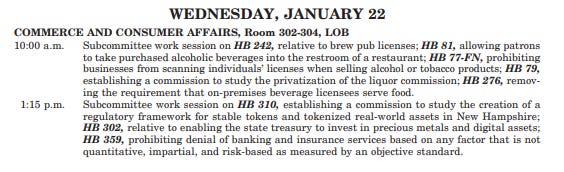
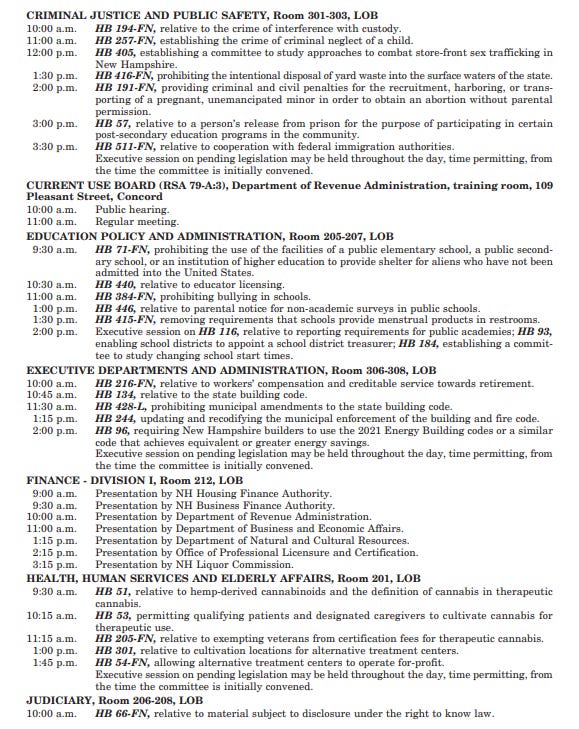
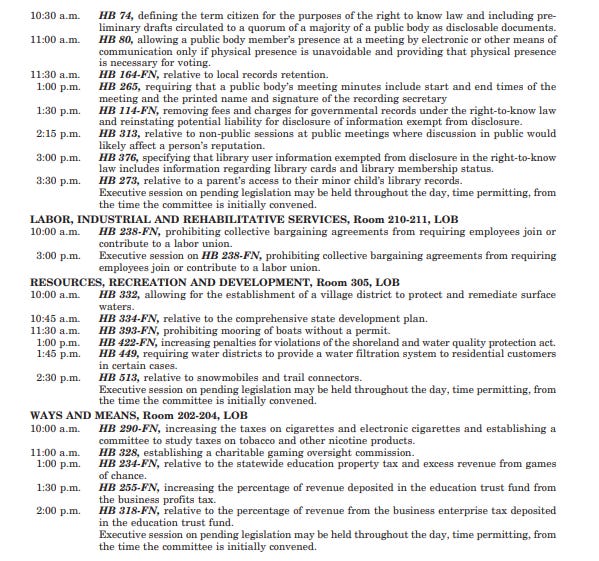
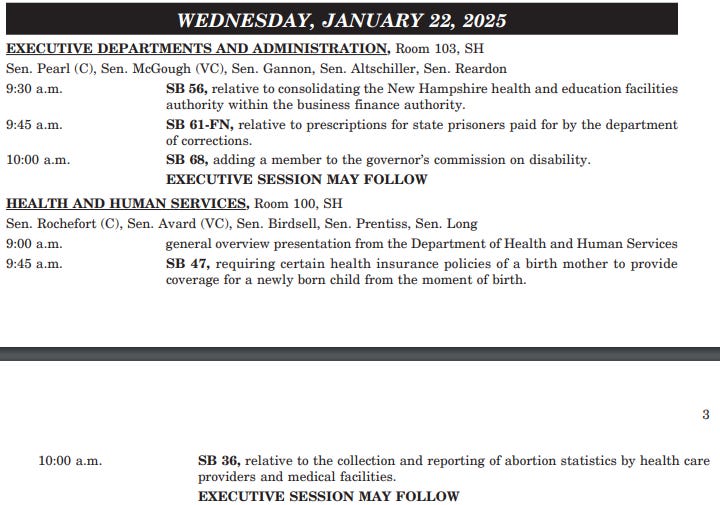
Screenshots of House and Senate Calendars
 |
 |
 |
 |
In-Depth Analysis of All Bills
House Criminal Justice And Public Safety
HB 194-FN
AN ACT relative to the crime of interference with custody.
Sponsor(s): (Prime) Rep. Lisa Post (R), Rep. John Potucek (R), Rep. James Spillane (R), Rep. Jess Edwards (R), Rep. David Love (R), Rep. Jim Maggiore (D), Rep. Sheila Seidel (R), Rep. Kristine Perez (R), Rep. Lorie Ball (R), Rep. Susan DeRoy (R), Sen. Timothy Lang (R), Sen. Victoria Sullivan (R)
Selected quote(s) from the bill:
1 New Paragraphs; Interference with Custody. Amend RSA 633:4 by inserting after paragraph IV the following new paragraphs:
V. A person is guilty of a class B felony if such person knowingly or purposely interferes with a lawful court order issued pursuant to RSA 461-A that has awarded parenting time of a child less than 18 years old and:
(a) Knowingly interferes with or obstructs child-parent contact or entices or persuades the child to leave the parenting time of the parent, guardian, or person standing in stead of the parent or guardian who is exercising parenting time under the court order; or
(b) Knowingly takes or retains the child in violation of the express terms of the court order, including a temporary order of a court regarding child custody.
VI.(a) A person is guilty of an offense if such person, when the person has not been awarded custody of the child by a court of competent jurisdiction and knows that a suit for divorce, separation, or child custody has been filed, takes the child out of the geographic area of the county or state without the permission of the court and with the intent to deprive the court of authority over the child.
(b) A person who is convicted of violating this paragraph shall be guilty of a violation and shall be fined not less than $250 nor more than $500 for a first or second offense. A person who is convicted of violating this paragraph a third or subsequent time shall be guilty of a class B felony.
VII. It shall be an affirmative defense to a charge under paragraph V or VI that, at the time of the offense, the person taking or retaining the child:
(a) Was entitled to parenting time or access to the child.
(b) Was acting in good faith to protect the child from real and imminent physical danger or psychological maltreatment as defined in RSA 169-C or was fleeing the commission or attempted commission of domestic or family violence, as those terms are used in RSA 173-B, against the person, and the person filed a non-frivolous petition documenting such danger and seeking to modify the court-ordered parenting plan prior to the interference or within 72 hours of the offense.
Summary:
This bill modifies the crime of interference with custody by adding penalties for knowingly violating court-ordered parenting time or removing a child to evade court jurisdiction, including escalating penalties for repeat offenders.
Argument For:
This bill strengthens enforcement of custody orders, ensuring compliance with court rulings and protecting parental rights, potentially reducing the burden on courts by deterring violations and aiding in the budget fight.
Argument Against:
The bill could increase judicial and correctional system costs due to higher prosecution and incarceration rates, adding financial strain during a budget fight.
Hearing: Wednesday, Jan 22 at 10:00 a.m. in Room 301-303 in the Legislative Office Building and streaming on YouTube.
HB 257-FN
AN ACT establishing the crime of criminal neglect of a child.
Sponsor(s): (Prime) Rep. Skip Rollins (R), Rep. Michael Moffett (R), Rep. Brian Sullivan (D), Rep. Cassandra Levesque (D), Rep. Diane Pauer (R), Rep. Hope Damon (D), Sen. Ruth Ward (R)
Selected quote(s) from the bill:
2 New Section; Criminal Code; Criminal Neglect of a Child. Amend RSA 639 by inserting after section 3 the following new section:
639:3-a Criminal Neglect of a Child.
I. A person is guilty of criminal neglect of a child if the person is responsible for a child's welfare and, through his or her action or failure to take action for reasons other than poverty, negligently fails to provide any of the following, so as to seriously endanger the physical, mental, or emotional health of a child:
(a) Necessary care.
(b) Necessary food.
(c) Necessary clothing.
(d) Necessary medical care.
(e) Necessary shelter.
(f) The protection from ingestion of or exposure to distribution or manufacture of controlled drugs.
…
III. A person who violates paragraph I is guilty of:
(a) A class A felony, if the neglect resulted in the child's death.
(b) A class B felony, if the neglect resulted in a serious bodily injury to the child or if the child becomes a victim of any offense under RSA chapters 632-A or 649-A, as a consequence of the neglect.
(c) A class B felony, if the actor has twice before been convicted of an offense under this section.
(d) A class A misdemeanor for any other violation of this section.
2 Extended Term of Imprisonment. Amend RSA 651:6, I(e) to read as follows:
(e) Has committed or attempted to commit any of the crimes defined in RSA 631, [or] 632-A, or 639:3-a against a person under 13 years of age;
Summary:
This bill establishes the crime of criminal neglect of a child, defining specific acts of neglect and prescribing penalties ranging from misdemeanors to felonies depending on the severity and consequences of the neglect.
Argument For:
This bill addresses a critical gap in child protection laws by holding individuals accountable for neglect, potentially deterring harmful behavior and safeguarding children, which could reduce long-term public spending on social and medical services.
Argument Against:
The bill may increase costs for the judicial and correctional systems due to the prosecution and incarceration of offenders, creating additional financial strain during an already challenging budget fight.
Hearing: Wednesday, Jan 22 at 11:00 a.m. in Room 301-303 in the Legislative Office Building and streaming on YouTube.
HB 405
AN ACT establishing a committee to study approaches to combat store-front sex trafficking in New Hampshire.
Sponsor(s): (Prime) Rep. Erica Layon (R)
Selected quote(s) from the bill:
1 Committee Established; Term Defined. There is established a committee to study approaches to combat store-front sex trafficking in New Hampshire. For the purposes of this committee, “store-front” shall refer to businesses in multi-unit commercial businesses which typically appear to be massage parlors or similar operations where individuals, typically immigrant women or children, are moved from location to location to avoid law enforcement.
…
3 Duties. The committee's study shall include, but not be limited to:
I. Review prior legislative attempts to combat store-front sex trafficking of individuals, including the reasons these attempts were unsuccessful.
II. Review non-legislative efforts to combat store-front sex trafficking of individuals, including the efficacy of these attempts and lessons learned.
III. Solicit and review input from organizations, business owners, and individuals on:
(a) Prior attempts to combat store-front sex trafficking.
(b) Minimizing impact on legitimate businesses.
(c) Potential collaborations needed to address the multi-state and multi-national features of these crimes.
IV. Consider non-traditional approaches, including allowing the termination of leases for entities suspected of sex trafficking that do not comply with duly authorized warrants or investigations as required under proposed legislation.
V. Solicit information regarding individuals who return to sex work in these conditions after receiving assistance to leave this work, in order to differentiate between continued victimization and willing participation in sex work, and the different approaches needed for these groups.
VI. If the committee finds that men are being sex trafficked in similar ways in New Hampshire, ensure protections are appropriately extended to all persons victimized in store-front sex trafficking in New Hampshire.
VII. Investigate ways to bring justice to those facilitating and participating in sex trafficking in New Hampshire.
VIII. Draft its proposal for legislation that would be intended for introduction in the 2026 session, reflecting the findings and conclusions of the committee.
Summary:
This bill establishes a legislative committee to study approaches to combat store-front sex trafficking in New Hampshire and requires the committee to report its findings and propose legislation by December 1, 2025.
Argument For:
This bill enables a thorough examination of the complex issue of store-front sex trafficking, potentially leading to effective legislation that addresses human trafficking while minimizing the impact on legitimate businesses, with minimal fiscal impact.
Argument Against:
The creation of the committee incurs administrative costs for member compensation and mileage, adding to state expenditures during a critical budget fight.
Hearing: Wednesday, Jan 22 at 12:00 p.m. in Room 301-303 in the Legislative Office Building and streaming on YouTube.
HB 416-FN
AN ACT prohibiting the intentional disposal of yard waste into the surface waters of the state.
Sponsor(s): (Prime) Rep. Rosemarie Rung (D), Rep. Karel Crawford (R), Rep. Karen Ebel (D), Rep. Nancy Murphy (D), Rep. John MacDonald (R), Rep. Richard Brown (R), Sen. David Watters (D)
Selected quote(s) from the bill:
1 New Section; New Hampshire Clean Lakes Program; Intentional Disposal of Yard Waste. Amend RSA 487 by inserting after section 25 the following new section:
487:25-a Intentional Disposal of Yard Waste. Intentional disposal of yard waste directly into surface waters, such as streams, rivers, lakes, or ponds shall constitute a violation punishable by a fine of $150 for a first offense, $300 for a second offense, and $750 for any subsequent offense. The authority to enforce this section shall extend to all peace officers in the state of New Hampshire.
Summary:
This bill prohibits the intentional disposal of yard waste into the surface waters of New Hampshire and establishes fines for violations to protect water quality and the environment.
Argument For:
This bill helps maintain clean water resources and prevents environmental degradation, with fines providing a minor increase in state revenue to aid in the ongoing budget fight.
Argument Against:
The bill imposes government regulations on private behavior, potentially infringing on individual freedoms and personal property rights by criminalizing actions that some may view as harmless.
Hearing: Wednesday, Jan 22 at 1:30 p.m. in Room 301-303 in the Legislative Office Building and streaming on YouTube.
HB 191-FN
AN ACT providing criminal and civil penalties for the recruitment, harboring, or transporting of a pregnant, unemancipated minor in order to obtain an abortion without parental permission.
Sponsor(s): (Prime) Rep. Glenn Cordelli (R), Rep. Lisa Freeman (R), Rep. Mark Pearson (R), Rep. Terry Roy (R), Rep. Paul Terry (R), Rep. Sheila Seidel (R), Rep. Susan DeRoy (R), Sen. Kevin Avard (R), Sen. Ruth Ward (R)
Selected quote(s) from the bill:
1 New Section; Criminal Code; Trafficking of a Minor for an Abortion. Amend RSA 633 by inserting after section 4 the following new section:
633:4-a Trafficking of a Minor for an Abortion.
I. A person is guilty of a class A misdemeanor if such person intentionally recruits, harbors, or transports a pregnant, unemancipated minor within this state for the purpose of:
(a) Concealing an act that would constitute an abortion under RSA 132:32 from the parents or legal guardian of the pregnant, unemancipated minor;
(b) Procuring an act that would constitute an abortion under RSA 132:32 for the pregnant, unemancipated minor, regardless of where the abortion is to be procured; or
(c) Obtaining an abortion-inducing drug for the pregnant, unemancipated minor for the purpose of an act that would constitute an abortion under RSA 329:43, regardless of where the abortion-inducing drug is obtained.
II. A person shall be guilty of a class B felony if the person is convicted of violating this section and has previously been convicted of 2 or more offenses under paragraph I.
…
IV. This section does not apply to:
(a) The parents or legal guardian of the unemancipated minor;
(b) A person who has obtained the written, notarized consent of the unemancipated minor's parent or legal guardian;
(c) A common carrier transporting passengers in the course and scope of their business; or
(d) An ambulance driver or operator and any corresponding emergency medical services personnel acting within the course and scope of their duties.
V. It shall not be a defense to a prosecution under this section that the pregnant, unemancipated minor consented to the actions prohibited by paragraph I.
2 New Chapter; Wrongful Death Actions For Certain Abortions Performed Contrary To Law. Amend RSA by inserting after chapter 507-H the following new chapter:
CHAPTER 507-I
Wrongful Death Actions For Certain Abortions Performed Contrary To Law
507-I:1 Liability; Who May Bring Suit.
I. A person who violates RSA 633:4-a, I, may be held liable in a civil action for the wrongful death of an unborn child who was aborted.
II. The civil action may be brought on behalf of the unborn child by:
(a) The biological mother of the unborn child;
(b) The biological father of the unborn child, unless the pregnancy resulted from an act committed by the biological father that constitutes an act of:
(1) Aggravated felonious sexual assault, as defined in RSA 632-A:2.
(2) Incest, as defined in RSA 639:2.
507-I:2 Damages. In a civil action arising from a violation of this chapter, the plaintiff may recover from the person who violated this chapter:
I. Economic damages;
II. Noneconomic damages;
III. Punitive damages; and
IV. Reasonable attorney's fees and court costs.
507-I:3 Exceptions.
I. This chapter does not apply to the provision of a medical diagnosis or consultation regarding pregnancy care of an unemancipated minor. As used in this chapter, a medical diagnosis or consultation regarding pregnancy care does not include performing or attempting to perform an abortion, as defined in RSA 132:32, I.
II. This section does not prohibit a licensed physician or another person from calling an ambulance for a minor patient if a medical emergency, pursuant to RSA 132:32, VIII, exists.
Loose context:
Were Gov. Ayotte to sign this bill into law, some might argue it would break her promise to veto new abortion restrictions.
Summary:
This bill establishes criminal and civil penalties for individuals who facilitate an abortion for a pregnant, unemancipated minor without parental consent, including allowing for wrongful death lawsuits in certain cases.
Argument For:
This bill reinforces parental rights and safeguards minors by ensuring that parental involvement is required in significant medical decisions, with potential to deter unlawful actions and reduce costs related to unregulated procedures.
Argument Against:
The bill restricts the autonomy of minors and individuals who assist them, imposing government overreach into deeply personal medical and family matters, potentially infringing on personal freedoms.
Hearing: Wednesday, Jan 22 at 2:00 p.m. in Room 301-303 in the Legislative Office Building and streaming on YouTube.
HB 57
AN ACT relative to a person’s release from prison for the purpose of participating in certain post-secondary education programs in the community.
Sponsor(s): (Prime) Rep. David Meuse (D)
Selected quote(s) from the bill:
1 Inmate Release; Post-Secondary Education. Amend RSA 651:25, I to read as follows:
I. The commissioner of corrections may release any person who has been committed to the state prison at any time during the term of sentence for the purpose of obtaining and working at gainful employment, to participate in post-secondary education in the community for which they have been accepted for enrollment, for the performance of uncompensated public service a…
2 Inmate Attendance at Post-Secondary Education Program. Amend RSA 651:25, III-IV to read as follows:
III. Any part of a day a prisoner is employed or enrolled in post-secondary education outside the walls of the institution shall count as a full day toward the serving of his or her sentence as though served inside the walls. An inmate so employed or enrolled in post-secondary education outside shall be subject to the rules and regulations of the institution and be under the direction and control of the officers thereof.
IV. If an inmate released for work or enrolled in post-secondary education escapes or fails to return inside the walls of the institution as required by the rules or the orders of the officers thereof or if on administrative home confinement, knowingly leaves a place without authority to do so, such inmate shall be punished ….
Summary:
This bill allows the commissioner of corrections to release prisoners for participation in post-secondary education programs in the community, provided they meet eligibility criteria and the sentencing court and prosecutor are notified with no objection.
Argument For:
This bill promotes rehabilitation and reduces recidivism by providing inmates with access to education, which can improve employment opportunities and lower long-term incarceration costs, helping alleviate budgetary pressures.
Argument Against:
The bill could raise concerns about public safety and accountability, as releasing prisoners for education may be viewed as prioritizing their rehabilitation over community security and justice for victims.
Hearing: Wednesday, Jan 22 at 3:00 p.m. in Room 301-303 in the Legislative Office Building and streaming on YouTube.
HB 511-FN
AN ACT relative to cooperation with federal immigration authorities.
Sponsor(s): (Prime) Rep. Joe Sweeney (R), Rep. Thomas Walsh (R), Rep. Ross Berry (R), Rep. Donald McFarlane (R), Sen. Bill Gannon (R), Sen. Daryl Abbas (R)
Selected quote(s) from the bill:
1 New Chapter; Anti-Sanctuary Act. Amend RSA by inserting after chapter 106-O the following new chapter:
CHAPTER 106-P
ANTI-SANCTUARY ACT
…
VI. “Sanctuary policy” means a law, policy, practice, procedure, or custom adopted or allowed by a state entity or local governmental entity which prohibits or impedes a law enforcement agency from complying with 8 U.S.C. section 1373 or which prohibits or impedes a law enforcement agency from communicating or cooperating with a federal immigration agency so as to limit such law enforcement agency in, or prohibit the agency from:
(a) Complying with an immigration detainer;
(b) Complying with a request from a federal immigration agency to notify the agency before the release of an inmate or detainee in the custody of the law enforcement agency;
(c) Providing a federal immigration agency access to an inmate for interview;
(d) Participating in any program or agreement authorized under section 287 of the Immigration and Nationality Act, 8 U.S.C. section 1357; or
(e) Providing a federal immigration agency with an inmate’s incarceration status or release date.
…
106-P:2 Prohibition of Sanctuary Policies.
No state government entity, local government entity, or law enforcement agency shall knowingly enact, issue, adopt, promulgate, enforce, permit, endorse, maintain, or have in effect any sanctuary policy.
106-P:3 Cooperation with Federal Immigration Authorities.
I. A law enforcement agency shall use best efforts to support the enforcement of federal immigration law.
II. Except as otherwise expressly prohibited by federal law, a state entity, local governmental entity, or law enforcement agency, or an employee, an agent, or a representative of the entity or agency, may not prohibit or in any way restrict a law enforcement agency from taking any of the following actions with respect to information regarding a person’s immigration status:
(a) Sending the information to or requesting, receiving, or reviewing the information from a federal immigration agency for purposes of this chapter.
(b) Recording and maintaining the information for purposes of this chapter.
(c) Exchanging the information with a federal immigration agency or another state entity, local governmental entity, or law enforcement agency for purposes of this chapter.
(d) Using the information to comply with an immigration detainer.
(e) Using the information to confirm the identity of a person who is detained by a law enforcement agency.
III. This section does not require a state entity, local governmental entity, or law enforcement agency to provide a federal immigration agency with information related to a victim of or a witness to a criminal offense if the victim or witness timely and in good faith responds to the entity’s or agency’s request for information and cooperation in the investigation or prosecution of the offense.
IV. This section does not authorize a law enforcement agency to detain an alien unlawfully present in the United States pursuant to an immigration detainer solely because the alien witnessed or reported a crime or was a victim of a criminal offense.
V. This section does not apply to any alien unlawfully present in the United States if he or she is or has been a necessary witness or victim of a crime of domestic violence, rape, sexual exploitation, sexual assault, murder, manslaughter, assault, battery, human trafficking, kidnapping, false imprisonment, involuntary servitude, fraud in foreign labor contracting, blackmail, extortion, or witness tampering.
106-P:4 Enforcement.
I. Any executive or administrative state, county, or municipal officer who violates his or her duties under this chapter may be subject to action by the attorney general, who may file suit against a local governmental entity or local law enforcement agency in a court of competent jurisdiction for declaratory or injunctive relief for a violation of this chapter.
II. If a local governmental entity or local law enforcement agency violates this chapter, the court shall enjoin the unlawful sanctuary policy. The court has continuing jurisdiction over the parties and subject matter and may enforce its orders with the initiation of contempt proceedings as provided by law.
III. An order approving a consent decree or granting an injunction shall include written findings of fact that describe with specificity the existence and nature of the sanctuary policy that violates this chapter.
Relevant context:
Gov. Ayotte talked about getting rid of sanctuary policies.
Summary:
This bill prohibits state and local governments from adopting sanctuary policies that impede the enforcement of federal immigration law and establishes mechanisms for enforcement through the Attorney General.
Argument For:
The bill promotes uniformity in immigration enforcement, ensuring state and local entities comply with federal law and reducing potential conflicts that could lead to inefficiencies or legal disputes, which may help mitigate future litigation costs.
Argument Against:
The bill infringes on local control and autonomy by mandating cooperation with federal immigration authorities, potentially undermining trust between immigrant communities and local law enforcement, which could negatively impact public safety.
Hearing: Wednesday, Jan 22 at 3:30 p.m. in Room 301-303 in the Legislative Office Building and streaming on YouTube.
House Education Policy And Administration
HB 71-FN
AN ACT prohibiting the use of the facilities of a public elementary school, a public secondary school, or an institution of higher education to provide shelter for aliens who have not been admitted into the United States.
Sponsor(s): (Prime) Rep. Juliet Harvey-Bolia (R), Rep. Joe Sweeney (R), Rep. Gregory Hill (R), Rep. Lisa Freeman (R), Rep. Diane Pauer (R), Rep. Katy Peternel (R), Rep. James Thibault (R), Rep. Matt Sabourin dit Choinière (R), Sen. Keith Murphy (R)
Selected quote(s) from the bill:
1 New Section; Prohibition on Use of School and Institution Facilities to Shelter Certain Aliens. Amend RSA 126-A by inserting after section 32 the following new section:
126-A:32-a Prohibition on Use of School and Institution Facilities to Shelter Certain Aliens.
…
II. As a condition on receipt of state financial assistance under any applicable program by a district public school, chartered public school, public academy, or an institution of higher learning, the facilities of the school or institution shall not be used to provide shelter or housing for specified aliens.
…
HB 71-FN- FISCAL NOTE
…
METHODOLOGY:
… The Department of Health and Human Services suggests that the bill may conflict with federal guidance, potentially resulting in the loss of federal funding from the Office of Refugee Resettlement and the Department of Housing and Urban Development. In the worst-case scenario in which all such funding were withheld, the Department estimates the loss of federal revenue at $12 to $18 million per year.
Relevant context:
Gov. Ayotte talked about getting rid of sanctuary policies.
Summary:
This bill prohibits public schools and institutions of higher education from providing shelter to aliens who have not been admitted into the United States, except in the case of short-term emergency shelter due to specified disasters.
Argument For:
This bill prevents the diversion of educational facilities from their primary purpose, potentially saving costs associated with facility use and maintenance during non-educational activities, which helps during the budget fight.
Argument Against:
The bill risks conflicts with federal guidance, potentially leading to the loss of $12 to $18 million in federal funding annually, exacerbating budget challenges for the state.
Hearing: Wednesday, Jan 22 at 9:30 a.m. in Room 205-207 in the Legislative Office Building and streaming on YouTube.
HB 440
AN ACT relative to educator licensing.
Sponsor(s): (Prime) Rep. Glenn Cordelli (R), Rep. Michael Moffett (R), Rep. Margaret Drye (R), Rep. Kristin Noble (R)
Selected quote(s) from the bill:
1 Rules; Scores Required for Education License Eligibility. Amend RSA 186:11, X(a) to read as follows:
(a) Certification of teachers, supervisors, and administrators in the public schools. The state board shall also examine the qualifications of candidates for those positions and issue certificates to those who meet the requirements of said rules. Such rules shall require all candidates seeking a New Hampshire license for administrator, teacher, instructional specialist or educational specialist to obtain passing scores on professional education assessments as determined by the state board of education. Career and technical education teachers may be exempt from this requirement if they pass the basic academic skills testing or an industry recognized credential.
Resource:
The National Ocupational Licensing Database (NCSL)
Summary:
This bill mandates that candidates for New Hampshire educator licenses, including teachers, administrators, instructional specialists, and educational specialists, must obtain passing scores on professional education assessments as determined by the state board of education.
Argument For:
This bill ensures that licensed educators meet uniform professional standards, potentially improving the quality of education across the state without imposing significant new costs, aiding long-term educational outcomes.
Argument Against:
Requiring additional standardized assessments could deter potential candidates, worsening the teacher shortage and increasing recruitment costs for schools, which may strain education budgets during a period of fiscal uncertainty.
Hearing: Wednesday, Jan 22 at 10:30 a.m. in Room 205-207 in the Legislative Office Building and streaming on YouTube.
HB 384-FN
AN ACT prohibiting bullying in schools.
Sponsor(s): (Prime) Rep. Peter Leishman (D), Rep. Mary Jane Wallner (D), Rep. Kimberly Rice (R)
Selected quote(s) from the bill:
1 New Paragraph; Pupil Safety and Violence Prevention; Bullying Resolution Conference Required. Amend RSA 193-F:4 by inserting after paragraph II the following new paragraph:
II-a. The school board of each school district and the board of trustees of a chartered public school shall, no later than 6 months after the effective date of this paragraph, adopt a written policy requiring the scheduling of bullying resolution conferences following the occurrence of a bullying or cyberbullying incident pursuant to paragraph I. The policy shall contain, at a minimum, the following components:
(a) Within 10 days of notification pursuant to subparagraph II-a(j), the school bullying officer, appointed pursuant to RSA 194-F:11, shall schedule a bullying resolution conference with the parent(s) or guardian(s) of the perpetrator and applicable school personnel. The conference shall occur even if the parent(s) or guardian(s) decline to participate or fail to attend.
(b) Following the conference, the bullying officer shall develop a written bullying action plan that details the actions that shall be taken by the perpetrator, the perpetrator's parent(s) or guardians(s), and school personnel, and which shall include, at a minimum:
(1) Attendance by the parent(s) or guardian(s) of the perpetrator in at least one instruction course that includes:
(A) The definition of bullying;
(B) Prevention strategies;
(C) Ways to talk to the perpetrator about bullying; and
(D) Evidence-based methods for resolving the underlying causes of bullying.
(2) Participation of the perpetrator in an age-appropriate anti-bullying class or workshop that includes:
(A) The impacts of bullying;
(B) The root causes of bullying; and
(C) Constructive conflict resolution strategies and coping mechanisms.
(c) Upon the subsequent occurrence of an incident investigated by the bullying officer and determined to be an act of bullying by the perpetrator against another pupil, the bullying officer shall notify the parent(s) or guardian(s) of the perpetrator and the bullying officer shall file a petition alleging that the perpetrator is a child in need of services pursuant to RSA 169-D:2, II(f).
2 New Section; Bullying Officer; Appointment; Duties. Amend RSA 193-F by inserting after section 10 the following new section:
193-F:11 Bullying Officer; Appointment; Duties.
I. School boards and boards of trustees of chartered public schools shall appoint bullying officers for their districts or chartered public schools.
II. Bullying officers shall, when directed by the school board or board of trustees, enforce the policies adopted by the school board or board of trustees pursuant to RSA 193-F:4, II-a.
III. A bullying officer or school official shall not file a petition alleging that the child is in need of services pursuant to RSA 169-D:2, II(f) until all steps in the school district's or chartered public school's intervention process under RSA 193-F:4, II-a have been followed.
3 New Subparagraph; Definitions; Child in Need of Services; Bullying Perpetrator. Amend RSA 169-D:2, II by inserting after subparagraph (e) the following new subparagraph:
(f) Who has committed a subsequent act of bullying or cyberbullying investigated by the bullying officer and determined to be an act of bullying by the perpetrator against another pupil.
Summary:
This bill requires schools to adopt anti-bullying policies that include parent conferences, action plans for bullying prevention, and enforcement measures, including the ability to designate repeat offenders as children in need of services.
Argument For:
This bill strengthens anti-bullying efforts, fostering safer school environments and reducing long-term societal costs associated with bullying-related mental health issues and juvenile delinquency, which may help alleviate state expenditures in the future.
Argument Against:
The bill imposes significant new costs on the state, including $264,000 in FY 2026 and increasing annually, as well as indeterminable local costs for appointing bullying officers and implementing required interventions, further straining the budget during a challenging fiscal period.
Hearing: Wednesday, Jan 22 at 11:00 a.m. in Room 205-207 in the Legislative Office Building and streaming on YouTube.
HB 446
AN ACT relative to parental notice for non-academic surveys in public schools.
Sponsor(s): (Prime) Rep. Melissa Litchfield (R), Rep. Jeffrey Tenczar (R), Rep. Daniel Popovici-Muller (R), Rep. Henry Giasson (R), Rep. Sayra DeVito (R)
Selected quote(s) from the bill:
1 Duties of State Board of Education; Administration of Non-Academic Surveys. Amend RSA 186:11, IX-d to read as follows:
IX-d. Require School Districts to Adopt a Policy Governing the Administration of Non-academic Surveys or Questionnaires to Students. .. The school district shall make such surveys or questionnaires available, at the school and on the school or school district's website, for review by a student's parent or legal guardian, and shall notify parents or legal guardians by sending such survey through email and any other means of delivery the district deems appropriate at least 10 days prior to distribution to students. …
Summary:
This bill requires school districts to notify parents or guardians by email at least 10 days before administering non-academic surveys to students and to provide copies of the surveys for review.
Argument For:
This bill increases parental transparency and involvement in students' education, fostering trust between schools and families without adding significant costs.
Argument Against:
The bill imposes administrative burdens on school districts to distribute surveys and track compliance, potentially increasing local education costs during a challenging budget climate.
Hearing: Wednesday, Jan 22 at 1:00 p.m. in Room 205-207 in the Legislative Office Building and streaming on YouTube.
HB 415-FN
AN ACT removing requirements that schools provide menstrual products in restrooms.
Sponsor(s): (Prime) Rep. Katy Peternel (R), Rep. Jess Edwards (R), Rep. Juliet Harvey-Bolia (R), Rep. Riché Colcombe (R), Rep. Sheila Seidel (R)
Selected quote(s) from the bill:
1 Repeal. RSA 189:16-a, relative to menstrual hygiene products in schools, is repealed.
Relevant current law:
189:16-a Menstrual Hygiene Products. –
I. The school district shall make menstrual hygiene products available at no cost in all gender neutral bathrooms and bathrooms designated for females located in public middle and high schools.
II. Menstrual hygiene products shall include sanitary napkins and tampons.
III. The school district shall bear the cost of supplying menstrual hygiene products. A school district may seek grants or partner with a nonprofit or community-based organization to fulfill this obligation.
Summary:
This bill removes the requirement for school districts to provide menstrual hygiene products in restrooms at no cost.
Argument For:
This bill reduces costs for school districts, offering potential savings that can be redirected to other educational priorities during tight budget periods.
Argument Against:
Eliminating this requirement may disproportionately affect students who cannot afford menstrual products, creating equity issues and potentially hindering attendance and academic performance.
Hearing: Wednesday, Jan 22 at 1:30 p.m. in Room 205-207 in the Legislative Office Building and streaming on YouTube.
House Executive Departments And Administration
HB 216-FN
AN ACT relative to workers' compensation and creditable service towards retirement.
Sponsor(s): (Prime) Rep. Carol McGuire (R), Rep. Peter Schmidt (D), Rep. Jaci Grote (D)
Selected quote(s) from the bill:
1 Workers' Compensation and Creditable Service for Retirement. Amend RSA 100-A:4, III(b) to read as follows:
(b) Notwithstanding the provisions of subparagraph (a) or any other law to the contrary, any member who receives a weekly award under the provisions of RSA 281-A from the commissioner of labor, for injury arising out of and in the course of employment, shall be entitled to creditable service for said period [not in excess of one year]. …
Summary:
This bill removes the one-year cap on creditable service toward retirement benefits for periods when a member is receiving workers' compensation.
Argument For:
This bill ensures that employees injured on the job are not penalized in their retirement benefits, providing a fairer system that supports workers and aligns with the principles of worker protection.
Argument Against:
By increasing retirement system liabilities and administrative costs, this bill imposes additional financial burdens on the state and local governments, with projected costs reaching up to $1.5 million annually, exacerbating budgetary challenges.
Hearing: Wednesday, Jan 22 at 10:00 a.m. in Room 306-308 in the Legislative Office Building and streaming on YouTube.
HB 134
AN ACT relative to the state building code.
Sponsor(s): (Prime) Rep. Carol McGuire (R), Rep. Keith Erf (R), Sen. Howard Pearl (R)
Selected quote(s) from the bill:
1 Definition of State Building Code. Amend RSA 155-A:1, IV to read as follows:
IV. … as published by the International Code Council Inc., and the National Electrical Code [2020] 2023, as published by the National Fire Protection Association, Inc., as reviewed and recommended by the state building code review board, including all amendments reviewed and approved by the board as of [May 10] September 13, 2024 ….
Summary:
This bill updates the state building code to include the 2021 versions of several international building codes and the 2023 National Electrical Code, along with amendments approved by the building code review board as of September 13, 2024.
Argument For:
Updating the building code ensures that construction practices align with the latest safety standards, energy efficiency measures, and technological advancements, ultimately reducing risks and promoting sustainability.
Argument Against:
Implementing new code requirements may increase construction costs for builders and property owners, which could burden individuals and businesses during a time of economic uncertainty.
Hearing: Wednesday, Jan 22 at 10:45 a.m. in Room 306-308 in the Legislative Office Building and streaming on YouTube.
HB 428-L
AN ACT prohibiting municipal amendments to the state building code.
Sponsor(s): (Prime) Rep. Joe Alexander (R), Rep. Carol McGuire (R), Rep. Dan McGuire (R), Rep. Mark Warden (R), Rep. Joe Sweeney (R), Rep. Jason Osborne (R), Rep. Ross Berry (R), Sen. Daniel Innis (R), Sen. Keith Murphy (R), Sen. Mark McConkey (R)
Selected quote(s) from the bill:
1 Powers of Cities and Towns; Building Codes. RSA 47:22 is repealed and reenacted to read as follows:
…
4 Local Amendments; Application. Amend RSA 155-A:3 to read as follows:
155-A:3 [Local Amendments;] Application. For a municipality which has adopted an enforcement mechanism [or additional regulations to the state building code pursuant to RSA 674:51]:
[I. The municipality may adopt local amendments to the state building code pursuant to RSA 674:51. The issuance of permits and the collection of fees pursuant RSA 155-A:2, III and issuance of permits and certificates of occupancy pursuant to RSA 155-A:2, IV shall not be considered amendments to the building code and shall not be subject to RSA 674:51, II.
II. The procedure for amendment shall be in accordance with applicable statutes and local regulations.
III] I. At a minimum, the municipality shall ensure that implementation and enforcement includes:
(a) Review and acceptance of appropriate plans.
(b) Issuance of building permits.
(c) Inspection of the work authorized by the building permits.
(d) Issuance of appropriate use and occupancy certificates.
…
[V. Any ordinance adopted under RSA 674:51 by a local legislative body shall be submitted to the state building code review board for review and confirmation.]
5 Power to Amend State Building Code Removed. RSA 674:51 is repealed and reenacted to read as follows:
674:51 Enforcement of State Building Code. The state building code established in RSA 155-A shall be effective in all towns and cities in the state and shall be enforced as provided in RSA 155-A:7.
I. Notwithstanding any other provision of law, no local legislative body shall enact any ordinance, adopt any rule, or implement any regulation that amends, overrides, or deviates from the state building code on or after the effective date of this section. All municipalities shall comply fully with the state building code without further local modification.
7 Repeal. The following are repealed:
I. RSA 155-A:10, IV(c) through (f), relative to the state building code review board.
II. RSA 674:34, II, relative to the powers of building code boards of appeals.
Summary:
This bill prohibits municipalities from amending the state building code, mandating uniform enforcement of the code across all localities in New Hampshire.
Argument For:
Standardizing the building code statewide reduces complexity for developers and contractors, lowering costs and promoting efficiency, especially for those operating in multiple municipalities.
Argument Against:
Restricting municipalities from amending the code removes local control, potentially limiting their ability to address unique community needs and enforce safety or environmental standards that exceed the state minimum.
Hearing: Wednesday, Jan 22 at 11:30 a.m. in Room 306-308 in the Legislative Office Building and streaming on YouTube.
HB 244
AN ACT updating and recodifying the municipal enforcement of the building and fire code.
Sponsor(s): (Prime) Rep. Carol McGuire (R), Rep. Keith Erf (R), Sen. Howard Pearl (R), Sen. Keith Murphy (R)
Selected quote(s) from the bill:
38 Power to Amend State Building Code and Establish Enforcement Procedures. Amend RSA 674:51 to read as follows:
674:51 [Power to Amend State Building Code and Establish Enforcement Procedures] Automatic Fire Suppression Sprinklers; Installation of Commercially Available Heating or Other Energy Systems.[ [The state building code established in RSA 155-A shall be effective in all towns and cities in the state and shall be enforced as provided in RSA 155-A:7. In addition, towns and cities shall have the following authority:]
[I. The local legislative body may enact as an ordinance or adopt, pursuant to the procedures of RSA 675:2-4, additional provisions of the state building code for the construction, remodeling, and maintenance of all buildings and structures in the municipality, provided that such additional regulations are not less stringent than the requirements of the state building code. The local legislative body may also enact a process for the enforcement of the state building code and any additional regulations thereto, and the provisions of a nationally recognized code that are not included in and are not inconsistent with the state building code. Any local enforcement process adopted prior to the effective date of this paragraph shall remain in effect unless it conflicts with the state building code or is amended or repealed by the municipality.]
II. Any such ordinance enacted or adopted under paragraph I by a local legislative body shall not be enforced unless confirmed by the building code review board pursuant to RSA 155-A:10, IV(c). The procedural history of local adoption relating to published notice, public hearing, and vote of approval shall be submitted to the board within 30 days of enactment or adoption and prior to enforcement.
III. The local ordinance or amendment adopted according to the provisions of paragraph I shall include, at a minimum, the following provisions:
(a) The date of first enactment of any building code regulations in the municipality and of each subsequent amendment thereto.
(b) Provision for the establishment of a building code board of appeals as provided in RSA 673:1, V; 673:3, IV; and 673:5.
(c) Provision for the establishment of the position of building inspector as provided in RSA 673:1, V. The building inspector shall have the authority to issue building permits as provided in RSA 676:11-13 and any certificates of occupancy as enacted pursuant to paragraph III, and to perform inspections as may be necessary to assure compliance with the local building code.
(d) A schedule of fees, or a provision authorizing the governing body to establish fees, to be charged for building permits, inspections, and for any certificate of occupancy enacted pursuant to paragraph III.
IV. The regulations adopted pursuant to paragraph I may include a requirement for a certificate of occupancy to be issued prior to the use or occupancy of any building or structure that is erected or remodeled, or undergoes a change or expansion of use, subsequent to the effective date of such requirement.]
…
68 Repeal. The following are repealed:
I. RSA 47:22, relative to the grant of power.
II. RSA 47:22-a, relative to manufactured housing.
III. RSA 47:22-b, relative to manufactured housing foundations.
IV. RSA 47:23, relative to amendments.
V. RSA 47:24, relative to exceptions.
VI. RSA 47:25, relative to examination by public.
VII. RSA 47:26, relative to public hearings and notice.
VIII. RSA 155-A:3, relative to building code local amendments and applications.
IX. RSA 673:1, III and V, relative to the establishment of local land use boards.
X. RSA 673:3, IV, relative to zoning board of adjustment and building code board of appeals.
XI. RSA 673:22, II, relative to transfer of documents upon abolition of zoning ordinance or building code.
XII. RSA 674:34, relative to powers of building code board of appeals.
XIII. RSA 674:52-a, relative to ordering building vacated.
XIV. RSA 676:11, relative to building permits required.
XV. RSA 676:12, relative to building permits to be withheld in certain cases.
XVI. RSA 676:13, relative to building permit restrictions.
Note:
This bill is absolutely gigantic.
Summary:
This bill reorganizes and updates how municipalities enforce the state building and fire code by repealing older sections, reenacting them under a clearer framework, and making minor grammar and spelling corrections. It appears this bill takes some authority away from local agencies for creating new building regulations.
AI Comprehensive Analysis of HB 244
Argument For:
By clarifying enforcement authority and preserving local fees for permits and inspections, it could help municipalities maintain or slightly increase revenue, which supports the budget fight.
Argument Against:
Requiring municipalities to update their administrative procedures may impose additional costs on local governments, making the budget fight more challenging.
Hearing: Wednesday, Jan 22 at 1:15 p.m. in Room 306-308 in the Legislative Office Building and streaming on YouTube.
HB 96
AN ACT requiring New Hampshire builders to use the 2021 Energy Building codes or a similar code that achieves equivalent or greater energy savings.
Sponsor(s): (Prime) Rep. Wendy Thomas (D), Rep. Kat McGhee (D), Rep. Will Darby (D)
Selected quote(s) from the bill:
1 Purpose. The purpose of bill is to provide the state of New Hampshire access to federal funding by using a building code equal to or greater than the standards set and provided for by the International Energy Conservation Code 2021, such as funding related to the Inflation Reduction Act, Infrastructure Investment and Jobs Act, and Department of Energy funding.
2 Definition of State Building Code. Amend RSA 155-A:1, IV to read as follows:
IV. "New Hampshire building code" or "state building code" means the adoption by reference of the International Building Code 2021, the International Existing Building Code 2021, the International Plumbing Code 2021, the International Mechanical Code 2021, the International Energy Conservation Code [2018] 2021, or a similar code that achieves an equivalent or greater energy savings, …
Summary:
This bill updates the New Hampshire building code to require the use of the 2021 International Energy Conservation Code or a similar code that achieves equivalent or greater energy savings, allowing the state to access federal funding under programs like the Inflation Reduction Act and the Infrastructure Investment and Jobs Act.
Argument For:
The bill helps secure federal funding for New Hampshire, reducing the state’s budget burden while promoting energy efficiency and long-term cost savings.
Argument Against:
The bill imposes potential upfront costs on builders and developers, which could increase housing and construction expenses during a period of economic uncertainty.
Hearing: Wednesday, Jan 22 at 2:00 p.m. in Room 306-308 in the Legislative Office Building and streaming on YouTube.
House Health, Human Services And Elderly Affairs
HB 51
AN ACT relative to hemp-derived cannabinoids and the definition of cannabis in therapeutic cannabis.
Sponsor(s): (Prime) Rep. Wendy Thomas (D), Rep. Suzanne Vail (D), Rep. Heath Howard (D)
Selected quote(s) from the bill:
1 Use of Cannabis for Therapeutic Purposes; Definitions; Cannabis. Amend RSA 126-X:1, III to read as follows:
III. "Cannabis" means all parts of any plant of the Cannabis genus of plants, whether growing or not; [the seeds thereof;] the resin extracted from any part of such plant; and every compound, salt, derivative, mixture, or preparation of such plant, [its seeds,] or its resin. Such term shall not include the mature stalks of such plants, fiber produced from such stalks, oil, or cake made from the seeds of such plants, any other compound, salt, derivative, mixture, or preparation of such mature stalks (except the resin extracted therefrom), fiber, oil, or cake[, or the sterilized seeds of such plants which are incapable of germination]. In this chapter, cannabis shall not include hemp grown, processed, marketed, or sold under RSA 439-A, except as provided in RSA 126-X:8, XIX.
2 New Paragraph; Use of Cannabis for Therapeutic Purposes; Alternative Treatment Centers; Requirements. Amend RSA 126-X:8 by inserting after paragraph XVIII the following new paragraph:
XIX.(a) An alternative treatment center may acquire, and may use in the manufacture of cannabis concentrate and cannabis infused products, CBD and other hemp-derived non-intoxicating cannabinoids not produced by an alternative treatment center in New Hampshire. All such non-intoxicating cannabinoids, and all cannabis concentrate and cannabis infused products manufactured from such non-intoxicating cannabinoids, shall be tested for contaminants and cannabinoid profile in accordance with this chapter and department rules.
(b) An alternative treatment center shall not use products that are derived from hemp which contain natural or synthetic tetrahydrocannabinol (THC) greater than 0.3 percent on a dry weight basis, which appear in any formulation, including delta-8 THC, delta-9 THC, or any other THC isomer variant.
Summary:
This bill updates the definition of "cannabis" for therapeutic use by removing "seeds" and permits alternative treatment centers to use non-intoxicating hemp-derived cannabinoids in their products, provided they meet contamination and cannabinoid profile standards.
Argument For:
Removing "seeds" from the definition of "cannabis" reduces regulatory burdens and aligns state law with federal standards, fostering clarity and supporting industry growth.
Argument Against:
Excluding "seeds" may create loopholes in tracking and enforcement, potentially complicating efforts to regulate cannabis-related activities comprehensively.
Hearing: Wednesday, Jan 22 at 9:30 a.m. in Room 201 in the Legislative Office Building and streaming on YouTube.
HB 53
AN ACT permitting qualifying patients and designated caregivers to cultivate cannabis for therapeutic use.
Sponsor(s): (Prime) Rep. Wendy Thomas (D), Rep. Jim Kofalt (R), Rep. Heath Howard (D)
Selected quote(s) from the bill:
1 Use of Therapeutic Cannabis for Therapeutic Purposes; Definitions. Amend RSA 126-X:1, IV to read as follows:
IV. “Cultivation location” means a locked and enclosed site, under the control of an alternative treatment center where cannabis is cultivated, secured with one or more locks or other security devices in accordance with the provisions of this chapter, or under the control of a qualifying patient or designated caregiver where cannabis is cultivated and which meets the requirements of this chapter.
2 Use of Therapeutic Cannabis; Definitions. Amend RSA 126-X:1, VI to read as follows:
VI. "Designated caregiver'' means an individual who:
…
(b)(1) Has agreed to assist with one or more (not to exceed 5) qualifying [patient's] patients in the therapeutic use of cannabis, …
(2) Has agreed to cultivate cannabis for therapeutic use pursuant to this chapter for no more than one qualifying patient;
…
4 Use of Therapeutic Cannabis; Definitions. Amend RSA 126-X:1, XIII(c) to read as follows:
(c) Cultivation by a designated caregiver or qualifying patient, except as provided under RSA 126-X:2, II-a and II-b.
5 New Paragraphs; Use of Therapeutic Cannabis Purposes; Protections. Amend RSA 126-X:2 by inserting after paragraph II the following new paragraphs:
II-a. Except as provided in RSA 126-X:3, VII(b), a qualifying patient or designated caregiver who has reported to the department a cultivation location that meets the requirements of this chapter, shall not be subject to arrest by state or local law enforcement, prosecution or penalty under state or municipal law, or denied any right or privilege for the therapeutic use of cannabis in accordance with this chapter, if, at the cultivation location, while transporting cannabis and cannabis plants and seedlings to a new cultivation location that has been reported to the department within the prior 21 days, or while transporting cannabis seedlings from an alternative treatment center to the cultivation location, the qualifying patient or designated caregiver possesses or cultivates an amount of cannabis that does not exceed the following:
(a) Eight ounces of usable cannabis;
(b) Any amount of unusable cannabis; and
(c) Three mature cannabis plants, 3 immature cannabis plants, and 12 seedlings.
II-b. A cultivation location under the control of a qualifying patient or designated caregiver shall meet the following requirements:
(a) It shall be at the qualifying patient’s or designated caregiver’s residence.
(b) It shall be reported to the department, except that either the qualifying patient or their designated caregiver, but not both, shall report a cultivation location to the department.
(c) It shall be locked and enclosed.
(d) The cannabis plants shall not be subject to public view, including from another private property, without the use of optical aids.
(e) It shall have a canopy of no more than 50 square feet, except that if more than one qualifying patient, designated caregiver, or both, share a cultivation location, the total canopy of all cannabis plants shall not exceed 100 square feet.
6 Use of Therapeutic Cannabis; Purposes; Protections. Amend RSA 126-X:2, III to read as follows:
III. A designated caregiver may receive compensation for costs, not to exceed $500 per calendar year, …. Such compensation shall not constitute the sale of [controlled substances] a controlled drug pursuant to RSA 318-B.
7 Use of Therapeutic Cannabis; Protections. Amend RSA 126-X:2, XV to read as follows:
XV. A laboratory, and the employees thereof, which conducts testing of cannabis [required under rules for] delivered to it by alternative treatment centers, [adopted under this chapter, and the employees thereof] qualifying patients, or designated caregivers, shall not be subject to arrest ….
8 Use of Therapeutic Cannabis; Prohibitions and Limits. Amend RSA 126-X:3, I to read as follows:
I. A qualifying patient may use and a qualifying patient or designated caregiver may cultivate cannabis on privately-owned real property only with written permission of the property owner or, in the case of leased property, with the permission of the tenant in possession of the property …. A tenant or guest of a tenant shall not cultivate cannabis on rented property if the lessor has prohibited therapeutic cannabis cultivation. …
9 New Subparagraph; Use of Therapeutic Cannabis; Registry Identification Cards. Amend RSA 126-X:4, I by inserting after subparagraph (h) the following new subparagraph:
(i) The qualifying patient's cultivation location, if any.
10 New Subparagraph; Use of Therapeutic Cannabis; Registry Identification Cards. Amend RSA 126-X:4, II by inserting after subparagraph (h) the following new subparagraph:
(i) The designated caregiver's cultivation location, where he or she may cultivate cannabis on behalf of a single qualifying patient who has not reported a cultivation location.
11 Use of Therapeutic Cannabis; Registry Identification Cards. Amend RSA 126-X:4, IX(a) to read as follows:
IX.(a) A qualifying patient shall notify the department before changing his or her designated caregiver or cultivation location. A designated caregiver shall notify the department before changing his or her cultivation location.
…
14 Use of Therapeutic Cannabis; Affirmative Defense. Amend RSA 126-X:5, I to read as follows:
…
(c) The actor is an employee of a laboratory conducting testing required for alternative treatment centers pursuant to rules adopted under this chapter or that tests cannabis provided to it by qualifying patients and designated caregivers.
15 New Subparagraph; Use of Therapeutic Cannabis; Alternative Treatment Centers. Amend RSA 126-X:8, XIII by inserting after subparagraph (c) the following new subparagraph:
(d) A qualifying patent or designated caregiver shall not obtain from an alternative treatment center more than 12 seedlings during a 3-month period.
16 Use of Cannabis for Therapeutic Purposes; Prohibitions and Limits. Amend RSA 126-X:3, VII to read as follows:
…
(b) The department may revoke a qualifying patient's or designated caregiver’s permission to cultivate cannabis for a violation of the rules adopted by the department or for a violation of any provision of this chapter.
…
XV.(a)(1) An alternative treatment center shall not possess or cultivate cannabis in excess of the following quantities:
[(1)] (A) Eighty mature cannabis plants, 160 [seedlings] immature cannabis plants, and 80 ounces of usable cannabis[, or 6 ounces of usable cannabis per qualifying patient]; and
[(2)] (B) Three mature cannabis plants, 12 [seedlings] immature cannabis plants, and 6 ounces of usable cannabis for each qualifying patient registered [as a qualifying patient] under this chapter.
(2) An alternative treatment center shall not be limited in the number of seedlings it can possess or cultivate.
Summary: This bill allows qualifying patients and designated caregivers to grow limited amounts of therapeutic cannabis at home under specified requirements.
Argument For: It can reduce patients’ costs, reduce law enforcement expenses, and therefore potentially help with budget considerations.
Argument Against: Letting patients grow at home could lower any state revenue from regulated sales and create additional oversight costs, thereby straining the budget.
Hearing: Wednesday, Jan 22 at 10:15 a.m. in Room 201 in the Legislative Office Building and streaming on YouTube.
HB 205-FN
AN ACT relative to exempting veterans from certification fees for therapeutic cannabis.
Sponsor(s): (Prime) Rep. Heath Howard (D), Rep. Wendy Thomas (D), Rep. Tom Mannion (R), Rep. Alissandra Murray (D), Rep. Matt Sabourin dit Choinière (R), Sen. Suzanne Prentiss (D)
Selected quote(s) from the bill:
1 Therapeutic Cannabis Registry; Waiver of Application or Renewal Fees for Veterans. Amend RSA 126-X:4, I(b) to read as follows:
(b) An application or a renewal application accompanied by the application or renewal fee. A renewal application and fee shall not be required if the applicant receives an extension to the written certification previously issued for fewer than 3 years. A veteran of the United States armed forces shall be exempt from the application or renewal fee upon verification of the individual's status as a veteran in accordance with RSA 21:50, I(b).
Summary:
This bill exempts veterans from the application and renewal fees associated with the therapeutic cannabis registry in New Hampshire.
Argument For:
By reducing financial barriers for veterans to access therapeutic cannabis, this bill provides meaningful support to those who served in the armed forces and may help alleviate the state budget pressures by shifting fee responsibilities to alternative treatment centers.
Argument Against:
This bill creates an unequal system by exempting veterans from fees while requiring other participants to continue paying, which could be perceived as unfair and lead to calls for further exemptions that may strain the program's financial sustainability.
Hearing: Wednesday, Jan 22 at 11:15 a.m. in Room 201 in the Legislative Office Building and streaming on YouTube.
HB 301
AN ACT relative to cultivation locations for alternative treatment centers.
Sponsor(s): (Prime) Rep. Suzanne Vail (D), Rep. Wendy Thomas (D), Rep. Heath Howard (D), Rep. Jodi Newell (D)
Selected quote(s) from the bill:
1 New Paragraph; Use of Cannabis for Therapeutic Purposes; Alternative Treatment Centers; Cultivation Location. Amend RSA 126-X:7 by inserting after paragraph X the following new paragraph:
XI. The department may authorize an alternative treatment center to operate additional cultivation locations, which may be a greenhouse, and which shall be subject to rules adopted by the department under RSA 126-X:6, III, and all applicable provisions of this chapter, including, but not limited to, compliance with local zoning laws. The department shall, in conjunction with the local governing body of the town or city where the additional cultivation location would be located, solicit input from qualifying patients, designated caregivers, and residents of the town or city in which the additional cultivation location would be located.
Summary:
This bill allows alternative treatment centers to operate additional cultivation locations, including greenhouses, subject to department rules and local zoning laws.
Argument For:
This bill could increase cannabis production capacity, potentially lowering costs for patients and increasing state tax revenue from therapeutic cannabis sales, which supports the budget fight.
Argument Against:
Allowing additional cultivation locations may lead to increased regulatory and oversight costs for the state, potentially straining resources without a guaranteed corresponding increase in revenue.
Hearing: Wednesday, Jan 22 at 1:00 p.m. in Room 201 in the Legislative Office Building and streaming on YouTube.
HB 54-FN
AN ACT allowing alternative treatment centers to operate for-profit.
Sponsor(s): (Prime) Rep. Wendy Thomas (D), Rep. Suzanne Vail (D)
Selected quote(s) from the bill:
3 Public Health; Use of Cannabis for Therapeutic Purposes; Alternative Treatment Centers; Requirements. ? Amend RSA 126-X:8, I to read as follows:
I. An alternative treatment center [shall] may be operated on a for-profit or not-for-profit basis for the benefit of its patients. …
? 4 New Paragraphs; Public Health; Use of Cannabis for Therapeutic Purposes; Alternative Treatment Centers; Requirements. ? Amend RSA 126-X:8 by inserting after paragraph XVIII the following new paragraphs:
XIX. ? Except as otherwise provided in this chapter, an alternative treatment center shall be subject to RSA 293-A if organized as a domestic business corporation, RSA 304-C if organized as a domestic limited liability company, and RSA 292 if organized as a voluntary corporation.
XX. ? An alternative treatment center organized as a voluntary corporation under RSA 292 may convert from a voluntary corporation under RSA 292 to either a domestic business corporation organized under RSA 293-A or a limited liability company organized under RSA 304-C in any of the following ways:
…
5 ?Voluntary Corporations and Associations; Powers of Corporations; Change of Name; Amending Articles; Conversion and Merger. ? Amend RSA 292:7 to read as follows:
292:7 Change of Name; Amending Articles.
…
II. ? An alternative treatment center registered pursuant to RSA 126-X and organized under this chapter may, pursuant to RSA 126-X:8, XX, convert to either a domestic corporation organized under RSA 293-A or a limited liability company organized under to RSA 304-C, and may merge with a domestic business corporation organized under RSA 293-A or a limited liability company organized under RSA 304-C.
Summary:
This bill allows alternative treatment centers to operate as for-profit entities and outlines mechanisms for converting nonprofit centers into for-profit corporations or LLCs.
Argument For:
Allowing alternative treatment centers to operate for profit could attract additional investment, increase state revenue through taxes, and support the budget fight by enabling financial growth in the therapeutic cannabis sector.
Argument Against:
Transitioning to for-profit operations may prioritize profit over patient care, potentially increasing costs for patients and introducing oversight expenses, which could complicate the budget fight by reallocating state resources.
Hearing: Wednesday, Jan 22 at 1:45 p.m. in Room 201 in the Legislative Office Building and streaming on YouTube.
House Judiciary
HB 66-FN
AN ACT relative to material subject to disclosure under the right to know law.
Sponsor(s): (Prime) Rep. Bob Lynn (R), Rep. Marjorie Smith (D), Rep. Jess Edwards (R), Rep. Katelyn Kuttab (R)
Selected quote(s) from the bill:
1 Definition of Governmental Proceedings. Amend RSA 91-A:1-a, II to read as follows:
II. "Governmental proceedings" means the transaction of any functions affecting any [or all citizens of the state] person by a public body.
2 Minutes and Records Available for Public Inspection; Electronic Record Requests. Amend RSA 91-A:4, I to read as follows:
I. [Every citizen] Any person … has the right to inspect all governmental records in the possession, custody, or control of such public bodies or agencies …
3 Access to Governmental Records and Meetings; Records Available for Public Inspection; Preliminary Drafts. Amend RSA 91-A:4, II to read as follows:
II. After the completion of a meeting of a public body, [every citizen] any person, … has the right to inspect all notes, preliminary drafts circulated to a quorum or a majority of the public body ….
4 New Paragraph; Access to Governmental Records and Meetings; Minutes and Records Available for Public Inspection. Amend RSA 91-A:4 by inserting after paragraph V the following new paragraph:
V-a.(a) Any person may request governmental records electronically or by mail without physically appearing at the regular business premises of public bodies or agencies to request governmental records.
(b) At the election of the person requesting the records, the public body or agency shall provide such records electronically or by mail without requiring the person's physical appearance at its business premises to receive delivery of the records. If the person requests that the records be provided by mail, the public body or agency may charge the person the cost of postage. No charge shall be made for records delivered electronically. This subparagraph does not preclude a public body from imposing charges authorized under paragraph VIII.
…
5 Appeals and Enforcement; Filing Fee or Surcharge. Amend RSA 91-A:7-c, I to read as follows:
I. Any party may appeal the ombudsman's final ruling to the superior court by filing a notice of appeal in superior court no more than 30 calendar days after the ombudsman's ruling is issued. The ombudsman's ruling shall be attached to the document initiating the appeal, admitted as a full exhibit by the superior court, considered by the judge during deliberations, and specifically addressed in the court's written order. [Citizen-initiated] Appeals shall have no filing fee or surcharge. The public body or public agency shall pay the sheriff's service costs if the public body or public agency, or its attorney, declines to accept service. Nothing in this section shall prevent a superior court from staying an ombudsman's decision pending appeal to the superior court.
Summary:
This bill expands the Right to Know law by allowing any person, not just New Hampshire citizens, to request governmental records, requiring preliminary drafts shared with quorums to be disclosed, permitting electronic requests and delivery of records, and adjusting the appeals process for ombudsman rulings.
Argument For:
The bill enhances transparency and accessibility of government operations, potentially increasing public trust and accountability while modernizing records processes, which could reduce administrative inefficiencies and support cost-effective governance.
Argument Against:
By broadening access and increasing disclosure requirements, the bill may result in higher administrative costs for processing and fulfilling requests, which could exacerbate budget pressures during a contentious fiscal environment.
Hearing: Wednesday, Jan 22 at 10:00 a.m. in Room 206-208 in the Legislative Office Building and streaming on YouTube.
HB 74
AN ACT defining the term citizen for the purposes of the right to know law and including preliminary drafts circulated to a quorum of a majority of a public body as disclosable documents.
Sponsor(s): (Prime) Rep. Jess Edwards (R), Rep. Bob Lynn (R)
Selected quote(s) from the bill:
1 Findings and Purpose. The general court finds that free speech and liberty of the press are essential to the security of freedom in a state and therefore organizations and individuals acting primarily in the role of the press shall be considered citizens under the provisions of this chapter.
2 New Paragraph; Definition Of Citizen. Amend RSA 91-A:1-a by inserting after paragraph I the following new paragraph:
I-a. “Citizen” means any person having a legal status in and relation to New Hampshire by virtue of domicile or any press acting on informing NH citizens, regardless of domicile.
3 Preliminary Draft Disclosure. Amend RSA 91-A:4, II to read as follows:
II. After the completion of a meeting of a public body, every citizen, during the regular or business hours of such public body, and on the regular business premises of such public body, has the right to inspect all notes, preliminary drafts circulated to a quorum or a majority of the public body, materials, tapes, or other sources used for compiling the minutes of such meetings, and to make memoranda or abstracts or to copy such notes, materials, tapes, or sources inspected, except as otherwise prohibited by statute or RSA 91-A:5.
Summary:
This bill defines "citizen" under New Hampshire’s Right to Know law to include residents of the state and members of the press, regardless of domicile, and requires preliminary drafts shared with a quorum of a public body to be disclosed.
Argument For:
This bill enhances transparency and accountability by ensuring that critical drafts and deliberations are accessible, and by explicitly including the press in the definition of "citizen," it strengthens democratic oversight.
Argument Against:
The additional disclosure requirements may impose administrative burdens and increased costs on public bodies, which could exacerbate budget constraints in the current fiscal environment.
Hearing: Wednesday, Jan 22 at 10:30 a.m. in Room 206-208 in the Legislative Office Building and streaming on YouTube.
HB 80
AN ACT allowing a public body member's presence at a meeting by electronic or other means of communication only if physical presence is unavoidable and providing that physical presence is necessary for voting.
Sponsor(s): (Prime) Rep. Len Turcotte (R), Rep. Glenn Bailey (R), Rep. Aidan Ankarberg (I), Rep. Claudine Burnham (R), Rep. Michael Granger (R), Rep. Kelley Potenza (R)
Selected quote(s) from the bill:
1 Attendance For Participation In Meeting. Amend RSA 91-A:2, III(a) to read as follows:
(a) A member of the public body may participate in a meeting other than by attendance in person at the location of the meeting only when such attendance is [not reasonably practical] unavoidable. Any reason that such attendance is [not reasonably practical] unavoidable shall be stated in the minutes of the meeting.
2 Physical Attendance Required For Voting. Amend RSA 91-A:2, III(e) to read as follows:
(e) A member participating in a meeting by the means described in this paragraph is deemed to be present at the meeting except for purposes of voting. All votes taken during such a meeting shall be by roll call vote.
Summary:
This bill requires members of public bodies to be physically present at meetings unless physical presence is unavoidable and mandates that voting can only occur in person.
Argument For:
This bill ensures accountability and transparency by requiring members to be physically present during decision-making, fostering more direct engagement and deliberation.
Argument Against:
The restriction on remote participation and voting may increase costs and logistical challenges for members, particularly during emergencies, and could impede the efficiency of meetings.
Hearing: Wednesday, Jan 22 at 11:00 a.m. in Room 206-208 in the Legislative Office Building and streaming on YouTube.
HB 164-FN
AN ACT relative to local records retention.
Sponsor(s): (Prime) Rep. Joe Alexander (R), Rep. Paul Berch (D), Rep. Bob Lynn (R), Rep. Katelyn Kuttab (R), Sen. Daniel Innis (R), Sen. Keith Murphy (R)
Selected quote(s) from the bill:
1 Local Records; Public Access. Amend RSA 5:35 to read as follows:
5:35 Local Records.
The director shall accept for storage in the state archives such local records as the municipal records board established under RSA 33-A:4-a may require. The director shall designate, with the approval of the municipal records board, a publicly accessible website for the retention and public access to local electronic records.
2 Local Government Records Manager; Website Development. Amend RSA 5:49, II to read as follows:
II. It shall be the responsibility of the local government records manager to advise the municipal records board concerning local government records policies and procedures, state services and financial support needed to assist or advise local officials, and regulations pertaining to local government [records, and grants for local government records management improvement pursuant to RSA 5:51].
3 New Paragraph; Duties of Local Government Records Manager. Amend RSA 5:49 by inserting after paragraph II the following new paragraph:
II-a. The local government records manager, or if the role is not filled, the state archivist, is authorized to employ specialists in records management, archives, and administration, consultants and or other specialists necessary to provide a publicly accessible website pursuant to RSA 5:35 and issue guidance for its proper use.
4 New Paragraph; Electronic Records. Amend RSA 33-A:5-a by inserting after paragraph II the following new paragraph:
III. Electronic municipal records, including paper municipal records transferred to electronic records in accordance with the provisions of paragraph I, may be stored on a publicly accessible website designated by, and in accordance with, guidance issued by the state archivist. If electronic municipal records are stored in this manner, no additional copy need be kept by the municipality if the municipality provides the public at least one cost-free method of accessing the website.
5 Minutes and Records Available for Public Inspection. Amend RSA 91-A:4, IV(a) to read as follows:
IV.(a) Each public body or agency shall, upon request for any governmental record reasonably described, make available for inspection and copying any such governmental record within its files when such records are immediately available for such release or, if the record has been uploaded to the website in accordance with RSA 33-A:5-a, III, provide the domain name of the website.
6 Appropriation. The sum of $150,000 for the fiscal year ending June 30, 2026 is hereby appropriated to the secretary of state, division of archives and records management for the local government records manager position at LG 21, creation, and maintenance of a publicly accessible website for the retention and public access to local electronic records, and implementation of provisions of this act. To the extent the secretary of state is unable to hire the local government records manager position, the funds allocated for the position may be used to employ an outside consultant to perform the duties required. The governor is authorized to draw a warrant for said sum out of any money in the treasury not otherwise appropriated.
Summary:
This bill mandates the creation of a publicly accessible website for storing and accessing local government electronic records, appropriating $150,000 to fund the initiative, including hiring or contracting a local government records manager.
Argument For:
The bill promotes transparency and public access to government records, enhancing accountability and modernizing records management, which could result in long-term cost efficiencies.
Argument Against:
The bill requires a significant upfront appropriation and creates recurring expenses, potentially increasing budgetary strain in future fiscal years amidst broader financial challenges.
Hearing: Wednesday, Jan 22 at 11:30 a.m. in Room 206-208 in the Legislative Office Building and streaming on YouTube.
HB 265
AN ACT requiring that a public body's meeting minutes include start and end times of the meeting and the printed name and signature of the recording secretary
Sponsor(s): (Prime) Rep. Marjorie Smith (D), Rep. Bob Lynn (R), Rep. Katelyn Kuttab (R)
Selected quote(s) from the bill:
1 Access to Governmental Records and Meetings; Meetings Open to Public. Amend RSA 91-A:2, II to read as follows:
II. … Minutes of all such meetings, including nonpublic sessions, shall include the names of members, persons appearing before the public bodies, [and] a brief description of the subject matter discussed and final decisions, the start time and end time of the meeting, and name and signature of the person who produced the minutes.
Summary:
This bill requires public meeting minutes to include the start and end times of the meeting as well as the printed name and signature of the recording secretary.
Argument For:
The bill improves transparency and accountability in public meetings by ensuring precise documentation of meeting details.
Argument Against:
The bill imposes additional administrative requirements on public bodies, potentially increasing workloads and costs.
Hearing: Wednesday, Jan 22 at 1:00 p.m. in Room 206-208 in the Legislative Office Building and streaming on YouTube.
HB 114-FN
AN ACT removing fees and charges for governmental records under the right-to-know law and reinstating potential liability for disclosure of information exempt from disclosure.
Sponsor(s): (Prime) Rep. Louise Andrus (R), Rep. Keith Ammon (R), Rep. Barbara Comtois (R), Rep. Riché Colcombe (R), Rep. John Sellers (R), Rep. Alvin See (R), Rep. Kristine Perez (R)
Selected quote(s) from the bill:
1 Right-to-Know; Fees for Records. Amend RSA 91-A:4, IV to read as follows:
…
(b) If a public body or agency is unable to make a governmental record available for immediate inspection and copying the public body or agency shall, within 5 business days of a request:
…
(3) Provide a written statement of the time reasonably necessary to determine whether the request shall be granted or denied and the reason for the delay[, and an itemized estimate of the cost of making the record available if a charge would be incurred under paragraph VIII].
…
[(e) A public body or agency may suggest to the requestor a reasonable modification of the scope of the request, if doing so would enable the body or agency to produce records sought more efficiently and affordably.
(f) A public body or agency responsible for responding to a records request shall not be liable for damages in a civil action caused by its fault or by fault attributable to it, arising out of disclosure of information exempt from disclosure pursuant to this chapter, provided that the public body or agency acted in good faith to redact any information that may be exempt from disclosure, unless the public body or agency can be shown to have acted in a wanton or reckless manner. The use of automated software to produce redactions or other automated processes to speed production in concert with spot checks shall qualify as good faith.]
2 Repeal. RSA 91-A:4,VIII and IX, relative to fees for records provided, are repealed.
Summary:
This bill removes fees and charges for governmental records under the right-to-know law and reinstates potential liability for the disclosure of information exempt from disclosure.
Argument For:
The bill enhances public access to government records by eliminating financial barriers, supporting transparency and accountability.
Argument Against:
The removal of fees reduces revenue for state and local governments, potentially straining budgets and increasing financial burdens during the budget fight.
Hearing: Wednesday, Jan 22 at 1:30 p.m. in Room 206-208 in the Legislative Office Building and streaming on YouTube.
HB 313
AN ACT relative to non-public sessions at public meetings where discussion in public would likely affect a person's reputation.
Sponsor(s): (Prime) Rep. Joe Alexander (R), Rep. David Love (R), Rep. Ross Berry (R)
Selected quote(s) from the bill:
1 Access to Governmental Records and Meetings; Nonpublic Sessions. Amend RSA 91-A:3, II(c) to read as follows:
(c) Matters which, if discussed in public, would likely affect adversely the reputation of any person, other than a member of the public body itself, unless such person [requests an open meeting] has a right to attend the meeting, at which point that person shall be given the opportunity to request an open meeting. If the person requests an open meeting, the request shall be granted. This exemption shall extend to any application for assistance or tax abatement or waiver of a fee, fine, or other levy, if based on inability to pay or poverty of the applicant.
Summary:
This bill allows individuals who have the right to attend a public meeting to request that discussions potentially affecting their reputation remain open to the public, rather than occurring in non-public sessions.
Argument For:
The bill enhances transparency and personal agency by allowing individuals to ensure that discussions about them occur in an open setting, promoting accountability in government actions.
Argument Against:
The bill could complicate sensitive discussions, potentially leading to reputational harm or legal challenges, and may increase the administrative burden on public bodies during a tight budget period.
Hearing: Wednesday, Jan 22 at 2:15 p.m. in Room 206-208 in the Legislative Office Building and streaming on YouTube.
HB 376
AN ACT specifying that library user information exempted from disclosure in the right-to-know law includes information regarding library cards and library membership status.
Sponsor(s): (Prime) Rep. Lisa Mazur (R), Rep. Joe Alexander (R), Rep. Ross Berry (R), Rep. Sheila Seidel (R), Rep. Henry Giasson (R), Rep. Sherri Reinfurt (R), Sen. Keith Murphy (R)
Selected quote(s) from the bill:
1 Right to Know: Library Cards. Amend RSA 91-A:5, IV to read as follows:
IV. Records pertaining to internal personnel practices; confidential, commercial, or financial information; test questions, scoring keys, and other examination data used to administer a licensing examination, examination for employment, or academic examinations; and personnel, medical, welfare, library user (including, but not limited to, library cards and library membership status), videotape sale or rental, and other files whose disclosure would constitute invasion of privacy. Without otherwise compromising the confidentiality of the files, nothing in this paragraph shall prohibit a public body or agency from releasing information relative to health or safety from investigative files on a limited basis to persons whose health or safety may be affected.
Summary:
This bill clarifies that library user information, including library card and membership status, is exempt from disclosure under the right-to-know law.
Argument For:
The bill strengthens privacy protections for library users, ensuring confidentiality and encouraging free and uninhibited use of library resources without fear of exposure.
Argument Against:
The bill does not address potential administrative costs for ensuring compliance, and it could limit transparency in cases where library records are relevant to broader public inquiries, adding complexity in a tight budgetary environment.
Hearing: Wednesday, Jan 22 at 3:00 p.m. in Room 206-208 in the Legislative Office Building and streaming on YouTube.
HB 273
AN ACT relative to a parent's access to their minor child's library records.
Sponsor(s): (Prime) Rep. Mike Drago (R), Rep. Jason Osborne (R), Rep. Melissa Litchfield (R), Rep. Riché Colcombe (R), Rep. Kristin Noble (R), Rep. Shane Sirois (R), Rep. Kristine Perez (R), Sen. Keith Murphy (R)
Selected quote(s) from the bill:
1 New Paragraph; Library User Records; Confidentiality; Access to Library Records of Minors. Amend RSA 201-D:11 by inserting after paragraph II the following new paragraph:
II-a. All library records related to a minor's current borrowing of printed library materials and audio-visual materials, such as DVDs and CDs, shall be available to the parent or legal guardian of the minor when requested by the parent or legal guardian whose address matches that on the minor's library account.
Summary:
This bill allows parents or legal guardians to access all library records related to their minor child’s borrowing of printed and audio-visual materials.
Argument For:
The bill enhances parental oversight by allowing parents to monitor their child’s library activity, aligning with parental rights to guide their child’s education and development.
Argument Against:
The bill imposes administrative burdens on libraries to verify and manage access requests, potentially increasing costs and complexity during a time of fiscal constraints.
Hearing: Wednesday, Jan 22 at 3:30 p.m. in Room 206-208 in the Legislative Office Building and streaming on YouTube.
House Labor, Industrial And Rehabilitative Services
HB 238-FN
AN ACT prohibiting collective bargaining agreements from requiring employees join or contribute to a labor union.
Sponsor(s): (Prime) Rep. Daniel Popovici-Muller (R), Rep. Gary Daniels (R), Rep. Mark Warden (R), Rep. Jason Osborne (R), Rep. Len Turcotte (R), Rep. Maureen Mooney (R), Rep. JD Bernardy (R), Rep. Yury Polozov (R), Rep. Donald McFarlane (R), Rep. Tim Mannion (R), Sen. Daniel Innis (R), Sen. Keith Murphy (R), Sen. Victoria Sullivan (R)
Selected quote(s) from the bill:
Name of Act. It is the intent of the general court that this act be known as “The New Hampshire Right to Work Act.”
2 New Chapter; Right to Work. Amend RSA by inserting after chapter 273-D the following new chapter:
CHAPTER 273-E
RIGHT TO WORK
273-E:1 Short Title. This chapter may be cited as "right to work."
273-E:2 Declaration of Public Policy. It is hereby declared to be the public policy of this state in order to maximize individual freedom of choice in the pursuit of employment and to encourage an employment climate conducive to economic growth, that all persons shall have, and shall be protected in the exercise of, the right freely, and without fear of penalty or reprise, to join or assist labor organizations, or to refrain from any such activity.
…
273-E:4 Right to Refrain. No person shall be required, as a condition of employment or continuation of employment, to:
I. Become or remain a member of a labor organization;
II. Pay any dues, fees, assessments, or other similar charges, however denominated, of any kind or amount to a labor organization; or
III. Pay any charity or other third party, in lieu of such payments, any amount equivalent to or pro-rata portion of dues, fees, assessments, or other charges required of members of a labor organization.
273-E:5 Prohibited Agreements.
I. Any agreement, understanding, or practice, written or oral, implied or expressed, between any labor organization and employer which violates the rights of employees as guaranteed by provisions of this chapter shall be prohibited.
II. Any term or provision of any agreement or understanding between any employee and any labor organization or employer that restricts the rights of employees as established by provisions of this chapter, such as a term that requires employees who resign their membership in a labor organization to continue to pay dues, fees, assessments, or other similar charges to that labor organization, shall be prohibited.
273-E:6 Penalties. Any person, employer, labor organization, agent, or representative of an employer or labor organization, who directly or indirectly imposes upon any person any requirement prohibited by this chapter shall be guilty of a misdemeanor, and, notwithstanding RSA 651:2, shall be subject for each offense to a fine not exceeding $1,000, or to imprisonment not exceeding 90 days, or both.
273-E:7 Injunctive Relief. Any person injured as a result of any violation or threatened violation of the provisions of this chapter shall be entitled to injunctive relief against any and all violators or persons threatening violations.
273-E:8 Damages. Any person injured as a result of any violation or threatened violation of the provisions of this chapter shall recover any and all damages, including costs and reasonable attorney fees, of any character resulting from such violation or threatened violation. Such remedies shall be independent of, and in addition to, the penalties and remedies proscribed in other provisions of this chapter.
273-E:9 Duty to Investigate and Enforce. The attorney general, or his or her designee, shall investigate any complaints of violation of this chapter, and shall prosecute all persons violating any of its provisions, and use all means at their command to ensure effective enforcement of the provisions of this chapter.
273-D:10 Exceptions. The provisions of this chapter shall not apply:
I. To employers and employees covered by the federal Railway Labor Act;
II. To federal employers and employees;
III. To employers and employees on exclusive federal enclaves;
IV. Where they would otherwise conflict with or be preempted by federal law; or
V. To any employment contract entered into before the effective date of this chapter. However, the provisions of this chapter shall apply to any renewal or extension of any existing contract.
Relevant Context:
Summary:
This bill prohibits collective bargaining agreements from requiring employees to join or contribute to a labor union as a condition of employment.
Argument For:
The bill supports individual worker freedom by ensuring employees cannot be compelled to join or financially support a union, potentially creating a more attractive business environment and reducing employer costs.
Argument Against:
The bill may weaken union bargaining power and reduce funding for union activities, which could diminish worker protections and benefits, ultimately impacting labor conditions and increasing long-term costs for workers.
Hearing: Wednesday, Jan 22 at 10:00 a.m. in Room 210-211 in the Legislative Office Building and streaming on YouTube.
House Resources, Recreation And Development
HB 332
AN ACT allowing for the establishment of a village district to protect and remediate surface waters.
Sponsor(s): (Prime) Rep. Rosemarie Rung (D), Rep. Karen Ebel (D), Rep. Nancy Murphy (D), Rep. Will Darby (D), Rep. Gregory Sargent (D), Sen. David Watters (D), Sen. Ruth Ward (R), Sen. David Rochefort (R)
Selected quote(s) from the bill:
1 Village District; Establishment. Amend RSA 52:1, I(m) - (n) to read as follows:
(m) The layout, acceptance, construction, and maintenance of roads;[and]
(n) The maintenance of ambulance services[.] ; and
(o) The protection and remediation of surface water quality within the district.
Summary:
This bill allows for the establishment of a village district specifically tasked with protecting and remediating surface water quality.
Argument For:
This bill enables towns sharing a body of water to implement consistent environmental policies, potentially reducing long-term costs associated with water quality issues and supporting economic development by preserving natural resources.
Argument Against:
Establishing and maintaining a new village district for water quality protection may increase administrative and operational expenses, straining local budgets during a period of significant financial challenges.
Hearing: Wednesday, Jan 22 at 10:00 a.m. in Room 305 in the Legislative Office Building and streaming on YouTube.
HB 334-FN
AN ACT relative to the comprehensive state development plan.
Sponsor(s): (Prime) Rep. Peter Lovett (D), Rep. Peter Bixby (D), Rep. Rosemarie Rung (D), Rep. Jaci Grote (D), Rep. Nicholas Germana (D), Rep. Heather Baldwin (D), Rep. Bill Bolton (D), Rep. Will Darby (D), Rep. Janet Lucas (D), Sen. David Watters (D)
Selected quote(s) from the bill:
1 Comprehensive State Development Plan; Natural Resources; Environmental Threats. Amend RSA 9-A:1, III to read as follows:
III. The comprehensive development plan shall include:
…
(7) A natural resources section which identifies trends in land protection, open space, drinking water aquifer identification and protection, protection of our lakes, rivers, estuaries, forest, wetlands and shoreline uplands, coastal marshlands, wildlife habitat, and farm land preservation and protection, and proposes policies and actions necessary at the state level to protect those resources which are perceived to be of statewide significance.
…
(14) An environmental threats section which identifies environmental threats from chemical and biological contamination, waste disposal, and inadequate recycling opportunities, in order to address the cumulative effects of natural and man-made contaminants on our air, waters, and land, and to anticipate possible future threats to our natural environment.
Summary:
This bill adds provisions to the comprehensive state development plan to include identifying and addressing environmental threats such as chemical contamination, waste disposal, and recycling inadequacies.
Argument For:
By addressing environmental threats in the state development plan, this bill enhances the state’s ability to mitigate future environmental risks, protecting natural resources and potentially reducing long-term remediation costs.
Argument Against:
The bill introduces significant new costs, estimated between $500,000 and $1,000,000 annually for plan modifications and related work, adding strain to the state budget during a critical fiscal period.
Hearing: Wednesday, Jan 22 at 10:45 a.m. in Room 305 in the Legislative Office Building and streaming on YouTube.
HB 393-FN
AN ACT prohibiting mooring of boats without a permit.
Sponsor(s): (Prime) Rep. Jonathan Smith (R), Rep. Glenn Cordelli (R), Rep. Karel Crawford (R), Rep. Lino Avellani (R), Rep. Stephen Woodcock (D), Rep. John MacDonald (R), Rep. Richard Brown (R), Rep. Katy Peternel (R), Rep. David Paige (D)
Selected quote(s) from the bill:
1 Mooring of Boats on Public Waters; Definitions. Amend RSA 270:59, III to read as follows:
III. "Mooring" when used as a noun, means a mooring anchor, or other fixed object or stationary point, with or without a mooring buoy together with attached chains, cables, ropes, and pennants and related equipment used for the purpose of securing watercraft; or any spuds, lifts, or other devices which are an integral part of the vessel and being used to secure a boat to the bottom of a water body in lieu of a dock or pier.
2 New Paragraph; Moorings Prohibited. Amend RSA 270:64 by inserting after paragraph III the following new paragraph:
IV. No person shall use spuds, lifts, or similar devices that are an integral part of a vessel, in lieu of a permitted mooring on any body of water requiring a mooring permit.
Summary:
This bill expands the definition of "mooring" to include spuds, lifts, and similar devices used to secure boats and prohibits their use without a permit in waters requiring mooring permits.
Argument For:
By regulating the use of spuds and similar devices, this bill helps ensure fair enforcement of mooring rules, potentially increasing compliance and reducing environmental and navigational risks without additional direct costs to the state.
Argument Against:
The bill imposes additional compliance burdens on boat owners and may require increased enforcement efforts, which could lead to indeterminate costs for local and state agencies, straining budgets during a critical fiscal period.
Hearing: Wednesday, Jan 22 at 11:30 a.m. in Room 305 in the Legislative Office Building and streaming on YouTube.
HB 422-FN
AN ACT increasing penalties for violations of the shoreland and water quality protection act.
Sponsor(s): (Prime) Rep. Rosemarie Rung (D), Rep. Karen Ebel (D), Rep. Nancy Murphy (D), Rep. John MacDonald (R), Rep. Richard Brown (R), Sen. David Watters (D), Sen. Rebecca Perkins Kwoka (D)
Selected quote(s) from the bill:
1 Penalties; Shoreland Water Quality Protection Act. Amend RSA 483-B:18, III to read as follows:
III. Persons violating the provisions of this chapter, who fail to restore the site to meet the applicable standards of this chapter within one year of receiving notification of a violation by the department, shall be subject to the following:
(a) Upon petition of the attorney general or of the municipality in which the violation occurred, the superior court may levy upon any person violating this chapter a civil penalty in an amount not to exceed [$5,000] $15,000 for each continuing violation. …
(b) The commissioner, after notice and hearing pursuant to RSA 541-A, may impose an administrative fine of up to [$5,000] $15,000 for each offense upon any person who violates this chapter. …
(c) Notwithstanding the [$5,000] $15,000 fine limit in subparagraph (b), the administrative fine for each repeat violation of this chapter may be multiplied by a factor of 2 for every previous violation committed by the person or entity.
Summary:
This bill increases the maximum penalties for violations of the Shoreland and Water Quality Protection Act from $5,000 to $15,000 per offense or violation.
Argument For:
The bill increases revenue by raising penalties, which can help address environmental damage and fund enforcement efforts during the ongoing budget fight.
Argument Against:
Higher penalties may disproportionately impact smaller property owners, potentially leading to increased litigation and enforcement costs that strain judicial and administrative resources.
Hearing: Wednesday, Jan 22 at 1:00 p.m. in Room 305 in the Legislative Office Building and streaming on YouTube.
HB 449
AN ACT requiring water districts to provide a water filtration system to residential customers in certain cases.
Sponsor(s): (Prime) Rep. Dan McGuire (R), Sen. Howard Pearl (R)
Selected quote(s) from the bill:
1 New Paragraph; Water Districts; Non-Potable Water. Amend RSA 31:139 by inserting after paragraph I the following new paragraph:
I-a. If a water district fails to meet potability standards set by the department of environmental services but is otherwise usable, and the cost of the remediation recommended by the department of environmental services is set before the legislative body and fails to pass, then the water district shall provide each residential customer with non-potable water a system capable of treating at least 2 gallons of water per bedroom daily. Maintenance of such systems shall not be the responsibility of the water district. Water districts shall have one year from the time of the failed vote before the legislative body to provide such systems to residents. Water districts may add a special assessment in order to pay for such systems. Commercial and municipal customers of the water district shall not be eligible for such system and shall post warning signs at each source of non-potable water that may be used by employees or the public. At least annually, the water district shall give a detailed explanation describing why the water is not potable to all users of water supplied by the water district.
Summary:
This bill requires water districts with non-potable water to provide residential customers with a water filtration system if remediation efforts fail to gain legislative approval.
Argument For:
This bill ensures access to safe drinking water for residents without significantly burdening the state budget, as costs can be offset through special assessments by water districts.
Argument Against:
The bill imposes new costs on water districts, which may result in higher fees for residents, and it does not address long-term solutions for ensuring potable water supply.
Hearing: Wednesday, Jan 22 at 1:45 p.m. in Room 305 in the Legislative Office Building and streaming on YouTube.
HB 513
AN ACT relative to snowmobiles and trail connectors.
Sponsor(s): (Prime) Rep. Thomas Schamberg (D), Rep. John Cloutier (D), Sen. David Rochefort (R)
Selected quote(s) from the bill:
1 Fish and Game; Bureau Responsibilities; Exception to Written Requests. Amend RSA 215-C:2, VII to read as follows:
VII. The supervisor of the bureau shall receive all written requests from persons applying for permission to establish a highway trail crossing or trail connector on any class I, class II, or class III highway for any snowmobile trail or cross country ski trail on which a snowmobile trail maintenance vehicle may operate. No request shall be necessary for specific connectors authorized under RSA 236:56, II(f). …
2 Snowmobiles; Crossings Over and Under Highways; Exception. Amend RSA 215-C:9, V to read as follows:
V. The policy governing any snowmobile, trail connector, or trail crossing within class I, II, and III highway rights-of-way shall be as determined by the commissioner of the department of transportation. Notwithstanding RSA 215-C:8, the commissioner may prescribe additional requirements for operation on a right-of-way under RSA 236:56, II(f).
3 New Subparagraph; Snowmobile Operation; Specific Type of Connector; Right-of-Way. Amend RSA 236:56, II by inserting after subparagraph (e) the following new subparagraph:
(f) Specific Connectors on State Right-of-Way. Notwithstanding subsection (d), where an established snowmobile trail connector becomes unavailable due to changed circumstances, and where a state right-of-way exists along a class I, II or III highway that would allow the connection of the portions of trails previously linked by the affected connector, and where no other reasonable trail connection alternative is available, snowmobiles shall be permitted to travel on the state right-of-way along a class I, II or III highway in a manner prescribed under 215-C:9, V to the extent necessary to connect the trail portions.
Summary:
This bill allows snowmobiles to operate on state highway rights-of-way to reconnect previously linked snowmobile trails when no other reasonable alternative exists.
Argument For:
This bill facilitates the reestablishment of vital snowmobile trail connections, potentially boosting tourism and local economies without imposing significant state budgetary burdens.
Argument Against:
Allowing snowmobiles on highway rights-of-way may increase maintenance costs and safety risks, potentially straining resources during budget negotiations.
Hearing: Wednesday, Jan 22 at 2:30 p.m. in Room 305 in the Legislative Office Building and streaming on YouTube.
House Ways And Means
HB 290-FN
AN ACT increasing the taxes on cigarettes and electronic cigarettes and establishing a committee to study taxes on tobacco and other nicotine products.
Sponsor(s): (Prime) Rep. Jerry Stringham (D)
Selected quote(s) from the bill:
1 Tax Imposed; Tobacco Tax. Amend RSA 78:2 to read as follows:
78:2 Tax Imposed.
I. A tax on all cigarettes and little cigars sold at retail in this state is imposed upon the consumer at the rate of [$1.78] $2.78 for each package containing 20 cigarettes or little cigars or at a rate proportional to such rate for packages containing other than 20 cigarettes or little cigars.
…
(b) A tax upon electronic cigarettes sold at retail in this state is imposed as follows:
(1) For closed cartridges or containers of liquid or other substances containing nicotine that are not intended to be opened, [at a rate of $0.30 per milliliter on the volume of the liquid or other substance in the cartridge or container as listed by the manufacturer] 65 percent of the wholesale sales price; and
(2) For containers of liquid or other substances containing nicotine that are intended to be opened, at a rate of [8] 65 percent of the wholesale sales price.
…
2 Committee Established. There is established a committee to study taxes on tobacco and other nicotine products.
…
4 Duties. The committee shall study taxes on tobacco and other nicotine products.
Summary:
This bill increases the tax rate on cigarettes and electronic cigarettes and establishes a committee to study taxes on tobacco and other nicotine products.
Argument For:
This bill is expected to generate significant additional revenue for the state, which could help address budget challenges and fund education and other public programs.
Argument Against:
The increased taxes could place a financial burden on consumers and potentially lead to reduced sales, negatively impacting businesses and state revenue over time.
Hearing: Wednesday, Jan 22 at 10:00 a.m. in Room 202-204 in the Legislative Office Building and streaming on YouTube.
HB 328
AN ACT establishing a charitable gaming oversight commission.
Sponsor(s): (Prime) Rep. Dick Ames (D), Rep. Paul Berch (D), Rep. Fred Doucette (R), Rep. Bill Ohm (R), Rep. Jerry Stringham (D), Rep. Sallie Fellows (D), Rep. Mary Hakken-Phillips (D), Rep. Walter Spilsbury (R), Rep. Linda Haskins (D), Sen. Timothy Lang (R), Sen. Donovan Fenton (D), Sen. David Rochefort (R), Sen. Pat Long (D)
Selected quote(s) from the bill:
1 Racing and Charitable Gaming; Study Commission Established. RSA 284:6-c is repealed and reenacted to read as follows:
284:6-c Study Commission Established. There is established a charitable gaming oversight commission.
…
V. The commission shall oversee the implementation of charitable gaming laws, including historical horse race gaming, shall consider the issues identified in the November 1, 2024, final report of the commission to study the effect of recent changes made to charitable gaming laws, including the newly authorized historical horse races established in 2023, 79:583, and shall make from time to time such recommendations for administrative and legislative changes to charitable gaming law and rules as it deems necessary and appropriate, including priority consideration of:
(a) Changes needed to address problem gambling.
(b) Changes needed to restructure or modify systems for allocating and overseeing the use of funds granted to the state and to charities and gaming operators participating in games of chance and in historical horse race gaming.
(c) Changes needed to prevent undue concentration or proliferation of gaming locations, facilities, and ownership, including a municipal option to opt into or out of components of charitable gaming.
(d) Changes that would enable the use of so-called slot machines instead of or in addition to historical horse racing machines.
(e) In its consideration of the allocation and use of charitable gaming funds and of the risk of undue economic concentration of gaming facilities and locations, the commission shall recommend any changes it deems needed to ensure compliance with Part 2, Article 6-b, of the New Hampshire Constitution relating to the use of lottery funds and Part 1, Article 83, of the New Hampshire Constitution relating to prohibiting monopolies and requiring free and fair competition.
…
79:587 Effective Date. Section 586 of this act shall take effect July 1, [2025] 2035.
Summary:
This bill establishes a charitable gaming oversight commission, modifies its membership and duties, and extends its authorization by 10 years.
Argument For:
This bill promotes responsible oversight of charitable gaming, ensures compliance with state constitutional provisions, and supports efficient allocation of gaming funds, which can increase state revenue and benefit public programs during budget challenges.
Argument Against:
Extending the commission and expanding its scope could lead to increased administrative costs and potential regulatory burdens, straining resources during a period of fiscal uncertainty.
Hearing: Wednesday, Jan 22 at 11:00 a.m. in Room 202-204 in the Legislative Office Building and streaming on YouTube.
HB 234-FN
AN ACT relative to the statewide education property tax and excess revenue from games of chance.
Sponsor(s): (Prime) Rep. Michael Harrington (R), Rep. Michael Granger (R)
Selected quote(s) from the bill:
1 Assessment; Education Tax. Amend RSA 76:3 to read as follows:
76:3 Education Tax. Beginning July 1, 2005, and every fiscal year thereafter, the commissioner of the department of revenue administration shall set the education tax rate at a level sufficient to generate revenue of $363,000,000, less any amount under RSA 76:3-a, when imposed on all persons and property taxable pursuant to RSA 76:8, except property subject to tax under RSA 82 and RSA 83-F. The education property tax rate shall be effective for the following fiscal year. The rate shall be set to the nearest 1/2 cent necessary to generate the revenue required in this section.
2 New Section; Excess Revenue from Games of Chance. Amend RSA 76 by inserting after section 3 the following new section:
76:3-a Excess Revenue from Games of Chance. The commissioner of the department of revenue administration shall reduce the level of revenue required to be generated under RSA 76:3 by the amount of revenue paid to the education trust fund under 287-D:20, minus $6,600,000, which is the estimated amount paid in state 2023 fiscal year.
Summary:
This bill reduces the statewide education property tax annually by the amount of revenue from games of chance exceeding $6.6 million, compared to fiscal year 2023 levels.
Argument For:
By linking education property tax reductions to gaming revenue, this bill provides tax relief to property owners while utilizing excess gaming funds, potentially alleviating budget pressures.
Argument Against:
Reducing property tax revenue based on fluctuating gaming income could create uncertainty in education funding, complicating long-term budget planning.
Hearing: Wednesday, Jan 22 at 1:00 p.m. in Room 202-204 in the Legislative Office Building and streaming on YouTube.
HB 255-FN
AN ACT increasing the percentage of revenue deposited in the education trust fund from the business profits tax.
Sponsor(s): (Prime) Rep. Thomas Schamberg (D)
Selected quote(s) from the bill:
1 Business Profits Tax; Distribution of Funds; Change in Percentage of Revenue. Amend RSA 77-A:20-a, I to read as follows:
I. The commissioner shall determine [41] 59 percent of the revenue produced by the tax imposed by RSA 77-A:2 for each fiscal year and shall certify such amounts to the state treasurer by October 1 of that year for deposit in the education trust fund established by RSA 198:39.
Summary:
This bill increases the percentage of revenue from the Business Profits Tax (BPT) allocated to the Education Trust Fund from 41% to 59%.
Argument For:
This bill redirects more revenue to the Education Trust Fund, potentially reducing reliance on property taxes for education funding and supporting the budget by ensuring consistent investment in schools.
Argument Against:
Shifting revenue from the General Fund to the Education Trust Fund could strain other state programs dependent on the General Fund, complicating the overall budget allocation during tight fiscal negotiations.
Hearing: Wednesday, Jan 22 at 1:30 p.m. in Room 202-204 in the Legislative Office Building and streaming on YouTube.
HB 318-FN
AN ACT relative to the percentage of revenue from the business enterprise tax deposited in the education trust fund.
Sponsor(s): (Prime) Rep. Thomas Schamberg (D)
Selected quote(s) from the bill:
1 Business Enterprise Tax; Distribution of Funds; Change in Percent of Revenue. Amend RSA 77-E:14, I to read as follows:
I. The commissioner shall determine [41] 59 percent of the revenue produced by the tax imposed by RSA 77-E:2 for each fiscal year and shall certify such amounts to the state treasurer by October 1 of that year for deposit in the education trust fund established by RSA 198:39.
Summary:
This bill increases the percentage of revenue from the Business Enterprise Tax (BET) deposited in the Education Trust Fund from 41% to 59%.
Argument For:
By allocating more BET revenue to the Education Trust Fund, this bill strengthens funding for public education, reducing reliance on property taxes and addressing long-term budgetary needs for schools.
Argument Against:
Redirecting revenue from the General Fund to the Education Trust Fund could create a shortfall for other state programs, intensifying budget challenges during the upcoming fiscal negotiations.
Hearing: Wednesday, Jan 22 at 2:00 p.m. in Room 202-204 in the Legislative Office Building and streaming on YouTube.
Senate Executive Departments And Administration
SB 56
AN ACT relative to consolidating the New Hampshire health and education facilities authority within the business finance authority.
Sponsor(s): (Prime) Sen. Daniel Innis (R)
Selected quote(s) from the bill:
1 Purpose and Findings. The general court finds that:
I. The New Hampshire Health and Education Facilities Authority and the New Hampshire Business Finance Authority perform similar and compatible financing and other functions that benefit New Hampshire citizens and communities, and the New Hampshire economy.
…
3 Public Safety and Welfare; Business Finance Authority; Management. Amend RSA 162-A:4, I to read as follows:
I. The management of the authority shall be vested in a board of 16 [14] directors, who shall serve without compensation. The governor, with the consent of the council, shall appoint 11 [9] members of the board, who shall include [an executive director of a regional planning commission and one elected or appointed local official] a member who is a postsecondary education or higher education official and a member who is a healthcare official. The governor shall designate one of the board members as chairperson. …
4 Public Safety and Welfare; Business Finance Authority Revenue Bonds; Definitions. Amend RSA 162-I:2, III to read as follows:
III. "Bond" means [an evidence of indebtedness issued by the authority under this chapter to finance a project in whole or in part or to refund indebtedness incurred for that purpose] any bond, note, or other obligation evidencing indebtedness issued or entered into or acquired or incurred by the authority under this chapter, including any certificate of participation or lease or lease-purchase, installment sale, or other financing agreement, and any refunding bond or other indebtedness with respect to a bond or any other evidence of indebtedness issued by the authority or another party.
5 Public Safety and Welfare; Business Finance Authority Revenue Bonds; Definitions. Amend RSA 162-I:2, V to read as follows:
V. "Eligible facility" means [a] any project or project costs as defined in this chapter, including any facility which consists of real property, personal property or both. …
6 Public Safety and Welfare; Business Finance Authority Revenue Bonds; Definitions. Amend RSA 162-I:2, VIII to read as follows:
VIII. "Project" means any capital improvement, purchase of receivables, property, assets, commodities, bonds, or other revenue streams or related assets, working capital program or liability or other insurance program. The term “project” shall include the creation, establishment, acquisition, construction, expansion, remodeling or replacement of an eligible facility, or of one or more structural or operational components of an eligible facility, financed by the issue of bonds under this chapter.
7 Public Safety and Welfare; Business Finance Authority Revenue Bonds; Definitions. Amend RSA 162-I:2, IX(g) to read as follows:
(g) Interest prior to and during construction and until one year after the completion of a project and capitalized interest;
8 Public Safety and Welfare; Business Finance Authority; Bonds. Amend RSA 162-I:8, II to read as follows:
II. [Every bond shall be signed on behalf of the authority by 2 persons designated by the board. Any person so designated shall be a member of the board, or the executive director, senior credit officer, or the chief financial officer of the authority. Each such signature may be manual or facsimile but at least one signature on every bond shall be manual, unless the bond bears a manual authentication or certification by a bank, trust company or other financial institution described in RSA 162-I:12, in which case each signature on behalf of the authority may be facsimile. Interest coupons, if any, shall bear the facsimile signature of one of the persons signing the bond on behalf of the authority. Bonds shall also bear the seal of the authority or a facsimile of the seal. Bonds executed as provided in this paragraph shall be valid notwithstanding that any or all of the persons whose signatures appear on the bond shall have ceased to hold office before delivery of and payment for the bond.] Bonds shall be executed in the manner provided in the resolution therefor and may be executed by one person designated by the board, provided that such execution may be by facsimile so long as the bond is signed by an authentication agent appointed by the authority. Any person so designated to execute a bond shall be a member of the board, or the executive director, senior credit officer, or the chief financial officer of the authority.
9 Public Safety and Welfare; Business Finance Authority; Approval of Governor and Council. RSA 162-I:9 is repealed and reenacted to read as follows:
162-I:9 Approval of Governor and Council.
I. The authority shall not acquire any interest in a project or an eligible facility or execute any financing or security document or issue any bonds with respect to the project or facility, unless the governor and council have found after a hearing that the proposed financing, operation and use of the project or facility will serve a public use and provide a public benefit and have determined that the authority's financing of the project will be within the policy of, and the authority conferred by, this chapter.
II. Nothing in this section shall prevent the authority from giving preliminary official approval of a proposed project or eligible facility and the financing of the proposed project or eligible facility. The finding and determination by the governor and council may be made upon the written recommendation of the authority supported by any documentation and information which the governor and council may request.
Summary:
This bill consolidates the New Hampshire Health and Education Facilities Authority into the Business Finance Authority, transferring all assets, liabilities, and functions to streamline operations and improve efficiency.
Argument For:
By merging these entities, the bill reduces administrative overhead, achieves operational efficiencies, and strengthens the state’s ability to support economic and community development, aiding the upcoming budget fight by potentially reducing costs.
Argument Against:
The consolidation may create transitional challenges, including potential disruptions in services and oversight, which could require additional resources to address and complicate budget management during the transition period.
Hearing: Wednesday, Jan 22 at 9:30 a.m. in Room 103 in the State House and streaming on YouTube.
SB 61-FN
AN ACT relative to prescriptions for state prisoners paid for by the department of corrections.
Sponsor(s): (Prime) Sen. James Gray (R)
Selected quote(s) from the bill:
1 Medical Services for State Prisoners. Amend RSA 623-C:2, III to read as follows:
III. Pharmacists shall substitute generically equivalent drug products for all legend and non-legend prescriptions paid for by the department of corrections, [including the Medicaid program,] unless the prescribing practitioner specifies that the brand name drug product is medically necessary. [Such notification shall be in the practitioner's own handwriting and shall be retained in the pharmacist's file.] The pharmacist shall not select an equivalent drug product unless its price to the purchaser or payor is less than the price of the prescribed drug product. The department may enter into agreements or collaborative purchasing structures to buy or acquire therapeutic agents that will result in cost savings to the department. The commissioner of the department of corrections may waive the application of RSA 623-C:2, I if the commissioner determines such action is necessary to ensure the availability of prescription and other pharmaceutical services to persons served by the state or to avert serious economic hardship in the provision of prescriptions and other pharmaceutical services. [For Medicaid fee for service clients, no prior authorization for generically equivalent drugs shall be required.]
Summary:
This bill allows the Department of Corrections to negotiate purchasing agreements with drug manufacturers for cost benefits and removes the requirement for handwritten notification from pharmacists when substituting generic drugs.
Argument For:
This bill could reduce state expenditures by enabling cost-effective purchasing agreements, thereby helping the state budget during the upcoming budget fight.
Argument Against:
Eliminating the handwritten notification requirement may reduce oversight or clarity in prescription substitutions, potentially increasing the risk of errors and associated costs.
Hearing: Wednesday, Jan 22 at 9:45 a.m. in Room 103 in the State House and streaming on YouTube.
SB 68
AN ACT adding a member to the governor's commission on disability.
Sponsor(s): (Prime) Sen. Timothy Lang (R), Sen. Howard Pearl (R)
Selected quote(s) from the bill:
1 Governor's Commission on Disability; Ex Officio Members. Amend RSA 275-C:3 to read as follows:
275-C:3 Ex Officio Members. The following, or their designees, shall serve as ex officio members without a vote on the commission: (1) the commissioner of health and human services, (2) the administrator of the bureau of vocational rehabilitation, department of education, (3) the supervisor of blind services, bureau of vocational rehabilitation, department of education, (4) the commissioner of labor, (5) the commissioner of the department of employment security, (6) the coordinator of the program for the deaf and hard of hearing, bureau of vocational rehabilitation, department of education, and [(6)] (7) a member of the state board of education designated by the governor.
Summary:
This bill adds the coordinator of the program for the deaf and hard of hearing as a non-voting ex officio member to the governor's commission on disability.
Argument For:
This bill ensures broader representation and expertise on the commission, enhancing advocacy for the deaf and hard of hearing community without imposing additional costs, which supports better-informed decisions during a tight budgetary environment.
Argument Against:
Adding another member to the commission, even in a non-voting capacity, could lead to additional administrative complexities and potential inefficiencies, which may not align with efforts to streamline government operations during budget constraints.
Hearing: Wednesday, Jan 22 at 10:00 a.m. in Room 103 in the State House and streaming on YouTube.
Senate Health And Human Services
SB 47
AN ACT requiring certain health insurance policies of a birth mother to provide coverage for a newly born child from the moment of birth.
Sponsor(s): (Prime) Sen. Regina Birdsell (R)
Selected quote(s) from the bill:
1 Insurance Policy of Birth Mother; Primary Coverage. Amend RSA 415:22 to read as follows:
415:22 Newborn Children.
I. All individual and group health insurance policies providing coverage on a provision of service or an expense incurred basis shall also provide [that] as a covered benefit under the policy coverage for the health insurance benefits [applicable for children are payable with respect to] for a newly born child of the insured or subscriber or a newly born child of a dependent child of the insured or subscriber from the moment of birth. The policy of the birth mother shall always be primary, and benefits paid for the newly born child shall not be subject to any additional cost sharing. Services for the newly born child shall only be covered under the policy of the other parent in the event the birth mother does not have health insurance or coverage for the newly born child under an employer-sponsored health plan.
II. Coverage for newly born children shall [consist of coverage of injury or sickness] be the same as provided by the policy for other covered persons including the necessary care and treatment of medically diagnosed congenital defects and birth abnormalities.
III. … No additional premium shall be collected for coverage of the newborn child for the first 31 days. …
Summary:
This bill makes the birth mother’s health insurance policy the primary coverage for a newborn child’s health care from the moment of birth, unless the mother lacks insurance or employer-sponsored health coverage.
Argument For:
This bill clarifies coverage responsibilities, reducing potential billing disputes and administrative costs, which may help insurers manage expenses more efficiently amid budget constraints.
Argument Against:
By potentially limiting coverage options and cost-sharing opportunities, this bill could increase financial strain on health insurance providers and may indirectly lead to higher premiums, complicating budget negotiations.
Hearing: Wednesday, Jan 22 at 9:45 a.m. in Room 100 in the State House and streaming on YouTube.
SB 36
AN ACT relative to the collection and reporting of abortion statistics by health care providers and medical facilities.
Sponsor(s): (Prime) Sen. Kevin Avard (R), Rep. Jeanine Notter (R), Rep. Kimberly Rice (R), Rep. Maureen Mooney (R), Rep. Diane Pauer (R), Sen. Regina Birdsell (R), Sen. Ruth Ward (R), Sen. Bill Gannon (R), Sen. Timothy Lang (R), Sen. Keith Murphy (R), Sen. Victoria Sullivan (R)
Selected quote(s) from the bill:
1 Health Care Provider Reporting of Abortion Performed. RSA 329:49 is repealed and reenacted to read as follows:
329:49 Reporting.
I. Nothing in paragraph II of this section shall be construed as requiring the communication or disclosure of personally identifiable health care information to the department.
II. Any health care provider who performs an abortion as defined in RSA 329:43, I, shall report the following information in writing to the medical facility in which the abortion is performed:
(a) Date and place of the abortion performed;
(b) Age of the pregnant patient;
(c) State of residence of pregnant patient;
(d) Method used to perform the abortion;
(e) Gestational age when the abortion was performed; and
(f) Any prescriptions written for the purpose of inducing abortion.
III. The medical facility shall report the information disclosed pursuant to paragraph II at least annually, or as required by the commissioner, to the department of health and human services. The commissioner shall prepare from these data such statistical tables with respect to maternal health, abortion procedures, and gestational age, as the commissioner deems useful and shall make an annual report thereof to the general court.
Summary:
This bill requires health care providers and medical facilities to collect and report specific abortion statistics, including patient demographics and procedural details, to the Department of Health and Human Services.
Argument For:
This bill promotes data transparency, which can improve maternal health policy decisions and provide valuable insights for public health planning, potentially reducing long-term healthcare costs.
Argument Against:
The bill imposes additional administrative burdens on medical providers and facilities, potentially increasing operational costs, which could strain healthcare budgets in an already tight fiscal environment.
Hearing: Wednesday, Jan 22 at 10:00 a.m. in Room 100 in the State House and streaming on YouTube.