Written by Andrew Horn of Amherst, NH
 |
Updates to my Sunday story on the Sanctuary Policies Ban Bill (HB 511)
I got the version of the bill that passed committee with all Democrats and Republicans voting in favor. Read it for yourself here.
I found out the ACLU is still opposed to this version of HB 511. Read it for yourself here.
You can read the original, introduced version of the bill here.
You can see the changes from the original version of the bill next to the new version of the bill here.
Executive Summary of 21 Notable Bills
HB 648-FN (bipartisan)
Subject: Insurance coverage for glucose monitoring and supplies.
Why Notable: Guarantees coverage of continuous glucose monitoring for diabetes patients without deductibles. Testimony split 13 for, 4 against.HB 678-FN (Lean Democratic)
Subject: Bans over-the-counter weight loss/muscle supplements for minors.
Why Notable: Addresses youth health and safety concerns; critics cite reduced consumer choice. Testimony: 6 for, 2 against.HB 639-FN (Republican)
Subject: Legal framework for blockchain/digital assets and a dedicated “blockchain dispute docket.”
Why Notable: Aims to attract blockchain businesses, though critics fear environmental and economic consequences. Testimony: 3 for, 4 against.HB 500-FN (Republican)
Subject: Creates “enhanced enforcement zones” on major highways with 50% higher speeding fines.
Why Notable: Raises revenue for speed patrols but drew concerns about disproportionate penalties. Testimony: 1 for, 4 against.HB 592-FN (Republican)
Subject: Rolls back key elements of recent bipartisan bail reforms and eliminates magistrates.
Why Notable: Sparks major debate on due process, with heavy public opposition (2 for, 60 against).HB 121-FN (Lean Republican)
Subject: Requires each school district to establish a special education parent advisory council.
Why Notable: Supporters want increased parent involvement; opponents worry about local costs. Testimony: 12 for, 8 against.HB 398 (Republican)
Subject: Holocaust and genocide studies must include impacts on people with disabilities.
Why Notable: Expands mandated history curriculum to highlight disability persecution. Testimony: 9 for, 3 against.HB 677-FN (Lean Republican)
Subject: Requires schools to maintain EpiPens for allergic emergencies.
Why Notable: Seeks to reduce risks of life-threatening reactions at school. Testimony: 4 for, 1 against.HB 329 (Democratic)
Subject: Mandates school policies on air quality, temperature control, and a heat illness plan.
Why Notable: Overwhelming backing from educators concerned about extreme classroom temps (159 for, 5 against).HB 278-FN (Democratic)
Subject: Incorporates a proxy carbon price in state procurement to account for climate costs.
Why Notable: Large supportive turnout (119 for, 9 against); critics warn of higher government spending.HB 516-FN (Democratic)
Subject: Appropriation to Volunteer NH for a new position assisting AmeriCorps/Peace Corps alumni.
Why Notable: Encourages continued public service pathways but faces fiscal opposition (3 for, 4 against).HB 634 (bipartisan)
Subject: Reorganizes the NH Council on Autism Spectrum Disorders, expanding membership and duties.
Why Notable: Some see improved autism policy oversight; others call it duplication of existing efforts (4 for, 2 against).HB 73 (bipartisan)
Subject: Emphasizes harm reduction within substance misuse treatment; modifies the Governor’s Commission.
Why Notable: Broadly supported as a public health approach to addiction. Testimony: 7 for, 2 against.HB 94-FN (Lean Republican)
Subject: Removes Medicaid coverage for circumcision unless medically necessary.
Why Notable: Highly polarizing: bodily autonomy vs. religious/cultural tradition. Testimony: 155 for, 63 against.HB 199 (Democratic)
Subject: Extends the statute of limitations to 20 years for PFAS exposure-related lawsuits.
Why Notable: Strongly backed by communities with contamination concerns (71 for, 5 against).HB 254-FN (bipartisan)
Subject: Legalizes “medical aid-in-dying” for terminally ill patients.
Why Notable: Major ethical debate; supporters see compassion, opponents fear slippery slopes (476 for, 234 against).SB 94 (Republican)
Subject: Bars new local building/fire code amendments that exceed state code standards.
Why Notable: Uniform regulations vs. local autonomy in addressing community-specific safety needs.SB 95 (Republican)
Subject: Exempts summer camp cabins from certain code requirements, mandating only basic fire safety.
Why Notable: Cuts overhead for seasonal camps but raises questions about occupant safety.SB 123-FN (bipartisan)
Subject: Requires Medicaid to cover ear acupuncture for substance misuse treatment.
Why Notable: Seeks a non-invasive method to aid detox; skeptics doubt cost-effectiveness.SB 132-FN (bipartisan)
Subject: Mandates insurance coverage for adult prosthetics, including activity-specific devices.
Why Notable: Potentially life-changing for amputees; insurers warn of premium increases.SB 120-FN (bipartisan)
Subject: Requires coverage of biomarker testing for diagnosis and ongoing management of diseases.
Why Notable: Advances personalized medicine; cost concerns remain for both insurers and the state.
Contents
Introduction - Quick Summaries of All Bills
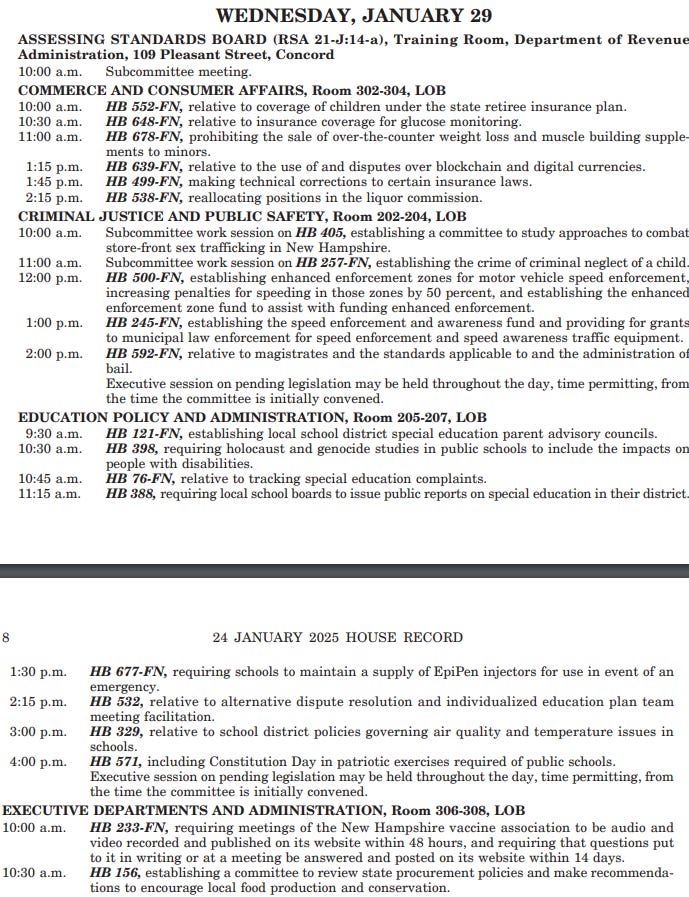
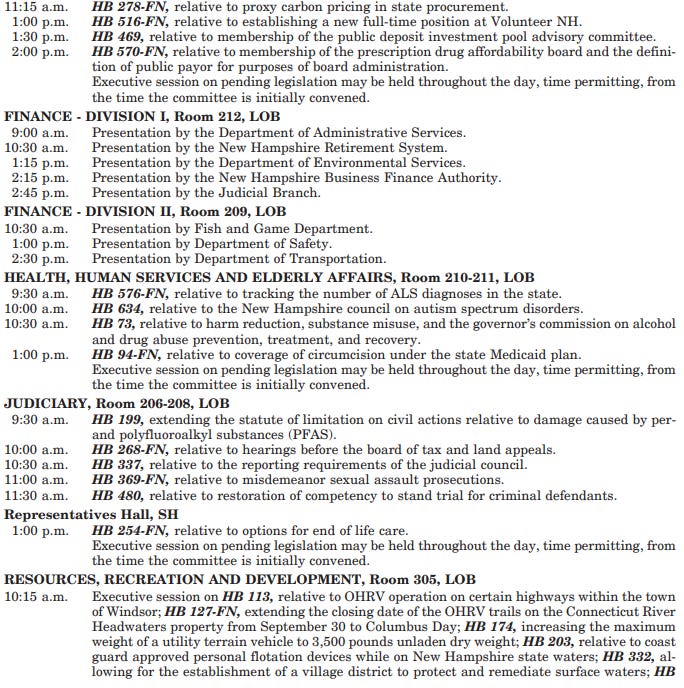
Screenshots of House Calendar
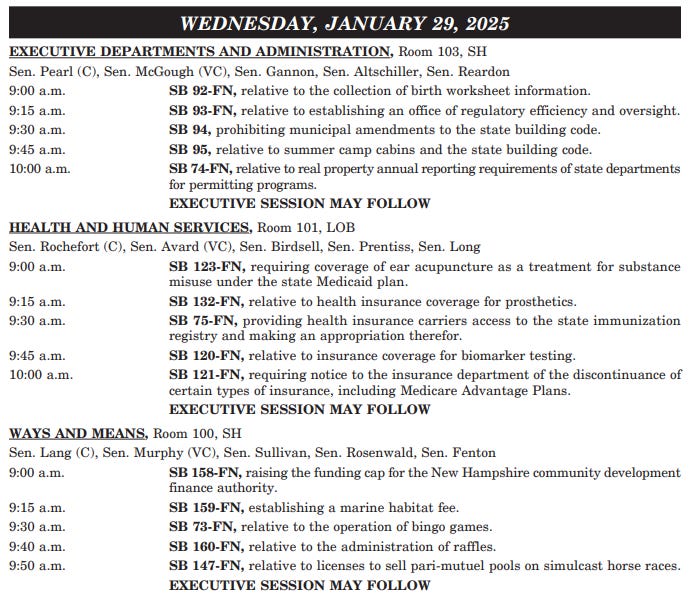
Screenshots of Senate Calendar
In-Depth Analysis of All Bills
Introduction - Quick Summaries of All Bills
House Commerce And Consumer Affairs
HB 552-FN (3 sponsors, Democratic): Expands state retiree insurance plan coverage to include dependent children up to age 25 regardless of student status; 5 for, 1 against.
HB 648-FN (13 sponsors, bipartisan): Requires insurance coverage of glucose monitoring and related diabetic supplies; 13 for, 4 against.
HB 678-FN (6 sponsors, Lean Democratic): Prohibits over-the-counter weight loss or muscle-building supplement sales to minors; 6 for, 2 against.
HB 639-FN (7 sponsors, Republican): Sets legal protections for blockchain and digital currencies, including a special blockchain dispute docket; 3 for, 4 against.
HB 499-FN (1 sponsor, Republican): Makes technical corrections to certain insurance laws, including dispute resolution procedures; 0 for, 0 against.
HB 538-FN (2 sponsors, Republican): Reallocates positions within the liquor commission, creating a finance and audit division; 0 for, 0 against.
House Criminal Justice And Public Safety
HB 500-FN (1 sponsor, Republican): Creates enhanced enforcement zones for speeding on major highways, raising penalties by 50%; 1 for, 4 against.
HB 245-FN (3 sponsors, Republican): Establishes a Speed Enforcement and Awareness Fund for municipal speed enforcement equipment; 1 for, 3 against.
HB 592-FN (5 sponsors, Republican): Overhauls bail administration and eliminates magistrates, reversing aspects of bipartisan bail reform; 2 for, 60 against.
House Education Policy And Administration
HB 121-FN (8 sponsors, Lean Republican): Mandates local school district special education parent advisory councils; 12 for, 8 against.
HB 398 (1 sponsor, Republican): Requires Holocaust/genocide curricula to include impacts on people with disabilities; 9 for, 3 against.
HB 76-FN (8 sponsors, Lean Republican): Requires the Department of Education to track special education complaints and publish annual reports; 4 for, 2 against.
HB 388 (3 sponsors, Republican): Mandates quarterly public school board reports on special education stats and spending; 9 for, 16 against.
HB 677-FN (7 sponsors, Lean Republican): Requires public schools to keep EpiPens on hand for emergencies; 4 for, 1 against.
HB 532 (1 sponsor, Republican): Maintains IEP facilitation as an option outside formal dispute resolution, clarifying administrative procedures; 0 for, 0 against.
HB 329 (8 sponsors, Democratic): Obligates school boards to address air quality and temperature issues, plus a heat illness plan; 159 for, 5 against.
HB 571 (10 sponsors, Republican): Adds Constitution Day to the set of required patriotic exercises in public schools; 5 for, 12 against.
House Executive Departments And Administration
HB 233-FN (9 sponsors, Lean Republican): Requires NH Vaccine Association to record and publish meeting audio/video and respond in writing to public questions; 8 for, 4 against.
HB 156 (8 sponsors, Lean Democratic): Forms a committee to review state procurement policies favoring local food production and conservation; 9 for, 1 against.
HB 278-FN (3 sponsors, Democratic): Incorporates a proxy carbon price for state procurement cost comparisons to reflect long-term environmental impacts; 119 for, 9 against.
HB 516-FN (3 sponsors, Democratic): Appropriates funds to Volunteer NH for a new full-time position supporting post-service AmeriCorps/Peace Corps pathways; 3 for, 4 against.
HB 469 (2 sponsors, Democratic): Adjusts membership on the Public Deposit Investment Pool advisory committee to include municipal managers; 5 for, 1 against.
HB 570-FN (2 sponsors, Bipartisan): Amends membership of Prescription Drug Affordability Board and clarifies “public payor” definition; 1 for, 1 against.
House Health, Human Services And Elderly Affairs
HB 576-FN (6 sponsors, bipartisan): Adds ALS to the list of conditions tracked under the critical health problems reporting act; 7 for, 5 against.
HB 634 (2 sponsors, bipartisan): Restructures the NH Council on Autism Spectrum Disorders, expanding membership and duties; 4 for, 2 against.
HB 73 (4 sponsors, bipartisan): Includes “harm reduction” in substance misuse efforts and modifies Governor’s Commission scope to emphasize public health approach; 7 for, 2 against.
HB 94-FN (8 sponsors, Lean Republican): Removes Medicaid coverage for infant circumcision unless medically necessary; 155 for, 63 against.
House Judiciary
HB 199 (13 sponsors, Democratic): Extends statute of limitations to 20 years for PFAS exposure-related damages; 71 for, 5 against.
HB 268-FN (1 sponsor, Republican): Allows certain Board of Tax and Land Appeals hearings to be held electronically, centralizing the venue; 1 for, 1 against.
HB 337 (2 sponsors, Republican): Requires members of the Judicial Council to file financial disclosures and report fee schedules; 2 for, 0 against.
HB 369-FN (8 sponsors, Republican): Changes misdemeanor sexual assault prosecution procedures involving minors; 2 for, 1 against.
HB 480 (10 sponsors, bipartisan): Directs committee on competency restoration to submit additional legislative proposals; 8 for, 0 against.
HB 254-FN (8 sponsors, bipartisan): Legalizes medical aid-in-dying for terminally ill adults; 476 for, 234 against.
Senate Executive Departments And Administration
SB 92-FN (9 sponsors, bipartisan): Revises birth worksheet data, records Apgar at 10 minutes, and restricts identifiable info to CDC; potential $68,000 funding loss issue.
SB 93-FN (1 sponsor, Republican): Establishes an Office of Regulatory Efficiency and Oversight to review state rules, requiring a $1.5 million appropriation; fosters business-friendly climate.
SB 94 (3 sponsors, Republican): Prohibits municipalities from adopting amendments stricter than the state building, energy, or fire code after July 1, 2025; local autonomy vs. uniform standards.
SB 95 (3 sponsors, Republican): Sets reduced code requirements for “summer camp cabins,” exempting them from certain plumbing and sprinkler mandates.
SB 74-FN (1 sponsor, Republican): Requires annual permit activity reports from state agencies regulating property use or construction; potential $1M–$2.5M cost to build new tracking systems.
Senate Health And Human Services
SB 123-FN (6 sponsors, bipartisan): Mandates Medicaid coverage of ear acupuncture for substance misuse; debate on cost-effectiveness in opioid treatment.
SB 132-FN (14 sponsors, bipartisan): Extends prosthetic device coverage in all health plans beyond just children; cost vs. life-improving coverage.
SB 75-FN (2 sponsors, Democratic): Grants health insurance carriers access to the state immunization registry, with $100,000 appropriation for technical upgrades; raises privacy questions.
SB 120-FN (6 sponsors, bipartisan): Requires coverage of biomarker testing in insurance and Medicaid; aims to enhance personalized medicine but might raise premiums.
SB 121-FN (1 sponsor, Republican): Requires 120-day notice to NH Insurance Department before discontinuing or altering entire lines of insurance, including Medicare Advantage.
Senate Ways And Means
SB 158-FN (8 sponsors, bipartisan): Raises NH Community Development Finance Authority cap from $5M to $10M, potentially reducing state tax revenue but expanding community projects.
SB 159-FN (6 sponsors, Lean Democratic): Establishes a marine habitat fee for ocean anglers, funding conservation; critics worry about extra costs.
SB 73-FN (1 sponsor, Republican): Increases total bingo prize limit from $4,000 to $6,000 and modifies carry-over coverall rules for bigger jackpots.
SB 160-FN (6 sponsors, bipartisan): Raises raffle ticket prices (from $1 to $10) and prize limits, potentially boosting charitable fundraising but also raising gambling concerns.
SB 147-FN (5 sponsors, Republican): Allows all charitable gaming facilities to offer simulcast horse-race betting, expanding pari-mutuel gambling.
Screenshot from House Calendar
 |
 |
 |
Screenshot from Senate Calendar
 |
In-Depth Analysis of All Bills
House Commerce And Consumer Affairs
HB 552-FN
AN ACT relative to coverage of children under the state retiree insurance plan.
3 sponsors, 100% Democratic
Sponsor(s): (Prime) Rep. James Newsom (D), Rep. David Luneau (D), Sen. Tara Reardon (D)
Selected quote(s) from the bill:
1 State Employees Group Insurance; Medical and Surgical Benefits; Eligibility of Children Between the Ages of 19 and 25. Amend RSA 21-I:30, IV to read as follows:
IV. Fully dependent minor children, children between the ages of 19 through 25 [if full-time students]
Summary:
This bill removes the requirement that young adult children of retired state employees must be full-time students to remain eligible for coverage under the retiree health benefit program.
Potential Argument For:
This bill expands health coverage options for retirees by allowing them to keep their dependent children insured regardless of student status, providing greater flexibility for families navigating financial or personal challenges.
Potential Argument Against:
This bill could lead to increased enrollment in the retiree health plan, potentially raising overall costs and placing a greater financial burden on the system.
Online Testimony
Currently, 5 people support and 1 person opposes the bill. 83% support of 6 people
Hearing: Wednesday, Jan 29 at 10:00 a.m. in Room 302-304 in the Legislative Office Building and streaming on YouTube.
HB 648-FN
AN ACT relative to insurance coverage for glucose monitoring.
13 sponsors, 62% Democratic
Sponsor(s): (Prime) Rep. Hope Damon (D), Rep. Skip Rollins (R), Rep. David Nagel (R), Rep. Jodi Newell (D), Rep. Carry Spier (D), Rep. Peggy Balboni (D), Rep. Loren Selig (D), Rep. Paige Beauchemin (D), Rep. Jennifer Mandelbaum (D), Sen. Ruth Ward (R), Sen. Bill Gannon (R), Sen. Suzanne Prentiss (D), Sen. David Rochefort (R)
Selected quote(s) from the bill:
1 Accident and Health Insurance; Individual; Coverage for Diabetes Services and Supplies; Glucose Monitoring Devices. Amend RSA 415:6-e to read as follows:
415:6-e Coverage for Diabetes Services and Supplies.
…
III. Each insurer that issues or renews any individual policy, plan, or contract of accident or health insurance providing benefits for medical or hospital expenses which provides [for] pharmacy or durable medical equipment coverage shall provide coverage for medically appropriate or necessary equipment used to treat diabetes subject to the terms and conditions of the policy and this paragraph. Equipment shall include traditional blood glucose monitors and continuous glucose monitoring systems (CGMS) and the necessary supplies for any person with a diagnosis of Type 2 diabetes or gestational diabetes. In this paragraph, a “continuous glucose monitoring system” means an instrument or device designed for the purpose of measuring glucose levels continuously through an in-dwelling sensor and the necessary supplies. "Supplies" shall include, but are not limited to, sensors, transmitters, receivers, lancets, and test strips.
(a) Coverage under this paragraph shall be provided without regard to the form of treatment. Insulin utilization, frequency of administration of insulin, or frequency of blood glucose testing shall not be a requirement for coverage of blood glucose monitoring or CGMS. Preferred providers or formularies shall include at least 2 of each kind of device. An endocrinology referral or prescription shall not be required. Prior authorization shall not be required.
(b) To qualify for continued coverage under this paragraph, the recipient must participate in follow-up care with their treating licensed health care practitioner, in person or through telehealth, at least once every 6 months during the first 18 months of the glucose monitoring, to assess the efficacy of using the monitor for treatment of his or her diabetes. After the first 18 months, such follow-up care must occur a minimum of once every 12 months.
(c) Glucose monitoring devices and supplies shall be covered without being subject to a deductible. Nothing in this paragraph shall prevent an insurer from reducing an insured’s copayment or coinsurance.
Summary:
This bill requires health insurance providers to cover glucose monitoring devices and supplies for individuals with diabetes, including continuous glucose monitoring systems (CGMS), without deductibles or prior authorization requirements.
Argument For:
This bill ensures that individuals with diabetes, including those with gestational diabetes, have access to essential glucose monitoring tools, which can prevent severe health complications such as stillbirth, hypoxic brain injuries, and neonatal intensive care unit (NICU) admissions. By reducing financial barriers to glucose monitoring, the bill helps patients maintain better glycemic control, improving both maternal and neonatal health outcomes. Additionally, the bill’s $30 cap on insulin prescriptions will alleviate financial strain on diabetes patients, ensuring continuous access to necessary medications.
Potential Argument Against:
This bill could lead to increased insurance costs, potentially raising premiums for all policyholders and placing additional financial burdens on insurers and the state.
Online Testimony
Currently, 13 people support and 4 people oppose the bill. 76% support of 17 people
Support
Gestational diabetes is difficult because patients need to learn quickly and poor glycemic control has grave effects of outcomes for both the mother and infant. The most feared poor outcome is stillbirth. Others can include a shoulder dystocia, where the head is delivered, but the body is stuck. This happens due to gestational diabetes causing disproportionate growth of the chest and abdomen compared to the head. Shoulder dystocia can lead to broken bones for infants, hypoxic brain injury, and, in worst case scenarios, death. … The great news is that we can prevent poor outcomes with great glucose control! The bad new is that we sometimes struggle to get moms the supplies that they need.
The $30 cap on insulin prescriptions will also ease financial burdens and help prevent dangerous gaps in treatment.
Hearing: Wednesday, Jan 29 at 10:30 a.m. in Room 302-304 in the Legislative Office Building and streaming on YouTube.
HB 678-FN
AN ACT prohibiting the sale of over-the-counter weight loss and muscle building supplements to minors.
6 sponsors, 83% Democratic
Sponsor(s): (Prime) Rep. Alicia Gregg (D), Rep. Lucy Weber (D), Rep. Mark Pearson (R), Rep. Gaby Grossman (D), Rep. Cassandra Levesque (D), Rep. Christal Lloyd (D)
Selected quote(s) from the bill:
1 New Chapter; Sale of Dietary Supplements for Weight Loss or Muscle Building. Amend RSA 359 by inserting after chapter 359-O the following new chapter:
CHAPTER 359-P
SALE OF DIETARY SUPPLEMENTS FOR WEIGHT LOSS OR MUSCLE BUILDING
…
359-P:2 Prohibition of Sale to Minors.
I. No retail establishment shall sell or distribute over-the-counter diet pills or dietary supplements for weight loss or muscle building to any individual under 18 years of age.
II. Any retail establishment that sells over-the-counter diet pills, or dietary supplements for weight loss or muscle building shall request, examine and reasonably rely upon a current and valid photographic identification establishing a person's age as at least 18 years of age prior to selling such person over-the-counter diet pills or dietary supplements for weight loss or muscle building.
III. Retail establishments shall conspicuously post at each purchase counter a notice developed and provided by the department of health and human services clearly communicating that certain over-the-counter diet pills, or dietary supplements for weight loss or muscle building are known to cause gastrointestinal impairment, tachycardia, hypertension, myocardial infarction, stroke, severe liver injury sometimes requiring transplant or leading to death, organ failure, other serious injury, and death.
IV. Any violation of this section shall constitute an unfair method of competition or an unfair or deceptive act or practice pursuant to chapter 358-A:2, and any right or remedy set forth in therein may be used to enforce the provisions of this chapter.
Summary:
This bill prohibits the sale of over-the-counter weight loss and muscle-building supplements to individuals under 18 years of age and imposes penalties on retail establishments that violate this restriction.
Potential Argument For:
This bill protects minors from the potential health risks associated with weight loss and muscle-building supplements, including cardiovascular issues, liver damage, and other serious medical conditions.
Potential Argument Against:
This bill restricts consumer choice and imposes an additional regulatory burden on retail establishments without clear evidence that such measures will effectively prevent harm.
Online Testimony
Currently, 6 people support and 2 people oppose the bill. 75% support of 8 people
Hearing: Wednesday, Jan 29 at 11:00 a.m. in Room 302-304 in the Legislative Office Building and streaming on YouTube.
HB 639-FN
AN ACT relative to the use of and disputes over blockchain and digital currencies.
7 sponsors, 100% Republican
Sponsor(s): (Prime) Rep. Keith Ammon (R), Rep. Mark Warden (R), Rep. Joe Sweeney (R), Rep. Jason Osborne (R), Rep. Calvin Beaulier (R), Rep. Joe Alexander (R), Sen. Kevin Avard (R)
Selected quote(s) from the bill:
3 New Chapter; Blockchain Basic Laws. Amend RSA by inserting after chapter 359-U the following new chapter:
CHAPTER 359-V
BLOCKCHAIN BASIC LAWS
…
359-V:2 Holding and Use of Private Digital Currency.
No state or local government agency or subdivision thereof shall prohibit, restrict, or otherwise impair the ability of an individual to:
I. Use digital assets to purchase legal goods or services;
II. Self-custody digital assets using a self-hosted wallet or third-party wallet.
III. Use digital assets as a method of payment without the imposition of any tax, withholding, assessment, or charge based solely on the fact that a digital asset was used as the method of payment.
359-V:3 Infrastructure to Run Blockchain Protected.
I. Any person shall be allowed to engage in home digital asset mining as long as the individual complies with all local noise ordinances. A political subdivision shall not place specific limits on sound decibels generated from home digital asset mining other than current limits set for sound pollution put forth by the political subdivision.
II. A digital asset mining business may engage in digital asset mining in any area that is zoned for industrial use.
III. No state or local government agency or subdivision thereof shall:
(a) Set a specific limit on sound decibels generated from home digital asset mining other than the limits set by the political subdivision for sound pollution generally;
(b) Set a specific limit on sound decibels generated from a digital asset mining business other than limits set for sound pollution which apply to industrial-zoned areas generally;
(c) Impose any requirement on a digital asset mining business that does not equally apply to all industrial-zoned properties, provided that an agency or subdivision may offer positive incentives that encourage blockchain-related businesses to favor proof-of-stake validation over proof-of-work;
(d) Make a zoning change to an area with a digital asset mining business without conducting all required notice and hearing procedures.
IV. Notwithstanding RSA 677:1, or any related provision of law, a digital asset mining business may appeal any zoning change described herein to the superior court. The court shall prohibit any such zoning change if the change was made to discriminate against a digital asset mining business.
V. No state or local government agency or subdivision thereof may establish a rate schedule for digital asset mining that creates discriminatory rates for digital asset mining businesses.
359-V:4 Right to Private Keys.
I. No person shall be compelled to produce a private key or make a private key known to any other person in any civil, criminal, administrative, legislative, or other proceeding in this state that relates to a digital asset, digital identity, or other interest or right to which the private key provides access.
II. A court may compel disclosure of a private key only if the party seeking compulsion demonstrates by clear and convincing evidence that the information or access sought cannot reasonably be obtained through other means, and that lack of disclosure would lead to irreparable harm. The court shall impose appropriate protections to ensure that disclosure is no broader than is necessary to serve the prevailing party's legitimate interests.
359-V:5 Blockchain-Based Trusts Recognized.
I. Trusts administered through a smart contract shall be subject to the jurisdiction of the courts of this state when RSA 564-B:2-202 is satisfied or if the settlor directed any person or entity located in New Hampshire to create the relevant smart contract.
II. In any legal matter involving a trust, any alleged contemnor shall be presumed to have a common law defense of impossibility to the extent that the person is ordered to modify the functionality of a smart contract. This presumption may, in appropriate cases, be overcome by clear and convincing evidence that the smart contract is not decentralized.
III. A smart contract may act as the functional equivalent of an irrevocable spendthrift trust if its protocols would satisfy the criteria for such a trust under RSA 564-B:1-103 and RSA 563-B:5-502. Any such smart contract shall have the protections of an irrevocable spendthrift trust under RSA 564-B:5-502.
IV. No person shall be lawfully compelled to furnish a plaintiff or court with direct access to a wallet whose sole purpose is to receive and distribute funds from a smart contract governed by paragraph III of this section.
V. This section shall not restrain a court from ordering a beneficiary to produce funds received from a smart contract. This section shall not mean that a person may be compelled to provide access to any wallet not described herein.
359-V:6 Processes Regarding Blockchain Networks.
I. No state or local government agency or subdivision thereof shall prohibit any person or business from operating a node for the purpose of connecting to a blockchain protocol or a protocol built on top of a blockchain protocol and transferring digital assets on a blockchain protocol or participating in staking on a blockchain protocol.
II. A person engaged in home digital asset mining or a digital asset mining business shall not be required to obtain a money transmitter license under RSA 399-G.
III. Operating a node or a series of nodes on a blockchain protocol shall not require an individual or business to obtain a money transmitter license under RSA 399-G.
IV. A business offering to provide digital asset mining or staking services for individuals or to other businesses shall not be considered as offering a security or investment contract under RSA 421-B.
V. Notwithstanding any other provision of law, anyone engaged in digital asset mining, operating a node or series of nodes on a blockchain network, or providing digital asset mining or staking services for individuals or other businesses shall not face liability related to a specific transaction merely by validating that transaction.
359-V:7 Civil Remedies.
I. Any person directly affected by a violation of this chapter may petition the superior court or the blockchain dispute docket for relief.
II. The superior court may order declaratory, injunctive, or other equitable relief.
III. Any person who prevails on any claim brought pursuant to this chapter, and shows by a preponderance of the evidence that the defendant engaged in a purposeful violation of this chapter, shall be entitled to an award of reasonable attorney's fees.
…
4 New Section; Courts; Superior Courts; Blockchain Dispute Docket. Amend RSA 491 by inserting after section 7-b the following new section:
491:7-c Blockchain Dispute Docket.
I. Without limiting the jurisdiction vested in any court in the state, and subject to the appointment of a presiding justice by the governor with the consent of the executive council as provided in this section, the supreme court may establish by court order not inconsistent with this section, a blockchain dispute docket in the superior court which shall have jurisdiction to hear and determine blockchain technology disputes, as described in this section, when:
(a) The parties have consented to the jurisdiction of the blockchain dispute docket by agreement or stipulation; and
(b) The dispute concerns “blockchain” technology as defined in RSA 359-V:1.
II. The governor, with the consent of the executive council, may appoint the first presiding justice of the blockchain dispute docket, who shall be qualified by reason of such person's knowledge and experience in matters of law and technology. The chief justice of the superior court, following the appointment or designation of the initial presiding justice, may designate such additional justices to preside over blockchain docket cases, as necessary, based upon caseload, disqualification of the presiding justice, or efficient allocation of judicial resources.
III. The presiding justice of the blockchain dispute docket shall be an associate justice of the superior court and shall be entitled to the compensation and benefits provided to all such justices under applicable law, including, but not limited to, RSA 491-A:1 and RSA 100-C.
IV. The workload of the presiding justice of the blockchain dispute docket shall be the matters before that docket. The presiding justice may be assigned to any other matter within the jurisdiction of the superior court or sit by designation on any other court in the same manner as any other associate justice of the superior court, as determined to be necessary by the chief justices of the superior and supreme courts.
V. Subject to the provisions of this section, all civil actions in which the principal claim or claims arise from or involve the following shall be assigned to the blockchain dispute docket for all purposes, including motion practice, discovery, injunctive relief, alternative dispute resolution, and hearing on the merits with or without a jury:
(a) Claims arising out of RSA 359-V.
(b) Claims arising from breach of contract or fiduciary duties, fraud, misrepresentation, business tort, or statutory violations arising out of blockchain technology dealings or transactions.
(c) Other complex disputes of a blockchain technology nature.
Summary:
This bill establishes legal protections for blockchain technology, amends definitions related to decentralized autonomous organizations, and creates a specialized blockchain dispute docket to oversee related legal matters.
Argument For:
This bill positions New Hampshire as a national leader in blockchain innovation by providing regulatory clarity that encourages investment, fosters economic growth, and attracts blockchain-based businesses. It supports sustainable energy use by enabling digital asset mining to utilize surplus renewable energy, helping stabilize power grids and incentivizing green infrastructure. By adopting a forward-thinking approach, New Hampshire can establish itself as a hub for blockchain technology, similar to Wyoming, ensuring long-term economic and technological benefits.
Argument Against:
This bill may place undue emphasis on an industry that has caused economic and environmental harm in other regions, leading to increased electricity costs for consumers and straining an already limited housing and labor market. The bill's broad deregulation of digital asset mining and blockchain operations could enable predatory practices, leaving consumers without sufficient protections against fraud and financial instability. Rushing into this industry without extensive research may result in unintended negative consequences for both residents and the state’s economic landscape.
Online Testimony
Currently, 3 people support and 4 people oppose the bill. 57% oppose of 7 people
Support
As we stand at the intersection of technological progress and economic opportunity, it is crucial that New Hampshire not only embraces emerging technologies but also provides a clear, forward-thinking regulatory framework that enables them to thrive. Bitcoin mining, in particular, offers an example of how blockchain technology can drive economic benefits while simultaneously promoting sustainability. … Conversely, well-structured regulations provide businesses with the confidence to expand operations, create jobs, and develop new technologies that can have far-reaching positive effects on the economy. In Wyoming, for example, clear and supportive blockchain regulations have made the state a hub for blockchain-based businesses, attracting major firms in the cryptocurrency and fintech sectors. By providing legal clarity on issues such as digital asset ownership, taxation, and the treatment of cryptocurrencies as property, Wyoming has fostered an environment in which blockchain technology can flourish. New Hampshire, with its strong tradition of supporting innovation and entrepreneurship, is well-positioned to follow a similar path and leverage blockchain technology for economic growth.
Opposition
No government surveillance of citizen's transactions. Stop the insanity of subjugating citizens to things that can hurt them. No digital currency, no blockchain, No digital assets, no digital asset mining, No fungible tokens, No Blockchain-Based Trusts, No Blockchain Network,
I don't think NH should rush into this field, especially given what just happened with the Chinese company's "deepseek." This could be a boon for some people, but this industry has hurt a lot of people in areas where these huge data centers have gone in. There are environmental issues and pocketbook issues. And consumers are the ones who are paying higher costs for increased use of electricity, just for one example. Businesses can't get people to fill jobs as it is now. And NH has a shortage of housing. Please don't jump on this without a lot of study. And please don't listen just to lobbyists for the industry. Do more research before getting more involved in this industry..
Hearing: Wednesday, Jan 29 at 1:15 p.m. in Room 302-304 in the Legislative Office Building and streaming on YouTube.
HB 499-FN
AN ACT making technical corrections to certain insurance laws.
1 sponsor, 100% Republican
Sponsor(s): (Prime) Rep. John Hunt (R)
Selected quote(s) from the bill:
1 Managed Care Law; Determining the Fair Value of Certain Health Care Items or Services Provided by Nonparticipating Providers. Amend RSA 420-J:8-e, XII(c) to read as follows:
(c) Each party participating in a fair value dispute resolution process under this section shall submit, together with [or no later than 10 days after] its submission of an offer for a payment amount as provided under paragraph III, one half of the fee charged by the certified IDR entity. If any party does not timely submit its half of the IDR entity's fee together with its offer for a payment amount, then the IDR entity shall, without further consideration, select the offer of the party that has paid its half of the fee as the winning offer and notify the parties of the determination as provided in paragraph VIII.
…
3 Insurance Claims Adjusters; Prohibition. Amend RSA 402-B:1 to read as follows:
402-B:1 Prohibition. It is unlawful for any person, whether as agent or employee, to act directly or indirectly, as an insurance claims adjuster on policies written on risks located in this state for any insurance company, including unadmitted surplus lines companies, unless licensed as provided in this chapter.
…
6 Insurance Department. Amend RSA 400-A:10, III to read as follows:
III. … The amount paid by the company under this paragraph in [any fiscal] the preceding calendar year shall be applied as a nontransferable credit against and to the extent of the company's administrative [fee] assessment under RSA 400-A:39 in the subsequent fiscal year and not thereafter.
…
9 New Subparagraph; Contract Between Public Adjuster and Insured. Amend RSA 402-D:13, II by inserting after subparagraph (c) the following new subparagraph:
(d) Requires the insured to pursue any litigation, arbitration, or dispute resolution process against the adjuster in a venue outside New Hampshire.
10 Paid-up Capital. Amend RSA 401:4 to read as follows:
401:4 Paid-up Capital. All stock companies organized under the provisions of this chapter shall have a paid-up capital of at least [$800,000] $3,000,000.
…
13 Insurance Department; Fees. Amend RSA 400-A:29 to read as follows:
400-A:29 Fees.
I. All fees shall be collected upon submission and shall be non-refundable.
I-a. Certificate of authority
(a) Application $1,000
…
(e) Amendment - address $25
…
V. Application to reserve corporation name ([90] 120 days) $25
…
X. Producers; resident and non-resident
(a) [Non-refundable] Application and license fee $210
(b) [Non-refundable] Biennial renewal $150
(c) Amendment to license - except change of name, change of address, or change of the designated registered license producer as required by RSA 402-J:6, II(b) $50
…
(g) Termination of appointment fee $25
[(h) Address change fee $10
(i) Mail return fee $25]
XI. Surplus lines; Company annual application for inclusion in approved list $250
[XII. Insurance vending machines
(a) Application fee, each machine $50
(b) Initial license, each machine $50
(c) Annual renewal, each machine $50]
…
[XV.]XIV. Adjuster's licenses; resident and non-resident
…
(c) Amendment to license - shall not include change of name or change of address $50
…
14 Insurance Claims Adjusters; License to Issue. Amend RSA 402-B:7, II to read as follows:
II. … [Change of address shall be accompanied by the fee required pursuant to RSA 400-A:29.]
…
21 Repeal. The following are repealed:
I. RSA 420-J:7, V, relative to the annual legislative report regarding network adequacy review by the insurance commissioner.
II. RSA 400-A:31, I(a), relative to the general premium tax report calculation by title insurers.
Summary:
This bill makes various technical corrections to New Hampshire insurance laws, including adjustments to dispute resolution procedures, notice requirements for discontinuing business lines, licensing rules for claims adjusters, foreign insurer regulations, and capital requirements for insurance companies.
Potential Argument For:
This bill updates and clarifies insurance regulations to improve efficiency, ensure consistency with industry standards, and remove outdated requirements that no longer serve a practical purpose.
Potential Argument Against:
This bill increases capital requirements for insurance companies, which could create barriers for new insurers entering the market and reduce competition.
Online Testimony
Currently, 0 people support and 0 people oppose the bill.
Hearing: Wednesday, Jan 29 at 1:45 p.m. in Room 302-304 in the Legislative Office Building and streaming on YouTube.
HB 538-FN
AN ACT reallocating positions in the liquor commission.
2 sponsors, 100% Republican
Sponsor(s): (Prime) Rep. John Hunt (R), Sen. Daniel Innis (R)
Selected quote(s) from the bill:
1 The Liquor Commission; Divisions and Directors. Amend RSA 176:8 to read as follows:
176:8 Divisions and Directors. The commission shall have [3] 4 divisions under the direction of unclassified division directors. … There shall be a division of marketing, merchandising, and warehousing, a division of administration, a division of finance and audit, and a division of enforcement and licensing. …
2 State Officers; Compensation; Positions Deleted. Amend RSA 94:1-a, I(b) by deleting:
GG Liquor commission chief operating officer
GG Liquor commission commissioner
3 State Officers; Compensation; Positions Added. Amend RSA 94:1-a, I(b) by inserting:
GG Liquor commission director of administration
GG Liquor commission director of finance and audit
Summary:
This bill establishes a new division of finance and audit within the liquor commission, updates the title of "chief operating officer" to "director of administration," and removes the commissioner position from the list of non-classified positions.
Potential Argument For:
This bill improves oversight and financial accountability by creating a dedicated finance and audit division within the liquor commission.
Potential Argument Against:
This bill increases government bureaucracy without clear evidence of necessity or fiscal impact.
Online Testimony
Currently, 0 people support and 0 people oppose the bill. of 0 people
Hearing: Wednesday, Jan 29 at 2:15 p.m. in Room 302-304 in the Legislative Office Building and streaming on YouTube.
House Criminal Justice And Public Safety
HB 500-FN
AN ACT establishing enhanced enforcement zones for motor vehicle speed enforcement, increasing penalties for speeding in those zones by 50 percent, and establishing the enhanced enforcement zone fund to assist with funding enhanced enforcement.
1 sponsor, 100% Republican
Sponsor(s): (Prime) Rep. Stephen Pearson (R)
Selected quote(s) from the bill:
1 New Section; Enhanced Highway Speed Zones. Amend RSA 265 by inserting after section 62 the following new section:
265:62-a Enhanced Highway Speed Zones.
I. The following highways are designated as enhanced speed zones:
(a) Interstate 95.
(b) Interstate 293.
(c) Interstate 393.
(d) Interstate 93.
(e) The F.E. Everett Turnpike.
(f) State Route 101.
(g) The Spaulding Turnpike.
II. A person who exceeds the posted speed limit by 15 miles per hour or more in any of the enhanced speed zones in paragraph I of this section shall be fined an enhanced speed zone penalty of 50 percent of the uniform fine for the speed violation established in the uniform fine schedule of motor vehicle violations.
III. There is established a nonlapsing fund to be known as the enhanced speed zone fund which shall be kept distinct and separate from all other funds. The entire 50 percent speed zone penalty in paragraph II of this section shall be deposited into the fund. The fund shall be continually appropriated to the department of safety for the purpose of funding increased speed patrols in enhanced highway speed zones.
…
2 New Subparagraph; Application of Receipts; Enhanced Speed Zone Fund. Amend RSA 6:12, I(b) by inserting after subparagraph (399) the following new subparagraph:
(400) Moneys deposited in the enhanced speed zone fund as established in RSA 265:62-a.
Summary:
This bill establishes enhanced enforcement zones on certain highways, increases penalties for speeding in those zones by 50 percent, and creates a dedicated fund to finance increased speed patrols.
Potential Argument For:
This bill strengthens traffic enforcement on major highways by discouraging excessive speeding through higher penalties, which enhances road safety and provides dedicated funding for additional patrols.
Potential Argument Against:
This bill disproportionately impacts drivers with increased fines while potentially creating a revenue-driven enforcement system rather than one focused solely on safety.
Online Testimony
Currently, 1 person supports and 4 people oppose the bill. 80% oppose of 5 people
Hearing: Wednesday, Jan 29 at 12:00 p.m. in Room 202-204 in the Legislative Office Building and streaming on YouTube.
HB 245-FN
AN ACT establishing the speed enforcement and awareness fund and providing for grants to municipal law enforcement for speed enforcement and speed awareness traffic equipment.
3 sponsors, 100% Republican
Sponsor(s): (Prime) Rep. Keith Ammon (R), Rep. Lisa Post (R), Sen. Denise Ricciardi (R)
Selected quote(s) from the bill:
1 New Section; Speed Enforcement and Awareness Fund and Grant Program. Amend RSA 265 by inserting after section 62 the following new section:
265:62-a Speed Enforcement and Awareness Fund and Grant Program.
I. There is established a nonlapsing fund to be known as the speed enforcement and awareness fund, which shall be kept distinct and separate from all other funds. The fund shall be continually appropriated to the department of safety for the purpose of providing grants to municipalities for the purchase of speed enforcement and speed awareness traffic equipment related to the enforcement of traffic laws.
…
(c) Moneys from the fund shall be used exclusively for:
(1) Speed detection devices, such as radar guns, lidar speed guns, and automated speed cameras.
(2) Speed awareness traffic equipment, such as digital speed display signs, portable speed monitoring trailers, and variable message boards.
(3) Data collection tools, such as traffic data recorders in order to conduct speed and volume analysis and studies.
…
2 Penalty Assessment Redistribution. Amend RSA 106-L:10, IV to read as follows:
IV. … The state treasurer shall deposit [66.66] 58.33 percent of the amount collected in the state general fund, 16.67 percent of the amount collected in the victims' assistance fund, [and] 16.67 percent of the amount collected in the judicial branch information technology fund, and 8.33 percent in the speed enforcement and awareness fund.
Summary:
This bill establishes the Speed Enforcement and Awareness Fund to provide financial assistance through a grant program for municipalities to purchase speed enforcement and awareness traffic equipment.
Potential Argument For:
This bill enhances public safety by ensuring municipalities have access to necessary speed enforcement tools, such as radar guns and speed display signs, to reduce traffic violations and accidents. By reallocating penalty assessment funds, it provides a sustainable funding source without requiring new taxes or fees.
Potential Argument Against:
This bill diverts funds from the state’s general fund, potentially reducing resources available for other public services.
Online Testimony
Currently, 1 person supports and 3 people oppose the bill. 75% oppose of 4 people
Hearing: Wednesday, Jan 29 at 1:00 p.m. in Room 202-204 in the Legislative Office Building and streaming on YouTube.
HB 592-FN
AN ACT relative to magistrates and the standards applicable to and the administration of bail.
5 sponsors, 100% Republican
Sponsor(s): (Prime) Rep. Ross Berry (R), Rep. Brian Cole (R), Rep. Mike Bordes (R), Rep. Steven Kesselring (R), Rep. Jonathan Morton (R)
Selected quote(s) from the bill:
1 Judicial Training; Magistrates Removed. Amend RSA 490-K:1 through 490-K:3 to read as follows:
490-K:1 Judicial Training Coordinator. … The judicial training coordinator shall develop high quality judicial branch training and continuing education programs and work to provide judges, [magistrates,] bail commissioners, administrators, and court staff with a reasonable opportunity to fulfill any mandatory orientation and initial required training as well as continuing educational requirements set by the chief justice of the supreme court.
…
2 Arrests in Criminal Cases; Place and Time of Detention. Amend RSA 594:20-a, I to read as follows:
I. When a person is arrested with or without a warrant, he or she may be committed to a county correctional facility, to a police station or other place provided for the detention of offenders, or otherwise detained in custody. The person shall be taken to appear before a [magistrate,] circuit court[,] or a superior court without unreasonable delay to answer for the offense. All persons shall appear no later than 24 hours after arrest[,or no later than 36 hours after arrest if arrested between 8:00 a.m. and 1:00 p.m. and the person's attorney is unable to attend an arraignment on the same day,] Saturdays, Sundays, and holidays excepted. [In the case of a person arrested when the court is not open within the next 24 hours, a decision on bail shall be made by a magistrate within 24 hours of the arrest for any of the crimes listed in RSA 597:2, III(a)(1). Hearings held by a magistrate pursuant to this section may be held telephonically, and the magistrate may conduct such hearing from any location within the state of New Hampshire, without regard to the jurisdiction in which the person was arrested. This section shall not be construed to prohibit telephonic hearings that are otherwise permitted by law or court rule].
3 Bail and Recognizances; Release of a Defendant Pending Trial. RSA 597:2 is repealed and reenacted to read as follows:
597:2 Release of a Defendant Pending Trial.
I. Except as provided in paragraph VII, upon the appearance before the court or justice of a person charged with an offense, the court or justice shall issue an order that, pending arraignment or trial, the person be:
(a) Released on his personal recognizance or upon execution of an unsecured appearance bond, pursuant to the provisions of paragraph III;
(b) Released on a condition or combination of conditions pursuant to the provisions of paragraph IV; or
(c) Temporarily detained to permit revocation of conditional release pursuant to the provisions of paragraph IX.
II. Except as provided in RSA 597:1-d, a person charged with a probation violation shall be entitled to a bail hearing. The court shall issue an order that, pending a probation violation hearing, the person be:
(a) Released on his or her personal recognizance or upon execution of an unsecured appearance bond, pursuant to the provisions of paragraph III;
(b) Released on a condition or combination of conditions pursuant to the provisions of paragraph IV; or
(c) Detained.
III. The court or justice shall order the prearraignment or pretrial release of the person on his or her personal recognizance, or upon execution of an unsecured appearance bond in an amount specified by the court, subject to the condition that the person not commit a crime during the period of his or her release, and subject to such further condition or combination of conditions that the court may require, unless the court determines that such release will not reasonably assure the appearance of the person as required or will endanger the safety of the person or of any other person or the community. The court may also consider as a factor in its determination under this paragraph or paragraph IV that a person who is detained as a result of his or her inability to meet the required conditions or post the required bond is the parent and sole caretaker of a child and whether, as a result, such child would become the responsibility of the division of children, youth, and families.
IV.(a) If the court or justice determines that the release described in paragraph III will not reasonably assure the appearance of the person as required or, as described in paragraph III or X, will endanger the safety of the person or of any other person or the community, the court shall issue an order that includes the following conditions:
(1) The condition that the person not commit a crime during the period of release; and
(2) Such further condition or combination of conditions that the court determines will reasonably assure the appearance of the person as required and the safety of the person or of any other person or the community, which may include the condition that the person:
(i) Execute an agreement to forfeit, upon failing to appear within 45 days of the date required, such designated property, including money, as is reasonably necessary to assure the appearance of the person as required, and post with the court such indicia of ownership of the property or such percentage of the money as the court or justice may specify;
(ii) Furnish bail for his appearance by recognizance with sufficient sureties or by deposit of moneys equal to the amount of the bail required as the court or justice may direct; and
(iii) Satisfy any other condition that is reasonably necessary to assure the appearance of the person as required and to assure the safety of the person or of any other person or the community.
(b) In considering the conditions of release described in subparagraph IV(a)(2)(i) or IV(a)(2)(ii), the court may upon its own motion, or shall upon the motion of the state, conduct an inquiry into the source of the property to be designated for potential forfeiture or offered as collateral to secure a bond, and shall decline to accept the designation, or the use as collateral, of property that because of its source will not reasonably assure the appearance of the person as required.
V. If a person is charged with any of the offenses listed in RSA 173-B:1, I or charged with violation of a protective order issued under RSA 458:16, III or after arraignment for violation of a protective order under RSA 173-B, the court or justice may order preventive detention without bail, or, in the alternative, restrictive conditions including but not limited to electronic monitoring and supervision, if there is clear and convincing evidence that the person poses a danger to another. The court or justice may consider, but shall not be limited to considering, any of the following conduct as evidence of posing a danger:
(a) Threats of suicide.
(b) Acute depression.
(c) History of violating protective orders.
(d) Possessing or attempting to possess a deadly weapon in violation of an order.
(e) Death threats or threats of possessiveness toward another.
(f) Stalking, as defined in RSA 633:3-a.
(g) Cruelty to or violence directed toward pets.
…
XI. A person detained by a circuit court has the right to:
(a) In the first instance, a hearing in circuit court within 36 hours after the filing of the motion, excluding weekends and holidays on a motion to reconsider the original detention order; and
(b) A decision upon a de novo appeal, pursuant to RSA 597:6-e, II, to the superior court within 36 hours of the filing of the appeal, excluding weekends and holidays.
…
5 Bail and Recognizances; Detention and Sanctions for Default or Breach of Conditions. Amend RSA 597:7-a, I to read as follows:
I. … The accused shall be brought before a justice [or magistrate] for a bail revocation hearing within [24] 48 hours, Saturdays, Sundays, and holidays excepted.
…
7 Repeal. The following are repealed:
I. 2024, 317:15, II, relative to appropriation regarding magistrates.
II. RSA 491-B, relative to magistrates.
III. RSA 597:7-a, I-b, relative to cash bail.
Summary:
This bill revises bail administration and standards, removes the role of magistrates from the judicial system, and eliminates the appropriation for magistrate positions.
Potential Argument For:
This bill streamlines the judicial process by eliminating magistrates, reallocating resources, and ensuring that bail decisions are made more consistently by judges.
Argument Against:
This bill will undo key bipartisan bail reforms that were recently enacted, disrupt a system that is still being implemented, and create unnecessary instability in judicial operations by eliminating magistrates before their impact can be properly evaluated.
Online Testimony
Currently, 2 people support and 60 people oppose the bill. 97% oppose of 62 people
Opposition
:Let;s not undo the positive work that has been done on bail reform!
Pass common sense bail reform, not this bill
This bill will dismantle some major bipartisan bail reforms that are extremely important. Please vote no.
This bill will undo much of the hard work that has been put into bail reform.
This bill has the potential to undo much of the thoughtful work that has gone into bail reform.
I oppose HB592 on principal. The bipartisan deal is just starting to take effect - and I understand that not everyone got everything they wanted in the deal last term. However, the 3 magistrates were just sworn and have only begun working. To upset the system now, seems to not permit the changes to take effect and would be in haste without understanding or fully evaluating its implementation.
—Mary Hakken-Phillips, An Elected Official
Hearing: Wednesday, Jan 29 at 2:00 p.m. in Room 202-204 in the Legislative Office Building and streaming on YouTube.
House Education Policy And Administration
HB 121-FN
AN ACT establishing local school district special education parent advisory councils.
8 sponsors, 88% Republican
Sponsor(s): (Prime) Rep. Glenn Cordelli (R), Rep. James Spillane (R), Rep. Mark Pearson (R), Rep. Paul Terry (R), Sen. Sharon Carson (R), Sen. David Watters (D), Sen. Ruth Ward (R), Sen. Bill Gannon (R)
Selected quote(s) from the bill:
1 New Section; District Special Education Parent Advisory Councils. Amend RSA 186-C by inserting after section 3-d the following new section:
186-C:3-e District Special Education Parent Advisory Councils.
I. Each local school district shall establish a district special education parent advisory council (DSEPAC).
II. The council shall be composed of a maximum of 11 parents with at least one member representing each town in the district. …
IV. The council’s duties shall include:
(a) Advising the district on matters relating to the education and safety of students with disabilities.
(b) Meeting at least quarterly with district administration to participate in the planning, development, and evaluation of district special education programs.
(c) Providing input on district policies, procedures, and practices related to special education.
(d) Facilitating communication between parents, the school board, and the district administration.
(e) Serving as a resource for parents, including providing information on state and federal rights of students with disabilities.
V. The council shall receive assistance from the administration and school board as needed, subject to the availability of staff and resources. The district shall ensure that the council has adequate resources to fulfill its duties, including access to meeting space, administrative support, and materials necessary for effective communication with parents and the community.
VI. Each school district shall, with the cooperation and participation of the DSEPAC, hold at least one workshop annually to review and answer questions regarding the rights of parents and students with disabilities under state and federal law. The workshop shall include information on the IEP process, dispute resolution options, and resources available to parents.
VII. The DSEPAC shall submit an annual report to the school board by July 1 of each year summarizing its activities, recommendations, and any concerns raised by parents during the year. This report shall be made publicly available on the district website.
Summary:
This bill requires school administrative units to establish a special education parent advisory council.
Argument For:
This bill creates a dedicated avenue for parents of students with disabilities to offer firsthand insights and feedback, ultimately improving special education services. This bill, according to supporters, would promote collaboration between families and educators, reduce misunderstandings, and address issues early, potentially avoiding costly legal disputes. This bill encourages parents to share tools and resources, fosters community support, and offers a formal channel to help ensure student needs are met more effectively.
Argument Against:
This bill places an additional administrative and financial burden on local school districts without providing state funding. This bill, opponents argue, is unnecessary because the special education process already emphasizes parent rights, and resources might be better spent addressing current funding shortfalls. This bill could be difficult to implement if volunteer involvement is low, and skeptics suggest that improving special education reimbursement formulas is a more pressing priority.
Online Testimony
Currently, 12 people support and 8 people oppose the bill. 60% support of 20 people
Support
I had much experience with trying to navigate my own child’s special education and it was confusing and frustrating. … An advisory council in my personal belief would help level the playing field a little for better student outcomes.
Across the country, special education advisory councils have proven to be an effective tool for improving communication, creating more inclusive educational practices, and making certain that parents' voices are heard in decision-making. …The requirement for annual workshops and an annual report to the school board is another positive aspect. This promotes transparency and keeps the conversation flowing, while also providing districts with a way to evaluate and improve their special education programs. … These councils are designed to enhance communication and collaboration between parents, schools, and district administrations. By improving communication and decision-making, the DSEPACs will help districts allocate resources more efficiently, prevent unnecessary legal disputes, and find proactive solutions before issues escalate into costly problems. Many of the rising costs in special education stem from the lack of early intervention, poor communication, and legal battles that often stem from misunderstandings between parents and school districts.
From my personal experience, this type of support is absolutely essential. … One concern I have, however, is …. Councils composed solely of individuals already involved in existing school programs are unlikely to meet the needs of the families this initiative is meant to serve. Parents like myself, who are already stretched thin, may not have the bandwidth to engage with a council that feels inaccessible or disconnected from the reality of raising children with special needs. Additionally, a council led by school or district employees may inadvertently reinforce existing biases or approaches that do not fully reflect the diverse perspectives and needs of parents. … I urge the inclusion of an impartial mediator or leader, independent from the school, to ensure the council’s efforts remain balanced and focused on the families it serves.
I am strongly in support of legislation requiring schools to develop SEPACs because I know the power of families supporting other families. … We are an untapped, free resource for school systems that are stretched thin.
This is important so that parents and caregivers know their rights and can hold a school district accountable.
As a retired teacher of children with disabilities, I know the value of parent and student involvement in education, so I support this bill as long as it is amended to include this provision: “The council shall be composed of a maximum of 11 parents of students with disabilities or students with disabilities, with at least one member representing each town in the district.” This amendment is essential to ensure SEPACs remain focused on elevating the voices of those most directly impacted and maintaining alignment with the goals of supporting children with disabilities and their families.
Opposition
Instead of considering HB121 which would establish local school district special education parent advisory councils, how about this legislative committee actually develop a special education reimbursement process that reimburses local school districts for a SUBSTANTIAL amount of special education costs? There was a $16.4 million shortfall in the amount the state budgeted to reimburse local school districts last November. The state only covered about 67.5 percent of the funding it was supposed to give to districts!
While I am a duly elected member of the Milford School Board, my testimony is solely my own. While the concept of an advisory council is a good one, I wonder if every district would be able to secure the volunteers to make the council work in a valuable and productive manner. … What I do like about this bill is the requirement to conduct an annual workshop for parents to inform them of the special education process. This could possibly be done in collaboration with the Parent Information Center (PIC). … Additionally, the focal impact on this bill is noted at $0, which is understated.
HB 121 adds a burden on parents by requiring formal meetings and even requiring an annual report to the school board "summarizing its activities, recommendations, and any concerns raised by parents during the year. This report shall be made publicly available on the district website."
The costs of this requirement are yet another thing that will require an increase in local property taxes to fund.
Adding an additional council for oversight of special education is cumbersome, unnecessary and would not be beneficial to students.
Hearing: Wednesday, Jan 29 at 9:30 a.m. in Room 205-207 in the Legislative Office Building and streaming on YouTube.
HB 398
AN ACT requiring holocaust and genocide studies in public schools to include the impacts on people with disabilities.
1 sponsor, 100% Republican
Sponsor(s): (Prime) Rep. Lorie Ball (R)
Selected quote(s) from the bill:
1 New Paragraph; State Board of Education; Holocaust and Genocide Studies, to Include the Impacts on People with Disabilities. Amend RSA 186:11 by inserting after paragraph XXXVII the following new paragraph:
XXXVIII. Require school districts to adopt a policy governing instruction in holocaust and genocide studies, which shall include the impact of such events on individuals with disabilities.
Summary:
This bill directs the state board of education to require school districts to provide instruction in Holocaust and genocide studies, including the impact of such events on people with disabilities.
Argument For:
This bill ensures that Holocaust and genocide education includes the often-overlooked experiences of individuals with disabilities, who were targeted for persecution and subjected to inhumane experiments. By broadening the curriculum, this bill fosters a more comprehensive understanding of historical atrocities and promotes inclusivity in education.
Potential Argument Against:
This bill places an additional mandate on school districts, which may require adjustments to existing curricula and resources.
Online Testimony
Currently, 9 people support and 3 people oppose the bill. 75% support of 12 people
Support
The Council believes that this legislation may have a positive impact on the developmentally/intellectually disabled community. Holocaust and genocide education across the country and world rarely highlights the attacks made against and, at times, the experiments done on, individuals with disabilities.
—Chase Eagleson, State Agency Staff, representing NH Council on Developmental Disabilities
Hearing: Wednesday, Jan 29 at 10:30 a.m. in Room 205-207 in the Legislative Office Building and streaming on YouTube.
HB 76-FN
AN ACT relative to tracking special education complaints.
8 sponsors, 75% Republican
Sponsor(s): (Prime) Rep. Katelyn Kuttab (R), Rep. Glenn Cordelli (R), Rep. Aidan Ankarberg (I), Rep. Lorie Ball (R), Rep. Matt Sabourin dit Choinière (R), Sen. Ruth Ward (R), Sen. Suzanne Prentiss (D), Sen. Denise Ricciardi (R)
Selected quote(s) from the bill:
1 New Section; Special Education State Complaints and Findings; Complaint Tracking. Amend RSA 186-C by inserting after section 5 the following new section:
186-C:5-a Special Education State Complaints and Findings; Complaint Tracking.
I. The department shall establish and maintain a tracking system for all state complaints related to special education services. The tracking system shall include, but not be limited to, the following information:
…
(e) A summary of the allegations.
…
II. The department shall make available summaries of all state complaints and their outcomes on the department’s website within 30 days of the issuance of the final decision on the complaint to the complainant. The department shall redact all personally identifiable information (PII) related to students and complainants to ensure compliance with the Family Educational Rights and Privacy Act (FERPA) and other state or federal privacy laws. …
…
III. The department shall publish an annual report by July 1st each year beginning in 2026. The annual report shall be made publicly available on the department’s website and provided to the office of special education advocate, state advisory council on the education of children with disabilities, and the chairmen of the house and senate education committees.
Summary:
This bill requires the Department of Education to establish and maintain a tracking system for all state complaints related to special education services and publish an annual report summarizing complaint data.
Argument For:
This bill increases transparency and accountability in special education by ensuring that complaints are systematically tracked and analyzed. By identifying patterns and potential systemic issues, the Department of Education can take informed actions to improve services and hold school districts accountable.
Argument Against:
This bill creates a tracking system for special education complaints but lacks a clear method for ensuring meaningful follow-through on resolving these issues. Without mandated corrective action or enforcement mechanisms, it may fail to lead to actual improvements in special education services.
Online Testimony
Currently, 4 people support and 2 people oppose the bill. 67% support of 6 people
Support
We need to be able to track issues and find where they may be starting. This also will help hold school districts accountable.
Opposition
The Council believes that this legislation may have a negative impact on the disability community. This legislation allows for the tracking of special education complaints, but does not set a method of meaningful follow-through to address the complaints in order to better the supported education (special education) system in the state.
—Chase Eagleson, State Agency Staff, representing NH Council on Developmental Disabilities
Hearing: Wednesday, Jan 29 at 10:45 a.m. in Room 205-207 in the Legislative Office Building and streaming on YouTube.
HB 388
AN ACT requiring local school boards to issue public reports on special education in their district.
3 sponsors, 100% Republican
Sponsor(s): (Prime) Rep. Susan Porcelli (R), Rep. James Creighton (R), Rep. Jodi Nelson (R)
Selected quote(s) from the bill:
1 New Section; Quarterly Reporting Required. Amend RSA 186-C by inserting after section 5 the following new section:
186-C:5-a Quarterly Reporting Required.
I. Superintendents shall provide school boards with a quarterly report on special education within their school district, for periods ending March 31, June 30, September 30, and December 31. The report shall be provided to the school board within 45 days of the end of each quarterly period. The report shall not include any student personally identifiable information.
II. The quarterly report on special education shall include:
(a) The number of students with IEPs and number of students making adequate progress toward IEP goals.
(b) The number of students with Section 504 plans and number of students making adequate progress toward plan goals.
(c) The number of special education personnel in the district, reported as the number of administrators, case managers, paraprofessionals, and specialists by discipline.
(d) The total costs of district special education personnel, and individual categories of cost for administrators, case managers, paraprofessionals, and specialists by discipline.
(e) The costs for contracted services within the district by type of service and number of students receiving such contracted services.
(f) The number and costs of students placed outside the district, with transportation costs reported separately.
(g) The number of students and costs associated with any extended school year programs (in the September 30 report only).
(h) The number of new special education complaints.
(i) The number of current alternative dispute resolution cases by type per RSA 186-C:23 and the number of due process hearings and due process hearing appeals.
(j) The total costs associated with each case in subparagraphs (h) and (i), including legal costs reported separately.
(k) The total revenue received for special education, including but not limited to state and federal aid.
Summary:
This bill requires superintendents to provide public quarterly reports to school boards on special education statistics within their district.
Argument For:
This bill increases transparency in special education spending and resource allocation, ensuring that funding is used effectively to support students with disabilities rather than being misallocated. By mandating detailed quarterly reports, it empowers parents, taxpayers, and the community to hold school districts accountable for student progress, staffing levels, and financial expenditures. Additionally, the inclusion of data on legal disputes highlights systemic challenges, helping to identify areas for improvement in special education services.
Argument Against:
This bill may violate student privacy rights under FERPA by making it easier to identify students receiving special education services, particularly in smaller districts. Additionally, it imposes a significant administrative burden on schools, diverting resources away from direct student support and potentially fostering an adversarial environment between special education families and the broader school community. Existing reporting mechanisms already ensure compliance with federal regulations while protecting student confidentiality.
Online Testimony
Currently, 9 people support and 16 people oppose the bill. 64% oppose of 25 people
Support
Families of children with disabilities know the truth: the money meant for special education often doesn’t make it to the students. While the costs are often highlighted, the reality is that these resources are frequently misused or not allocated properly. HB388 will help by requiring quarterly reports that show how funds are being used—whether that’s for the number of students with IEPs, their progress, staffing levels, or the financial resources being spent.
This bill introduces an opportunity for greater transparency, ensuring that schools and districts are held accountable. Importantly, it explicitly safeguards students' privacy by prohibiting the release of any identifiable information, thereby protecting their rights while fostering a more equitable and supportive educational environment.
Opposition
The Council believes that this legislation may have a negative impact on the disability community. This legislation may create an "us vs them" situation within education service which may disproportionally pit families in and not in supported educated against each other with no benefit to either party.
—Chase Eagleson, State Agency Staff, representing NH Council on Developmental Disabilities
This bill seeks to violate FERPA rights of children with special education needs.
In small towns, such as mine, it would be easy for the public to identify which students are receiving particular services, which is a violation of FERPA, and this bill would further stigmatize those students who are getting federally-mandated services to advance their education.
As a former educator, I think it is outrageous that you even have to consider this action! Shame on NH who is clearly trying to ruin public education for the children of this state.
This is a privacy issue and imposes more administrative work. If it is about money, it doesn't matter if there is one kid in a district who needs special ed. They deserve to get it. They won't get help in private schools. Do the supporters of this bill think they are disposable and undeserving?
This bill would pose privacy concerns for students with disabilities. There are already reporting mechanisms which protect the confidentiality and privacy of the students.
Hearing: Wednesday, Jan 29 at 11:15 a.m. in Room 205-207 in the Legislative Office Building and streaming on YouTube.
HB 677-FN
AN ACT requiring schools to maintain a supply of EpiPen injectors for use in event of an emergency.
7 sponsors, 86% Republican
Sponsor(s): (Prime) Rep. Mike Drago (R), Rep. Erica Layon (R), Rep. Julius Soti (R), Rep. Eric Turer (D), Rep. Jodi Nelson (R), Rep. Katelyn Kuttab (R), Sen. Regina Birdsell (R)
Selected quote(s) from the bill:
1 Supply of Epinephrine Auto-Injectors. RSA 200:44-b, I-II is repealed and reenacted to read as follows:
I. A school district shall adopt a policy to maintain a supply of epinephrine auto-injectors for use in an allergic emergency when a nurse is employed or contracted by the district. The nurse shall determine the quantity and type of medication the school shall maintain.
II. To obtain life-saving allergy medication for a school district, a health care practitioner may prescribe epinephrine auto-injectors in the name of a school district for use in life-saving allergy emergency situations. If an epinephrine auto-injector is used pursuant to this subdivision, the school nurse shall order a replacement within 5 business days.
2 Supply of Epinephrine Auto-Injectors; Reporting. RSA 200:44-b, V is repealed and reenacted to read as follows:
V. Schools shall submit an annual report to the department of education summarizing the supply and use of epinephrine auto-injectors pursuant to this subdivision.
3 New Subparagraph; Anaphylaxis Training Required. Amend RSA 200:44-a, I by inserting after subparagraph (b) the following new subparagraph:
(c) Designated assistive personnel shall be identified by the school nurse in consultation with the principal to ensure as many hours of the school day are covered by at least one assistive person.
Summary:
This bill requires public schools to maintain a supply of epinephrine auto-injectors, including nasal spray options, mandates annual reporting on their supply and use, ensures at least one trained assistive personnel is available throughout the school day, and provides limited state funding for reimbursement.
Argument For:
This bill ensures that schools are adequately prepared to respond to life-threatening allergic emergencies by maintaining a stock of epinephrine auto-injectors, including nasal spray options for easier administration. It addresses a demonstrated need from educators and staff who have expressed concerns about emergency preparedness. By mandating trained assistive personnel, the bill increases safety coverage during the school day, potentially saving lives.
Potential Argument Against:
This bill imposes an unfunded mandate on school districts, requiring them to maintain and replace epinephrine auto-injectors without providing sufficient state funding to cover costs.
Online Testimony
Currently, 4 people support and 1 person opposes the bill. 80% support of 5 people
Support
I am a co-sponsor and have been contacted directly by constituents in my community who work in education, about the need for this - particularly the nasal administration option.
—Rep. Eric Turer, An Elected Official
Hearing: Wednesday, Jan 29 at 1:30 p.m. in Room 205-207 in the Legislative Office Building and streaming on YouTube.
HB 532
AN ACT relative to alternative dispute resolution and individualized education plan team meeting facilitation.
1 sponsor, 100% Republican
Sponsor(s): (Prime) Rep. Lorie Ball (R)
Selected quote(s) from the bill:
1 Alternative Dispute Resolution. Amend RSA 186-C:23, I to read as follows:
I. In order to encourage informal resolution of differences of opinion regarding the provision of special education, the following methods of alternative dispute resolution shall be available to parents and school districts:
…
[(c) IEP facilitation.]
2 New Section; IEP Team Meeting Facilitation. Amend RSA 186-C by inserting after section 24 the following new section:
186-C:24-a IEP Team Meeting Facilitation.
I. The department shall make IEP team meeting facilitation available to parents and school districts as an option to resolve disputes under this chapter.
II. The department of education shall adopt rules, pursuant to RSA 541-A, regarding procedures for IEP team meeting facilitation.
Summary:
This bill allows IEP team meeting facilitation to be an option for resolving disputes between parents and school districts without categorizing it as an alternative dispute resolution method.
Potential Argument For:
This bill ensures that IEP team meeting facilitation remains available as a voluntary option for parents and school districts while clarifying its role outside of formal dispute resolution methods.
Potential Argument Against:
This bill removes IEP facilitation from the list of alternative dispute resolution methods, which may reduce its perceived legitimacy as a structured approach for resolving special education disputes.
Online Testimony
Currently, 0 people support and 0 people oppose the bill. of 0 people
Hearing: Wednesday, Jan 29 at 2:15 p.m. in Room 205-207 in the Legislative Office Building and streaming on YouTube.
HB 329
AN ACT relative to school district policies governing air quality and temperature issues in schools.
8 sponsors, 100% Democratic
Sponsor(s): (Prime) Rep. Brian Sullivan (D), Rep. Patricia Cornell (D), Rep. Donald Bouchard (D), Rep. Muriel Hall (D), Rep. Hope Damon (D), Rep. Tracy Bricchi (D), Sen. David Watters (D), Sen. Suzanne Prentiss (D)
Selected quote(s) from the bill:
1 Air Quality and Temperature School Policy. Amend RSA 200:48 to read as follows:
200:48 Air Quality in Schools. The school board of each school district shall develop and implement a policy governing air quality and temperature issues in schools. … The policy shall also address methods of minimizing or eliminating poor indoor air quality and temperature conditions.
2 New Section; Heat Illness Prevention and Emergency Response Plan. Amend RSA 200 by inserting after section 200:48 the following new section:
200:48-a Heat Illness and Emergency Response Plan. The school board of each school district shall develop and implement a heat illness prevention and emergency response plan and provide training to school employees on how to carry out the plan.
3 Investigation of Air Quality; Temperature Conditions. Amend RSA 200:11-a to read as follows:
200:11-a Investigation of Air Quality.
I. … The purpose of the investigation shall be to consider physical factors that can influence the air quality and temperature conditions within the schoolhouse or building. … The survey shall allow an evaluation of the following physical conditions that can impact air quality and temperature conditions: general cleanliness, ventilation, moisture control, and chemical use and storage. …
II. The department of education shall notify every public school in New Hampshire how to access the United States Environmental Protection Agency Tools for Schools program and shall [encourage] require public schools to implement the program to help provide and maintain good indoor air quality in public school buildings.
III. Any school principal or designee who has conducted a good faith report under RSA 200:11-a shall be immune from civil liability.
Summary:
This bill requires school boards to develop policies addressing air quality and temperature issues in schools and mandates a heat illness prevention and emergency response plan with staff training.
Argument For:
This bill ensures that students and teachers have safe and healthy learning environments by addressing extreme temperatures and poor air quality, which negatively impact concentration, attendance, and overall well-being. Testimony from educators highlights that extreme heat and cold make classrooms uninhabitable, leading to health risks such as asthma complications, migraines, and even fainting incidents. Implementing these policies will align schools with workplace standards, providing students and teachers the same basic protections expected in other environments.
Argument Against:
This bill diverts legislative attention from more pressing educational issues such as curriculum improvements and teacher retention, adding unnecessary mandates instead of allowing local school boards to address these concerns as needed.
Online Testimony
Currently, 159 people support and 5 people oppose the bill. 97% support of 164 people
Support
I am a classroom teacher on the 4th floor. My classroom has reached 90 degrees in September and June.
As a former educator, I can unreservedly testify to the utter futility of trying to teach in a classroom of 80 degrees or higher.
Throughout September and into October, as well as in may and June, temperatures in the classroom can reach 86°.
The extreme temperatures in our school are unhealthy for students and staff. Some classrooms are as cold as 48 degrees F in the winter and 98 degrees F in the warmer months.
On many occasions, the temperatures can reach over 85 degrees Fahrenheit, making it extremely uncomfortable and difficult for both teaching and learning to occur effectively. … Prolonged exposure to such high temperatures can lead to fatigue, dehydration, and difficulty concentrating.
Wouldn't you want the good air quality and temperature control where you work? Of course you would. So why wouldn't you want it for our most vulnerable population. Your children. Grandchildren, etc.
Students and teachers should have safe, comfortable workplaces. It is reasonable to pass a bill to ensure good air quality and temperature in schools.
Temps in classrooms climb to near the 90s at the beginnings and ends of the school years, and air conditions in every room is not an option because that would trip the electrical circuits. Additionally in the winter, some classrooms barely reach 60 degrees.
During the winter months my heat is set so high that my students complain of being warm and have a hard time staying awake. … The temperature is controlled by the district office. In the warmer months our classrooms can reach into the mid-eighties. … I personally have a Doctor's note from my hematologist at Lahey to have an AC in my window due to a health condition. However, I was told by district officials that I would no longer be allowed to keep it and facilities removed it.
In the fall and spring, it can reach over 90 degrees. We have air conditioners in the windows, but they are inadequate to cool the air. … Temperatures this winter fluctuate between mid 50s to a high of low 80s - which II cannot adjust, it is a fundamental issue with the school’s heating system.
Opposition
I have attended and worked in public schools with messed up temperature controls for 32 years, and can recognize that this is not an issue to waste law-makers' time on. I suggest that it gets dropped and everyone focus on pertinent curriculum and hiring good teachers at healthy rates of pay.
Hearing: Wednesday, Jan 29 at 3:00 p.m. in Room 205-207 in the Legislative Office Building and streaming on YouTube.
HB 571
AN ACT including Constitution Day in patriotic exercises required of public schools.
10 sponsors, 100% Republican
Sponsor(s): (Prime) Rep. Kristine Perez (R), Rep. Glenn Cordelli (R), Rep. Jess Edwards (R), Rep. Louise Andrus (R), Rep. Jose Cambrils (R), Rep. Yury Polozov (R), Rep. Ron Dunn (R), Rep. Daniel Popovici-Muller (R), Rep. James Thibault (R), Sen. Sharon Carson (R)
Selected quote(s) from the bill:
1 Patriotic Exercises. Amend RSA 189:18 to read as follows:
189:18 Patriotic Exercises. In all public schools of the state one session, or a portion thereof, during the weeks in which Memorial Day, Constitution Day, and Veterans Day fall, shall be devoted to exercises of a patriotic nature, which shall include a discussion of the words, meaning, and history of the Pledge of Allegiance and the Star Spangled Banner, and which may include speakers, instruction, presentations, and other events as appropriate. Federal Constitution exercises may include recognition of the New Hampshire constitution as well as exercises related to our rights and responsibilities as citizens.
Summary:
This bill requires public schools to dedicate one session during the week of Constitution Day to exercises of a patriotic nature, including discussions on the meaning and history of the Pledge of Allegiance and the Star-Spangled Banner, as well as activities related to the U.S. and New Hampshire Constitutions.
Argument For:
This bill ensures that all students have an opportunity to learn about the Constitution, fostering civic awareness and engagement. By dedicating time to patriotic exercises, students gain a deeper understanding of their rights and responsibilities as citizens, reinforcing the values that uphold American democracy.
Potential Argument Against:
This bill mandates additional instructional requirements on public schools, which may place undue burdens on educators and reduce flexibility in curriculum planning.
Online Testimony
Currently, 5 people support and 12 people oppose the bill. 71% oppose of 17 people
Support
All children should learn about the Constitution.
Hearing: Wednesday, Jan 29 at 4:00 p.m. in Room 205-207 in the Legislative Office Building and streaming on YouTube.
House Executive Departments And Administration
HB 233-FN
AN ACT requiring meetings of the New Hampshire vaccine association to be audio and video recorded and published on its website within 48 hours, and requiring that questions put to it in writing or at a meeting be answered and posted on its website within 14 days.
9 sponsors, 89% Republican
Sponsor(s): (Prime) Rep. Barbara Comtois (R), Rep. David Love (R), Rep. Judy Aron (R), Rep. Mike Belcher (R), Rep. Robert Wherry (R), Rep. Yury Polozov (R), Rep. Kristine Perez (R), Rep. Kelley Potenza (R), Rep. Jonah Wheeler (D)
Selected quote(s) from the bill:
1 New Paragraph; Membership, Powers, and Duties of the New Hampshire Vaccine Association; Recording and Posting Requirements. Amend RSA 126-Q:3 by inserting after paragraph V the following new paragraph:
VI. In addition to the requirements for meetings under RSA 91-A, the board of directors of the association shall:
(a) Audio and video record all meetings and publish the recordings on its website in a generally accessible format within 48 hours of the meeting.
(b) At a meeting, answer any questions received in writing or verbally and post those questions and answers on its website within 14 days of the meeting.
Summary:
This bill requires the New Hampshire Vaccine Association to audio and video record all meetings, publish the recordings on its website within 48 hours, and post written and verbal questions along with answers on its website within 14 days.
Potential Argument For:
This bill increases transparency and accountability by ensuring that the public has timely access to the New Hampshire Vaccine Association’s meetings and responses to public inquiries.
Potential Argument Against:
This bill imposes additional administrative burdens on the New Hampshire Vaccine Association, potentially increasing costs and delaying other operational responsibilities.
Online Testimony
Currently, 8 people support and 4 people oppose the bill. 67% support of 12 people
Hearing: Wednesday, Jan 29 at 10:00 a.m. in Room 306-308 in the Legislative Office Building and streaming on YouTube.
HB 156
AN ACT establishing a committee to review state procurement policies and make recommendations to encourage local food production and conservation.
8 sponsors, 75% Democratic
Sponsor(s): (Prime) Rep. Peter Bixby (D), Rep. Alexis Simpson (D), Rep. Megan Murray (D), Rep. Tony Caplan (D), Rep. Kelley Potenza (R), Rep. Nicholas Germana (D), Sen. David Watters (D), Sen. Daniel Innis (R)
Selected quote(s) from the bill:
1 Committee Established. There is established a committee to study local agricultural procurement and conservation practices.
…
3 Duties. The committee shall:
I. Assess current practices for procuring locally produced food.
II. Evaluate economic and environmental impacts of supporting conservation-focused farming.
III. Develop recommendations for potential incentive mechanisms.
IV. Align findings with state food system planning goals.
…
5 Report. The committee shall report its findings … on or before November 1, 2025.
Summary:
This bill establishes a committee to review state procurement policies and make recommendations to encourage local food production and conservation.
Argument For:
This bill strengthens New Hampshire's small businesses, farms, and economy by promoting local food procurement and conservation. By keeping more food production within the state, it enhances economic resilience and ensures more money stays in local communities. Farmers who work directly in the industry see this as a positive step toward a more self-sufficient and sustainable food system.
Potential Argument Against:
This bill creates a new committee without guaranteeing action, potentially leading to unnecessary bureaucracy without meaningful policy changes.
Online Testimony
Currently, 9 people support and 1 person opposes the bill. 90% support of 10 people
Support
I support HB 156. This is a common sense move that could help to strengthen New Hampshire's small businesses, farms, and economy. We can be more resilient and provide for our own food needs and keep that money in our state. As someone who has worked on multiple farms in New Hampshire I can see the good that could come from moving in this direction.
Hearing: Wednesday, Jan 29 at 10:30 a.m. in Room 306-308 in the Legislative Office Building and streaming on YouTube.
HB 278-FN
AN ACT relative to proxy carbon pricing in state procurement.
3 sponsors, 100% Democratic
Sponsor(s): (Prime) Rep. Nicholas Germana (D), Rep. Kat McGhee (D), Rep. Lucius Parshall (D)
Selected quote(s) from the bill:
1 New Section; Proxy Carbon Pricing. Amend RSA 21-I by inserting after section 14-d the following new section:
21-I:14-e Proxy Carbon Pricing.
I. In this section, "proxy carbon pricing" means the price of the cost of carbon dioxide equivalent greenhouse gas emissions based on modeled rates on a graduated scale over time as set forth in paragraph III.
II. In its procurement decisions, the department of administrative services shall incorporate a proxy carbon price in cost comparisons for transportation costs and for building heating and cooling costs for all new construction and renovations. The calculation of the proxy carbon cost and the cost comparisons for purchasing decisions shall be included in the state’s annual energy report under RSA 21-I:14-c.
III. Beginning January 1, 2026, the commissioner shall use a proxy carbon price of $85 per ton and shall increase such per ton costs by $10 every January 1 until January 1, 2050. Prices shall be inflation-adjusted from a 2010 valuation. The carbon dioxide equivalent emissions of natural gas shall be determined using a methane multiplier of 1.3 times the carbon dioxide emissions of natural gas to account for one percent methane leakage at 80 times the 20-year warming forcing equivalence of carbon dioxide.
Summary:
This bill requires the Department of Administrative Services to incorporate proxy carbon pricing into cost comparisons for transportation and building heating and cooling costs in state procurement decisions.
Argument For:
This bill prepares New Hampshire for the inevitable adoption of carbon pricing at the federal and global levels, ensuring taxpayer dollars are spent with future economic realities in mind. By factoring in the true cost of carbon pollution, the state can make fiscally responsible investments in cleaner, more energy-efficient transportation and infrastructure, ultimately saving money and reducing dependence on fossil fuels. Additionally, it positions New Hampshire to remain competitive in global markets where carbon pricing is already being implemented.
Argument Against:
This bill will impose additional administrative burdens on the Department of Administrative Services, potentially requiring more staff and resources to analyze carbon pricing impacts, without providing funding for these efforts. It also risks increasing procurement costs for the state by prioritizing lower-carbon options, which may be more expensive upfront, ultimately leading to higher costs for taxpayers.
Online Testimony
Currently, 119 people support and 9 people oppose the bill. 93% support of 128 people
Support
We must account for the unpriced externalities in the choices before us.
It is globally apparent that the heating climate is dangerous to health, agriculture, economies and food supplies. Nations are responding with carbon pricing. This country has not done so yet, and it is past time.
Carbon pricing is an essential piece to curbing carbon pollution. More and more nations are adopting it. It will affect us in the near future in the form of CBAMs.
We should do everything to promote alternative sources of energy. Additionally we should do everything we can to support clean energy. This bill will highlight the financial feasibility of making the investment - which will literally pay dividends.
I would love to see NH lead for positive change once again. Carbon pricing is going to happen here in the United States and it is the easiest way to help slow down climate change.
I think it is important for the legislature to be well informed on all aspects of the energy policy that would hep fight climate change. We owe it to our children.
Proxy carbon pricing is a fiscally sound risk management strategy that hundreds of businesses and cities across the country, and some states, are already using. Please don't let NH be left behind.
Preparation includes increase building and transportation efficiency, electrification of heating, cooking, and transportation, avoiding new fossil fuel infrastructure, and accelerating clean energy and storage solution deployments.
New Hampshire needs to be prepared for this transition so that we are not left behind or locked into fossil fuel use as this energy source becomes increasingly expensive.
Opposition
This will needlessly increase costs to the NH taxpayer.
Hearing: Wednesday, Jan 29 at 11:15 a.m. in Room 306-308 in the Legislative Office Building and streaming on YouTube.
HB 516-FN
AN ACT relative to establishing a new full-time position at Volunteer NH.
3 sponsors, 100% Democratic
Sponsor(s): (Prime) Rep. Matthew Wilhelm (D), Rep. Mary Jane Wallner (D), Sen. Rebecca Perkins Kwoka (D)
Selected quote(s) from the bill:
1 Appropriation; Volunteer NH. Volunteer NH, as established in RSA 19-H:1, shall determine how much money is needed to fund a new full-time position to support post-service college and career pathways for AmeriCorps alumni and returned Peace Corps volunteers, and that sum for the fiscal year ending June 30, 2026 is hereby appropriated to Volunteer NH for such purpose. The governor is authorized to draw a warrant for said sum out of any money in the treasury not otherwise appropriated.
Summary:
This bill requires Volunteer NH to determine the necessary funding for a new full-time position to support post-service college and career pathways for AmeriCorps alumni and returned Peace Corps volunteers and appropriates that amount for the fiscal year ending June 30, 2026.
Potential Argument For:
This bill ensures that AmeriCorps alumni and returned Peace Corps volunteers receive dedicated support in navigating post-service educational and career opportunities, maximizing the impact of their service and contributions to the workforce.
Argument Against:
This bill needlessly increases costs to New Hampshire taxpayers by funding a new government position that may not provide sufficient return on investment.
Online Testimony
Currently, 3 people support and 4 people oppose the bill. 57% oppose of 7 people
Opposition
Waste of money.
This will needlessly increase costs to the NH taxpayer.
Hearing: Wednesday, Jan 29 at 1:00 p.m. in Room 306-308 in the Legislative Office Building and streaming on YouTube.
HB 469
AN ACT relative to membership of the public deposit investment pool advisory committee.
2 sponsors, 100% Democratic
Sponsor(s): (Prime) Rep. Jim Maggiore (D), Rep. Jaci Grote (D)
Selected quote(s) from the bill:
1 State Treasurer and State Accounts; Public Deposit Investment Pool; Public Deposit Investment Pool Advisory Committee. Amend RSA 6:47, I to read as follows:
I. There is established an advisory committee on the public deposit investment pool, consisting of the following members:
…
(d) One member [Two members] appointed by the New Hampshire Bankers Association.
…
(h) One member appointed by the Municipal Managers Association of New Hampshire.
Summary:
This bill requires a member of the Municipal Managers Association of New Hampshire to sit on the public deposit investment pool advisory committee and reduces the number of members appointed by the New Hampshire Bankers Association from two to one.
Potential Argument For:
This bill ensures that municipal managers have direct representation in decisions related to the public deposit investment pool, strengthening local government input while maintaining a balanced advisory committee.
Potential Argument Against:
This bill reduces the representation of the banking industry on the advisory committee, which may limit financial expertise in guiding public deposit investment decisions.
Online Testimony
Currently, 5 people support and 1 person opposes the bill. 83% support of 6 people
Hearing: Wednesday, Jan 29 at 1:30 p.m. in Room 306-308 in the Legislative Office Building and streaming on YouTube.
HB 570-FN
AN ACT relative to membership of the prescription drug affordability board and the definition of public payor for purposes of board administration.
2 sponsors, 50% Republican
Sponsor(s): (Prime) Rep. Jess Edwards (R), Sen. Cindy Rosenwald (D)
Selected quote(s) from the bill:
1 Drug Affordability Board; Definition of Public Payor. Amend RSA 126-BB:1, VI to read as follows:
VI. "Public payor" means any health plan which includes coverage for prescription drugs and is paid for in whole or in part by state general funds or any division of state, county, or municipal government that administers a health plan for its employees or an association of state, county, or municipal employers that administers a health plan for its employees. "Public payor" also includes health care paid for by the department of corrections.
2 New Subparagraph; Prescription Drug Affordability Board; Alternate Member Added. Amend RSA 126-BB:2, I by inserting after subparagraph (c) the following new subparagraph:
(d) One alternate appointed by the commissioner of the department of health and human services selected from the advisory council established in RSA 126-BB:4. Notwithstanding paragraph II, the alternate board member’s term shall be coterminous with their membership on the advisory council. The alternate board member may participate in deliberations of the board in the event any member elects to be recused as provided in RSA 126-BB:3 or is absent.
3 Prescription Board Affordability Board; Chairperson. Amend RSA 126-BB:2, IV to read as follows:
IV. The chair of the board shall be elected by an affirmative vote of at least 4 of the 5 members of the board and shall serve a 2-year term. The chair of the board shall be elected in odd numbered years within 3 months of submission of the annual report specified in RSA 126-BB:5, IV.
4 Prescription Board Affordability Board; Executive Director. Amend RSA 126-BB:2, VI to read as follows:
VI. The board shall be administratively attached to the department of health and human services. [For a limited time,] The board may employ an executive director until June 30, 2030, subject to the availability of funds, who shall be an unclassified employee. The executive director shall be appointed by and serve at the pleasure of the board. [Said position shall be effective for no more than 2 years following the date of hire of the individual first selected to fill the position.] The board may also employ [one contracted employee or more] classified or contract employees, dependent on the availability of funds.
Summary:
This bill revises the definition of "public payor" for the Prescription Drug Affordability Board, adds an alternate board member from the advisory council, establishes a two-year term for the board chairperson, and extends the board's authority to employ an executive director until June 30, 2030.
Potential Argument For:
This bill ensures the Prescription Drug Affordability Board operates effectively by clarifying the definition of public payors, adding an alternate board member to prevent disruptions in decision-making, and maintaining leadership stability with a two-year chairperson term.
Potential Argument Against:
This bill increases state expenditures by extending the executive director position through 2030, which may not be necessary and could place additional financial strain on the state's general fund.
Online Testimony
Currently, 1 person supports and 1 person opposes the bill. 50% support of 2 people
Hearing: Wednesday, Jan 29 at 2:00 p.m. in Room 306-308 in the Legislative Office Building and streaming on YouTube.
House Health, Human Services And Elderly Affairs
HB 576-FN
AN ACT relative to tracking the number of ALS diagnoses in the state.
6 sponsors, 67% Democratic
Sponsor(s): (Prime) Rep. Rosemarie Rung (D), Rep. Karel Crawford (R), Rep. Karen Ebel (D), Rep. John MacDonald (R), Sen. David Watters (D), Sen. Suzanne Prentiss (D)
Selected quote(s) from the bill:
1 New Subparagraph; Critical Health Problems Reporting Act; Amyotrophic Lateral Sclerosis (ALS) Added. Amend RSA 141-A:2, I by inserting after subparagraph (c) the following new subparagraph:
(d) Amyotrophic lateral sclerosis (ALS).
2 Effective Date. This act shall take effect 60 days after its passage.
Summary:
Argument For:
Argument Against:
Online Testimony
Currently, 7 people support and 5 people oppose the bill. 58% support of 12 people
Support
I am a neurologist at DH in Lebanon and on the NH Rare Disease Council who takes care of the majority of ALS patients in NH, We very much need an ALS reportable registry. MA, VT, ME and CA now have them. Registries are a way to track diseases and better understand the etiology of diseases. Cancer and infectious disease registries already exist. They make a huge difference in the realm of public health and epidemiology. It also helps patients directly by finding them help such as care for veterans with ALS through the VA Administration and help finding multidisciplinary ALS Clinics and benefits that they might be entitled to, ALS is considered a rare disease, but I see a lot of it in my clinics (approximately 60 new cases a year). Data suggests that NH is a state at the top of the list for incidence of the disease, It is a devastating disease both for the patients and their families, The State of NH owes such a registry to its residents. Unfortunately, all good things involve investment in funds. Prior attempts of getting a reportable registry in NH were met with financial worries by the Legislature and DH, I am optimistic that the costs could be kept relatively low, Vermont serves as a model and could be queried on how they are managing financially. I do very much appreciate anything the NH Legislature can do to help find a cure for this horrible disease,
Opposition
If this is the bill to allow personal vaccibe data to be sent to insurance companies - JUST SAY NO! there is soooo much potential bad that could come from this - and no goodness.
Hearing: Wednesday, Jan 29 at 9:30 a.m. in Room 210-211 in the Legislative Office Building and streaming on YouTube.
HB 634
AN ACT relative to the New Hampshire council on autism spectrum disorders.
2 sponsors, 50% Democratic
Sponsor(s): (Prime) Rep. Jerry Stringham (D), Rep. Jess Edwards (R)
Selected quote(s) from the bill:
1 New Hampshire Council on Autism Spectrum Disorders. RSA 171-A:32 is repealed and reenacted to read as follows:
171-A:32 New Hampshire Council on Autism Spectrum Disorders Established; Duties.
I. There is established a council on autism spectrum disorders (NHCASD) to provide leadership in promoting comprehensive and quality education, health care, and services for individuals with autism spectrum disorders and their families. The members of the council shall be as follows:
…
IV. The council shall:
(a) Provide advisory leadership on training, policy, data collection, and coordination of support and services for individuals with autism spectrum disorders and their families.
(b) Collaborate with groups and organizations that focus on providing quality services to individuals with autism spectrum disorder and their families.
(c) Make recommendations on best practices in New Hampshire for serving individuals with autism spectrum disorder.
(d) Provide an online listing of resources for individuals and families of people with autism spectrum disorder.
(e) Make an annual report to the governor, the speaker of the house of representatives, the president of the senate, the commissioners of the department of health and human services and department of education, the members of the house committees on education, health, human services and elderly affairs, and finance, and the members of the senate committees on education, health and human services, and finance.
V. The department of health and human services shall provide administrative support to the council.
Summary:
This bill revises the membership and duties of the New Hampshire Council on Autism Spectrum Disorders (NHCASD) to expand representation, improve coordination of services, and enhance its advisory role on autism-related policy and resources.
Argument For:
This bill strengthens the NHCASD by ensuring greater representation of autistic individuals, their families, and professionals from diverse disciplines, allowing for more informed and effective policy recommendations. By increasing interdisciplinary collaboration and improving statewide access to autism-related resources, the bill enhances support networks for individuals with autism and their families. The inclusion of more autistic voices in decision-making promotes policies that align with lived experiences, ultimately fostering a more responsive and inclusive system of care.
Argument Against:
This bill fails to address the longstanding inaction and ineffectiveness of the NHCASD, which has not met its statutory obligations, including the failure to produce an annual report since 2017. Expanding membership and responsibilities without addressing structural dysfunction only creates redundancy, especially given the overlapping efforts of the New Hampshire Developmental Services Quality Council. Rather than revising a non-functioning council, resources should be directed toward strengthening the Quality Council, which already provides oversight and support for individuals with autism.
Online Testimony
Currently, 4 people support and 2 people oppose the bill. 67% support of 6 people
Support
I am Autistic and a Licensed Clinical Social Worker. I am a clinical mental health therapist who specializes in neurodivergent-affirming care and Autism Spectrum Disorder. I'm glad to see a proposal like this one for many reasons. - I appreciate that it expands the council members to include more Autistic individuals and family members who will be able to inform policy and practice based on lived experience. - I'm happy to see an increased diversity of professional backgrounds included on the council, as each Autistic person is unique and our support needs can be complex and span a range of professional disciplines including medical, clinical mental health, and equal access to employment, education, housing, and rights and representation in legal matters. - As someone who has dedicated my career to supporting and uplifting my community, neurodiversity-affirming care and Autism support is a rapidly expanding focus area in the clinical mental health field. I'm happy to see that the council will have increased focus on supporting Granite Staters in accessing the care and resources that they need, and supporting professionals in building a strong interdisciplinary network of services across the state.
Opposition
I am writing to express my strong opposition to HB634, which revises the membership and duties of the New Hampshire Council on Autism Spectrum Disorders (NHCASD). While the bill intends to provide more structure to the council, I believe that these changes will not address the critical issues surrounding its lack of action and the unnecessary duplication of efforts already being provided by other state entities. The NHCASD has consistently failed to meet its statutory obligations. The council has not provided an annual report since 2017, and there has been little to no public involvement or accountability in the years that followed. The inability of the council to provide even basic resources, such as an online listing of services for individuals with Autism Spectrum Disorder (ASD), is particularly troubling, as families rely on these resources to navigate services and supports. Moreover, the council has not met since 2019, and there has been no substantive work on the 2014 NH Statewide Autism Spectrum Disorder (ASD) Needs Assessment or the critical issues facing individuals with autism and their families. [https://nhfv.org/wp-content/uploads/2013/09/Needs-Assessment-2014-Final-Draft.pdf] These ongoing gaps, particularly during the pandemic, highlight the council's failure to take meaningful action. The council has attempted to restart meetings since June 2024, but none of these meetings have met the NH RSA 91-A meeting requirements. The revised membership and expanded duties proposed in HB634 duplicate the efforts already being addressed by other established bodies. Specifically, the New Hampshire Developmental Services Quality Council, created in 2007, already oversees the quality assurance and improvement of services for individuals with disabilities, including those with ASD. This council ensures that at least 51% of its members are individuals with disabilities or parents of individuals served by the system, providing essential oversight with direct input from those most affected. It is concerning that, despite the existing work of the Developmental Services Quality Council, HB634 proposes to revise the membership and duties of the NHCASD with overlapping responsibilities. This creates another layer of bureaucracy and duplication without addressing the real, ongoing challenges that families face in accessing timely and effective support. As a parent of a loved one with autism, I respectfully urge you to reconsider the changes proposed in HB634. Rather than revising the makeup of a council that has already proven ineffective, I strongly advocate for a more focused approach. Strengthening the Developmental Services Quality Council would allow the state to continue addressing many of the concerns outlined in HB634, while ensuring that resources are concentrated on improving services for individuals with ASD, with direct input from those most impacted. We cannot afford to waste more time and resources on a council that has repeatedly failed to meet its responsibilities. Repealing the NHCASD and strengthening the Developmental Services Quality Council will ensure that efforts and resources are directed toward providing meaningful support to families and individuals living with autism. Thank you for your time and consideration of this important matter. Sincerely, Tracy Walbridge Rochester, NH
Really I began attending the meetings myself since they came back after a hiatus over issues or a maternity leave from member of the council. Once the council resumed by Zoom starting in June. remotely. They’ve held meetings and with agendas that were voted on yet nothing has been happening to make any difference. Appears they attend once are discouraged with the way it appears to be not figured out. Every month council voting members are dwindling. it is said that the NHCASD is just starting. It has been holding monthly meetings for close to eight months. I observed a lot of public interest attendance yet every month it’s as if it’s just new community members attend yet they act as if it’s brand new. Every month it’s just word salad meetings that are doing nothing. They have only six out of twenty plus attendees as being able to vote. I can’t understand that there hasn’t been a way to fill even one board position. The quality council is covering the same objectives as the NHCASD does and commitment to fulfilling its obligations. It is also important to note that the NH Autism Spectrum Disorder Council is an agency-led body, distinct from the NH Quality Council, though many of the same individuals serve on both councils. This overlap further complicates the council's ability to function independently and fulfill its intended purpose. This has been almost eight months of meetings with same outcome none! Given all these reasons I cannot support and strongly oppose the bill. We can use this opportunity to Repeal the NHCASD and strengthen the quality council. Many of the same individuals serve on both councils. This overlap further complicates the council's ability to function independently and fulfill its intended purpose. Thank you for considering. commitment to fulfilling its obligations.
Hearing: Wednesday, Jan 29 at 10:00 a.m. in Room 210-211 in the Legislative Office Building and streaming on YouTube.
HB 73
AN ACT relative to harm reduction, substance misuse, and the governor's commission on alcohol and drug abuse prevention, treatment, and recovery.
4 sponsors, 50% Republican
Sponsor(s): (Prime) Rep. David Nagel (R), Rep. Jess Edwards (R), Rep. Jennifer Mandelbaum (D), Sen. David Watters (D)
Selected quote(s) from the bill:
1 Governor's Commission on Alcohol and Drug Abuse Prevention, Treatment, and Recovery. Amend RSA 12-J:1 through RSA 12-J:4 to read as follows:
12-J:1 Commission Established; Membership; Terms.
There is hereby established a commission which shall serve in an advisory capacity to the governor and the general court regarding the importance of prevention as well as the delivery of effective and coordinated alcohol and other drug [abuse] misuse programs of prevention, treatment using a public health informed approach to address addiction, and recovery services throughout the state.
…
12-J:2 Organization of Commission; Task Forces; Staffing.
…
II.(a) To assist the commission in the performance of its duties, the chairperson shall create task forces. The chairperson shall initially create task forces to address the following issues:
(1) Prevention.
(2) Treatment and reduction of societal and individual harm.
(3) Recovery.
(4) Program monitoring and evaluation.
(b) To assist the commission in the performance of its duties, the chairperson may create additional task forces.
(c) The commission chairperson shall appoint at least one commission member to serve on each task force as chairperson.
(d) Based upon recommendations from each task force, the commission chairperson may appoint non-commission members to serve as adjunct members of each task force for a term of one year. In appointing adjunct members, the chairperson shall ensure that youth have the opportunity to participate directly in the work of appropriate task forces.
(e) Each task force shall:
(1) Develop a mission statement, including its goals and objectives.
(2) Report to the commission on a regular basis concerning available programs, funding, and unmet needs.
(3) Identify program areas where improved coordination is needed.
II-a. The chairperson shall create a budget task force comprised of the individuals listed in RSA 12-J:1, III(a) to report biannually on financial expenditures for substance [abuse] misuse related work throughout state government as detailed in RSA 12-J:4, III and recommend budget policy priorities to the commission regarding the allocation of funding alcohol and other drug prevention, treatment including reduction of societal and individual harm, and recovery services across state agencies and throughout the state.
…
12-J:3 Duties.
The duties of the commission shall be to:
I. Develop and revise, as necessary, a statewide plan for the effective prevention of alcohol and other drug [abuse] misuse, particularly among youth, and a comprehensive system of treatment including reduction of societal and individual harm and recovery services for individuals and families affected by alcohol and other drug [abuse] misuse. ? Nothing in RSA 12-J should be construed to limit care of chronic pain and hospice and palliative care patients, including use of the term “misuse” which shall be utilized, as intended, to broaden the scope of work across the substance use continuum of care. The statewide plan shall:
(a) Identify the causes, the nature and scope, and the impact of alcohol and other drug [abuse] misuse in New Hampshire.
(b) Identify and prioritize unmet needs for prevention as a leading state initiative, treatment including reduction of societal and individual harm, and recovery services.
(c) Recommend initiatives and policy considerations to the general court to reduce the incidence of alcohol and other drug [abuse] misuse in New Hampshire.
(d) Identify and quantify public and private resources available to support alcohol and drug [abuse] misuse prevention, treatment including reduction of societal and individual harm, and recovery.
(e) Specify additional resources necessary to address unmet needs for prevention, treatment including reduction of societal and individual harm, and recovery.
…
II. Advise the governor and general court on and promote the development of effective community-based alcohol and other drug [abuse] misuse prevention strategies.
III. Advise the governor and the general court on and promote the development of treatment services, including reduction of societal and individual harm, to meet the needs of society and citizens addicted to alcohol or other drugs.
…
IV. Identify unmet needs and the resources required to reduce the incidence of alcohol and drug [abuse] misuse in New Hampshire and to make recommendations to the governor and general court regarding legislation and funding to address such needs.
…
12-J:4 Meetings and Reports.
I. The commission shall meet at least 4 times each year and may convene public hearings as necessary to promote the goals of the commission.
II. The commission shall submit an annual report …. The annual report shall:
(a) Identify alcohol and other drug [abuse] misuse prevention as a leading state initiative, treatment including reduction of societal and individual harm, and recovery services and programs provided by state departments and agencies or funded in whole or in part by state or federal funds;
…
(b) Coordinate and collaborate with other local agencies, including law enforcement agencies, organizations, and providers involved in comprehensive prevention programs for people who inject drugs to minimize duplication of effort.
5 New Subparagraph; ?Syringe Service Programs; Activities. ?Amend RSA 318-B:43, II by inserting after subparagraph (b) the following new subparagraph:
(b-1) ? Consult and inform municipal law enforcement agencies concerning syringe service program and harm reduction activities.
6 New Section; Controlled Drug Act; Syringe Service Programs. ? Amend RSA 318-B by inserting after section 43 the following new section:
318:43-a ?Syringe Service Programs; Authorized Activities and Funding Sources. ?
I. ?Notwithstanding any other law to the contrary, any person authorized under RSA 318-B:43 to operate a syringe service program may engage in eligible activities, as defined in paragraph IV.
II. ? State funds including, but not limited to, funds received by the state in the New Hampshire opioid litigation settlement may be used to support the activities of syringe service programs as permitted under this section and RSA 318-B:43.
III. ? No person shall be prohibited from using federal funds for eligible activities and syringe service programs as authorized in RSA 318-B:43, so long as the use of the federal funds is consistent with federal law and any rules governing use of the funds.
Summary:
This bill defines harm reduction and drug misuse, enhances the Governor's Commission on Alcohol and Drug Abuse Prevention, Treatment, and Recovery, and establishes a statewide substance use disorder access point program to expand treatment and recovery services.
Argument For:
This bill adopts harm reduction as a proven, cost-effective approach to addressing substance use disorder, ensuring that individuals receive compassionate, evidence-based support rather than punitive measures. By providing overdose prevention education, access to naloxone, and referrals to treatment, it saves lives and reduces the long-term societal and healthcare costs associated with untreated addiction. Medical professionals emphasize that harm reduction strategies improve individual health, prevent future public health crises, and ultimately contribute to economic and social stability by keeping people in the workforce and reducing foster care placements and incarceration rates.
Potential Argument Against:
This bill could be seen as enabling drug misuse by providing resources that some may argue normalize or facilitate continued substance use rather than focusing on complete abstinence.
Online Testimony
Currently, 7 people support and 2 people oppose the bill. 78% support of 9 people
Support
Working with people who are struggling to recover from substance abuse is one of the best parts of my job. … The opiate epidemic has ravaged our communities for long enough that unfortunately many believe that all we can do to quell it has already been done; we feel tired of fighting the tide and overwhelmed at the scope of the damage. … If we can create systems to intervene earlier and more effectively in addiction, we can help a woman keep herself and her baby healthier (save healthcare money), we get her back to the workforce (contribute to the economy), we keep her kids out of foster care (saving social services money), we prevent the cycle from repeating itself.
I’m the medical director for a NH based medical organization providing wrap-around care for people living with addiction. … Harm reduction is a compassionate and cost effective strategy for tackling this crisis; it also has the best evidence for success of any approach that has been tried. Continuing to pour resources into the punishment based paradigm that has been failing us for over a century hurts everyone involved.
I’m a medical provider living and working in NH and providing harm reduction care for people struggling with addiction in our state. … Since harm reduction has the best data for success and the lowest cost of implementation, it makes the most sense to focus our policy interventions here. Speaking as an addiction medicine provider, a New Hampshire tax-payer, and a person with whom loved ones have struggled with addiction, I believe this is the right path forward.
Hearing: Wednesday, Jan 29 at 10:30 a.m. in Room 210-211 in the Legislative Office Building and streaming on YouTube.
HB 94-FN
AN ACT relative to coverage of circumcision under the state Medicaid plan.
8 sponsors, 88% Republican
Sponsor(s): (Prime) Rep. Julius Soti (R), Rep. Jason Osborne (R), Rep. Ellen Read (D), Rep. Daniel Popovici-Muller (R), Rep. Kelley Potenza (R), Rep. Donald McFarlane (R), Rep. Matt Sabourin dit Choinière (R), Sen. Keith Murphy (R)
Selected quote(s) from the bill:
II. Medical assistance provided under the state Medicaid plan shall not include the circumcision of children unless the procedure is medically necessary pursuant to paragraphs III or IV.
Summary:
This bill removes Medicaid coverage for circumcision unless the procedure is determined to be medically necessary for specific diagnoses.
Argument For:
This bill ensures that Medicaid funds are reserved for essential medical care rather than elective, non-therapeutic procedures. Circumcision is not medically necessary in the vast majority of cases, and no major medical organization recommends routine infant circumcision. By preventing taxpayer dollars from covering a procedure that permanently alters a child's body without consent, this bill upholds principles of bodily autonomy while ensuring public healthcare funds are used responsibly.
Argument Against:
This bill disproportionately impacts low-income families, limiting access to a procedure that remains a common cultural and religious practice among Jewish, Muslim, and some Christian families. It effectively places financial barriers on families who wish to uphold religious traditions, creating an inequitable healthcare system where only those with private insurance or personal funds can access circumcision for non-medical reasons.
Online Testimony
Currently, 155 people support and 63 people oppose the bill. 71% support of 218 people
Support
I was circumcised as an infant. I was not given a choice, and was forced to undergo a procedure I would not have chosen for myself. This has caused me an extreme amount of distress throughout my life, and I wish I had no been forced to undergo it.
Medicaid is intended for essential medical care, NOT for purely cosmetic procedures like circumcision.
This bill is about respecting bodily autonomy and ensuring that every individual has the right to make decisions about their own body—something that should never be taken away at birth. … The foreskin is a natural and vital part of the body, not a mistake or an extra flap of skin to be discarded. It plays an important role in protection, sensation, and sexual function.
In the specific case of circumcision, I believe that it is a violation of a child's bodily autonomy which should neither be endorsed nor bankrolled by the state.
The United States is one of the last countries to routinely mutilate boys at their birth. … Circumcision is disfiguring. It is irreversible. It has no place in a modern society. … It should be abandoned, just like slavery, the subjugation of women, indentured, servitude, debtors prison, and so on and so on.
I support that every individual has the right to body autonomy. No genital surgery should be performed on any individual without their consent. No parent should have the right to change the function or appearance of their children genitals based on what they perceive as attractive.
It is unethical to unnecessarily touch and modify the natural structure of a baby's genitals. It causes unnecessary pain for the infant and disrupts the mother-infant bond. Tax dollars should not support the circumcision of minors.
Our reproductive organs have many functions and the foreskin is there to differentiate between these functions, which is why it is important to ensure that our children have the right to remain as their mothers have created them. While I do not oppose the views of those people who resort to circumcision for religious reasons, I do oppose the fact that Medicaid pay for such practices.
We were born into a society that commits an unspeakable crime against its own sons. Our job as compassionate adults is to put an end to the child abuse.
I do not support any public funding of routine infant circumcission
Opposition
I oppose this bill because it is singling out a specific group of people and it is making a government decision on personal healthcare. To me the right to healthcare is a human right no matter what.
I oppose this bill - my Jewish and Muslim neighbors observe circumcision as an integral practice to their faith. Removing this procedure from those covered by Medicaid will undoubtedly present a barrier to someone being able to practice their faith.
Circumcision as many benefits when performed at birth. Costs are minimal. It’s convenient. And there are documented benefits including a large reduction in UTIs and thus sepsis in newborns. Later on there are less STDS and less cancer risk of performed at birth.
Christian Americans have a choice about observing circumcision; for Jewish and Muslim Americans, this is a foundational ritual.
Religious equality and health related consequences
This bill interferes with a fundamental rite for both Jews and Muslims and should be opposed and voted down overwhelmingly. I strongly oppose this bill. What possible purpose could it have other than to show a profound disrespect of our Jewish and Muslim brothers and sisters?
I oppose this bill and offer the follow reasons: 1. The practice has both long-standing historic and preventative medical reasons. 2. The health benefits have been proven over thousands of years. 3. The procedure, especially soon after birth, is about 10 minutes in length, and has a minimal impact on the infant, with very low risk. 4. The procedure is elective and those adult decision makers can choose not to have it done, reducing the short-term costs. 5. The impact of the procedure lowers the life-cycle costs to taxpayers over the long term.
In the beginning, God said, Whoever sheds the blood of man, by man shall his blood be shed, for God made man in his own image (Gen 9:6). It is common sense that if a society kills itself, it shall not survive. Only God determines who lives and who dies. Oppose HB 254
Hearing: Wednesday, Jan 29 at 1:00 p.m. in Room 210-211 in the Legislative Office Building and streaming on YouTube.
House Judiciary
HB 199
AN ACT extending the statute of limitation on civil actions relative to damage caused by per-and polyfluoroalkyl substances (PFAS).
13 sponsors, 100% Democratic
Sponsor(s): (Prime) Rep. Suzanne Vail (D), Rep. Karen Ebel (D), Rep. Kat McGhee (D), Rep. Nancy Murphy (D), Rep. Rosemarie Rung (D), Rep. Wendy Thomas (D), Rep. Peter Petrigno (D), Rep. Jaci Grote (D), Rep. David Meuse (D), Rep. Will Darby (D), Sen. David Watters (D), Sen. Donovan Fenton (D), Sen. Debra Altschiller (D)
Selected quote(s) from the bill:
1 Statute of Limitations; Civil Actions; PFAS Exposure. Amend RSA 485-H:12 to read as follows:
485-H:12 Statute of Limitations; Civil Actions; PFAS Exposure.
Notwithstanding RSA 508:4, a [A] civil action arising out of any harm or injury caused by a person or entity found legally responsible for or an action for any damages resulting from a PFAS exposure may be brought within the [6] 20 years after the datethe plaintiff discovers, or in the exercise of reasonable diligence should have discovered, such harm, injury, or damages and the causal relationship of an act or omission to such harm, injury or damages.
Summary:
This bill extends the statute of limitations for civil actions related to harm or injury caused by PFAS exposure from 6 years to 20 years after the plaintiff discovers the harm and its causal relationship.
Argument For:
This bill ensures that individuals and communities affected by PFAS contamination have a fair opportunity to seek justice, recognizing that the health effects of PFAS exposure, such as cancer and autoimmune diseases, may not become evident for decades. Extending the statute of limitations is necessary because the legal process is often slow, and proving causation in environmental contamination cases takes years of research and data collection. Given that corporate polluters have historically been shielded from accountability, this bill takes a crucial step in prioritizing the rights of affected citizens over the interests of industry lobbyists.
Potential Argument Against:
This bill may create uncertainty for businesses and industries by extending their potential legal liability for PFAS-related claims over an extended period, potentially increasing costs and discouraging investment.
Online Testimony
Currently, 71 people support and 5 people oppose the bill. 93% support of 76 people
Support
There are many people and towns still dealing with PFAS and courts are slow to move things along because courts have many items on their dockets. People and towns should have the time to file civil actions.
PFAS contamination has been linked to a range of serious health issues, and the effects often do not become apparent until years after exposure. By extending the statute of limitations, this bill ensures that individuals affected by PFAS exposure have a fair opportunity to seek justice, even if the harm is discovered long after the initial exposure.
I have read and fully support the testimony of Melissa Hansen, a Portsmouth resident (whom I do not know) that she submitted through the online portal.
We must do everything we can to protect our citizens, especially our children, from dangerous chemicals.
The time line for civil action needs to be extended for damages caused by PFAS to twenty years.
Extending the Statute of Limitations to twenty years makes us a little less welcoming to polluters. Removing the Statute of Limitations entirely would send a much more effective message. Polluters who know they’re polluters should be made to understand that New Hampshire doesn’t want their business.
There needs to be more time to file claims since the PFA's problems are so pervasive and enduring.
We must protect our lakes! And our groundwater.
Though I would vastly prefer that there be no statute of limitations on civil actions for harm or injury relative to damage caused by per-and polyfluoroalkyl substances (PFAS); extending the statute of limitations to within 20 years after the plaintiff discovers (or should have discovered) that harm/injury and the causal relationship, is the right thing to do. … A more recent Merrimack Kidney Cancer Phase 3 Feasibility Study only came about as a result of the cancer registry data FINALLY showing a 42% increased incidence of kidney cancer amongst residents. The question now is… “How many years will it take for health-harmed residents to be able to “prove” that their kidney cancer is the result of their PFAS exposure here?”
—Rep. Nancy Murphy, An Elected Official
Hearing: Wednesday, Jan 29 at 9:30 a.m. in Room 206-208 in the Legislative Office Building and streaming on YouTube.
HB 268-FN
AN ACT relative to hearings before the board of tax and land appeals.
1 sponsor, 100% Republican
Sponsor(s): (Prime) Rep. Bob Lynn (R)
Selected quote(s) from the bill:
1 Board of Tax and Land Appeals; Offices; Hearings. Amend RSA 498-A:16 to read as follows:
498-A:16 Offices; Hearings. The board shall be provided with suitable office space in Concord, together with such furnishings and office equipment as shall be necessary for the administration of its business, and with a suitable room in which it may hold hearings. Any party may elect to participate in a just compensation hearing under RSA 498-A:24 though electronic or telephonic means consistent with RSA 91-A. All hearings before the board shall be open to the public[, and each hearing shall be held in the county in which the declaration has been filed unless the parties agree to a hearing elsewhere. To the extent of available space, hearings shall be conducted in the respective county courthouse; otherwise, they shall be held in such place or places, accessible to the public, as the board shall direct].
Summary:
This bill codifies the Board of Tax and Land Appeals' authority to hold hearings in its Concord hearing room and allows parties to request electronic or telephonic hearings.
Argument For:
This bill enhances efficiency and reduces costs by eliminating the requirement for hearings to be held in the county where a declaration of taking was filed, leading to savings for the state, counties, and municipalities. By allowing electronic and telephonic participation, the bill also improves accessibility for parties involved in hearings, ensuring a more convenient and flexible process.
Potential Argument Against:
This bill could make it more difficult for individuals to attend hearings in person by centralizing them in Concord, potentially disadvantaging those without reliable internet or transportation.
Online Testimony
Currently, 1 person supports and 1 person opposes the bill. 50% support of 2 people
Opposition
I am against this bill, and feel that it would be bad for NH.
Hearing: Wednesday, Jan 29 at 10:00 a.m. in Room 206-208 in the Legislative Office Building and streaming on YouTube.
HB 337
AN ACT relative to the reporting requirements of the judicial council.
2 sponsors, 100% Republican
Sponsor(s): (Prime) Rep. Kenneth Weyler (R), Rep. Keith Erf (R)
Selected quote(s) from the bill:
1 New Subparagraph; Financial Disclosure; Persons Required to File. Amend RSA 15-A:3, I by inserting after subparagraph (h) the following new subparagraph:
(i) All members of the judicial council, including members appointed by the judiciary and members of the New Hampshire Bar Association.
2 New Paragraph; Judicial Council; Reporting Requirement Added. Amend RSA 604-A:10 by inserting after paragraph III the following new paragraph:
III-a. The judicial council shall report any fee schedules established to the legislature and to the supreme court.
Summary:
This bill requires members of the judicial council to submit financial disclosures and mandates the judicial council to report any fee schedules to the legislature and the supreme court.
Potential Argument For:
This bill increases transparency and accountability by ensuring that members of the judicial council disclose their financial interests and that any fee schedules they establish are reported to both the legislature and the supreme court.
Potential Argument Against:
This bill places additional administrative burdens on judicial council members and may discourage qualified individuals from serving due to increased disclosure requirements.
Online Testimony
Currently, 2 people support and 0 people oppose the bill. 100% support of 2 people
Hearing: Wednesday, Jan 29 at 10:30 a.m. in Room 206-208 in the Legislative Office Building and streaming on YouTube.
HB 369-FN
AN ACT relative to misdemeanor sexual assault prosecutions.
8 sponsors, 100% Republican
Sponsor(s): (Prime) Rep. Kelley Potenza (R), Rep. Bob Lynn (R), Rep. Katelyn Kuttab (R), Rep. Claudine Burnham (R), Rep. Marie Louise Bjelobrk (R), Rep. Matt Sabourin dit Choinière (R), Sen. Denise Ricciardi (R), Sen. Victoria Sullivan (R)
Selected quote(s) from the bill:
3 New Section; Sexual Assault and Related Offenses; Cases Involving Misdemeanor Sexual Assaults Against Minors. Amend RSA 632-A by inserting after section 9 the following new section:
632-A:9-a Misdemeanor Sexual Assault Prosecutions with Victim is Less Than 16 Years of Age.
I. In any prosecution for a violation of RSA 632-A:4 involving a victim 16 years of age or under at the time the prosecution is commenced, and which is brought in the circuit court, the defendant may elect to either:
(a) Appeal within 30 days after the arraignment to the superior court for a jury trial pursuant to the provisions of Rule of Criminal Procedure 21(a); or
(b) Proceed with a trial in the circuit court, which will constitute a waiver of the right to a jury trial and the right to appeal for a jury trial pursuant to RSA 502-A:12 and 599:1.
II. A circuit court shall not proceed with a trial under subparagraph I(b) unless it has conducted a colloquy with the defendant and finds that the defendant has knowingly, voluntarily, and intelligently waived his or her right to a jury trial.
Summary:
This bill requires a defendant charged with a misdemeanor sexual assault of a minor under the age of 16 to choose between proceeding with a trial in circuit court without a jury or appealing immediately to superior court for a jury trial.
Potential Argument For:
This bill ensures that defendants facing serious misdemeanor charges involving minors make an informed decision about their right to a jury trial, helping to streamline judicial proceedings while maintaining due process protections.
Potential Argument Against:
This bill limits defendants' ability to seek a jury trial after a circuit court conviction, potentially restricting their legal recourse and due process rights in cases involving serious allegations.
Online Testimony
Currently, 2 people support and 1 person opposes the bill. 67% support of 3 people
Hearing: Wednesday, Jan 29 at 11:00 a.m. in Room 206-208 in the Legislative Office Building and streaming on YouTube.
HB 480
AN ACT relative to restoration of competency to stand trial for criminal defendants.
10 sponsors, 60% Republican
Sponsor(s): (Prime) Rep. Mark Pearson (R), Rep. Terry Roy (R), Rep. Jennifer Rhodes (R), Rep. Bob Lynn (R), Rep. Eric Turer (D), Rep. Katelyn Kuttab (R), Rep. Alicia Gregg (D), Sen. Bill Gannon (R), Sen. Donovan Fenton (D), Sen. Pat Long (D)
Selected quote(s) from the bill:
1 Directive to Study Committee; Recommendations. The committee to study restoration of competency, established in RSA 135:49, shall submit any additional recommendations for legislative proposals … on or before July 1, 2025.
Summary:
This bill directs the committee studying restoration of competency to submit any additional legislative proposals by July 1, 2025.
Potential Argument For:
This bill ensures that the committee studying restoration of competency has the opportunity to provide further recommendations, allowing for a more comprehensive approach to addressing competency restoration issues.
Potential Argument Against:
This bill may be unnecessary if the committee has already provided sufficient recommendations in its November 1, 2024 report.
Online Testimony
Currently, 8 people support and 0 people oppose the bill. 100% support of 8 people
Hearing: Wednesday, Jan 29 at 11:30 a.m. in Room 206-208 in the Legislative Office Building and streaming on YouTube.
HB 254-FN
AN ACT relative to options for end of life care.
8 sponsors, 62% Democratic
Sponsor(s): (Prime) Rep. Bob Lynn (R), Rep. Marjorie Smith (D), Rep. David Milz (R), Rep. Stephen Woodcock (D), Rep. Mike Bordes (R), Rep. Eric Turer (D), Rep. David Paige (D), Rep. Bill Bolton (D)
Selected quote(s) from the bill:
1 Short Title. This act shall be known as "The New Hampshire End of Life Freedom Act".
2 New Chapter; End of Life Options. Amend RSA by inserting after chapter 137-L the following new chapter:
CHAPTER 137-M
END OF LIFE OPTIONS
…
137-M:2 Attending and Consulting Health Care Provider Determination; Patient Form. An attending health care provider may provide a prescription for medical aid-in-dying medications to an individual only after the attending health care provider has:
I. Determined that the individual has:
(a) Mental capacity;
(b) A terminal condition;
(c) Prognosis of 6 months or less to live, or is enrolled in Medicare-certified hospice;
(d) Voluntarily made the request for medical aid in dying; and
(e) The ability to self-administer the medical aid-in-dying medications.
II. Determined that the individual is making an informed decision as defined in RSA 137-M:1, VII.
III. Determined in good faith that the individual's request does not arise from coercion or undue influence by another person, institution, or other party.
IV. Noted in the individual's health record the attending health care provider's determination that the individual qualifies to receive medical aid in dying.
V. Educated the qualified individual on:
(a) The recommended procedure for self-administering the medication;
(b) The safe-keeping and proper disposal of unused medication in accordance with state and federal law;
(c) The importance of having another person present when the individual self-administers the medication; and
(d) Not taking the medication in a public place.
VI.(a) Confirmed that the individual is either:
(1) Enrolled in a Medicare-certified hospice program; or
(2) Eligible to receive medical aid in dying after the attending health care provider has referred the individual to a consulting health care provider; and
(b) That the consulting health care provider has:
(1) Examined the individual;
(2) Reviewed the individual's relevant medical records; and
(3) Confirmed and has independently determined and documented that the individual meets all of the requirements of RSA 137-M:2, I, II, and III.
VII. Provided substantially the following form to the individual and entered the form into the individual's health record after the form has been completed with all of the required signatures and initials:
REQUEST FOR MEDICATIONS TO END MY LIFE IN A PEACEFUL MANNER
I, (patient name), am an adult of sound mind. I am suffering from a terminal condition that is incurable and irreversible and that, according to reasonable medical judgment, will result in my death within 6 months. My health care provider has determined that the condition is in its terminal phase. (Patient Initials)
I have been fully informed of my diagnosis and prognosis, the nature of the medical aid-in-dying medications to be prescribed and the potential associated risks, the expected result, as well as feasible alternative, concurrent, or additional treatment opportunities, including hospice care and palliative care focused on relieving symptoms and reducing suffering. (Patient Initials)
I request that my health care provider prescribe medications and that a pharmacist dispense those medications that will end my life in a peaceful manner if I choose to self-administer the medications, and I authorize my health care provider to contact a willing pharmacist to fulfill this request. (Patient Initials)
I further understand that although most deaths occur within 3 hours, my death may take longer. My health care provider has counseled me about this possibility.
I understand that I have the right to rescind this request at any time. (Patient Initials)
I understand the full import of this request, and I expect to die if I self-administer the medical aid-in -dying medications prescribed. (Patient Initials)
I make this request voluntarily, on my own without coercion or undue influence from other individuals, institutions, or other parties and without reservation.
Signed:
Date: Time:
DECLARATION OF WITNESSES:
We declare that the person signing this request:
1. is personally known to us or has provided proof of identity;
2. signed this request in our presence;
3. appears to be of sound mind and not under duress, fraud, or undue influence; and
4. is not a patient for whom either of us is a health care provider.
Witness 1: Witness 2:
Signature:
Printed Name:
Relationship to Patient:
Date: .
NOTE: No more than one witness shall be a relative by blood, marriage, or adoption of the person signing this request. No more than one witness shall own, operate, or be employed at a health care facility where the person signing this request is a patient or resident.
…
137-M:4 Determining Mental Capacity. If either the attending health care provider or the consulting health care provider has doubts as to whether the individual has mental capacity and is unable to confirm that the individual is able to make an informed decision, the attending health care provider or consulting health care provider shall refer the individual to a mental health professional for a determination regarding mental capacity.
I. The mental health professional who evaluates the individual under this section shall submit to the requesting attending or consulting health care provider a written determination of whether the individual has the mental capacity to make informed health care decisions.
II. If the mental health professional determines that the individual does not have the mental capacity to make informed health care decisions, the individual shall not be deemed a qualified individual and the attending health care provider shall not prescribe medication to the individual under this chapter.
137-M:5 Waiting Period. A prescription for medical aid-in-dying medications shall:
I. Not be filled until 48 hours after the prescription for medical aid-in-dying medications has been written, unless the qualified individual's attending health care provider has medically confirmed that the qualified individual may, within reasonable medical judgment, die before the expiration of the 48-hour waiting period identified herein, in which case, the prescription may be filled once the attending health care provider affirms that all requirements have been fulfilled pursuant to RSA 137-M:2; and
II. Indicate the date and time that the prescription for medical aid-in-dying medications was written and indicate the first allowable date and time when it may be filled.
137-M:6 Eligibility and Due Diligence.
I. A mentally capable individual that meets the criteria in RSA 137-M:2 is eligible to request a prescription for medications under this chapter. The individual may make the requests in person or via telehealth pursuant to RSA 167:4-d.
II. The attending and consulting health care providers of an eligible individual shall have met all the requirements of RSA 137-M:2 through RSA 137-M:5.
III. At the time the qualified individual meets with the consulting health care provider, the consulting health care provider shall offer the individual an opportunity to rescind the request.
IV. Requests for medical aid in dying may be made only by the eligible individual and shall not be made by the individual’s surrogate decision-maker, guardian, health care proxy, attorney-in-fact for health care, nor via advance health care directive.
V. If a requesting individual decides to transfer care to an alternative provider, the records custodian of the transferor provider shall transfer to the transferee provider all relevant medical records within 2 business days, including written documentation of the dates of the individual’s request concerning medical aid in dying.
…
III. No health care provider who objects for reasons of conscience to participating in the provision of medical aid in dying shall be required to participate in the provision of aid in dying under any circumstance.
Summary:
This bill establishes a legal process for terminally ill, mentally capable adults with six months or less to live to request and self-administer prescription medication, under specific safeguards, in order to end their lives peacefully.
Argument For:
This bill recognizes that some terminally ill patients experience unbearable suffering and should be able to choose a peaceful death without leaving home or resorting to more violent means. This bill includes rigorous safeguards, such as confirming a terminal diagnosis, verifying mental capacity, and requiring the patient to self-administer the medication, thereby ensuring voluntary, well-informed decisions. Many supporters believe this choice aligns with core New Hampshire values of personal freedom, dignity, and compassion at the end of life.
Argument Against:
This bill, by enabling physicians to provide life-ending prescriptions, is viewed by opponents as undermining the medical profession’s duty to preserve life and risking abuses toward vulnerable populations. Opponents argue it promotes a dangerous message in a society already struggling with high suicide rates, and that improving palliative and hospice care is a more ethical means of addressing end-of-life suffering. They believe life should be respected until natural death, fearing a slippery slope toward broader acceptance of hastened death in non-terminal situations.
Online Testimony
Currently, 476 people support and 234 people oppose the bill. 67% support of 710 people
Support
This is an amazing opportunity for NH residents to be able to truly express "live free or die" when choosing to end THEIR OWN life. Please support. Thank you
As a senior citizen I believe we should each have the right to make the final decision about how we leave this earth!
A person in pain without any chance of recovery should have the right to end their own pain in a peaceful way. A person knowing there is no cure for their diagnosis should have to endure the last of their lives in painful constant medications, which will never cure them.
Death with Dignity ??
If you have ever had a pet nearing the end of life, you know that you would do anythig to prevent that pet from undergoing unnecessary pain or discomfort. Why would we do less for ourselves or our loved ones.
For the sake of a culture of life, we need to stop this darkness and support this bill.
I wholeheartedly support this legislation, which can help to end a person’s suffering and provide dignity to the end of life. I work in veterinary medicine, and have seen first hand, how assistance in dying offers peace to our pets and their families.
If I contract a terminal illness I would want the option to not suffer through the last 1-2 months of pain. I cared for both my parents and an aunt as they approached death. I have seen the suffering. I want the option to cut it short.
I have worked with too many terminal patients to feel otherwise. And i believe that those who oppose this bill might feel differently if they were to spend hours, days, weeks and months with a dying person. Then they would understand.
The bill sponsors, from both political parties, have taken great care to ensure that this end-of-life option is conducted according to the highest and best moral and ethical standards. In a word, it is merciful.
Opposition
Please oppose HB254 Thank you,Robert Hickey
By framing suicide as a medical treatment in New Hampshire, it opens a dangerous door for our veterans, trans individuals, those with disabilities or brain injuries, and even the medical professionals who have taken an oath to do no harm. This bill paves the way for the future expansion of who qualifies for assisted death, and proponents are quick to tell us that this is acceptable because, in their words, "it’s not suicide."
God is the sole author of life and death. Most of our most vulnerable members of society cannot make life altering decisions for themselves. We who value life from birth to natural death Must speak life for them.
God gives life. People who are suicidal need help. Give them the support and help they need.
Research has shown where assisted suicide is in place, there is an increase in suicide by those who have significant depression and other chronic mental health issues. Please do not support this bill.
I have a daughter with a disability. For people with disabilities this a bill that leads us down a very slippery slope. One case that I react viscerally to is this one. https://en.m.wikipedia.org/wiki/Robert_Latimer
All human life is sacred.
Our entire nation should protect the life of all individuals from the womb to the tomb and put an end to assisted suicide. As one of your concerned constituents, I call on all of you to support legislation that affirms the humanity of every human life provides them with equal protection under the law.
Here we are with rampant suicide rates among young people, military combat vets, and particular society groups like the LGBTQ ("deaths of despair" 50,000 alone in 2022!) But now, you're going to give suicide a selective "pass" and undo all our efforts to counter the devaluation of Life and facilitate self-destruction? Really? Open that door, and there will be inevitable expansion - that's just unfortunately human nature, not to mention the legal and conscience complications that will ensue.
Hearing: Wednesday, Jan 29 at 1:00 p.m. in Room Reps Hall in the State House and streaming on YouTube.
Senate Executive Departments And Administration
SB 92-FN
AN ACT relative to the collection of birth worksheet information.
9 sponsors, 67% Democratic
Sponsor(s): (Prime) Sen. Cindy Rosenwald (D), Rep. Jess Edwards (R), Rep. Jaci Grote (D), Rep. Keith Erf (R), Rep. Bob Lynn (R), Rep. Carrie Sorensen (D), Sen. Donovan Fenton (D), Sen. Debra Altschiller (D), Sen. Pat Long (D)
Selected quote(s) from the bill:
1 Vital Records Administration; Completion of Birth Worksheet. Amend RSA 5-C:19, II(a)(3)(A) to read as follows:
(A) Current name and [maiden] name prior to first marriage.
2 Vital Records Administration; Completion of Birth Worksheet. Amend RSA 5-C:19, II(a)(6)(L) to read as follows:
(L) The Apgar score, which is an evaluation of a newborn infant's physical status, [at one minute and] at 5 minutes and at 10 minutes.
3 New Paragraph; Vital Records Administration; Completion of Birth Worksheet. Amend RSA 5-C:19 by inserting after paragraph XI the following new paragraph:
XII. When the division of vital records administration releases information on a birth to the Centers for Disease Control, it shall not include:
(a) The names of the mother, father, or baby;
(b) Their dates of birth, except for year of birth;
(c) Their medical record numbers; or
(d) Their residential address, mailing address if different from the residential address, or zip code.
Summary:
This bill updates language on the birth worksheet, adds a requirement to record the Apgar score at 10 minutes, and prohibits the Division of Vital Records from including certain personally identifiable information when sharing birth data with the CDC.
Potential Argument For:
This bill strengthens privacy protections by preventing the release of personally identifiable information in birth records, reducing the risk of data misuse or breaches.
Argument Against:
This bill may result in a loss of up to $68,000 per year in federal funding for birth-related activities and could disrupt maternal and child health programs by limiting access to essential birth data.
Hearing: Wednesday, Jan 29 at 9:00 a.m. in Room 103 in the State House and streaming on YouTube.
SB 93-FN
AN ACT relative to establishing an office of regulatory efficiency and oversight.
1 sponsor, 100% Republican
Sponsor(s): (Prime) Sen. Daniel Innis (R)
Selected quote(s) from the bill:
1 New Subdivision; Office of Regulatory Efficiency and Oversight. Amend RSA 12-O by inserting after section 76 the following new subdivision:
Office of Regulatory Efficiency and Oversight
…
12-O:78 Powers and Duties.
I. The office of regulatory efficiency and oversight shall have the power and duty to petition for, initiate, appear, or intervene in any proceeding concerning rulemaking before any board, commission, agency, or regulatory body in which the interests of private industry in New Hampshire are involved and to represent the interests of such industries.
II. The office of regulatory efficiency and oversight shall work in collaboration with private industry, executive agencies, the legislature, and any other parties the executive director deems appropriate to produce an overall cost-benefit analysis, within 6 months of initial appointment of the executive director, that may be used to determine the impact existing rules have and proposed rulemaking could have on private industry. The overall cost-benefit analysis shall be made public upon its completion and updated from time to time as the executive director deems fit.
III. The office of regulatory efficiency and oversight shall, in addition to an overall cost benefit analysis, also create a methodology for targeted cost benefit analyses with respect to specific regulatory stakeholders. These analyses shall include evaluation of the issue the regulation is attempting to solve and proposed alternative approaches to solve the issue with their costs, benefits, and impacts on stakeholders. The office of regulatory efficiency and oversight may use both the overall cost-benefit analysis and the targeted cost-benefit analyses to inform and advise the public, executive agencies, and the legislature and its committees about the impacts of existing or proposed rules on private industry.
IV. The office of regulatory efficiency and oversight shall accept complaints and comments from private industry regarding existing or proposed rules and use both the overall and targeted cost-benefit analysis pursuant to paragraphs II and III to determine the impact of existing or proposed rules to such private industry. Within 6 months from initial appointment of the executive director, the office shall have an online presence whereby private industry may submit complaints and comments.
…
VII. The executive director shall have the authority to contract for outside consultants within the limits of funds available to the office.
12-O:79 Submission of Proposed Agency Administrative Rules. Executive agencies shall submit all proposed rules to the office of regulatory efficiency and oversight at least 30 days prior to their initial public hearing pursuant to RSA 541-A:11.
2 Appropriation; Department of Business and Economic Affairs; Office of Regulatory Efficiency and Oversight. The sum of $1,500,000 for the fiscal year ending June 30, 2026 is hereby appropriated to the department of business and economic affairs for administration of the office of regulatory efficiency and oversight established under RSA 12-O:77. Such funds shall be non-lapsing. The governor is authorized to draw a warrant for said sums out of any money in the treasury not otherwise appropriated.
Summary:
This bill establishes the Office of Regulatory Efficiency and Oversight as an independent agency within the Department of Business and Economic Affairs to analyze regulations, improve government efficiency, and advocate for private industry in regulatory rulemaking.
Potential Argument For:
This bill creates a dedicated office to streamline regulatory processes, reduce bureaucratic inefficiencies, and ensure that private industry concerns are considered in rulemaking, ultimately fostering a more business-friendly environment in New Hampshire.
Potential Argument Against:
This bill adds a new layer of government bureaucracy with an initial $1.5 million appropriation, yet its long-term costs and effectiveness remain uncertain, potentially leading to unnecessary spending without clear benefits.
Hearing: Wednesday, Jan 29 at 9:15 a.m. in Room 103 in the State House and streaming on YouTube.
SB 94
AN ACT prohibiting municipal amendments to the state building code.
3 sponsors, 100% Republican
Sponsor(s): (Prime) Sen. Mark McConkey (R), Sen. Daniel Innis (R), Sen. Keith Murphy (R)
Selected quote(s) from the bill:
1 Power to Amend State Building Code and Establish Enforcement Procedures. Amend RSA 674:51, I to read as follows:
I. The local legislative body [may enact as an ordinance or adopt, pursuant to the procedures of RSA 675:2-4, additional amendments to the state building code for structures in the municipality, providing that such additional amendments are not inconsistent with or less stringent than, nor intended to replace, the requirements of the most recent edition of the state building code adopted under RSA 155-A, and provided that each amendment submitted to the building code review board relates to one article or section of that code. The local legislative body may adopt a nationally recognized code not included in, and not inconsistent with, the state building code, except for a nationally recognized code which has the same or similar scope or purpose, as determined by the building code review board, that is included in the most recent edition of the state building code adopted under RSA 155-A, and the intent of this restriction shall not be avoided by the adoption of local amendments as determined by the building code review board. The local legislative body may also enact a process for the enforcement of the state building code, additional amendments and any additional codes adopted under this paragraph. Local amendments and codes regulated by this paragraph adopted prior to July 1, 2024, and the procedural history of adoption per RSA 155-A:10 shall be submitted for review to the building code review board for review and confirmation that such additional amendments are not inconsistent with or less stringent than, nor intended to replace, the requirements of the most recent edition of the building code adopted under RSA 155-A. No local amendment shall be enforced if it has not been submitted to the building code review board within 60 days of the effective date of this paragraph. Upon the withholding of confirmation of a submitted local amendment by the state building code review board, the amendment shall not be enforced.] shall not enact, adopt, or implement any new ordinance, rule, or regulation that amends, overrides, deviates from, or differs from the adopted state building code, state energy code, or state fire code established under RSA 155-A and RSA 153. All municipalities shall fully comply with the state codes without further local modification. Existing local amendments to the state building code, energy code, or fire code that were in effect as of July 1, 2025, shall remain valid and enforceable.
2 New Section; Limitation on Local Amendments. Amend RSA 155-A by inserting after section 2 the following new section:
155-A:2-a Limitation on New Local Amendments. Municipalities are prohibited from enacting, adopting, or implementing any new local amendments to the state building code, state energy code, or state fire code after July 1, 2025. Local amendments in effect as of July 1, 2025, shall remain valid and enforceable, provided they were adopted according to the procedures established by RSA 155-A and RSA 153.
3 Grant of Power. Amend RSA 47:22 to read as follows:
47:22 Grant of Power. The board of mayor and aldermen, or the corresponding governmental body of any city, [is hereby empowered and authorized in the passing and adopting of ordinances, establishing codes, rules and regulations for the construction of buildings, relating to the installation of plumbing, the use of concrete, masonry, metal, iron and wood, and other building material, the installation of electric wiring, and fire protection incident thereto or for the prevention of fires to adopt any additional regulations or amendments provided that such additional amendments are not inconsistent with or less stringent than, nor intended to replace, the requirements of the most recent edition of the state building code adopted under RSA 155-A, or the state fire code adopted under RSA 153, and provided that each amendment submitted to the building code review board or the state fire marshal relates to one article or section of the code. The board of mayor and aldermen may adopt a nationally recognized code not included in, and not inconsistent with, the state building code or state fire code, except for a nationally recognized code which has the same or similar scope or purpose, as determined by the building code review board for amendments to the state building code or the state fire marshal for amendments to the state fire code, that is included in the most recent edition of the state building code adopted under RSA 155-A, or the state fire code adopted under RSA 153, and the intent of this restriction shall not be avoided by the adoption of local amendments as determined by the building code review board for amendments to the state building code and the state fire marshal for amendments to the state fire code. Upon adoption of such ordinance wherein such code, rules and regulations or portions thereof have been incorporated by reference, there shall be filed 3 copies of such codes, rules and regulations in the main office of the municipal department or agency administering the same and 3 copies in the office of the city clerk. All copies of any code, rules and regulations filed as provided herein, shall be for use and examination by the public. Local amendments to the state building code and codes regulated by this paragraph adopted prior to July 1, 2024, and the procedural history of adoption per RSA 155-A:10 shall be submitted for review to the building code review board for review and confirmation that such additional amendments are not inconsistent with or less stringent than, nor intended to replace, the requirements of the most recent edition of the state building code adopted under RSA 155-A. No local amendment shall be enforced if it has not been submitted to the state building code review board within 60 days of the effective date of this paragraph. Upon the withholding of confirmation of a submitted local amendment by the building code review board, the local amendment shall not be enforced. Local amendments to the state fire code adopted prior to July 1, 2024, and the procedural history of adoption per RSA 153:4-a, shall be submitted to the state fire marshal for review and confirmation that such amendments are not in conflict or less restrictive than the state fire code and are based on sound engineering practices. The state fire marshal shall confirm that the local amendments are enacted and adopted by the local legislative body. No local amendment shall be enforced if it has not been submitted to the state fire marshal within 60 days of the effective date of this paragraph. Upon the withholding of confirmation of a submitted local amendment by the state fire marshal local amendment shall not be enforced.] shall not pass or adopt new ordinances, codes, or regulations that amend or contradict the state building code, state energy code, or state fire code. Local amendments in effect as of July 1, 2025, shall remain valid and enforceable.
Summary:
This bill prohibits local legislative bodies from adopting new regulations that differ from the state building code, energy code, or fire code, ensuring uniform compliance across all municipalities.
Potential Argument For:
This bill ensures consistency in building regulations across the state, reducing confusion for developers and homeowners while streamlining compliance and enforcement.
Potential Argument Against:
This bill removes local control over building regulations, preventing municipalities from addressing unique safety, environmental, or structural concerns specific to their communities.
Hearing: Wednesday, Jan 29 at 9:30 a.m. in Room 103 in the State House and streaming on YouTube.
SB 95
AN ACT relative to summer camp cabins and the state building code.
3 sponsors, 100% Republican
Sponsor(s): (Prime) Sen. Mark McConkey (R), Sen. Timothy Lang (R), Sen. Keith Murphy (R)
Selected quote(s) from the bill:
1 New Section; Summer Camp Cabins. Amend RSA 155-A by inserting after section 13 the following new section:
155-A:14 Summer Camp Cabins.
I. In this section:
…
(d) "Summer camp cabin" means a structure not in excess of 2 stories that:
(1) Has 2 means of egress;
(2) Is occupied for no more than 150 days within any rolling 365-day time span; and
(3) Can accommodate 60 or fewer persons.
II. Notwithstanding any other provision of RSA 155-A:2 or RSA 153:5 to the contrary, the codes shall not require measures concerning summer camp cabins any more stringent than the ones in this section.
III. Summer camp cabins shall:
(a) Not be required to have plumbing or electrical systems. However, if a summer camp cabin does have such systems, then the applicable provisions of the codes shall apply.
(b) Be equipped with smoke detectors and handheld fire extinguishers as required by the codes. Sprinkler systems shall not be required.
(c) Have an emergency exit plan for every bunk. These plans shall be available to the state fire marshal or their designee upon request.
Summary:
This bill establishes specific safety and construction requirements for summer camp cabins, exempting them from certain stringent building and fire code measures while mandating basic fire safety provisions.
Potential Argument For:
This bill provides reasonable regulatory flexibility for summer camp cabins by removing unnecessary code requirements while ensuring fundamental fire safety measures, reducing costs for camp operators without compromising occupant safety.
Potential Argument Against:
This bill weakens existing building and fire codes by exempting summer camp cabins from standard safety measures, potentially increasing fire and structural risks for occupants.
Hearing: Wednesday, Jan 29 at 9:45 a.m. in Room 103 in the State House and streaming on YouTube.
SB 74-FN
AN ACT relative to real property annual reporting requirements of state departments for permitting programs.
1 sponsor, 100% Republican
Sponsor(s): (Prime) Sen. Howard Pearl (R)
Selected quote(s) from the bill:
1 New Section; Reporting Requirements. Amend RSA 20 by inserting after section 6 the following new section:
20:6-a Reporting Requirements. All state departments administering permitting programs that regulate the use of real property or the construction or operation of stationary structures, infrastructure, or facilities on real property shall, beginning on February 28, 2025, and on each February 28 thereafter, report in writing to the senate president, the speaker of the house of representatives, the chair of the senate executive departments and administration committee, and the chair of the house executive departments and administration committee on the previous calendar year’s permitting activity. Such reports shall identify each permitting program administered by the department, enumerate the categories of permits the department has the authority to issue within each program, and for each such category of permit state:
I. The number of applications for such permits and the number of such permits the department granted or denied.
II. The number of applications pending as of January 1 of the year that is the subject of the report and when each such application was submitted to the department.
III. For any application that was pending at any time without decision more than 90 days after submission to the department:
(a) The date on which the department notified the applicant that the application was incomplete or the department requested further information from the applicant.
(b) The date on which the applicant submitted further information to the department in response to an incompleteness determination or a request for further information.
(c) The number and length of any extensions requested by the department of any applicable deadline set by statute or rule for a decision on the application.
(d) The date of any public hearing on the application.
(e) The date on which the department rendered a decision on the application.
Summary:
This bill requires all state departments administering permitting programs to submit annual reports detailing their permitting activities to legislative leaders and relevant committee chairs.
Potential Argument For:
This bill increases government transparency by ensuring that permitting processes are regularly documented and reported, allowing for better oversight and potential improvements in efficiency.
Potential Argument Against:
This bill imposes significant administrative and financial burdens on state departments, with the Department of Environmental Services estimating costs between $1,000,000 and $2,500,000 to implement a new tracking system and hire additional staff.
Hearing: Wednesday, Jan 29 at 10:00 a.m. in Room 103 in the State House and streaming on YouTube.
Senate Health And Human Services
SB 123-FN
AN ACT requiring coverage of ear acupuncture as a treatment for substance misuse under the state Medicaid plan.
6 sponsors, 50% Republican
Sponsor(s): (Prime) Sen. Victoria Sullivan (R), Rep. Mark McLean (R), Rep. Mark Proulx (R), Sen. David Watters (D), Sen. Donovan Fenton (D), Sen. Pat Long (D)
Selected quote(s) from the bill:
1 New Section; State Medicaid Plan; Substance Misuse Treatment; Ear Acupuncture. Amend RSA 167 by inserting after section 3-m the following new section:
167:3-n State Medicaid Plan; Substance Misuse Treatment; Ear Acupuncture Included. Medical assistance under the state Medicaid plan shall include ear acupuncture as a treatment for substance misuse. The initial treatment may be administered during detox and throughout treatment for opioid addiction and other types of substance misuse. The department of health and human services shall submit any amendment to the state Medicaid plan necessary for implementation to the Centers for Medicare and Medicaid Services no later than January 1, 2026.
Summary:
This bill requires Medicaid to cover ear acupuncture as a treatment for substance misuse, including opioid addiction, during detox and throughout treatment.
Potential Argument For:
This bill expands treatment options for individuals struggling with substance misuse by including ear acupuncture, which may provide a non-invasive, low-cost supplement to existing treatments.
Potential Argument Against:
This bill mandates coverage for a treatment whose effectiveness remains debated in the medical community, potentially increasing Medicaid costs without clear evidence of significant benefits.
Hearing: Wednesday, Jan 29 at 9:00 a.m. in Room 101 in the Legislative Office Building and streaming on YouTube.
SB 132-FN
AN ACT relative to health insurance coverage for prosthetics.
14 sponsors, 57% Democratic
Sponsor(s): (Prime) Sen. Bill Gannon (R), Rep. Kenneth Weyler (R), Rep. Kimberly Rice (R), Rep. Alexis Simpson (D), Sen. David Watters (D), Sen. Ruth Ward (R), Sen. Cindy Rosenwald (D), Sen. Suzanne Prentiss (D), Sen. Rebecca Perkins Kwoka (D), Sen. Donovan Fenton (D), Sen. Debra Altschiller (D), Sen. Howard Pearl (R), Sen. Tim McGough (R), Sen. Pat Long (D)
Selected quote(s) from the bill:
1 Accident and Health Insurance; Coverage for Prosthetic Devices. Amend RSA 415:18-ff to read as follows:
415:18-ff Coverage for Prosthetic Devices [for Children].
Each insurer that issues or renews a policy of group or blanket accident or health insurance providing benefits for medical or hospital expenses shall provide coverage for prosthetic devices, including activity-specific prosthetic devices, for [children under 19 years of age,] individuals who are residents of this state and covered by such insurance.
Summary:
This bill requires health insurance policies to provide coverage for adult prosthetics, including activity-specific prosthetic devices, expanding the current requirement that only applies to children's prosthetics.
Potential Argument For:
This bill ensures equitable access to medically necessary prosthetic devices for all individuals, improving quality of life and enabling participation in work and daily activities.
Potential Argument Against:
This bill could lead to higher health insurance premiums for individuals, businesses, and local governments due to increased claims costs associated with expanded prosthetic coverage.
Hearing: Wednesday, Jan 29 at 9:15 a.m. in Room 101 in the Legislative Office Building and streaming on YouTube.
SB 75-FN
AN ACT providing health insurance carriers access to the state immunization registry and making an appropriation therefor.
2 sponsors, 100% Democratic
Sponsor(s): (Prime) Sen. Cindy Rosenwald (D), Sen. Suzanne Prentiss (D)
Selected quote(s) from the bill:
1 Immunization Registry. Amend RSA 141-C:20-f, IV and V to read as follows:
IV. Access to the information in the registry shall be limited to primary care physicians, nurses, other appropriate health care providers as determined by the commissioner, schools, child care agencies, health plans, and government health agencies or researchers demonstrating a legitimate need for such information as determined by the commissioner.
V. The information contained in the registry shall be used for the following purposes:
…
(b) To improve immunization rates and health care quality improvement efforts, including by facilitating notice to registrants of overdue or upcoming immunizations.
…
2 Appropriation; Department of Health and Human Services; Immunization Registry. There is hereby appropriated the sum of $100,000 for the biennium ending June 30, 2027 to the department of health and human services, division of public health services, for the technical modifications to the immunization registry
Summary:
This bill allows health insurance carriers to access the state immunization registry and appropriates $100,000 to the Department of Health and Human Services for necessary technical modifications.
Potential Argument For:
This bill improves immunization rates and healthcare quality by enabling health plans to access immunization records, ensuring timely vaccinations and better coordination of care.
Potential Argument Against:
This bill raises privacy concerns by expanding access to sensitive immunization data to health insurance carriers without explicit patient consent.
Hearing: Wednesday, Jan 29 at 9:30 a.m. in Room 101 in the Legislative Office Building and streaming on YouTube.
SB 120-FN
AN ACT relative to insurance coverage for biomarker testing.
6 sponsors, 67% Democratic
Sponsor(s): (Prime) Sen. Daniel Innis (R), Rep. Mary Jane Wallner (D), Rep. John Potucek (R), Sen. David Watters (D), Sen. Cindy Rosenwald (D), Sen. Suzanne Prentiss (D)
Selected quote(s) from the bill:
1 New Subdivision; Managed Care Law; Biomarker Testing. Amend RSA 420-J by inserting after section 19 the following new subdivision:
…
420-J: 21 Biomarker Testing; Health Benefit Plan Coverage Requirements.
I. Each health carrier issuing, amending, delivering or renewing a health benefit plan on or after January 1, 2026 shall include coverage for biomarker testing as defined in RSA 420-J:20, II, pursuant to the criteria established in this section.
II. Biomarker testing shall be covered for the purposes of diagnosis, treatment, appropriate management, or ongoing monitoring of an enrollee’s disease or condition when the test is supported by medical and scientific evidence, including, but not limited to:
(a) Labeled indications for an FDA-approved or -cleared test;
(b) Indicated tests for an FDA-approved drug;
(c) Warnings and precautions on FDA-approved drug labels;
(d) Centers for Medicare and Medicaid Services (CMS) National Coverage Determinations or Medicare Administrative Contractor (MAC) Local Coverage Determinations; or
(e) Nationally recognized clinical practice guidelines and consensus statements.
…
2 New Section; Medicaid Coverage of Biomarker Testing. Amend RSA 167 by inserting after section 4-f the following new section:
167:4-g Biomarker Testing; Medicaid Coverage Requirements.
I. The state Medicaid plan shall cover biomarker testing as defined in RSA 420-J:20, II, in accordance with the requirements of this section.
Summary:
This bill requires health insurance plans, including the state Medicaid program, to cover biomarker testing for diagnosis, treatment, and ongoing monitoring of diseases and conditions.
Potential Argument For:
This bill ensures that patients have access to biomarker testing, which can improve disease detection, personalize treatment, and enhance health outcomes, potentially reducing long-term healthcare costs by enabling earlier and more effective interventions.
Potential Argument Against:
This bill imposes an indeterminable financial burden on insurers and the state by mandating coverage for additional medical testing, which may lead to increased premiums or higher state healthcare expenditures.
Hearing: Wednesday, Jan 29 at 9:45 a.m. in Room 101 in the Legislative Office Building and streaming on YouTube.
SB 121-FN
AN ACT requiring notice to the insurance department of the discontinuance of certain types of insurance, including Medicare Advantage Plans.
1 sponsor, 100% Republican
Sponsor(s): (Prime) Sen. Kevin Avard (R)
Selected quote(s) from the bill:
The bill is a request of the insurance department.
…
1 Discontinuance of Lines of Business; Notice Required. Amend RSA 402:84 to read as follows:
402:84 Discontinuance of Lines of Business; Notice Required.
I. Any licensed insurance company authorized to transact [fire or casualty] business in this state shall provide 120 days' notice to its appointed agents of record in New Hampshire of the insurance company's decision to cease writing an entire line of business. …
II. Unless otherwise required, any licensed insurance company authorized to transact business in this state shall provide 120 days' written notice to the commissioner of the insurance company's decision to cease writing an entire line of business or if it significantly modifies the offerings under any particular line of business.
III. Any licensed insurance company offering Medicare Advantage Plans under Medicare Part C in this state shall provide 120 days' written notice to the commissioner of the insurance company's decision to modify or terminate its contract with the Centers for Medicare and Medicaid Services by mutual consent pursuant to 42 CFR 422.508, cease offering Medicare Advantage Plans in a particular county, or if it significantly modifies the offerings of its Medicare Advantage Plans. The insurance company shall notify the commissioner in writing, using the format prescribed by the commissioner.
Summary:
This bill requires insurance companies to provide 120 days' written notice to the insurance department before discontinuing or significantly modifying a line of business, including Medicare Advantage Plans.
Potential Argument For:
This bill ensures transparency and stability in the insurance market by requiring insurance companies to notify regulators in advance of major business changes, allowing for better oversight and consumer protection.
Potential Argument Against:
This bill imposes additional regulatory burdens on insurance companies, potentially making it more difficult for them to adapt quickly to market conditions.
Hearing: Wednesday, Jan 29 at 10:00 a.m. in Room 101 in the Legislative Office Building and streaming on YouTube.
Senate Ways And Means
SB 158-FN
AN ACT raising the funding cap for the New Hampshire community development finance authority.
8 sponsors, 50% Republican
Sponsor(s): (Prime) Sen. Daniel Innis (R), Rep. Maureen Mooney (R), Sen. David Watters (D), Sen. Ruth Ward (R), Sen. Cindy Rosenwald (D), Sen. Rebecca Perkins Kwoka (D), Sen. Timothy Lang (R), Sen. Donovan Fenton (D)
Selected quote(s) from the bill:
1 Public Safety and Welfare; Community Development Finance Authority; New Investment Tax Credit. Amend RSA 162-L:10, IV(b) to read as follows:
(b) Contributions received by the authority for which credit is to be taken shall not exceed $10,000,000 [$5,000,000] in any state fiscal year. Contributions received by the authority in excess of $10,000,000 [$5,000,000] in any state fiscal year shall not be eligible for credit in such fiscal year but may be carried forward to the next succeeding fiscal year or years and shall be given priority in determining the total contributions eligible for credit in such fiscal year.
Summary:
This bill raises the funding cap for the New Hampshire Community Development Finance Authority from $5 million to $10 million per fiscal year.
Potential Argument For:
This bill increases investment in community development projects, leveraging additional federal funds and stimulating economic activity that could generate new jobs and revenue for state, county, and local governments.
Potential Argument Against:
This bill reduces state revenue from the Business Profits Tax, Business Enterprise Tax, and Insurance Premium Tax by up to $3.75 million in FY 2026, with an indeterminable but potentially larger impact in future years.
Hearing: Wednesday, Jan 29 at 9:00 a.m. in Room 100 in the State House and streaming on YouTube.
SB 159-FN
AN ACT establishing a marine habitat fee.
6 sponsors, 83% Democratic
Sponsor(s): (Prime) Sen. David Watters (D), Rep. Peter Bixby (D), Rep. Cathryn Harvey (D), Rep. Mike Ouellet (R), Sen. Rebecca Perkins Kwoka (D), Sen. Debra Altschiller (D)
Selected quote(s) from the bill:
1 New Section; Marine Habitat Fee; Account Established. Amend RSA 214 by inserting after section 1-g the following new section:
214:1-h Marine Habitat Fee; Marine Habitat Account Established.
I. A marine habitat fee shall be paid by all persons 16 years of age or older, in addition to each applicable marine license required by Title XVIII, to take, land, transport, or possess marine species in the marine waters of this state. The executive director shall establish the amount of the marine habitat fee in rules, in accordance with RSA 541-A.
II. The state treasurer shall establish a separate nonlapsing account within the fish and game fund, to be known as the marine habitat account, to which shall be credited all fees collected under RSA 214:1-h, I. The state treasurer may accept public and private grants and donations for deposit into the account.
Summary:
This bill establishes a marine habitat fee for individuals engaging in marine species activities and creates a dedicated fund to support marine habitat conservation, restoration, and public access in New Hampshire.
Potential Argument For:
This bill provides a dedicated funding source for the conservation and restoration of marine habitats, ensuring long-term sustainability for marine species and supporting public access to these natural resources.
Potential Argument Against:
This bill imposes an additional fee on individuals engaging in marine activities, which could create a financial burden and discourage participation in fishing and related activities.
Hearing: Wednesday, Jan 29 at 9:15 a.m. in Room 100 in the State House and streaming on YouTube.
SB 73-FN
AN ACT relative to the operation of bingo games.
1 sponsor, 100% Republican
Sponsor(s): (Prime) Sen. Timothy Lang (R)
Selected quote(s) from the bill:
1 Bingo and Lucky 7; Definitions. Amend RSA 287-E:1, IV-a to read as follows:
IV-a. "Carry-over coverall" means a bingo game in which a prize is awarded to the player who achieves coverall within [50] 49 or fewer balls. If no player achieves coverall in 49 or fewer balls, [the prize accumulates and is] all remaining funds after all prize payouts shall be rolled over to successive game dates.
2 Operation of Bingo Games. Amend RSA 287-E:7, XI to read as follows:
XI. Except as provided in paragraphs XIII and XV, all prizes, tokens, or awards used, given, offered or awarded in connection with any game or series of games conducted on one game date shall not exceed the total value of [$4,000] $6,000, up to $500 of which may be provided by the commercial hall.
3 New Subparagraphs; Operation of Bingo Games. Amend RSA 287-E:7, XVI by inserting after subparagraph (d) the following new subparagraphs:
Summary:
This bill revises the definition and operational rules of "carry-over coverall" bingo games and increases the total prize limit per game date from $4,000 to $6,000.
Potential Argument For:
This bill enhances the appeal of bingo games by increasing prize amounts and introducing new game features, which could boost participation and revenue for charitable organizations.
Potential Argument Against:
This bill may encourage increased gambling activity without sufficient oversight, potentially leading to negative social consequences for vulnerable individuals.
Hearing: Wednesday, Jan 29 at 9:30 a.m. in Room 100 in the State House and streaming on YouTube.
SB 160-FN
AN ACT relative to the administration of raffles.
6 sponsors, 50% Republican
Sponsor(s): (Prime) Sen. Timothy Lang (R), Rep. Dick Ames (D), Rep. Michael Moffett (R), Sen. David Watters (D), Sen. Donovan Fenton (D), Sen. Howard Pearl (R)
Selected quote(s) from the bill:
1 Raffles Held in Conjunction with Bingo Games; Tickets; Distribution. Amend RSA 287-A:8 to read as follows:
287-A:8 Tickets; Distribution.
I. All raffle tickets sold in conjunction with bingo games shall be numbered [sequentially].
II. No ticket or multiple tickets shall be sold for more than [$1] $10.
III. Notwithstanding RSA 287-A:4, raffle tickets sold in conjunction with bingo games shall be sold only [by members of a charitable organization licensed by the lottery commission to conduct bingo and only] at bingo games being operated by the charitable organization.
2 Prizes. Amend RSA 287-A:10 to read as follows:
287-A:10 Prizes. Prizes awarded at any raffle held in conjunction with a bingo game shall not exceed [$500] $1,200 wholesale cost.
3 Effective Date. This act shall take effect July 1, 2025.
Summary:
This bill increases the maximum price of raffle tickets sold in conjunction with bingo games from $1 to $10, raises the maximum prize value from $500 to $1,200, and removes certain restrictions on ticket sales.
Potential Argument For:
This bill allows charitable organizations to raise more funds through raffle ticket sales while offering larger prizes, making fundraising efforts more effective and attractive to participants.
Potential Argument Against:
This bill may encourage higher-stakes gambling at bingo events, potentially leading to financial harm for vulnerable participants.
Hearing: Wednesday, Jan 29 at 9:40 a.m. in Room 100 in the State House and streaming on YouTube.
SB 147-FN
AN ACT relative to licenses to sell pari-mutuel pools on simulcast horse races.
5 sponsors, 100% Republican
Sponsor(s): (Prime) Sen. Timothy Lang (R), Sen. Bill Gannon (R), Sen. Daniel Innis (R), Sen. Howard Pearl (R), Sen. Keith Murphy (R)
Selected quote(s) from the bill:
1 Lottery and Horse Racing. Amend the title of chapter 284 to read as follows:
LOTTERY AND HORSE RACING
2 License. Amend the introductory paragraph of RSA 284:15, I to read as follows:
I. Any person, association, or corporation desiring to hold [or simulcast] a running or harness horse race or meet for public exhibition, at or for which pari-mutuel pools are to be sold, shall apply to said lottery commission for a license to do so. …
3 New Paragraph; License. Amend RSA 284:15 by inserting after paragraph III the following new paragraph:
IV. Any person, association, or corporation desiring to sell pari-mutuel pools on a simulcast running or harness horse race shall apply to the lottery commission for a license to do so in accordance with RSA 284:22-a.
…
5 Issuance of Licenses. Amend RSA 284:16 to read as follows:
284:16 Issuance of Licenses. … The license shall set forth the name of the licensee, the place where the races or race meets [or simulcastings] are to be held, and the time and number of days during which racing [or simulcasting] may be conducted by said licensee. …
6 Pari-Mutuel Pools on Simulcast Racing. RSA 284:22-a is repealed and reenacted to read as follows:
284:22-a Pari-Mutuel Pools on Simulcast Racing.
…
II. In order to be eligible for a license to sell pari-mutuel pools on simulcast races, an applicant shall have been either:
(a) A game operator employer licensed under RSA 287-D as of May 1, 2020, and still licensed as of the effective date of this section. For licensees qualified under this subparagraph, the sale of pari-mutuel pools on simulcast horse races must take place within the enclosure of a facility at which the licensee holds its licensed gaming activities under RSA 287-D, and that such facility is located within the city or town in which the licensee held its license on May 1, 2020; or
(b) An entity that applied for a game operator employer license between January 1, 2023, and October 15, 2023, provided that the applicant entity has the same ownership and officers as the time of their initial application. For licensees that are qualified under this subparagraph, the sale of pari-mutuel pools on simulcast horse races must take place within the enclosure of a facility at which the applicant entity holds its licensed gaming activities under RSA 287-D, and that such facility is located within the city or town identified on the original application filed with the lottery commission within the time frame identified under this subparagraph.
III. A licensee may sell pari-mutuel pools on simulcast horse races, provided:
(a) Such sales are within the enclosure of the facility at which the licensee holds a license under RSA 287-D;
…
7 Payment. Amend RSA 284:24 to read as follows:
284:24 Payment. Payments made under RSA 284:23 shall be made [no later than 3 calendar days after each racing day] in a time and manner prescribed by the lottery commission. Failure to make payments in the time prescribed shall subject the licensee to a civil forfeiture of $50 for each day the payments are overdue.
…
9 Repeal. The following are repealed:
I. RSA 284:15-a, IV and VI, relative to requirements for license to simulcast dog racing.
II. RSA 284:16-a, relative to issuance of licenses.
III. RSA 284:16-c, relative to license restricted.
Summary:
This bill expands simulcast horse race betting to all charitable gaming facilities.
Potential Argument For:
This bill increases revenue opportunities for charitable gaming facilities by allowing them to offer simulcast horse race betting, potentially generating more funds for local charities and the state.
Potential Argument Against:
This bill expands gambling in New Hampshire, which could lead to increased problem gambling and associated social costs without clear evidence of economic benefits.
Hearing: Wednesday, Jan 29 at 9:50 a.m. in Room 100 in the State House and streaming on YouTube.