Written by Andrew Horn of Amherst, NH
 |
Executive Summary
Commerce and Licensing Bills
SB 24 authorizes students under 21 in brewing or enology programs to taste alcoholic beverages under supervision. (Senate Session, Committee Report: 6-0)
SB 19 repeals the requirement for hotels/motels to post rental rates, aligning with digital-era booking practices. (Senate Session, Committee Report: 5-0)
SB 25 permits credit unions to compensate board members for their services. (Senate Session, Committee Report: 5-0)
Clean Energy Financing
SB 4 replaces older energy district statutes with a new C-PACER program for commercial property clean energy financing. (Senate Session, Committee Report: 5-0)
Official State Marsupial
SB 30 designates the Virginia opossum as the state marsupial, renaming it “New Hampshire opossum.” (Senate Session, Committee Report: 5-0)
Partial Pension Relief
SB 20 reinstates a 7.5% state share of political subdivision employer pension contributions. (Senate Session, Committee Report: 7-0)
Immigration
SB 13 invalidates driver’s licenses exclusively issued to undocumented immigrants in other states. (Senate Session, Committee Report: 3-2)
SB 62 bars municipalities from prohibiting local police participation in ICE’s 287(g) program. (Senate Session, Committee Report: 3-2)
SB 71 disallows “sanctuary” policies and fines localities that restrict cooperation with federal immigration authorities. (Senate Session, Committee Report: 3-2)
Fentanyl Offenses
SB 14 imposes mandatory minimum prison sentences (3.5–7 years) for fentanyl possession above set thresholds. (Senate Session, Committee Report: 3-2)
Cannabis
HB 186 legalizes and regulates adult-use cannabis, dedicating tax revenue to substance misuse treatment. (Hearing)
Firearm-Related Measures
HB 56 mandates universal firearm background checks and a 72-hour waiting period. (Hearing)
HB 207 repeals state prohibitions on blackjacks, slung shots, and metallic knuckles for adults. (Hearing)
HB 352 bans firearms within 100 feet of polling sites except for law enforcement. (Hearing)
HB 506 requires a new background check before returning seized firearms after protective orders expire. (Hearing)
HB 551 removes the state licensure requirement for dealers of pistols/revolvers, defaulting to federal rules. (Hearing)
Education and Spending Thresholds
HB 603 raises special education state aid from $2,100 to $29,556 per student. (Hearing)
HB 407 sets a 15% voter turnout requirement for adopting budgets in towns using ballot referenda. (Hearing)
Recovery Housing
HB 432 treats recovery houses as single-family residential use under zoning, prohibiting extra permits. (Hearing)
Contents
Quick Summary - All Bills
Screenshots of Senate Calendar No. 7
Screenshots of Senate Calendar No. 7a
Screenshots of House Calendar
In-Depth Analysis of All Senate Session Bills
In-Depth Analysis of All Hearing Bills
Quick Summary - All Bills
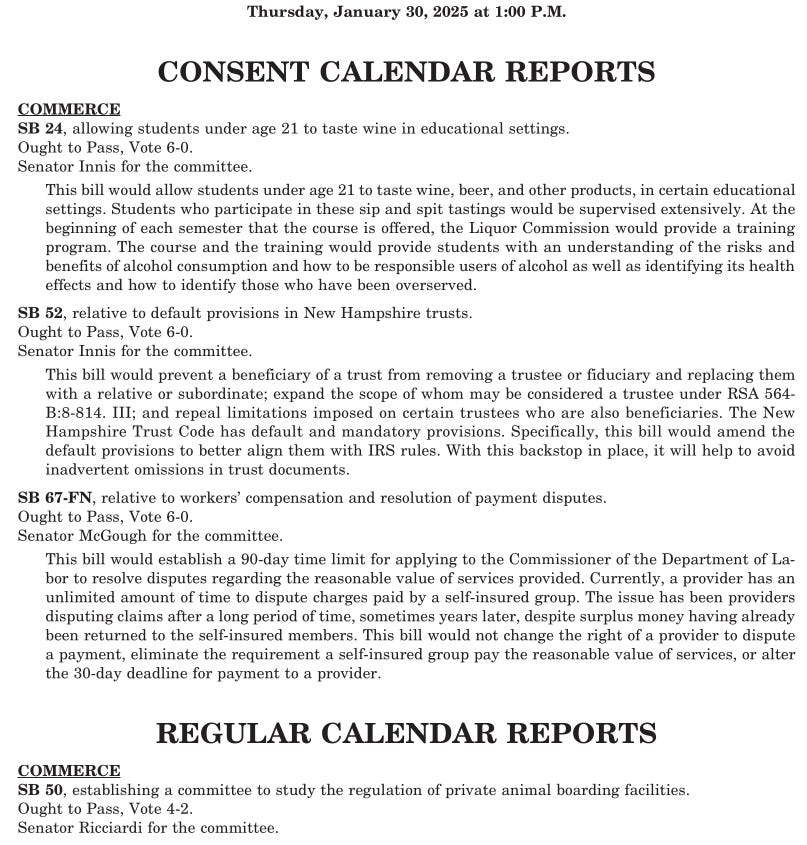
Senate Session (Consent Calendar)
Proposed Amendment to Senate Rules
Summary: Adds “Committee on Education Finance” to the Senate’s standing committees, with minor housekeeping updates.
SB 22-FN (1 sponsor, Republican)
Committee: Senate Children and Family Law
Summary: Allows child care licensing unit direct access to applicants’ full criminal history for background checks.
Committee Report Vote: Ought to Pass, 3-0SB 28 (6 sponsors, Bipartisan)
Committee: Executive Departments and Administration
Summary: Clarifies date of injury for workers’ compensation PTSD claims for emergency responders.
Committee Report Vote: Ought to Pass, 5-0SB 29 (11 sponsors, Bipartisan)
Committee: Executive Departments and Administration
Summary: Expands health care workplace safety commission; mandates monthly reporting of violent incidents to Dept. of Labor.
Committee Report Vote: Ought to Pass, 5-0SB 31-FN (8 sponsors, Bipartisan)
Committee: Executive Departments and Administration
Summary: Creates an apprentice guide license under supervision of a licensed guide in fishing or hunting.
Committee Report Vote: Ought to Pass w/ Amendment, 5-0SB 32 (7 sponsors, Bipartisan)
Committee: Executive Departments and Administration
Summary: Updates Fish & Game statutes to modernize notice requirements, align state/federal waterfowl regs, and repeal outdated references.
Committee Report Vote: Ought to Pass w/ Amendment, 5-0SB 61-FN (1 sponsor, Republican)
Committee: Executive Departments and Administration
Summary: Permits Dept. of Corrections to secure better drug pricing and removes handwritten prescription rules for inmate meds.
Committee Report Vote: Ought to Pass, 3-0SB 68 (2 sponsors, Republican)
Committee: Executive Departments and Administration
Summary: Adds a deaf/hard-of-hearing coordinator to the governor’s commission on disability as an ex officio member.
Committee Report Vote: Ought to Pass, 3-0SB 18 (8 sponsors, Bipartisan)
Committee: Health and Human Services
Summary: Lets DHHS commissioner expand bed capacity at a pediatric intermediate care facility if data shows need.
Committee Report Vote: Ought to Pass, 5-0SB 37 (4 sponsors, Bipartisan)
Committee: Health and Human Services
Summary: Revises residential care licensing, mandates public posting of inspection/investigation results, clarifies training.
Committee Report Vote: Ought to Pass, 5-0SB 47 (1 sponsor, Republican)
Committee: Health and Human Services
Summary: Clarifies that the birth mother’s insurance policy is primary for newborn coverage unless unavailable.
Committee Report Vote: Ought to Pass w/ Amendment, 5-0SB 24 (14 sponsors, Bipartisan)
Committee: Commerce
Summary: Allows students under 21 in enology/brewing courses to taste alcoholic beverages under close supervision.
Committee Report Vote: Ought to Pass, 6-0SB 52 (3 sponsors, Republican)
Committee: Commerce
Summary: Clarifies trust code rules on fiduciary powers, aligns with IRS regulations, and repeals outdated trustee limitations.
Committee Report Vote: Ought to Pass, 6-0SB 67-FN (3 sponsors, Bipartisan)
Committee: Commerce
Summary: Establishes a 90-day limit to dispute workers’ comp payments, ensuring timely finality for employers and providers.
Committee Report Vote: Ought to Pass, 6-0
Senate Session (Regular Calendar)
SB 4 (2 sponsors, Bipartisan)
Committee: Commerce
Summary: Replaces existing law with a streamlined C-PACER program for commercial property clean energy/resiliency financing.
Committee Report Vote: Ought to Pass, 5-0SB 19 (1 sponsor, Republican)
Committee: Commerce
Summary: Eliminates requirement for hotels/motels to post room rates publicly, aligning with modern online booking norms.
Committee Report Vote: Ought to Pass, 5-0SB 25 (1 sponsor, Republican)
Committee: Commerce
Summary: Allows credit union board directors to receive compensation for their board services.
Committee Report Vote: Ought to Pass, 5-0SB 50 (1 sponsor, Republican)
Committee: Commerce
Summary: Forms a study committee on regulating private animal boarding facilities for improved oversight.
Committee Report Vote: Ought to Pass, 4-2SB 30 (15 sponsors, Bipartisan)
Committee: Executive Departments & Administration
Summary: Declares the Virginia opossum as the official state marsupial, renaming local opossums “New Hampshire opossums.”
Committee Report Vote: Ought to Pass w/ Amendment, 5-0SB 20-FN (12 sponsors, Bipartisan)
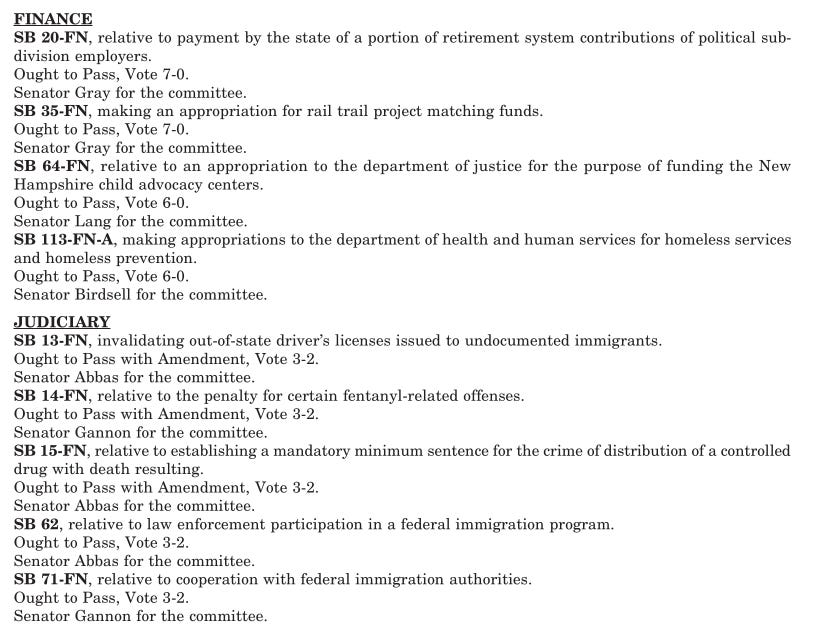
Committee: Finance
Summary: Resumes 7.5% state share of political subdivision pension costs to relieve local budgets.
Committee Report Vote: Ought to Pass, 7-0SB 35-FN (7 sponsors, Bipartisan)
Committee: Finance
Summary: Appropriates $600,000 to build a Warner rail trail link via CMAQ matching funds.
Committee Report Vote: Ought to Pass, 7-0SB 64-FN (8 sponsors, Bipartisan)
Committee: Finance
Summary: Provides $3M to NH child advocacy centers for forensic interviews, reduces trauma for abused children.
Committee Report Vote: Ought to Pass, 6-0SB 113-FN-A (1 sponsor, Republican)
Committee: Finance
Summary: Allocates $30M over two years for homeless shelters, eviction prevention, and supportive housing.
Committee Report Vote: Ought to Pass, 6-0SB 13-FN (12 sponsors, Republican)
Committee: Judiciary
Summary: Invalidates driver’s licenses from states that issue them exclusively to undocumented immigrants; sets penalty.
Committee Report Vote: Ought to Pass w/ Amendment, 3-2SB 14-FN (11 sponsors, Republican)
Committee: Judiciary
Summary: Creates 3.5–7-year mandatory minimums for fentanyl-class possession above specified grams.
Committee Report Vote: Ought to Pass w/ Amendment, 3-2SB 15-FN (11 sponsors, Republican)
Committee: Judiciary
Summary: Requires 10-year sentence if drug distribution leads to death, focusing on fentanyl.
Committee Report Vote: Ought to Pass w/ Amendment, 3-2SB 62 (12 sponsors, Republican)
Committee: Judiciary
Summary: Prohibits local governments from restricting law enforcement collaboration with ICE’s 287(g) program.
Committee Report Vote: Ought to Pass, 3-2SB 71-FN (19 sponsors, Republican)
Committee: Judiciary
Summary: Bans “sanctuary” policies, punishes municipalities that don’t cooperate with federal immigration.
Committee Report Vote: Ought to Pass, 3-2
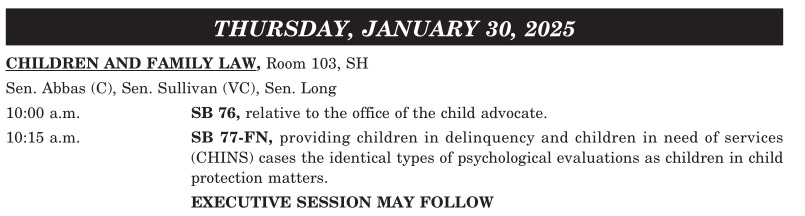
Senate Children and Family Law
SB 76 (3 sponsors, Democratic)
Summary: Broadens the Office of the Child Advocate’s jurisdiction to any child receiving or needing services from state agencies, expands records access, and clarifies confidentiality rules.SB 77-FN (6 sponsors, Lean Democratic)
Summary: Requires that delinquency and CHINS psychological evaluations be done/supervised by a licensed psychologist trained in evidence-based treatment of childhood trauma.
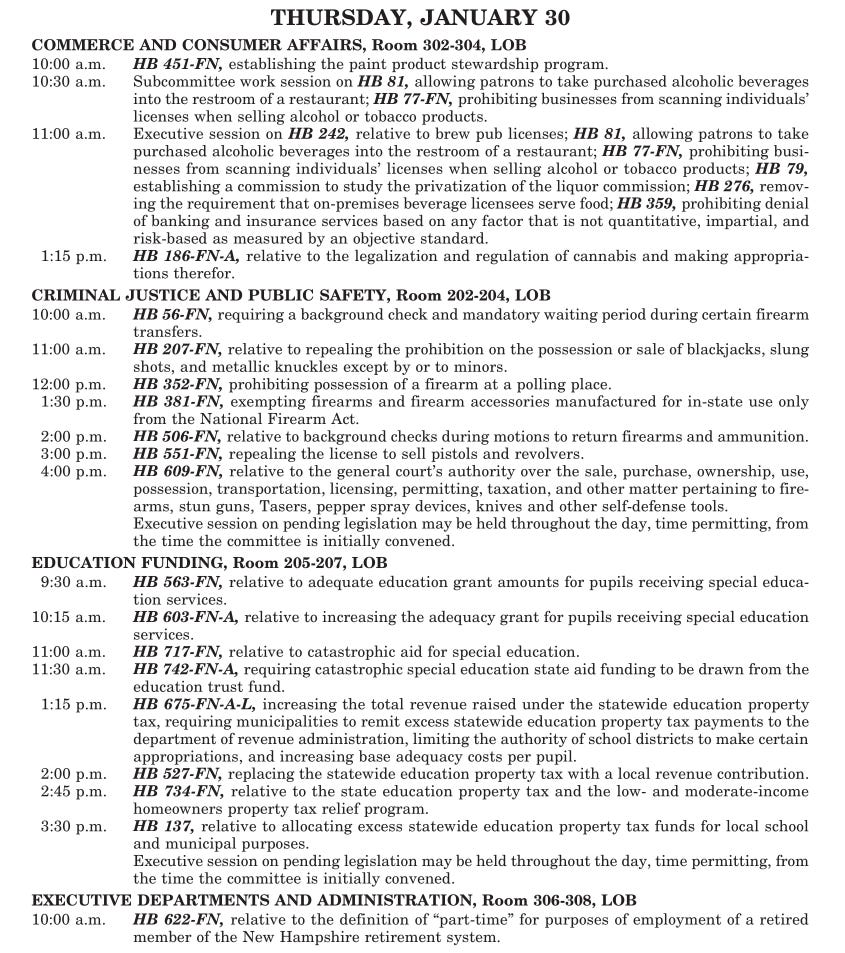
House Commerce and Consumer Affairs
HB 451-FN (12 sponsors, Bipartisan)
Summary: Establishes a paint product stewardship program funded by fees, shifting disposal costs to manufacturers.
Online: 71 support vs. 2 opposeHB 186-FN-A (2 sponsors, Democratic)
Summary: Legalizes and regulates cannabis for adults 21+, dedicates tax revenue to substance misuse programs.
Online: 25 support vs. 3 oppose
House Criminal Justice and Public Safety
HB 56-FN (10 sponsors, Democratic)
Summary: Imposes universal firearm background checks and a 72-hour waiting period.
Online: 214 support vs. 65 opposeHB 207-FN (11 sponsors, Republican)
Summary: Legalizes blackjacks/slung shots/metal knuckles for adults; retains prohibition for minors.
Online: 14 support vs. 68 opposeHB 352-FN (5 sponsors, Democratic)
Summary: Bans firearms within 100 feet of polling places, except for law enforcement.
Online: 188 support vs. 46 opposeHB 381-FN (4 sponsors, Republican)
Summary: Exempts in-state manufactured firearms from the National Firearm Act if never leaving NH.
Online: 17 support vs. 63 opposeHB 506-FN (5 sponsors, Republican)
Summary: Requires a new background check prior to returning firearms seized under restraining or bail orders.
Online: 7 support vs. 11 opposeHB 551-FN (2 sponsors, Republican)
Summary: Repeals state licensing to sell pistols/revolvers, leaving only federal requirements.
Online: 14 support vs. 60 opposeHB 609-FN (8 sponsors, Republican)
Summary: Strengthens state preemption by barring local firearms, pepper spray, Taser restrictions.
Online: 9 support vs. 36 oppose
House Education Funding
HB 563-FN (8 sponsors, Lean Republican)
Summary: Modifies adequacy grants with weighted special ed categories, adjusting amounts for actual needs.
Online: 6 support vs. 7 opposeHB 603-FN-A (8 sponsors, Democratic)
Summary: Increases special education state aid from $2,100 to $29,556 per pupil.
Online: 120 support vs. 4 opposeHB 717-FN (1 sponsor, Republican)
Summary: Reduces catastrophic aid threshold from 3.5 to 3.0 times average per-pupil cost, increasing state share.
Online: 12 support vs. 3 opposeHB 742-FN-A (8 sponsors, Democratic)
Summary: Ends proration of catastrophic special ed aid, mandating full reimbursement from the Education Trust Fund.
Online: 108 support vs. 2 opposeHB 675-FN-A-L (2 sponsors, Republican)
Summary: Increases total SWEPT revenue, caps local school appropriations, sends “excess” tax receipts to the state.
Online: 15 support vs. 123 opposeHB 527-FN (1 sponsor, Democratic)
Summary: Eliminates statewide education property tax, shifts entirely to a local revenue contribution model.
Online: 3 support vs. 4 opposeHB 734-FN-A (2 sponsors, Democratic)
Summary: Requires all SWEPT funds go to Education Trust Fund; expands low-moderate income homeowner relief.
Online: 44 support vs. 1 opposeHB 137 (3 sponsors, Republican)
Summary: Lets “excess” statewide education property tax funds remain local instead of remitting them to the state.
Online: 7 support vs. 43 oppose
House Municipal and County Government
HB 272 (4 sponsors, Lean Republican)
Summary: Exempts agricultural/farming activities (not agritourism) from municipal “quiet hour” noise ordinances.
Online: 6 support vs. 0 opposeHB 149-FN (6 sponsors, Republican)
Summary: Places both original and amended warrant article language on the ballot; if both pass, higher “yes” percentage wins.
Online: 1 support vs. 8 opposeHB 230-L (6 sponsors, Republican)
Summary: Limits local health officers’ powers to nuisance removal only, restricting broader public health mandates.
Online: 121 support vs. 2 opposeHB 339 (6 sponsors, Lean Democratic)
Summary: Requires municipal master plans to address farmland preservation, plus any other relevant development topics.
Online: 4 support vs. 1 opposeHB 407 (5 sponsors, Republican)
Summary: Imposes 15% turnout requirement for passing spending/budget warrant articles in ballot-referenda towns.
Online: 0 support vs. 22 opposeHB 432 (6 sponsors, Bipartisan)
Summary: Recognizes recovery houses as equivalent to single-family residences under zoning, no extra permits needed.
Online: 103 support vs. 5 opposeHB 447 (14 sponsors, Lean Republican)
Summary: Extends disabled-veteran property tax exemption to VA hospital–adapted homes, not just VA grant–adapted ones.
Online: 7 support vs. 0 oppose
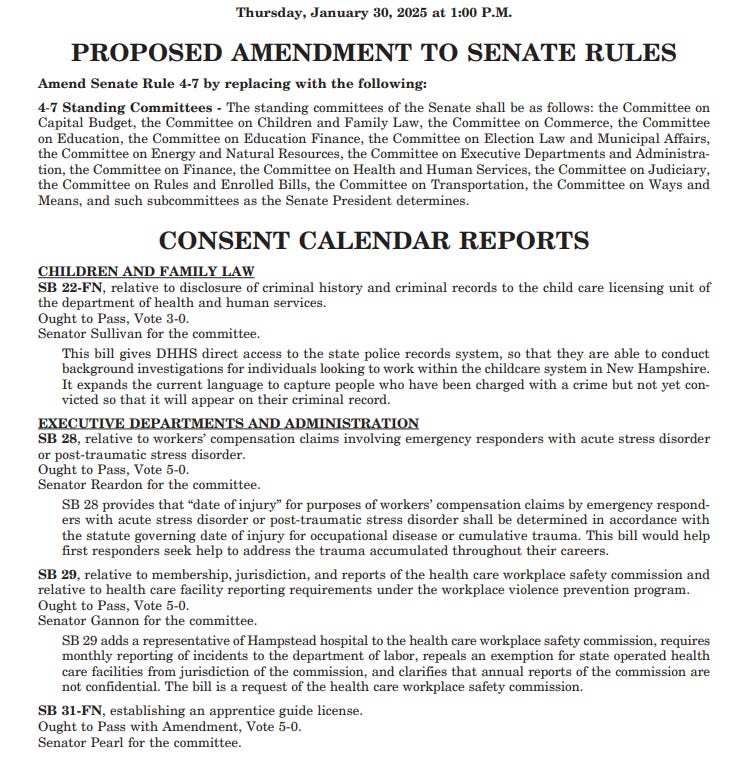
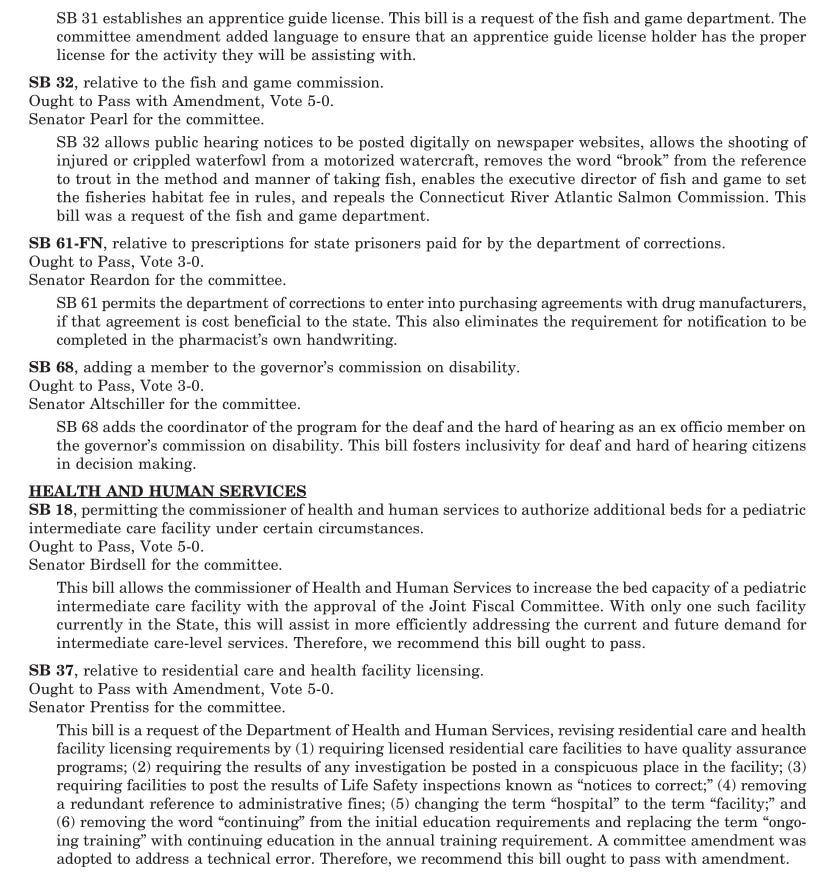
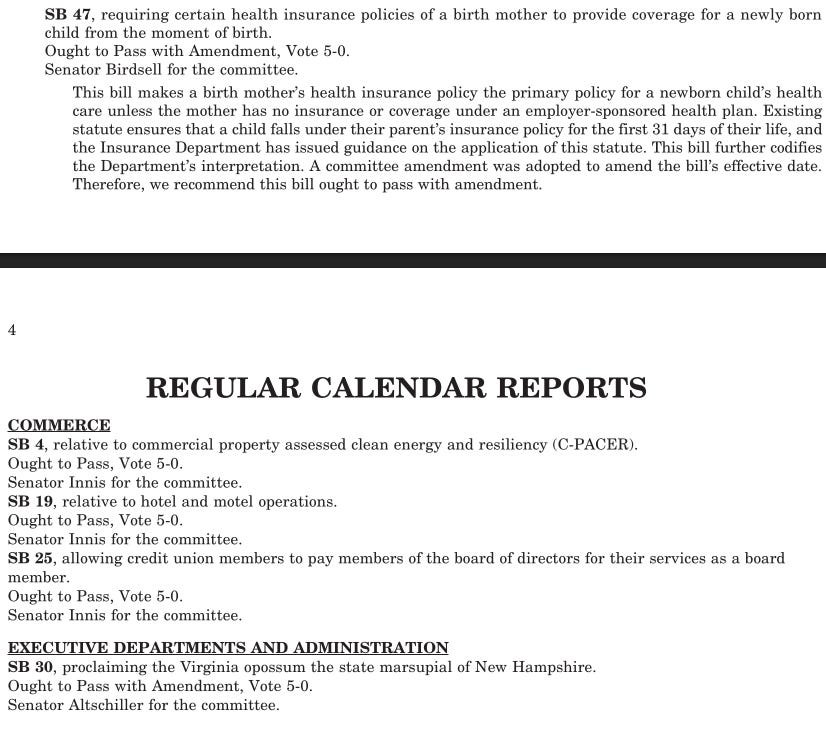
Screenshots of Senate Calendar No. 7
 |
 |
 |
 |
 |
s
Screenshots of Senate Calendar No. 7a
 |
 |
Screenshots of House Calendar
 |
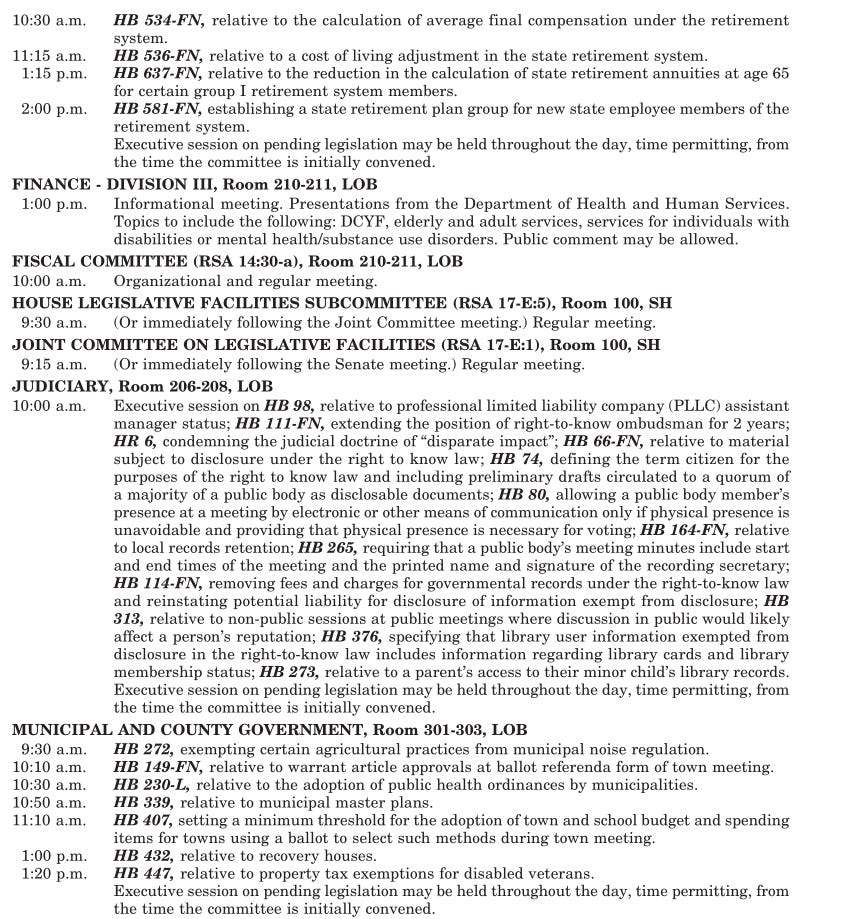 |
In-Depth Analysis of All Senate Session Bills
Proposed Amendment to Senate Rules
PROPOSED AMENDMENT TO SENATE RULES Amend Senate Rule 4-7 by replacing with the following: 4-7 Standing Committees - The standing committees of the Senate shall be as follows: the Committee on Capital Budget, the Committee on Children and Family Law, the Committee on Commerce, the Committee on Education, the Committee on Education Finance, the Committee on Election Law and Municipal Affairs, the Committee on Energy and Natural Resources, the Committee on Executive Departments and Administration, the Committee on Finance, the Committee on Health and Human Services, the Committee on Judiciary, the Committee on Rules and Enrolled Bills, the Committee on Transportation, the Committee on Ways and Means, and such subcommittees as the Senate President determines.
Effect: Adds Committee on Education Finance
Senate Consent Calendar Reports
Bills on the consent calendar are considered noncontroversial and acted on without debate.
Relevant Senate Rule:
6-23 Removal - Any member may request removal of any bill or resolution listed on the Consent Calendar. Any item removed from the Consent Calendar shall be taken up at the conclusion of the Regular Calendar. All items remaining on the Consent Calendar shall be acted upon without debate.
SB 22-FN
On Consent Calendar
AN ACT relative to disclosure of criminal history and criminal records to the child care licensing unit of the department of health and human services.
Hearing Report | Committee Report
Primary Sponsor: Sen. Howard Pearl (R)
Committee: Senate Children and Family Law
Committee recommendation: Ought to Pass,3-0, Consent Calendar
Selected quote(s) from the bill:
The bill is a request of the department of health and human services.
…
1 Child Day Care Licensing; State Registry and Criminal Records Check; Revocation of Registration and Withholding of State Funds. Amend RSA 170-E:7, II(b) to read as follows:
(b) Upon completion of the [background investigation] criminal history report, the division of state police shall release [copies of the criminal conviction record] a report of the applicant’s criminal history and record information, including confidential criminal history record information,
…
III. … If any individual … is registered or required to be registered on a state sex offender registry or repository, or the National Sex Offender Registry, or has been charged pending disposition or…
…
(b) … Upon completion of the [background investigation] criminal history report, the division of state police shall release [copies of the criminal conviction records] a report of the applicant’s criminal history and record information, including confidential criminal history record information,
…
V. … If any person … is registered or required to be registered on a state sex offender registry or repository, or the National Sex Offender Registry, or has beencharged pending disposition or …
Summary:
This bill allows the child care licensing unit of the Department of Health and Human Services (DHHS) to access an applicant's full criminal history and record information directly from the state police and use this information to determine eligibility for employment in childcare.
Argument For:
This bill enhances child safety by ensuring that individuals with serious criminal records or pending charges do not work in childcare settings. By granting DHHS direct access to criminal history records, it closes gaps that previously allowed individuals with pending charges to slip through the system. Supporters argue that this measure aligns with existing safeguards in the Department of Education and improves transparency in childcare background checks.
Hearing Summary:
The Senate Children and Family Law Committee held a hearing on January 14, 2025, where the bill was introduced by Sen. Pearl at the request of DHHS. Supporters, including representatives from DHHS, the state police, and Early Learning NH, emphasized the need to include ongoing charges in background checks to prevent individuals with serious offenses from working with children. Questions were raised about the treatment of annulled convictions and whether pending charges should impact hiring decisions. The committee voted 3-0 in favor of recommending the bill as "Ought to Pass," placing it on the consent calendar for further legislative action.
SB 28
On Consent Calendar
AN ACT relative to workers' compensation claims involving emergency responders with acute stress disorder or post-traumatic stress disorder.
Hearing Report | Committee Report
Primary Sponsor: Sen. Regina Birdsell (R)
Co-Sponsors: Sen.Bill Gannon (R), Sen. Pat Long (D), Sen. Suzanne Prentiss (D), Rep. Timothy Soucy (D), Rep. Stephen Pearson (R)
Committee: Executive Departments and Administration
Committee recommendation: Ought to Pass,5-0, Consent Calendar
Selected quotes from the bill:
1 Workers' Compensation; Acute Stress Disorder and Post-Traumatic Stress Disorder. Amend RSA 281-A:17-c …
281-A:17-c Acute Stress Disorder and Post-Traumatic Stress Disorder; Presumption.
I.Notwithstanding … [RSA 281-A:16,] …
II. For purposes of this section, the date of injury for acute stress disorder and post-traumatic stress disorder in an emergency responder shall be subject to the provisions for determining date of injury for occupational disease or cumulative trauma under RSA 281-A:16.
Summary:
This bill clarifies that the "date of injury" for workers' compensation claims involving emergency responders with acute stress disorder or post-traumatic stress disorder will be determined based on the standard for occupational disease or cumulative trauma, rather than the first exposure to trauma.
Argument For:
This bill ensures that emergency responders suffering from PTSD or acute stress disorder due to repeated traumatic exposure over their careers are eligible for workers' compensation. Currently, requiring the date of first exposure may disqualify many responders from receiving necessary support, discouraging them from seeking treatment. By aligning PTSD claims with other occupational diseases, the bill removes an arbitrary barrier to care and acknowledges the cumulative nature of trauma in emergency response work.
Hearing Summary:
The Senate Executive Departments and Administration Committee held a hearing on SB 28, with testimony largely in favor of the bill. Senator Birdsell introduced the bill, explaining that it ensures workers' compensation eligibility for emergency responders by setting the injury date as the last exposure rather than the first. Representatives from the Professional Fire Fighters of New Hampshire and the Commission to Study the Incidence of PTSD in First Responders supported the bill, citing the cumulative nature of trauma and the need to reduce stigma around seeking help. Some concerns were raised about the potential for increased claims, but proponents argued that the bill clarifies existing law rather than expanding eligibility. The committee ultimately voted 5-0 in favor of recommending the bill as "Ought to Pass."
SB 29
On Consent Calendar
AN ACT relative to membership, jurisdiction, and reports of the health care workplace safety commission and relative to health care facility reporting requirements under the workplace violence prevention program.
Hearing Report | Committee Report
Primary Sponsor: Sen. Cindy Rosenwald (D)
Co-Sponsors: Sen. James Gray (R), Sen. Tara Reardon (D), Sen. Denise Ricciardi (R), Sen. Donovan Fenton (D), Sen. Kevin Avard (R), Rep. Brian Sullivan (D), Rep. Mark MacKenzie (D), Rep. Wayne MacDonald (R), Rep. Lucy Weber (D), Rep. William Palmer (D)
Committee: Executive Departments and Administration
Committee recommendation: Ought to Pass,5-0, Consent Calendar
Selected quotes from the bill:
The bill is a request of the health care workplace safety commission.
1 New Subparagraph; Health Care Workplace Safety Commission; Membership; Hampstead Hospital Added. Amend RSA 151-J:1, II(a) by inserting after subparagraph (2) the following new subparagraph:
(2-a) A representative of Hampstead hospital, appointed by the hospital.
2 Health Care Workplace Violence Prevention Program; Reporting of Workplace Violence Events to the Department of Labor. Amend RSA 277-C:2, IV and V to read as follows:
IV-a.The commissioner of the department of labor … shall adopt rules … deemed necessary for the implementation of this section, including a common reporting form. Health facilities shall use the form to report workplace violence or hostile words incidents to the department of labor on a monthly basis.
V.(a) The annual report required under paragraph IVand the monthly reports to the department of labor required under paragraph IV-a shall include … workplace violence or hostile words incident …
3 Reports; Confidentiality. Amend RSA 151-J:7 to read as follows:
151-J:7 Reports. … Annual reports of the commission shall not be confidential, butany information about processes or outcomes [provided pursuant to this section] shall be aggregate data only and shall not reference individual incidents, patients, health care providers, or institutions, in accordance with the confidentialityrequirements of RSA 151-J:5.
4 Repeal. RSA 151-J:9, relative to the exemption of state operated medical facilities from the jurisdiction of the New Hampshire health care workplace safety commission, is repealed.
Summary:
This bill adds a representative of Hampstead Hospital to the health care workplace safety commission, mandates monthly reporting of workplace violence incidents to the Department of Labor, removes an exemption for state-operated health care facilities from the commission’s jurisdiction, and clarifies that annual reports of the commission are not confidential.
Argument For:
This bill implements key recommendations from the first annual report of the Workplace Safety Commission, which was created in response to an increase in workplace violence in health care settings. With nearly 3,000 reported incidents of violence in hospitals, including 33 resulting in serious injuries, the bill ensures uniform reporting requirements for all hospitals, including Hampstead Hospital, to provide better data for policy improvements. Requiring monthly reporting and making annual reports publicly accessible will enhance transparency and accountability, ultimately leading to safer workplaces for health care workers.
Hearing Summary:
The Senate Executive Departments and Administration Committee held a hearing on SB 29 on January 15, 2025, with all committee members present. Senator Cindy Rosenwald introduced the bill, explaining that it implements recommendations from the Workplace Safety Commission’s first annual report in response to increasing workplace violence in hospitals. She noted that Hampstead Hospital has not participated in the commission and emphasized the importance of standardized reporting. The New Hampshire Hospital Association (NHHA) testified in support, highlighting that workplace violence is likely underreported and that the commission’s work is helping hospitals improve safety. Opponents of the bill, Julie Smith and Curtis Howland, did not provide detailed testimony. The committee subsequently voted 5-0 to recommend the bill as "Ought to Pass."
SB 31-FN
On Consent Calendar
AN ACT establishing an apprentice guide license.
Hearing Report | Committee Report
Primary Sponsor: Sen. Howard Pearl (R)
Co-Sponsors: Sen. Daniel Innis (R), Sen. Timothy Lang (R), Sen. Kevin Avard (R), Sen. Tara Reardon (D), Sen. David Rochefort (R), Rep. Judy Aron (R), Rep. James Spillane (R)
Committee: Executive Departments and Administration
Committee recommendation: Ought to Pass with Amendment,5-0, Consent Calendar
Selected quotes from the bill:
This bill is a request of the fish and game department.
1 New Section; Apprentice Guide License. Amend RSA 215 by inserting after section 9 the following new section:
215:10 Apprentice Guide License.
I. Any person who wishes to become a hunting or fishing guide but who has not completed the written and oral board requirements to become a licensed guide as required in RSA 215:2, may purchase an apprentice guide license. … A person holding a valid apprentice guide license may guide in activities, including hunting or fishing, only when accompanied by a properly licensed guide who is 18 years of age or older.
Amendment:
Amend RSA 215:10, I as inserted by section 1 of the bill by replacing it with the following:
I. Any person who wishes to become a hunting or fishing guide but who has not completed the written and oral board requirements to become a licensed guide as required in RSA 215:2, may purchase an apprentice guide license. Additional requirements for an individual to qualify for the apprentice guide license shall include passing a criminal background check and certification in first-aid and CPR before an application may be submitted. A person holding a valid apprentice guide license, along with the proper license for the activity they will be assisting with, may guide in activities, including hunting or fishing, only when accompanied by a properly licensed guide who is 18 years of age or older. The fees for a resident or non-resident apprentice guide license shall be set in rules pursuant to RSA 541-A, as provided in RSA 215:4.
Summary:
This bill establishes an apprentice guide license, allowing individuals who have not yet completed the written and oral board requirements to gain supervised experience under a licensed hunting or fishing guide.
Amendment Summary:
The amendment clarifies that an apprentice guide license holder must also possess the proper license for the activity they will be assisting with.
Argument For:
This bill provides an opportunity for aspiring guides to gain practical experience under the supervision of a licensed guide, better preparing them to meet the testing requirements for full licensure. It mirrors the successful apprentice hunter license program and ensures that new guides develop the necessary skills in a controlled and responsible manner. The New Hampshire Fish and Game Commission supports this bill, recognizing its value in maintaining high standards for guides while allowing for hands-on learning.
Hearing Summary:
The Senate Executive Departments and Administration Committee held a hearing on January 15, 2025, where Senator Howard Pearl introduced the bill, explaining that it was developed with input from the Guides’ Association to provide hands-on experience for prospective guides. Colonel Kevin Jordan of the New Hampshire Fish and Game Department testified in favor, highlighting that changes to the guide licensure process had made it more rigorous and that this bill would help applicants gain real-world experience. The Fish and Game Commission formally supported the bill. The committee later recommended the bill ought to pass with an amendment, which clarified that apprentice guides must also hold the proper license for the activity they are assisting with. The committee vote was unanimous at 5-0.
SB 32
On Consent Calendar
AN ACT relative to the fish and game commission.
Committee Hearing | Committee Report
Primary Sponsor: Sen. Howard Pearl (R)
Co-Sponsors: Sen. Regina Birdsell (R), Sen. Kevin Avard (R), Sen. Timothy Lang (R), Sen. Daniel Innis (R), Sen. David Rochefort (R), Sen. Tara Reardon (D)
Committee: Executive Departments and Administration
Committee recommendation: Ought to Pass with Amendment,5-0, Consent Calendar
Selected quotes from the bill:
1 Hearings to Receive Suggestions from the Public; Digital Hearing Notices Allowed. Amend RSA 206:11 to read as follows:
206:11 Hearings to Receive Suggestions from the Public. … Public notice of said hearings may be published on the newspaper's website.
2 New Paragraph; Methods of Taking; Hunting from Motor Vehicle, OHRV, Snowmobile, Boat, or Aircraft. Amend RSA 207:7 by inserting …
V. The provisions of this section shall not apply shooting of injured or crippled waterfowl from a motorized watercraft.
3 Nets; Traps. Amend RSA 211:9 to read as follows:
211:9 Nets; Traps. … A circular drop net, not more than 48 inches in diameter, or a square net of equal area, may be used for taking minnows for bait, from waters not inhabited by [brook] trout.
4 Fisheries Habitat Fee; Established in Rule. Amend RSA 214:1-g, I to read as follows:
I. A [one dollar] fisheries habitat fee, which shall be set in rules adopted by the executive director in accordance with RSA 541-A, shall be required to be paid by all persons 16 years of age or older …
5 Repeal. RSA 213-A, relative to the Connecticut River Atlantic salmon commission, is repealed.
Amendment:
Amend RSA 206:11 as inserted by section 1 of the bill by replacing it with the following:
206:11 … [his] their duties. … Public notice of said hearings may be published on the newspaper's website, and linked to the fish and game website. … [his] their
Summary:
This bill allows public hearing notices to be posted digitally on newspaper websites, permits the shooting of injured or crippled waterfowl from a motorized watercraft, removes the word "brook" from references to trout in fishing regulations, enables the executive director of Fish and Game to set the fisheries habitat fee in rules, and repeals the Connecticut River Atlantic Salmon Commission.
Amendment Summary:
The amendment updates the language in RSA 206:11 to allow public hearing notices to be published on newspaper websites with a required link to the Fish and Game website and replaces gender-specific references to the executive director with gender-neutral language.
Argument For:
This bill modernizes public notification practices by allowing Fish and Game to post hearing notices on newspaper websites, reflecting the shift toward digital media. It aligns state hunting regulations with federal law by permitting the shooting of injured or crippled waterfowl from a motorized watercraft, reducing waste and improving hunting ethics. The removal of "brook" from trout regulations provides clarity in fisheries management, while granting the executive director authority to set habitat fees ensures consistency across Fish and Game programs. Additionally, repealing the Connecticut River Atlantic Salmon Commission eliminates outdated statutory language following its federal reorganization.
Hearing Summary:
The hearing on SB 32 opened at 9:04 a.m. and closed at 9:16 a.m. Senator Pearl introduced the bill as a request from Fish and Game, describing it as a housekeeping measure. Supporters, including representatives from Fish and Game, emphasized that the bill modernizes notification procedures, aligns state regulations with federal law, and removes outdated statutory references. The amendment was proposed to ensure hearing notices posted on newspaper websites would also be linked to the Fish and Game website. The committee voted unanimously (5-0) to recommend the bill as Ought to Pass with Amendment.
SB 61-FN
On Consent Calendar
AN ACT relative to prescriptions for state prisoners paid for by the department of corrections.
Committee Hearing | Committee Report
Sponsor(s): (Prime) Sen. James Gray (R)
Committee: Executive Departments and Administration
Committee recommendation: Ought to Pass,3-0, Consent Calendar
Selected quote(s) from the bill:
1 Medical Services for State Prisoners. Amend RSA 623-C:2, III to read as follows:
III. Pharmacists shall substitute generically equivalent drug products for all legend and non-legend prescriptions paid for by the department of corrections, [including the Medicaid program,] unless the prescribing practitioner specifies that the brand name drug product is medically necessary. [Such notification shall be in the practitioner's own handwriting and shall be retained in the pharmacist's file.] The pharmacist shall not select an equivalent drug product unless its price to the purchaser or payor is less than the price of the prescribed drug product. The department may enter into agreements or collaborative purchasing structures to buy or acquire therapeutic agents that will result in cost savings to the department. The commissioner of the department of corrections may waive the application of RSA 623-C:2, I if the commissioner determines such action is necessary to ensure the availability of prescription and other pharmaceutical services to persons served by the state or to avert serious economic hardship in the provision of prescriptions and other pharmaceutical services. [For Medicaid fee for service clients, no prior authorization for generically equivalent drugs shall be required.]
Summary:
This bill permits the Department of Corrections to enter into purchasing agreements with drug manufacturers if cost beneficial to the state and eliminates the requirement for prescription notifications to be completed in the pharmacist’s own handwriting.
Argument For:
This bill allows the Department of Corrections to negotiate directly with drug manufacturers, potentially reducing costs and securing better pricing through bulk purchasing agreements. It ensures that the department can legally pursue the most cost-effective medication options, whether brand-name or generic, without being constrained by outdated statutory language. Additionally, the elimination of handwritten notification requirements modernizes recordkeeping and aligns with current electronic health record practices.
Hearing Summary:
At the hearing, Senator James Gray introduced the bill, emphasizing that it was requested by the Department of Corrections to achieve cost savings. Director Paula Mattis from the Department of Corrections explained that in some cases, brand-name medications can be more cost-effective than generics and that current statutes restrict the department’s ability to secure the best pricing. She also stated that handwritten prescription notifications are outdated and unnecessary due to modern electronic health records. The committee clarified that the bill would not impact inmate access to necessary medications but would strictly serve as a cost-saving measure. The committee subsequently voted 3-0 in favor of recommending the bill as "Ought to Pass" and placed it on the consent calendar.
Agency Recommendation:
According to Sen. Gray, the bill was recommended by the Department of Corrections.
SB 68
On Consent Calendar
AN ACT adding a member to the governor's commission on disability.
Committee Hearing | Committee Report
Sponsor(s): (Prime) Sen. Timothy Lang (R), Sen. Howard Pearl (R)
Committee: Executive Departments and Administration
Committee recommendation: Ought to Pass,3-0, Consent Calendar
Selected quote(s) from the bill:
1 Governor's Commission on Disability; Ex Officio Members. Amend RSA 275-C:3 to read as follows:
275-C:3 Ex Officio Members. The following, or their designees, shall serve as ex officio members without a vote on the commission: (1) the commissioner of health and human services, (2) the administrator of the bureau of vocational rehabilitation, department of education, (3) the supervisor of blind services, bureau of vocational rehabilitation, department of education, (4) the commissioner of labor, (5) the commissioner of the department of employment security, (6) the coordinator of the program for the deaf and hard of hearing, bureau of vocational rehabilitation, department of education, and [(6)] (7) a member of the state board of education designated by the governor.
Summary:
This bill adds the coordinator of the program for the deaf and hard of hearing as an ex officio, non-voting member of the governor’s commission on disability.
Argument For:
This bill ensures that the deaf and hard of hearing community has direct representation in the governor’s commission on disability, allowing for better-informed policy decisions. With 50,000 New Hampshire residents affected by hearing disabilities, adding an expert will improve policy outcomes, foster inclusivity in decision-making, and align with state and federal priorities for disability representation.
Hearing Summary:
The hearing for SB 68 lasted four minutes, with Senators Pearl, Altschiller, and Reardon present. Senator Lang introduced the bill, explaining that it was requested by the Department of Education to provide a voice for the deaf and hard of hearing in the commission. Richard Sala from the Bureau of Vocational Rehabilitation testified in support, stating that adding an expert would improve policy outcomes and align with federal and state priorities. He noted that many individuals with hearing disabilities face additional challenges and that representation would foster inclusivity. The committee voted 3-0 in favor of the bill, recommending it ought to pass.
Recommendation by Agency:
Senator Lang said this bill is a request of the Department of Education.
SB 18
On Consent Calendar
AN ACT permitting the commissioner of health and human services to authorize additional beds for a pediatric intermediate care facility under certain circumstances.
Committee Hearing | Committee Report
Primary Sponsor: Sen. Cindy Rosenwald (D)
Co-Sponsors: Sen. David Rochefort (R),Sen. Pat Long (D),Sen. Regina Birdsell (R),Sen. Donovan Fenton (D),Sen. Suzanne Prentiss (D),Rep. Lucy Weber (D),Rep. David Nagel (R)
Committee: Health and Human Services
Committee recommendation: Ought to Pass,5-0, Consent Calendar
Selected quotes from the bill:
1 Residential Care and Health Facility Licensing; License or Registration Required; Pediatric Intermediate Care Facility; Bed Capacity. Amend RSA 151:2, VI(a) to read as follows:
(2) Provided however … any pediatric intermediate care facility, established before the effective date of this subparagraph is authorized to house 2 additional pediatric residents beyond its licensed capacity prior to that date…. Notwithstanding the moratorium established in subparagraph (a)(1), the commissioner of health and human services may assess the capacity of any pediatric immediate care facility and report any need for additional beds to the standing policy committees of the house and senate with jurisdiction over health and human services and the fiscal committee of the general court. If the commissioner determines additional beds are necessary, the commissioner may increase a pediatric intermediate care facility's number of licensed beds upon approval of the fiscal committee of the general court.
Summary:
This bill allows the commissioner of health and human services to increase the bed capacity of a pediatric intermediate care facility with the approval of the Joint Fiscal Committee.
Argument For:
This bill ensures that New Hampshire can meet the growing demand for pediatric intermediate care by allowing the commissioner of health and human services to authorize additional beds as needed, subject to fiscal oversight. The only facility in the state, Cedarcrest Center for Children with Disabilities, has seen a 30% increase in demand over the past three years and has been forced to turn away children in need of care. Expanding capacity would not only help New Hampshire children receive care closer to home but also reduce hospital costs, as Cedarcrest’s daily rate is significantly lower than hospital stays.
Hearing Summary:
The Senate Health and Human Services Committee held a hearing on SB 18 on January 15, 2025, where the bill was supported by multiple senators, healthcare advocates, and representatives from Cedarcrest Center for Children with Disabilities. Senator Rosenwald emphasized that the bill maintains the long-term care bed moratorium while allowing for necessary pediatric intermediate care expansion. Dr. Jay Hayston, CEO of Cedarcrest, highlighted the growing demand for their services, noting that the facility is currently turning away eligible children due to limited capacity. He stressed that expanding Cedarcrest’s capacity would reduce overall healthcare costs and improve patient outcomes. The committee unanimously recommended the bill ought to pass with a 5-0 vote.
SB 37
On Consent Calendar
AN ACT relative to residential care and health facility licensing.
Committee Hearing | Committee Report
Primary Sponsor: Sen. Timothy Lang (R)
Co-Sponsors: Sen. Pat Long (D), Sen. Keith Murphy (R), Sen. Mark McConkey (R)
Committee: Health and Human Services
Committee recommendation: Ought to Pass,5-0, Consent Calendar
Selected quotes from the bill:
The bill is a request of the department of health and human services.
1 Residential Care and Health Facility Licensing; Proceedings of Residential Care Facility Quality Assurance Program; Confidentiality. Amend RSA 151:5-c, I …
I. … in licensed residential care facilities, such facilities [may voluntarily] shallmaintain a quality assurance program for its residents as set forth in this section.
2 Residential Care and Health Facility Licensing; Investigations and Consultations. Amend RSA 151:6, I …
I. The department of health and human services may investigate, in response to a complaint alleging a violation of this chapter or when it has good reason to believe that the provisions of this chapter or rules adopted under this chapter have been violated by any facility licensed under this chapter or agency required to be licensed in accordance to RSA 151:2, I or any facility providing services beyondroom and board to 2 or more individuals unrelated to the owner or manager. ... Investigation results shall be provided as a written report that identifies any noncompliance with this chapter and applicable rules adopted under this chapter. The results of this investigation and any later investigation shall be posted in a conspicuous place in the facility in the manner determined by the commissioner of the department of health and human services. The results so posted shall indicate the facilities and services investigated and the results for each such facility or service.
3 Residential Care and Health Facility Licensing; Annual Inspection. Amend RSA 151:6-a, II(c) to read as follows:
(c) Facilities shall [not] be required to post notices to correct issued under subparagraph (a) of this paragraph.
4 Residential Care and Health Facility Licensing; Civil Fines. Amend RSA 151:16-b to read as follows:
151:16-b Civil Fines. All [administrative fines and other] civil monetary penalties collected by the department from facilities licensed under this chapter shall be kept by the state treasurer …
5 Residential Care and Health Facility Licensing; Patients' Bill of Rights. Amend RSA 151:21, XXIII(b)(1)(D) to read as follows:
(D) Visitors are noncompliant with written [hospital] facilitypolicy.
6 Residential Care and Health Facility Licensing: Patients' Bill of Rights. Amend RSA 151:21, XXIII(f)(3) …
(3) [Hospital] Facility visitation policy detailing the rights and responsibilities specified in this paragraph, and the limitations placed upon those rights by written hospital policy on its website.
7 Residential Care and Health Facility Licensing; Dementia Training for Direct Care Staff in Residential Facilities; Continuing Education. Amend RSA 151:50 …
151:50 Continuing Education. The commissioner shall adopt rules to require at least 6 hours of initial [continuing] education for covered administrative staff members and covered direct service staff members and shall require at least 4 hours of [ongoing training] continuing education each calendar year.
Amendment:
Amend the bill by replacing section 6 with the following:
6 Residential Care and Health Facility Licensing: Patients' Bill of Rights. Amend RSA 151:21, XXIII(f)(3)to read as follows:
(3) [Hospital] Facility visitation policy detailing the rights and responsibilities specified in this paragraph, and the limitations placed upon those rights by written [hospital] facility policy on its website.
Summary:
This bill revises residential care and health facility licensing requirements by mandating quality assurance programs in residential care facilities, requiring the posting of investigation and Life Safety inspection results, updating terminology, and modifying training requirements for staff.
Amendment Summary:
The amendment ensures that a facility’s visitation policy is consistent in language across different sections, replacing "hospital" with "facility" in all relevant references.
Argument For:
This bill strengthens oversight and transparency in residential care facilities by ensuring that quality assurance programs are mandatory, investigation results are publicly posted, and Life Safety inspections are easily accessible. By clarifying terminology and standardizing training requirements, the bill promotes better care for residents while maintaining accountability for facilities.
Hearing Report:
The Senate Health and Human Services Committee held a hearing on the bill, where stakeholders discussed the importance of improving residential care facility standards. Testimony emphasized the need for transparency in inspections and investigations to protect residents. There was general support for ensuring clear quality assurance measures and better training standards, though concerns were raised about the potential administrative impact on facilities.
Agency Recommendation:
This bill was requested by the Department of Health and Human Services, as stated in the bill analysis, indicating agency support for the proposed changes.
SB 47
On Consent Calendar
AN ACT requiring certain health insurance policies of a birth mother to provide coverage for a newly born child from the moment of birth.
Committee Hearing | Committee Report
Sponsor(s): (Prime) Sen. Regina Birdsell (R)
Committee: Health and Human Services
Committee recommendation: Ought to Pass with Amendment,5-0, Consent Calendar
Selected quote(s) from the bill:
1 Insurance Policy of Birth Mother; Primary Coverage. Amend RSA 415:22 to read as follows:
415:22 Newborn Children.
I. All individual and group health insurance policies providing coverage on a provision of service or an expense incurred basis shall also provide [that] as a covered benefit under the policy coverage for the health insurance benefits [applicable for children are payable with respect to] for a newly born child of the insured or subscriber or a newly born child of a dependent child of the insured or subscriber from the moment of birth. The policy of the birth mother shall always be primary, and benefits paid for the newly born child shall not be subject to any additional cost sharing. Services for the newly born child shall only be covered under the policy of the other parent in the event the birth mother does not have health insurance or coverage for the newly born child under an employer-sponsored health plan.
II. Coverage for newly born children shall [consist of coverage of injury or sickness] be the same as provided by the policy for other covered persons including the necessary care and treatment of medically diagnosed congenital defects and birth abnormalities.
III. … No additional premium shall be collected for coverage of the newborn child for the first 31 days. …
…
2 Effective Date. This act shall take effect 60 days after its passage.
Amendment:
Amend the bill by replacing section 2 with the following:
2 Effective Date. This act shall take effect January 1, 2026.
Summary:
This bill makes a birth mother's health insurance policy the primary policy for a newborn child's health care unless the mother has no insurance or coverage under an employer-sponsored health plan.
Amendment Summary:
The amendment changes the bill’s effective date to January 1, 2026.
Argument For:
This bill ensures that newborn children receive seamless health coverage under their birth mother’s insurance policy from the moment of birth, preventing gaps in care. It codifies the New Hampshire Insurance Department’s existing interpretation of the law, reducing confusion for parents and insurance providers. By clarifying cost-sharing and coverage responsibilities, this bill simplifies the claims process and ensures newborns receive essential healthcare without undue financial burdens on families.
Hearing Summary:
The committee heard testimony from Senator Birdsell, who introduced the bill at the request of the Insurance Department to codify its interpretation of existing law. Michelle Heaton from the Insurance Department testified that this statute has been in place since 1975 to ensure newborns receive coverage for their first 31 days and that the bill clarifies how cost-sharing and premiums apply. She stated that insurers were consulted on the language and did not raise objections. Supporters, including New Futures, argued that the bill ensures infants receive essential medical care without financial barriers. Paula Rogers from AHIP remained neutral but raised questions about how coordination of benefits would work between both parents' insurance policies. She also suggested changing the bill’s effective date to January 1 for compliance reasons, which was adopted as an amendment. The committee unanimously recommended the bill ought to pass with amendment.
Agency Recommendation:
The New Hampshire Insurance Department recommended this bill. This was stated in the bill analysis and confirmed during testimony by Michelle Heaton, Director of Life and Health at the Insurance Department. She explained that the bill codifies the Department’s existing guidance and ensures consistency in insurance coverage for newborns.
SB 24
On Consent Calendar
AN ACT allowing students under age 21 to taste wine in educational settings.
Committee Hearing | Committee Report
Primary Sponsor: Sen. Daniel Innis (R)
Co-Sponsors: Sen. Victoria Sullivan (R), Sen. Howard Pearl (R), Sen. Timothy Lang (R), Sen. Kevin Avard (R), Sen. Ruth Ward (R), Sen. David Rochefort (R), Sen. James Gray (R), Sen. Keith Murphy (R), Sen. Daryl Abbas (R), Sen. Mark McConkey (R), Rep. Timothy Horrigan (D), Rep. John Potucek (R), Rep. Alvin See (R), Rep. James Thibault (R)
Committee: Commerce
Committee recommendation: Ought to Pass,6-0, Consent Calendar
Selected quotes from the bill:
1 New Section; Consumption by Minors; Educational Settings. Amend RSA 179 by inserting after section 10-a the following new section:
179:10-b Consumption by Minors; Educational Settings.
…
II. A qualified student may taste an alcoholic beverage
(a) A qualified student shall attend and complete an alcohol educational program, provided by the liquor commission, before the student tastes any alcoholic beverage provided by the qualified academic institution.
(b) The qualified academic institution shall maintain records of tastings which shall include the course number, instructor, location of the tasting, and listing of alcoholic beverages tasted. Such records shall be made available to the liquor commission upon request.
(g) The qualified student tastes the alcoholic beverage for educational purposes as part of the instruction in a course required for an associate degree or bachelor degree.
Summary:
This bill allows students aged 18 to 20 who are enrolled in qualified academic institutions to taste, but not consume, alcoholic beverages in educational settings as part of coursework in enology or brewing programs, under strict supervision and regulatory oversight.
Argument For:
This bill provides students in enology and brewing programs with essential hands-on education under closely monitored conditions, ensuring they develop a responsible understanding of alcohol while preparing for careers in the hospitality and beverage industries. By requiring supervision, mandated training from the Liquor Commission, and strict record-keeping, the bill includes significant safeguards to prevent misuse. Additionally, similar laws exist in eight other states without reported negative consequences, and industry stakeholders and higher education institutions strongly support the measure.
Hearing Summary:
The Senate Commerce Committee held a hearing on SB 24, where multiple senators and representatives, as well as industry and education stakeholders, testified in support. Senator Innis emphasized the bill’s role in educating students responsibly about alcohol, with extensive supervision and training from the Liquor Commission. Other supporters, including representatives from the New Hampshire Lodging & Restaurant Association and the University of New Hampshire, stressed the bill’s benefits for workforce development in hospitality and beverage industries. The New Hampshire Liquor Commission’s Chief of Enforcement provided neutral testimony, highlighting the need for balance between education and accountability. There was no opposition to the bill. The committee ultimately voted 6-0 in favor, recommending it ought to pass.
Agency Recommendation:
The New Hampshire Liquor Commission was involved in shaping the bill, with Chief of Enforcement Mark Armaganian testifying that they worked with stakeholders to ensure appropriate oversight while supporting industry education.
SB 52
On Consent Calendar
AN ACT relative to default provisions in New Hampshire trusts.
Committee Hearing | Committee Report
Sponsor(s): (Prime) Sen. Daniel Innis (R), Rep. John Hunt (R), Rep. Bob Lynn (R)
Committee: Commerce
Committee recommendation: Ought to Pass,6-0, Consent Calendar
Selected quote(s) from the bill:
1 New Hampshire Trust Code; Duties and Powers of Trustee; Discretionary Powers; Tax Savings. Amend RSA 564-B:8-814 to read as follows:
564-B:8-814 Discretionary Powers; Tax Savings.
(a) Notwithstanding the breadth of discretion granted to a trustee, trust advisor, or trust protector, individually or collectively referred to in this section as a "fiduciary", whether or not exercising fiduciary powers, in the terms of the trust, including the use of such terms as "absolute," "sole," or "uncontrolled," the [trustee] fiduciary shall exercise a discretionary power in good faith and in accordance with the terms and purposes of the trust and the interests of the beneficiaries.
…
(2) A fiduciary [a trustee] may not exercise a power to make discretionary distributions to satisfy any [a] legal obligation [of support that] the fiduciary[trustee] personally owes another person, including a legal obligation of support.
(3) A beneficiary of a trust acting in any capacity may not remove a fiduciary and replace such fiduciary with a fiduciary who is related or subordinate to the beneficiary within the meaning of section 672(c) of the Internal Revenue Code unless:
(A) The fiduciary’s discretionary power to make distributions to or for the benefit of the beneficiary is limited by an ascertainable standard;
(B) The fiduciary’s discretionary power may not be exercised to satisfy any of the beneficiary’s legal obligations for support or other purposes; and
(C) The fiduciary’s discretionary power may not be exercised to grant to the beneficiary a general power to appoint property of the trust to the beneficiary, the beneficiary’s estate, or the creditors thereof within the meaning of section 2041 of the Internal Revenue Code;
(4) Subparagraph (3) shall not apply if the appointment of the fiduciary by the beneficiary may be made only in conjunction with another person having substantial interest in the property of the trust subject to the power which is adverse to the exercise of the power in favor of the beneficiary within the meaning of section 2041(b)(1)(C)(ii) of the Internal Revenue Code.
…
3 Repeal. RSA 564-B:8-818, relative to limitations on certain trustees who are beneficiaries, is repealed.
Summary:
This bill prevents a beneficiary of a trust from removing a trustee or fiduciary and replacing them with a relative or subordinate, expands the scope of who may be considered a trustee under RSA 564-B:8-814, and repeals limitations imposed on certain trustees who are also beneficiaries.
Argument For:
This bill ensures that New Hampshire remains a leading jurisdiction for trusts by strengthening default provisions that align with IRS rules, reducing the risk of unintended tax consequences for trust settlors and beneficiaries. By expanding the definition of fiduciary to include trust advisors and trust protectors, it clarifies that all fiduciaries are held to the same good faith obligations. Additionally, preventing beneficiaries from appointing relatives or subordinates as trustees helps preserve the integrity and independence of trust administration.
Hearing Summary:
The hearing lasted nine minutes and featured testimony in support of the bill from Senator Daniel Innis and representatives from the New Hampshire Trust Council. Proponents emphasized that the bill aligns New Hampshire’s trust laws with IRS regulations, reducing potential tax complications for trust settlors. They also highlighted the bill’s role in maintaining the state’s competitive position in the trust industry, which currently manages over $1.6 trillion in assets. Concerns about family-run trusts were addressed, with supporters asserting that the bill protects smaller trusts from inadvertent tax-related errors. There was no opposition testimony, and the committee ultimately voted 6-0 to recommend the bill as “Ought to Pass.”
SB 67-FN
On Consent Calendar
AN ACT relative to workers' compensation and resolution of payment disputes.
Committee Hearing | Committee Report
Sponsor(s): (Prime) Sen. Tim McGough (R), Sen. Donovan Fenton (D), Sen. David Rochefort (R)
Committee: Commerce
Committee recommendation: Ought to Pass,6-0, Consent Calendar
Selected quote(s) from the bill:
1 Workers' Compensation; Payment for Reasonable Value of Services. Amend RSA 281-A:24, I(c) and (d) to read as follows:
(c) Effort shall be made to resolve any dispute as to the reasonable value of service prior to applying to the commissioner for resolution of such a dispute, provided that no such application to the commissioner shall be made unless:
(1) The health care provider has notified the employer or the employer's insurance carrier, whichever is applicable, no more than 45 days after payment, of the provider's disagreement on the reasonable value of services provided; and
(2) No more than 45 days have passed since the notification required in subparagraph (1).
Summary:
This bill establishes a 90-day time limit for applying to the commissioner to resolve disputes regarding the reasonable value of services provided in workers' compensation cases.
Argument For:
This bill ensures timely resolution of payment disputes in workers' compensation cases, preventing providers from disputing payments years after they were made, which disrupts financial planning for self-insured groups. It maintains the right to dispute charges, does not alter the 30-day payment deadline, and promotes certainty for all parties involved in workers' compensation claims.
Hearing Summary:
The Senate Commerce Committee held a hearing on January 23, 2025, where the bill received broad support from senators and industry representatives. Supporters emphasized that the bill would prevent late disputes over payments, which currently have no time limit, creating financial uncertainty for self-insured groups. No opposition testimony was recorded. The New Hampshire Department of Labor reviewed the bill and stated they could implement the proposed changes. The committee later voted unanimously (6-0) to recommend the bill as "Ought to Pass."
Agency Recommendation:
The New Hampshire Department of Labor reviewed the bill and indicated they could implement the proposed changes. This was stated by Deputy Commissioner Danielle Albert during the hearing.
Senate Regular Calendar Reports
SB 4
AN ACT relative to commercial property assessed clean energy and resiliency (C-PACER).
Committee Hearing | Committee Report
Sponsor(s): (Prime) Sen. Daniel Innis (R), Sen. Tara Reardon (D)
Committee: Commerce
Committee recommendation: Ought to Pass,5-0
Selected quote(s) from the bill:
2 Adoption by Municipality. Amend RSA 53-F:2, IV to read as follows:
IV. The language of the question shall designate [an energy efficiency and clean energy] the district, which may cover all or a portion of the area within the municipality, or may designate all or a portion of the area within the municipality as part of [an energy efficiency and clean energy] a district that encompasses all or portions of multiple municipalities.
3 Authority. Amend RSA 53-F:3 to read as follows:
53-F:3 Authority. To achieve the public benefits of protecting the economic and social well-being by reducing energy costs in the community and risks to the community associated with future escalation in energy prices, and addressing the threat of global climate change, any municipality which has adopted the provisions of this chapter and established an energy efficiency and clean energy district may, upon a finding by the governing body of the municipality, after notice and hearing, that the energy conservation and efficiency and clean energy improvements will serve the public purposes as set forth in this chapter and not primarily be for the benefit of private persons or uses even though such private benefits and uses may incidentally result, do the following:
I. The authority is designated by the legislature to administer the program for all municipalities within the state. The authority is authorized to, at its direction, contract with a third party, whether private or governmental, to manage the day-to-day administration of the program. Anticipated expenses for the administration of the program shall be borne by the owners of eligible properties participating in the program.
II. A municipality which adopts this chapter shall thereafter be authorized to establish one or more energy efficiency and clean energy districts. A municipality, at its discretion, may establish the district within the entirety of its jurisdictional boundaries.
…
III. A municipality may enter into an agreement with a property owner to impose a voluntary special assessment to repay the financing of qualified projects on commercial property located in a region.
III-a. An assessment may not be imposed to repay the financing of the purchase or installation of products or devices not permanently affixed to commercial property.
III-b. A municipality may enter into an agreement to impose a voluntary special assessment only after a project application is approved. The special assessment is created through a written contract between the municipality and with the recorded property owner of the commercial property or the property owner of a leasehold estate to be assessed.
III-c. Prior to entering into the written assessment contract, the property owner must receive and furnish to the program administrator a written statement, executed by each holder of a mortgage or deed of trust on the property securing indebtedness, consenting to the assessment and indicating that the assessment does not constitute an event of default under the mortgage or deed of trust.
III-d. To establish a C-PACER program under this chapter, the municipality shall take action in the following order, and adopt a resolution that includes:
(a) A finding that the financing of qualified projects through special assessments is a valid public purpose;
(b) A statement that the municipality intends to authorize direct financing between property owners and capital providers as the means to finance qualified projects;
(c) A statement that the municipality intends to authorize special assessments, entered into voluntarily by a property owner with the municipality by means of the written assessment contract, as the means to repay the financing for qualified projects available to property owners;
(d) A description of the types of qualified projects that may be subject to special assessments;
(e) A description of the boundaries of the region;
(f) That administration of the program shall be by the authority or its designee; and
(g) A statement identifying the appropriate municipal program official or department responsible for executing the appropriate documentation for the imposition of a special assessment.
III-e. The authority is authorized to impose fees and charges deemed necessary by the authority for the purposes of administering the program. To the degree collected from the property owner, the authority shall reimburse a municipality for actual expenses incurred by the municipality in the performance of the municipalities’ duties pursuant to this chapter.
Summary:
This bill replaces the energy efficiency and clean energy districts statute with a commercial property assessed clean energy and resiliency (C-PACER) program, streamlining financing for energy and resiliency improvements on commercial properties through special tax assessments.
Argument For:
This bill simplifies and centralizes the C-PACER financing process, making it easier for commercial property owners to secure funding for energy efficiency and resiliency upgrades without relying on municipal resources. By allowing energy costs to be financed separately from primary mortgages, it reduces upfront capital requirements for developers, which can increase housing and commercial development. Additionally, the bill addresses technical issues in current law that have previously prevented the program from being effectively used in New Hampshire, aligning it with successful models in other states.
Hearing Summary:
The Senate Commerce Committee held a hearing on January 9, 2025, where the bill received broad support from legislators, business leaders, clean energy advocates, and municipal representatives. Proponents, including Senator Daniel Innis and representatives from the New Hampshire Business Finance Authority, emphasized that the bill would make C-PACER financing more accessible by removing statutory barriers and centralizing administration under the Business Finance Authority. Testimony highlighted that the bill would reduce upfront costs for property owners, encourage private investment in energy efficiency, and help increase housing development. No opposition was expressed during the hearing. The committee subsequently recommended the bill ought to pass with a unanimous 5-0 vote.
Agency Recommendation:
The New Hampshire Business Finance Authority recommended this bill. Executive Director James Key-Wallace testified that the BFA would serve as the central administrator, relieving municipalities of administrative burdens, and that the bill would correct legal issues that previously made the program unworkable.
SB 19
AN ACT relative to hotel and motel operations.
Committee Hearing | Committee Report
Primary Sponsor: Sen. Daniel Innis (R)
Committee: Commerce
Committee recommendation: Ought to Pass,5-0
Selected quotes from the bill:
1 Trade and Commerce; Hotels, Tourist Cabins, Etc.; Registered Departure Date. Amend RSA 353:3-b to read as follows:
353:3-b Registered Departure Date. All hotel keepers and all persons keeping public lodging houses, tourist camps, or cabins shall, upon the registration of each guest, [cause an entry to be made in the book or card system required by RSA 353:3 which shall] record the guest's agreed upon departure time and date.
…
2 Repeal. The following are repealed:
I. RSA 353:3-a, relative to posting of rental rates.
II. RSA 353:5, relative to motel signs.
Summary:
This bill repeals the requirement for hotel keepers to post rental rates in hotel rooms and for motel operators to display signs with rental rates.
Argument For:
This bill removes outdated regulations that no longer serve a practical purpose in the digital age, where consumers can easily compare rates online. Lodging businesses should not be burdened with unnecessary requirements that do not reflect current industry practices. Aligning record-keeping requirements with modern standards ensures clarity and consistency in the law.
Hearing Summary:
The hearing lasted five minutes, with testimony exclusively in support of the bill. Senator Daniel Innis explained that the bill modernizes outdated lodging industry regulations by eliminating requirements that were once necessary but are now obsolete due to digital price comparison tools. Mike Somers of the New Hampshire Lodging & Restaurant Association supported the bill, emphasizing that non-compliance with current statutes creates unnecessary confusion for businesses. The committee unanimously voted 5-0 in favor of passing the bill.
SB 25
AN ACT allowing credit union members to pay members of the board of directors for their services as a board member.
Committee Hearing | Committee Report
Primary Sponsor: Sen. Daniel Innis (R)
Committee: Commerce
Committee recommendation: Ought to Pass,5-0
Selected quotes from the bill:
1 Banks and Banking; Loan Associations; Credit Unions; Compensation RSA 383-E:6-607(a) is repealed and reenacted to read as follows:
(a) Any credit union may pay to each of the members of the board of directors, credit committee, and supervisory committee for his or her services as a member of the board or committee(s) a sum that may, from time to time, be fixed by the members at an annual meeting.
Summary:
This bill repeals the requirement for hotel keepers to post rental rates in guest rooms and motel operators to display signs with rental rates, aligning regulations with modern digital booking practices.
Argument For:
This bill removes outdated and unnecessary regulations that no longer serve a practical purpose in the digital age, where consumers can easily compare hotel and motel rates online. By eliminating these requirements, businesses are relieved of an administrative burden that few, if any, guests rely on when booking accommodations. Additionally, aligning record-keeping requirements with previous legislative updates ensures consistency in lodging regulations.
Hearing Summary:
The hearing lasted five minutes, during which Senator Daniel Innis testified that the bill would modernize hotel and motel regulations by removing antiquated requirements. He explained that posting rental rates in rooms and on signage is unnecessary today due to the widespread use of online booking platforms. Mike Somers of the New Hampshire Lodging & Restaurant Association supported the bill, stating that compliance with the existing statute places an unnecessary burden on businesses. There was no opposition or neutral testimony. The Senate Commerce Committee unanimously voted 5-0 in favor of the bill.
SB 50
AN ACT establishing a committee to study the regulation of private animal boarding facilities.
Committee Hearing | Committee Report
Sponsor(s): (Prime) Sen. Ruth Ward (R)
Committee: Commerce
Committee recommendation: Ought to Pass,4-2
Selected quote(s) from the bill:
1 Committee Established. There is established a committee to study the regulation of private animal boarding facilities.
…
3 Duties. The committee shall:
I. Review current laws and regulations pertaining to private animal boarding facilities;
II. Identify how facilities are licensed and how incidents are reported when an animal has been harmed, lost, or killed in their care;
III. Identify gaps, if any, that may exist in current rules and regulations; and
IV. Solicit testimony from any person or organization with relevant information or expertise.
…
5 Report. The committee shall report its findings and any recommendations for proposed legislation to the president of the senate, the speaker of the house of representatives, the senate clerk, the house clerk, the governor, and the state library on or before November 1, 2025.
Summary:
This bill establishes a committee to study the regulation of private animal boarding facilities, including reviewing existing laws, identifying licensing procedures, and examining incident reporting processes.
Argument For:
This bill addresses the need for oversight of private animal boarding facilities to ensure the safety and well-being of pets. Testimony highlighted cases where pets were lost, injured, or exposed to contagious diseases due to lack of regulation, leaving pet owners with little recourse. By studying current laws and identifying gaps, this committee would lay the groundwork for potential legislation to improve standards and accountability.
Potential Argument Against:
This bill may lead to unnecessary government regulation that could burden small businesses and increase costs for pet owners. Pet owners should take personal responsibility when selecting a facility rather than relying on state intervention. Additionally, creating this committee is a step toward licensing requirements that could be costly and difficult to enforce.
Hearing Summary:
The Senate Commerce Committee held a hearing on SB 50 on January 23, 2025. Supporters, including Senator Ruth Ward, legal experts, pet owners, and representatives from the Humane Society, testified about incidents of lost or harmed pets and the lack of oversight in private animal boarding facilities. Testimony highlighted gaps in current regulations, with comparisons to other states that require licensing. No opposition testimony was presented. The committee later voted 4-2 to recommend the bill as "Ought to Pass."
SB 30
AN ACT proclaiming the Virginia opossum the state marsupial of New Hampshire.
Committee Hearing | Committee Report
Primary Sponsor: Sen. Donovan Fenton (D)
Committee: Executive Departments And Administration
Committee recommendation: Ought to Pass with Amendment, 5-0
Co-Sponsors: Sen. Timothy Lang (R), Sen. Rebecca Perkins Kwoka (D), Sen. Pat Long (D), Sen. Daryl Abbas (R), Sen. Daniel Innis (R), Sen. David Watters (D), Sen. Keith Murphy (R), Sen. Denise Ricciardi (R), Sen. David Rochefort (R), Sen. Regina Birdsell (R), Sen. Tara Reardon (D), Sen. Suzanne Prentiss (D), Sen. Ruth Ward (R), Sen. Debra Altschiller (D), Rep. Mark Pearson (R), Rep. Cathryn Harvey (D), Rep. Paul Berch (D)
Selected quotes from the bill:
1 New Section; State Marsupial. Amend RSA 3 by inserting after section 31 the following new section:
3:32 State Marsupial. The Virginia opossum (Didelphis virginiana) is hereby designated as the official state marsupial of New Hampshire.
Amendment:
Amend RSA 3:32 as inserted by section 1 of the bill by replacing it with the following:
3:32 State Marsupial. The Virginia opossum (Didelphis virginiana) is hereby designated as the official state marsupial of New Hampshire and such opossums found within our borders shall be known as "New Hampshire opossums."
Summary:
This bill proclaims the Virginia opossum the state marsupial of New Hampshire and renames such opossums within the borders of the state as "New Hampshire opossums."
Amendment Summary:
The amendment renames opossums found within New Hampshire as "New Hampshire opossums" in addition to designating the Virginia opossum as the state marsupial.
Argument For:
This bill provides an opportunity to engage young Granite Staters in the legislative process, as it was inspired by a petition from a 5th-grade class. The Virginia opossum is the only marsupial in North America and plays an important ecological role by eating ticks, which helps reduce Lyme disease in New Hampshire. Recognizing the opossum as a state symbol can raise awareness about its benefits and possibly reduce the number of opossums killed on roads.
Hearing Summary:
The hearing lasted seven minutes, with no opposition or neutral testimony. Senator Donovan Fenton introduced the bill but allowed two 5th-grade students from Chesterfield School, Vivien Deal-Sosa and Vera Cusimano, to present their argument. They emphasized the opossum’s resilience, its role in controlling tick populations, and its status as the only marsupial in New Hampshire. The Humane Society of the United States also voiced support. The committee voted 5-0 in favor of the bill with an amendment renaming opossums within state borders as "New Hampshire opossums."
SB 20-FN
AN ACT relative to payment by the state of a portion of retirement system contributions of political subdivision employers.
Committee Hearing | Committee Report
Primary Sponsor: Sen. Cindy Rosenwald (D)
Committee: Finance
Committee recommendation: Ought to Pass, 7-0
Co-Sponsors: Sen. Pat Long (D), Sen. Donovan Fenton (D), Sen. Tara Reardon (D), Sen. Debra Altschiller (D), Sen. Suzanne Prentiss (D), Sen. David Watters (D), Sen. Rebecca Perkins Kwoka (D), Rep. Mary Jane Wallner (D), Rep. Laura Telerski (D), Rep. Alexis Simpson (D), Rep. Michael Edgar (D), Rep. David Nagel (R)
Selected quotes from the bill:
2 Retirement System; Employer Contributions; State Share of Contributions. Amend RSA 100-A:16, II(b) and (c) to read as follows:
…
any employer [shall pay the full amount of such total contributions] other than the state, shall pay 92.5 percent of such total contributions, and 7.5 percent thereof shall be paid by the state; and provided further that, in case of group II members employed by the state, the state shall pay both normal and accrued liability contributions.
…
in the case of teachers,any employer other than the state, shall pay 92.5 percent of such total contributions, and 7.5 percent thereof shall be paid by the state; and provided further that, in case of teacher members employed by the state, the stateshall pay both normal and accrued liability contributions.
Summary:
This bill requires the state to pay 7.5 percent of the employer contributions for the retirement system costs of group I teachers and group II members, reducing the financial burden on political subdivisions and local taxpayers.
Argument For:
This bill helps alleviate the local property tax burden by resuming a portion of the state's previous contributions to municipal retirement costs, which were fully eliminated in 2011. The legislation provides direct property tax relief by lowering the pension costs that cities and towns must fund, ensuring that municipalities can better manage budgets without cutting essential public services such as education, police, and fire departments. Supporters argue that the bill restores a previous state commitment and addresses rising costs that municipalities have struggled to absorb, particularly given the significant increases in pension obligations over the past decade.
Hearing Summary:
The Senate Finance Committee heard testimony in support of the bill from municipal leaders, public officials, and advocacy groups who emphasized the rising property tax burden and the need for state assistance in pension costs. Prime sponsor Senator Rosenwald argued that resuming the state's contribution is the only direct method for the legislature to provide property tax relief, noting that cities like Nashua have shouldered millions in extra costs due to the state’s withdrawal from funding. Other municipal representatives highlighted that property tax increases are making homeownership less affordable and affecting recruitment and retention of teachers, police officers, and firefighters. Opponents, including Greg Moore and Christopher Rice, expressed concerns that the bill would create a new recurring state expense without safeguards against rising municipal payroll costs. The committee ultimately voted 7-0 in favor of passing the bill.
Agency Recommendation:
The New Hampshire Municipal Association (NHMA) supported the bill as a longstanding policy priority, advocating for the restoration of state retirement contributions as part of the partnership between state and local governments. This was confirmed in testimony from NHMA Executive Director Margaret Byrnes, who emphasized that state support for municipal expenses effectively provides property tax relief.
SB 35-FN
AN ACT making an appropriation for rail trail project matching funds.
Committee Hearing | Committee Report
Primary Sponsor: Sen. Daniel Innis (R)
Co-Sponsors: Sen. David Watters (D), Sen. Tara Reardon (D), Sen. Ruth Ward (R), Sen. Kevin Avard (R), Sen. Donovan Fenton (D), Rep. Stephanie Payeur (D)
Committee: Finance
Committee recommendation: Ought to Pass, 7-0
Selected quote from the bill:
1 Appropriation; Department of Transportation; Rail Trail Matching Funds; Town of Warner. In addition to any other state investments in rail trail projects, the sum of $600,000 in general funds for the fiscal year ending June 30, 2026, is appropriated to the department of transportation to be granted to the town of Warner as matching funds for the Congestion Mitigation and Air Quality (CMAQ) grant to build a section of the rail trail in Warner to link Contoocook Village with downtown Warner.
Summary:
This bill allows the child care licensing unit of the Department of Health and Human Services to directly access an applicant's criminal history and record information from the state police and use such information to determine the applicant’s eligibility.
Argument For:
This bill enhances the ability of the Department of Health and Human Services to make informed decisions regarding the eligibility of individuals seeking employment in child care settings by allowing direct access to criminal history information. Ensuring that those with disqualifying offenses are identified promptly helps protect children from potential harm. Additionally, the bill aligns state procedures with federal requirements under the Child Care and Development Block Grant Act of 2014.
Hearing Summary:
The hearing discussed the necessity of providing the Department of Health and Human Services with direct access to criminal history reports from the state police to improve the efficiency of background checks for child care providers. Supporters emphasized that the bill would help streamline the hiring process while maintaining child safety. No significant opposition was recorded during the hearing.
Agency Recommendation:
This bill was requested by the Department of Health and Human Services, as indicated in the bill analysis.
SB 64-FN
AN ACT relative to an appropriation to the department of justice for the purpose of funding the New Hampshire child advocacy centers.
Committee Hearing | Committee Report
Committee: Finance
Committee recommendation: Ought to Pass, 6-0
Sponsor(s): (Prime) Sen. Timothy Lang (R), Rep. Michael Moffett (R), Rep. Matthew Coker (R), Sen. Daniel Innis (R), Sen. Cindy Rosenwald (D), Sen. Rebecca Perkins Kwoka (D), Sen. Howard Pearl (R), Sen. David Rochefort (R)
Selected quote(s) from the bill:
1 Appropriation. Department of Justice; New Hampshire Child Advocacy Centers. There is hereby appropriated to the department of justice the sum of $3,000,000 for the fiscal year ending June 30, 2026, which shall not lapse until June 30, 2027, and shall be for the purpose of funding the New Hampshire child advocacy centers. The governor is authorized to draw a warrant for said sum out of any money in the treasury not otherwise appropriated.
Summary:
This bill appropriates $3,000,000 to the Department of Justice for the purpose of funding the New Hampshire child advocacy centers through the fiscal year ending June 30, 2027.
Argument For:
This bill ensures continued funding for the 11 Child Advocacy Centers (CACs) across New Hampshire, which provide critical support for child abuse investigations, reduce trauma for victims, and strengthen the justice system’s ability to hold offenders accountable. Testimony from law enforcement, prosecutors, and child protection advocates emphasized that CACs are essential for conducting forensic interviews, coordinating multidisciplinary investigations, and providing trauma-informed support services. Maintaining this funding will help retain experienced staff, expand behavioral health programs, and sustain vital services for vulnerable children and their families.
Argument Against:
This bill was opposed by Jesse Medeiros, Curtis Howland, and Kristin Hardwick, but no substantive arguments against the bill were included in the hearing report.
Hearing Summary:
The Senate Finance Committee held a hearing on January 28, 2025, where testimony overwhelmingly supported the bill. Grant Bosse introduced the bill on behalf of Senator Lang, explaining that it provides level funding for CACs through the next biennium. Joy Barrett of the Granite State Children's Alliance and multiple law enforcement officials, including Chief Peter Marr and retired Chief Nick Willard, testified on the importance of CACs in child abuse investigations. Testimony highlighted that CACs ensure proper forensic interviews, provide vital support services to families, and facilitate effective law enforcement investigations. Strafford County Attorney Emily Garod emphasized that forensic interviews conducted by CACs are crucial for prosecuting child abuse cases while protecting the integrity of the justice process. The committee ultimately voted 6-0 in favor of recommending the bill as "Ought to Pass."
Agency Recommendation:
The Department of Justice did not request this appropriation in its budget, as confirmed by Joy Barrett of the Granite State Children's Alliance during the hearing. However, the Senate has taken the position to include this funding through legislation.
SB 113-FN-A
AN ACT making appropriations to the department of health and human services for homeless services and homeless prevention.
Committee Hearing | Committee Report
Sponsor(s): (Prime) Sen. Regina Birdsell (R)
Committee: Finance
Committee recommendation: Ought to Pass, 6-0
Selected quote(s) from the bill:
1 Appropriation; Department of Health and Human Services; Homeless Services.
I. The sum of $12,000,000 for the fiscal year ending June 30, 2026, and the sum of $12,000,000 for the fiscal year ending June 30, 2027, are hereby appropriated to the department of health and human services for the purpose of contracting with nonprofits that provide a continuum of services to individuals and families who are experiencing homelessness. The appropriations made in this section shall be in addition to any other funds appropriated to the department. The governor is authorized to draw a warrant for said sums out of any money in the treasury not otherwise appropriated. Notwithstanding RSA 14:30-a, VI, the department is authorized, without prior approval of the fiscal committee of the general court, to accept and expend any matching federal funds available for services.
II. The sum of $3,000,000 for the fiscal year ending June 30, 2026, and the sum of $3,000,000 for the fiscal year ending June 30, 2027, are hereby appropriated to the department of health and human services for the housing stabilization fund to contract with nonprofits that provide eviction prevention and rehousing services. Funding may be used for assistance with rental deposits, rental guarantees, or rental assistance. The department of health and human services shall annually report the usage of this fund with regional breakdowns according to populations including families with children, low-income seniors, and veterans.
Summary:
This bill appropriates $30 million over two years to the Department of Health and Human Services to fund homeless shelters, eviction prevention, and rehousing services and directs the department to renew the 1915(i) Medicaid state plan amendment for supportive housing services.
Argument For:
This bill provides critical funding to address New Hampshire’s growing homelessness crisis, where unsheltered homelessness has increased by 71.3% in the last year. It ensures that existing homeless shelters can remain open, expands emergency shelter capacity, and provides funding for eviction prevention services, which is a more cost-effective solution than addressing homelessness after it occurs. Without this funding, many shelters face closure, forcing municipalities and hospitals to bear the increased financial burden of housing insecure individuals.
Hearing Summary:
The Senate Finance Committee held a hearing on January 28, 2025, where multiple stakeholders testified in support of the bill. Senator Birdsell and various nonprofit leaders emphasized the urgency of the homelessness crisis and the need for immediate funding to prevent shelter closures and provide eviction prevention assistance. Mayor Kahn highlighted the strain on municipal budgets due to rising housing instability, while nonprofit shelter providers detailed the financial shortfalls they face. The Department of Health and Human Services provided neutral testimony, stating that the bill aligns with existing efforts and includes a directive to renew the 1915(i) Medicaid amendment. The committee voted 6-0 to recommend the bill as "Ought to Pass."
Agency Recommendation:
The Department of Health and Human Services supports the bill, as indicated by testimony from Finance Director Kyra Leonard, who confirmed that the department intends to renew the 1915(i) Medicaid amendment and that the bill aligns with current funding priorities.
SB 13-FN
AN ACT invalidating out-of-state driver's licenses issued to undocumented immigrants.
Committee Hearing | Committee Report
Sponsor(s): (Prime) Sen. Bill Gannon (R), Rep. Kenneth Weyler (R), Rep. Michael Vose (R), Rep. Lilli Walsh (R), Sen. Regina Birdsell (R), Sen. Kevin Avard (R), Sen. Ruth Ward (R), Sen. Daniel Innis (R), Sen. Timothy Lang (R), Sen. Keith Murphy (R), Sen. David Rochefort (R), Sen. Victoria Sullivan (R)
Committee: Judiciary
Committee recommendation: Ought to Pass with Amendment, 3-2
Amendment:
Amend the bill by replacing all after the enacting clause with the following:
1 New Paragraph; Driver's License Penalty; Undocumented Immigrants; Invalid License. Amend RSA 263:1 by inserting after paragraph III the following new paragraph:
IV. If a driver’s license is of a class of licenses issued by another state exclusively to undocumented immigrants who are unable to prove lawful presence in the United States when the licenses are issued, the driver’s license, or other permit purporting to authorize the holder to operate a motor vehicle on public roadways, is invalid in this state and does not authorize the holder to operate a motor vehicle in this state. Such classes of licenses include licenses that are issued exclusively to undocumented immigrants or licenses that are substantially the same as licenses issued to citizens, residents, or those lawfully present in the United States but have markings establishing that the license holder is not lawfully present in the United States.
(a) Law enforcement officers or other authorized representatives of the department shall not initiate a traffic stop solely on suspicion of a violation of RSA 263:1, IV.
(b) The department, to facilitate the enforcement of this paragraph and to aid in providing notice to the public and visitors of invalid licenses, shall maintain on its website a list of out-of-state classes of driver's licenses that are invalid in this state. The department shall update this list no later than annually. Any state on this list may contact the department to have themselves removed from the list if the state can demonstrate in that state’s laws or regulations that the type of license listed on the department’s website is not issued exclusively to undocumented immigrants.
(c) Any person in violation of this statute shall be guilty of a violation. For a second or subsequent offense, the person shall be guilty of a class B misdemeanor.
2 Driver's License Compact; Undocumented Foreign State Licenses Invalid. Amend RSA 263:77, I(b)(2) to read as follows:
(2) Except as specified in RSA 263:1, IV, [Make] make the reciprocal recognition of licenses to drive and eligibility therefor more just and equitable by considering the overall compliance with motor vehicle laws, ordinances and administrative rules and regulations as a condition precedent to the continuance or issuance of any license by reason of which the licensee is authorized or permitted to operate a motor vehicle in any of the party states.
Summary:
This bill invalidates out-of-state driver’s licenses issued exclusively to undocumented immigrants, prohibiting their use for driving in New Hampshire and making their use a violation or a class B misdemeanor for repeat offenses.
Amendment Summary:
The amendment clarifies that law enforcement officers may not initiate a traffic stop solely on suspicion of possessing an invalid license. It also allows states to petition for removal from the invalid license list by demonstrating that their licenses are not issued exclusively to undocumented immigrants. The penalty for a first offense is reduced to a violation, with a class B misdemeanor applying only for repeat offenses.
Argument For:
This bill ensures that New Hampshire maintains control over who can legally drive on its roads by preventing the recognition of driver’s licenses issued exclusively to undocumented immigrants by other states. Supporters argue that it strengthens public safety by ensuring only individuals with verifiable legal presence can operate motor vehicles and aligns New Hampshire’s policies with federal immigration standards. The bill also follows the precedent set by Florida, where similar measures were enacted without significant economic or tourism consequences.
Argument Against:
This bill undermines the principle of interstate license recognition and may encourage law enforcement profiling by effectively requiring officers to assess a driver’s immigration status. Opponents argue that denying undocumented individuals the ability to legally drive does not improve public safety but rather forces them to drive without insurance, increasing risks for all road users. Additionally, opponents warn that it could disproportionately harm mixed-status families and create economic burdens for undocumented workers who rely on driving in a state with limited public transportation options.
Hearing Summary:
The bill was debated for over an hour, with testimony from both supporters and opponents. Senator Gannon defended the bill as necessary for state sovereignty over road access, referencing Florida’s model and a 2020 Homeland Security report on undocumented migrants with criminal charges. Senators raised concerns about the bill’s impact on the Interstate Driver’s License Compact and potential for bias in enforcement. The NH Division of Motor Vehicles testified that only two states, Connecticut and Delaware, issue distinct licenses to undocumented immigrants, and there was uncertainty about how a database to enforce the bill would function. The ACLU and other opponents emphasized the legal complications of invalidating licenses issued lawfully by other states and the public safety risks of forcing undocumented individuals to drive without licenses. Ultimately, the Judiciary Committee voted 3-2 to recommend the bill as "Ought to Pass with Amendment."
SB 14-FN
AN ACT relative to the penalty for certain fentanyl-related offenses.
Committee Hearing | Committee Report
Primary Sponsor: Sen. Bill Gannon (R)
Committee: Judiciary
Committee recommendation: Ought to Pass with Amendment, 3-2
Co-Sponsors: Sen. Daryl Abbas (R), Sen. Timothy Lang (R), Sen. Kevin Avard (R), Sen. Daniel Innis (R), Sen. David Rochefort (R), Sen. Regina Birdsell (R), Sen. Keith Murphy (R), Sen. Kenneth Weyler (R), Sen. Mark Pearson (R), Sen. JD Bernardy (R)
Selected quotes from the bill:
1 Controlled Drug Act; Penalties. Amend RSA 318-B:26, I(a) to read as follows:
…
(A) A fentanyl class drug in a quantity of 5 grams or more, including any adulterants or dilutants, shall carry a minimum term of imprisonment of not less than 3 years and 6 months incarceration. A fentanyl class drug in a quantity of 28 grams or more, including any adulterants or dilutants, shall carry a minimum term of imprisonment of not less than 7 years incarceration. The court may not defer, combine, or run concurrently with any other sentence the mandatory minimum unless:
(i) The offender was less than 18 years of age at the time of the commission of the offense for which the offender is to be sentenced;
(ii) The offender’s mental capacity, at the time of the commission of the offense for which the offender is to be sentenced, was significantly impaired to the extent that the defendant was deemed incompetent. However, a voluntarily induced intoxicated or drugged condition may not be considered an impairment for the purposes of this subparagraph; or
(iii) The offender was an accomplice, the conduct constituting the offense was principally the conduct of another, and the offender's participation was relatively minor.
Amendment:
Amend the introductory paragraph of RSA 318-B:26, I(a)(3)(A) as inserted by section 1 of the bill by replacing it with the following:
(A) A fentanyl class drug in a quantity of 20 grams or more, including any adulterants or dilutants, shall carry a minimum term of imprisonment of not less than 3 years and 6 months incarceration. A fentanyl class drug in a quantity of 50 grams or more, including any adulterants or dilutants, shall carry a minimum term of imprisonment of not less than 7 years incarceration. If a defendant charged under this subparagraph cooperates with a law enforcement investigation which results in an arrest or conviction, the defendant shall not be subject to the minimum term of imprisonment outlined in this subparagraph. The court may not defer, combine, or run concurrently with any other sentence the mandatory minimum unless:
Summary:
This bill establishes mandatory minimum sentences for possession of fentanyl class drugs, requiring 3.5 years for 20 grams or more and 7 years for 50 grams or more, with exceptions for cooperation with law enforcement or specific mitigating factors.
Amendment Summary:
The amendment increases the fentanyl quantity thresholds for mandatory minimums from 5g and 28g to 20g and 50g, adds an exemption for defendants who cooperate with law enforcement investigations resulting in arrests or convictions, and retains exceptions for minors, individuals with impaired mental capacity, and minor accomplices.
Argument For:
This bill addresses the lethality of fentanyl by imposing stricter penalties on high-volume possession, deterring distribution and prioritizing public safety. Supporters argue mandatory minimums target dealers, not users, and align with enforcement successes in reducing opioid fatalities, as noted by Manchester’s 21% overdose decline. The amendment’s cooperation clause further incentivizes aiding law enforcement to dismantle trafficking networks.
Argument Against:
This bill risks incarcerating individuals with substance use disorder, as even 20g may reflect personal use due to tolerance, while diverting resources from treatment programs proven to reduce overdoses. Opponents highlight the high fiscal cost of incarceration, potential racial bias, and the undermining of judicial discretion, arguing that harm reduction and access to Narcan—not punitive measures—drive progress in combating the opioid crisis.
Hearing Summary:
The hearing featured testimony from 4 supporters and 63 opponents. Supporters, including Senator Gannon and Manchester Mayor Ruais, emphasized deterrence and enforcement efficacy, citing reduced overdoses. Opponents, such as defense attorneys and advocacy groups, argued mandatory minimums harm recovery efforts, disproportionately affect addicted individuals, and increase costs. Questions arose about correctional capacity, thresholds for personal use versus distribution, and the bill’s alignment with federal sentencing guidelines.
Agency Recommendation:
No agency recommendation is indicated in the analysis or testimony. The fiscal note consulted agencies but did not report endorsements.
SB 15-FN
AN ACT relative to establishing a mandatory minimum sentence for the crime of distribution of a controlled drug with death resulting.
Committee Hearing | Committee Report
Primary Sponsor: Sen. Bill Gannon (R)
Co-Sponsors: Sen. Kevin Avard (R), Sen. James Gray (R), Sen. Daryl Abbas (R), Sen. Timothy Lang (R), Sen. Regina Birdsell (R), Rep. Michael Vose (R), Rep. Lilli Walsh (R), Rep. Melissa Litchfield (R), Rep. JD Bernardy (R), Rep. Aboul Khan (R)
Committee: Judiciary
Committee recommendation: Ought to Pass with Amendment, 3-2
Selected quotes from the bill:
1 Controlled Drug Act; Penalties. Amend RSA 318-B:26, IX to read as follows:
IX. Any person who manufactures, sells, or dispenses methamphetamine, lysergic acid, diethylamide phencyclidine (PCP) or any other controlled drug classified in schedules I or II, or any controlled drug analog thereof, in violation of RSA 318-B:2, I or I-a, is strictly liable for a death which results from the injection, inhalation or ingestion of that substance, and [may] shall be sentenced to not less than 10 years of imprisonment up to [for] life imprisonment [or for such term as the court may order].
Amendment:
Amend the introductory paragraph of RSA 318-B:26, IX as inserted by section 1 of the bill by replacing it with the following:
IX. Any person who manufactures, sells, or dispenses methamphetamine, lysergic acid, diethylamide phencyclidine (PCP) or any other controlled drug classified in schedules I or II, or any controlled drug analog thereof, in violation of RSA 318-B:2, I or I-a, excluding any fentanyl class drug, including any adulterants or dilutants, is strictly liable for a death which results from the injection, inhalation, or ingestion of that substance, and may be sentenced to imprisonment for life or for such term as the court may order. Any person who manufactures, sells, or dispenses a fentanyl class drug, including any adulterants or dilutants, is strictly liable for a death which results from the injection, inhalation, or ingestion of that substance, and may be sentenced to imprisonment for life or for such term as the court may order, except that such term shall not be less than 10 years of imprisonment. For purposes of this section, the person's act of manufacturing, dispensing, or selling a substance is the cause of a death when:
Summary:
This bill establishes a mandatory minimum sentence of 10 years for the crime of distributing a fentanyl-class drug resulting in death, while maintaining judicial discretion for other controlled substances.
Amendment Summary:
The amendment excludes non-fentanyl Schedule I and II drugs from the mandatory minimum provision, allowing judicial discretion in sentencing for those cases, while still imposing a 10-year minimum for fentanyl-class drug distribution resulting in death.
Argument For:
This bill ensures that those who knowingly distribute fentanyl, a highly lethal drug, face serious consequences when their actions result in death. By imposing a mandatory minimum sentence, the bill provides justice for families who have lost loved ones and strengthens deterrence against fentanyl trafficking. Prosecutors testified that proving "death resulting" cases is already difficult, so this bill targets high-level distributors without significantly increasing the risk of wrongful convictions.
Argument Against:
This bill could lead to the incarceration of individuals who are themselves struggling with substance use disorder, as many prosecutions for "death resulting" cases involve friends or family members rather than major drug dealers. Opponents argue that mandatory minimums remove judicial discretion, preventing courts from considering individual circumstances. Testimony also pointed to studies from other states showing that similar policies did not reduce overdose deaths and, in some cases, led to an increase.
Hearing Summary:
The Senate Judiciary Committee held a hearing on January 14, 2025, where the bill received mixed testimony. Supporters, including the bill’s sponsor and a county prosecutor, argued that the mandatory minimum would deter fentanyl distribution and provide justice for victims' families. Opponents, including defense attorneys, the ACLU, and harm reduction advocates, warned that the bill could disproportionately impact small-scale users and those with substance use disorders. They also cited studies showing that mandatory minimums have not reduced overdoses in other states. The committee ultimately voted 3-2 to recommend the bill with an amendment that limited the mandatory minimum to fentanyl-class drugs only.
SB 62
AN ACT relative to law enforcement participation in a federal immigration program.
Committee Hearing | Committee Report
Sponsor(s): (Prime) Sen. Bill Gannon (R), Rep. Kenneth Weyler (R), Rep. Aboul Khan (R), Rep. JD Bernardy (R), Rep. Lilli Walsh (R), Sen. Sharon Carson (R), Sen. Regina Birdsell (R), Sen. Kevin Avard (R), Sen. Timothy Lang (R), Sen. Howard Pearl (R), Sen. Keith Murphy (R), Sen. Tim McGough (R), Sen. Victoria Sullivan (R)
Committee: Judiciary
Committee recommendation: Ought to Pass, 3-2
Selected quote(s) from the bill:
1 New Chapter; Participation in Federal Immigration Programs. Amend RSA by inserting after chapter 106-O the following new chapter:
…
106-P:1 Participation in Federal Immigration Programs.
Neither the state nor any county, municipality, or other political subdivision of this state shall prohibit or impede any state, county, or local law enforcement agency from applying for entry or entering into an agreement with the United States Immigration and Customs Enforcement to participate in a federal 287(g) program pursuant to 8 U.S.C. section 1357(g).
Summary:
This bill prohibits the state or any local government in New Hampshire from preventing law enforcement agencies from applying for or entering into agreements with U.S. Immigration and Customs Enforcement (ICE) under the federal 287(g) program.
Argument For:
This bill ensures that local and state law enforcement agencies have the autonomy to collaborate with ICE without interference from municipal or state-level restrictions. Proponents argue that such partnerships enhance public safety by allowing local officers to assist federal authorities in immigration enforcement, particularly given the increasing concerns about border security. The bill does not mandate participation but protects the ability of law enforcement to choose whether to engage in the program.
Argument Against:
This bill limits local control by preventing municipalities and state officials from deciding whether their law enforcement agencies should engage in federal immigration enforcement. Opponents argue that such agreements can undermine community trust in local law enforcement, create unfunded mandates for local governments, and are unnecessary since there is no evidence that any jurisdiction in New Hampshire has prohibited participation in the 287(g) program. Additionally, concerns were raised about the minimal immigration enforcement needs at New Hampshire’s northern border.
Hearing Summary:
The hearing opened with Senator Gannon explaining that the bill ensures municipalities cannot prevent local law enforcement from participating in 287(g) agreements with ICE. He noted that the bill does not mandate participation but allows agencies to apply without interference. Testimony in support included arguments about the necessity of state and local cooperation in immigration enforcement, referencing concerns about border security and the effectiveness of 287(g) agreements. Opponents, including the ACLU and immigrant rights advocates, contended that the bill was unnecessary, diminished local governance, and could lead to unfunded mandates. Concerns were also raised about potential negative impacts on community trust in law enforcement. The Judiciary Committee voted 3-2 to recommend the bill as Ought to Pass.
SB 71-FN
AN ACT relative to cooperation with federal immigration authorities.
Committee Hearing | Committee Report
Sponsor(s): (Prime) Sen. Bill Gannon (R), Rep. Kenneth Weyler (R), Rep. Aboul Khan (R), Rep. Michael Vose (R), Rep. Melissa Litchfield (R), Rep. Lilli Walsh (R), Sen. Regina Birdsell (R), Sen. Kevin Avard (R), Sen. James Gray (R), Sen. Daniel Innis (R), Sen. Denise Ricciardi (R), Sen. Timothy Lang (R), Sen. Howard Pearl (R), Sen. Daryl Abbas (R), Sen. Keith Murphy (R), Sen. David Rochefort (R), Sen. Mark McConkey (R), Sen. Tim McGough (R), Sen. Victoria Sullivan (R)
Committee: Judiciary
Committee recommendation: Ought to Pass, 3-2
Selected quote(s) from the bill:
106-P:2 Prohibition of Sanctuary Policies.
Except as otherwise expressly prohibited by state or federal law, local governmental entities may not prohibit or impede any state or federal law enforcement agency from complying with title 8 of the United States Code.
106-P:3 Enforcement.
I. Any local governmental entity that violates this chapter may be subject to action by the attorney general, who may file suit against a local governmental entity in a court of competent jurisdiction for a violation of this chapter. Relief for violations of this chapter shall be determined by the court and may include injunctive relief and punitive damages. Punitive damages may include a fine of up to 25 percent of the total state funds received by the local government entity in the fiscal year when the violation occurred. Any fines collected for violations of this chapter shall be lapsed to the general fund of the state of New Hampshire.
II. An order approving a consent decree or granting an injunction shall include written findings of fact that describe with specificity the existence and nature of the sanctuary policy that violates this chapter.
Summary:
This bill prohibits local governmental entities from enacting policies that impede state or federal law enforcement agencies from complying with federal immigration laws and establishes penalties for violations, including fines of up to 25% of the entity's state funding.
Argument For:
This bill ensures that all local governments in New Hampshire comply with federal immigration laws, preventing sanctuary policies that could obstruct law enforcement efforts. Supporters argue that cooperation with federal agencies is essential for public safety, citing concerns about crime, drug trafficking, and border security. By enforcing compliance, the bill aims to create a uniform standard and enhance law enforcement's ability to remove individuals who pose a threat to communities.
Argument Against:
This bill imposes a mandate on local governments, stripping them of the authority to determine their own law enforcement priorities. Opponents argue that it could divert local resources away from community policing to immigration enforcement, leading to potential legal liabilities and financial burdens for municipalities. Additionally, they contend that the bill could harm relationships between immigrant communities and law enforcement, discouraging crime reporting and cooperation.
Hearing Summary:
The hearing featured strong opposition, with 168 individuals opposing the bill and 15 supporting it. Proponents, including Senator Gannon and Senator McGough, argued that sanctuary policies obstruct law enforcement and that cooperation with federal immigration authorities is necessary for public safety. They highlighted concerns about crime, drug trafficking, and border security. Opponents, including representatives from the ACLU and immigrant rights groups, contended that the bill is an unfunded mandate that removes local control, could harm community trust, and places additional financial burdens on municipalities. The Judiciary Committee ultimately recommended the bill "Ought to Pass" by a 3-2 vote.
In-Depth Analysis of All Hearing Bills
House Commerce And Consumer Affairs
HB 451-FN
AN ACT establishing the paint product stewardship program.
12 sponsors, Bipartisan
Sponsor(s): (Prime) Rep. Karen Ebel (D), Rep. Peter Bixby (D), Rep. Megan Murray (D), Rep. Jaci Grote (D), Rep. Judy Aron (R), Rep. James Creighton (R), Rep. Nicholas Germana (D), Sen. David Watters (D), Sen. Kevin Avard (R), Sen. Cindy Rosenwald (D), Sen. Denise Ricciardi (R), Sen. Howard Pearl (R)
Selected quote(s) from the bill:
1 New Subdivision; Paint Product Stewardship Program. Amend RSA 149-M by inserting after section 64 the following new subdivision:
Paint Product Stewardship Program
…
149-M:66 Paint Product Stewardship Program Plan.
I. A manufacturer of paint sold at retail in New Hampshire, or representative organization, shall submit to the commissioner a plan for the establishment of a postconsumer paint product stewardship program to cover paint products as defined in RSA 149-M:65. Additional paint products may be proposed in a subsequent program plan in consultation with the department.
II. A plan submitted to the department under this section shall:
(a) Provide a list of participating manufacturers and brands covered by a program.
(b) Provide information on the paint products covered by the program.
(c) Establish a goal for the number and geographic distribution of collection sites for postconsumer paint products.
(d) Describe how paint products covered by a program will be managed using environmentally sound management practices.
(e) Describe education and outreach efforts to inform consumers about a program.
(f) Provide examples of collection site procedural manuals for architectural paint products, including training procedures and electronic copies of materials that will be provided to collection sites.
(g) Describe the funding mechanism and any added fee to paint products sold in New Hampshire as a result of a program. The description shall demonstrate how the funding mechanism will not exceed the costs to operate and sustain a program in accordance with sound management practices.
…
149-M:67 Plan Submission and Approval.
I. A plan required by RSA 149-M:66 shall be submitted within 12 months of the effective date of this subdivision. The department may extend the time for submission of the plan for cause shown. A manufacturer or representative organization may propose an update to an approved program plan by submitting a revised program plan as described in RSA 149-M:66.
II. The department shall review a plan submitted under RSA 149-M:66. The department shall publish a notice on its website that the plan is available for public review at least 30 days prior to making a determination of whether to approve the plan.
…
149-M:68 Sale of Paint. Upon the date of implementation:
I. A manufacturer or retailer shall not sell, or offer for sale, a paint product to any person in New Hampshire unless the manufacturer or manufacturer’s representative organization is implementing an approved program plan as required by RSA 149-M:66.
II. A retailer shall be in compliance with this section if, on the date the paint product was offered for sale, the manufacturer is listed on the department’s website as implementing or participating in an approved program plan, or if the paint brand is listed on the department’s website as being included in the program.
…
149-M:69 Annual Report.
I. A manufacturer or representative organization implementing an approved program plan under this subdivision shall submit a report annually to the commissioner that details the program.
…
149-M:70 Liability and Disclosure.
I. A manufacturer or representative organization implementing or participating in a program shall be exempt from RSA 356 with respect to any claim of a violation of antitrust, restraint of trade, unfair trade practice, or other anticompetitive conduct arising from conduct undertaken in accordance with a program.
…
149-M:71 Administrative Fee.
I. Manufacturers and stewardship organizations shall collectively pay the department’s administrative fee for its reasonably incurred personnel costs related to implementing and enforcing this chapter. The timing and amount of administrative fee payments shall be determined in consultation with the department.
…
149-M:73 Postconsumer Paint from Households and Small Businesses.
I. Postconsumer paint that is otherwise defined as hazardous waste by RSA 147-A and rules adopted by the department pursuant thereto, and that is received at a collection site, shall be managed as universal waste in accordance with rules established by the department.
Summary:
This bill establishes a paint product stewardship program requiring manufacturers to implement a collection and disposal system for postconsumer paint, funded by fees added to paint sales.
Argument For:
This bill creates a sustainable, industry-funded system for collecting and disposing of leftover paint, reducing environmental hazards and landfill costs. It shifts financial responsibility from taxpayers to paint manufacturers, ensuring convenient drop-off locations while preventing improper disposal of hazardous materials. The program follows successful models in other states and aligns with the NH Solid Waste Management Plan’s goal of minimizing waste impact.
Potential Argument Against:
This bill imposes additional costs on consumers through mandatory fees on paint purchases.
Online Testimony
Currently, 71 people support and 2 people oppose the bill. 97% support of 73 people
Support
Instead of taxpayers covering paint disposal costs through municipal hazardous waste collection programs, manufacturers assume financial responsibility.
Any bill put forward with Karen Ebel ‘s name on it is a home run as far as I’m concerned. Please support this important bill. Thank you so much.
This bill could become a model for future waste disposal bills. Please support this bill.
My name is Katie Phillips and I care about speacal education please don’t take it away from students that really need these services in school
I am writing to support this legislation, which will provide a structured system to prevent waste paint from being improperly discarded in landfills or waterways and encourage the recycling and environmentally sound disposal of leftover paint.
HB451 is a forward-thinking bill that can become a model for meeting the goals of the NH Solid Waste Management Plan by focusing on the highest levels of the Solid Waste Management Hierarchy established in RSA 149-M:3. Please vote yes on this bill.
HB 451 deals only with paint products, taking the burden and cost away from municipal waste departments. It will provide an excellent opportunity to lessen the burden on municipal waste departments, while setting up a manageable first NH system for producer responsibility.
DES would oversee rulemaking, plan reviews, regulatory enforcement & evaluation, with administrative costs reimbursed annually by manufacturers through a fee paid to the General Fund.
Hearing: Thursday, Jan 30 at 10:00 a.m. in Room 302-304 in the Legislative Office Building and streaming on YouTube.
HB 186-FN-A
AN ACT relative to the legalization and regulation of cannabis and making appropriations therefor.
2 sponsors, Democratic
Sponsor(s): (Prime) Rep. Jared Sullivan (D), Rep. Heath Howard (D)
Selected quote(s) from the bill:
3 New Subdivision; Substance Misuse Prevention, Treatment, and Recovery Funds. Amend RSA 126-A by inserting after section 105 the following new subdivision:
Substance Misuse Prevention, Treatment, and Recovery Funds
126-A:106 Substance Misuse Prevention, Treatment, and Recovery Funds; Management and Distribution of Funds.
I. The commissioner of the department of health and human services, in coordination with the governor's commission on alcohol and other drugs under RSA 12-J, shall administer the substance misuse prevention, treatment, and recovery fund established in RSA 318-F:27.
…
6 New Chapter; Regulation of Cannabis. Amend RSA by inserting after chapter 318-E the following new chapter:
CHAPTER 318-F
REGULATION OF CANNABIS
…
318-F:2 Personal Use of Cannabis.
I. Except as otherwise provided in this chapter, the following acts, if undertaken by a person 21 years of age or older, shall not be illegal under New Hampshire law or the law of any political subdivision of the state or be a basis for seizure or forfeiture of assets under New Hampshire law:
(a) Possessing, consuming, using, displaying, obtaining, purchasing, processing, producing, or transporting an amount of cannabis that does not exceed the possession limit, except that no adult other than one who is acting in his or her capacity as a staffer of a cannabis product manufacturer or alternative treatment center may perform volatile extractions.
(b) Transferring an amount of cannabis that does not exceed the possession limit to a person who is 21 years of age or older without remuneration. For purposes of this paragraph, a transfer is for remuneration if cannabis is given away contemporaneously with another transaction between the same parties, if a gift of cannabis is offered or advertised in conjunction with an offer for sale of goods, services, or admission to an event, or if the gift of cannabis is contingent upon a separate transaction for goods, services, or the price of admission to an event.
(c) Transferring cannabis, including cannabis products, to a cannabis testing facility.
(d) Controlling property where the acts described under this section occur.
(e) Assisting another person who is 21 years of age or older in any of the acts described under this section.
…
318-F:3 Home Cultivation.
I. Except as provided in paragraph II, if undertaken by a person 21 years of age or older, it shall not be illegal under New Hampshire law, shall not be a criminal or civil offense under New Hampshire law or the law of any political subdivision of New Hampshire, and shall not be a basis for seizure or forfeiture of assets under New Hampshire law to grow, process, or cultivate an amount of cannabis that does not exceed the possession limit.
…
318-F:4 Smoking or Vaping Cannabis in Public Prohibited; Penalty. No person shall smoke or vaporize cannabis in any public place.
I. First offense: Any person who violates this section shall be guilty of a violation for the first offense and shall be fined not more than $100, and shall forfeit all cannabis and cannabis products on their person.
…
318-F:5 Odor and Personal Possession of Cannabis Not Grounds for a Search.
I. Except as provided in paragraph II of this section, the odor of cannabis or burnt cannabis, or the possession of a quantity of cannabis that the officer does not have probable cause to believe exceeds the possession limit of cannabis, shall not constitute in part or in whole probable cause or reasonable suspicion and shall not be used as a basis to support any stop or search of a person or motor vehicle.
…
318-F:7 Cannabis Commission.
I. There is hereby established a cannabis commission, which shall have regulatory and licensing authority over cannabis establishments.
…
318-F:8 Cannabis Advisory Board.
I. There shall be a cannabis advisory board to study and make recommendations consistent with the purpose and findings of this chapter on the regulation of cannabis and cannabis products in New Hampshire.
…
318-F:9 Enforcement Authority.
I. The commission shall have the primary responsibility for enforcing this chapter. Local, county, and state law enforcement officers shall also have jurisdiction to enforce this chapter. Such authority may be delegated to agents working under their authority.
…
318-F:13 Licensure Procedures for Cannabis Establishments.
I. Each application for a license to operate a cannabis establishment shall be submitted to the commission.
…
318-F:14 Enactment of Municipal Ordinances.
I. The voters of every municipality shall vote by ballot, in such manner as provided by the governing body, on whether to allow cannabis retail stores in their municipality at the first annual meeting after July 1, 2025. The wording of the question shall be substantially as follows: “Shall we allow the operation of cannabis retail stores within this city or town?”
…
318-F:17 Restrictions on Location Near Schools. No cannabis establishment shall operate, nor shall a prospective cannabis establishment apply for a license, if the establishment would be located within 1,000 feet of the property line of a pre-existing public or private pre-school, elementary, or secondary school.
318-F:18 Informational Materials and Warning Labels.
I. The commission, in consultation with the department, shall design at least 2 versions of informational handouts, one of which is specific to high potency products.
…
318-F:20 Proof of Purchaser's Identity.
I. For the purposes of this chapter, any person or entity making the sale of cannabis or cannabis accessories to any purchaser whose age is in question may accept any official documentation listed in RSA 179:8 as proof that the purchaser is 21 years of age or older.
…
318-F:21 Driving; Minors; and Control of Property.
I. Nothing in this chapter shall be construed to permit driving or operating under the influence of drugs or liquor pursuant to RSA 265-A, nor shall this section prevent the state from enacting and imposing penalties for driving under the influence of or while impaired by cannabis.
…
318-F:24 Alcohol Infused Cannabis Products Prohibited.
I. It shall be unlawful to manufacture, import, offer, or sell in this state a consumable product that contains cannabis or any form of tetrahydrocannabinol in combination with beer, wine, spirits, or any other type of liquor in the same product.
…
318-F:27 Substance Misuse Prevention, Treatment and Recovery Fund Established. There is hereby established in the state treasury the substance misuse prevention, treatment, and recovery fund that shall be kept distinct and separate from all other funds. All proceeds allocated to the fund pursuant to RSA 318-F:26 shall be deposited in the fund. The state treasurer shall invest the fund in accordance with RSA 6:8. Any earnings on fund moneys shall be added to the fund. All moneys in the fund shall be nonlapsing and shall be continually appropriated to the commissioner of the department of health and human services for the purposes and in the manner set forth in RSA 126-A:106.
Summary: This bill legalizes, regulates, and taxes cannabis for adults over 21, establishes a commission to oversee licensing and enforcement, and allocates revenue to public programs including substance misuse treatment.
Argument For: This bill addresses longstanding disparities in marijuana enforcement that disproportionately affect marginalized communities.
This bill creates a new revenue stream that can fund education, addiction recovery, and other critical services without raising property taxes.
This bill reduces stigma for medical cannabis users and aligns New Hampshire with neighboring states that already benefit from a regulated cannabis market.
Potential Argument Against: This bill could increase overall cannabis use and related public health or safety concerns, including impaired driving.
Online Testimony
Currently, 25 people support and 3 people oppose the bill. 89% support of 28 people
Support
Look at states like Colorado and Massachusetts. After marijuana was legalized, their economies boomed. The same thing can happen to New Hampshire if cannabis was legalized.
While I don't use cannabis recreationally or medically, a friend of mine does use it to manage the pain she experiences from multiple chronic health conditions. The legalization of cannabis in NH would end the stigma for her and others in her situation.
New Hampshire faces a significant deficit. Increasing property taxes to cover the gap would undoubtedly anger residents. Instead, why not follow the lead of nearly half the country and tap into a proven multi-billion-dollar industry?
This bill provides sensible regulations similar to alcohol, including age restrictions, quality control testing, and continued penalties for impaired driving. The tax revenue directed toward substance misuse prevention and treatment programs will benefit our communities.
Opposition
This is longer than "War and Peace".
Hearing: Thursday, Jan 30 at 1:15 p.m. in Room 302-304 in the Legislative Office Building and streaming on YouTube.
House Criminal Justice And Public Safety
HB 56-FN
AN ACT requiring a background check and mandatory waiting period during certain firearm transfers.
10 sponsors, Democratic
Sponsor(s): (Prime) Rep. David Meuse (D), Rep. Marjorie Smith (D), Rep. Suzanne Vail (D), Rep. Christine Seibert (D), Rep. Peter Petrigno (D), Rep. Jaci Grote (D), Rep. Alicia Gregg (D), Rep. Loren Selig (D), Rep. Jennifer Mandelbaum (D), Sen. Debra Altschiller (D)
Selected quote(s) from the bill:
2 New Chapter; Background Checks for Firearms Transfers. Amend RSA by inserting after chapter 159-F the following new chapter:
CHAPTER 159-G
BACKGROUND CHECKS FOR FIREARMS TRANSFERS
…
159-G:2 Firearms Transfers to be Conducted Through a Licensed Firearms Dealer.
I. No person shall transfer a firearm unless the requirements of paragraph II are met.
II. When neither party to a prospective firearms transfer is a licensed firearms dealer, a licensed firearms dealer shall facilitate the transfer between the proposed transferor and proposed transferee as follows:
(a) The proposed transferor and proposed transferee shall appear at the business premises of a licensed firearms dealer, along with the firearm they intend to transfer, and request that the licensed firearms dealer facilitate the transfer in accordance with this section. When facilitating a firearm transfer pursuant to this section, the licensed firearms dealer shall process the transfer as if he or she were transferring the firearm from their own inventory.
(b) The proposed transferor may remove the firearm from the business premises of the licensed firearms dealer after the licensed firearms dealer has initiated the background check, provided that the proposed transferor must return to the business premises of the licensed firearms dealer and deliver the firearm to the licensed firearms dealer prior to the competition of the transfer.
(c) The licensed firearms dealer shall not complete the transfer of the firearm until it is determined, through the completion of the proposed transferee’s background check, that the proposed transferee is not a prohibited person.
(d) If the background check reveals that the proposed transferee is a prohibited person, the licensed firearms dealer shall notify the proposed transferor and proposed transferee that the transfer cannot proceed.
(e) If the proposed transferee is not a prohibited person and all other legal requirements are met, the proposed transferor shall deliver the firearm to the licensed firearms dealer at their business premises, so that the licensed firearms dealer may complete the transfer.
(f) The licensed firearms dealer may charge a reasonable fee to cover administrative costs incurred by the licensed firearms dealer for facilitating the transfer of the firearm.
159-G:3 Successful Completion of Background Check. No firearm shall be transferred to a proposed transferee until the applicable state or federal agency responsible for conducting the background check has determined that the proposed transferee is not a prohibited person and has communicated such results to the licensed firearms dealer.
159-G:4 Purchase and Delivery of Firearms; Mandatory Waiting Period.
A seller shall not knowingly deliver a firearm to a purchaser sooner than 72 hours after the initiation of a background check by a licensed firearms dealer. The waiting period shall expire after 72 hours or upon the successful completion of the background records check, whichever occurs later.
159-G:5 Exceptions.
The provisions of this chapter shall not apply when:
I. The firearm owner temporarily transfers the firearm to another person while hunting, target shooting, or attempting to prevent imminent harm to any person for the duration that the threat of imminent harm exists, provided neither party is a prohibited person.
II. The firearm transfer is between immediate family members, including as an inheritance, provided neither party is a prohibited person;
III. The firearm transfer is by or to the holder of a valid federal license under 18 U.S.C. section 923 as a firearms manufacturer, importer, dealer, or collector;
IV. The firearm transfer is by or to a law enforcement agency; or
V. The firearm transfer is by or to a law enforcement officer or member of the United States Armed Forces acting within the course of his or her official duties.
159-G:6 Penalties.
I. Any individual or person who violates any provision of this chapter shall be guilty of a class B misdemeanor for a first offense, and a class A misdemeanor for a second or subsequent offense.
Summary: This bill requires that all firearm transfers be processed through a licensed dealer who conducts a criminal background check and imposes a 72-hour waiting period, with certain exceptions.
Argument For: This bill addresses critical safety concerns by ensuring every firearm transfer undergoes a background check, closing loopholes and helping prevent those with violent or dangerous histories from obtaining guns. This bill also includes a brief waiting period that can reduce impulsive acts of violence or self-harm while still respecting lawful gun ownership through reasonable exemptions for immediate family transfers. By mandating dealer-facilitated transfers, this bill promotes consistent recordkeeping and protects public safety without substantially burdening responsible gun owners.
Argument Against: This bill imposes additional burdens on lawful firearm owners by introducing a mandatory waiting period that may hinder people, especially those facing immediate threats, from acquiring a means of self-defense in a timely manner. This bill also risks criminalizing normal firearm activities, such as safety training or lending guns between responsible adults, by requiring transfers to go through licensed dealers. Overall, this bill adds layers of regulation that may not effectively deter crime but instead limit the rights and freedoms of law-abiding citizens.
Online Testimony
Currently, 214 people support and 65 people oppose the bill. 77% support of 279 people
Support
This is a very modest gun safety measure. The public supports background checks, and the legislature should also.
My biggest fear has become that my nine year old nephew Tristan will be affected by or even die by gun violence, along with the same that could happen to children of my friends and coworkers that I consider family. My next biggest fear is that my partner and family members working in schools and non-profits won't return home from work one day.
I support this bill because it works to ensure that guns are sold by businesses who have gone through a licensing process and to prevent guns from being sold to those who would be a danger to others or to themselves. Thank you.
Excellent idea to have at minimum a sales transaction record to help investigate chain of custody of a firearm after an incident. Please support public safety and pass this bill
—Curtis Register, An Elected Official
Most of the gun deaths in NH are suicides. Waiting periods are proven to reduce death by suicide and give people a second chance during a time of crisis. Please support HB56 and save lives.
This bill would decrease illegal gun ownership by allowing enough time to do effective background checks, without impeding legal gun ownership.
Please, let's have commonsense gun laws in place in New Hampshire.
i support hb 56
Background checks save lives and are supported by the vast majority of the population. Please support this bill that will keep NH citizens safer from gun violence.
PLEASE PLEASE help put a stop to the massive slaughter of innocent citizens because of ignorance and putting gun rights above the right to life… … It makes no logical sense that one must obtain a driver’s license and not a license to carry a gun.
Opposition
This is a major infringement against the Second Amendment, property rights, and the ability to defend oneself. Being allowed to sell your legal property is a fundamental right, regardless if others deem it "dangerous," i.e. cars.
This bill is unnecessary since background checks are already conducted with a purchase of a firearm. By delaying us the right to protect ourselves even with a waiting period, you will prevent those who elect you to protect themselves against those who look to do harm against them.
Frankly, I could mention quite a few times when in the normal occurrence of events a “change of possession through sale trade of gift” happens, but it would be a very long list, and one that would seem easily explained, until a prosecutor is on one side and you are on the other. This bill cuts such a wide swath that it accidentally prosecutes the innocent and this is something that no law should do.
This bill only restricts the rights of gun owners and there is no evidence that waiting periods reduce crime. Can't live free if you cant urgently obtain means to defend yourself.
We do not need any more restrictions on firearms in New Hampshire.
There are already more than enough laws in place requiring background checks and no new ones are needed OR WANTED. Waiting periods are just another way to attempt to control our ability to protect ourselves and will no NOTHING to protect a single person.
I think before trying to change guns laws in a state that is one of the safest in America, you should try changing the laws that don't actually protect the women. Because from personal experience a piece of paper doesn't stop a stalker or husband/boyfriend from doing harm.
This bill seeks to criminalize gun saftey advocates. In addition we have seen repeatedly all over the country that waiting periods don't work it makes it so women being stalked have to wait to get a gun to protect themselves when the restraining order fails it in no way makes us safer.
No waiting period ever. A background check is relatively fast and nothing else should ever limit our 2nd Amendment rights!
Hearing: Thursday, Jan 30 at 10:00 a.m. in Room 202-204 in the Legislative Office Building and streaming on YouTube.
HB 207-FN
AN ACT relative to repealing the prohibition on the possession or sale of blackjacks, slung shots, and metallic knuckles except by or to minors.
11 sponsors, Republican
Sponsor(s): (Prime) Rep. James Spillane (R), Rep. Jordan Ulery (R), Rep. Keith Ammon (R), Rep. Jason Osborne (R), Rep. Brian Cole (R), Rep. Jess Edwards (R), Rep. Terry Roy (R), Rep. Cyril Aures (R), Rep. Dennis Mannion (R), Sen. Howard Pearl (R), Sen. Keith Murphy (R)
Selected quote(s) from the bill:
1 Carrying or Selling Weapons. RSA 159:16 is repealed and reenacted to read as follows:
159:16 Carrying or Selling Weapons.
I. Any person under the age of 18 who carries on his or her person any blackjack, slung shot, or metallic knuckles shall be guilty of a violation; and such weapon or articles so carried by such a person shall be forfeited to the state.
II. Any person who sells, delivers, or otherwise transfers any blackjack, slung shot, or metallic knuckles to a person under the age of 18 shall be guilty of a violation.
2 Repeal. RSA 159:17, relative to exceptions to the prohibition against carrying or selling weapons, is repealed.
Summary
This bill restricts the possession, sale, or transfer of blackjacks, slung shots, or metallic knuckles to individuals under 18, effectively repealing the blanket prohibition for adults.
Argument For
This bill removes an outdated law that prohibits adults from possessing non-lethal self-defense tools, aligning it with other permissible items like knives or metal pipes.
This bill recognizes that adults should have the freedom to choose the tools they use for personal protection, reflecting a modern approach to self-defense rights.
Argument Against
This bill broadens public access to weapons that can potentially be used for violent purposes, undermining community safety. This bill departs from established prohibitions and fails to justify why law-abiding citizens need these items, raising concerns about unnecessary risks to public well-being.
Definitions:
Blackjack – A small, flexible club, typically with a weighted end, used as a blunt-force weapon. Often made of leather with lead or sand inside, it’s designed to incapacitate someone with a single strike.
Slung Shot – Not to be confused with a slingshot, this is a small weight (often a metal ball or lead sinker) attached to a flexible cord or strap, historically used as a weapon by swinging it to deliver a forceful blow. It was commonly associated with street gangs in the 19th century.
Metallic Knuckles (Brass Knuckles) – A set of metal loops designed to be worn over the knuckles to enhance the impact of a punch, making it more damaging and reducing injury to the wielder's hand.
Online Testimony
Currently, 14 people support and 68 people oppose the bill. 83% oppose of 82 people
Support
I don't see myself going out and buying anything, but it's absurd that these are illegal.
Common items such as metal pipes or ordinary tools are closely similar to these items, but are not illegal or regulated. The prohibitions on these objects and their definitions are antiquated and are no longer relevant.
Adult should not be restricted on the kinds of tools they choose to use to protect themselves. Period.
There is no reason for these non-lethal self-defense objects should be illegal for adults. The current law is out of step with current laws that allow for the possession of other self-defense tools such as knives.
This law seems unenforceable. It makes sense to repeal it..
Opposition
There is no reason any law abiding citizen needs any of these weapons.
Our Gun laws are perfect in this state!
The system is working. Children should not be seduced into marriage before they are old enough to understand what it means.
—Susan Almy, An Elected Official
Why do we need these other than for violent use. I oppose this bill.
—Kathleen Malsbenden, Judicial Branch Employee/Official
The Second Amendment doesn't mention these weapons, and I doubt that "well-armed militias" of the Revolutionary Period employed them. … I think we're beyond any need for that form of combat in 2025.
This bill? Absolutely Not. Do weaken the penalty for possession or sale of blackjacks, slung shots, and metallic knuckles to or by minors.
more weapons are not needed and there is no viable reason for some of these weapons to be in our society.
Hearing: Thursday, Jan 30 at 11:00 a.m. in Room 202-204 in the Legislative Office Building and streaming on YouTube.
HB 352-FN
AN ACT prohibiting possession of a firearm at a polling place.
5 sponsors, Democratic
Sponsor(s): (Prime) Rep. Timothy Horrigan (D), Rep. Suzanne Vail (D), Rep. David Meuse (D), Rep. Jodi Newell (D), Rep. Loren Selig (D)
Selected quote(s) from the bill:
1 New Subdivision; Firearms Prohibited at Polling Places. Amend RSA 159 by inserting after section 27 the following new subdivision:
Firearms Prohibited at Polling Places
159:28 Firearms Prohibited at Polling Places.
I. No person shall knowingly carry a loaded or unloaded pistol, revolver, firearm, or other deadly weapon as defined in RSA 625:11, V, whether open or concealed, or whether licensed or unlicensed, within 100 feet of a polling place during a federal, state, or municipal election.
II. Any person who violates the provisions of this section shall be guilty of a class A misdemeanor.
159:29 Exceptions. The provisions of RSA 159:28 shall not apply to:
I. Law enforcement officers on duty at the polling place.
II. Uniformed law enforcement officers while they are exercising their right to vote.
III. Non-uniformed law enforcement officers who are conceal-carrying their service weapon while they are exercising their right to vote.
IV. A person who secures an unloaded firearm in a motor vehicle while at the polling place.
2 Absentee Voting; Eligibility. Amend RSA 657:1, I to read as follows:
I. Any person who will be absent on the day of any state election …. A person who is unable to appear at any time during polling hours at his or her polling place because of an employment obligation or because he or she is unwilling or unable to comply with the prohibition of firearms at polling places in RSA 159:28 shall be considered absent for purposes of this chapter.
Summary:
This bill prohibits the possession of firearms within 100 feet of a polling place during federal, state, or municipal elections, with exceptions for law enforcement officers and individuals securing an unloaded firearm in a vehicle, while allowing those unwilling or unable to comply to vote by absentee ballot.
Argument For:
This bill enhances the safety of voters and poll workers by removing firearms from polling places, reducing the risk of intimidation and potential violence in an already tense political environment. Testimony from election workers and voters highlights concerns that the presence of firearms at polling sites can deter participation in democracy and create an atmosphere of fear. By prohibiting firearms at polling places, this bill ensures that every voter can cast their ballot without feeling threatened, reinforcing trust in the electoral process.
Argument Against:
This bill infringes upon the constitutional right to bear arms and creates a gun-free zone that could make polling places more vulnerable to criminal activity. Opponents argue that New Hampshire is one of the safest states in the country, in part due to its armed citizenry, and that prohibiting firearms at polling places undermines self-defense rights. Additionally, the provision requiring those unwilling to comply to vote absentee is seen as disenfranchising lawful gun owners who prefer to vote in person.
Online Testimony
Currently, 188 people support and 46 people oppose the bill. 80% support of 234 people
Support
Protect our polling places!
I support this bill because it ensures safety for poll workers and voters and that no one feels threatened while exercising their right to vote.
I support this bill because citizens who wish to perform their civic duty on behalf of their state should not have to worry about risking their lives in doing so. Please vote for this common-sense bill.
I support this bill because people should not be allowed to bring firearms to a polling location. What group of idiots thinks it's OK now to allow firearms in polling locations???
Very intimidating and frankly unnecessary.
There is no need for a gun while voting. There is no reason to risk making voters fearful of others carrying weapons. We are proud of our fair, free, well-run elections in New Hampshire.
HB352 prohibits possession of a firearm at a polling place. This is important to me because it will help ensure my own safety, the safety of poll workers, and the safety of all voters. No one should feel threatened while exercising their right to vote.
I am a poll worker and the thought of guns at a polling place is terrifying. Crowds of people, sometimes with emotions running very high -- I wouldn't feel safe if I knew that guns were in the room.
As a poll worker in Durham every election cycle, I strongly support prohibition of firearms at the polls. Poll workers and voters need to feel safe.
The presence of arms at a polling place can be intimidating.
Opposition
Criminals and those who intimidate don't follow the law. This proposed unconstitutional "law" will only serve to disarm law abiding citizens. … This "law" is not an excuse to disarm us all. It actually does. And it may make more people stay away from the polls.
Again. Stop messing with my rights affirmed in the nation's and state's constitution.
No! How can this bill even be considered? Please protect us and vote no. Background checks and safe polling places are the bare minimum you can provide us.
This bill turns polling places into gun-free zones, making them infinitely less safe for those who choose to vote, Statistics show that 94-98% of mass shootings occur in gun-free zones because they are soft targets
I quote the Crime Prevention Research Center (CPRC) “97.8 percent of mass shootings over a 68-year period, occurred in “GUN-FREE ZONES.” Our great State does not have a polling place violence issue and none is foreseen, as it is widely known that a high percentage of our populace carries some method of self defense.
There are, in fact, historical traditions alas no longer enforced in the two Swiss cantons of Appenzell Innerrhoden and Glarus requiring that every voter be armed before they are admitted to the polls. If only states in America had been so wise.
A polling place is already a very controversial location and could be subject to a form of violence or terrorism. The single officer stationed at a polling place may not be enough to handle an unknown violent attack if it were to occur.
Once again, the out-of-state gun control lobby is pushing another gun control bill in one of the SAFEST STATES in the country . . . get these out-of-state lobbyists out of our legislature!
Don't the people who propose these sorts of laws EVER LEARN from history? Let's make NH one of the safest states in the country, not one of the most dangerous, like other states who have enacted such laws.
Hearing: Thursday, Jan 30 at 12:00 p.m. in Room 202-204 in the Legislative Office Building and streaming on YouTube.
HB 381-FN
AN ACT exempting firearms and firearm accessories manufactured for in-state use only from the National Firearm Act.
4 sponsors, Republican
Sponsor(s): (Prime) Rep. Mike Belcher (R), Rep. Tom Mannion (R), Rep. Travis Corcoran (R), Rep. Matt Sabourin dit Choinière (R)
Selected quote(s) from the bill:
1 New Section; Firearms and Accessories; In-State Use Only. Amend RSA 159 by inserting after section 27 the following new section:
159:28 Firearms and Accessories Manufactured in New Hampshire for In-State Use Only.
I. Firearms and accessories manufactured within the state of New Hampshire, including but not limited to rifles, pistols, revolvers, shotguns, slides, receivers, barrels, suppressors, magazines, grips, and stocks, may be marked “For NH use only. Not for export outside NH.”
II. Such marked firearms and accessories shall not be exported or possessed outside the state and shall be ineligible for interstate commerce. It shall be a class B misdemeanor to export or transfer such a marked firearm or accessory outside the borders of the state.
III. It shall be a class B misdemeanor to alter, destroy, or remove the marking “For NH use only. Not for export outside NH” from marked firearms and accessories unless the firearm or accessory is rendered permanently inoperable.
IV. Firearms and accessories marked “For NH use only. Not for export outside NH,” while remaining within the state, shall be exempt from federal regulation of interstate commerce and any act of Congress reliant on authority delegated under the Commerce Clause of the United States Constitution.
Summary:
This bill exempts firearms and firearm accessories manufactured for in-state use only from the National Firearm Act.
Argument For:
This bill reinforces New Hampshire’s state sovereignty by resisting federal overreach and ensuring that firearms made and sold exclusively within the state are not subject to unnecessary federal regulation. It strengthens the right to bear arms for New Hampshire citizens while also fostering local businesses and job creation in the firearms industry. Additionally, similar laws have been passed in other states without negative consequences, proving the viability of this approach.
Argument Against:
This bill undermines the National Firearm Act, which is designed to protect public safety by regulating firearms and their accessories at a national level. Exempting New Hampshire-made firearms from federal oversight could create loopholes that make enforcement of firearm laws more difficult and compromise public safety. There is no compelling reason to exclude in-state firearms from national regulations, and doing so could contribute to the broader issue of gun violence in the country.
Online Testimony
Currently, 17 people support and 63 people oppose the bill. 79% oppose of 80 people
Support
Other freedom loving states have done this. Why not us.
This bill resists the federal laws which strip New Hampshire of its state sovereignty. The commerce clause should not impact commerce in legal items (firearms) made and sold only in New Hampshire.
We have a proud tradition of protecting our rights and one of those is supporting firearms manufacturers who support our military. Keep the Federal Government OUT of our business.
This bill would solidify the protection of the the right to bear arms of NH citizens from all outside infringement. It could also enhance the NH advantage by encourage small businesses formation, job creation and boost state revenue in areas related to the firearms and self-defense industries.
The bill supports local businesses and reduces federal overreach into our state’s firearms laws. It’s crucial for maintaining New Hampshire’s tradition of firearm manufacturing and ownership.
NH citizens have NH Constitutional rights self-contained with the state! Federal level has no say in the matter. That's what makes NH the best state in the union.
I am in support of this bill. Kansas passed a similar bill in 2013, and it has not caused any negative consequences. This would be a great step in removing an unfair and pointless tax from NH residents.
The new administration supports this bill at a federal level. Its good for New Hampshire residents.
Opposition
Our Gun laws are perfect in this state!
The system is working. Children should not be seduced into marriage before they are old enough to understand what it means.
—Susan Almy, An Elected Official
Very intimidating and frankly unnecessary.
Guns manufactured anywhere need to be part of the National Firearms Act. My safety is as important as anyone’s gun. I oppose this bill.
I oppose this exemption and urge you to do the same. The National Firearm Act is intended to protect us from the epidemic of gun violence in our country, and there is no reason for this waiver.
There is no reason to exempt firearms and firearm accessories manufactured for In-state use only from the National Firearm Act.
There is no viable reason for these accessories to be used in our state, to go against the National Firearms Act is ludicrous.
Hearing: Thursday, Jan 30 at 1:30 p.m. in Room 202-204 in the Legislative Office Building and streaming on YouTube.
HB 506-FN
AN ACT relative to background checks during motions to return firearms and ammunition.
5 sponsors, Republican
Sponsor(s): (Prime) Rep. Dennis Mannion (R), Rep. Terry Roy (R), Rep. Ted Gorski (R), Rep. Jeffrey Tenczar (R), Sen. Tim McGough (R)
Selected quote(s) from the bill:
1 New Section; Criminal Background Checks; Motions for the Return of Firearms and Ammunition. Amend RSA 159-D by inserting after section 3 the following new section:
159-D:4 Motions for the Return of Firearms and Ammunition.
I. In any matter pending before a court in New Hampshire where firearms and/or ammunition have been seized or removed from an individual in connection with a restraining order issued under RSA 173-B or RSA 633:3-a, an order pertaining to a criminal proceeding such as a bail order, or any other order issued pursuant to the statutory or equitable authority of a court, the individual whose firearms and/or ammunition property has been seized or removed shall be entitled to the prompt return of his or her property upon the termination or expiration of the relevant order, unless such individual is explicitly prohibited from receiving said property by a state or federal statute.
II. A court shall not be required to request, conduct, or receive the results of a background check prior to returning firearm property to its owner.
Summary:
This bill establishes a procedure for courts to conduct a discretionary background check before returning firearms or ammunition that were seized in connection with a court order.
Argument For:
This bill ensures that firearms seized due to protective or criminal orders are returned promptly once those orders expire, while also allowing courts to verify that an individual is not legally prohibited from possessing firearms before returning them. By setting clear timeframes for background checks and appeals, the bill balances Second Amendment rights with public safety concerns.
Argument Against:
This bill imposes an unnecessary additional barrier to reclaiming legally owned firearms, as the court has already determined that they should be returned. Requiring a background check before returning property sets a dangerous precedent for government overreach, and NICS checks could be used arbitrarily to delay or prevent firearm returns without due cause.
Online Testimony
Currently, 7 people support and 11 people oppose the bill. 61% oppose of 18 people
Support
Live Free or Die, once again, our State motto. Taking the tools of self-defense that have been unjustly taken from citizens of this State should be returned as soon as possible. Period. No quibbling.
Opposition
Imagine requiring a background check to receive any other type of your property back, such as a seized vehicle or money. People who are falsely accused wait far too long to get their property back.
Our gun and weapons laws are fine.
I would argue if the court has determine someone should receive their guns and ammo back, they should have never been taken in the first place and adding an additional obstacle to get them back is an egregious infringement against personal property rights and the right to self-defense. At the end of the day, this bill is just a thinly veiled attempt to implement soft revocation of some one's right to bear arms without any clear path of recourse to get them back.
A person's suitability has already been thoroughly reviewed after having been put through the wringer of court proceeding which absconded with his firearm. In this case, NICS is yet another gate, manned by bureaucrats, with a motive to deny to cover-their-ass.
Hearing: Thursday, Jan 30 at 2:00 p.m. in Room 202-204 in the Legislative Office Building and streaming on YouTube.
HB 551-FN
AN ACT repealing the license to sell pistols and revolvers.
2 sponsors, Republican
Sponsor(s): (Prime) Rep. Michael Granger (R), Rep. John Sellers (R)
Selected quote(s) from the bill:
1 Immunity for Law Enforcement Officers; Cross-Reference Deleted. Amend RSA 159:6-g to read as follows:
159:6-g Immunity for Law Enforcement Officers. A law enforcement officer who issues a license in good faith under RSA 159:6 [or 159:8] shall be immune from liability resulting or arising from any action or misconduct with a firearm committed by any individual to whom a license to carry a firearm has been issued.
2 Repeal. The following are repealed:
I. RSA 159:8, relative to the license to sell pistols and revolvers.
II. RSA 159:8-a, relative to sale of a pistol or revolver to a nonresident.
III. RSA 159:8-b, relative to penalties for the sale of a pistol or revolver to a nonresident in violation of RSA 159:8-a.
IV. RSA 159:10, relative to penalties for sale without a license required under RSA 159:8.
3 Effective Date. This act shall take effect January 1, 2026.
Summary:
This bill repeals the local licensing requirement for the sale of pistols and revolvers.
Argument For:
This bill eliminates an unnecessary layer of bureaucracy, as federal law already regulates firearm sales, including background checks for commercial dealers. Removing state licensing requirements reduces administrative burdens on small businesses and municipalities while ensuring legal clarity for private firearm sales.
Argument Against:
This bill removes a crucial safeguard that ensures those selling firearms meet legal standards, just as licensing is required for driving due to public safety concerns. Without local oversight, there is a higher risk of firearms being sold by individuals who should not be dealing in weapons, increasing the potential for misuse and danger to the public.
Online Testimony
Currently, 14 people support and 60 people oppose the bill. 81% oppose of 74 people
Support
Fed law already covers this and there is no reason for it to be on our books. RSA 159:8 simply seeks to add administrative burdens to businesses, small town governments, and through several forays on social media serves to confuse individuals reading our laws and trying to determine how to legally sell a firearm.
State licenses are just another layer of bureaucracy that does nothing to ensure safety, Sales from a commercial firearms dealer are already regulated by federal law, and include NICS checks.
Live Free or Die, once again, our State motto. We fought a bloody revolution and many Sons of Liberty died in our State for those Rights. The Founding Fathers would be appalled to see what has become of the United States. Let's remedy that and get back to the Freedom we fought so hard for.
Opposition
Our gun and weapons laws are fine.
There is no reason to repeal the obligation of obtaining a license to sell a pistol or firearm. It will bring in revenue and be a way to assure the seller isn’t a criminal as well.
Harm from pistols and revolvers is immediate, devastating, and cannot be reversed, same as harm from a car accident by a poor (unlicensed) driver. Thus, a license to sell pistols and revolvers, items that cause great and immediate harm even more than a wayward driver, must stay in place, so that others have some amount of protection.
Guns are dangerous, and they should not be sold without a license
We must always have a way of holding to account those selling pistols and revolvers.
Hearing: Thursday, Jan 30 at 3:00 p.m. in Room 202-204 in the Legislative Office Building and streaming on YouTube.
HB 609-FN
AN ACT relative to the general court's authority over the sale, purchase, ownership, use, possession, transportation, licensing, permitting, taxation, and other matter pertaining to firearms, stun guns, Tasers, pepper spray devices, knives and other self-defense tools.
8 sponsors, Republican
Sponsor(s): (Prime) Rep. Samuel Farrington (R), Rep. Erica Layon (R), Rep. Cyril Aures (R), Rep. Clayton Wood (R), Rep. Donald McFarlane (R), Rep. Matt Drew (R), Rep. Sayra DeVito (R), Rep. Susan DeRoy (R)
Selected quote(s) from the bill:
1 Preemption and Right of Action. Amend RSA 159:26 to read as follows:
159:26 Firearms, Ammunition, and Knives; Authority of the State.
I. To the extent consistent with federal law, the [state] general court of New Hampshire shall have authority and jurisdiction over the sale, purchase, ownership, use, possession, transportation, licensing, permitting, taxation, or other matter pertaining to firearms, firearms components, ammunition, firearms supplies, stun guns, Tasers, pepper spray devices, [or] knives, or other self-defense tools in the state. Except as otherwise specifically provided by state statute, no ordinance, rule, or regulation of a political subdivision or agency may regulate the sale, purchase, ownership, use, possession, transportation, licensing, permitting, taxation, or other matter pertaining to firearms, firearms components, ammunition, or firearms supplies in the state. Nothing in this section shall be construed as affecting a political subdivision's right to adopt zoning ordinances for the purpose of regulating firearms, stun guns, Tasers, pepper spray devices, [or] knives, or other self-defense tools businesses in the same manner as other businesses or to take any action allowed under RSA 207:59.
II. Upon the effective date of this section, all municipal ordinances and regulations not authorized under paragraph I relative to the sale, purchase, ownership, use, possession, transportation, licensing, permitting, taxation, or other matter pertaining to firearms, firearm components, ammunition, firearms supplies, stun guns, Tasers, pepper spray devices, [or] knives, or other self-defense tools shall be null and void.
III. Any person aggrieved by a violation of this chapter may petition the superior court under RSA 91-A:7 and seek remedies under RSA 91-A:8.
Summary:
This bill grants the General Court exclusive authority over the regulation of firearms, stun guns, Tasers, pepper spray devices, knives, and other self-defense tools, nullifying local ordinances and prohibiting municipal regulation of these items.
Argument For:
This bill creates a uniform set of regulations for self-defense tools across the state, preventing confusion for residents traveling between municipalities with differing laws. By centralizing authority at the state level, it ensures that local governments cannot infringe upon the right to self-defense, reinforcing individual freedoms. Additionally, it aligns with New Hampshire's tradition of state sovereignty and resistance to federal overreach.
Potential Argument Against:
This bill removes the ability of local governments to regulate self-defense tools in a way that reflects the needs and concerns of their communities.
Online Testimony
Currently, 9 people support and 36 people oppose the bill. 80% oppose of 45 people
Support
It makes null and void existing local ordinances and rules governing the possession, sale, and transfer of common self-defense items. This makes the law uniform throughout the state, thus lessening confusion when traveling from town to town and facing variations in the laws.
And once again, we need to remember why we fought a Revolution. No matter who is in the White House right now, we need to strengthen our laws to ensure the Federal Government does not overreach further. The reason for the Second Amendment is for exactly that purpose.
This bill strengthens the right to self-defense by ensuring that individuals can own and use stun guns, Tasers, and pepper spray without local restrictions and by centralizing regulatory authority under the state, the bill prevents local governments from infringing on individual rights.
The bill is essential for preserving state sovereignty in matters of personal freedom and safety.
Opposition
Our gun and weapons laws are fine.
Hearing: Thursday, Jan 30 at 4:00 p.m. in Room 202-204 in the Legislative Office Building and streaming on YouTube.
House Education Funding
HB 563-FN
AN ACT relative to adequate education grant amounts for pupils receiving special education services.
8 sponsors, Lean Republican
Sponsor(s): (Prime) Rep. Rick Ladd (R), Rep. Peter Leishman (D), Rep. Steven Smith (R), Rep. Glenn Cordelli (R), Rep. Patricia Cornell (D), Rep. Margaret Drye (R), Rep. Walter Spilsbury (R), Sen. Ruth Ward (R)
Selected quote(s) from the bill:
1 Cost of an Opportunity for an Adequate Education. Amend RSA 198:40-a, I-II(c) to read as follows:
I. For the biennium beginning July 1, [2023] 2025, the annual cost of providing the opportunity for an adequate education as defined in RSA 193-E:2-a shall be as specified in paragraph II. The department shall adjust the rates specified in this paragraph in accordance with RSA 198:40-d.
II.(a) A cost of [$4,100] $4,266 per pupil in the ADMR, plus differentiated aid as follows:
(b) An additional [$2,300] $2,393 for each pupil in the ADMR who is eligible for a free or reduced price meal anytime during the determination year; plus
(c) An additional [$800] $832 for each pupil in the ADMR who is an English language learner anytime during the determination year; plus
2 Cost of an Opportunity for an Adequate Education; Special Education Services. RSA 198:40-a, II(d) is repealed and reenacted to read as follows:
(d)(1) An additional $2,185 for each pupil in the ADMR who is receiving special education services with a category A disability, $3,278 for each pupil in the ADMR who is receiving special education services with a category B disability, and $7,648 for each pupil in the ADMR who is receiving special education services with a category C disability.?
(2) ? For this subparagraph, "category A disability” applies to pupils receiving special education services inside regular class 80 percent or more of the day; "category B disability” applies to pupils receiving special education services inside regular class less than 80 percent of the day; and “category C disability” applies to pupils receiving special education services in separate schools, residential facilities, homebound, or hospital placements.?Categories A, B, and C apply to pupils ages 5 through 21. Any pupil receiving special education services identified by the department that was not identified in the department’s data collection efforts to determine categories A, B, and C, shall default to category A.
Summary:
This bill increases education adequacy costs and introduces three weighted categories of special education services to determine differentiated aid in adequacy education grant funds.
Potential Argument For:
This bill ensures that schools receive additional funding based on the varying levels of special education services required by students, providing a more equitable distribution of resources to meet diverse educational needs.
Argument Against:
This bill increases education spending without implementing additional accountability measures, potentially leading to inefficient use of taxpayer funds, particularly in public schools that lack parental oversight and school choice options.
Online Testimony
Currently, 6 people support and 7 people oppose the bill. 54% oppose of 13 people
Opposition
I work in an educational and counseling setting for people with various disabilities. I have worked with high school students, young adults, and older adults that have diverse backgrounds and experiences. It has become increasingly apparent that it is important for our public schools to remain accountable for the educational services they provide. This is especially important due to the nature of funding for these schools and the potential for mismanagement of these taxpayer funds. Until a policy of school choice is enacted to ensure parents have further control and influence over the management of public schools and how they choose to educate children, I oppose this bill.
Hearing: Thursday, Jan 30 at 9:30 a.m. in Room 205-207 in the Legislative Office Building and streaming on YouTube.
HB 603-FN-A
AN ACT relative to increasing the adequacy grant for pupils receiving special education services.
8 sponsors, Democratic
Sponsor(s): (Prime) Rep. Heath Howard (D), Rep. Nicholas Germana (D), Rep. Alissandra Murray (D), Rep. Jonah Wheeler (D), Rep. Loren Selig (D), Rep. Hope Damon (D), Sen. David Watters (D), Sen. Suzanne Prentiss (D)
Selected quote(s) from the bill:
1 Cost of an Opportunity for an Adequate Education. Amend RSA 198:40-a to read as follows:
198:40-a Cost of an Opportunity for an Adequate Education.
…
(d) An additional [$2,100] $29,556 for each pupil in the ADMR who is receiving special education services anytime during the determination year.
Summary:
This bill increases the annual per-pupil funding for students receiving special education services from $2,100 to $29,556, ensuring that state aid better reflects the actual cost of providing special education.
Argument For:
This bill provides necessary financial relief to school districts by aligning state funding for special education students with the actual costs incurred, reducing reliance on local property taxes and ensuring equitable access to essential services. Without this funding increase, students with disabilities risk being underserved due to resource constraints, impacting both their education and the broader classroom environment. By passing this bill, New Hampshire affirms its commitment to meeting its constitutional obligation to provide an adequate education for all students, regardless of ability.
Argument Against:
This bill significantly increases state education expenditures, raising concerns about financial sustainability and potential mismanagement of taxpayer funds. Without additional oversight mechanisms, the substantial increase in funding may not be effectively allocated, potentially leading to inefficiencies in special education spending. Opponents argue that expanding school choice and parental control over education funding would be a more effective approach to improving educational outcomes rather than increasing state-controlled expenditures.
Online Testimony
Currently, 120 people support and 4 people oppose the bill. 97% support of 124 people
Support
As a retired Special educator I am well aware of the necessity to properly fund special education services. Our society is only as strong as it's weakest links. We need to support our students who are differently abled.
I believe education is the most important thing we can do for our children and the future of this state. As such we need to fund it adequately and make sure our students a.k.a. “our future” has a strong education. Public school is a foundation for our state and our country and we need to make sure that we protect it at all costs.
I strongly support this bill.
I support this bill because it increases the payments the State makes to school districts on behalf of students with educational disabilities from $2,100 to $29,556 per student, the actual average extra cost to schools, thus sharing this financial responsibility across the state.
The current Law in NH should remain the same. We must guarantee that every woman has the right to make this decision without interference of the government.
This bill is important to bring NH education up to par with other states and countries. Well-funded education creates more opportunities for all students and teachers.
As a long time resident of NH, I am getting very tired of legislators not supporting public education and shirking their responsibilities. This bill starts to show there is some seriousness in supporting educating funding and accountability.
Special Education must be funded. We need to prevent homelessness, child abuse, foster care, incarceration, illicit drug abuse. Supporting and funding Special Education of New Hampshire children and youth is preventative spending.
The State needs to increase payments to school districts to pay for the students with education disabilities to meet the actual costs for these students. This would more evenly spread the financial costs across the state.
There should be a higher age limit to marriage. Age 18 should be the minimum
Opposition
I work in an educational and counseling setting for people with various disabilities. I have worked with high school students, young adults, and older adults that have diverse backgrounds and experiences. It has become increasingly apparent that it is important for our public schools to remain accountable for the educational services they provide. This is especially important due to the nature of funding for these schools and the potential for mismanagement of these taxpayer funds. Until a policy that ensures parents have further control and influence over the management of public schools and how they choose to educate children, I oppose this bill. School choice should be a priority to help empower individuals and families to determine the best course of action for education and this will help to avoid the many apparent problems in our current public school structure.
Hearing: Thursday, Jan 30 at 10:15 a.m. in Room 205-207 in the Legislative Office Building and streaming on YouTube.
HB 717-FN
AN ACT relative to catastrophic aid for special education.
1 sponsor, Republican
Sponsor(s): (Prime) Rep. Rick Ladd (R)
Selected quote(s) from the bill:
1 Special Education; State Aid. Amend RSA 186-C:18, III to read as follows:
…
(b) The school district shall be liable for 3 [1/2] times the estimated state average expenditure per pupil …
(c) The department of education shall be liable for 80 percent of the cost above the 3 [1/2] times the estimated state average expenditure per pupil …
Summary:
This bill lowers the threshold at which school districts qualify for special education aid, reducing the cost burden on districts by adjusting the funding formula from 3.5 times the state average per-pupil expenditure to 3.0 times.
Potential Argument For:
This bill provides critical financial relief to school districts by increasing state aid for special education, ensuring that more students receive the support they need without overburdening local budgets.
Potential Argument Against:
This bill increases the state's financial responsibility for special education funding, potentially leading to higher expenditures from the Education Trust Fund without a guaranteed increase in appropriations.
Online Testimony
Currently, 12 people support and 3 people oppose the bill. 80% support of 15 people
Hearing: Thursday, Jan 30 at 11:00 a.m. in Room 205-207 in the Legislative Office Building and streaming on YouTube.
HB 742-FN-A
AN ACT requiring catastrophic special education state aid funding to be drawn from the education trust fund.
8 sponsors, Democratic
Sponsor(s): (Prime) Rep. David Luneau (D), Rep. Patricia Cornell (D), Rep. Stephen Woodcock (D), Rep. Muriel Hall (D), Rep. Peggy Balboni (D), Rep. Hope Damon (D), Sen. Suzanne Prentiss (D), Sen. Donovan Fenton (D)
Selected quote(s) from the bill:
1 Education; Special Education; State Aid. Amend RSA 186-C:18, III(a) to read as follows:
III.(a) The state board of education through the commissioner, department of education, shall distribute aid available under this paragraph as entitlement to such school districts as have a special education pupil for whose costs they are responsible, for whom the costs of special education in the fiscal year exceed 3 /2 times the estimated state average expenditure per pupil for the school year preceding the year of distribution. [If in any year, the amount appropriated for distribution as special education aid in accordance with this section is insufficient therefor, the appropriation shall be prorated proportionally based on entitlement among the districts entitled to a grant. If there are unexpended funds appropriated under this paragraph at the end of any fiscal year, such funds shall be distributed for court-ordered placements and episodes of treatment under RSA 186-C:19-b. The state may designate up to $250,000 of the funds which are appropriated as required by this paragraph, for each fiscal year, to assist those school districts which, under guidelines established by rules of the state board of education, may qualify for emergency assistance to mitigate the impact of special education costs. The state may designate up to an additional $250,000 of the funds which are appropriated under this paragraph for each fiscal year for any community of 1,000 or fewer residents to mitigate the impact of special education costs when emergency assistance is necessary to prevent significant financial harm to such district or community. Upon application to the commissioner of education, and approval by the commissioner, such funds may be accepted and expended by school districts in accordance with this chapter; provided, however, that if a school district has received emergency assistance funds for certain children with disabilities, it shall not receive special education aid for those same children with disabilities. If any of the funds designated for emergency assistance under this paragraph are not used for such emergency assistance purposes, the funds shall be used to assist school districts in meeting special education cost increases in their special education programs as provided by this paragraph.]
2 Education; Special Education; State Aid. Amend RSA 186-C:18, IV to read as follows:
IV. [The state shall appropriate an amount for each fiscal year to assist special education programs that are statewide in their scope, and that meet the standards for such programs established by the state board of education. Funds under this paragraph shall be administered and distributed by the state board of education through the commissioner.] The source of funds for payments under this section shall be moneys from the education trust fund established in RSA 198:39. The governor is authorized to draw a warrant from the education trust fund to satisfy the state's obligation under this section. Such warrant for payment shall be issued regardless of the balance of funds available in the education trust fund. If the balance in the education trust fund, after the issuance of any such warrant, is less than zero, the state comptroller shall transfer sufficient funds from the general fund to eliminate such deficit. The commissioner of the department of administrative services shall inform the fiscal committee and the governor and council of such balance. This reporting shall not in any way prohibit or delay the distribution of payments.
Summary:
This bill removes the prorated distribution requirement for special education funding in cases of insufficient funds and mandates that special education funding be drawn from the education trust fund, ensuring full reimbursement to school districts.
Argument For:
This bill ensures that all qualified reimbursements for catastrophic special education costs are fully paid to school districts rather than being prorated when the spending cap is reached, reducing administrative burdens and providing timely financial support. By guaranteeing adequate special education funding, the bill helps prevent negative societal outcomes such as homelessness, child abuse, and incarceration, making it a form of preventative spending that benefits both students and the state in the long run. Additionally, drawing funds from the education trust fund fulfills the state's constitutional obligation to provide an adequate public education while alleviating the financial burden on local property taxpayers.
Potential Argument Against:
This bill could significantly increase state expenditures, potentially leading to budget shortfalls or requiring additional transfers from the general fund, which may impact other state priorities.
Online Testimony
Currently, 108 people support and 2 people oppose the bill. 98% support of 110 people
Support
We are only as strong as our weakest citizens. And if you treat children with special needs as second class citizens, you will end up supporting them for the rest of their lives. This is the chance to educate, help, support these children into becoming adults, and allowing them the ability to become individuals and most importantly independent.
I live in Concord, and our community struggles to pay for students' needs. It's time for the state to pick up its fair share of the total cost of an "adequate" education for New Hampshire's students.
All qualified reimbursements would be paid out by the State to school districts, instead of prorating the reimbursements when the spending cap is reached.
Special Education must be funded. We need to prevent homelessness, child abuse, foster care, incarceration, illicit drug abuse. Supporting and funding Special Education of New Hampshire children and youth is preventative spending.
I strongly support this bill.
For far too long, the state has ignored its constitutional obligation to provide an adequate public education for all children. It's time to right the wrong!
The current Law in NH should remain the same. We must guarantee that every woman has the right to make this decision without interference of the government.
I support paying out the reimbursements and not waiting.
As a music therapist and social worker who has worked in school systems, I have often encountered budgetary restrictions that prevents students from accessing needed services. Ensuring that schools have consistent, quality support and students get the supports they need should be a top priority for everyone.
Support all special Ed and school funding
Hearing: Thursday, Jan 30 at 11:30 a.m. in Room 205-207 in the Legislative Office Building and streaming on YouTube.
HB 675-FN-A-L
AN ACT increasing the total revenue raised under the statewide education property tax, requiring municipalities to remit excess statewide education property tax payments to the department of revenue administration, limiting the authority of school districts to make certain appropriations, and increasing base adequacy costs per pupil.
2 sponsors, Republican
Sponsor(s): (Prime) Rep. Joe Sweeney (R), Rep. Jason Osborne (R)
Selected quote(s) from the bill:
1 Education Tax. RSA 76:3 is repealed and reenacted to read as follows:
76:3 Education Tax.
I. For the fiscal year beginning July 1, 2025, statewide base adequacy aid paid through statewide education property tax shall be $773,000,000.
…
2 Commissioner's Warrant. Amend RSA 76:8, II to read as follows:
II. The commissioner shall issue a warrant under the commissioner's hand and official seal for the amount computed in paragraph I to the selectmen or assessors of each municipality by December 15 directing them to assess such sum and pay it to the municipality for the use of the school district or districts and, if there is an excess statewide education property tax payment pursuant to RSA 198:47-a, directing them to assess the amount of the excess payment and pay it to the department of revenue administration for deposit in the education trust fund. Such sums shall be assessed at such times as may be prescribed for other taxes assessed by such selectmen or assessors of the municipality.
3 New Paragraphs; Commissioner's Warrant. Amend RSA 76:8 by inserting after paragraph III the following new paragraphs:
IV. Until June 30, 2027, school district appropriation amounts, less facilities acquisition and construction, authorized in paragraph III and reported pursuant to RSA 198:4-a, shall not be more than the previous year’s appropriation, less facilities acquisition and construction, times the previous 3 years average Consumer Price Index pursuant to paragraph VI.
(a) After June 30, 2027, the school district appropriation amount, less facilities acquisition and construction, authorized in paragraph III shall not be more than the greater of the following:
(1) The 3-year average percent change in ADMR used for the purposes of calculating adequate education grants pursuant to RSA 198:40-a applied to the previous year’s appropriation, less facilities acquisition and construction, or
(2) The 3-year average appropriation, less facilities acquisition and construction.
(b) School districts seeking appropriations, less facilities acquisition and construction, to assess local property taxes in excess of paragraph IV, as applicable, shall do so by a 2/3 majority vote of their legislative body on each vote or warrant article in excess of the appropriation determined in paragraph V. The vote to exceed the excess shall not be a voice vote.
…
4 New Sections; Excess Statewide Education Property Tax Payment. Amend RSA 198 by inserting after section 47 the following new sections:
198:47-a Excess Statewide Education Property Tax Payment.
I. Any statewide education property tax collected by a municipality pursuant to a warrant issued by the commissioner of the department of revenue administration pursuant to RSA 76:8 that exceeds the amount determined by the department of education to pay for an adequate education in that municipality shall be remitted to the department of revenue administration.
…
5 Cost of an Opportunity for an Adequate Education. Amend RSA 198:40-a, II(a) to read as follows:
(a) A cost of [$4,100] $7,356.01 per pupil in the ADMR, plus differentiated aid as follows:
6 Effective Date. This act shall take effect July 1, 2025.
Summary:
This bill modifies the formula for statewide adequacy aid, ties education funding increases to the Consumer Price Index, mandates municipalities to return excess education tax revenue to the state, imposes a tax cap on local school districts, and raises the total revenue collected through the statewide education property tax.
Argument For:
This bill ensures a fairer distribution of education funding by redirecting excess statewide education property tax revenue from wealthier towns to the state’s Education Trust Fund, helping underfunded districts receive the support they need. By tying funding adjustments to the Consumer Price Index, the bill accounts for rising costs, ensuring schools remain financially stable without requiring constant legislative intervention. Additionally, the tax cap enforces fiscal responsibility in school districts, preventing unchecked budget increases that could lead to excessive property taxes.
Argument Against:
This bill undermines local control by imposing state-mandated budget caps on school districts, restricting their ability to respond to unique financial needs, including unexpected costs for special education and transportation. By requiring municipalities to remit excess education tax revenue, it effectively removes locally raised funds from their intended use and redistributes them based on a state formula. The rigid spending limits could force dramatic cuts in local schools, hurting students and teachers while centralizing financial decisions that should be made at the community level.
Online Testimony
Currently, 15 people support and 123 people oppose the bill. 89% oppose of 138 people
Support
Wealthier towns should not be the only ones benefiting from surplus funds while other communities struggle with underfunded schools. By pooling resources at the state level, we can ensure that all districts receive the support they need to provide quality education for every student. Additionally, adjusting school funding annually based on the Consumer Price Index (CPI) is a practical and necessary measure.
Yet another way to reduce excessive taxes on NH citizens.
—John Potucek, An Elected Official
These school appropriations are out of control and not sustainable. It's time to reign them in.
I support this bill to control school appropriations. I am a retiree and could be forced from my home with these unsustainable. Thank you.
I support this bill to control school appropriations. I am a retiree and could be forced from my home with these unsustainable increases.
This bill offers a fantastic balance that affords our schools the ability to keep pace with inflation while also enforcing fiscal discipline w/in the school districts. That fiscal discipline has a direct positive downstream impact in terms of keeping property taxes manageable.
Opposition
One thing we have always counted on in NH is local control of funding decisions for schools. To attempt to abolish that control is arbitrary and capricious. Vote NO on HB 675!
Asking schools to work within a strict formula when many of the line items a school must budget for are not even known yet, is ridiculous. That is not how you would budget for a private company or even for your household. You need the wiggle room to pivot. Students need resources, well trained teachers and a building that is not falling apart to learn.
No, this bill ties the hands of the school districts to spend the money raised. It isn't enough money to begin with. This bill intends to fill the state's coffers from money directed to the schools, while the state reduces so many sources of revenue that it is mind-boggling.
It's way way past time for the Legislature to fund education. They have ignored citizens, courts, students needs and parents for how many years?
stop pushing education costs onto local property taxes - start using the education funds already in NH law and stop misappropriating them for other uses and for education vouchers. Education funds should support public education not private tutors and private schools
Keep local control local.
New Hampshire prides itself on local control. This bill is not the New Hampshire way. Oppose this bill!
While increasing the base aid from the state for public schools is sorely needed, this aid should be provided with "no strings attached" other than adhering to state DOE regulations for curriculum, inclusion, providing a free and appropriate public education, etc. New Hampshire is a state that prides itself on local control.
NEA-NH: While HB 675 would increase the statewide property tax to fund a higher amount of base aid to local school districts, it would then handcuff them to a strict formula limiting their budgets, forcing dramatic reductions to local schools.
This bill would limit the authority of school districts to make certain appropriations and limit how much they can spend in their budgets.
Hearing: Thursday, Jan 30 at 1:15 p.m. in Room 205-207 in the Legislative Office Building and streaming on YouTube.
HB 527-FN
AN ACT replacing the statewide education property tax with a local revenue contribution.
1 sponsor, Democratic
Sponsor(s): (Prime) Rep. Sallie Fellows (D)
Selected quote(s) from the bill:
2 Determination of Education Grants. Amend RSA 198:41, I and I-a to read as follows:
I. Except for municipalities where all school districts therein provide education to all of their pupils by paying tuition to other institutions, the department of education shall determine the total education grant for the municipality as follows:
(a) Add the per pupil cost of providing the opportunity for an adequate education for which each pupil is eligible pursuant to RSA 198:40-a, I-III, and from such amount;
(b) Subtract the [amount of the education tax warrant to be issued by the commissioner of revenue administration for such municipality reported pursuant to RSA 76:8 for the next tax year] local contribution; and
(c) Add the municipality's extraordinary need grant pursuant to RSA 198:40-f.
I-a. For municipalities where all school districts therein provide education to all of their pupils by paying tuition to other institutions, the department of education shall determine the total education grant for each municipality as the lesser of the 2 following calculations:
(a) The amount calculated in accordance with paragraph I of this section; or
(b) The total amount paid for items of current education expense as determined by the department of education minus the [amount of the education tax warrant to be issued by the commissioner of revenue administration for such municipality reported pursuant to RSA 76:8 for the next tax year] local contribution.
3 New Paragraph; Local Tax Cap; 2026 Tax Year. Amend RSA 32:b-5 by inserting after paragraph I-a the following new paragraph:
I-b. For the 2026 tax year only, local education taxes for the prior fiscal year shall be the sum of the state and local education property taxes raised for 2025.
4 New Paragraph; Semi-Annual Collection of Taxes in Certain Cities and Towns. Amend RSA 76:15-a by inserting after paragraph I the following new paragraph:
I-a. For the 2026 tax year only, the previous year's local education property tax rate shall be the sum of the state and local education property tax rates for 2025.
5 New Paragraph; Quarterly Billing of Taxes in Certain Cities and Towns. Amend RSA 76:15-aa by inserting after paragraph II the following new paragraph:
II-a. For the 2026 tax year only, for purposes of the quarterly billing calculation under paragraph I or II, the previous year's local education property tax rate shall be the sum of the state and local education property tax rates for 2025.
6 Applicability. Sections 3-5 of this act shall apply to the tax year beginning April 1, 2026.
7 Repeal. The following are repealed:
I. RSA 76:3, relative to the education tax.
II. RSA 76:8, relative to the commissioner's warrant.
III. RSA 198:56-198:61, relative to low- and moderate-income homeowners property tax relief.
IV. RSA 198:39, I(d), relative to distribution of funds from the education trust fund for the low- and moderate-income homeowners property tax relief program.
8 Effective Date.
I. Paragraphs I and II of section 7 of this act shall take effect July 1, 2025.
II. Paragraphs III and IV of section 7 of this act shall take effect January 1, 2027.
III. Sections 1 and 2 of this act shall take effect July 1, 2026.
IV. The remainder of this act shall take effect January 1, 2026.
Summary:
This bill replaces the statewide education property tax with a local revenue contribution from political subdivisions, ensuring that local funding for education is determined by the lower of either the prior state education tax warrant or the calculated cost of providing an adequate education.
Potential Argument For:
This bill allows local governments greater control over education funding by shifting financial responsibility from the state to municipalities, potentially increasing efficiency and local accountability in school budgeting.
Argument Against:
This bill removes the state's financial obligation to provide equitable education funding, disproportionately burdening lower-income homeowners and increasing disparities between wealthy and poor districts. By eliminating the statewide education property tax and the Low and Moderate Homeowners Property Tax Relief program, it exacerbates funding gaps and forces municipalities to bear the full weight of education costs, potentially leading to budget instability and higher local taxes.
Online Testimony
Currently, 3 people support and 4 people oppose the bill. 57% oppose of 7 people
Opposition
HB 527’s proposed changes to how education funding is managed—removing SWEPT, eliminating the Low and Moderate Homeowners Property Tax Relief, and shifting the burden to local governments—further removes and distances the State from its responsibility to provide equitable education funding for all New Hampshire children. HB 527 will disproportionately affect lower-income homeowners, increase local revenue disparities, and create budgetary instability for municipalities. Our town’s constituents are already overwhelmed by rising taxes and rising costs, our town needs the State to fund what it is mandated to provide. SWEPT is not a perfect model. But eliminating it does not absolve the state from its responsibility to create a school funding mechanism that results in a uniform tax for all residents. Signing HB 527 into law will provide a pathway for the State to shirk their financial responsibility for education and push these costs off yet again onto town budgets. HB 527 will deepen the divide in educational resources and outcomes between rich and poor districts, undermining the principle of equal educational opportunities for all students in New Hampshire.
Hearing: Thursday, Jan 30 at 2:00 p.m. in Room 205-207 in the Legislative Office Building and streaming on YouTube.
HB 734-FN
AN ACT relative to the state education property tax and the low- and moderate-income homeowners property tax relief program.
2 sponsors, Democratic
Sponsor(s): (Prime) Rep. Dick Ames (D), Rep. David Luneau (D)
Selected quote(s) from the bill:
1 Taxation; Apportionment, Assessment and Abatement of Taxes; Education Tax. Amend RSA 76:3 to read as follows:
76:3 Education Tax.
I. Beginning July 1, 2025 [2005], and every fiscal year thereafter, the commissioner of the department of revenue administration shall set the education tax rate at a level sufficient to generate revenue of $363,000,000 when imposed on all persons and property taxable pursuant to RSA 76:8, except property subject to tax under RSA 82 and RSA 83-F. The education property tax rate shall be effective for the following fiscal year. The rate shall be set to the nearest 1/2 cent necessary to generate the revenue required in this section.
II. The amount of $363,000,000 specified paragraph I shall be adjusted annually for inflation and rounded to the nearest $100 by the commissioner of the department of revenue administration based on the average change in the Consumer Price Index for All Urban Consumers, Northeast Region, as published by the United States Bureau of Labor Statistics. The average change shall be calculated using the calendar year ending 6-months prior to the beginning of the current fiscal year.
2 Taxation; Apportionment, Assessment and Abatement of Taxes; Commissioner's Warrant. Amend RSA 76:8, II to read as follows:
II. The commissioner shall issue a warrant under the commissioner's hand and official seal for the amount computed in paragraph I to the selectmen or assessors of each municipality by December 15 directing them to assess such sum and pay all revenue received to the department of revenue administration for deposit in the education trust fund. Such payments by municipalities shall be made in 4 quarterly installments in accordance with schedules, standards, and procedures established by rules adopted by the department of revenue administration after consultation with the commissioner of education. [it to the municipality for the use of the school district or districts.]Such sums shall be assessed at such times as may be prescribed for other taxes assessed by such selectmen or assessors of the municipality.
3 Taxation; Apportionment, Assessment and Abatement of Taxes; Information. Amend RSA 76:11-a, II to read as follows:
II. The tax bill shall also contain a statement informing the taxpayer of the types of tax relief for which the taxpayer has the right to apply. The statement shall explicitly list the low- and moderate-income homeowners property tax relief program specified by RSA 198:57 and shall include information on how to apply for the program. The following statement shall be considered adequate:
"If you are elderly, disabled, blind, a veteran, or veteran's spouse, or are unable to pay taxes due to poverty or other good cause, you may be eligible for a tax exemption, credit, abatement, or deferral which can reduce your current property tax bill. For details and application information, contact (insert title of local assessing officials or office to which application should be made and deadline for application).
Depending on your income, you may also be eligible for a refund of some of your taxes under the low- and moderate-income homeowners property tax relief program. To find out how to get a refund, call the New Hampshire Department of Revenue Administration at (insert current telephone number here) or visit the department’s website at (insert current website address here). Applications for refunds are due by June 30."
This statement shall be prominent, [and] legible, and [may either be] printed in at least 12-point font with a boldface font, either on the tax bill itself, or on a separate sheet of paper enclosed with the tax bill. A municipality may in its discretion choose to include more detailed information about the eligibility criteria for different forms of tax relief, provided, however, that the information in the above statement shall be considered a minimum.
4 Education; Adequate Education; Education Trust Fund; Education Trust Fund Created and Invested. Amend RSA 198:39, II(k) to read as follows:
(k) The full amount of education property tax payments from the department of revenue administration pursuant to RSA 76:8, II.
(l) Any other moneys appropriated from the general fund.
5 Education; School Money; Low- and Moderate-Income Homeowners Property Tax Relief. Amend RSA 198:57, III and IV to read as follows:
III. An eligible tax relief claimant is a person who:
(a) Owns a homestead or interest in a homestead subject to the education tax;
(b) Resided in such homestead on the date of the final tax bill, as defined in RSA 76:1-a, for the year [on April 1 of the year] for which the claim is made, except such persons as are on active duty in the United States armed forces or are temporarily away from such homestead but maintain the homestead as a primary domicile; and
(c) Realizes total household income of:
(1) $65,000 [$37,000] or less if a single person;
(2) $77,500 [$47,000] or less if a married person or head of a New Hampshire household.
IV. All or a portion of an eligible tax relief claimant's [state] education property taxes[, RSA 76:3,] shall be rebated as follows:
(a) Multiply the total local assessed value of the claimant's property by the percentage of such property that qualifies as the claimant's homestead;
(b) Multiply $165,000 [$220,000] by the most current local equalization ratio as determined by the department of revenue administration;
(c) Multiply the lesser of the amount determined in subparagraph (a) or (b) by the sum of the following: [the education tax rate as shown on the tax bill under RSA 76:11-a;]
(1) The local education tax rate as shown on the tax bill under RSA 76:11; and
(2) The state education tax rate as shown on the tax bill under RSA 76:11.
(d) Multiply the product of the calculation in subparagraph (c) by the following percentage as applicable to determine the amount of tax relief available to the claimant, provided that the maximum amount of tax relief available to any claimant in any fiscal year shall not exceed $1,100:
(1) If a single person and total household income is:
(A) less than $27,000 [$23,100], 100 percent;
(B) More than $27,000 [$23,100] but less than $65,000 [$27,800], a percentage that is reduced from 95 percent by 5 percent for each $2,000 of household income above $27,000 [60 percent];
(C) More than $65,000, zero percent. [$27,800 but less than $32,400, 40 percent; or]
[(D) $32,400 but less than or equal to $37,000, 20 percent.]
(2) If a head of a New Hampshire household or a married person and total household income is:
(A) less than $39,500 [$29,400], 100 percent;
(B) More than $39,500 but less than or equal to $77,500, a percentage that is reduced from 95 percent by 5 percent for each $2,000 of household income above $39,500 [$29,400 but less than $35,300, 60 percent];
(C) More than $77,500, zero percent. [$35,300 but less than $41,100, 40 percent; or]
[(D) $41,100 but less than or equal to $47,000, 20 percent.]
(e) The amount determined by subparagraph (c) [(d)] is the allowable tax relief in any year, provided, however, that the aggregate of tax relief checks issued by the commissioner to all taxpayers claiming eligibility for tax relief shall not exceed $30,000,000 for the fiscal year to which the claim applies, exclusive of late filed claims which are accepted by the commissioner pursuant to paragraph VI (b) which shall be counted against the $30,000,000 limit for the fiscal year in which the claims are received, and that the commissioner shall reduce proportionally the amount of each taxpayer’s tax relief check for that fiscal year when a reduction is necessary to conform to the $30,000,000 limit for that fiscal year.
6 New Paragraphs; Education; School Money; Low- and Moderate-Income Homeowners Property Tax Relief. Amend RSA 198:57 by inserting after paragraph VIII the following new paragraphs:
IX. The amounts specified in subparagraph III(c), IV(b), IV(d), and IV(e) shall be adjusted annually for inflation and rounded to the nearest $100 by the commissioner of the department of revenue administration based on the average change in the Consumer Price Index for All Urban Consumers, Northeast Region, as published by the Bureau of Labor Statistics. The average change shall be calculated using the calendar year ending 12-months prior to the beginning of the program year.
…
7 Committee Established. There is established a committee to study the low- and moderate-income homeowners property tax relief program authorized by RSA 198:57 and 198:58.
…
III. The committee, with the support of the commissioner of the department of revenue administration, shall study or solicit input or testimony the following:
(a) Issues relating to the extension of the low- and moderate-income homeowners property tax relief program to tenants who indirectly pay education property taxes as part of the rent that they pay for the right to live in their principal place of residence and domicile and shall make recommendations regarding said extension.
(b) The relationship between household income, property values, and property taxation, as well as the sufficiency of data relating to that relationship that is currently available to the department of revenue administration, including data needed to determine the impact of property tax changes by property classification, value, and ownership status, including owner-occupied, out-of-state, commercial, residential, or other relevant ownership categories, and shall report on its findings and recommendations on said relationship, data sufficiency, and changes in assessment data collected, eligibility, and funding levels that would improve the low- and moderate-income homeowners property tax relief program.
(c) The components of a statewide property tax deferral program designed to provide relief to homeowner property taxpayers where taxpayer-specific circumstances temporarily impair such taxpayers ability to timely pay their property tax bills, and shall make recommendations regarding the development of such a program.
…
V. The committee shall report its findings … on or before November 1, 2025.
Summary:
This bill requires the Department of Revenue Administration to collect and deposit all state education property tax revenues into the education trust fund, revises the formula for state education grants, expands eligibility for low- and moderate-income homeowners' property tax relief, and establishes a committee to study the tax relief program.
Argument For:
This bill creates a more equitable and sustainable funding system for public education in New Hampshire by ensuring that all revenue from the statewide education property tax is distributed fairly across communities rather than allowing wealthier towns to retain excess funds while poorer districts struggle. By adjusting school funding annually based on inflation, the bill helps maintain adequate resources for students and educators without budget shortfalls. Additionally, the bill expands property tax relief eligibility for low- and moderate-income homeowners, alleviating financial burdens for those most affected by rising property taxes. The establishment of a study committee further ensures ongoing oversight and refinement of the tax relief program to maximize its effectiveness.
Potential Argument Against:
This bill redistributes local tax revenues to the state level, reducing municipal control over education funding and potentially increasing administrative complexities.
Online Testimony
Currently, 44 people support and 1 people oppose the bill. 98% support of 45 people
Support
As a lifelong New Hampshire resident and an educator, I strongly believe that every student, regardless of their zip code, deserves access to a well-funded education. This bill represents an important step toward addressing disparities in school funding while also providing much-needed tax relief to low- and moderate-income homeowners. By requiring towns to send all revenue from the statewide education property tax (SWEPT) to the state's General Fund, this bill ensures that education funding is distributed more fairly across all communities. Currently, wealthier towns benefit disproportionately by keeping excess revenue, while less affluent towns struggle to provide the necessary resources for their students. Redirecting these funds at the state level will help ensure that all school districts receive equitable support, rather than allowing disparities to persist. Additionally, this bill wisely incorporates a provision that adjusts school funding annually based on the Consumer Price Index (CPI). This is a necessary measure to ensure that our education system keeps pace with inflation and rising costs. Without regular adjustments, school budgets become increasingly strained, forcing districts to make cuts that negatively impact students and educators alike. Another key benefit of HB734 is the increased eligibility for low- and moderate-income homeowners to receive property tax relief. Rising property taxes are a burden on many families, and this provision helps to alleviate that financial strain. Ensuring that more homeowners can access tax relief will help make homeownership more sustainable, particularly for those in financially vulnerable situations. Finally, the establishment of a committee to study the tax relief program is a prudent step toward ensuring that these measures are effective and properly implemented. This allows for continued oversight, evaluation, and potential adjustments to better serve homeowners and maintain fiscal responsibility. While I fully support the goals of this bill, I urge the legislature to ensure that the redistribution of funds is handled with transparency and accountability. There must be clear oversight and reporting mechanisms in place to guarantee that school districts receive the resources they need without unnecessary bureaucratic obstacles. HB734 is a comprehensive and forward-thinking bill that addresses both the need for equitable education funding and the importance of property tax relief for struggling homeowners. I urge the committee to support this bill and take an important step toward creating a fairer and more effective education funding system in New Hampshire.
YES, I support fixing SWEPT as proscribed by the courts (even though it is not enough).
This bill, as ordered by the Courts, would alleviate property tax burdens and fix our state’s SWEPT tax scheme
Hearing: Thursday, Jan 30 at 2:45 p.m. in Room 205-207 in the Legislative Office Building and streaming on YouTube.
HB 137
AN ACT relative to allocating excess statewide education property tax funds for local school and municipal purposes.
3 sponsors, Republican
Sponsor(s): (Prime) Rep. Glenn Cordelli (R), Rep. Kenneth Weyler (R), Sen. Mark McConkey (R)
Selected quote(s) from the bill:
1 Apportionment, Assessment and Abatement of Taxes; Commissioner's Warrant; Allocation of Excess Taxes Collected. Amend RSA 76:8, II and II-(a) to read as follows:
II. The commissioner shall issue a warrant under the commissioner's hand and official seal for the amount computed in paragraph I to the selectmen or assessors of each municipality by December 15 directing them to assess such sum and pay it to the municipality for the use of the school district or districts. Such sums shall be assessed at such times as may be prescribed for other taxes assessed by such selectmen or assessors of the municipality. Any such sum collected in excess of the adequacy grant under RSA 198:40-a by a municipality shall remain with the municipality for the use of the school district or districts.
II-a. At the time the warrant is issued pursuant to paragraph II, the commissioner shall report to the governor, the speaker of the house of representatives, the president of the senate, the chairs of the senate and house education committees, and the commissioner of education, a statement of the education tax warrants to be issued for the tax year commencing April 1 of the succeeding year.
Summary:
This bill allows municipalities to retain any excess statewide education property tax (SWEPT) funds they collect beyond the adequacy grant requirement, rather than sending the surplus to the state.
Potential Argument For:
This bill ensures that local tax dollars remain within the community that generated them, giving municipalities greater control over their school funding and other local needs.
Argument Against:
This bill diverts excess SWEPT funds from the Education Trust Fund, which is used to support municipalities that do not raise enough revenue to meet the state’s constitutional obligation to fund an adequate education. Instead of redistributing resources equitably, it allows wealthier municipalities to retain surplus funds while underfunded districts continue to struggle.
Online Testimony
Currently, 7 people support and 43 people oppose the bill. 86% oppose of 50 people
Opposition
Any excess SWEPT should be sent to the Education Trust Fund to be distributed to municipalities that didn't raise enough through SWEPT for the state to meet its constitutional obligation to fund an adequate education. HB137 should be voted inexpedient to legislate.
All excess SWEPT should be sent to the Education Trust Fund to be distributed to municipalities that didn't raise enough through SWEPT for the state to meet its constitutional obligation to fund an adequate education. Please vote HB137 inexpedient to legislate. Thank you.
No, this bill ties the hands of the school districts to spend the money raised. It isn't enough money to begin with. This bill intends to fill the state's coffers from money directed to the schools, while the state reduces so many sources of revenue that it is mind-boggling. Same as my last testimony because the state is unfairly handling the money that is being generated.
Property rich towns should return excess funds to the state to be Shared equitably across the State.
Hearing: Thursday, Jan 30 at 3:30 p.m. in Room 205-207 in the Legislative Office Building and streaming on YouTube.
House Executive Departments And Administration
HB 622-FN
AN ACT relative to the definition of "part-time” for purposes of employment of a retired member of the New Hampshire retirement system.
4 sponsors, Republican
Sponsor(s): (Prime) Rep. Douglas Trottier (R), Rep. Mark Proulx (R), Rep. Mike Bordes (R), Sen. Howard Pearl (R)
Selected quote(s) from the bill:
1 New Hampshire Retirement System; Definitions. Amend RSA 100-A:1, XXXIV to read as follows:
XXXIV. "Part-time" for purposes of employment of a retired member of the New Hampshire retirement system, but excepting per diem court security officers and court bailiffs, and the assistant director for safety and security of the judicial branch, means employment by one or more participating employers of the retired member which shall not exceed [1,352] 1,664 hours in a calendar year, except as provided in RSA 100-A:7-b, and except that outside private detail assignments performed by retired law enforcement officers shall not count as hours worked under this paragraph. [Notwithstanding the foregoing, no retired member shall be employed on a part-time basis by any participating employer for a period of 28 days from the member's effective date of retirement.]
Summary:
This bill increases the maximum hours a part-time employee in the New Hampshire Retirement System may work, eliminates the 28-day waiting period before a retired member can be rehired part-time, and exempts certain private detail assignments performed by retired law enforcement officers from the maximum hours cap.
Potential Argument For:
This bill allows experienced retirees to continue contributing to the workforce without unnecessary restrictions, providing flexibility for both retirees and employers while addressing workforce shortages.
Argument Against:
This bill could increase costs for political subdivisions due to the potential rise in part-time employment without additional NHRS contributions, potentially exacerbating the system’s unfunded liabilities and reducing the incentive to hire full-time employees.
Online Testimony
Currently, 1 people support and 46 people oppose the bill. 98% oppose of 47 people
Opposition
I oppose this bill
Hearing: Thursday, Jan 30 at 10:00 a.m. in Room 306-308 in the Legislative Office Building and streaming on YouTube.
HB 534-FN
AN ACT relative to the calculation of average final compensation under the retirement system.
8 sponsors, Bipartisan
Sponsor(s): (Prime) Rep. Mark Pearson (R), Rep. Timothy Soucy (D), Rep. Mark Proulx (R), Rep. Mark MacKenzie (D), Rep. Mike Bordes (R), Rep. Matthew Coker (R), Rep. Alicia Gregg (D), Sen. Bill Gannon (R)
Selected quote(s) from the bill:
1 New Subparagraph; New Hampshire Retirement System; Calculation of Average Final Compensation. Amend RSA 100-A:1, VIII by inserting after subparagraph (c) the following new subparagraph:
(d) Notwithstanding the foregoing, any periods in which the member receives supplemental pay paid by the employer while the member is receiving workers' compensation shall be excluded from the calculation of the average percentage of compensation paid in excess of the full base rate of compensation.
Summary:
This bill excludes supplemental pay provided by an employer while a member is receiving workers' compensation from the calculation of the average percentage of compensation paid above the full base rate of compensation.
Argument For:
This bill will save New Hampshire taxpayers money by reducing pension costs associated with the New Hampshire Retirement System. By excluding supplemental pay from the calculation of Average Final Compensation (AFC), the bill lowers the amount of compensation that can inflate pension benefits, ultimately reducing liabilities and employer contribution rates.
Potential Argument Against:
This bill could result in lower retirement benefits for workers who received supplemental pay while on workers' compensation, potentially reducing financial security for employees injured on the job.
Online Testimony
Currently, 43 people support and 3 people oppose the bill. 93% support of 46 people
Support
I support this bill
This bill will save NH taxpayers money.
Hearing: Thursday, Jan 30 at 10:30 a.m. in Room 306-308 in the Legislative Office Building and streaming on YouTube.
HB 536-FN
AN ACT relative to a cost of living adjustment in the state retirement system.
4 sponsors, Democratic
Sponsor(s): (Prime) Rep. Jaci Grote (D), Rep. Peter Leishman (D), Sen. David Watters (D), Sen. Debra Altschiller (D)
Selected quote(s) from the bill:
1 New Section; Retirement System; Cost of Living Adjustment. Amend RSA 100-A by inserting after section 41-e the following new section:
100-A:41-f Cost of Living Adjustment; Supplemental Allowance.
I. Any retired member of the New Hampshire retirement system or any of its predecessor systems, who has been retired for at least 60 months prior to or on July 1, 2025, or any beneficiary of such member who is receiving an allowance, shall be entitled to receive a cost of living adjustment (COLA) as a supplemental allowance, on the retired member's first anniversary date occurring on or after July 1, 2026. The amount of such supplemental allowance shall be 1-1/2 percent of a member's or beneficiary's annual retirement allowance which is $50,000 or less, or otherwise 1-1/2 percent of the first $50,000 of a retired member's or beneficiary's allowance.
II. The total actuarial cost of the supplemental allowance under paragraph I, as determined by the actuary and certified by the board of trustees of the retirement system, shall be terminally funded from the state annuity accumulation fund.
Summary:
This bill provides a cost-of-living adjustment (COLA) to members of the New Hampshire Retirement System who have been retired for at least 60 months as of July 1, 2025, granting a 1.5% increase on the first $50,000 of their annual retirement allowance.
Argument For:
This bill ensures that retired public employees can maintain their financial stability amid rising living costs, helping prevent elderly retirees from losing their homes and falling into financial hardship. Retirees' pensions lose purchasing power over time, and adjusting for inflation supports their dignity and well-being. Additionally, pension benefits contribute significantly to the state's economy, as the majority of these funds are spent within New Hampshire, generating further economic activity.
Potential Argument Against:
This bill increases costs for the state and local governments, requiring additional employer contributions and raising the actuarial accrued liability of the retirement system by $100.7 million.
Online Testimony
Currently, 181 people support and 6 people oppose the bill. 97% support of 187 people
Support
Our pensions have fallen so very far behind due to high inflation over the past several years. Any little bit will help. Please support this bill! Thank you!
I support this bill and I ask you to do so as well. I am a retired state employee at 67 years of age and support a disabled family member as well. I gave my best as an employee and hope NH does everything it can to keep the employee retirement system up to date with cost of living.
I support this bill
—Chris Burke, State Agency Staff
Yes
I Support this Bill
—Shannon Peters, State Agency Staff
As a retired State Employee for almost 25 years, an increase in the COLA would be much appreciated given the high cost of living these days. Thanks you.
State retirees should get a yearly COLA and not have to live on a reduced buying power fixed income. They earned it. Let’s not turn our backs on them.
It has been a very long time since retirees were granted a real COLA, i.e,, one which became a permanent addition to the beneficiary's base retirement allowance. My cost of living has increased dramatically since I retired in 2008 but my state pension has remained pretty much the same, which makes it difficult to survive with ever-increasing costs for food, taxes, etc.
This small increase matters a lot in these days of price increases. And most of that money will go back into NH businesses!
Elderly people are losing their homes. We don't need more homeless.
Hearing: Thursday, Jan 30 at 11:15 a.m. in Room 306-308 in the Legislative Office Building and streaming on YouTube.
HB 637-FN
AN ACT relative to the reduction in the calculation of state retirement annuities at age 65 for certain group I retirement system members.
2 sponsors, Bipartisan
Sponsor(s): (Prime) Rep. David Luneau (D), Rep. Wayne MacDonald (R)
Selected quote(s) from the bill:
1 Service Retirement Allowances for Teachers and State Group I Member Employees; Application of Benefit. RSA 100-A:5, I(b); 100-A:6, I(b)(1)(A) and (B); and 100-A:6, I(d)(1)(A) and (B), as amended by 2023, 79:459, relative to the reduction of a retiree's annuity at the member's full retirement age under the federal Social Security system, shall apply to any group I retired state employee member or retired teacher member of group I who retired prior to July 1, 2023, and who have not reached full social security retirement age by July 1, 2025.
Summary:
This bill extends the reduction of a retiree's annuity at full retirement age under the federal Social Security system to Group I retired state employees and teachers who retired before July 1, 2023, and have not yet reached full Social Security retirement age by July 1, 2025.
Argument For:
This bill corrects an unfair reduction in pension benefits that was originally designed with an earlier Social Security retirement age in mind. As Social Security benefits are now further delayed, reducing pensions at age 65 unfairly deprives retirees of income they expected and earned. Additionally, pension benefits contribute positively to the state’s economy, generating $1.70 in local economic output for every dollar paid to retirees. Passing this bill ensures fairness for retirees and strengthens the economic well-being of New Hampshire.
Potential Argument Against:
This bill increases costs to the state and local governments, raising employer pension contributions by an estimated $1.15 million in FY 2028 and adding $13 million in actuarial accrued liability to the retirement system.
Online Testimony
Currently, 101 people support and 3 people oppose the bill. 97% support of 104 people
Support
Yes
Reducing pension benefits was designed to take into account SS benefits. Now that SS benefits are further away, that reduction simply takes money away from the economy. The NHRS's benefits have a positive impact on the state's economy. For example, in 2020, every dollar of pension paid to a New Hampshire resident generated $1.70 in local economic output.
—Gregory Ives, State Agency Staff
I support this bill
—Chris Burke, State Agency Staff
I support HB 637
—AJ Lambert, State Agency Staff
I support this bill. Please do everything you can to pass this bill.
—Karen Lufkin, State Agency Staff
I oppose this bill
—Donovan Burleigh, State Agency Staff
The full age of retirement for social security is now almost age 67. Why should state employees' pensions be reduced at age 65? It makes no sense. Please fix this inequity by passing this bill. Thank you.
Hearing: Thursday, Jan 30 at 1:15 p.m. in Room 306-308 in the Legislative Office Building and streaming on YouTube.
HB 581-FN
AN ACT establishing a state retirement plan group for new state employee members of the retirement system.
9 sponsors, Republican
Sponsor(s): (Prime) Rep. Dan McGuire (R), Rep. Carol McGuire (R), Rep. Jason Osborne (R), Rep. Brian Seaworth (R), Rep. Jim Kofalt (R), Rep. Erica Layon (R), Sen. Daniel Innis (R), Sen. Howard Pearl (R), Sen. Keith Murphy (R)
Selected quote(s) from the bill:
1 Participation by Members; Retirement System; Defined Contribution Plan. Amend the introductory paragraph of RSA 100-A:3, I(a) to read as follows:
I.(a) Any person who becomes [an] a political subdivision employee, teacher, permanent policeman, or permanent fireman after the date of establishment, or who begins state employee service before July 1, 2025, working in a position for an employer under this chapter as determined by common law standards, shall become a member of the defined benefit retirement system as a condition of employment. In addition, employees appointed to an unclassified position with no fixed term on or after July 1, 2011 and before July 1, 2025 shall become members of the defined benefit retirement system as a condition of employment, if they are receiving benefits from the retirement system.
…
2 Unfunded Accrued Liability; Group III Members. Amend RSA 100-A:16, II(e)(1) to read as follows:
(e)(1) … The accrued liability contribution percentage chargeable to a group III employer shall be determined by charging the group I member accrued liability contribution for the group III members.
3 New Subdivision; Group III; Retirement System Defined Contribution Plan. Amend RSA 100-A by inserting after section 58 the following new subdivision:
Group III Retirement System Defined Contribution Plan
100-A:59 Definitions. In this subdivision:
…
100-A:60 Group III; Defined Contribution Plan Established. There is hereby established a retirement benefit plan for members required to, or who voluntarily elect to, enroll in the plan, who began service on or after July 1, 2025. The defined contribution retirement plan is intended to qualify under 26 U.S.C. section 401(a) and section 414(d), the Internal Revenue Code, as a qualified retirement plan established and maintained by the state for its employees. All qualifying contributions shall be held and invested by the commission. All assets received by the plan shall be held for the exclusive benefit of plan participants and their beneficiaries and applied solely as provided by the plan. The commission shall determine the terms and provisions of the plan not inconsistent with this subdivision, the Internal Revenue Code, or other applicable law and shall provide for the plan’s administration.
100-A:61 Membership. Any state employee other than a teacher, permanent policeman, or permanent fireman, who was entered on the payroll on a full-time or eligible part-time basis on or after July 1, 2025 shall as a condition of employment be a member of the group III defined contribution plan established in this subdivision; except that membership shall be optional in the case of elected officials, officials appointed for fixed terms, unclassified state employees, or those employees of the general court who are eligible for membership in the retirement system.
…
100-A:65 Contributions by Member. The member participating under this subdivision shall contribute 7 percent of earnable compensation to the plan.
100-A:66 Limitations on Contributions. Notwithstanding any other provisions of this plan, the annual total member contributions to each individual's account under this plan, including any additional voluntary contributions under RSA 101-B, may not exceed, for any limitation year, the amount permitted under 26 U.S.C. section 415 at any time. …
100-A:67 Contributions by Employer. Employers under the plan shall contribute an amount equal to or greater than 5 percent of a member's earnable compensation for deposit in the member's individual account.
100-A:68 Investment of Individual Accounts.
I. A member’s individual account shall be invested as authorized in RSA 101-B.
II. Except to the extent clearly set out in the terms of the investment plans offered by the employer to the employee, the employer is not liable to the participant for investment losses if the prudent investment standard has been met.
III. The employer, administrator, state, or commission, or a person or entity who is otherwise a fiduciary, is not liable for any participant’s investment loss that results from the participant’s directing the investment of plan assets allocated to the participant’s account.
100-A:69 Vesting. Contributions and investment return attributable to contributions shall be 100 percent vested as of the date of contribution or accrual.
100-A:70 Withdrawal of Funds. Distributions from an account of a member shall be permitted in the following circumstances, subject to applicable rules and limitations under federal regulations:
I. Termination of employment.
II. Retirement.
III. Upon turning age 59½ and still employed as limited by federal regulations.
IV. If the member becomes disabled.
V. If the member dies.
VI. Financial hardship as defined in applicable federal regulations.
VII. Required distributions.
100-A:71 Required Distributions. All payments under this subdivision shall start and be made in compliance with the minimum distribution requirements and incidental death benefit rules of Internal Revenue Code section 401(a)(9). The commission shall take any action and make any distributions it may determine are necessary to comply with those requirements.
100-A:72 Health Insurance Group Insurance Inclusion. Any retired member and his or her beneficiaries may participate in the retiree group insurance programs authorized by RSA 21-I:26 through RSA 21-I:36 at his or her own expense unless otherwise provided.
4 Initial Funding; Appropriation. All initial fees, costs and expenses of establishing and administering the plan and investing the assets of the plan under RSA 100-A:59 through 100-A:72 shall be borne by the state general fund until July 1, 2026, after which they will be borne by the participants and paid from assessments against the balances of the individual investment accounts as established by the commission. The governor is authorized to draw a warrant for the sum necessary for such administration out of any money in the treasury not otherwise appropriated.
Summary:
This bill establishes a Group III defined contribution retirement plan for new state employees hired on or after July 1, 2025, requiring their participation while allowing current Group I employees to opt in.
Argument For:
This bill modernizes the state retirement system by aligning it with contemporary employment practices that emphasize flexibility and portability. It simplifies budgeting by eliminating long-term pension liabilities, ensuring financial transparency, and making state employment more competitive in the hiring market. By reducing reliance on defined benefit pensions, it prevents future budget crises and fiscal mismanagement while providing employees with direct control over their retirement savings.
Argument Against:
This bill undermines the stability of the state workforce by removing pensions, which are a major incentive for state employment. New Hampshire already struggles to attract and retain public employees, and this change will further shrink the applicant pool by making state jobs less attractive compared to private-sector positions. Additionally, defined benefit pensions contribute significantly to the state economy, generating $1.70 in local economic output for every dollar paid out, whereas a defined contribution plan does not offer the same economic security or stability for retirees.
Online Testimony
Currently, 11 people support and 169 people oppose the bill. 94% oppose of 180 people
Support
This provides another "retirement option" for government employees.
—John Potucek, An Elected Official
I do not support this bill
I cannot emphasize enough the importance of this bill. Modern employment practices favor flexible portable retirement plans. Modern governance requires budgeting simplicity and honesty. This plan is the first step to provide both. This is what competitive hiring practices look like. Pensions were a big improvement, in 1890! Budgeting during population and economic growth with borrowed money is criminally easy. Not so much when pension liability is included on the books. This changes the KickTheCan mentality and makes hiring easier for NH. Do it today. Then do the hard work of ending pension programs entirely. Make it honest.
Opposition
The bill needs to be rewritten before final adoption. The wording is open to interpretation. Get a better labor lawyer to write it.
For the love of god, do not pass this bill. You work for me, not the other way around and I order you to oppose this bill. Stop this madness!!!!!
—Karen Lufkin, State Agency Staff
I oppose this bill
For every dollar paid out as pension benefits generates about $1.70 in local economic output. NH public employees already have the option to supplement their retirement benefits through a deferred compensation plan. This bill creates more bureaucracy, adds nothing to retirement income for retirees, and may negatively affect the NH economy.
—Gregory Ives, State Agency Staff
There should be a higher age limit to marriage. Age 18 should be the minimum
Many State agencies are hurting for help. This bill is not going to help hire people, and now there is a hiring freeze. This makes no sense!
This is such a bad idea. People who work for the State are already receiving less money to do so. People decide to go to work for the State of NH because of the benefits. If you take away the pension benefit, the pool of prospective employees will be reduced significantly. Please vote NO on this bill. Thank you.
I Oppose this bill
—Chris Burke, State Agency Staff
I oppose HB581
—AJ Lambert, State Agency Staff
I do not support the creation of a new retirement group III.
Hearing: Thursday, Jan 30 at 2:00 p.m. in Room 306-308 in the Legislative Office Building and streaming on YouTube.
House Municipal And County Government
HB 272
AN ACT exempting certain agricultural practices from municipal noise regulation.
4 sponsors, Lean Republican
Sponsor(s): (Prime) Rep. Barbara Comtois (R), Rep. Peter Bixby (D), Rep. Judy Aron (R), Rep. Catherine Kenny (R)
Selected quote(s) from the bill:
1 Powers and Duties of Towns; Power to Make Bylaws. Amend RSA 31:39, I(n) to read as follows:
(n) Regulating noise, except that no ["quiet hours"] ordinance or bylaw that attempts to regulate noise from activities related to farms, agriculture, and farming as defined in RSA 21:34-a shall be enforceable within a town. This exception shall not apply to agritourism as defined in RSA 21:34-a, II(b)(5).
2 Powers of City Councils; Bylaws and Ordinances. Amend RSA 47:17, XX to read as follows:
XX. No ["quiet hours"] ordinance or bylaw that attempts to regulate noise from activities related to farms, agriculture, and farming as defined in RSA 21:34-a shall be enforceable within a city. This exception shall not apply to agritourism as defined in RSA 21:34-a, II(b)(5).
3 Effective Date. This act shall take effect 60 days after its passage.
Summary:
This bill removes "quiet hours" language from municipal noise regulations, exempting farms, agriculture, and farming activities from local noise ordinances, while maintaining noise regulations for agritourism.
Potential Argument For:
This bill protects farmers by ensuring they can conduct necessary agricultural activities without being restricted by local noise ordinances, supporting food production and rural economies.
Potential Argument Against:
This bill could lead to increased noise disturbances in residential areas near farms, reducing quality of life for nearby residents who would no longer have recourse under local noise ordinances.
Online Testimony
Currently, 6 people support and 0 people oppose the bill. 100% support of 6 people
Hearing: Thursday, Jan 30 at 9:30 a.m. in Room 301-303 in the Legislative Office Building and streaming on YouTube.
HB 149-FN
AN ACT relative to warrant article approvals at ballot referenda form of town meeting.
6 sponsors, Republican
Sponsor(s): (Prime) Rep. John Sellers (R), Rep. Richard Lascelles (R), Rep. Diane Pauer (R), Rep. James Creighton (R), Rep. Robert Wherry (R), Sen. Kevin Avard (R)
Selected quote(s) from the bill:
1 Use of Official Ballot. Amend RSA 40:13, IV(b) to read as follows:
(b) [Warrant] For warrant articles that are amended, both the original warrant article and amended warrant article shall be placed consecutively on the official ballot for a final vote [on the main motion, as amended]. Immediately preceding the original warrant article on the official ballot, the following statement shall appear: "If both the amended and original versions of Article X are approved, the version receiving the higher percentage of "yes" votes will be adopted.", where X is the article number. The original language shall contain the notation "Original" and amended warrant language shall contain the notation "Amended".
2 Use of Official Ballot. Amend RSA 40:13, XIII to read as follows:
XIII. Approval of all warrant articles shall be by simple majority except for questions which require a 2/3 or 3/5 vote by law, contract, or written agreement.
3 New Paragraph; Use of Official Ballot. Amend RSA 40:13 by inserting after paragraph XIII the following new paragraph:
XIII-a. In the case of a warrant article amended by the first session per paragraph IV, if the original and amended versions of the warrant article are both approved, only the version with the higher percentage of "yes" votes shall be adopted. If both versions of the warrant article receive the same percentage of “yes” votes, then the amended version of the warrant article shall be adopted. The percentage of “yes” votes is the number of “yes” votes divided by total number of “yes” and “no” votes on ballot for the warrant article.
Summary:
This bill allows both the original and amended versions of a warrant article to be placed consecutively on the official ballot for final voter approval, with the version receiving the higher percentage of "yes" votes being adopted.
Potential Argument For:
This bill increases transparency and voter choice by allowing residents to directly vote on both the original and amended versions of a warrant article, ensuring that the most preferred version is enacted.
Argument Against:
This bill would create significant confusion for voters, particularly those who did not attend the deliberative session, as they may not understand the differences between the original and amended warrant articles. Additionally, it undermines the deliberative session process by allowing the original version to be reinstated, disregarding the input of voters who participated in amending the article.
Online Testimony
Currently, 1 people support and 8 people oppose the bill. 89% oppose of 9 people
Opposition
I urge you to reject this bill, as it would create enormous confusion for voters. Especially those voters who would not have been in attendance at deliberative session. It would also take away the voice of those voters who attended deliberative session and chose to amend the warrant article. This bill would open the door to enormous chaos for all involved.
—Bernard Campbell, An Elected Official
Hearing: Thursday, Jan 30 at 10:10 a.m. in Room 301-303 in the Legislative Office Building and streaming on YouTube.
HB 230-L
AN ACT relative to the adoption of public health ordinances by municipalities.
6 sponsors, Republican
Sponsor(s): (Prime) Rep. Juliet Harvey-Bolia (R), Rep. Diane Pauer (R), Rep. Erica Layon (R), Rep. Tom Mannion (R), Rep. Mike Drago (R), Sen. Daniel Innis (R)
Selected quote(s) from the bill:
1 Local Adoption of Public Health Ordinances. Amend RSA 147:1, I to read as follows:
I. The health officers of towns may make regulations for the prevention and removal of nuisances, [and such other regulations relating to public health] or other similar threats to public health, as in their judgment the health and safety of the people require, which shall take effect when approved by the selectmen, recorded by the town clerk, and published in some newspaper printed in the town, or when copies thereof have been posted in 2 or more public places in the town.
Summary:
This bill restricts the authority of town health officers by limiting their ability to impose public health mandates, allowing them only to make regulations for the prevention and removal of nuisances or similar threats to public health.
Argument For:
This bill ensures that town health officers, who often have minimal training, cannot impose broad mandates such as lockdowns or mask requirements, which were widely viewed as overreaching and ineffective during the COVID-19 pandemic. It protects individual freedoms and prevents a repeat of what many citizens saw as excessive restrictions on daily life. By limiting these powers, local health officers can still provide guidance and recommendations without infringing on personal rights.
Argument Against:
This bill weakens the ability of local health officers to respond swiftly and effectively to public health emergencies, potentially putting communities at risk. Health officials have access to scientific and medical resources that the general public does not, and limiting their authority could delay necessary measures in the face of a serious outbreak or other health crisis.
Online Testimony
Currently, 121 people support and 2 people oppose the bill. 98% support of 123 people
Support
I support HB230
Since local municipalities lack the necessary training and expertise to enforce such measures, this bill restricts the authority of town health officers to issue mandates.
While it's not everything I'd want in and ideal world, it does successfully limit these officer's power, which is currently unlimited. And in future pandemics, these volunteers with 3 hours of training, would be unable to impose a town mask mandate, lockdown restriction, or any other insane measure they imposed during the last pandemic.
Town health officers should not have the latitude to impose broad based restrictions like masking mandates, lockdowns, etc. The citizens will not sit by and allow the outlandish restrictions on freedom need rights that the Covid era brought to our towns, This bill absolutely should be signed.
I support this bill because it limits the power of town health officers, which is currently unlimited. After the last pandemic experience in 2020-2021, I am very leery of health officials with minimal training having the power to impose a mask mandates, lockdowns, and other restrictions on the public.
Limiting the authority of town health officers to make mandates is a good step in protecting freedom.
This bill limits the authority of town health officers to make mandates. While it's not everything I'd want in and ideal world, it does successfully limit these officer's power, which is currently unlimited. And in future pandemics, these volunteers with 3 hours of training, would be unable to impose a town mask mandate, lockdown restriction, or any other insane measure they imposed during the last pandemic.
Local health officials should not have unlimited power to dictate health mandates in our communities like what happened during covid. This bill limits their powers.
After the experience in 2020, I am very leery of health officials with minimal training having the power to impose a draconian restrictions on the public. As hindsight has shown, the decision making in 2020-2021 was out of control and, in many instances, flew in the face of common sense (e.g., six-feet separation, remain indoors, no fresh air or sunshine, business closures, etc.). Let’s not let that ever happen again.
Let's hope Kelly Ayotte will pass this bill since Chris Sununu vetoed it last year! Please listen to your constituents. Thank you, Bronwyn Sims
Opposition
Health officials have access to health and safety materials prior to the gets wr public. In their capacity as a health official it is imperative they are able to protect the general public in the event of a catastrophic medical emergency.
I oppose this bill. Members of the public cannot be relied upon to follow scientific medical guidelines.
Hearing: Thursday, Jan 30 at 10:30 a.m. in Room 301-303 in the Legislative Office Building and streaming on YouTube.
HB 339
AN ACT relative to municipal master plans.
6 sponsors, Lean Democratic
Sponsor(s): (Prime) Rep. Peter Bixby (D), Rep. Judy Aron (R), Rep. Nicholas Germana (D), Rep. Linda Haskins (D), Rep. Allison Knab (D), Sen. David Watters (D)
Selected quote(s) from the bill:
1 New Subparagraphs; Master Plan; Purpose and Description. Amend RSA 674:2 by inserting after subparagraph III(q) the following new subparagraphs:
(r) An agriculture and food production section which shows existing agricultural areas and addresses the need for agricultural land preservation and the importance of retaining and promoting food production enterprises.
(s) Any other section addressing any other topic relevant to the appropriate future development of the area under the jurisdiction of the planning board that is not specifically enumerated in this section.
Summary:
This bill expands the scope of municipal master plans to include provisions for preserving agricultural land, promoting food production enterprises, and addressing any other relevant topics.
Potential Argument For:
This bill strengthens municipal planning by ensuring that agricultural land preservation and food production are considered, which can enhance food security and support local farmers.
Potential Argument Against:
This bill may create additional planning burdens for municipalities by requiring them to address agricultural preservation and other unspecified topics without clear guidelines.
Online Testimony
Currently, 4 people support and 1 people oppose the bill. 80% support of 5 people
Hearing: Thursday, Jan 30 at 10:50 a.m. in Room 301-303 in the Legislative Office Building and streaming on YouTube.
HB 407
AN ACT setting a minimum threshold for the adoption of town and school budget and spending items for towns using a ballot to select such methods during town meeting.
5 sponsors, Republican
Sponsor(s): (Prime) Rep. Ross Berry (R), Rep. Joe Sweeney (R), Rep. Jason Osborne (R), Rep. Joe Alexander (R), Rep. Samuel Farrington (R)
Selected quote(s) from the bill:
1 New Paragraph; Use of Ballot; Threshold for Warrants. Amend RSA 40:13 by inserting after paragraph IV the following new paragraph:
VI-a. Notwithstanding any provision to the contrary, no warrant article relative to the adoption of town or school spending items shall pass unless such measure receives votes from at least 15 percent of the registered voters in the town and a majority of those voting.
Summary:
This bill establishes a minimum threshold for the adoption of town and school budget and spending items in towns using ballot voting at town meetings, requiring at least 15% of registered voters to participate and a majority vote for passage.
Potential Argument For:
This bill ensures that significant budget and spending decisions reflect the will of a more substantial portion of the electorate, preventing a small, unrepresentative group from making critical financial decisions for the entire town.
Argument Against:
This bill would likely result in the failure of town and school budgets in years when voter turnout is low, despite majority support from those who do vote, leading to disruptions in local governance and essential public services. Additionally, it could create legal and logistical challenges, such as determining whether special meetings or default budgets would be necessary when turnout fails to meet the threshold, potentially causing chaos in municipal operations.
Online Testimony
Currently, 0 people support and 22 people oppose the bill. 100% oppose of 22 people
Opposition
The Town of Merrimack rarely gets 15 % of our registered voters to come out to vote despite effort of Town Hall to get the word out by mailing a voter’s guide to every residence and advertising polling time and date in several places around Town.
This would open the door to all kinds of choas. What would happen if the turnout doesn't reach the mark? Would a special meeting have to be called to adopt a budget? Would the default budget go into effect? This doesn't seem like it's been fully thought out.
—Bernard Campbell, An Elected Official
Hearing: Thursday, Jan 30 at 11:10 a.m. in Room 301-303 in the Legislative Office Building and streaming on YouTube.
HB 432
AN ACT relative to recovery houses.
6 sponsors, Bipartisan
Sponsor(s): (Prime) Rep. Merryl Gibbs (D), Rep. Mark Proulx (R), Rep. David Preece (D), Rep. Wayne MacDonald (R), Rep. Hope Damon (D), Sen. Rebecca Perkins Kwoka (D)
Selected quote(s) from the bill:
1 Recovery House; Definition. Amend RSA 153:10-d, II to read as follows:
II. In this section, "recovery house" means a [residence] primarily non-transient dwelling or dwelling unit that provides a [safe, healthy, family-like,] substance-free living environment that supports individuals in recovery from addiction living as a single household and is centered on peer support and a connection to services that promote long-term recovery; provided that "recovery housing" shall not include a boarding house, a rooming house, a halfway house, or any other facility requiring a license pursuant to RSA 151.
2 New Paragraph; Purposes of Zoning Ordinances; Recovery Houses. Amend RSA 674:17 by inserting after paragraph IV the following new paragraph:
V. A recovery house, as defined in RSA 153:10-d, II, that is located within a single-family, 2-family, or multi-family structure shall be treated in every zoning ordinance as a single-family, 2-family, or multi-family use, respectively, and shall not be subject to permitting or approval processes that a zoning ordinance or other land use regulation adopted under this title does not similarly require of other such uses.
Summary:
This bill revises the definition of a recovery house to clarify its status as a primarily non-transient dwelling and mandates that such houses be treated as residential uses under zoning ordinances without additional permitting requirements.
Argument For:
This bill removes zoning barriers that have hindered the development of recovery housing, ensuring that individuals overcoming addiction have stable and supportive living environments. By clarifying zoning treatment, it allows municipalities to support recovery housing without unnecessary regulatory obstacles, helping to address the ongoing housing shortage for individuals in recovery. Additionally, requiring certification or progress toward certification ensures that recovery homes meet established standards while allowing flexibility for operators to establish new facilities.
Argument Against:
This bill could place recovery houses in residential neighborhoods without sufficient oversight, potentially exposing communities to risks if recovery homes fail to enforce strict zero-tolerance policies for substance use. Without stronger oversight mechanisms, some recovery houses may operate without adequate safeguards, leading to concerns about community safety and the well-being of residents in both the homes and surrounding areas.
Online Testimony
Currently, 103 people support and 5 people oppose the bill. 95% support of 108 people
Support
This bill will clarify guidelines and definitions to enhance development of recovery housing,
We need uniform expectations across towns and cities so that the smaller municipalities in particular have guidelines that are consistent as many just don’t know what to do so they either do “nothing” or “everything”.
Helping towns and municipalities create housing for those in recovery greatly increases the chance people will recover and become productive members of society. Help is just that, help. It is not a hand out. We need to give our citizens every chance to succeed.
Housing can be a huge barrier to continued recovery and NH should support individual towns and cities develop the housing resources they need. I would love to see more people be able to stay close to their communities in certified recovery homes instead of needing to travel to a different part of the state for recovery housing.
Access to housing remains one of the greatest obstacles for people facing substance misuse. Recovery housing provides a safe and healthy living environment and is associated with many positive outcomes including decreased rates of substance use, lower chances of reoccurrence, and reduced rates of incarceration.
To have a definition for recovery housing will help to eliminate the difficulties recovery homes face in many of our small towns. I have owned and operated recovery housing in NH for over 12 years and this definition is the best I’ve seen in the past few versions.
Recovery Housing is saving lives, and there is not enough of it, ESPECIALLY in the rural parts of the state. Even in Manchester, where everyone comes to get recovery services, there is not enough of a supply for the demand. More is needed.
Appropriate Recovery Housing MUST be the first element provided, if the remainder of the recovery program is to have a fair chance at succeeding. Though many community members do not realize it, Recovery Housing is a baseline necessity and asset, not a liability.
Recovery is a priority, and the safety of housing is key to recovery.
I'm reaching out to you in my capacity as Alderman At Large for the City of Nashua amd Chairman of our Planning and Economic Development Committee. I believe the City of Nashua would benefit from more clarity around zoning and fire regulation for sober homes. I hope you can support this bill.
—Melbourne Moran Jr, An Elected Official
Opposition
While I i understand the need for recovery house for all manors to help people overcome life’s difficulties, I feel there has to be restrictions on their location. Placing these residential areas lead to potential issues. And not minor inconvenience but major life changing events.
There are numerous cases of recovery houses not providing strict zero tolerance policies for people actively using substances. Until we can ensure that strict policies are being enforced in these recovery houses that will ensure safety for the community, individuals, and potential residents of these homes I believe this bill should not be passed.
This codifies a self-conflicting lie as to the nature of the dwelling.
Hearing: Thursday, Jan 30 at 1:00 p.m. in Room 301-303 in the Legislative Office Building and streaming on YouTube.
HB 447
AN ACT relative to property tax exemptions for disabled veterans.
14 sponsors, Lean Republican
Sponsor(s): (Prime) Rep. James Creighton (R), Rep. Larry Gagne (R), Rep. Maureen Mooney (R), Rep. Michael Moffett (R), Rep. Megan Murray (D), Rep. Terry Roy (R), Rep. Judy Aron (R), Rep. Nicholas Germana (D), Rep. Allison Knab (D), Rep. John Suiter (R), Sen. Kevin Avard (R), Sen. Ruth Ward (R), Sen. Daniel Innis (R), Sen. Donovan Fenton (D)
Selected quote(s) from the bill:
1 Property Taxes; Certain Disabled Veterans. Amend the introductory paragraph of RSA 72:36-a to read as follows:
Any person, who is discharged from military service of the United States and who meets the veteran eligibility criteria established by RSA 21:50, and who owns a home which has been specially adapted by the Veterans Administration through an approved Special Adapted Housing (SAH) or Special Home Adaptation (SHA) grant, or owns a home that has been specially adapted and has been acquired using proceeds from the sale of such an SAH or SHA home, or owns a home that is ADA compliant and meets the needs of their disability or is modified through the VA Hospital system, the person or person's surviving spouse, as defined in RSA 72:29, V, shall be exempt from all taxation on said homestead, provided that:
2 Effective Date. This act shall take effect 60 days after its passage.
Summary:
This bill expands property tax exemptions to include veterans with specially adapted homes that meet their disability needs through modifications made by the VA Hospital system.
Potential Argument For:
This bill ensures that disabled veterans who have had their homes modified through the VA Hospital system receive the same tax benefits as those who used federal grant programs, promoting fairness and recognizing the sacrifices of all disabled veterans.
Potential Argument Against:
This bill could reduce municipal tax revenues, potentially shifting the tax burden onto other property owners.
Online Testimony
Currently, 7 people support and 0 people oppose the bill. 100% support of 7 people
Hearing: Thursday, Jan 30 at 1:20 p.m. in Room 301-303 in the Legislative Office Building and streaming on YouTube.
Senate Children And Family Law
SB 76
AN ACT relative to the office of the child advocate.
3 sponsors, Democratic
Sponsor(s): (Prime) Sen. Pat Long (D), Rep. Peter Petrigno (D), Sen. Debra Altschiller (D)
Selected quote(s) from the bill:
The bill is a request of the office of the child advocate.
…
1 Office of the Child Advocate; Definitions. Amend RSA 21-V:1, IV-X to read as follows:
IV. "Child" or "youth" means a person [under the age of] through age 21 who is in the custody of or receiving services from the [division] agency, or who was in the custody of or received services from the [division] agency within the past 3 years, or whose siblings, parents, or other caretakers have been the subject of a report to the division within the past 3 years, or who is receiving [services from any executive agency], has received, or should have received services from any agency.
…VI. "Executive agency" means a state agency within the executive branch [that provides services to children] related to the care of, or that provides services to, children.
…
X. "Record" means all records, documents, books, papers, files, photographs, microfilms, [sound] audio and/or video recordings, magnetic storage media, drafts, computer data, court documents, reports, electronic databases, emails and any other form of communication, and all other materials, regardless of physical form or characteristics, created, generated, recorded, received, possessed, or controlled by or on behalf of executive agencies.
2 Office of Child Advocate; Office Established. Amend RSA 21-V:2, II-VII to read as follows:
II. Provide independent oversight of executive agencies to:
(a) Ensure that children involved with an agency[, and in particular, children served by the child welfare or juvenile justice systems,] receive timely, safe, and effective services and that their best interests are being protected.
(b) Strengthen the state by working in collaboration with agencies and other necessary parties on cases under review.
(c) Ensure that children placed [in the care of] by the state in any state-owned, public, or private facility or receiving services under the supervision of an agency [in any public or private facility,] receive humane and dignified treatment at all times, with full respect for the child's personal dignity, right to privacy, and right to adequate and appropriate healthcare and education in accordance with state and federal law.
…
III. Upon its own initiative or upon receipt of a complaint, review and if deemed necessary:
(a) Investigate the actions of any agency and make appropriate referrals; provided that the office inquires whether the claimant has contacted the department of health and human services [specific complaints shall be handled by the] ombudsman pursuant to RSA 126-A:4, III.
…
IV. Regularly consult with [executive] agencies and the oversight commission.
V. Provide information and referral [services] to the public regarding [all child-serving state] services available to children[, particularly child protection and juvenile justice services].
VI. Perform educational outreach and advocacy initiatives in furtherance of the mission and responsibilities of the office.
VII. Periodically review the facilities and procedures of any and all institutions or residences, state-owned, public or private, where a child has been placed by an agency.
…
4 Office of the Child Advocate; Information Confidentiality. Amend RSA 21-V:5, II-III to read as follows:
II. The office investigations and oversight activities[,] and the information gathered [in such investigations and oversight activities, including] therein, the identity of any complainant and individuals from whom information is acquired, and all office records shall be exempt from the public disclosure provisions of RSA 91-A[ Such investigations, oversight activities, and information], and shall be privileged and exempt from use or disclosure in any criminal or civil matter or administrative proceeding.
…
5 Office of the Child Advocate; Annual Report. Amend RSA 21-V:8 to read as follows:
21-V:8 Annual Report. [Beginning November 1, 2020, and each November 1 thereafter,] the child advocate shall submit an annual report of the activities and findings of the office by January 1 of each year, …
Summary:
This bill expands the authority and oversight of the Office of the Child Advocate by broadening definitions, increasing access to agency records, and enhancing the office’s ability to review, investigate, and advocate for children receiving or in need of state services.
Potential Argument For:
This bill strengthens the Office of the Child Advocate by ensuring broader oversight and access to information, allowing for more effective advocacy and protection of children involved with state agencies.
Potential Argument Against:
This bill increases the power and scope of the Office of the Child Advocate, which may lead to conflicts with existing agencies and raise concerns about privacy and bureaucratic overreach.
Hearing: Thursday, Jan 30 at 10:00 a.m. in Room 103 in the State House and streaming on YouTube.
SB 77-FN
AN ACT providing children in delinquency and children in need of services (CHINS) cases the identical types of psychological evaluations as children in child protection matters.
6 sponsors, Lean Democratic
Sponsor(s): (Prime) Sen. Debra Altschiller (D), Rep. Mark Pearson (R), Rep. Zoe Manos (D), Sen. Cindy Rosenwald (D), Sen. Suzanne Prentiss (D), Sen. Donovan Fenton (D)
Selected quote(s) from the bill:
1 New Section; Delinquent Children; Placement for Evaluation. Amend RSA 169-B by inserting after section 19-d the following new section:
169-B:19-e Placement for Evaluation. Any psychological evaluations, including measures of personality functioning, shall be conducted or supervised by a licensed psychologist with specialized training in the evidence-based treatment of childhood trauma.
2 New Section; Children in Need of Services; Placement for Evaluation. Amend RSA 169-D by inserting after section 9-d the following new section:
169-D:9-e Placement for Evaluation. Any psychological evaluations, including measures of personality functioning, shall be conducted or supervised by a licensed psychologist with specialized training in the evidence-based treatment of childhood trauma.
Summary:
This bill requires that psychological evaluations, including assessments of personality functioning, for children placed for evaluation in delinquency and children in need of services proceedings be conducted or supervised by a licensed psychologist with specialized training in evidence-based treatment of childhood trauma.
Potential Argument For:
This bill ensures that children undergoing psychological evaluations in delinquency and services proceedings receive assessments from professionals with specialized training in childhood trauma, leading to more accurate diagnoses and appropriate treatment plans.
Potential Argument Against:
This bill may limit the pool of qualified psychologists available to conduct evaluations, potentially leading to delays in assessments for children in the juvenile justice and services systems.
Hearing: Thursday, Jan 30 at 10:15 a.m. in Room 103 in the State House and streaming on YouTube.