Written by Andrew Horn of Amherst, NH
 |
Executive Summary - 10 Bills/Resolutions
HB 699
Significance: The bill has generated a large volume of testimony (691 total).
Action: Proposes updates to special education definitions by adding new terms and revising or removing certain existing provisions.
CACR 7
Significance: Proposes a constitutional amendment.
Action: Aims to establish a presumption of innocence in both civil and criminal actions brought by the state.
HB 666-FN
Significance: Addresses confidentiality concerns in libraries.
Action: Establishes new penalties for disclosing a person’s library membership status without authorization.
HB 697-FN
Significance: Involves rules regarding court appearances for witnesses.
Action: Allows civilian witnesses to receive fees and mileage if they must return to court due to scheduling beyond their control.
HB 722-FN
Significance: Links the cost of tuition to graduate salaries.
Action: Allows lawsuits against educational institutions that exceed certain thresholds in tuition relative to graduate earnings.
HB 746-FN
Significance: Addresses property tax assessments and court costs.
Action: Permits taxpayers to recover attorney’s fees if they successfully appeal a property tax assessment.
HB 682
Significance: Eliminates an office related to offshore wind development.
Action: Removes the office of offshore wind industry development, dissolves related committees, and shifts some duties to the office of energy innovation.
HB 575-FN
Significance: Covers offshore wind energy infrastructure in state waters.
Action: Prohibits offshore wind projects in New Hampshire and revokes permits for any such infrastructure.
HB 567-FN
Significance: Focuses on the scope of renewable energy classifications.
Action: Removes “useful thermal energy” from the definitions that qualify for renewable energy classes.
SB 72-FN
Significance: Relates to parental authority in education.
Action: Establishes a Parents’ Bill of Rights in Education, describing various parental rights regarding school information and decisions.
Contents
Quick Summaries — All Bills
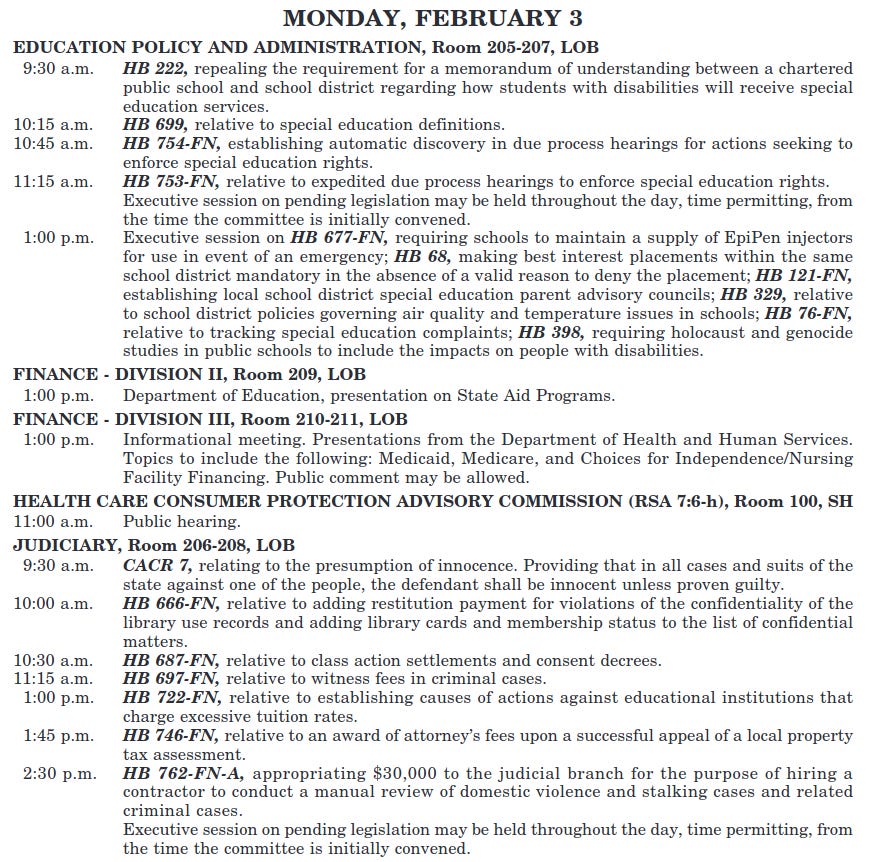
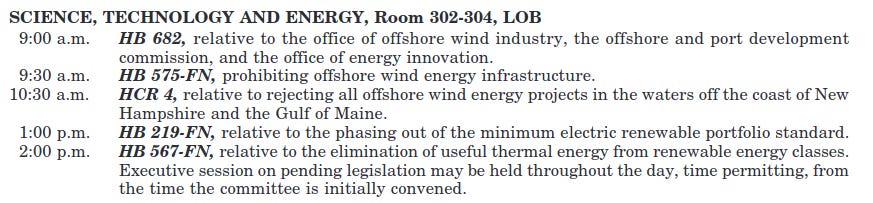
Screenshots from House Calendar
Screenshot from Senate Calendar
In-Depth Analyses — All Bills
Quick Summaries — All Bills
House Education Policy And Administration
HB 222
Sponsors: 3, Bipartisan
Summary: Repeals the requirement for a memorandum of understanding (MOU) between chartered public schools and school districts regarding special education services.
Online Testimony: 15 support, 6 opposeHB 699
Sponsors: 3, Republican
Summary: Updates special education definitions, adding certain terms and revising or removing provisions related to disability supports.
Online Testimony: 4 support, 687 opposeHB 754-FN
Sponsors: 6, Bipartisan
Summary: Establishes automatic discovery in special education due process hearings, requiring schools to disclose specific documents at least five business days before a prehearing conference.
Online Testimony: 5 support, 2 opposeHB 753-FN
Sponsors: 10, Bipartisan
Summary: Requires that expedited special education due process hearings not exceed the timelines for regular due process hearings.
Online Testimony: 7 support, 0 oppose
House Judiciary
CACR 7
Sponsors: 7, Republican
Summary: Proposes a constitutional amendment requiring that individuals charged by the state in civil or criminal matters be presumed innocent until proven guilty.
Online Testimony: 10 support, 1 opposeHB 666-FN
Sponsors: 7, Republican
Summary: Expands confidentiality of library user records to include membership status and imposes a $500 restitution penalty plus a notarized public apology for unauthorized disclosure.
Online Testimony: 3 support, 5 opposeHB 687-FN
Sponsors: 4, Republican
Summary: Requires that unclaimed class action settlement funds go to the state’s general fund, prohibits courts from redirecting those funds to charities or other organizations, and caps attorneys’ fees using the Laffey Matrix unless otherwise determined by the court.
Online Testimony: 2 support, 3 opposeHB 697-FN
Sponsors: 7, Lean Republican/Bipartisan
Summary: Allows civilian witnesses in criminal cases to collect fees and mileage if they must return to court through no fault of their own.
Online Testimony: 3 support, 0 opposeHB 722-FN
Sponsors: 1, Republican
Summary: Establishes legal recourse against educational institutions if their tuition rates exceed certain thresholds tied to graduates’ salary levels.
Online Testimony: 0 support, 4 opposeHB 746-FN
Sponsors: 5, Republican
Summary: Permits courts to award reasonable attorneys’ fees to taxpayers who prevail in a property tax abatement appeal.
Online Testimony: 5 support, 2 opposeHB 762-FN
Sponsors: 9, Democratic
Summary: Appropriates $30,000 for a judicial branch contractor to review domestic violence and stalking cases for data collection and analysis.
Online Testimony: 4 support, 2 oppose
House Science, Technology And Energy
HB 682
Sponsors: 8, Republican
Summary: Eliminates the office of offshore wind industry development and related committees, transferring certain functions to the office of energy innovation.
Online Testimony: 22 support, 126 opposeHB 575-FN
Sponsors: 9, Republican
Summary: Prohibits offshore wind energy infrastructure in New Hampshire waters and revokes any already-approved projects.
Online Testimony: 25 support, 129 opposeHCR 4
Sponsors: 10, Republican
Summary: Resolution encouraging the rejection of offshore wind energy projects in the Gulf of Maine until additional assessments are completed.
Online Testimony: 22 support, 123 opposeHB 219-FN
Sponsors: 5, Republican
Summary: Phases out the state’s Renewable Portfolio Standard by 2030, reducing the renewable energy percentage requirements annually.
Online Testimony: 4 support, 149 opposeHB 567-FN
Sponsors: 4, Republican
Summary: Removes “useful thermal energy” from the definition of renewable energy classes under the RPS.
Online Testimony: 4 support, 116 oppose
Senate Children And Family Law
SB 72-FN
Sponsors: 18, Republican
Summary: Establishes a Parents’ Bill of Rights in Education, enumerating parental oversight and school disclosure requirements.
Screenshots from House Calendar
 |
 |
Screenshot from Senate Calendar
 |
In-Depth Analyses - All Bills
House Education Policy And Administration
HB 222
AN ACT repealing the requirement for a memorandum of understanding between a chartered public school and school district regarding how students with disabilities will receive special education services.
3 sponsors, Bipartisan
Sponsor(s): (Prime) Rep. Peggy Balboni (D), Rep. David Luneau (D), Rep. Maureen Mooney (R)
Selected quote(s) from the bill:
1 Repeal. RSA 194-B:5, VIII, relative to memorandums of understanding between chartered public schools and resident districts of students with disabilities, is repealed.
Summary:
This bill repeals the requirement for a memorandum of understanding (MOU) between chartered public schools and school districts regarding how students with disabilities receive special education services.
Argument For:
This bill removes an unnecessary administrative burden that has created inefficiencies, legal costs, and delays in delivering special education services to students with disabilities. Prior to the MOU requirement, charter schools and districts successfully collaborated on a case-by-case basis, relying on Individualized Education Programs (IEPs) as the binding document governing special education services. Eliminating the MOU mandate will restore flexibility, reduce costs, and allow charter schools and districts to focus on directly supporting students rather than navigating bureaucratic obstacles.
Argument Against:
This bill removes a critical mechanism for clarifying responsibilities between charter schools and school districts, potentially leading to disputes over funding and service provision for students with disabilities. Without MOUs, there is a risk of delays in services, financial inefficiencies, and additional burdens on public school districts, which could face unexpected costs and double billing. Rather than eliminating these agreements, efforts should be focused on strengthening collaboration and accountability between charter and traditional public schools to better serve all students.
Online Testimony
Currently, 15 people support and 6 people oppose the bill. 71% support of 21 people
Support
While intended to improve collaboration, these agreements have instead created unnecessary administrative burdens without adding value to the delivery of special education services. ... Instead of fostering cooperation, the MOU mandate has resulted in delays and inefficiencies that hinder schools’ ability to meet the needs of students with disabilities.
The need to navigate a separate MOU process for each district-charter partnership has become an obstacle to efficient operation, at times creating friction where partnership in serving our shared students is most required. ... By removing the MOU requirement, charter schools and districts can return to a more streamlined and flexible manner to determine their working agreements, reducing any unintended delays and additional costs, refocusing the team on enhancing responsiveness to the needs of students.
The IEP is the binding document that mandates services to be provided to students with IEP’s, not an MOU. ... Please repeal this requirement, as it has not benefitted working relationships or processes to support IEP students.
The idea of an MOU dictating how services are delivered defies the very intention of IDEA, team decision-making, and the IEP, which is the only document that should determine what services a student needs. ... It simply puts everyone in a bad position unnecessarily and diverts attention and resources away from what really matters, which is ensuring those students who attend charter schools are given the services they need and deserve in the way that their teams have determined is most appropriate.
This unfunded demand has created increased costs for both public and charter schools; for instance, legal expenses. ... The education plan is the legally binding document that drives the services, supports, and additional things such as accommodations and modifications, to meet the needs of the child, not an MOU.
This law has created excess work which has been costly and at times we have incurred legal fees in order to accomplish having an MOU signed. ... An MOU is NOT a legally binding document, that is the IEP.
In my experience, the IEP is the binding document that mandates services to be provided to students with IEP’s, not an MOU. ... Therefore, I support this bill.
Opposition
MOUs exist to clarify responsibilities, ensuring that students with disabilities receive the services they are entitled to under federal and state law. ... This lack of clarity does not eliminate bureaucracy—it increases it, leading to disputes, delays, and potential lapses in services for students who need them most.
Hearing: Monday, Feb 03 at 9:30 a.m. in Room 205-207 in the Legislative Office Building and streaming on YouTube.
HB 699
AN ACT relative to special education definitions.
3 sponsors, Republican
Sponsor(s): (Prime) Rep. Katelyn Kuttab (R), Rep. Glenn Cordelli (R), Rep. Margaret Drye (R)
Selected quote(s) from the bill:
1 Special Education; Definitions. Amend RSA 186-C:2 to read as follows:
186-C:2 Definitions.
In this chapter:
…
I-c. “Bureau” means the bureau of special education support within the division of learner support in the department of education.
I-d. “Acquired brain injury” means a brain injury that occurs after birth, including injury sustained by infection, disease, or lack of oxygen resulting in total or partial functional disability, or psychosocial impairment, or both, that adversely affects a child’s educational performance and requires special education and or related services.
II. "Approved program" means a program of special education [that has been approved by the state board of education and that is maintained by a school district, regional special education center, private organization, or state facility for the benefit of children with disabilities, and may include home instruction provided by the school district] within the school district that is responsible for all aspects of the provision of special education services and related supports, including special education staff or district personnel who are assigned roles for the provision of special education services and related supports. This includes specialized educational environments, and the accommodations, modifications, and services delivered within the general education setting to support children with disabilities and has been approved by the bureau.
II-a. “Educational environment” means a special education setting that has received approval from the bureau, this environment is managed by the school district and serves children with disabilities, as specified in their individual education program, when they are removed from their general education setting. Educational environments are resource rooms, self-contained classrooms, and early childhood special education programs.
…
[V.(a) "Related services" means:
(1) Suitable transportation to all children with disabilities whose individualized education program requires such transportation. The school district may board a child as close to the place where instruction is to be furnished as possible, and shall provide transportation, if required by the child's individualized education program, from the place where the child is boarded to the place of instruction; and
(2) Such developmental, corrective, and other supportive services as are specifically required by an individualized education program to assist a child with a disability to benefit from special education; and
(3) Services necessary for a child with a disability to benefit from special education and when placement in a residential facility has been made by the legally responsible school district in order to comply with RSA 186-C:9, or when placement has been ordered by a hearings officer or by a court of competent jurisdiction on appeal, pursuant to rules adopted by the state board of education under RSA 186-C:16, IV.
(b) "Related services" shall not include medical services unless such services are necessary for purposes of diagnosis and evaluation.
VI. "Functionally blind" means a pupil who has:
(a) Visual acuity of 20/200 or less in the better eye with the use of the best correction for any refractive error, or a limited field of vision in which the widest diameter of the visual field subtends an angle no greater than 20 degrees.
(b) A medically indicated expectation of visual deterioration.
(c) A functional limitation resulting from a medically diagnosed visual impairment which restricts the child's ability to read and write standard print at levels expected of other children of comparable ability and grade level. ]
V. “Specially designed instruction” is defined in the Individuals with Disabilities Act 34 C.F.R. section 300.39(b)(3) and means instruction which is:
(a) Provided by special education teachers or related services providers;
(b) Delivered in an explicit, systemic manner;
(c) Can be provided in any educational environment in accordance with the child’s IEP and least restrictive environment;
(d) Directly addresses goals in the child’s IEP;
(e) Is closely monitored to make sure that the student is making progress and mastering their goals; and
(f) Does not involve lowering standards or expectation for the student and provides ambitious goals.
VI. “Special education information system” is the electronic information system used by all districts to report their special education data and student information for federal and state requirements.
Summary:
This bill updates and clarifies special education definitions by adding new terms (such as “Bureau” and “Acquired brain injury”) and revising existing language for approved programs, educational environments, and specially designed instruction to better align with federal standards.
Argument For:
This bill enhances clarity and consistency in special education by aligning state definitions with federal standards, which will reduce bureaucratic confusion and ensure that all stakeholders—parents, educators, and administrators—operate from a common framework to support students with disabilities.
Argument Against:
This bill narrows critical definitions and removes key supports—such as related services and protections for functionally blind students—thereby restricting the flexibility of IEP teams to meet individual student needs and risking segregation from general education environments.
Online Testimony
Currently, 4 people support and 687 people oppose the bill. 99% oppose of 691 people
Support
HB 699 helps ensure that all stakeholders—parents, educators, administrators, and service providers—are working from the same framework when identifying and supporting students with disabilities. Aligning state terminology with federal standards, such as those outlined in the Individuals with Disabilities Education Act (IDEA), will reduce confusion, streamline processes, and promote equitable access to resources across school districts.
Opposition
To remove general education as a possible environment for our students' services is a severe disservice. The elimination of the functionally blind identification is reprehensible and will eliminate key supports for visually impaired students.
Removing services and inclusive school environments would deny children and young adults opportunities that every human deserves—an education, natural friendships, and participation in sports and hobbies. Inclusivity teaches all students the skills to be kind, helpful members of society—something we are often missing nowadays.
I don’t see the benefit of excluding children with disabilities in classroom discussions.
This is wrong on so many levels. Shame on you for trying to sneak this through.
Stop decimating public education.
I oppose this bill.
Research has proven that students with disabilities educated in the general education setting have better academic and social outcomes, as do their non-disabled peers. By being included, my daughter has developed stronger communication skills, learned from peer role models, and improved her academic outcomes.
Educational research shows that students with disabilities in inclusive classrooms, with the right support, thrive academically and socially. This bill seeks to roll back measures that have protected students for over 50 years.
This will disrupt services for my son, and thousands of kids that need speech and other services. This is cruel, and I will campaign actively against anyone who votes for it.
To eliminate related services is to deny students with disabilities their right to access Free and Appropriate Public Education as required by IDEA. It seems illegal to deny students the documented services that assist them in accessing their education.
Hearing: Monday, Feb 03 at 10:15 a.m. in Room 205-207 in the Legislative Office Building and streaming on YouTube.
HB 754-FN
AN ACT establishing automatic discovery in due process hearings for actions seeking to enforce special education rights.
6 sponsors, Bipartisan
Sponsor(s): (Prime) Rep. Nancy Murphy (D), Rep. Marjorie Smith (D), Rep. Gaby Grossman (D), Rep. Bill Boyd (R), Rep. Katelyn Kuttab (R), Rep. Lorie Ball (R)
Selected quote(s) from the bill:
1 New Paragraph; Special Education; Due Process Hearing; Automatic Discovery. Amend RSA 186-C:16-b by inserting after paragraph III-a the following new paragraph:
III-b.(a) In any action against a local school district seeking to enforce special education rights under state or federal law, and the complaint has not been resolved during the 30-day resolution period provided in 34 C.F.R. section 300.510, the local school district shall disclose to the parent, legal guardian or surrogate parent, and permit to discover, inspect, and copy, all items and information that relate to the appropriateness of the child's program or placement, or of the program or placement proposed by the local school district, and are in the possession, custody, or control of the local school district, at least 5 business days before any prehearing conference described in RSA 541-A:31, V(c).
(b) Such discoverable items and information shall include, but not be limited to:
(1) Specific documentation for the federal eligibility determination.
(2) Current and/or partial IEPs in place within the last 3 years.
(3) Complete and/or partial IEPs being proposed.
(4) Copies of written prior notices within the last 3 years.
(5) Any reports or testing supporting the current and/or partial IEPs in place.
(6) Any reports or testing supporting the complete and/or partial IEPs being proposed.
(7) Any progress reports related to IEP goals, benchmarks, short-term objectives, or progress toward meeting the annual IEP goals.
Summary:
This bill establishes automatic discovery in due process hearings for actions seeking to enforce special education rights, ensuring parents and guardians receive key documents at least five business days before a pre-hearing conference.
Argument For:
This bill promotes fairness and transparency in the special education due process system by ensuring that families have timely access to essential documents such as Individualized Education Programs (IEPs), evaluations, and progress reports. By requiring schools to disclose these materials before pre-hearing conferences, the bill levels the playing field between families and school districts, fostering more informed discussions and equitable agreements. Ensuring access to this information upholds the rights of students with disabilities and improves the likelihood of appropriate educational placements.
Potential Argument Against:
This bill may create additional administrative burdens for school districts, as the cost and effort required to comply with mandatory discovery are indeterminable and could strain resources, particularly for districts handling multiple special education disputes.
Online Testimony
Currently, 5 people support and 2 people oppose the bill. 71% support of 7 people
Support
Having gone through the due process system myself, I can attest to the importance of having access to core documents—such as the Individualized Education Program (IEP), Written Prior Notice (WPN), evaluations, and progress reports—prior to a pre-hearing conference. ... This is not just a matter of fairness; it is a matter of ensuring that the rights of students with disabilities are fully protected and that their educational needs are met.
Hearing: Monday, Feb 03 at 10:45 a.m. in Room 205-207 in the Legislative Office Building and streaming on YouTube.
HB 753-FN
AN ACT relative to expedited due process hearings to enforce special education rights.
10 sponsors, Bipartisan
Sponsor(s): (Prime) Rep. Nancy Murphy (D), Rep. Marjorie Smith (D), Rep. Charles McMahon (R), Rep. Glenn Cordelli (R), Rep. Gaby Grossman (D), Rep. Heath Howard (D), Rep. Lorie Ball (R), Sen. Sharon Carson (R), Sen. David Watters (D), Sen. Suzanne Prentiss (D)
Selected quote(s) from the bill:
1 New Paragraph; Special Education; Due Process Hearing. Amend RSA 186-C:16-b by inserting after paragraph I the following new paragraph:
I-a. In no case may an expedited due process hearing pursuant to 34 C.F.R. section 300.532(c)(2) exceed the timeline for conducting a regular due process hearing pursuant to 34 C.F.R. section 300.515(a).
Summary:
This bill requires that expedited due process hearings must not exceed the timelines applicable to regular due process hearings in actions to enforce special education rights.
Potential Argument For:
This bill ensures consistency in due process hearings for special education disputes, preventing unnecessary delays in expedited cases.
Potential Argument Against:
This bill may unintentionally lengthen expedited due process hearings, undermining their purpose of providing swift resolution in urgent special education matters.
Online Testimony
Currently, 7 people support and 0 people oppose the bill. 100% support of 7 people
Hearing: Monday, Feb 03 at 11:15 a.m. in Room 205-207 in the Legislative Office Building and streaming on YouTube.
House Judiciary
CACR 7
CONCURRENT RESOLUTION PROPOSING CONSTITUTIONAL AMENDMENT
7 sponsors, Republican
Sponsor(s): (Prime) Rep. Kelley Potenza (R), Rep. Andrew Prout (R), Rep. Paul Terry (R), Rep. JD Bernardy (R), Rep. Kristin Noble (R), Rep. Claudine Burnham (R), Sen. Keith Murphy (R)
Selected quote(s) from the bill:
I. That the first part of the constitution be amended by inserting after article 15 the following new article:
[Art.] 15-a [Presumption of Innocence.] In all cases and suits of the state against one of the people, whether criminal or civil, and whether in equity or law, and in any court or tribunal whatsoever, the accused shall be innocent unless proven guilty.
Summary:
This bill proposes a constitutional amendment to explicitly require that in all cases and suits brought by the state against an individual, whether criminal or civil, the accused shall be presumed innocent unless proven guilty.
Argument For:
This bill strengthens due process by enshrining the presumption of innocence within the New Hampshire Constitution, ensuring that all individuals accused by the state, whether in criminal or civil cases, are afforded the fundamental right to be considered innocent until proven guilty. By making this principle explicit, the bill provides an additional safeguard against potential government overreach and reinforces the fairness of the legal system.
Argument Against:
This bill could make it harder for victims, particularly in civil cases, to seek justice by raising the burden of proof against those accused of wrongdoing. Critics argue that this change may disproportionately benefit individuals engaged in fraud, abuse, or other harmful actions, making it more difficult for victims to prove their claims and obtain relief in court.
Online Testimony
Currently, 10 people support and 1 people oppose the bill. 91% support of 11 people
Support
I am in full support of this bill.
—Susan DeRoy, An Elected Official
Opposition
This is to make it harder for women to get divorced when they come for divorce next. Only criminals and scammers and people who victimize others need it to be harder for victims to prove they’ve been victimized.
Hearing: Monday, Feb 03 at 9:30 a.m. in Room 206-208 in the Legislative Office Building and streaming on YouTube.
HB 666-FN
AN ACT relative to adding restitution payment for violations of the confidentiality of the library use records and adding library cards and membership status to the list of confidential matters.
7 sponsors, Republican
Sponsor(s): (Prime) Rep. Lisa Mazur (R), Rep. Joe Alexander (R), Rep. Ross Berry (R), Rep. Sheila Seidel (R), Rep. Henry Giasson (R), Rep. Sherri Reinfurt (R), Sen. Keith Murphy (R)
Selected quote(s) from the bill:
1 Statewide Library Development System; Library User Records; Confidentiality. Amend RSA 201-D:11, I and II to read as follows:
I. …Such records include, but are not limited to, library, library cards, library membership status, information system, and archival records related to the circulation and use of library materials or services, including records of materials that have been viewed or stored in electronic form.
II. Records described in paragraph I may be disclosed to the extent necessary for the proper operation of such libraries and shall be disclosed upon request by, or consent of, the user or pursuant to subpoena[,] or court order[, or where otherwise required by statute].
2 New Paragraph; Library User Records; Confidentiality. Amend RSA 201-D:11 by inserting after paragraph III the following new paragraph:
IV. Any library, library staff member, or member of the general public who discloses an individual’s library card or membership status without a court order or explicit consent of the individual in question, shall be in violation of this section and subject to a restitution payment of $500, made payable from the violator to the aggrieved individual whose information was released without their consent or a court order. Furthermore, the violator shall issue a public apology to the aggrieved individual. The apology shall be notarized and sent via certified mail to the aggrieved individual.
Summary:
This bill adds penalties, including a $500 restitution payment and a public apology, for violating the confidentiality of library user records, including library cards and membership status.
Potential Argument For:
This bill strengthens privacy protections for library users by ensuring that their library card and membership status remain confidential, deterring unauthorized disclosures and reinforcing trust in library institutions.
Argument Against:
This bill imposes excessive penalties for minor infractions, potentially criminalizing routine interactions in libraries, creating an unnecessary burden on library staff, and forcing taxpayers to fund compliance measures that do not serve a significant public interest.
Online Testimony
Currently, 3 people support and 5 people oppose the bill. 62% oppose of 8 people
Opposition
This is a waste of time. No. Please find something else to work on. Never in the history of librarians have they been interested enough to leak who's checking out books. It's a library.
Someone pointing out that a library card is nonexistent, or invalid, and then being punished to pay $500 restitution, along with a notarized letter of apology does not seem like a fair restitution. ... This bill and the penalty required of it serves no purpose to the public.
I oppose this Bill
Hearing: Monday, Feb 03 at 10:00 a.m. in Room 206-208 in the Legislative Office Building and streaming on YouTube.
HB 687-FN
AN ACT relative to class action settlements and consent decrees.
4 sponsors, Republican
Sponsor(s): (Prime) Rep. Travis Corcoran (R), Rep. Ross Berry (R), Rep. Mike Belcher (R), Rep. Michael Granger (R)
Selected quote(s) from the bill:
1 Short Title. This bill may be known as and cited to as "The Class Action Settlement and Consent Decree Reform Act."
2 New Section; Judgments; Class Action Judgments. Amend RSA 524 by inserting after section 13 the following new section:
524:14 Class Action Judgments.
I. All money in a class action judgment which has not been distributed to members of the class, or where it has become impossible to distribute such funds under the judgment, shall be escheated to the state general fund. It is hereby prohibited to apply the doctrine of cy pres or to otherwise alter the judgment to prevent this escheat.
II. No portion of a class action settlement or judgment shall include payment to entities other than class members or to pay attorneys' fees.
3 New Paragraph; Attorneys' Fees for Services. Amend RSA 508:4-e by inserting after paragraph III the following new paragraph:
IV. Attorneys' fee awards in class action lawsuits and lawsuits to obtain consent decrees are limited to that as provided in the Laffey Matrix, unless the court determines otherwise.
Summary:
This bill mandates that any unclaimed or undistributable funds from a class action judgment must be transferred to the state general fund, prohibits the application of the cy pres doctrine to redirect such funds, and limits attorneys' fee awards in class action lawsuits to the Laffey Matrix unless the court determines otherwise.
Potential Argument For:
This bill ensures that unclaimed class action settlement funds benefit the state rather than being redirected to third parties, while also promoting fairness in attorney compensation by tying fees to standardized rates.
Argument Against:
This bill's limitation on attorneys' fees may discourage class action lawsuits by making them financially unviable for many firms, reducing access to legal recourse for consumers and smaller plaintiffs.
Online Testimony
Currently, 2 people support and 3 people oppose the bill. 60% oppose of 5 people
Opposition
This limits Attorneys' fee awards in class action lawsuits to that as provided in the Laffey Matrix (local fee averaging). This encourages proliferation of smaller-firm lawyers chasing class action lawsuits for the boosted fee. Many suits would otherwise not been viable or economic. The other portion of this bill is fine (to escheat to the state general fund those undistributable proceeds of a class action suit).
Hearing: Monday, Feb 03 at 10:30 a.m. in Room 206-208 in the Legislative Office Building and streaming on YouTube.
HB 697-FN
AN ACT relative to witness fees in criminal cases.
7 sponsors, Lean Republican
Sponsor(s): (Prime) Rep. Kelley Potenza (R), Rep. Paul Terry (R), Rep. Melissa Litchfield (R), Rep. Mike Drago (R), Rep. Katelyn Kuttab (R), Rep. Jodi Newell (D), Rep. Jonah Wheeler (D)
Selected quote(s) from the bill:
1 Witnesses; Fees. RSA 516:16 is repealed and reenacted to read as follows:
516:16 Witness Fees for Returning to Court. In any criminal proceeding, no witness shall be eligible to receive a fee for appearing in court pursuant to a summons to appear except if a civilian witness appears in court at the time and place designated but is required, through no fault of the witness, to return to court to testify in the same proceeding for a second or subsequent day. For each subsequent day, the civilian witness shall be entitled to a payment for each day of attendance and mileage for each mile's travel to and from the place of testifying; mileage to be allowed for each day's attendance where the witness is required to leave the town or city in which he or she resides to testify. The rate of the fees shall be the same as those authorized in 28 U.S.C. section 1821.
Summary:
This bill allows civilian witnesses in criminal proceedings to receive fees and mileage reimbursement if they are required to return to court on a subsequent day through no fault of their own.
Potential Argument For:
This bill ensures that civilian witnesses who are required to return to court multiple times are fairly compensated for their time and travel, reducing the financial burden on individuals participating in the justice system.
Potential Argument Against:
This bill could lead to indeterminate increases in state expenditures, as it is unclear how frequently civilian witnesses will need to return, and it does not specify whether the Judicial Branch or the Department of Justice will cover these costs.
Online Testimony
Currently, 3 people support and 0 people oppose the bill. 100% support of 3 people
Hearing: Monday, Feb 03 at 11:15 a.m. in Room 206-208 in the Legislative Office Building and streaming on YouTube.
HB 722-FN
AN ACT relative to establishing causes of actions against educational institutions that charge excessive tuition rates.
1 sponsor, Republican
Sponsor(s): (Prime) Rep. Travis Corcoran (R)
Selected quote(s) from the bill:
1 Short Title. This act shall be known as the New Hampshire Predatory College Degree Consumer Protection Act.
2 New Paragraph; Trade and Commerce; Regulation of Business Practices for Consumer Protection; Acts Unlawful. Amend RSA 358-A:2 by inserting after paragraph XVIII the following new paragraph:
XIX. Charging or receiving, or soliciting to charge or receive, an unreasonable rate of tuition for degree programs that exceed the statutory threshold set by RSA 358-A:10-b. For the purpose of this paragraph, an "unreasonable rate" means a rate that is exorbitant and disproportionate to the services performed.
3 New Section; Actions Against Unreasonable Rates of Tuition. Amend RSA 358-A by inserting after section 10-a the following new section:
358-A:10-b Actions Against Unreasonable Rates of Tuition.
…
II. Any educational institution that charges a tuition rate for a degree that has a total cost (including tuition and fees, but excluding room, board, and transportation) calculated over the average number of semesters required to attain the degree that exceeds the threshold set in paragraph III shall be in violation of RSA 358-A:2.
III. If 30 percent of the average, annualized, 4-year, pre-tax, inflation adjusted salary of graduates of the degree program, whether working in the field that the degree program specializes in or not, is insufficient to cover the annual payment on a 10 year payoff schedule for the total cost of the program at an annual percentage rate equal to that charged on January 1 of the year the degree is completed by the Federal Family Education Loan (FFEL) program, or similar or successor program if FFEL is discontinued, then the educational institution charging such rate shall have exceeded the permissible threshold permitted under this paragraph.
IV. Educational institutions shall be immune from criminal or civil actions under this section if the person or persons involved in the purported transaction with the educational institution:
(a) Is not a United States citizen at the time of matriculation;
(b) Signs, witnesses, and notarizes a form stating, in red ink and in minimum 50 point font:
"I understand that this degree program is abusive under the definition in the New Hampshire Predatory College Degree Consumer Protection Act, and I waive my right to sue for unfair trade practices."
V. Educational institutions that charge tuition rates that exceed the permissable statutory threshold under paragraph III shall, in addition to all other fines, penalties, and remedies provided for in this chapter, be liable to any person for the total cost of tuition and fees paid, plus interest, for the degree program or programs in which the person was enrolled.
VI. The statute of limitations for civil actions under this section shall be 10 years from the date from which a final tuition or fee payment was credited to a person's educational institution account.
VII. Under this section, attorneys fees for class action lawsuits:
(a) Shall be capped at 10 percent of the total amount awarded; and
(b) Shall only be awarded to persons, as defined in this section, and their successors and assigns.
Summary:
This bill establishes criminal penalties and civil causes of action against educational institutions that charge tuition rates deemed excessive based on graduates' average earnings and ability to repay student loans.
Argument For:
This bill protects students from predatory tuition rates that leave them with insurmountable debt while educational institutions continue to profit. By setting a clear legal standard for what constitutes an excessive tuition rate, it ensures accountability for institutions that charge disproportionate fees relative to the financial outcomes of their graduates.
Argument Against:
This bill places an undue burden on students to assess whether their degree program meets the statutory threshold while also allowing institutions to exempt themselves from liability through a waiver form. Additionally, it may be difficult to enforce due to challenges in obtaining graduate salary data and reliance on federal agencies to provide key financial metrics.
Online Testimony
Currently, 0 people support and 4 people oppose the bill. 100% oppose of 4 people
Opposition
The schools that intentionally defraud, especially those that force the federal government to forgive student loans, they should be criminally charged with fraud. Why do we need a new law placing even more responsibility on the student to vet these businesses that accept federal funds? Why would the student being scammed into signing a form exempt the scammer from a fraud charge?
Hearing: Monday, Feb 03 at 1:00 p.m. in Room 206-208 in the Legislative Office Building and streaming on YouTube.
HB 746-FN
AN ACT relative to an award of attorney's fees upon a successful appeal of a local property tax assessment.
5 sponsors, Republican
Sponsor(s): (Prime) Rep. David Love (R), Rep. Dan McGuire (R), Rep. Kristin Noble (R), Rep. Ricky Devoid (R), Rep. Brian Nadeau (R)
Selected quote(s) from the bill:
1 Taxation; Board of Tax and Land Appeals; Legal Counsel. Amend RSA 71-B:20 to read as follows:
71-B:20 Legal Counsel.
I. … All costs and expenses of said proceeding, for which the town or city would otherwise be liable, excepting the salaries of the attorney general or [his] the attorney general's staff member engaged therein, shall be a proper charge against the appropriation for the department of revenue administration. …
II. Whenever a petition being brought in the superior court or before the board by a taxpayer against a city or town results in an assessment or reassessment for an abatement of the tax so assessed, upon the taxpayer's request, the taxpayer shall be entitled to reasonable attorney's fees and the costs of investigation and litigation.
Summary:
This bill awards a taxpayer reasonable attorney's fees for a successful appeal of a property assessment.
Potential Argument For:
This bill ensures that taxpayers who successfully challenge incorrect property assessments are not financially burdened by legal costs, promoting fairness in the tax appeal process.
Potential Argument Against:
This bill could increase legal costs for municipalities and counties, potentially leading to higher local tax rates to cover the additional expenditures.
Online Testimony
Currently, 5 people support and 2 people oppose the bill. 71% support of 7 people
Hearing: Monday, Feb 03 at 1:45 p.m. in Room 206-208 in the Legislative Office Building and streaming on YouTube.
HB 762-FN-A
AN ACT appropriating $30,000 to the judicial branch for the purpose of hiring a contractor to
9 sponsors, Democratic
Sponsor(s): (Prime) Rep. Zoe Manos (D), Rep. Alexis Simpson (D), Rep. Ellen Read (D), Rep. Alicia Gregg (D), Rep. Linda Haskins (D), Rep. Allison Knab (D), Rep. Toni Weinstein (D), Sen. Debra Altschiller (D), Sen. Pat Long (D)
Selected quote(s) from the bill:
1 Judicial Branch; New Independent Contractor Position; Appropriation.
I. One independent contractor position is created in the judicial branch. The independent contractor shall conduct a manual review of domestic violence and stalking cases and related criminal cases in order to compile and collate data for statistical analysis for the judicial branch, the governor’s commission on domestic violence, sexual assault and stalking, and other interested persons or organizations. The independent contractor shall not gather, record, or compile any personal information that identifies any party.
II. The amount of $30,000 for the position established in paragraph I is hereby appropriated to the judicial branch from state general funds for the biennium ending June 30, 2027. If funds from other sources, including but not limited to federal or state matching funds or grants become available, the judicial branch shall expend those funds prior to appropriated funds. The governor is authorized to draw a warrant for said sum out of any money in the treasury not otherwise appropriated.
Summary:
This bill appropriates $30,000 to the judicial branch to hire an independent contractor to manually review domestic violence, stalking, and related criminal cases, compiling data for statistical analysis by the judicial branch, the governor’s commission on domestic violence, sexual assault, and stalking, and other interested organizations.
Argument For:
This bill provides a necessary resource to ensure domestic violence and stalking cases are properly reviewed and that systemic failures in case handling are identified and addressed. Testimony highlights cases where abusers evade justice for years due to procedural gaps, leaving victims vulnerable and without protection. By compiling and organizing case data, this bill helps improve accountability and ensures better outcomes for victims of domestic violence and stalking.
Argument Against:
This bill lacks clear guidelines on the scope, methodology, and expected outcomes of the data review, making it an inefficient use of funds. Without defined parameters, such as the specific data points to be collected, how cases will be selected, or how findings will be applied, the expenditure risks producing an inconclusive or unusable report.
Online Testimony
Currently, 4 people support and 2 people oppose the bill. 67% support of 6 people
Support
This is a much needed resource for the residents of NH. Too many cases go unsolved, or unchecked and it puts your constituents in danger.
He then just refused to go to court for six years, he would be given PR bail that he would violate, he would get bail jumping charges that he wouldn’t go to court for, he was arrested for felon in possession of a weapon, he was arrested for possession of drugs, then he would get PR bail and new bail jumping charges for those too. … If my case was mishandled I can only imagine many others were.
Opposition
This bill fails to require any useful product of the expenditure. Missing are detailed description of the review's scope of review, methods of analysis, input parameters, cross-correlations, output report features, attestable recommendations. how results might be used ....
Hearing: Monday, Feb 03 at 2:30 p.m. in Room 206-208 in the Legislative Office Building and streaming on YouTube.
House Science, Technology And Energy
HB 682
AN ACT relative to the office of offshore wind industry, the offshore and port development commission, and the office of energy innovation.
8 sponsors, Republican
Sponsor(s): (Prime) Rep. Michael Harrington (R), Rep. Jeanine Notter (R), Rep. Aboul Khan (R), Rep. Douglas Thomas (R), Rep. JD Bernardy (R), Rep. Kelley Potenza (R), Rep. Matt Sabourin dit Choinière (R), Rep. Linda McGrath (R)
Selected quote(s) from the bill:
1 Office of Offshore Wind Industry Development and Energy Innovation. Amend the subdivision heading preceding RSA 12-O:51 to read as follows:
Office of [Offshore Wind Industry Development and] Energy Innovation
2 Office of Energy Innovation. Amend RSA 12-P:7-b to read as follows:
12-P:7-b Office of [Offshore Wind Industry Development and] Energy Innovation Established.
I. There is established in the department of energy the office of [offshore wind industry development and] energy innovation. The office shall be under the supervision of a classified director of the office of [offshore wind industry development and] energy innovation, who shall serve under the supervision of the commissioner. The director shall provide administrative oversight and ensure that the responsibilities of the office described in this section are fulfilled.
II. The office of [offshore wind industry development and] energy innovation shall:
(a) Support the work of the New Hampshire members of the Intergovernmental Renewable Energy Task Force administered by the federal Bureau of Ocean Energy Management (BOEM).
[(b) Support the work of the offshore wind commission established in RSA 374-F:10.
(c) Assist the offshore wind commission to develop and implement offshore wind development strategies including:
(1) Assessment of port facilities.
(2) Economic impact analyses.
(3) Supply chain analyses.
(4) Outcome and performance measurements.
(d) Collaborate with key state agencies and partners on offshore wind industry development initiatives.
(e) Coordinate offshore wind industry economic development policy, including:
(1) Development of workforce.
(2) Identification of and recruitment of offshore wind development employers.
(3) Identification and recruitment of offshore wind supply chain employers.
(4) Promotion of New Hampshire's benefits to the various components of the offshore wind industry.
(5) Provide updates and guidance to the general court with regard to policy and funding.]
…
6 Renewable Energy Fund. Amend RSA 362-F:10, I to read as follows:
I. There is hereby established a renewable energy fund. This nonlapsing special fund shall be continually appropriated to the department of energy to be expended in accordance with this section; provided that at the start of the period in which there is no adopted state operating budget, the department of energy shall in a timely manner seek the approval of the fiscal committee of the general court to continue using moneys from the renewable energy fund to support renewable energy rebate and grant programs in order to ensure there are no interruptions to the programs. The state treasurer shall invest the moneys deposited therein as provided by law. Income received on investments made by the state treasurer shall also be credited to the fund. All payments to be made under this section shall be deposited in the fund. Any remaining moneys paid into the fund under paragraph II of this section, excluding class II moneys, shall be used by the department of energy to support thermal and electrical renewable energy initiatives, [and offshore wind initiatives,] including the office of [offshore wind industry development and] energy innovation. Class II moneys shall primarily be used to support solar energy technologies in New Hampshire. All initiatives supported out of these funds shall be subject to audit by the department of energy as deemed necessary. All fund moneys including those from class II may be used to administer this chapter, but all new employee positions shall be approved by the fiscal committee of the general court. No new employees shall be hired by the department of energy due to the inclusion of useful thermal energy in class I production.
7 Purchased Power Agreement. Amend RSA 362-H:2, VI to read as follows:
VI. The public utilities commission shall ensure the provisions of RSA 485-I:5 and RSA 485-I:6, to the extent those provisions are completed[, prior to approving power purchase agreements for offshore wind energy resources from the Gulf of Maine]. The applicant shall fund the studies required in RSA 485-I:5 and RSA 485-I:6 and such expenses shall be a recoverable expense.
…
10 Repeal. The following are repealed:
I. RSA 12-O:51-a, relative to the offshore wind industry workforce training center committee.
II. RSA 374-F:10, relative to the offshore wind and port development commission.
III. RSA 485-I:6, II, relative to additional studies or mitigation related to offshore wind development in the Gulf of Maine.
Summary:
This bill eliminates the office of offshore wind industry development, repeals the offshore wind industry workforce training center committee and the offshore and port development commission, and transfers the grid modernization advisory council and hydrogen advisory council to the office of energy innovation.
Argument For:
This bill is a necessary housekeeping measure to align New Hampshire’s energy policies with HB 575 and HRC 4, streamlining government functions and ensuring consistency in the state’s approach to energy innovation and regulatory oversight. By removing outdated or redundant offices and consolidating responsibilities, the bill enhances administrative efficiency and focuses resources on broader clean energy initiatives.
Argument Against:
This bill weakens New Hampshire’s ability to develop offshore wind energy, which is a clean, reliable, and cost-effective power source that would reduce dependence on imported fossil fuels and create jobs. Eliminating the office of offshore wind industry development and related committees undermines efforts to position the state as a leader in renewable energy, restricts economic opportunities, and slows progress toward energy independence.
Online Testimony
Currently, 22 people support and 126 people oppose the bill. 85% oppose of 148 people
Support
This bill is primarily a housekeeping step in support of HB 575 and HRC 4. I support HB 682 since the language changes are consistent with HB 575 and HRC 4, which I fully support. I will be presenting my testimony on HB 575 and HRC 4 in person at the Feb 3rd public hearing.
Opposition
This bill would hurt the nascent offshore wind industry in NH at a time when we should be expanding our renewable energy sources in order to slow climate change. Offshore wind can and should be an important part of our renewable energy sources. Please vote no on this bill. Thank you for your consideration.
HB 682 is another shortsighted move by the legislature. NH needs to move forward with renewable energy, not backwards.
Wind power can play a fundamental role in our energy mix. We cannot eliminate this office; it is critical to our future resources of renewable, safe energy.
Offshore wind is a clean, reliable energy source that would reduce our reliance on fossil fuels and bring jobs to our state. The office of offshore wind, the office of energy innovation, and the committee on wind workforce training should remain in effect for the good of New Hampshire and the planet.
Investigating renewable energy generation is vitally important to the urgent need to reduce energy generation via fossil fuels and to switch to renewables. NH has already seen some of the dire consequences of climate change, from catastrophic flooding to unprecedented storms to warming winters. These changes threaten the economy, our beautiful natural environment, and Granite Staters' lives.
Any bill that opposes any kind of support for alternatives to carbon based fuels is dangerous for our seaside communities and the futures of all of our children. I urge you to paste the address below into your internet address line, read the report, and to please, vote this bill down.
The state of New Hampshire needs both additional supplies of electricity and the jobs associated them. This bill is simply not good governance and not in the interest of the citizens of the state.
Investigating offshore wind renewable energy generation is vitally important to the urgent need to reduce energy generation via fossil fuels and to switch to renewables. NH has already seen some of the dire consequences of climate change, from catastrophic flooding to unprecedented storms to warming winters.
This bill would hurt offshore wind in New Hampshire. Offshore wind is a vital part in working towards renewable energy and stopping the climate crisis. We cannot afford to miss this opportunity at clean energy. Thank you for your consideration.
We must transition to clean energy!!!
Hearing: Monday, Feb 03 at 9:00 a.m. in Room 302-304 in the Legislative Office Building and streaming on YouTube.
HB 575-FN
AN ACT prohibiting offshore wind energy infrastructure.
9 sponsors, Republican
Sponsor(s): (Prime) Rep. Kelley Potenza (R), Rep. Aboul Khan (R), Rep. Douglas Thomas (R), Rep. Michael Harrington (R), Rep. Judy Aron (R), Rep. Jose Cambrils (R), Rep. Matt Sabourin dit Choinière (R), Rep. Linda McGrath (R), Sen. Victoria Sullivan (R)
Selected quote(s) from the bill:
1 Statement of Purpose and Intent.
I. The general court intends to protect New Hampshire’s coastal environment, economy, and public health by preventing the development of offshore wind energy infrastructure in its territorial waters and ensuring that no other state may bring such infrastructure into New Hampshire, either via maritime or overland routes. This ban includes, but is not limited to, the transport, installation, and maintenance of offshore wind cables, turbines, or any equipment related to offshore wind energy development.
II. The purpose of the act is to safeguard New Hampshire’s natural resources, preserve the economic vitality of its coastal and maritime industries, and maintain control over the state’s infrastructure. The act reflects New Hampshire’s commitment to protecting its environmental and economic interests by preventing the importation and development of offshore wind energy projects within its borders.
2 New Section; Coastal Program; Prohibition on Offshore Wind Energy Infrastructure. Amend RSA 485-I by inserting after section 6 the following new section:
485-I:7 Prohibition on Offshore Wind Energy Infrastructure.
I. No person shall engage in the landing, transmission, or installation of offshore wind energy cables, equipment, or related infrastructure at any port or facility within the state of New Hampshire, whether by sea or by land. The prohibition includes, but is not limited to, the transport, installation, and maintenance of offshore wind cables, turbines, or any associated equipment.
II. No state agency, port authority, or private entity in New Hampshire may authorize or permit the use of any state-owned or state-regulated infrastructure for the landing, transport, or operation of offshore wind energy projects, regardless of their point of origin.
III. The following acts are prohibited:
(a) The landing of offshore wind cables or equipment in New Hampshire ports or on state land.
(b) The use of New Hampshire ports, facilities, or infrastructure for the transport, installation, or maintenance of offshore wind projects.
(c) The transport or delivery of offshore wind infrastructure to New Hampshire, either by sea or by land, by any other state or foreign entity.
IV. Any company or individual who attempts to develop offshore wind projects in violation of this section shall be subject to a civil forfeiture to the state of not more than $50,000 for each violation and each day of a continuing violation.
V. If a developer has already received state approval for a project, including permits for environmental review or construction, such permits shall be revoked or suspended, effectively halting the project.
VI. Any violation of this section, or any rule adopted or order issued under it, shall be subject to enforcement by injunction, including mandatory injunction, issued by the superior court upon application by the attorney general. The state or an interested party may seek an injunction through the courts to stop unlawful offshore wind development activities.
VII. Any person, private company, or corporation that violates any provisions of this section or any rule adopted or order issued under it shall be guilty of a misdemeanor for the first offense. Continued construction or operation resulting in a second offense will lead to felony charges.
VIII. If illegal offshore wind activities have caused environmental harm or disruption, the violator shall be held financially responsible and required to restore the affected area or take corrective action.
3 Peaceful Uses of Atomic Energy; Coordination of Studies and Development Activities; Reference Removed. Amend RSA 162-B:4, II to read as follows:
II. To assist the commissioner of the department of energy in his or her role as senior adviser to the governor with respect to the development and regulatory activities of the state government relating to the industrial and commercial uses of nuclear energy, the position of coordinator of nuclear development and regulatory activities is established in the department of energy[, office of offshore wind industry development and energy innovation].
4 Renewable Energy Fund; Reference Removed. Amend RSA 362-F:10, I to read as follows:
I. There is hereby established a renewable energy fund. This nonlapsing special fund shall be continually appropriated to the department of energy to be expended in accordance with this section; provided that at the start of the period in which there is no adopted state operating budget, the department of energy shall in a timely manner seek the approval of the fiscal committee of the general court to continue using moneys from the renewable energy fund to support renewable energy rebate and grant programs in order to ensure there are no interruptions to the programs. The state treasurer shall invest the moneys deposited therein as provided by law. Income received on investments made by the state treasurer shall also be credited to the fund. All payments to be made under this section shall be deposited in the fund. Any remaining moneys paid into the fund under paragraph II of this section, excluding class II moneys, shall be used by the department of energy to support thermal and electrical renewable energy initiatives [and offshore wind initiatives, including the office of offshore wind industry development and energy innovation]. Class II moneys shall primarily be used to support solar energy technologies in New Hampshire. All initiatives supported out of these funds shall be subject to audit by the department of energy as deemed necessary. All fund moneys including those from class II may be used to administer this chapter, but all new employee positions shall be approved by the fiscal committee of the general court. No new employees shall be hired by the department of energy due to the inclusion of useful thermal energy in class I production.
5 Purchased Power Agreements; Reference Removed. Amend RSA 362-H:2, VI to read as follows:
VI. The public utilities commission shall ensure the provisions of [RSA 485-I:5 and] RSA 485-I:6, to the extent those provisions are completed[, prior to approving power purchase agreements for offshore wind energy resources from the Gulf of Maine]. The applicant shall fund the studies required in [RSA 485-I:5 and] RSA 485-I:6 and such expenses shall be a recoverable expense.
6 Repeal. The following are repealed:
I. RSA 12-P:7-b, relative to the office of offshore wind industry development and energy innovation.
II. RSA 12-O:51-a, relative to the offshore wind industry workforce training center committee.
III. RSA 188-E:30 and RSA 6:12, I(b)(394), relative to the workforce development and innovation fund.
IV. RSA 374-F:10, relative to the offshore wind and port development commission.
V. RSA 485-I:5, relative to the geographic location description within the coastal program.
VI. RSA 485-I:6, II, relative to additional studies or mitigation related to offshore wind development in the Gulf of Maine.
7 Effective Date. This act shall take effect upon its passage.
Summary:
This bill prohibits offshore wind energy infrastructure or development in New Hampshire, repeals various state offices and funds related to offshore wind, and bans the transport, installation, or maintenance of offshore wind projects within the state.
Argument For:
This bill protects New Hampshire’s coastal environment and economy by preventing the development of offshore wind projects that threaten marine ecosystems, harm the fishing industry, and increase electricity costs. Testimony highlights concerns over turbine construction disrupting habitats, increasing whale deaths, and generating environmental contamination, such as fiberglass debris washing ashore. Additionally, offshore wind projects rely on costly government subsidies while providing questionable energy returns, making them a financial burden for taxpayers and ratepayers.
Argument Against:
This bill eliminates a critical pathway for New Hampshire to develop clean, renewable energy, reducing energy independence and increasing reliance on imported fossil fuels. Testimony underscores that offshore wind is a cost-effective and sustainable energy source that can create jobs, attract investment, and mitigate climate change impacts. Banning offshore wind would hinder the state’s ability to diversify its energy portfolio, leading to higher long-term costs for consumers while other states benefit from renewable energy advancements.
Online Testimony
Currently, 25 people support and 129 people oppose the bill. 84% oppose of 154 people
Support
The offshore wind industry promised us cheap green energy. Instead, it is causing skyrocketing electric bills while we are subsidizing foreign companies with our tax dollars.
—Linda McGrath, An Elected Official
The installation of turbines will disrupt marine habitats, killing sea creatures and turning once-thriving areas into wastelands. ... Their extreme cost will never be offset by their energy production, ultimately leading to increased electricity bills for residents across the state.
I support this bill because there is not enough technology or evidence that offshore wind is an economically and environmentally viable method to produce energy. I’d much rather devote the time, resources, tech, and funding to promote a proven clean and safe energy source like nuclear.
I totally support this bill primarily because wind farms off our coast would endanger our fishing and lobstering industry as well as be a navigation problem. Offshore wind is one of the most expensive energy sources there is and would only hurt the consumer.
I oppose wind energy! They are unsightly, kill whales, and we have plenty of energy available we are not using!
NO offshore wind projects. ... Dead whales, pieces breaking off etc.
Opposition
We must transition to clean energy!!!
To remain as energy independent as possible all modes of energy generation need to remain on the table.
STOP DESTROYING THE EARTH
Investigating offshore wind renewable energy generation is vitally important to the urgent need to reduce energy generation via fossil fuels and to switch to renewables. These changes threaten the economy, our beautiful natural environment, and Granite Staters' lives.
I am in complete support of offshore wind and fully support its development as a way to generate energy that does not pollute our air and environment. This bill endangers the future of clean development and makes the future dangerous for my children.
I oppose this bill because we in NH need should support offshore wind energy and therefore its infrastructure. It is a healthy choice for New Hampshire and supports our health, welfare, and economic development.
Climate change is real. NH has to act now to move to alternative sources of power.
By passing a law that bans wind energy in NH we will be increasing our dependence on outside energy sources. ... Let the market decide based on production costs, not laws that pick winners and losers.
Please oppose this chilling of free speech and putting it into a law. Such vaguely worded directives could prevent the government from getting advice and making sure that all citizens are included in decisions.
We must transition to clean energy!!!
Hearing: Monday, Feb 03 at 9:30 a.m. in Room 302-304 in the Legislative Office Building and streaming on YouTube.
HCR 4
A RESOLUTION relative to rejecting all offshore wind energy projects in the waters off the coast of New Hampshire and the Gulf of Maine.
10 sponsors, Republican
Sponsor(s): (Prime) Rep. Douglas Thomas (R), Rep. Aboul Khan (R), Rep. Jason Osborne (R), Rep. Lisa Freeman (R), Rep. Jose Cambrils (R), Rep. JD Bernardy (R), Rep. Sheila Seidel (R), Rep. Matt Sabourin dit Choinière (R), Sen. Regina Birdsell (R), Sen. Bill Gannon (R)
Selected quote(s) from the bill:
Resolved by the House of Representatives, the Senate concurring:
That the general court categorically rejects offshore wind projects until such time as these questions are fully vetted and verified, without financial risk to the state or ratepayer, and only upon the approval of the general court; and
That the general court urges the neighboring ocean states take similar action until such time as all questions and risks have been fully satisfied to result in no harm.
Summary:
This bill calls for the rejection of all offshore wind projects in and around the waters off the coast of New Hampshire and the Gulf of Maine until more comprehensive studies assess their effects on the ocean ecosystem, fishing industry, and electric ratepayers.
Argument For:
This bill prioritizes environmental caution and economic stability by ensuring that offshore wind projects are not approved until their full impacts on marine ecosystems, the fishing industry, and electricity rates are thoroughly understood. Proponents argue that past offshore wind projects in other states have been costly, unreliable, and environmentally damaging, citing concerns over whale deaths, disruptions to seabeds, and toxic water discharge from ocean substations. Given New Hampshire's existing energy resources, they contend that the state does not need to rush into offshore wind development without clear evidence of its benefits.
Argument Against:
This bill would hinder the development of a proven, renewable energy source that can reduce reliance on fossil fuels, lower long-term energy costs, and create local jobs. Opponents argue that offshore wind is a critical part of energy independence, particularly since New Hampshire lacks fossil fuel deposits and must import energy. They emphasize that wind power is cleaner, safer, and more affordable than coal, gas, and oil, and rejecting offshore projects outright would put New Hampshire behind neighboring states in adopting sustainable energy solutions.
Online Testimony
Currently, 22 people support and 123 people oppose the bill. 85% oppose of 145 people
Support
I oppose any and all off shore wind projects in NH. They are expensive, provide very little energy, and are bad for the environment.
I oppose wind energy! They are unsightly, kill whales, and we have plenty of energy available we are not using!
NO offshore wind projects. Dead whales, pieces breaking off etc.
Opposition
Offshore wind is a clean, reliable energy source that would reduce our reliance on fossil fuels and bring jobs to our state. Wind and solar energy are more affordable than coal, gas, and oil.
This concurrent resolution urges the state as a whole to reject all offshore wind energy projects off the coast of NH and in the Gulf of Maine. Please keep offshore wind projects in place and keep clean energy for the coast of NH and the Gulf of Maine.
Wind can generate enough power to eliminate the dangerous nuclear power at the Seabrook Nuclear Station, which is corroding as we speak.
I believe that wind and solar are clean, reliable sources of energy and that New Hampshire should be developing these forms of energy to reduce our dependence on fossil fuels which contribute to climate change. In addition, developing these sources of energy would bring jobs to the state.
I support the consideration of offshore wind energy projects in the waters off the coast of New Hampshire and the Gulf of Maine.
Offshore wind is a cleaner alternative to fossil fuels, which are driving all species, including us, toward extinction. Offshore wind could also bring jobs to the state if we let it.
Offshore wind is an affordable, reliable, clean power source, and the legislature's attempts to ban it are deeply misguided. As our state and country at large continue to experience devastating impacts from climate change, it is more critical than ever that we scale up -- not slow down -- the development of renewable energy.
We must transition to clean energy!!!
I am in complete support of offshore wind and fully support its development as a way to generate energy that does not pollute our air and environment. This bill endangers the future of clean development and makes the future dangerous for my children.
I believe the president recently declared an energy emergency. Domestic energy sources such as wind, solar and geothermal therefore should not be eliminated, but encouraged.
Hearing: Monday, Feb 03 at 10:30 a.m. in Room 302-304 in the Legislative Office Building and streaming on YouTube.
HB 219-FN
AN ACT relative to the phasing out of the minimum electric renewable portfolio standard.
5 sponsors, Republican
Sponsor(s): (Prime) Rep. Michael Harrington (R), Rep. Jeanine Notter (R), Rep. Michael Vose (R), Rep. James Summers (R), Rep. JD Bernardy (R)
Selected quote(s) from the bill:
2 New Section; Phase Out of Electric Renewable Portfolio Minimum Standard. Amend RSA 362-F by inserting after section 3-a the following new section:
362-F:3-b Phase Out of Minimum Electric Renewable Portfolio Standards. The department of energy shall implement a phase out of the minimum electric renewable portfolio standard requirements under RSA 362-F:3 by 2030. For each year after calendar year 2025, the department shall determine and administer a 20 percent reduction in the minimum percentages for renewable generation in each class from the percentages applicable in 2025. Beginning in 2026, electric utilities may offer default service customers up to 100 percent qualified renewable resource generated power.
Summary:
This bill requires the Department of Energy to phase out the minimum electric renewable portfolio standard over a five-year period, eliminating it by 2030.
Potential Argument For:
This bill reduces compliance costs for electricity providers, which could lower electricity rates for consumers by eliminating mandates that require the purchase of renewable energy certificates or alternative compliance payments.
Argument Against:
This bill would phase out New Hampshire’s Renewable Portfolio Standard, removing financial incentives for clean energy projects, which could slow the state's transition to renewable energy and increase dependence on fossil fuels. Opponents argue that renewable energy fosters local job creation, shields residents from global energy price volatility, and supports long-term economic and environmental sustainability.
Online Testimony
Currently, 4 people support and 149 people oppose the bill. 97% oppose of 153 people
Opposition
We need renewable energy if we're going to make any progress on climate change.
This legislation would amend RSA 362-F:3 to phase out the minimum electric renewable portfolio standard. I oppose this bill because clean energy will provide many well-documented benefits over polluting fossil fuels.
HB219 will phase out the New Hampshire Renewable Portfolio Standard, which encourages addition of locally sourced renewable energy to our electricity grid. I oppose this, since it's in New Hampshire's interest to source energy locally, and without adding pollutants and greenhouse gases to the atmosphere.
Supporting renewable energy provides NH freedom from the ups and downs of the prices of oil and gas. Defeat this bill that will keep us on the outsider controlled energy treadmill forever.
This bill eliminates our renewable portfolio standard. We should be strengthening our renewable portfolio, not eliminating it.
We must transition to clean energy!!!
While you may be able to delude yourself ... fossil (including uranium ore) fuels are the energy of the past.
If it passes, this bill will phase out the NH Renewable Portfolio Standard (RPS), the mandate for setting targets to replace fossil fuels. They are unsustainable, and NH needs a more secure energy future.
Wind energy is currently the most cost effective method of generating electricity. ... Please do not restrict wind power in our naturally-beautiful state.
Please reject HB 219-FN. ... Unlike fossil fuel that is finite, chaotic, dangerous, and dirty, these sources provide sustainable, dependable, safe, and clean energy.
Hearing: Monday, Feb 03 at 1:00 p.m. in Room 302-304 in the Legislative Office Building and streaming on YouTube.
HB 567-FN
AN ACT relative to the elimination of useful thermal energy from renewable energy classes.
4 sponsors, Republican
Sponsor(s): (Prime) Rep. Michael Harrington (R), Rep. Jeanine Notter (R), Rep. Douglas Thomas (R), Rep. James Summers (R)
Selected quote(s) from the bill:
1 Minimum Electric Renewable Portfolio Standards; Definition; Renewable Energy Source. Amend RSA 362-F:2, XV to read as follows:
XV. "Renewable energy source," "renewable source," or "source" means a class I, II, III, or IV source of electricity [or a class I source of useful thermal energy]. An electrical generating facility, while selling its electrical output at long-term rates established before January 1, 2007 by orders of the commission under RSA 362-A:4, shall not be considered a renewable source.
2 Minimum Electric Renewable Portfolio Standards; Technologies Producing Useful Thermal Removed. Amend RSA 362-F:3 to read as follows:
362-F:3 Minimum Electric Renewable Portfolio Standards. For each year specified in the table below, each provider of electricity shall obtain and retire certificates sufficient in number and class type to meet or exceed the following percentages of total megawatt-hours of electricity supplied by the provider to its end-use customers that year, except to the extent that the provider makes payments to the renewable energy fund under RSA 362-F:10, II:
2008 2009 2010 2011 2012 2013 2014 2015 2025 and thereafter
Class I 0.0% 0.5% 1% 2% 3% 3.8% 5% 6% [15% (*)] 6%
Class II 0.0% 0.0% 0.04% 0.08% 0.15% 0.2% 0.3% 0.3% [0.7%] 0.3%
Class III [3.5% 4.5% 5.5% 6.5% 1.4% 1.5% 3.0% 8.0% 8.0%] 1%
Class IV 0.5% 1% 1% 1% 1% 1.3% 1.4% 1.5% 1.5%.
[*Class I increases an additional 0.9 percent per year from 2015 through 2025. A set percentage of the class I totals shall be satisfied annually by the acquisition of renewable energy certificates from qualifying renewable energy technologies producing useful thermal energy as defined in RSA 362-F:2, XV-a. The set percentage shall be 0.4 percent in 2014, 0.6 percent in 2015, 0.8 percent in 2016, and increased annually by 0.2 percent per year from 2017 through 2023, after which it shall remain unchanged. Class II shall increase to 0.5 percent beginning in 2018, 0.6 percent beginning in 2019, and 0.7 percent beginning in 2020, otherwise classes II-IV shall remain at the same percentages from 2015 through 2025 except as provided in RSA 362-F:4, V-VI.]
3 Renewable Energy Classes; Useful Thermal Removed. Amend the introductory paragraph of RSA 362-F:4, I to read as follows:
I. Class I (New) shall include the production of electricity [or useful thermal energy] from any of the following, provided the source began operation after January 1, 2006, except as noted below:
4 Renewable Energy Classes; Biomass Technologies Producing Useful Thermal Energy Removed. Amend RSA 362-F:4, III to read as follows:
III. Class III ([Existing Biomass/]Methane) shall include the production of electricity [from any of the following] from methane gas, provided the source began operation prior to January 1, 2006 [and except as provided in subparagraph (b):
(a) Eligible biomass technologies having a gross nameplate capacity of 25 MWs or less.
(b) Methane gas.]. Effective for electricity production commencing January 1, 2017, methane gas shall not qualify for class III if the production is from a source or sources which began operation prior to January 1, 2006 and which source exceeds, or sources exceed, a total gross nameplate capacity of 10 MWs in the aggregate located at any single landfill site. All phases, stages, cells, lifts, expansions, and other landfill areas shall be combined in determining the single landfill site gross nameplate capacity. Only class III and potential class III eligible sources at any single landfill site shall be included in determining whether the 10 MW aggregate limitation has been exceeded.
5 Repeals. The following are repealed:
I. RSA 362-F:4, I(l) relative to biomass technologies producing useful thermal energy.
II. RSA 362-F:2, XV-a, relative to the definition of useful thermal.
Summary:
This bill removes technologies producing useful thermal energy from the definition of renewable energy sources and reduces the minimum percentage requirements for renewable portfolio standards that electricity providers must meet.
Argument For:
This bill reduces compliance costs for electricity providers, leading to lower electricity prices for consumers and businesses across New Hampshire. By removing useful thermal energy from renewable portfolio standards, it prioritizes electric-based renewables, which can be more efficient and reliable than biomass or other thermal sources. Additionally, the bill aligns state regulations more closely with past standards, ensuring a stable and predictable energy market.
Argument Against:
This bill undermines New Hampshire’s commitment to renewable energy by eliminating useful thermal energy as a recognized renewable source, weakening incentives for biomass and geothermal projects that create jobs and reduce fossil fuel dependence. Opponents argue that it will harm the state’s timber and biomass industries, negatively impacting rural economies and forest management. Furthermore, reducing the renewable portfolio standards benefits fossil fuel interests at the expense of long-term energy security and environmental sustainability.
Online Testimony
Currently, 4 people support and 116 people oppose the bill. 97% oppose of 120 people
Support
I oppose wind energy! They are unsightly, kill whales, and we have plenty of energy available we are not using!
Opposition
Dear Sir: I oppose this bill because I believe that the state of New Hampshire needs to keep the useful definition of thermal energy from the states definition of renewable energy classes. Thank you, Donald Leisman.
thermal energy is a vital component in our energy infrastructure
All sources of energy, including thermal, should be encouraged to enhance energy security and lower costs for NH residents.
I ask that the Committee oppose this Bill. This bill removes useful thermal energy from the state's definition of renewable energy classes. Please keep the definition "thermal energy " in place.
Thermal energy has proven to be a useful renewable energy source-please do not remove it from the renewable energy sources list.
We must transition to clean energy!!!
Thermal energy is absolutely a renewable form of energy. Why would one remove it?
According to an internet search, "useful thermal energy" refers to heat energy that can be directly applied to a practical purpose, like heating a building, powering industrial processes, or providing hot water, essentially capturing heat that would otherwise be wasted. We are in an energy emergency in the US, the president just declared it to be so. Energy should not be wasted.
Geothermal energy is clean in terms of carbon dioxide being transferred from underground storage into the active carbon cycle. It's not just madness to ignore these facts, it's downright cruel to those that will be affected (including those who live near trees that will be more likely to catch fire, or those that live near the coasts who will be affected in multiple ways including stronger hurricanes). Please do not restrict green energy in our naturally-beautiful state.
Investigating renewable energy generation is vitally important to the urgent need to reduce energy generation via fossil fuels and to switch to renewables. NH has already seen some of the dire consequences of climate change, from catastrophic flooding to unprecedented storms to warming winters. These changes threaten the economy, our beautiful natural environment, and Granite Staters' lives.
Hearing: Monday, Feb 03 at 2:00 p.m. in Room 302-304 in the Legislative Office Building and streaming on YouTube.
Senate Children And Family Law
SB 72-FN
AN ACT establishing a parents' bill of rights in education.
18 sponsors, Republican
Sponsor(s): (Prime) Sen. Timothy Lang (R), Rep. Jason Osborne (R), Rep. Michael Moffett (R), Sen. Sharon Carson (R), Sen. Regina Birdsell (R), Sen. Kevin Avard (R), Sen. James Gray (R), Sen. Ruth Ward (R), Sen. Bill Gannon (R), Sen. Daniel Innis (R), Sen. Denise Ricciardi (R), Sen. Howard Pearl (R), Sen. Daryl Abbas (R), Sen. Keith Murphy (R), Sen. David Rochefort (R), Sen. Mark McConkey (R), Sen. Tim McGough (R), Sen. Victoria Sullivan (R)
Selected quote(s) from the bill:
2 New Chapter; Parents' Bill of Rights in Education. Amend RSA by inserting after chapter 189-A the following new chapter:
CHAPTER 189-B
PARENTS' BILL OF RIGHTS IN EDUCATION
189-B:1 Short Title. This chapter may be cited as the Parent’s Bill of Rights in Education.
189-B:2 Definitions. In this chapter:
…
189-B:3 Parental Rights.
I. All parental rights are reserved to the parents of minor children in this state without obstruction or interference from any school or school personnel. The rights of a parent regarding his or her child or children include, but are not limited to, the following:
(a) The right to direct the upbringing and the moral or religious training of a parent’s minor child.
(b) The right to direct the education of a parent’s minor child. This right includes the right to choose to enroll the child in an assigned resident public school, a public charter school, an approved nonpublic school, a home education program, or an education freedom account program, as set forth in RSA 193:1 and RSA 194-F:1, et seq.
(c) The right to request that a child be enrolled in a public school other than the public school assigned to them by their residence to avoid a manifest educational hardship, as set forth in RSA 193:3.
(d) The right to enroll a child in a private school, including a religious school, a home education program, or other available options, as authorized by law, as an alternative to public education, as set forth in RSA 193:1 and RSA 194:F-1, et seq.
(e) The right to obtain access for a child to public curricular courses and co-curricular programs offered by the local school district where the student resides while choosing to enroll their child in a non-public public chartered, home education or EFA program, as set forth in RSA 193:1-c and RSA 194-F:2, II(d).
(f) The right to inspect any instructional material used as part of the educational curriculum for a child within a reasonable period following a request, as set forth in 20 U.S.C. section 1232h(c)(1)(C).
(g) The right to exempt a minor child from immunizations if, in the opinion of a physician, the immunization is detrimental to the child or because of religious beliefs, as set forth RSA 141-C:20-a and RSA 141-C:20-c.
(h) The right to exempt a public-school student from participating in required statewide assessments in English, language arts, mathematics, and/or science, as set forth in RSA 193-C:6.
(i) The right to receive information regarding the level of achievement and academic growth of a child in the state academic assessments in English, language arts, mathematics, and/or science, as set forth in the Every Student Succeeds Act, 20 U.S.C. section 1112 (e)(1)(B)(i).
(j) The right to opt out of health or sex education and any other objectionable material, as set forth in RSA 186:11, IX-b and IX-c.
(k) The right to access and review all education records relating to a minor child within 14 days after the day the school receives a request for access as set forth in RSA 189:66, IV, and 34 C.F.R. 99.5.
(l) The right to be promptly notified if a criminal offense has been committed against a minor child, as set forth in RSA 193-D:4.
(m) The right to be notified whenever seclusion or restraint has been used on the child as set forth in RSA 126-U:7.
(n) The right to be informed of the school district’s policy regarding discipline policies and procedures, as set forth in RSA 193:13.
(o) The right to be advised of any non-academic survey or questionnaire to be administered to a child and the requirement that the parent consent to a child completing such a survey or questionnaire, as well as the right to opt the child out of the Youth Risk Behavior Survey developed by the Centers for Disease Control and Prevention, as set forth in RSA 186:11, IX-d.
(p) The right to access and review all medical records of a child maintained by a school or school personnel, except:
(1) As restricted by RSA 132:32-132:36, RSA 141-C:18, RSA 141-F:7, RSA 135-C:19-a; or
(2) If the parent has been convicted of any crime of violence against the minor child; or
(3) If the parent is the subject of an investigation of a crime committed against the minor child and a law enforcement agency has requested of the applicable court that the information not be released to the parent in order to protect the integrity of an ongoing investigation.
(q) The right to consent in writing before a biometric scan of a child is made, shared, or stored, as set forth in RSA 189:65 and RSA 189:68.
(r) The right to consent in writing before any record of a child’s blood or deoxyribonucleic acid (DNA) is created, stored, or shared, except as required by general law or authorized pursuant to a court order.
(s) The right to be informed of, and provide consent to, any medical procedure or treatment to be performed on a child, except pursuant to RSA 132:34, RSA 141-C:18, or for the provision of emergency medical treatment.
I-a. Children, themselves, also enjoy fundamental rights in this state as protected by the state and federal constitutions that shall be without obstruction or interference from any school or school personnel, including the rights to freedom of religion, freedom of association, freedom of speech, privacy, and due process.
II. Federal law provides for additional parent and family involvement for schools that are receiving Title I, Part A; Title I, Part C (migrant); Title III, Part A (EL) funds, including:
(a) The right to receive information, including student reports, in an understandable and uniform format and to the extent practicable, in a language that parents can understand, as set forth in 20 U.S.C. sections 1112(e)(4); 1114(b)(4); 1116(e)(5); and 1116(f).
(b) Upon request of the parent, the right to receive information regarding state qualifications of the student’s classroom teachers and paraprofessionals providing services to the child, as set forth in 20 U.S.C. section 1112(e)(1)(A)(i-ii).
(c) The right to receive an annual local educational agency report card that includes information on such agency as a whole and each school served by the agency, as set forth in 20 U.S.C. section 1111(h)(2)(A-B)(i-iii).
III. Nothing in this chapter shall:
(a) Authorize a parent of a minor child in this state to engage in conduct that is unlawful or to abuse or neglect his or her minor child in violation of general law.
(b) Prohibit a court of competent jurisdiction, law enforcement officer, or employees of a government agency that is responsible for child welfare from acting in their official capacity.
(c) Require disclosure of information provided to any counselor, school psychologist, school nurse, or other certified healthcare provider where the information provided was reasonably expected to be confidential.
(d) Override any student's right to confidentiality that otherwise exists in court rules.
(e) Prohibit required disclosures as a mandated reporter or otherwise required by law.
189-B:4 Violations.
I. No school or school personnel, shall infringe upon any of the parental rights set forth in RSA 189-B:3, unless the infringement is supported by clear and convincing evidence and is narrowly tailored to address the compelling state interest.
II. Any parent claiming violation of any provision of this chapter may bring an action for declaratory and/or injunctive relief and monetary damages against the school. If a parent prevails in any such court action, the court shall award to the parent his or her reasonable attorneys’ fees and court costs, including any such attorneys’ fees and court costs incurred in an appeal to the supreme court. If a parent does not prevail in any court action brought under this chapter, then the court shall award to the defendants reasonable attorney fees and court costs, including reasonable attorney fees and court costs incurred by appeals up to and including the supreme court.
189-B:5 Procedure Upon Determination of The Existence of a Compelling State Interest Warranting Infringement Upon Parental Rights. Upon determining that a compelling state interest requires a school or school personnel to infringe upon any of the parental rights described in this chapter, such school personnel shall immediately notify his or her superior of his or her intent to infringe upon parental rights in a written report that identifies each of the articulable facts that the person believes justifies the infringement of parental rights. Such report shall identify the individual parental rights that the school or school personnel proposes to infringe upon and the basis for such infringement. The report shall also state the anticipated duration for the continued impingement of parental rights and all steps the school or school personnel proposes to take to address the compelling state interest. The infringement of parental rights shall continue for no longer than is necessary to address the compelling state interest.
189-B:6 School Board Notification of Parent’s Rights. Every school board shall annually provide a written notice to all parents of minors in the district of their rights as set forth in RSA 189-B:3.
Summary:
This bill establishes a Parents' Bill of Rights in Education, outlining parental rights regarding their children's education, health, and school-related matters while setting restrictions on schools' ability to withhold information from parents.
Potential Argument For:
This bill reinforces parental authority by ensuring that schools cannot withhold important information about a child’s education, well-being, or behavior, promoting transparency and accountability in the education system.
Potential Argument Against:
This bill may place undue burdens on schools by requiring them to disclose information in all circumstances, potentially infringing on students’ privacy rights and creating conflicts between parental authority and the best interests of the child.
Hearing: Monday, Feb 03 at 10:00 a.m. in Room Reps Hall in the State House and streaming on YouTube.