Written by Andrew Horn of Amherst, NH
 |
EXECUTIVE SUMMARY
Below are five of the most noteworthy and controversial bills or resolutions in this legislative package, with brief insights into why they draw heightened attention:
HB 476-FN (House Judiciary)
Restricting Elective Abortion after 15 Weeks
Why It’s Notable: Sparks intense debate on reproductive rights and state intervention, reflected in a massive wave of public opposition.Non-Germane Amendment to HB 476-FN (House Judiciary)
Shifting from Abortion Restrictions to Mandatory Data Reporting
Why It’s Notable: Completely overhauls the original abortion limit, spotlighting legislative maneuvering and the complexities of abortion policy.HCR 6 (House Education Policy and Administration)
Calling for Removal of a School Superintendent
Why It’s Notable: Raises questions about local vs. state authority, free speech at school events, and the balance between parental rights and administrative discretion.HB 129-FN (House Education Policy and Administration)
Defining “Evidence-Based” in Public Education
Why It’s Notable: Seeks to impose a strict scientific standard in education, potentially affecting teaching methods statewide and sparking debate on academic freedom vs. standardized approaches.HB 436 (House Science, Technology and Energy)
Establishing a Commission on Unidentified Anomalous Phenomena
Why It’s Notable: Unconventional legislation that addresses public reports of UFO-like sightings, reflecting broader national interest in anomalous aerial phenomena.
Contents
Quick Look at All Bills
Screenshots from House Calendar
In-Depth Analysis of All Bills
Quick Look at All Bills
House Education Policy and Administration
HB 129-FN (6 sponsors, Republican)
Defines “evidence-based” in public education, excluding subjective data and mandating reproducible study criteria.HCR 6 (1 sponsor, Republican)
Calls for the removal of a local school superintendent, citing violations of parents’ rights to peaceful protest.HB 208-FN (3 sponsors, Republican)
Modifies school nurse certification requirements, expanding acceptable experience and adjusting leadership expectations.HB 68 (9 sponsors, Republican)
Mandates best interest student placements within the same district unless a valid reason to deny is established.
House Judiciary
HB 476-FN (9 sponsors, Republican)
Restricts elective abortion at or after 15 weeks of gestation, introducing criminal and civil penalties for violations.Non-Germane Amendment to HB 476-FN (1 sponsor, Republican)
Replaces the 15-week abortion limit with provisions for comprehensive data reporting on induced terminations of pregnancy.
House Science, Technology and Energy
HB 189 (8 sponsors, bipartisan)
Redefines “clean energy” in the state energy strategy to include small-scale nuclear and removes references to an efficiency board.HB 221 (6 sponsors, Republican)
Updates cost-effectiveness evaluations for system benefit charges, potentially impacting funding for energy efficiency programs.HB 224-FN (5 sponsors, Republican)
Requires that excess funds from the renewable energy fund be rebated to ratepayers instead of financing new programs.HB 436 (3 sponsors, bipartisan)
Creates a commission to solicit reports on unidentified anomalous phenomena within New Hampshire, forwarding data to national archives.HB 627 (7 sponsors, bipartisan)
Allows the Public Utilities Commission to designate new telecommunications providers for federal Lifeline support.HB 460-FN (3 sponsors, Democratic)
Requires expanded consideration of competition and value for customer-generators in reviewing utility investments in distributed energy.
Screenshots from House Calendar
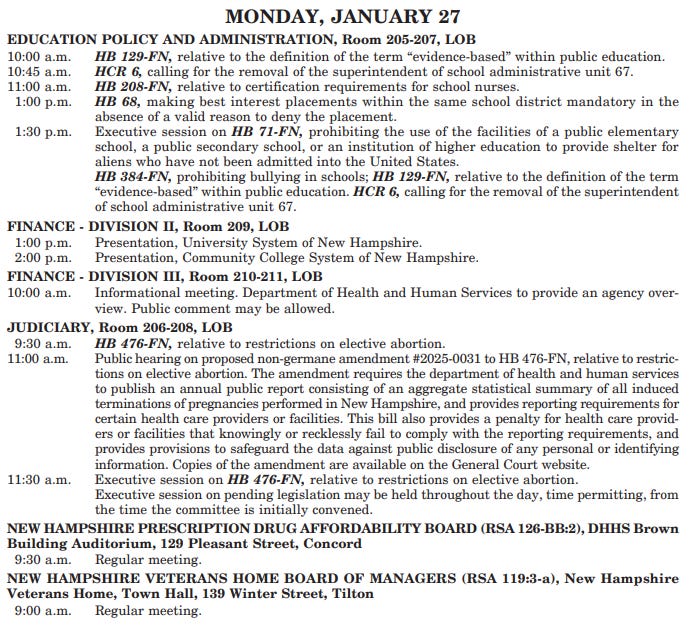 |
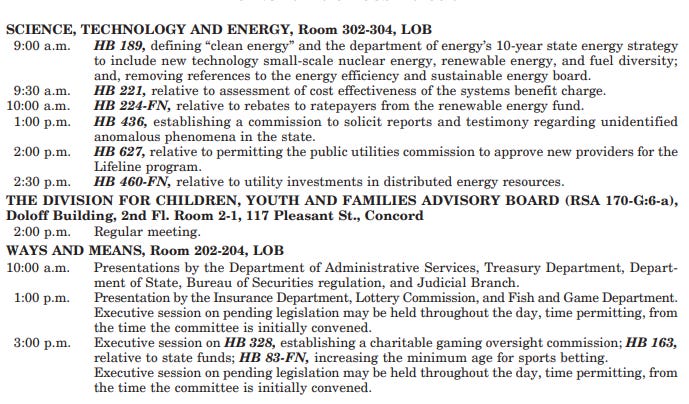 |
In-Depth Analysis of All Bills
House Education Policy And Administration
HB 129-FN
AN ACT relative to the definition of the term "evidence-based" within public education.
Sponsor(s): (Prime) Rep. Mike Belcher (R), Rep. Margaret Drye (R), Rep. Katy Peternel (R), Rep. Kristin Noble (R), Rep. Travis Corcoran (R), Rep. Matt Sabourin dit Choinière (R)
Selected quote(s) from the bill:
3 New Section; Evidence-Based Methods Required. Amend RSA 193-E by inserting after section 1 the following new section:
193-E:1-a Evidence-Based Methods Required.
I. All methods of delivering public education shall be evidence-based, including educator training, policies, and any pedagogical methods attached to or accompanying curriculum (though not to the content of the curriculum itself) adopted by the department of education, local school districts, and any other regulatory body that may prescribe teaching methods.
…
IV. The department and all local school districts shall make publicly available the scientific studies on which they relied to assure the methods meet the definition of "evidence-based." If the curriculum provider is a third party, the department or school board may require the provider to furnish it to them.
Summary:
This bill defines "evidence-based" as reproducible methods confirmed by studies within or across disciplines, excludes subjective measurements like self-reported data, and mandates that public education systems adhere to this definition in all methods, training, and communications.
Online Testimony
Currently, 5 people support and 30 people oppose the bill.
Argument for:
This bill promotes a rigorous scientific standard in education by prioritizing reproducible studies over subjective or anecdotal evidence, ensuring that teaching methods are grounded in proven effectiveness and transparency, ultimately benefiting student outcomes.
Argument against:
This bill imposes an overly narrow and rigid definition of "evidence-based," disregarding the diverse needs of students and the professional judgment of educators, while also creating significant administrative costs and potential inefficiencies in adapting teaching methods to comply with its requirements.
Hearing: Monday, Jan 27 at 10:00 a.m. in Room 205-207 in the Legislative Office Building and streaming on YouTube.
HCR 6
A RESOLUTION calling for the removal of the superintendent of school administrative unit 67.
Sponsor(s): (Prime) Rep. Mike Belcher (R)
Selected quote(s) from the bill:
Whereas, the general court finds that the superintendent of school administrative unit (SAU) 67, Marcy Kelley, violated the public good and acted against the enumerated rights of citizens of New Hampshire in levying charges of "harassment," trespassed, removed and banned such persons through prohibiting the lawful and quiet expression of protest by parents, guardians and others against government actions impacting their children and community through display of pink colored armbands marked "XX" at sporting events; and
…
Resolved by the House of Representatives, the Senate concurring:
That the superintendent of SAU 67, Marcy Kelley, should be removed from this position of public trust.
Summary:
This bill calls for the removal of the superintendent of School Administrative Unit 67, citing actions that allegedly violated public trust by infringing on parents' rights to protest at school events.
Online Testimony
Currently, 23 people support and 252 people oppose the bill.
Argument for:
This bill ensures accountability by addressing actions taken by the superintendent that exceeded her authority, such as restricting parents' rights to peaceful protest, which is a violation of their First Amendment rights and undermines public trust in local educational leadership.
Argument against:
This bill represents an unnecessary overreach by the state legislature into local school governance, undermining the authority of elected school boards and setting a dangerous precedent of politicizing administrative decisions, particularly when the superintendent was fulfilling her responsibility to protect students from harassment.
Hearing: Monday, Jan 27 at 10:45 a.m. in Room 205-207 in the Legislative Office Building and streaming on YouTube.
HB 208-FN
AN ACT relative to certification requirements for school nurses.
Sponsor(s): (Prime) Rep. Jess Edwards (R), Rep. Katy Peternel (R), Rep. Sheila Seidel (R)
Selected quote(s) from the bill:
1 School Nurse; Certification. Amend RSA 200:29, II(a)(2)-(b)(1) to read as follows:
(2) Have 3 years acute or chronic care current experience [in pediatric nursing or other related nursing areas] with a priority within pediatric settings.
(b) An applicant for certification as a school nurse shall have the skills, competencies, [and] and/or knowledge in the following areas:
(1) In the area of delivery of the school nursing services, the skills, [and] abilities and/or aptitude to:
2 School Nurse; Certification. Amend RSA 200:29, II(b)(3)(B) to read as follows:
(B) Providing leadership in the [profession and] professional nursing practice setting.
Summary:
This bill modifies certification requirements for school nurses, making it easier to qualify by broadening acceptable experience and adjusting skill and leadership expectations.
Potential Argument For:
This bill addresses the broader issue of excessive occupational regulations in the US, reducing unnecessary barriers and expanding the pool of qualified school nurse candidates, which could alleviate staffing shortages and benefit schools.
Potential Argument Against:
The original requirements ensured school nurses possessed specific pediatric and leadership skills critical to student health and safety, and relaxing these standards risks compromising the quality of care provided to students.
Online Testimony
Currently, 1 people support and 4 people oppose the bill.
Hearing: Monday, Jan 27 at 11:00 a.m. in Room 205-207 in the Legislative Office Building and streaming on YouTube.
HB 68
AN ACT making best interest placements within the same school district mandatory in the absence of a valid reason to deny the placement.
Sponsor(s): (Prime) Rep. Erica Layon (R), Rep. Dan McGuire (R), Rep. Glenn Cordelli (R), Rep. Douglas Thomas (R), Rep. Judy Aron (R), Rep. James Thibault (R), Sen. Ruth Ward (R), Sen. Keith Murphy (R), Sen. Victoria Sullivan (R)
Selected quote(s) from the bill:
Summary:
This bill makes best interest placements within the same school district mandatory in the absence of a valid reason to deny the placement.
Online Testimony
Currently, 12 people support and 26 people oppose the bill.
Argument for:
This bill seeks to correct the current system where school administrators may deny best interest placements to save district funds, ensuring that students can be reassigned within the district to better fit their educational needs. It provides more flexibility and transparency in the placement process, allowing students and their families to choose the best educational environment without additional financial burdens on the district.
Argument against:
This bill removes control from local school boards, which are better positioned to make in-district placement decisions based on specific community needs. By imposing state mandates, it undermines local governance and could lead to less responsive and cost-effective educational policies, potentially disrupting the established processes that ensure quality education within districts.
Hearing: Monday, Jan 27 at 1:00 p.m. in Room 205-207 in the Legislative Office Building and streaming on YouTube.
House Judiciary
HB 476-FN
AN ACT relative to restrictions on elective abortion.
Sponsor(s): (Prime) Rep. Katy Peternel (R), Rep. Katherine Prudhomme-O'Brien (R), Rep. Mark Pearson (R), Rep. Paul Terry (R), Rep. John Sellers (R), Rep. Sheila Seidel (R), Rep. Cyril Aures (R), Rep. Claudine Burnham (R), Rep. Michael Granger (R)
Selected quote(s) from the bill:
329:53 Prohibition.
I. Except in the case of a medical emergency as specifically defined in paragraph III, no abortion shall be performed, induced, or attempted by any health care provider unless a health care provider has first made a determination of the probable gestational age of the fetus. In making such a determination, the health care provider shall conduct an obstetric ultrasound examination of the patient for the purpose of making the determination. This paragraph shall be construed to require the performance of an ultrasound only if the provider either knows that the fetus has a gestational age of at least 15 weeks or is conscious of a substantial risk that the fetus has a gestational age of at least 15 weeks.
II. Except in the case of fetal abnormalities incompatible with life, or a medical emergency as specifically defined in paragraph III, no health care provider shall knowingly perform, induce, or attempt to perform an abortion upon a pregnant woman when the probable gestational age of her fetus has been determined to be at least 15 weeks or in the absence of a determination by a health care provider pursuant to paragraph I as to the fetus’ probable gestational age.
III. For the purposes of this subdivision only, “medical emergency” means a condition in which an abortion is necessary to preserve the life of the pregnant woman whose life is endangered by a physical disorder, physical illness, or physical injury, including a life-endangering physical condition caused by or arising from the pregnancy itself, or when continuation of the pregnancy will create a serious risk of substantial and irreversible impairment of a major bodily function, as defined in RSA 329:43, V, of the pregnant woman.
329:54 Reporting.
I. Any health care provider who performs an abortion under 329:53, III shall report, in writing, to the medical facility in which the abortion is performed the reason for the determination that a medical emergency existed. The health care provider’s written report shall be included in a written report from the medical facility to the department of health and human services. If the abortion is not performed in a medical facility, the health care provider shall report, in writing, the reason for the determination that a medical emergency existed to the department of health and human services as part of the written report made by the health care provider to the department. The health care provider and the medical facility shall retain a copy of the written reports required under this section for not less than 5 years.
329:55 Criminal Penalties.
Any health care provider who knowingly performs or induces an abortion in violation of this subdivision and knows that the fetus has a gestational age of at least 15 weeks, or consciously disregards a substantial risk that the fetus has a gestational age of at least 15 weeks, shall be guilty of a class B felony and, in addition to any other penalties the court may impose, be fined not less than $10,000 and not more than $100,000.
329:56 Civil Remedies.
I. The woman, the father of the fetus if married to the mother at the time she receives an abortion in violation of this subdivision, and/or, if the mother has not attained the age of 18 years at the time of the abortion, the maternal grandparents of the fetus may in a civil action obtain appropriate relief, unless the pregnancy resulted from the plaintiff’s criminal conduct or, if brought by the maternal grandparents, the maternal grandparents consented to the abortion.
II. Such relief shall include monetary damages for all psychological and physical injuries caused by the violation of this subdivision.
329:57 Review by New Hampshire Board of Medicine.
I. A defendant health care provider accused of violating this subdivision may seek a hearing before the board of medicine as to whether the health care provider’s conduct was necessary to save the life of the mother whose life was endangered by a physical disorder, physical illness, or physical injury, including a life-endangering physical condition caused by or arising from the pregnancy itself; and/or as to whether the continuation of the pregnancy would have created a serious risk of substantial and irreversible impairment of a major bodily function, as defined in RSA 329:43, V, of the pregnant woman.
…
3 Fetal Life Protection Act; Definitions. Amend RSA 329:43, XI to read as follows:
XI. "Fetus" means an unborn offspring, [from] after the embryo stage [which is the end of the twentieth week after conception or, in the case of in vitro fertilization, the end of the twentieth week after implantation,] until birth.
Summary:
This bill restricts elective abortions after 15 weeks of gestational age, except in cases of medical emergencies or fetal abnormalities incompatible with life, and prohibits penalties against healthcare providers for abortions performed before 15 weeks unless explicitly outlined by law.
Online Testimony
Currently, 855 people support and 10,106 people oppose the bill.
Argument For:
This bill sets a 15-week limit on abortion, recognizing that unborn children are already developing vital organs, can feel pain, and deserve protection. It affirms that women should be supported with compassionate alternatives rather than offered a procedure that destroys innocent life. By passing this legislation, our state champions human rights for the most vulnerable among us while still safeguarding women’s health.
Argument Against:
This bill imposes an arbitrary 15-week cutoff that ignores the fact many people do not even know they are pregnant by then, denying them essential screenings and care. It offers no meaningful exceptions for rape, incest, or the health of the mother, betraying New Hampshire’s long-held principles of individual freedom and personal autonomy. Ultimately, it endangers women’s lives, violates bodily autonomy, and undermines the “Live Free or Die” spirit by placing politics above safe, compassionate healthcare.
Hearing: Monday, Jan 27 at 9:30 a.m. in Room 206-208 in the Legislative Office Building and streaming on YouTube.
Non-Germane Amendment to HB 476-FN
Sponsor: Rep. Bob Lynn (R)
Selected quote(s) from the bill:
II.(a) The division shall collect non-identifying confidential data on induced termination of pregnancy occurring within the state of New Hampshire using the New Hampshire Vital Record Information Network (NHVRIN) electronic system or any modified or replacement electronic system under the jurisdiction of the division. The division shall bear all responsibility for maintaining the confidentiality of these records. This data shall be stored using only the confidential number of the health care provider assigned by the department to the provider prior to the submission of the form. Provider names or other identifying data shall not be stored in the division or department data systems. This data shall only be released to the department as authorized by this section. Each health care provider or facility shall use an electronic form for such purpose. The electronic form shall be made available by the department to each health care provider or facility. The form shall only require disclosure of information required under this section. The department shall assign a confidential number to each health care provider and facility required to submit the electronic form under this section. The confidential number, or any other personally identifiable information, obtained under this paragraph shall be for statistical purposes only and therefore be exempt from disclosure under RSA 91-A.
(b) The electronic form shall be completed by the health care provider or the facility and securely transmitted to the division on or before the 15th day of each month for all induced terminations of pregnancy occurring within the previous month. The electronic form shall only be submitted if induced terminations of pregnancy were performed in the preceding month. A health care provider or facility who knowingly or recklessly fails to report the induced termination of a pregnancy under this section shall be guilty of violation and shall be fined an amount not to exceed $1,000 for each offense.
Summary:
This amendment to HB 476-FN completely removes the original restrictions limiting elective abortions to 15 weeks of gestational age and instead mandates the Department of Health and Human Services to annually report aggregate statistics on induced terminations of pregnancy in New Hampshire, establishes reporting requirements for healthcare providers and facilities, imposes penalties for non-compliance, and ensures the confidentiality of the collected data.
Argument for:
This amendment enhances transparency and data-driven policy-making by requiring comprehensive annual reports on induced terminations of pregnancy, which can inform public health strategies. By removing the 15-week abortion limit, it allows greater flexibility for healthcare providers to make decisions based on individual medical circumstances without being constrained by restrictive gestational age limits.
Argument against:
This amendment eliminates the existing 15-week restriction on elective abortions, potentially allowing abortions to occur later in pregnancy without clear gestational limits, which some may argue undermines protections for fetal life. Additionally, the increased reporting requirements could impose significant administrative burdens on healthcare providers and facilities, potentially diverting resources from patient care.
Hearing: Monday, Jan 27 at 11:00 a.m. in Room 206-208 in the Legislative Office Building and streaming on YouTube.
House Science, Technology And Energy
HB 189
AN ACT defining "clean energy" and the department of energy's 10-year state energy strategy to include new technology small-scale nuclear energy, renewable energy, and fuel diversity; and, removing references to the energy efficiency and sustainable energy board.
Sponsor(s): (Prime) Rep. Douglas Thomas (R), Rep. Jeanine Notter (R), Rep. Keith Ammon (R), Rep. Michael Vose (R), Rep. Kat McGhee (D), Rep. Lisa Freeman (R), Sen. Kevin Avard (R), Sen. Timothy Lang (R)
Selected quote(s) from the bill:
1 New Section; Statutory Construction; Clean Energy. Amend RSA 21 by inserting after section 54 the following new section:
21:55 Clean Energy. The words "clean energy" shall include small-scale nuclear energy, renewable energy, and fuel diversity.
2 Department of Energy; State Energy Strategy. Amend RSA 12-P:7-a, I(c) to read as follows:
(c) [Renewable energy and fuel diversity] Clean energy.
3 Department of Energy; State Energy Strategy. Amend RSA 12-P:7-a, III to read as follows:
III. The strategy development process shall include review and consideration of relevant studies and plans, including but not limited to those developed by the independent system operator of New England (ISO-NE), the public utilities commission, [the energy efficiency and sustainable energy board,] legislative study committees and commissions, and other state and regional organizations as appropriate.
Summary: This bill defines "clean energy" to include small-scale nuclear energy, renewable energy, and fuel diversity within the department of energy's 10-year state energy strategy, and removes references to the energy efficiency and sustainable energy board.
Potential Argument for: This bill broadens the state's clean energy portfolio by including small-scale nuclear energy and promoting fuel diversity, which can enhance energy security and foster technological innovation within the department of energy's strategic planning.
Online Testimony
Currently, 6 people support and 6 people oppose the bill.
Argument against: This bill attempts to label unclean energy sources as "clean energy" by including small-scale nuclear energy and fuel diversity without proper definitions, potentially misleading the public and excluding the energy efficiency and sustainable energy board from essential energy strategy planning.
Hearing: Monday, Jan 27 at 9:00 a.m. in Room 302-304 in the Legislative Office Building and streaming on YouTube.
HB 221
AN ACT relative to assessment of cost effectiveness of the systems benefit charge.
Sponsor(s): (Prime) Rep. Michael Harrington (R), Rep. Jeanine Notter (R), Rep. Douglas Thomas (R), Rep. Michael Vose (R), Rep. James Summers (R), Rep. JD Bernardy (R)
Selected quote(s) from the bill:
1 Restructuring Policy Principals. Amend RSA 374-F:3, VI-a(d)(4) to read as follows:
(4) Cost Effectiveness. [For the purpose of the March 1, 2022 filing, and future plan offerings,] The commission's review of the cost effectiveness shall be based upon the latest completed and available Avoided Energy Supply Cost Study for New England, the results of any Evaluation, Measurement, and Valuation studies contracted for by the department of energy or joint utilities, incorporate savings impacts associated with free-ridership for those programs and measures where such free-ridership may have a material impact on savings figures[, and use the]. When reviewing cost effectiveness for program years through and including 2026, the commission shall use the Granite State Test as the primary test, with the addition of the Total Resource Cost test as a secondary test. The commission may consider modifications to the Granite State Test and different or additional tests developed through an adjudicative process and approve them by order prior to the commencement of any triennium period beginning with program year 2027, provided such order is issued no less than 12 months prior to the beginning of the triennium period to which the test is to be applied. In any review, the commission shall use benefit per unit cost as only one factor in considering whether the utilities have prioritized program offerings appropriately among and within customer classes.
Summary:
This bill modifies the assessment of system benefit charges' cost effectiveness by updating the criteria and methodologies used by the commission to evaluate energy programs, including the use of the Granite State Test and the Total Resource Cost test.
Potential Argument for:
This bill enhances the accuracy and robustness of evaluating the cost effectiveness of system benefit charges by incorporating updated studies and multiple testing methodologies, ensuring that energy programs are financially sustainable and effectively prioritize savings across customer classes.
Online Testimony
Currently, 0 people support and 65 people oppose the bill.
Argument against: This bill threatens essential programs like NH Saves by altering the funding and evaluation criteria for system benefit charges, potentially reducing support for low-income energy efficiency initiatives and undermining long-standing, bipartisan-supported conservation efforts that benefit both individuals and businesses in New Hampshire.
Hearing: Monday, Jan 27 at 9:30 a.m. in Room 302-304 in the Legislative Office Building and streaming on YouTube.
HB 224-FN
AN ACT relative to rebates to ratepayers from the renewable energy fund.
Sponsor(s): (Prime) Rep. Jeanine Notter (R), Rep. Jason Osborne (R), Rep. Douglas Thomas (R), Rep. Ross Berry (R), Sen. Keith Murphy (R)
Selected quote(s) from the bill:
1 Electric Renewable Portfolio Standard; Renewable Energy Fund. Amend RSA 362-F:10, I to read as follows:
I. … Any remaining moneys paid into the fund under paragraph II of this section[, excluding class II moneys, shall be used by the department of energy to support thermal and electrical renewable energy initiatives and offshore wind initiatives, including the office of offshore wind industry development and energy innovation. Class II moneys shall primarily be used to support solar energy technologies in New Hampshire. All initiatives supported out of these funds shall be subject to audit by the department of energy as deemed necessary] that are in excess of administration costs and incentive payments, shall be rebated to all retail electric ratepayers in the state on a per-kilowatt-hour basis, in a timely manner to be determined by the commission.
Summary:
This bill requires moneys paid into the renewable energy fund to be rebated to ratepayers.
Potential Argument for:
This bill ensures that any surplus funds in the renewable energy fund are returned to ratepayers, providing them with direct financial benefits and promoting fiscal responsibility in the management of renewable energy resources.
Online Testimony
Currently, 6 people support and 40 people oppose the bill.
Argument against:
This bill rebating the balance of the Renewable Energy Fund to ratepayers risks increasing energy costs for NH residents and businesses, stalling job creation and economic growth in local industries, and undermining efforts to reduce harmful emissions.
Hearing: Monday, Jan 27 at 10:00 a.m. in Room 302-304 in the Legislative Office Building and streaming on YouTube.
HB 436
AN ACT establishing a commission to solicit reports and testimony regarding unidentified anomalous phenomena in the state.
Sponsor(s): (Prime) Rep. Aidan Ankarberg (I), Rep. Tom Mannion (R), Rep. Kristin Noble (R)
Selected quote(s) from the bill:
12-Q:1 Unidentified Anomalous Phenomena Commission Established. There is established a commission to actively request or seek reports and testimony regarding instances of unidentified anomalous phenomena within the skies and territory of the state of New Hampshire for the purposes of their collection and transmittance to the National Archives and Records Administration (NARA) in accordance with Public Law 118-31, sections 1841-1843, also known as the 2024 National Defense Authorization Act.
…
III. Duties.
(a) The commission shall actively request or seek testimony and evidence provided by the public regarding instances of unidentified anomalous phenomena occurring over and/or within the state of New Hampshire so as to make those records available to the NARA in accordance with the 2024 National Defense Authorization Act.
(b) The commission shall ensure that no information is disclosed that would violate any federal statute regarding national security as outlined in the 2024 National Defense Authorization Act.
…
V. Report. The commission shall report its findings and any recommendations for proposed legislation to the speaker of the house of representatives, the president of the senate, the house clerk, the senate clerk, the governor, and the state library on or before November 1, 2025.
Summary:
This bill establishes a commission to solicit reports and testimony regarding unidentified anomalous phenomena in the state.
Potential Argument against:
This bill may divert state resources towards investigating phenomena with limited evidence, potentially neglecting more pressing public safety and infrastructure needs.
Online Testimony
Currently, 1 person supports and 4 people oppose the bill.
Argument for:
This bill creates a public forum for citizens to report inappropriate activities within the skies and territory of New Hampshire, enhancing safety near airports and addressing recent drone sightings.
Hearing: Monday, Jan 27 at 1:00 p.m. in Room 302-304 in the Legislative Office Building and streaming on YouTube.
HB 627
AN ACT relative to permitting the public utilities commission to approve new providers for the Lifeline program.
Sponsor(s): (Prime) Rep. Michael Vose (R), Rep. Jess Edwards (R), Rep. Erica Layon (R), Rep. Bob Lynn (R), Rep. Wayne MacDonald (R), Rep. Katelyn Kuttab (R), Rep. Thomas Cormen (D)
Selected quote(s) from the bill:
1 New Paragraph; Affordable Telephone Service; Rulemaking; Standards. Amend RSA 374:22-p by inserting after paragraph VIII the following new paragraph:
IX.? Notwithstanding RSA 362:6, the commission may designate any commercial mobile service provider or telecommunications company as an eligible telecommunications carrier for purposes of receiving federal universal service support and offering services supported by federal universal service support mechanisms. This is in addition to any commercial mobile service provider or telecommunications company designated as an eligible telecommunications carrier pursuant to 47 U.S.C. sections 214(e)(1) and 214(e)(2), and 47 C.F.R. section 54.201. The commission may adopt rules necessary to implement this subsection.
Summary:
This bill permits the public utilities commission to designate any commercial mobile service provider or telecommunications company as eligible for federal universal service support, thereby expanding the Lifeline program.
Potential Argument For:
This bill enhances the Lifeline program by allowing more providers to participate, increasing access to affordable telecommunications services for low-income individuals.
Potential Argument Against:
This bill may complicate the regulation of the Lifeline program by increasing the number of eligible providers, potentially leading to inconsistent service quality and oversight challenges.
Online Testimony
Currently, 0 people support and 1 person opposes the bill.
Hearing: Monday, Jan 27 at 2:00 p.m. in Room 302-304 in the Legislative Office Building and streaming on YouTube.
HB 460-FN
AN ACT relative to utility investments in distributed energy resources.
Sponsor(s): (Prime) Rep. Kat McGhee (D), Rep. Thomas Cormen (D), Sen. David Watters (D)
Selected quote(s) from the bill:
1 Electric Utility Investment in Distributed Energy Resources; Rate Filing; Authorization. Amend RSA 374-G:5, II(f) to read as follows:
(f) The effect on competition within the region's electricity markets and the state's energy services market, including the extent to which utility rates, tariffs, metering, data sharing, consolidated billing, and load estimation and settlement processes enable customer-generators and limited producers under RSA 362-A to be able to realize credit for value produced and costs avoided comparable to those benefits claimed in the electric utility’s proposal to support its proposed investment.
Summary:
This bill further defines a factor that the Public Utilities Commission must consider to determine public interest prior to authorizing a utility's rate recovery for its portion of investments.
Potential Argument against:
This bill expands the Public Utilities Commission’s review scope, potentially requiring additional personnel and resources without a clear understanding of its impact on state expenditures, utility rates, and local governments.
Online Testimony
Currently, 48 people support and 0 people oppose the bill.
Argument for:
This bill enables market competition in the development of cost-effective local energy solutions by allowing customer-generators and limited producers to receive credit for the value they produce and costs they avoid, thereby driving innovation and lowering energy costs for consumers.
Hearing: Monday, Jan 27 at 2:30 p.m. in Room 302-304 in the Legislative Office Building and streaming on YouTube.